
Is Bittensor a Good Buy at Current Prices?
As of 14 November 2026: Bittensor has closed below its October low and both moving averages since late October, putting the trend reversal in question. We check with our own price data what that means for buying.


Which topics should we dive deeper into?
Select what genuinely interests you. Your picks feed directly into our editorial planning.
Crypto news that's actually worth your time.
Weekly. 60 seconds. Carefully curated by our editors: no hype, no promo flood, no spam.
As of 14 November 2026: Bittensor with updated figures
Bittensor closed at $214.88 on 13 November 2026, 22.2 percent below the $276.20 on which the analysis below, dated 22 October 2026, is based. The figures in this section are daily closing prices from CoinGecko; cryptoticker.io calculated the moving averages and the RSI from them.
| Metric | 13 November 2026 |
|---|---|
| Closing price | $214.88 |
| 50-day average | $245.69 |
| 200-day average | $243.92 |
| RSI (14 days) | 36.5 |
| Change over 30 days | −20.6% |
| Change over 90 days | +9.3% |
| Twelve-month high | $345.70 (25 March 2026) |
| Twelve-month low | $152.22 (11 February 2026) |
| Daily trading volume (30-day average) | $115 million |
That puts TAO 12.5 percent below its 50-day average and 11.9 percent below its 200-day average. The 14-day relative strength index stands at 36.5, in neutral territory between 30 and 70. Trading volume averaged around $115 million a day over the past 30 days, below the 90-day average of around $185 million.
Both marks at which the analysis of 22 October was to fail have been hit. TAO first closed below $254.58, the low of 18 October, on 24 October, and since 29 October it has also closed below $250.48, the 200-day average at the time, for 16 consecutive days. The average itself has since fallen to $243.92, with the price well below it. The trend reversal confirmed by our August yardstick is therefore in question again. The opposite mark of $308.63 never came within reach: the highest close since the analysis was $257.28 on 22 October, the lowest $211.92 on 12 November.
The sections below reflect the situation as of 22 October 2026.
Bittensor (TAO) changes hands at 276.20 US dollars in the early hours of Thursday, 22 October 2026, up 0.2 percent over 24 hours. Since our first assessment on 25 August, when TAO cost 228.10 dollars, the price has risen 21.1 percent. The path in between went well beyond today's level: on 26 September TAO closed at 321.18 dollars and touched 339.93 dollars intraday. Since then it has given back 14.0 percent, with the October low at 254.58 dollars on 18 October. A market capitalisation of 3.22 billion dollars ranks TAO 29th, against 34th in August. The question is the same, the starting point is not: is Bittensor a good buy at current prices, now that the trend has turned and the price has been correcting since late September?
cryptoticker.io collected the price data for this update itself late on 21 October 2026, with market data from CoinMarketCap. The moving averages, the relative strength index and the distances to the twelve-month extremes were calculated in-house from the daily closing prices of the past twelve months plus the current quote, using standard formulas (exponential moving averages, RSI according to Wilder). Intraday highs, lows and daily turnover come from CoinMarketCap's daily candles. The table sets today's readings against those of our first analysis on 25 August.
| Metric | 25 August 2026 | 22 October 2026 |
|---|---|---|
| Price | $228.10 | $276.20 |
| 50-day average | $207.63 | $270.00 |
| 200-day average | $239.76 | $250.48 |
| Distance to the 200-day line | -4.9% | +10.3% |
| Relative Strength Index (14 days) | 62.7 | 49.0 |
| Trading volume, 24 hours | $229.4m | $179.9m |
| Market capitalisation | $2.57bn | $3.22bn |
Advertisement: Crypto futures trading: Bitget offers leverage of up to 100x. Leverage can lead to high losses. Our exchange comparison shows more platforms.
Bittensor price analysis: where the TAO price stands today
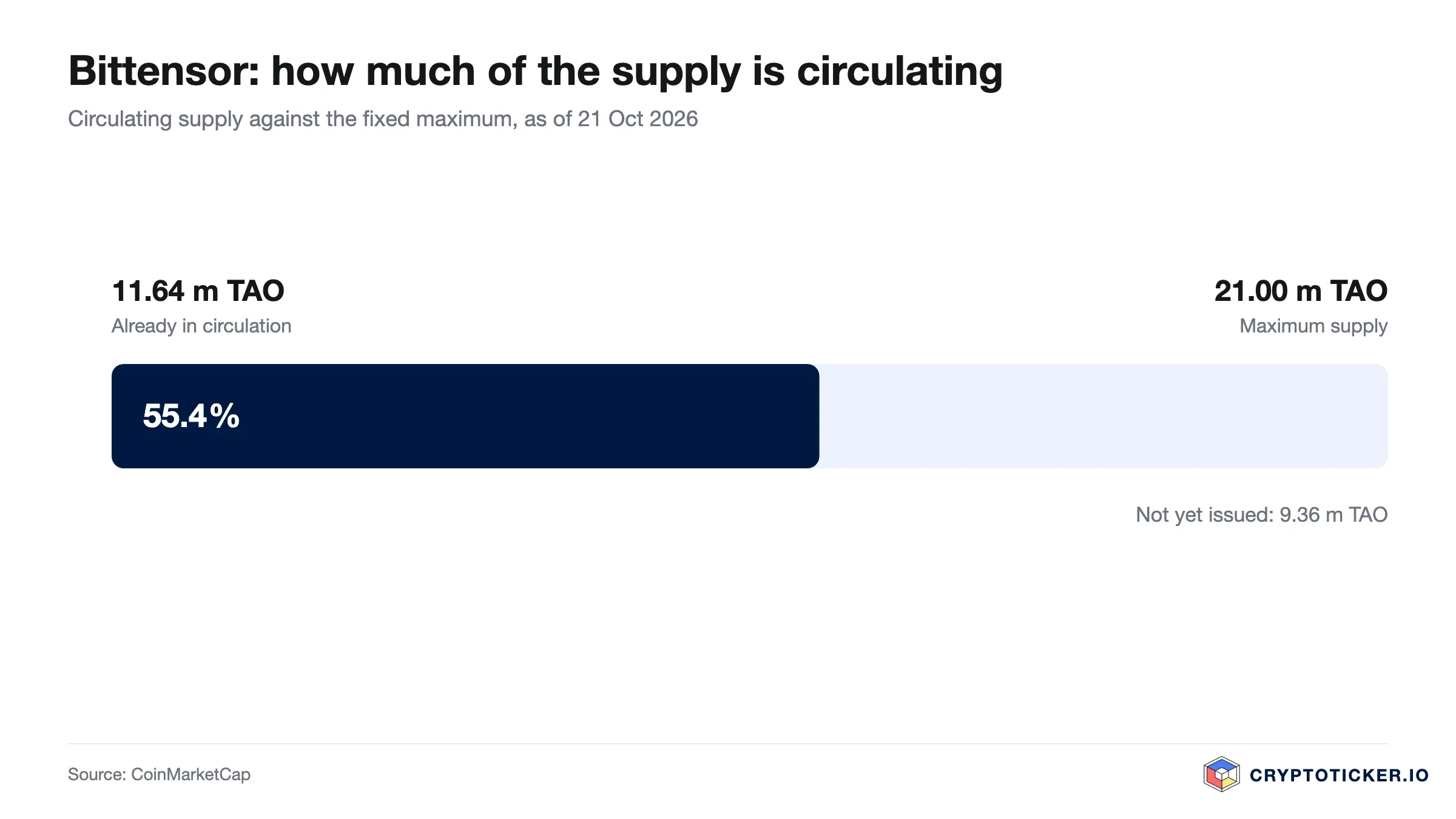
At 276.20 dollars, Bittensor carries a market capitalisation of 3.22 billion dollars and ranks 29th among all crypto assets. Circulating supply stands at 11.64 million TAO against a hard maximum of 21 million, 55.4 percent of all tokens that will ever exist. The price trades 2.3 percent above the 50-day average of 270.00 dollars and 10.3 percent above the 200-day average of 250.48 dollars, and the 50-day line itself now runs 7.8 percent above the 200-day line.
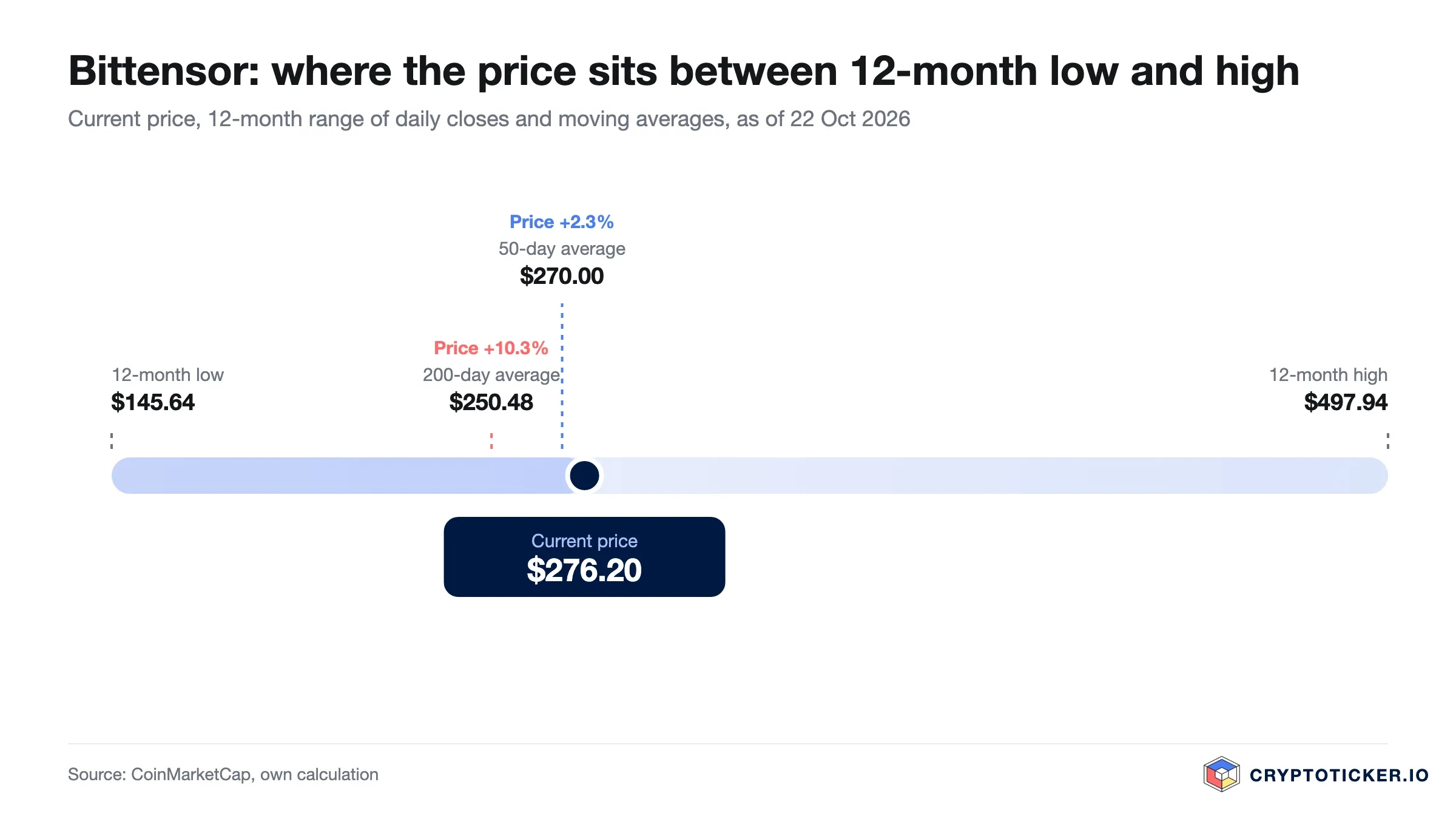
The marks that frame the current zone have shifted. Overhead, the first is the highest close since 12 October, 278.70 dollars from 15 October, then the 16 October high of 290.58 dollars, the highest October close of 308.63 dollars from 6 October and the September peak of 321.18 dollars on a closing basis. Since 13 October TAO has traded between 254.58 and 290.58 dollars intraday. Below, the levels are the 50-day average at 270.00 dollars, the October low of 254.58 dollars and the 200-day average at 250.48 dollars, 9.3 percent beneath the price. The twelve-month low of 145.64 dollars from February, the level we named in August as the one that would have to give way before the recovery could be called a failure, is now 47.3 percent below.
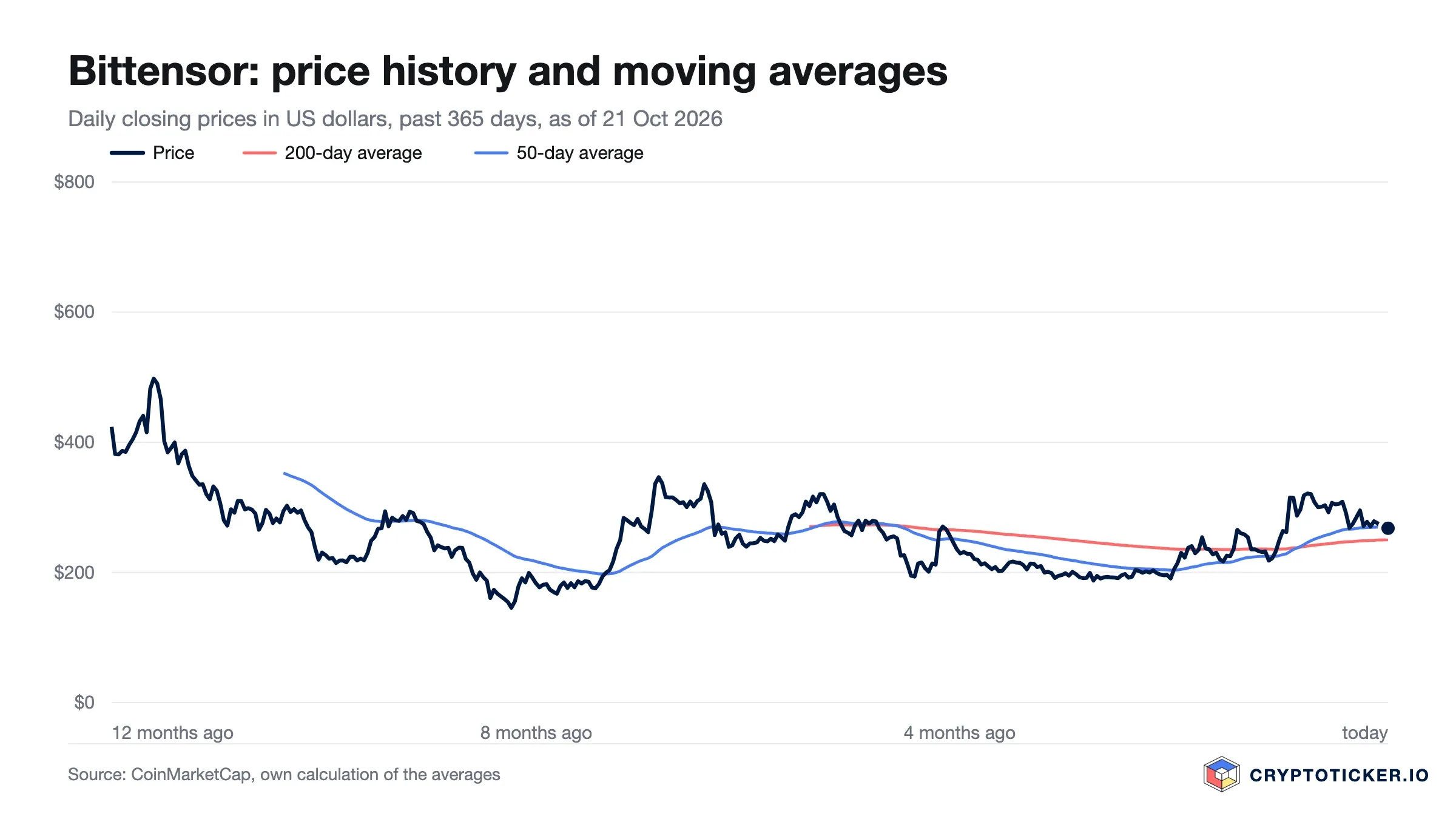
Over 90 days TAO is up 42.7 percent, over 30 days down 10.3 percent and over seven days up 2.6 percent. Where the price bands could run from here is laid out in the Bittensor price prediction.
Is the Bittensor downtrend broken or only interrupted?
In August we set out the test: a weekly close above the 200-day average, then at 239.76 dollars, would be the first evidence that the twelve-month downtrend had ended. That evidence arrived on 6 September, when TAO closed the week at 265.32 dollars on 465 million dollars of daily turnover. After one relapse to a weekly close of 231.18 dollars on 13 September, every weekly close since 20 September has stayed above the mark, and since 18 September TAO has not closed a single day below the 200-day average. The bearish crossover from the winter, which we said would take weeks of stability to undo, was reversed with the close of 25 September, when the 50-day average rose through the 200-day line at 242.66 against 241.16 dollars using the same method as in August. Neither falsifying condition came close: the lowest weekly close since 25 August was 227.64 dollars on 30 August, well above 207.63 dollars, and 145.64 dollars was never in sight.
The strongest single day was 21 September, when TAO closed 20.1 percent higher at 314.65 dollars on 635 million dollars of turnover, the busiest session of the past three months. There was no Bittensor-specific trigger; the token moved with the AI-linked crypto sector as a whole, as we noted the same day in our analysis of the rally without news. Over twelve months TAO is still down 27.6 percent from 381.69 dollars a year ago.
Since late September the direction has reversed. From 5 to 8 October, in the market-wide sell-off that saw 1.16 billion dollars of positions liquidated on 8 October, TAO lost 12.1 percent on a closing basis, and 12 October brought a further 8.1 percent drop. The October low of 254.58 dollars came on 18 October, the day many altcoins marked their lows, and still held above the 200-day average. With the downtrend broken by our own definition, the open question has changed: whether the correction since 26 September ends above the 200-day line or starts to undo the young reversal.
What RSI and moving averages mean for a TAO entry
The relative strength index over 14 days stands at 49.0, almost exactly mid-scale. In August it read 62.7, in the upper half of the scale, and we described that as the least comfortable region for a buyer. What followed was a full swing: the index slipped below 50 in early September, reached 75.5 on 21 September and fell to 44.0 in the sell-off of 8 October. Since 12 October it has stayed between 44.9 and 48.9. The momentum premium of August is gone, and there is no oversold reading either.
The relationship between the two averages now carries the more important message. The 50-day average has risen from 207.63 dollars in August to 270.00 dollars and sits 7.8 percent above the 200-day average at 250.48 dollars, so the long-term structure that pointed down in August now points up. Since 14 October, however, the 50-day line has flattened between 269.02 and 270.00 dollars, and the price crossed it four times on a closing basis between 17 and 20 October. The 200-day line keeps rising, from 248.49 dollars on 8 October to 250.23 dollars on 20 October, about 15 cents a day.
The practical consequence is still one of method. In August we argued that staggered buying would capture a return towards the 50-day zone; it did, with a close of 216.88 dollars on 2 September and an intraday low of 213.57 dollars on 16 September, 6.4 percent below our August price. Today the distances are 2.2 percent down to the 50-day average, 7.8 percent to the October low and 9.3 percent to the 200-day average.
What trading volume reveals about demand for Bittensor
Bittensor turned over 179.9 million dollars in the past 24 hours, roughly 5.6 percent of its market capitalisation, against 8.9 percent in August. That remains a healthy ratio at this rank and means an ordinary position can be entered and exited without moving the price.
The trend in volume tells the story of the autumn. In August the seven-day average of 236.0 million dollars stood well above the 30-day average of 139.2 million. Today the order is reversed: the seven-day average of 173.0 million sits 35.6 percent below the 30-day average of 268.4 million, which still includes the September rally and its peak session of 635 million dollars on 21 September. Since 13 October daily turnover has ranged from 122 to 227 million dollars. Measured against the twelve-month median of 163.8 million dollars we cited in August, turnover was higher on 44 of 57 days since 25 August, so the advance was carried by real participation and the October correction has come on cooling activity.
Elevated volume works in both directions, as we wrote in August. The Fear and Greed Index then stood at 80 points, in extreme greed territory. In the early hours of 22 October CoinMarketCap's index shows 54, a neutral reading, after a 60-day low of 48 on 17 October. Such readings describe the present rather than forecasting the future.
Which structural factors speak for Bittensor
The supply mechanics are the clearest structural argument. TAO is capped at 21 million tokens and issued on a halving schedule, the design logic that the Bitcoin white paper set out for a predictable, declining rate of new issuance. The first halving took place in mid-December 2025 and cut daily issuance from about 7,200 to 3,600 TAO, according to Grayscale Research. With 11.64 million tokens in circulation, 44.6 percent of the maximum is still to come, but at half the earlier pace; the fully diluted value of 5.80 billion dollars is 1.8 times the market capitalisation.
The second factor is what the network is for. Bittensor organises subnets in which participants supply machine-learning work and are compensated in TAO according to how the network rates their contribution. Since Runtime 475 went live on 7 October, subnet owners can choose between the established Yuma Consensus and a new mode called Null, in which only the validator with the largest stake sets weights, in exchange for capacity of up to 2,500 slots per subnet instead of 256. What that means for delegators and miners is explained in our piece on Null consensus and the new subnet slots. How much real demand the network generates remains an open question and should be treated as one.
The third factor is access and regulatory clarity. The Grayscale Bittensor Trust, so far traded over the counter under the ticker GTAO, reported in an 8-K filed on 5 October that Coinbase Prime will hold part of its TAO alongside BitGo, which remains primary custodian; our report on the custody split has the details. Grayscale started the route towards an exchange-traded fund with an SEC filing on 30 December 2025. Under the EU crypto-asset regime supervised by ESMA, exchanges serving European customers need authorisation, and the disclosure and custody rules that come with it apply to TAO as to other crypto assets. That framework does nothing for the price, and it removes one category of risk that used to sit between European buyers and smaller tokens.
What speaks for buying Bittensor at current prices
Three arguments carry weight at 276.20 dollars.
The trend has turned, by the test we set. The 50-day average crossed above the 200-day line on 25 September and now sits 7.8 percent above it. TAO has not closed below the 200-day average since 18 September, not even on the lows of 8 and 18 October.
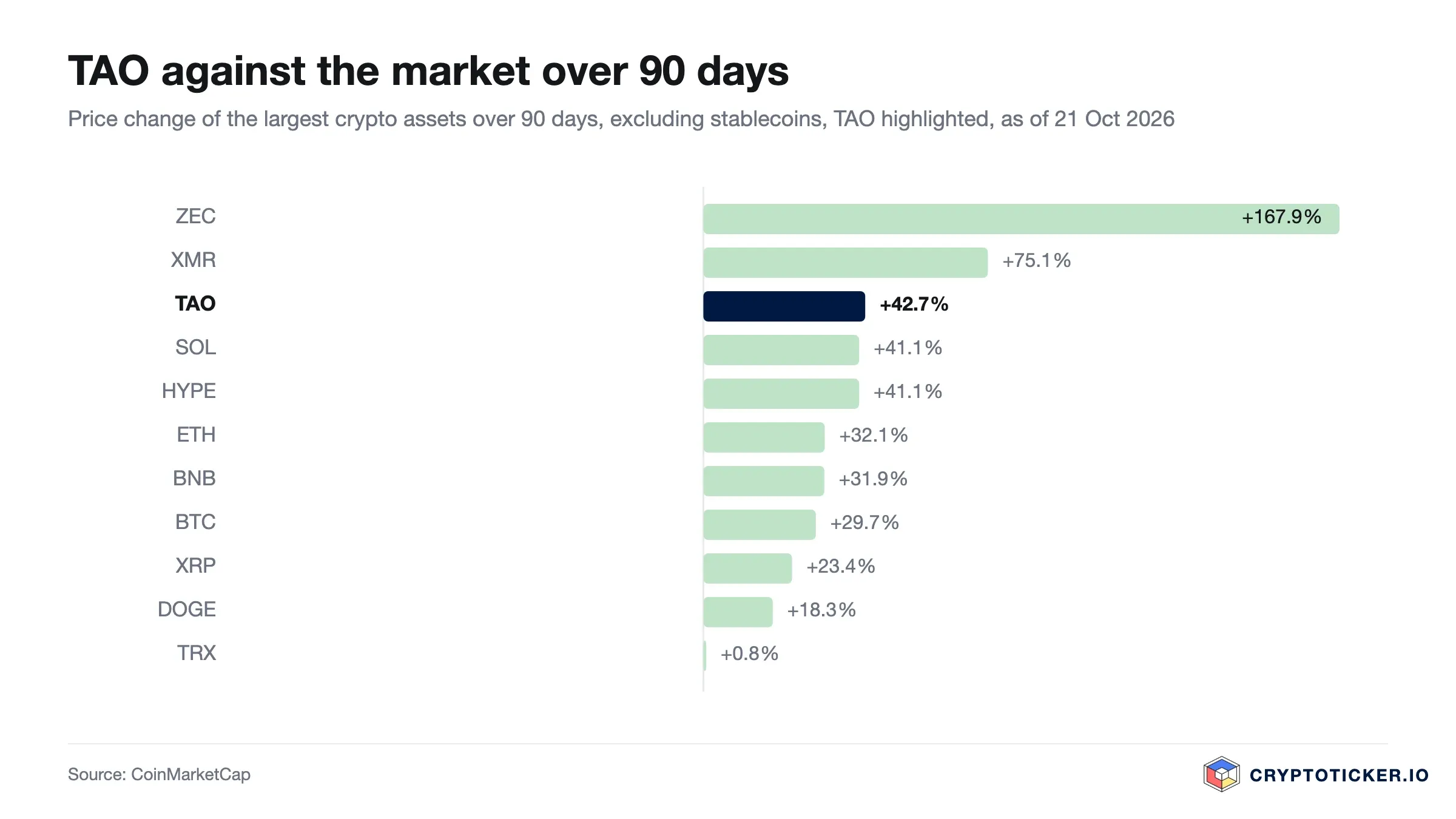
Relative strength is high. Over 90 days TAO is up 42.7 percent, third among the large crypto assets excluding stablecoins, behind Zcash at 167.9 percent and Monero at 75.1 percent and ahead of Bitcoin at 29.7 percent. The price is still 44.5 percent below the twelve-month high of 497.94 dollars, so an entry here is not an entry at a peak.
The supply side and access have improved. Since the halving only about 3,600 new TAO arrive each day under a fixed 21 million cap, and the Grayscale trust now spreads its holdings across two custodians. The AI narrative that drives interest in the sector can be volatile; the issuance schedule underneath it does not change with sentiment.
 Find a crypto exchange with an EU licence
What speaks against buying Bittensor at current prices
Three arguments cut the other way, and none is weaker than those above.
The correction is still running. TAO is 14.0 percent below its 26 September closing high and 18.7 percent below the intraday peak of 339.93 dollars, and over 30 days it is down 10.3 percent. October showed how quickly such drops build: minus 12.1 percent from 5 to 8 October, minus 8.1 percent on 12 October, and a 15.2 percent gap between the high and the low of 8 October. Since mid-October the price has been oscillating around a flat 50-day average, which offers no direction yet.
Activity is cooling and the narrative link remains. The seven-day volume average sits 35.6 percent below the 30-day average, and turnover has fallen from 8.9 to 5.6 percent of market capitalisation. The strongest day of the autumn, 21 September, came without Bittensor-specific news and in step with other AI-linked tokens. Interest in that sector can compress as fast as it expands, and over twelve months TAO is still 27.6 percent lower.
Open questions in the network and a demanding backdrop. Under the new Null mode a single validator decides how a subnet's rewards are distributed, and the penalty for deviating validators that Yuma applies falls away. 44.6 percent of the maximum supply is still to be issued. On the macro side, the Federal Reserve raised rates to 3.75 to 4.00 percent on 16 September, its minutes of 7 October signalled another hike, and US consumer prices rose 3.7 percent in September. Bitcoin stood at 84,760 dollars on 21 October with a market share of 59 to 60 percent, and the next Fed meeting on 27 and 28 October is the first date on which the rate question can show up in prices again.
How to buy Bittensor (TAO) at current prices
TAO is listed on most large exchanges, though not on every European broker, so the venue question is worth settling first. Regulated European platforms such as Bitpanda or Kraken cover the usual payment routes; fee structures differ enough to matter for a staggered purchase, and the exchange comparison sets them side by side. Buyers who want authorisation status as a filter can start from the overview of regulated exchanges.
Costs come in three parts: the trading fee, typically between 0.1 and 1.5 percent depending on venue and order type, the spread between bid and ask, which is modest for a token with 179.9 million dollars in daily turnover, and the withdrawal fee if the tokens leave the exchange. Limit orders instead of market orders remove much of the second cost, which matters on days like 8 October with a 15.2 percent intraday range.
Custody is the decision that outlasts the trade. Tokens meant to be held for months belong in a wallet whose keys you control, and the devices for that are compared in the hardware wallet comparison. TAO uses its own network addresses, so confirm that a device supports the chain before buying one.
So is Bittensor a good buy at current prices?
Update of 14 November 2026: this assessment reflects the situation as of 22 October 2026. Both marks at which the assumption was to fail have been hit: TAO has closed below $254.58 and below the 200-day average of $250.48 at the time since 29 October, most recently at $214.88. The current assessment is in the section “As of 14 November 2026” at the top of the article.
For a horizon of a few weeks, the data argue for neither urgency nor alarm. At 276.20 dollars you buy into a confirmed uptrend that has given back 14.0 percent since 26 September, with the RSI at a neutral 49.0 and the price just above a flat 50-day average. The upside to the highest October close of 308.63 dollars is 11.7 percent, the downside to the October low of 254.58 dollars 7.8 percent. Our August view that a pullback towards the 50-day average would be an ordinary event proved right: TAO closed below that line on 15 September and bottomed at 213.57 dollars intraday the next day, before rising 40.8 percent above our August price to the September closing high. The next test on the calendar is the Federal Reserve meeting on 27 and 28 October.
For a horizon of a year or more, the case has strengthened since August. The trend has turned, issuance runs at half the earlier pace, subnets can hold far more participants, and institutional custody is broader. An entry 44.5 percent below the twelve-month high, into an asset with a capped supply of 21 million tokens and a functioning use inside its own network, has a plausible risk profile provided the position is sized for a return to the 200-day average or below. The thesis still depends on demand for decentralised machine-learning work growing and Bittensor taking part in it.
Three conditions would falsify the constructive reading from here. A daily close below 254.58 dollars, the 18 October low, would break the range in place since 13 October and extend the correction. Several closes in a row below the 200-day average, now at 250.48 dollars, would call the September reversal into question; that last happened from 10 to 17 September. Conversely, a daily close above 308.63 dollars on turnover above the 30-day average of 268.4 million dollars would be the highest since late September and the signal that the correction since 26 September is over.
Buying Bittensor: what to take away
- The 200-day average at 250.48 dollars now decides the trend question. TAO broke above the line in September and the averages crossed on 25 September; below it the reversal would be in doubt again. The possible price bands from here are set out in the Bittensor price prediction.
- Momentum argues for staggering rather than a single purchase. A neutral RSI of 49.0 and a range of 254.58 to 290.58 dollars since 13 October make the entry date less decisive than the plan, and fee differences compound across several tranches. The exchange comparison shows where staggered buying costs least.
- Settle custody before the purchase, not after it. Anything intended to be held beyond a few weeks does not belong on an exchange account permanently. Suitable devices are listed in the hardware wallet comparison.
Disclosure: Some of the providers mentioned in this article work with us through partner programmes. This has no influence on the price analysis or on the assessment of the chart situation; the price data comes from a public market data source and can be verified there.
(As of 14 November 2026; analysis as of 22 October 2026. This article is not investment advice. Prices, fees and conditions change; check them with the provider before every purchase. Crypto assets are subject to large price swings, and a total loss is possible.)
Partner links: some links on this page are partner links. If you become a customer through one of them, we may earn a commission at no extra cost to you. Selection, ratings and ranking are decided independently by our editorial team. Ethics and Independence · Ownership and Funding
Transparency note: This article was produced with the assistance of artificial intelligence and reviewed by our editorial team before publication. All figures and claims were checked against the primary sources linked in the text. The feature image was generated with AI.
For later? Save this article and find it again in your profile.
Related articles
- Is Jupiter a Good Buy at Current Prices?
- Will Bitcoin Go Back Up? Three Scenarios to Year-End: $70,000, $80,000 or $100,000
- Is Aerodrome Finance a Good Buy at Current Prices?
- Solana Price Below $95: Record ETF Outflows and Whale Selling Push SOL to a 7-Month Low
- Ethereum Price Below $2,300: Is $2,000 Next or Is This the Bottom?
Which topics should we dive deeper into?
Select what genuinely interests you. Your picks feed directly into our editorial planning.
Crypto news that's actually worth your time.
Weekly. 60 seconds. Carefully curated by our editors: no hype, no promo flood, no spam.

October 30, 2026 11:28 PM

Is Polygon a Good Buy at Current Prices?
Polygon sits roughly half below its twelve-month high and keeps running into both moving averages. What the chart structure, the RSI and the trading volume say about buying POL at the current price.
October 28, 2026 6:40 AM

Is Morpho a Good Buy at Current Prices?
Morpho trades around a quarter below its twelve-month high while still holding above its long-term average. What argues for and against buying into the DeFi lending token at this level.
October 27, 2026 11:25 PM

Is Arbitrum a Good Buy at Current Prices?
Arbitrum sits well below its twelve-month high and above its long-term average. We check what argues for and against buying ARB at this level, and which condition would prove the recovery wrong.
October 27, 2026 7:27 AM

Is Venice Token a Good Buy at Current Prices?
Venice Token has multiplied within twelve months and has been correcting since its September high. We check the chart, the supply and the risks of VVV against the question of whether the token is a good buy at the current price.
October 26, 2026 11:22 PM

Is Sky a Good Buy at Current Prices?
Sky is the renamed MakerDAO, and its governance token is tied to the earnings of a lending protocol with its own stablecoin. Is SKY a good buy at current prices? We weigh the chart position, the savings rate, supply mechanics and the open question of European regulation.
October 21, 2026 12:33 AM

Is Worldcoin a Good Buy at Current Prices?
As of November 11, 2026: Worldcoin has fallen below both moving averages and the marks of the October analysis, while the twelve-month low holds. What chart, supply and World ID now mean for buying WLD.

October 19, 2026 4:42 PM

Bittensor (TAO): 2,500 slots per subnet instead of 256, and what TAO stakers need to know
Bittensor has shipped the Null Consensus mode with Runtime 475: capacity per subnet rises from 256 to as many as 2,500 identifiers, and only the validator with the largest stake still sets the weights. There is also a registration via computing work that requires no TAO burn.

October 12, 2026 10:27 AM

Is Bitcoin Still a Good Investment in October 2026?
Spot ETFs have changed who sets the Bitcoin price, and the easy repricing is behind us. What still supports BTC, what could break it, and how much belongs in a portfolio today.
October 9, 2026 10:39 AM

Bittensor (TAO): Grayscale adds Coinbase as a second custodian, price 10.7 percent below the weekly high
Grayscale will have the TAO of its Bittensor trust held by BitGo and Coinbase in future and disclosed that in an 8-K on 5 October. The price stands at $275.96, 10.7 percent below the weekly high.
September 28, 2026 9:47 AM
XRP Price Drops Below $1.50: Where Is Ripple Heading This Week?
XRP price slips under $1.50 after a red weekend. Here is the XRP price analysis with the higher and lower targets that matter this week.
September 28, 2026 4:28 AM

Is Quant a Good Buy at the Current Price?
As of 13 November 2026: Quant has broken below its October low of 182 dollars and trades below its 50-day average, but well above its 200-day line. We check with our own price data what that means for buying at the current price.
September 21, 2026 7:12 PM

Bittensor Price Up 14 Percent: A Rally Without News
TAO climbs to $287 with no single piece of news behind it. Why that is itself information, how the network works and which number sets Bittensor apart from the other AI tokens.
September 20, 2026 9:21 AM

Is Ethena a Good Buy at Current Prices?
As of November 11, 2026: Ethena has fallen below both moving averages, while the zone around $0.13 to $0.14 holds. Is ENA a good buy at current prices? We examine chart, supply and the revenue question.
August 31, 2026 11:20 PM

Is Mantle a Good Buy at Current Prices?
As of November 11, 2026: Mantle has fallen below both moving averages, while the twelve-month low still holds. We check with our own price data what chart, supply and liquidity mean for buying now.
August 27, 2026 11:25 AM

Is Pump.fun a Good Buy at Current Prices?
As of 13 November 2026: PUMP has fallen below its 50-day average and sits just above its 200-day line. We check with our own price data what that and the supply overhang mean for buying Pump.fun at the current price.
August 27, 2026 6:38 AM

Is NEAR Protocol a Good Buy at Current Prices?
As of 14 November 2026: NEAR has broken out of its October range to the downside and closes below its 50-day average, but above the 200-day line. We check with our own price data what that means for buying now.
August 27, 2026 4:31 AM

Is AAVE a Good Buy at Current Prices?
As of November 11, 2026: AAVE has slipped below its 50-day and just below its 200-day average, while the August mark still holds. We check with our own price data what that means for buying at current prices.
August 27, 2026 3:39 AM

Is Cronos a Good Buy at Current Prices?
As of November 11, 2026: Cronos has fallen below both moving averages and trades just above its twelve-month low. We check with our own calculations what speaks for and against buying.
August 27, 2026 3:24 AM

Is Hedera a Good Buy at Current Prices?
As of 14 November 2026: by our yardstick Hedera's bottoming has failed, and it is closing at its lowest level in twelve months. We check with our own price data what that means for buying at the current price.
August 27, 2026 2:21 AM

Is SUI a Good Buy at Current Prices?
SUI is holding its 200-day moving average and trades 51 percent above its twelve-month low, with the 50-day line now above the 200-day. We check whether the coin is a good buy at current prices.
August 26, 2026 4:21 AM

Is Uniswap a Good Buy at Current Prices?
As of 14 November 2026: Uniswap has left its mid-October range to the downside and is sitting on its 200-day average. We check with our own price data what that means for buying at current prices.
August 24, 2026 12:50 AM

Is Bitcoin Cash a Good Buy at Current Prices?
Bitcoin Cash has held its summer gains but the rally has stalled: the price now sits right on its 50-day line with the RSI back to neutral and turnover halved. We work through what speaks for and against buying BCH at current prices.
August 24, 2026 12:34 AM

Is Monero a Good Buy at Current Prices?
As of 15 November 2026: Monero has fallen below its October low and just below the 200-day average, and the October breakout has not held. We check with our own price data what that means for buying at current prices.
August 24, 2026 12:19 AM

Is Zcash a Good Buy at Current Prices?
Zcash has given back part of its September advance and now sits just above its 50-day average. We look at what the trend, the RSI and the turnover actually support, and under which conditions the case for buying ZEC breaks down.
August 23, 2026 2:21 PM

Is Hyperliquid a Good Buy at Current Prices?
HYPE slipped below its 50-day average in October, triggering the test we set in September. What buybacks, team sales and leverage mean now: is Hyperliquid a good buy at current prices?


More from CryptoTicker