
Is Monero a Good Buy at Current Prices?
Monero broke above the level we named in September as the test for a trend change. What the breakout, an overbought RSI and EU rules mean now: is Monero a good buy at current prices?





Which topics should we dive deeper into?
Select what genuinely interests you. Your picks feed directly into our editorial planning.
Crypto news that's actually worth your time.
Weekly. 60 seconds. Carefully curated by our editors: no hype, no promo flood, no spam.
Monero (XMR) trades at $623.68 in the night to Thursday, 22 October 2026, up 0.4 percent in 24 hours and 13.0 percent on the week. Since our first assessment on 30 September the price first gave ground and then broke out: the sell-off of 6 to 8 October took XMR down to $514.63 on 10 October, and from 17 October it climbed sharply, reaching $624.98 intraday on 20 October. Monero now stands 16.0 percent above the price in our first version, 21.2 percent above the October low and still 12.5 percent below the highest daily close of the past twelve months, $713.07 in January. The question this article answers is the same: is Monero a good buy at current prices, and under which conditions would that assessment no longer hold?
A note on method: cryptoticker.io collected the price data for this update itself late on 21 October 2026, from CoinMarketCap market data. The calculation is based on the daily closing prices of the past twelve months with the live price as the last data point; the moving averages follow the standard exponential formula, the relative strength index the standard 14-day period. Intraday highs and lows come from CoinMarketCap's daily candles. The table sets the figures from our first analysis on 30 September alongside.
| Metric | 30 September 2026 | 22 October 2026 |
|---|---|---|
| Price | $537.68 | $623.68 |
| 50-day average | $497.65 | $531.53 |
| 200-day average | $416.38 | $443.38 |
| Distance to the 200-day line | +29.1% | +40.7% |
| Relative Strength Index (14 days) | 52.3 | 72.2 |
| Trading volume, 24 hours | $105.6m | $260.7m |
| Market capitalisation | $10.11bn | $11.74bn |
Monero price analysis: where the XMR price stands and which levels matter
At $623.68, Monero holds a market capitalisation of about 11.74 billion US dollars and has moved up from 14th to 12th place among all crypto assets. The price sits 17.3 percent above the 50-day exponential moving average at $531.53 and 40.7 percent above the 200-day at $443.38, against 8.0 and 29.1 percent at the end of September. Unlike most altcoins, Monero has widened that gap in October: the price has risen faster than the averages, which kept climbing themselves.
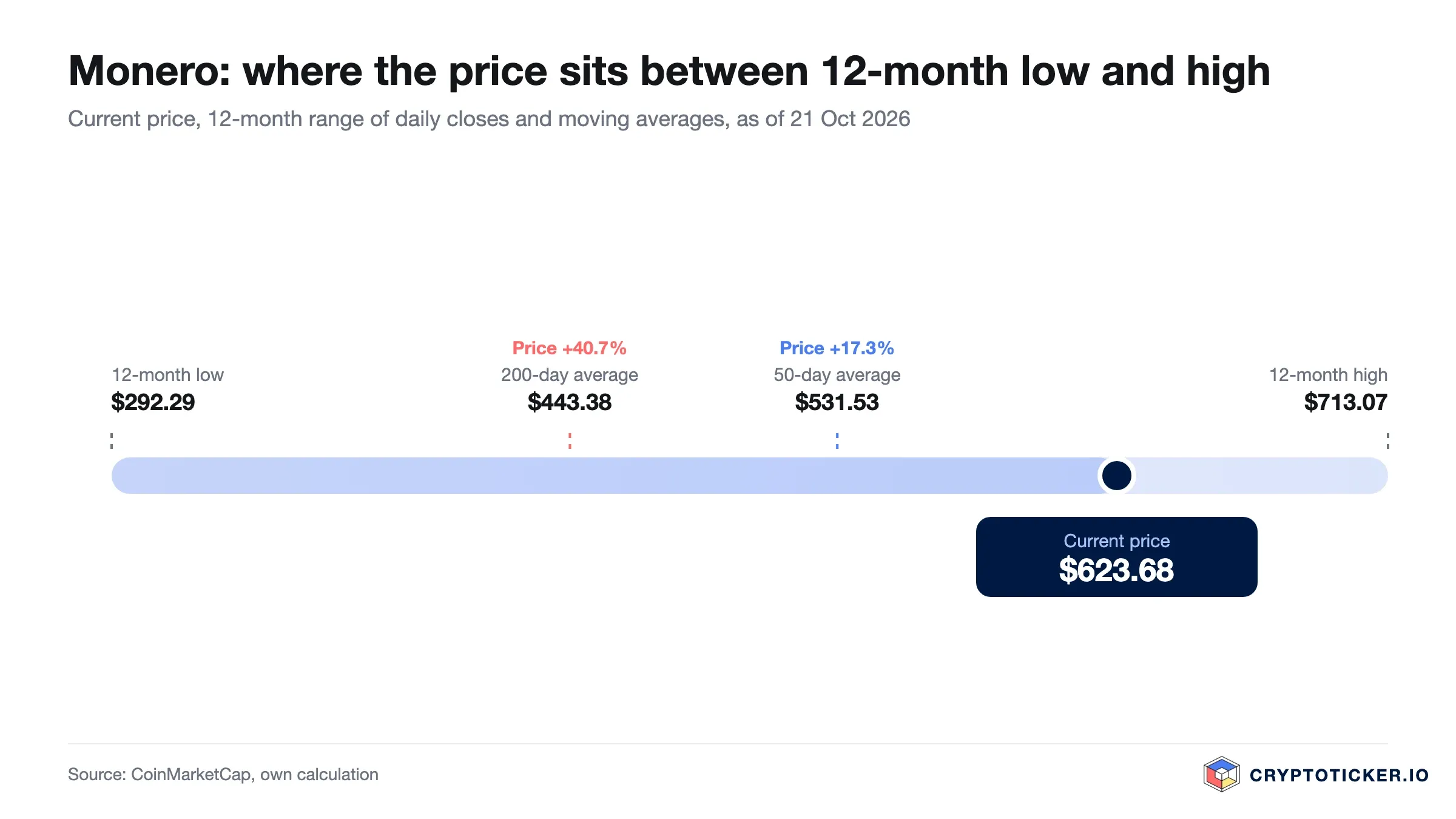
The levels have moved up. Overhead, the first is the September intraday high of $631.17 from 21 September, and above it the January high with the highest daily close of $713.07. Below the price, the first support is the zone around $591, the former interim high that the price cleared on 18 October. Beneath that sit the 50-day line at $531.53 and the October low of $514.63, and the 200-day line at $443.38 remains the dividing line between a constructive and a broken medium-term structure.
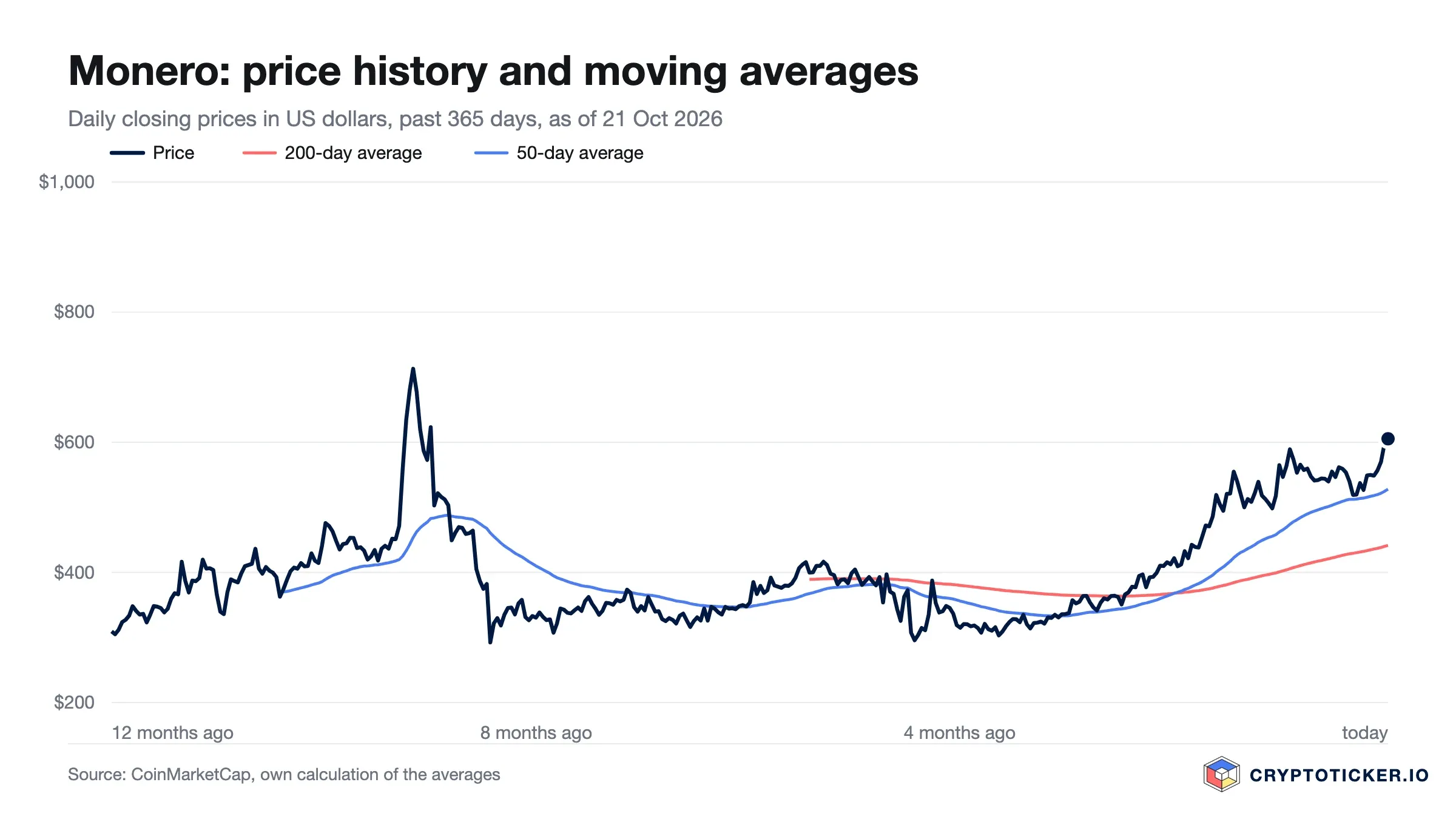
The medium-term numbers have strengthened across the board: plus 4.8 percent over 30 days, 74.7 percent over 90 days and 101.6 percent over twelve months, from $309.33 a year ago. Circulating supply stands at 18,820,685 XMR.
Is the Monero downtrend broken, or only interrupted?
In September we called this a genuine trend change rather than a pause, with one qualification: the twelve-month high. That reading has strengthened. The weekly close on Sunday 18 October came in at $597.48, above the former interim high around $591, and the price has since pushed on to $623.68. On 18 October, a day on which many altcoins set their lows after the Federal Reserve's September rate rise and the sell-off of early October, Monero gained 8.1 percent while Zcash lost 3.7 percent; our report on the price gap between Monero and Zcash covers that divergence.
The qualification still stands, though it has shrunk. As long as the January high is unchallenged, what has been broken is the intermediate downtrend rather than the whole drawdown that began in January 2026, when Monero lost 59 percent on a closing basis down to $292.29 in early February. More than three quarters of that loss has now been recovered, and closing the remaining gap to $713.07 would take a further 14.3 percent.
The condition we set in September to falsify the constructive reading was a daily close back below $416.38 that holds for several sessions. That has not happened. The lowest close since our first version was $519.47 on 9 October, and Monero did not close below its 50-day line on a single day in October.
What RSI and moving averages mean for a Monero entry
The 14-day relative strength index stands at 72.2, above the level of 70 that is conventionally read as overbought. On 30 September it read 52.3 and on 12 October 46.8; between 16 and 19 October alone it climbed from 56.4 to 68.7. In September we called the midpoint reading the least comfortable for an entry. The current reading is uncomfortable for the opposite reason: the market is stretched.
The gap between price and the two averages is the more useful signal. At 40.7 percent above the 200-day line and 17.3 percent above the 50-day, Monero trades well clear of both. Gaps of this size usually close either through a pullback toward the averages or through a sideways phase in which the averages catch up, and neither outcome favours a buyer who needs an immediate move higher.
The practical consequence for anyone considering an entry at $623.68 is that the risk is now defined by the breakout level rather than by the averages. The zone around $591 is where a normal pullback after a breakout would be expected to find support; below it, the 50-day line at $531.53 is 14.8 percent beneath the current price.
What Monero trading volume reveals about demand
Turnover over the past 24 hours came to about 260.7 million US dollars, 1.9 times the seven-day average of 138.8 million to 20 October. The 30-day average stands at roughly 123.9 million and the 90-day average at about 113.8 million. On 30 September the figures were 105.6 million for 24 hours against a 30-day average of 133.6 million.
The reading has therefore flipped. In September the price was rising on contracting participation, which we described as a move carried by a thin bid. In October the advance came with volume: on 18 and 19 October turnover reached 186.3 and 184.9 million dollars, well above the monthly average. The market is still narrower than for comparable coins, though; on 18 October Zcash traded roughly three and a half times Monero's volume.
Structural factors that speak for Monero: supply mechanics, usage and regulation
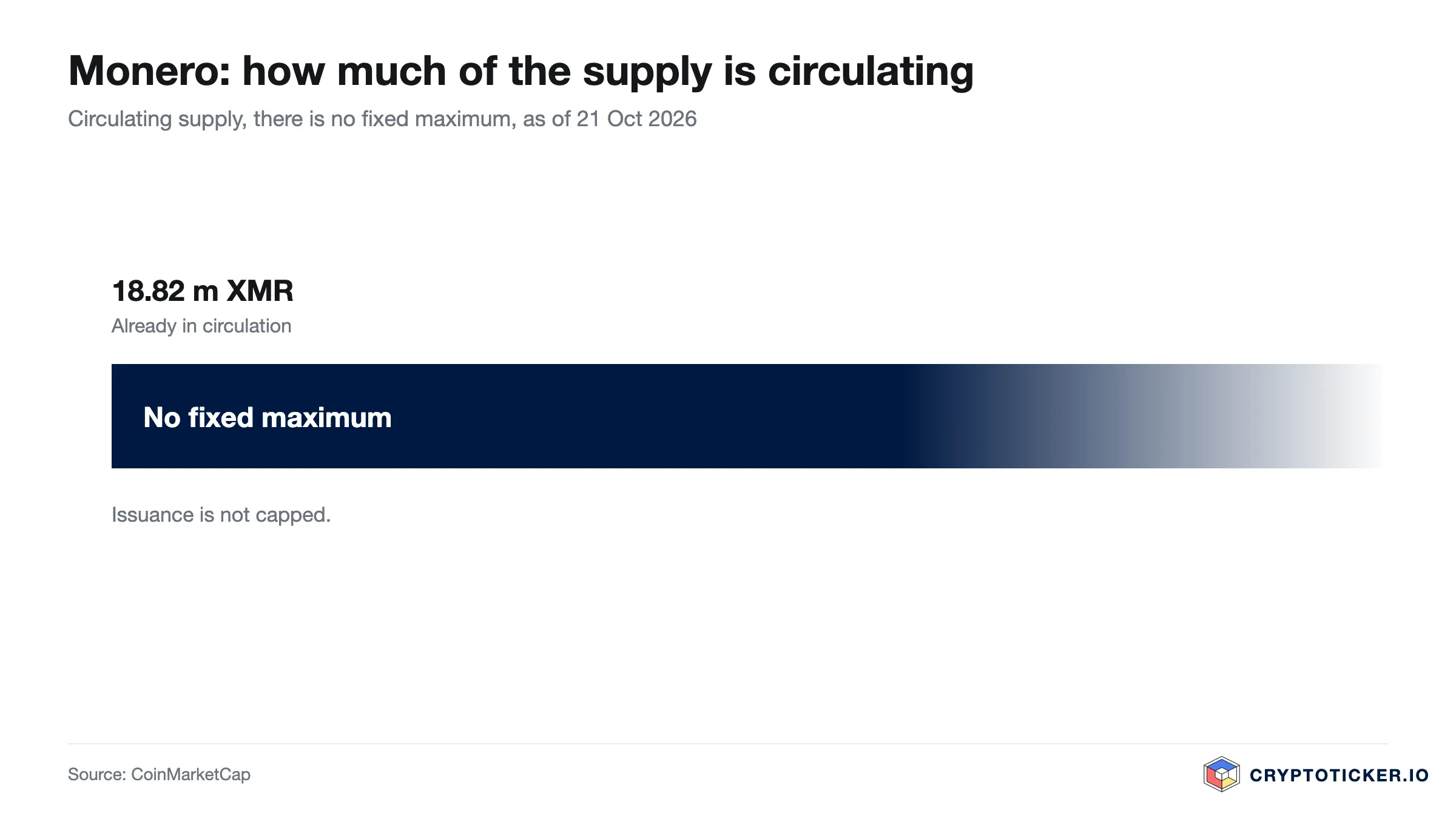
Monero's supply schedule is unusual and worth understanding before any purchase. Circulating supply stands at 18,820,685 XMR, 9,388 more than at our first version, and the protocol carries no fixed maximum supply. After the initial emission curve was exhausted in 2022, issuance moved to a constant tail emission of 0.6 XMR per block designed to keep paying miners indefinitely. With a block about every two minutes that is roughly 157,700 XMR a year, about 0.84 percent of supply, a rate that declines as a percentage over time. Anyone who buys Monero expecting the hard-capped scarcity story familiar from the original Bitcoin design is buying a different mechanism.
The usage case rests on privacy at the protocol level. Ring signatures, stealth addresses and confidential transaction amounts are mandatory rather than optional, which is what gives the asset its fungibility argument. The technical documentation is published by the project at getmonero.org. Development continues: on 5 October the FCMP++ upgrade, the largest change to Monero's privacy in years, went live on a dedicated stress-test network, with no date yet for the main network, as our explainer on the FCMP++ stressnet fork sets out. On the main network, maintenance releases 0.18.5.3 and 0.18.5.4 followed on 6 and 17 October.
Regulation is the factor that cuts both ways, and it is the single most important structural consideration here. In the European Union, the framework for crypto assets is set out by the authorities documented at ESMA, and from 10 July 2027 the EU anti-money-laundering regulation prohibits crypto-asset service providers from keeping accounts that allow transactions to be obscured, explicitly including through anonymity-enhancing coins. Licensed venues are already acting on it: of the eight large exchanges whose trading pairs we checked on 5 October, none offered XMR to customers in Germany through an EU-licensed service. Our guide to buying Monero in Germany covers the details and the remaining routes.
Three arguments for buying Monero at current prices
The trend structure has strengthened. Price above both the 50-day average at $531.53 and the 200-day at $443.38, with the shorter average above the longer, is the configuration buyers generally want to see, and the weekly close above $591 on 18 October has cleared the last interim high before the January peak. The advance has come on rising volume.
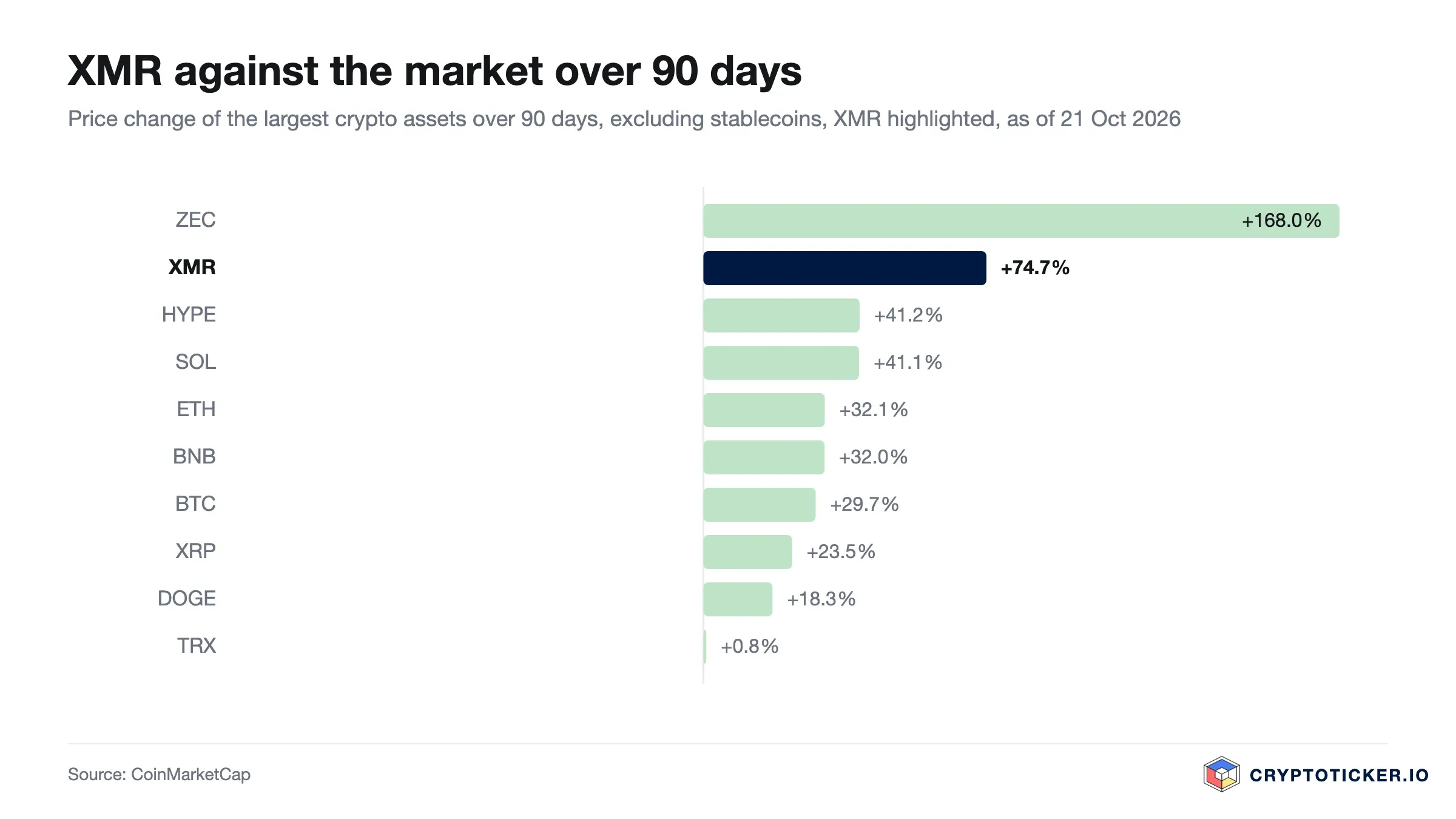
Relative strength stands out. Over 90 days Monero has gained 74.7 percent, more than any of the ten largest crypto assets excluding stablecoins other than Zcash at 168.0 percent, against 29.7 percent for Bitcoin. On 18 October, when much of the market was setting lows, XMR rose 8.1 percent.
The privacy niche has few substitutes. Whatever one makes of the regulatory pressure, demand for protocol-level privacy has few credible outlets, and Monero remains one of the largest of them at rank 12 by market capitalisation, with active development behind it.
Three arguments against buying Monero at current prices
The entry is stretched. At $623.68 the price stands 40.7 percent above its 200-day line and 17.3 percent above the 50-day, with an RSI of 72.2 in overbought territory. A buyer who sees the price return to the 50-day line at $531.53 sits on a loss of 14.8 percent without anything being wrong with the trend.
Regulatory availability is a real risk to the position, not a background concern. None of the large EU-licensed exchanges we checked on 5 October offered XMR to customers in Germany, and from 10 July 2027 the EU anti-money-laundering regulation bars crypto-asset service providers from handling such accounts. An asset that cannot be sold at regulated European venues is an asset whose exit is harder to plan than its entry.
The trading base remains narrow. Even after the jump, turnover of 260.7 million dollars equals only 2.2 percent of market capitalisation, and venues outside the EU framework can interrupt service: KuCoin closed XMR deposits for wallet maintenance on 10 October, while withdrawals remained open.
The macro calendar adds a further caution. The Federal Reserve meets on 27 and 28 October after minutes released on 7 October pointed to a further rate rise, and US consumer prices rose 3.7 percent in September.
How to buy Monero at current prices: costs, custody and providers
The first step for Monero specifically is not choosing a provider but checking availability. Licensed European venues already apply the EU rules, so XMR is not part of their offer for customers in Germany; confirm that your intended provider currently offers XMR in your country, with deposits and withdrawals open, before you plan anything else. Our exchange comparison sets out the venues and their conditions for the rest of your portfolio, and the overview of regulated exchanges is the more relevant of the two for anyone who wants a supervised counterparty. Outside licensed platforms, the remaining routes are exchanges without an EU licence, atomic swaps between Bitcoin and Monero and non-custodial decentralised exchanges; all three work technically, none offers supervision or a settlement statement.
On costs, the figures that matter are the trading fee, the spread and the withdrawal fee, and for a mid-cap asset the spread is frequently the largest of the three; atomic swaps often price noticeably away from the market because liquidity is thin. In the week to 20 October XMR's daily ranges ran between 2.4 and 6.6 percent, so a limit order is the safer tool. Individual provider conditions are set out in reviews such as our Kraken review, and current terms should be verified at the provider itself.
On custody, Monero held at an exchange is exposed both to the venue's solvency and to any future change in its listing policy, and self-custody removes the second exposure entirely. The options are covered in our hardware wallet comparison. Hardware support for XMR is narrower than for the largest assets, which is another item to verify before a purchase.
Is Monero a good buy at current prices, short term and long term?
Short term, the chart makes a clearer case than in September: the intermediate downtrend is broken and volume is confirming the advance. The price of that clarity is a stretched entry, with an RSI of 72.2 and a gap of 17.3 percent to the 50-day line. The breakout zone around $591 is 5.2 percent below the current price, the 50-day line 14.8 percent below, and the highest daily close of $713.07 14.3 percent above, so reward and pullback risk are roughly in balance.
Long term, the assessment still turns on a question that is not a chart question: whether protocol-level privacy retains a durable market that you can access. In September we named a further material reduction in regulated European availability as one of two conditions that would falsify the constructive case. Our count on 5 October showed how little room is left for that: no large EU-licensed exchange offers XMR to customers in Germany. Those decisions were largely taken before our first version, so the condition as written has not been triggered, but the access constraint it describes is already the norm. The other condition, a sustained daily close below $416.38, has not come close.
This assessment would count as refuted by one of three things. First, a return below $591 that holds for several daily closes, which would mark the breakout as a false one and make the 50-day line around $532 the next test. Second, a daily close below the October low of $514.63, which would break the sequence of higher lows and open the way to the 200-day line at $443.38. Third, in the other direction, a large EU-licensed exchange restoring XMR for customers in Germany, which would take much of the weight out of the access risk. This is an assessment of conditions, not a recommendation to buy or to sell.
Buying Monero: what to take away
- The trend is constructive and the entry is stretched. At $623.68 the price holds 40.7 percent above the 200-day average of $443.38 and 17.3 percent above the 50-day of $531.53, with an RSI of 72.2. Longer-term expectations belong in a separate frame; our Monero price prediction sets these out.
- Check availability before anything else. Privacy assets are not offered by licensed European venues, and from 10 July 2027 EU rules bar them from handling such accounts. Start with the comparison of regulated exchanges rather than with the chart.
- Plan custody at the same time as the purchase. Holdings left at a venue are exposed to that venue's future listing decisions as well as to its solvency; the hardware wallet comparison covers the alternatives and the support limitations that apply to XMR.
Disclosure: Some of the providers mentioned in this article work with us through partner programmes. This has no influence on the price analysis or on the assessment of the chart situation; the price data comes from a public market data source and can be verified there.
(As of 22 October 2026, first version of 30 September 2026. This article is not investment advice. Prices, fees and conditions change; check them with the provider before every purchase. Crypto assets are subject to high price volatility and a total loss is possible.)
Transparency note: This article was produced with the assistance of artificial intelligence and reviewed by our editorial team before publication. All figures and claims were checked against the primary sources linked in the text. The feature image was generated with AI.
Related articles
Which topics should we dive deeper into?
Select what genuinely interests you. Your picks feed directly into our editorial planning.
Crypto news that's actually worth your time.
Weekly. 60 seconds. Carefully curated by our editors: no hype, no promo flood, no spam.

September 23, 2024 8:44 AM
Is it a Good Idea to Buy XRP below $0.60?
With recent XRP price drops positioning it below the $0.60 mark, investors are left pondering. Is it a good idea to buy XRP below $0.60?

February 17, 2026 11:00 AM
Monero Price Analysis 2026: From $800 Peak to Regulatory Support Test
Monero (XMR) experienced a volatile start to 2026, hitting an all-time high of $800 before a regulatory-driven correction sent prices back to the $330 range.

September 28, 2026 4:28 AM

Is Quant a Good Buy at the Current Price?
Quant climbed as high as 357 dollars after the bank mandate and has since fallen back sharply. Is QNT a good buy at the current price? We check the chart, volume, the banks' timetable and the token's role with our own data.
August 27, 2026 4:31 AM

Is AAVE a Good Buy at Current Prices?
AAVE has worked its way back above both the 200-day and the 50-day moving average, yet still trades far below its twelve-month high. Using our own price data, we examine what speaks for and against an entry at current prices.
August 27, 2026 3:24 AM

Is Hedera a Good Buy at Current Prices?
Hedera met our trend-reversal test in September, then gave back the entire IBM jump. What higher lows, HashPack's stock tokens and Hitachi's exit from the council mean now: is Hedera a good buy at current prices?
August 27, 2026 2:21 AM

Is SUI a Good Buy at Current Prices?
SUI is holding its 200-day moving average and trades 51 percent above its twelve-month low, with the 50-day line now above the 200-day. We check whether the coin is a good buy at current prices.
August 16, 2026 12:21 PM

Is Toncoin a Good Buy at Current Prices?
Toncoin, now traded as Gram (GRAM), has fallen back below both moving averages and the September breakout has failed. What the Telegram wallet, volume and the base mean now: is Toncoin a good buy at current prices?
September 28, 2026 9:47 AM
XRP Price Drops Below $1.50: Where Is Ripple Heading This Week?
XRP price slips under $1.50 after a red weekend. Here is the XRP price analysis with the higher and lower targets that matter this week.
August 23, 2026 1:16 AM

Is PEPE a Good Buy at the Current Price?
PEPE has given up the 50-day moving average but still holds clearly above the 200-day line. Is the memecoin a good buy at the current price, or is the rally already running on thin volume?
November 7, 2025 3:36 PM

Top 5 Privacy Tokens to Watch Before 2026
Zcash jumps 78% in a week, leading a major rally in privacy coins. Here are the top 5 privacy tokens by market cap in 2025.
August 24, 2026 12:50 AM
Is Bitcoin Cash a Good Buy at Current Prices?
Bitcoin Cash has held its summer gains but the rally has stalled: the price now sits right on its 50-day line with the RSI back to neutral and turnover halved. We work through what speaks for and against buying BCH at current prices.
October 6, 2026 10:36 PM

Buying Monero in Germany: six major exchanges no longer list XMR
On October 5, 2026, of eight trading venues checked only two still carry an XMR pair, and neither is open to German customers. MiCA Article 76(3) explains the delistings, and Article 79 of the anti-money-laundering regulation sets the tougher limit from July 10, 2027.
March 29, 2026 2:07 PM

Is Ethereum a Good Store of Value?
Is Ethereum a reliable store of value? We analyze ETH price history, the "ultrasound money" narrative, and its long-term potential for 2026 and beyond.
October 8, 2024 10:46 AM

This Memecoin Made 100% in 1 Month...Meet MOG Token
MOG crypto has seen a significant price increase over the past month, attracting attention from traders and investors.
October 21, 2026 12:33 AM
Is Worldcoin a Good Buy at Current Prices?
Worldcoin has reclaimed both of its moving averages, and the 50-day line has crossed above the 200-day line for the first time this year. Whether that makes WLD a buy depends on the locked supply and on whether demand holds.
September 20, 2026 9:21 AM

Is Ethena a Good Buy at Current Prices?
Ethena has rebounded hard off its twelve-month low and still trades far below its high. Is ENA a good buy at current prices? We check the chart, the supply schedule and the source of the yield with our own price data.

September 19, 2026 4:34 AM

Monero Jumps 11 Percent to $575: What XMR Holders in Germany Should Check Now
Monero gained 11.19 percent in 24 hours and is outrunning the wider market. For German holders, however, the decisive date is July 10, 2027: from then on, authorized exchanges may no longer carry XMR.
March 25, 2026 10:38 AM
Ethereum News: ETH Targets $2,200 as Geopolitical Tensions Ease and Bitcoin Reclaims $71k
Ethereum nears $2,200 while Bitcoin reclaims $71,000 amid reports of US-Iran peace talks. Here are the latest ETH chart trends and market sentiment for March 2026.
October 12, 2026 10:27 AM
Is Bitcoin Still a Good Investment in October 2026?
Spot ETFs have changed who sets the Bitcoin price, and the easy repricing is behind us. What still supports BTC, what could break it, and how much belongs in a portfolio today.
September 20, 2026 1:27 PM

Why Is PEPE Rising Right Now? Three Explanations Circulate, None Is Documented
PEPE has been up by double digits for a week, and three reasons for it are doing the rounds online: whales are buying, a fund is coming, a large buyback is due. We checked all three. What the data really says, and how you tell whether a crypto report is worth anything.
August 27, 2026 11:25 AM

Is Pump.fun a Good Buy at Current Prices?
PUMP now sits only just above its 50-day average and still trades below its twelve-month high. We check with our own price data what argues for and against buying Pump.fun at the current price.
August 27, 2026 6:38 AM

Is NEAR Protocol a Good Buy at Current Prices?
NEAR has nearly tripled since August, and the trend break we defined back then has happened. What ETF buying, leverage and issuance mean now: is NEAR Protocol a good buy at current prices?
August 27, 2026 6:23 AM

Is Bittensor a Good Buy at Current Prices?
Bittensor has passed the trend test we set in August: a weekly close above the 200-day average and a moving-average crossover in September. What the correction since the peak means: is Bittensor a good buy at current prices?
August 27, 2026 3:39 AM

Is Cronos a Good Buy at Current Prices?
Cronos has reclaimed its 200-day line for the first time since the spring, and the RSI is back out of overbought. We weigh what speaks for and against buying CRO at the current price.
August 26, 2026 4:21 AM

Is Uniswap a Good Buy at Current Prices?
Uniswap has gained about three quarters since August, and the trend test we set back then has been passed. What the fee switch, CME futures and the correction since September mean now: is Uniswap a good buy at current prices?

More from CryptoTicker