
Crypto Exchanges Head to Head: Which Pairing Is Cheaper Where
Before opening an account, the question is rarely which exchange is best overall, but whether it should be this one or that one. This article sorts through the most searched head-to-heads, puts the cost per 1,000 euros side by side and explains the most expensive mix-up: one provider with two interfaces and a factor of seventeen between them.





Which topics should we dive deeper into?
Select what genuinely interests you. Your picks feed directly into our editorial planning.
Crypto news that's actually worth your time.
Weekly. 60 seconds. Carefully curated by our editors: no hype, no promo flood, no spam.
Why a head-to-head says more than a ranking
A ranking answers the question of which exchange performs well overall. Before opening an account, though, almost everyone faces a different question: this one or that one? Two names are on the table, and the difference comes down to three figures rather than an overall score.
That is why every pairing from our provider base has a comparison page of its own, with the same key figures side by side: the published trading fee, the cost of a purchase of 1,000 euros, the number of tradable crypto assets, the payment methods and the regulatory status. This article sorts through the head-to-heads that are searched for most often.
The most expensive mix-up: one provider, two products
Before the pairings, a point that no ranking picks up and every head-to-head reveals immediately: several providers run two separate interfaces, and their prices are worlds apart.
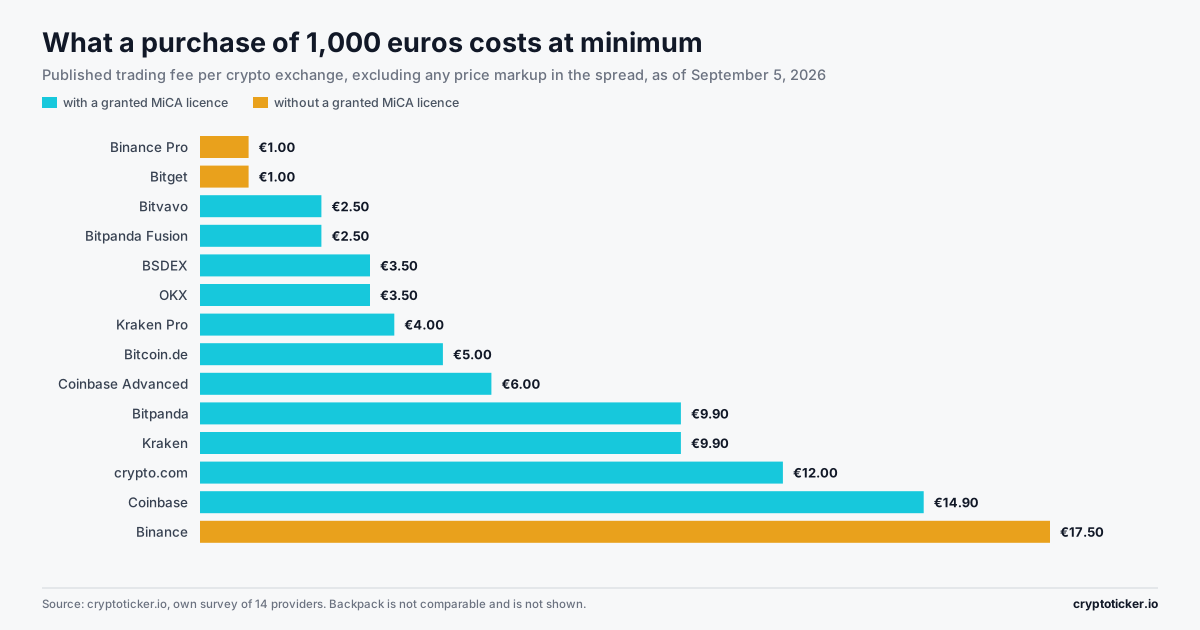
At Binance, a simple instant buy costs 1.75 percent, while trading through the pro interface costs 0.10 percent. On a purchase of 1,000 euros that is 17.50 euros against 1.00 euro, a factor of seventeen at the same provider and with the same login. The same split exists at Coinbase and Coinbase Advanced, at Bitpanda and Bitpanda Fusion, and at Kraken and Kraken Pro. Our comparison pages put the two interfaces side by side: Binance vs Binance Pro, Coinbase vs Coinbase Advanced, Bitpanda vs Bitpanda Fusion and Kraken vs Kraken Pro.
Anyone reading a comparison should therefore check first which of the two products it covers. A head-to-head between the simple interface of one provider and the professional interface of another compares two different things.
The most searched head-to-heads at a glance
The selection follows search demand: of our English comparison pages, these five had the most impressions in Google search between August 10 and September 6, 2026. The figures come from the comparison pages themselves, collected on September 11, 2026. The basis is a bitcoin purchase of 1,000 euros, calculated with the published trading fee. A markup in the price is not included; more on that below.
| Head-to-head | Fee, left | Fee, right | Cost per 1,000 euros | Comparison page |
|---|---|---|---|---|
| Bitcoin.de against Gate.io | 0.50 percent | 0.20 percent spot, 0.15 percent with GT | 5.00 euros against no figure | Bitcoin.de vs Gate.io |
| Coinbase against Gate.io | 1.49 percent | 0.20 percent spot, 0.15 percent with GT | 14.90 euros against no figure | Coinbase vs Gate.io |
| Gate.io against Traders Place | 0.20 percent spot, 0.15 percent with GT | 0.90 percent | no figure against 9.00 euros | Gate.io vs Traders Place |
| Binance against eToro | 1.75 percent | 1.00 percent plus spread | 17.50 against 10.00 euros | Binance vs eToro |
| Binance against Kraken Pro | 1.75 percent | 0.40 percent | 17.50 against 4.00 euros | Binance vs Kraken Pro |
Gate.io sits on one side of three of these five pairings. Its comparison page lists a spot trading fee of 0.20 percent, or 0.15 percent if the fee is paid in the platform's own GT token, but no cost for a purchase in euros. The table shows that as no figure instead of filling in an estimate.
The last row shows the mix-up described above in practice: the Binance instant buy at 1.75 percent against the professional interface of Kraken at 0.40 percent. The fair counterpart to Kraken Pro would be Binance Pro at 0.10 percent.
What the fee figure does not show
The published trading fee is the part of the price a provider names voluntarily. Alongside it sit three items that appear in no price list and often add up to more.
- The price markup. The price you buy at can deviate from the market price. At providers without a published fee, that markup is the business model. From the outside it can only be measured by comparing several quotes in the same second.
- The withdrawal fee. It applies when you move coins to a wallet of your own, and it depends on the network. On the comparison pages it has a line of its own, because with small amounts it can exceed the trading fee.
- The minimum amount. It decides whether a fee tier is within your reach at all. A low percentage is of little use if the smallest possible purchase is above your budget.

The supervisory question counts too
Since MiCA, a single licensing requirement applies to crypto service providers across the European Union. For a head-to-head that has become a hard distinction, because it has nothing to do with the price and still decides whether a service is usable.
OKX holds a MiCA licence via Malta, crypto.com does too, Bitpanda is authorised in several EU states, and eToro operates under CySEC supervision. Binance withdrew its licence application with the Greek supervisor in June 2026 according to its own statement, and its BaFin application in Germany as well; which EU state is to take over instead has not been named so far. For retail investors in the EU, margin and futures products are also restricted there.
If you want to check both sides of a head-to-head on this question, the regulatory status appears on every comparison page as a line of its own, with a date. The full overview is in our comparison of regulated crypto exchanges.
Further head-to-heads that are searched for often
Beyond the five pairings above, the searches fall into four groups. The order follows the impressions of our English comparison pages in Google search between August 10 and September 6, 2026.
- KuCoin against the large exchanges: Binance vs KuCoin, KuCoin vs OKX, Coinbase vs KuCoin and Kraken vs KuCoin. As with Gate.io, the comparison pages list a spot fee for KuCoin, 0.10 percent or 0.08 percent with the KCS token, but no cost for a purchase in euros.
- Binance against the global competition: Binance vs OKX, Binance vs Bitget, Binance vs ByBit EU and Binance vs crypto.com. OKX at 0.35 percent, Bitget at 0.10 percent and crypto.com at 1.20 percent all publish a lower fee than the Binance instant buy at 1.75 percent.
- Bitget against Gate.io and OKX: Bitget vs Gate.io and Bitget vs OKX. Bitget publishes 0.10 percent, which is 1.00 euro per 1,000 euros, but according to its comparison page holds no MiCA authorisation yet; its application with Austria's FMA was pending as of August 2026.
- Neobrokers: Revolut vs Trade Republic and Revolut vs Scalable Capital. Zero percent in fees at Trade Republic does not mean free of charge: where no fee is published, the provider earns on the price markup, and that markup is not disclosed. Brokers are compared as a group in our comparison of crypto brokers.
If you are after the overall picture rather than a single head-to-head, you will find it in our comparison of crypto exchanges with every provider we have assessed.
How to read a head-to-head
The order in which the lines matter depends on what you intend to do. Three typical cases, and what decides them.
- A one-off purchase left untouched: what counts is the cost per 1,000 euros and the withdrawal fee, because you move the coins to a wallet of your own in the end. The number of tradable crypto assets is a side issue.
- A monthly savings plan: what counts is the percentage, because it repeats with every instalment, along with the minimum amount. A difference of one percentage point costs around 240 euros over ten years at 200 euros a month.
- Active trading: what counts is the maker and taker model with its volume tiers, and not the entry price. Here the professional interfaces of the large providers are regularly ten times cheaper than their instant-buy variant.
One thing appears in no comparison and still decides the matter: whether you can reach your money when it counts. The providers' status pages often show withdrawal problems earlier than any news report, and a provider without a granted EU licence can restrict its offering for retail investors at any time.
Common questions about comparing exchanges
Which crypto exchange has the lowest fees?
Among the published trading fees, the professional interfaces lead the field, Binance Pro among them at 0.10 percent. Among the simple instant-buy interfaces, Bitvavo at 0.25 percent comes ahead of Bitpanda at 0.99 percent and Binance at 1.75 percent. Providers without a published fee earn on the price markup.
What is the difference between Binance and Binance Pro?
It is the same provider with the same account, but two interfaces. The instant buy costs 1.75 percent, trading through the pro view costs 0.10 percent. The same split exists at Coinbase Advanced and Bitpanda Fusion.
Can an exchange without a MiCA licence be used in the EU?
Access often remains in place, but the offering can be restricted, particularly for leveraged products. Whether and where a provider is licensed appears on every comparison page in the line on regulation.
Does it matter for tax which exchange I buy at?
Not for the amount of tax, very much so for the effort. What matters is whether the provider delivers a usable export of your transactions. The tax rules are set out in our article on crypto tax in Germany.
Why do the fees differ from the providers' own figures?
The figures here are list prices on the day of collection. Discount tiers based on trading volume, payment in a provider's own token or time-limited promotions change them. Before you open an account, the provider's price page is what counts.
Sources and status of the figures
- Fees, costs per 1,000 euros and provider figures from the CryptoTicker comparison pages, collected in September 2026
- Selection of the head-to-heads: impressions of our English comparison pages in Google Search Console, August 10 to September 6, 2026
- Details on regulatory status from the providers' statements and the registers of the competent authorities
- Binance on the withdrawal of its licence application with the Greek supervisor HCMC of June 24, 2026
(As of September 11, 2026. This article is not investment advice. Prices and fee structures change; check the terms with the provider before you buy. List prices move, and the price page of the provider in question is what governs.)
 Regulated crypto exchanges: who holds an EU licence
Transparency note: This article was produced with the assistance of artificial intelligence and reviewed by our editorial team before publication. All figures and claims were checked against the primary sources linked in the text.
Related articles
- How to Switch from Binance to a MiCA Regulated Crypto Exchange
- Binance fees: 0.1 percent to trade, and one drawback compared with MiCA-licensed exchanges
- Binance Is Out of the EU: How to Move to a MiCA-Regulated Exchange
- Binance Is Leaving the EU on July 1 — What It Means for Your Funds
- Bitget Review 2026: Fees, Safety After the $388M Hack and Who Can Use It
Which topics should we dive deeper into?
Select what genuinely interests you. Your picks feed directly into our editorial planning.
Crypto news that's actually worth your time.
Weekly. 60 seconds. Carefully curated by our editors: no hype, no promo flood, no spam.

October 16, 2026 4:34 AM

25 cents to trade, 1.31 euros to withdraw: the Bitvavo fees on 100 euros of Bitcoin
The trading fee is the smallest of four cost items: on 100 euros the purchase costs 25 cents, while moving Bitcoin to your own wallet costs 1.31 euros. We recorded every item separately on 15 October 2026 and measured the spreads of the four largest euro pairs ourselves.

July 9, 2026 10:12 AM
MiCA Wiped Out 92% of Europe's Crypto Firms: Here's Who Survived and Who's Cashing In
The July 1 deadline turned 3,000+ EU crypto firms into a few hundred. Binance is out, Tether's gone, and a handful of winners now own the market.
September 20, 2026 10:11 PM
Kraken Review: Fees, MiCA Licence and Withdrawals in Euro
A purchase through Kraken's standard interface costs 1 percent plus spread; on Kraken Pro it is 0.40 to 0.80 percent. What deposits, trading, withdrawals and tax records really cost at the crypto exchange, with the numbers from the official fee schedule.
August 6, 2026 3:05 PM
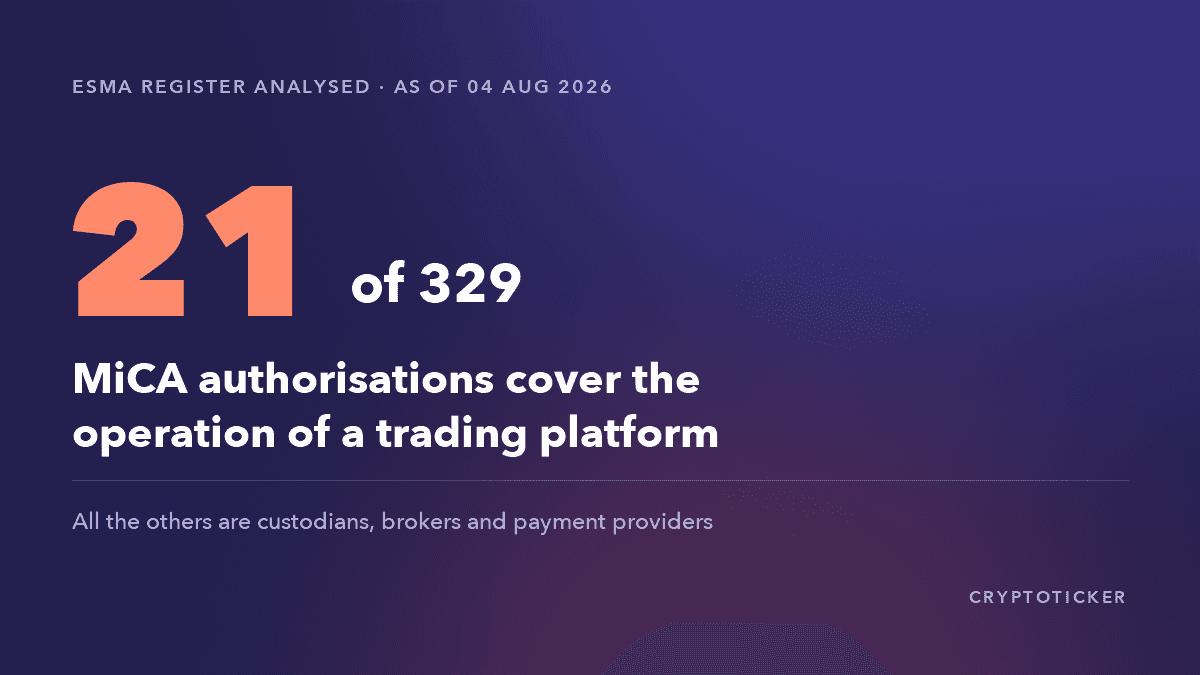
MiCA Register 2026: Only 21 of 329 Licences Are Real Exchanges
ESMA publishes the register of MiCA-authorised providers as an open file. We worked through all of it — and the result is not what the phrase “licensed crypto exchange” suggests.
June 25, 2026 11:19 AM

Binance Pulls Its EU Licence Bid: What It Means for Your Crypto
Binance just withdrew its MiCA licence application in Greece days before the EU deadline. Here's what it means for users, your funds, and the crypto market.
August 11, 2026 9:18 AM

Your Crypto Exchange Is Telling You to Withdraw: How to Spot Phishing After the MiCA Deadline
Unauthorised crypto providers now have to tell their EU customers to withdraw, which leaves fraudsters an easy run with faked requests. Here is how to check in two minutes whether the message is genuine.

July 10, 2026 10:30 AM
Binance Reveals Where Its EU Users Went After MiCA
Binance just revealed where most departing EU users moved their crypto after MiCA — and the answer is raising hard questions about the new rulebook.
September 11, 2026 1:40 PM

Inactivity Fees at Crypto Exchanges: How to Check Whether Your Dormant Account Loses Money Every Month
Two providers have just raised their rates for dormant accounts, one of them to as much as 52 US dollars a month. Our own survey of 15 fee pages shows why you will almost never find the answer for your account without logging in.
October 14, 2026 1:29 AM

South Korea blocks 27 unregistered exchanges, KuCoin and MEXC are on the list
South Korea's anti-money-laundering unit blocked access to 27 websites of unregistered foreign exchanges on October 13, 2026, KuCoin, MEXC and BingX among them. In Germany the grandfathering for legacy providers lapsed back on December 31, 2025, and at KuCoin a granted EU licence stands against an order that still prohibits the commencement of business.
September 29, 2026 10:33 AM
ESMA puts reverse solicitation on its 2027 watch list: what investors need to know about exchanges without an EU licence
ESMA presented its work programme for 2027 on September 28, 2026 and made reverse solicitation a supervisory priority. What that means if your coins sit with a provider without EU authorisation, and which three steps make sense now.
September 6, 2026 10:20 PM
Bison App: a 1.25 Percent Spread, 27 Percent of the Staking Rewards and Trading Without an Order Book
The crypto app of Boerse Stuttgart advertises freedom from fees. You pay through the spread instead. What the licences actually cover, why there is no order book, and why the tax report loses its value once you transfer coins out.
August 14, 2026 6:18 PM
Bitcoin From a Foreign Exchange to Austria: Which Tax Data You Need
Transferring Bitcoin from a foreign exchange to an Austrian platform: which tax data can be missing for the withholding tax. And what investors need to watch out for.
October 5, 2026 10:35 AM

"We deliberately invested in our expansion": Bitpanda reports a loss of around 14 million euros for 2025
Bitpanda GmbH reports a loss of around 14 million euros for 2025, after a profit of 61.7 million euros the year before, on adjusted revenue that rose to 371 million euros. What the numbers mean for your custody, your terms and the holding period.
October 4, 2026 1:42 AM

Five crypto apps for beginners: costs and custody compared
Fee-free rarely means free of charge with crypto apps: between 0.15 and 2.49 percent per purchase lies a factor of ten. What five apps cost German beginners, who holds the coins and which app permits a transfer to your own wallet.
September 26, 2026 4:21 AM
Operation Herakles disconnects 13,888 phone numbers: what to check on crypto investment calls
Six authorities have disconnected 13,888 phone numbers used by investment fraudsters to call their victims in Operation Herakles, 9,304 of them in the past three months alone. What the Federal Network Agency now requires of telecoms providers and which three checks protect you from the scheme.
August 22, 2026 1:23 AM

Binance Withdrawal Deadline September 9: What ALCX, ARDR, NFP and POND Holders Should Know Now It Has Passed
Recap as of September 27, 2026: Binance had announced it would stop withdrawals of ALCX, ARDR, NFP and POND on September 9, 2026 at 03:00 UTC. Spot trading in these tokens had been suspended since July 10, and the exchange is winding down its EU business. This article describes the situation before the deadline.
October 16, 2026 1:35 PM

Kraken parent Payward buys Saldo Bank: the first crypto firm with a bank of its own in the EU
Payward, the parent of Kraken, agreed on October 14 to buy the Lithuanian Saldo Bank and would be the first crypto firm with a bank of its own in the EU. What is established, what stays open until the planned completion in 2027 and what may change for the protection of your euros.
October 10, 2026 7:40 PM

Decentralised Crypto Exchanges (DEX): Network Fee Against Pool Fee, and Why Custody Decides
On Ethereum a swap through a decentralised exchange currently costs three to five cents in network fees, while the fee for the liquidity pool runs between 0.01 and 1.00 percent depending on the pair. That leaves both routes level on cost, and what comes afterwards decides: custody, supervision and records.
October 5, 2026 1:29 AM
Chainalysis attributes $387 million from the Bitget hack to North Korea: what matters now for investors in Germany
The analytics firm Chainalysis attributes the theft of around $387 million at Bitget to actors with ties to the DPRK and puts the annual total above one billion dollars. What that means for custody, choice of exchange and record-keeping in Germany.
September 10, 2026 7:17 PM
Binance Delists USDP: You Have Until November 24 to Withdraw Your Pax Dollar
Binance is removing the Pax Dollar stablecoin from its platform altogether. For holders in the European Economic Area the date that counts is the withdrawal deadline on November 24, 2026, well after the trading halt on September 24.
September 6, 2026 10:12 PM

MoonPay Fees: Up to 4.5 Percent, a Partner Margin on Top, and a Markup You Never See as a Fee
MoonPay is the buy button built into many crypto wallets. The European price list names four layers of cost, and only three of them show up as line items. What the provider is allowed to do, and what it expressly is not.
June 17, 2026 7:21 PM
Binance EU Access at Risk: What MiCA Could Mean for BNB and Crypto Users
Binance is facing one of its biggest regulatory tests in Europe as the MiCA deadline approaches. Could this put BNB and EU crypto users under pressure?
October 1, 2026 7:15 PM
Bitpanda fees from 0.99 to 2.49 percent: what is behind it
Bitpanda assigns every coin to one of four price tiers, from 0.99 percent for Bitcoin to 2.49 percent for small caps. What 100 euros costs in and out, why the spread is missing from the mandatory document, and where 0.25 percent is enough under the same roof.

October 12, 2026 7:43 PM

Canton Coin Arrives in Ripple Custody: What Investors Need to Know
Ripple Custody has held Canton Coin and CIP-56 tokens since version 1.43. What the institutional custody solution means for you as a retail investor, and where you can trade CC in Europe at all.
October 11, 2026 10:39 PM
Buying Dogecoin: instant buy at one percent or the order book at 0.8?
Seven cents per €100 separated the best asks of three authorised exchanges on Sunday evening. Between instant buy and order book at the same provider lie 75 cents.
September 30, 2026 1:32 PM
100 Euros Into Bitcoin Without Fees: What Actually Arrives at Five Providers
Five providers serving German retail customers, €100 invested: after the disclosed fee, between €98.50 and €100 is left. Only one provider names the spread as well, and with it the whole price.
September 26, 2026 4:14 PM

Bitget Withdrawals Resume on September 28: What to Check on a Residual Balance Now
Bitget is releasing the withdrawals frozen after the September 24 incident in four stages from September 28. For a residual balance held from Germany that is a deadline, not a reason to wait.
More from CryptoTicker