
Canton Coin Arrives in Ripple Custody: What Investors Need to Know
Ripple Custody has held Canton Coin and CIP-56 tokens since version 1.43. What the institutional custody solution means for you as a retail investor, and where you can trade CC in Europe at all.





Which topics should we dive deeper into?
Select what genuinely interests you. Your picks feed directly into our editorial planning.
Crypto news that's actually worth your time.
Weekly. 60 seconds. Carefully curated by our editors: no hype, no promo flood, no spam.
Ripple has held assets from the Canton Network since October 5, 2026. Its custody product, Ripple Custody, supports Canton Coin (CC) and tokens built to the CIP-56 standard as of version 1.43. Crypto Briefing reported this on October 7, and the trade service TokenPost announced the same release on the same day with its own details on the technical integration.
For retail investors, nothing changes about the route to buying, at least for now. Ripple Custody is a custody solution for banks, funds and depositaries, not for individual portfolios. The news matters for a different reason: it reveals how Canton assets are actually held, and that route differs markedly from the one you know from Bitcoin or Ether.
The price is taking the news calmly. CC trades at $0.1254 on Sunday evening according to CoinGecko's market data, up 5.73 percent within a day. Over a week it is still down 2.55 percent. Market capitalisation stands at 4.99 billion dollars, which is rank 24 among all cryptocurrencies.
Ripple Custody 1.43 Adds Canton Coin and CIP-56 Tokens
Version 1.43 is, as Crypto Briefing describes it, a release with extended support for installations in an institution's own data centre and for hybrid operating models. What is new is that an institution can hold and move Canton Coin and CIP-56 tokens in the same environment as its other digital assets.
CIP-56 is the token standard of the Canton Network, comparable to what ERC-20 is for Ethereum: a shared set of build instructions so that software can treat every token on the chain alike. It covers the tokens issued through the so-called DA Registry, the issuance register behind the network. TokenPost additionally names a second build-out stage of the ledger as a prerequisite for the rollout.
Canton Coin carries the name Amulet in the protocol. The token pays for use of the network and rewards the operators of the nodes, much like a network fee.
Canton Network and Canton Coin, Explained in One Sentence
The Canton Network is a blockchain for financial institutions in which every application has its own walled-off area and only the parties to a transaction can see its contents. That walling-off is precisely why banks work with it: a trading book does not have to become public just because it sits on a chain.
We last covered the network on October 4, when the US settlement house DTCC started up its tokenisation on Canton. For the background, see our piece on the launch of DTCC tokenisation on Canton. The Ripple news picks up exactly there: once institutional assets sit on the chain, someone needs a custody solution for them.

The Validator Stays With the Client, and So Does the Key
This is the part that matters for understanding it. Ripple does not run the network nodes itself. The model is known in the trade as bring your own validator: the institution or its service provider runs the validator, and Ripple Custody manages the accounts through it.
What a Validator Does in the Canton Network
A validator is a machine that checks and keeps a record of a blockchain's transactions. On Bitcoin you do not need one to own coins; a key pair is enough. On Canton, by contrast, account-keeping hangs on a party on the chain, and that party has to be served by a validator.
The signing keys stay in the client's vault, according to Crypto Briefing, and can be secured through a hardware security module or a key management service. A hardware security module is a dedicated device that generates and uses secret keys without ever releasing them. Prepared transactions have a 24-hour window in which they can be signed.
For custody in a private portfolio, that is an unfamiliar construction. Our hardware wallet comparison shows how to take charge of the keys for common cryptocurrencies yourself; on Canton that route does not readily apply, for the reasons set out above.
 Find a wallet to hold your own keys
What Version 1.43 Does Not Yet Cover: No DvP Settlement
The integration has clear limits, and both reports name them. In this version Canton runs exclusively through Ripple Custody's programming interface. Arbitrary commands to a Canton application are not provided for, and nor is deploying your own contracts.
Above all, delivery versus payment is missing. That means the exchange in which delivery and payment are technically coupled, so that neither side has to go first. For securities trading that is the real prize, and it is still outstanding. Read the news as finished trading infrastructure and you are reading too much into it.
The Price Since October 4: From $0.1242 to $0.1254
Little has happened in the market since our last Canton piece. On October 4, CC stood at $0.1242 according to CoinGecko's daily data. On October 5, the day of the Ripple release, it was $0.1294, after which it fell back as far as $0.1188 on October 9. Today it is $0.1254. On balance that leaves the price roughly one percent higher seven days after the DTCC piece.
The levels that follow from this are tight. The daily high was $0.1275 and the daily low $0.1175. The all-time high of $0.1942 from February 3, 2026 is 35 percent away. The DTCC news of October 4 did not lift the price durably, and the custody news of October 5 held for exactly one day.
That points to a sober observation: infrastructure news moves this token briefly and then fizzles out. This is not a value judgement on the network but a description of what the price series of the past two weeks shows.
18 Trading Venues, and Only One of Them Holds a MiCA Licence
Now to the question that counts in practice: where can you actually get CC? CoinGecko lists 26 trading pairs for Canton Coin across 18 venues. Daily turnover of 16.7 million dollars is spread very unevenly. Bybit accounts for 5.60 million dollars, Temple Digital Group for 4.68 million, OKX for 1.73 million, Kraken for 1.47 million and Upbit for 1.16 million. After that it thins out: Bitget 0.95, KuCoin 0.70, Gate 0.54 and MEXC 0.42 million dollars.
Kraken as the Only Venue With an EU Licence
Among these venues, Kraken is the one a European investor can use as a matter of course. Kraken received its European licence under the Markets in Crypto-Assets Regulation from the Central Bank of Ireland and lists it in its own overview under the entity Payward Europe Solutions Limited. Coinbase, Bitpanda and Bitvavo do not appear in the list of trading venues for CC at all.
What the licensing requirement means in concrete terms for providers in Germany, we set out in our overview of MiCA obligations for crypto companies. If you are looking for a trading venue with a European licence, our overview of regulated crypto exchanges helps with the selection.
How thin trading in CC is relative to its market capitalisation, we already placed in context today in a separate analysis of the 25 largest cryptocurrencies. The short version for this article: rank 24 on the list promises more tradability than the order book delivers.

Pre-Approval and Two-Step Handover for Incoming Assets
One detail of version 1.43 deserves attention, because it solves a real problem. Incoming transfers can be pre-approved, and there are two-step handovers: a transfer is first offered, and the recipient accepts it, rejects it or withdraws it.
On open chains such as Ethereum, anyone can send any token into your account whether you want it or not. That is the basis of a widespread scam in which worthless or poisoned tokens are scattered into other people's accounts. For a bank, an unannounced inbound transfer is also a money-laundering compliance problem. The two-step handover takes that case off the table.
 Find a crypto exchange with an EU licence
Self-Custody Works Differently on Canton Than on Bitcoin
To sum up the practical part: with Bitcoin, a hardware wallet costing 60 to 150 euros is enough, and you hold your coins without any third party involved. On Canton, account-keeping hangs on a party on the chain that a validator serves. Ripple solves that for institutions by having the client provide the validator while Ripple Custody manages the accounts.
A private investor will not run a validator. In practice that means your CC sits with the exchange you bought it on, and you carry that exchange's counterparty risk. To weigh that up, the selection is in our overview of the best crypto exchanges.
One caveat belongs with this: whether and which wallet providers will support Canton Coin for retail customers in future cannot be read off the available announcements. The Ripple release expressly concerns the institutional side.
Tax in Germany: One-Year Holding Period, 1,000-Euro Exemption
For tax, German law treats Canton Coin like other cryptocurrencies. Gains on a sale count as a private disposal transaction under Section 23 of the Income Tax Act. Sell within a year of buying and the gain is taxable; once a year has passed it stays tax-free. Within the one-year period, an exemption threshold of 1,000 euros applies to all private disposal transactions of a year taken together. Exceed it and the entire gain becomes taxable, not just the excess.
The One-Year Period Meets a Thin Order Book
With a token that has a thin order book, that carries an awkward side effect. If you want to sell at year end to meet a deadline, the order book has a say in the price at which you manage it. At 16.7 million dollars of daily turnover across all venues, a larger order cannot be placed just anywhere.
Our Assessment: Custody Is Solved, Tradability Is Not
In our view the news is worth more to the network than to the token. Three documented points support that: with DTCC since October 4 and Ripple Custody since October 5, Canton has gained both a settlement application and an institutional custody solution within two days. Equally documented points argue against a quick price effect: the price stands roughly one percent higher seven days after the DTCC news, 35 percent below the all-time high of February 3, and trading is spread across a few venues, of which essentially one is readily accessible to European investors.
What follows from that: betting on Canton means betting on an infrastructure story with a horizon of several years, not on an event with a price effect this week. What argues against hanging too much on this assessment: delivery versus payment is still missing, and without it the institutional build-out stays incomplete. A total loss is possible with any crypto asset.
Canton Coin: Without a MiCA Exchange, Access in Germany Stays Narrow
- Settle the trading venue before you buy. Check whether your provider lists CC at all and whether it holds a European licence. The licensed selection is in our overview of regulated crypto exchanges.
- Size your order to the order book. At 16.7 million dollars of daily turnover, a limit order beats buying at market. Which exchange offers which order types and fees is shown in our comparison of the best crypto exchanges.
- Plan custody realistically. Classic self-custody as with Bitcoin is not available for CC. What self-custody looks like for the common coins is set out in our hardware wallet comparison.
(As of October 11, 2026. This article is not investment advice. Prices and fee structures change; check the terms with the provider before you buy.)
Frequently asked questions about Canton Coin
Transparency note: This article was produced with the assistance of artificial intelligence and reviewed by our editorial team before publication. All figures and claims were checked against the primary sources linked in the text. The feature image was generated with AI.
Related articles
- CC Canton Token Surges Into Top 20 — Can It Break Into the Top 10 Next?
- WhiteBIT Coin (WBT): Lightning Brings Bitcoin Withdrawals at 0.15 Percent, What You Can Do Now
- Canton Jumps 15.6 Percent to $0.13: What to Check on Trading Volume Before You Order
- Binance Is Out of the EU: How to Move to a MiCA-Regulated Exchange
- Bitget Withdrawals Resume on September 28: What to Check on a Residual Balance Now
Which topics should we dive deeper into?
Select what genuinely interests you. Your picks feed directly into our editorial planning.
Crypto news that's actually worth your time.
Weekly. 60 seconds. Carefully curated by our editors: no hype, no promo flood, no spam.

August 6, 2026 3:05 PM
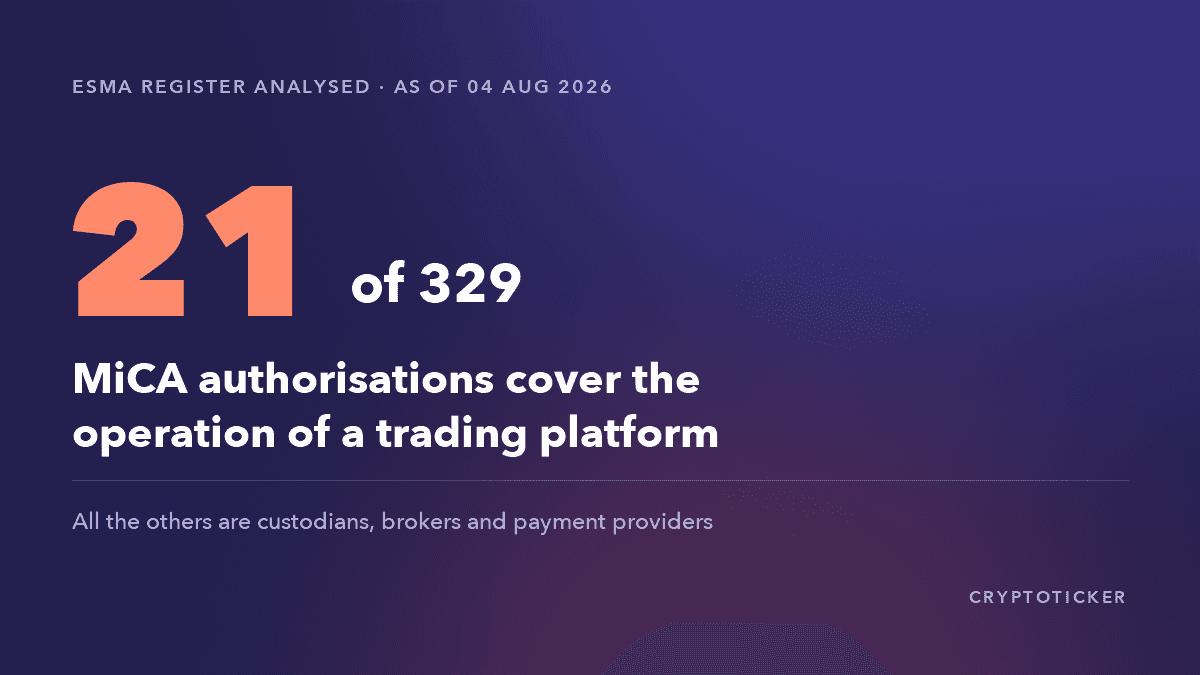
MiCA Register 2026: Only 21 of 329 Licences Are Real Exchanges
ESMA publishes the register of MiCA-authorised providers as an open file. We worked through all of it — and the result is not what the phrase “licensed crypto exchange” suggests.
August 11, 2026 9:18 AM

Your Crypto Exchange Is Telling You to Withdraw: How to Spot Phishing After the MiCA Deadline
Unauthorised crypto providers now have to tell their EU customers to withdraw, which leaves fraudsters an easy run with faked requests. Here is how to check in two minutes whether the message is genuine.
September 29, 2026 7:12 PM
MEXC Refunds $340,000: The Attacker's API Key Survived the Account Freeze
During an account takeover at MEXC, an attacker created an API key with withdrawal rights that the exchange did not revoke when it restored the account. Twenty-seven minutes after the withdrawal freeze expired, roughly $340,000 was gone.

June 30, 2026 11:20 PM

How to Switch from Binance to a MiCA Regulated Crypto Exchange
Binance is winding down EU services after missing the MiCA deadline. Here's why it's happening and how to move your funds to a regulated platform safely.
September 10, 2026 1:21 AM

Crypto Exchanges Head to Head: Which Pairing Is Cheaper Where
Before opening an account, the question is rarely which exchange is best overall, but whether it should be this one or that one. This article sorts through the most searched head-to-heads, puts the cost per 1,000 euros side by side and explains the most expensive mix-up: one provider with two interfaces and a factor of seventeen between them.
October 3, 2026 10:24 AM

WhiteBIT Coin (WBT): 32,426 Tokens Burned on 1 October, Price 4 Percent Below the Record
WhiteBIT destroyed its own tokens again on 1 October 2026: 32,426 WBT worth 2,716,488 USDT. The price stands at $84.22, which is 4.2 percent below the all-time high of 21 September.
September 29, 2026 10:33 AM
ESMA puts reverse solicitation on its 2027 watch list: what investors need to know about exchanges without an EU licence
ESMA presented its work programme for 2027 on September 28, 2026 and made reverse solicitation a supervisory priority. What that means if your coins sit with a provider without EU authorisation, and which three steps make sense now.
September 29, 2026 10:14 AM
387.5 million dollars at Bitget: the attack ran through a bought-in security product, what to watch now
Bitget has disclosed how the attackers reached its withdrawal systems on September 24: through a previously unknown flaw in a security product it had bought in. The second stage of the withdrawal schedule opens today at 08:00 UTC, and for the balance you keep on any exchange the case changes the arithmetic.
August 28, 2026 1:33 AM
Sending Crypto: Why the Wrong Network Costs You the Balance on 51 of the 100 Largest Crypto Assets
When you withdraw from a crypto exchange, the network you pick decides whether your balance arrives or is lost for good. Our own analysis of August 26, 2026 shows that 51 of the 100 largest crypto assets exist on several chains at once.

June 26, 2026 5:35 PM
Binance Is Leaving the EU on July 1 — What It Means for Your Funds
Binance will stop serving EU customers from July 1 after failing to secure a MiCA licence. Here's what it means for your funds and your next move.
September 16, 2026 1:28 PM
Crypto Withdrawal to Your Own Wallet: Ten Providers Checked, Three Will Not Let Your Coins Out
Seven of ten providers available in Germany offer a payout to a wallet address you control yourself; three do not. Our survey of September 16, 2026, shows how to spot the difference before you buy, and why the question matters right now.

September 26, 2026 7:40 AM

The RAIN Token After the Enlivex Termination: What to Check on Access, Forced Sale and Holding Period
Enlivex terminated a share placement of 66,666,667 shares payable in RAIN tokens on September 22, 2026. The token sits 46.4 percent below its all-time high, and at Kraken the withdrawal deadline expired long ago.
September 26, 2026 4:21 AM
Operation Herakles disconnects 13,888 phone numbers: what to check on crypto investment calls
Six authorities have disconnected 13,888 phone numbers used by investment fraudsters to call their victims in Operation Herakles, 9,304 of them in the past three months alone. What the Federal Network Agency now requires of telecoms providers and which three checks protect you from the scheme.
August 15, 2026 9:31 PM

Crypto Exchange Shutting Down: What to Do Before the Deadline Passes
Binance, BitMart, Luno and Revolut have ended or cut back their European business within seven weeks. This guide shows which deadline expires first, how a forced sale is treated for tax, and what to secure before the account closes.
October 8, 2024 10:46 AM

This Memecoin Made 100% in 1 Month...Meet MOG Token
MOG crypto has seen a significant price increase over the past month, attracting attention from traders and investors.
July 21, 2024 6:37 PM

MAJOR Ripple News: How Will These Developments Impact XRP Price?
New developments involving Ripple could have a huge impact on XRP price. What are they and how will XRP price react to this?
October 5, 2026 1:29 AM

Chainalysis attributes $387 million from the Bitget hack to North Korea: what matters now for investors in Germany
The analytics firm Chainalysis attributes the theft of around $387 million at Bitget to actors with ties to the DPRK and puts the annual total above one billion dollars. What that means for custody, choice of exchange and record-keeping in Germany.
October 4, 2026 7:13 AM

DTCC Tokenization Goes Live on Canton in October: 50 Institutions and an SEC Letter With an Expiry Date
The US depository DTCC moves its tokenization service into commercial operation in October, and one of the two launch chains is Canton. What the rebuild of securities settlement is worth, and why Canton Coin still remains a security with a tiny euro market.
September 30, 2026 10:24 PM

$766 Million Lost to Crypto Hacks in One Month: What It Means for Your Custody
CertiK counts around $766.4 million in damage for September 2026, the highest monthly figure of the year. Two incidents carry more than 92 percent of it, and both hit a place where your balance could be sitting too.
September 27, 2026 4:11 PM

Ripple Cannot Freeze 83 Million Dollars in Stolen XRP: What to Check in Custody and Deposits
The attacker from the Bitget incident has moved around 83 million dollars in XRP, and Ripple has no technical means to stop it. What can be frozen, what cannot, and why an account freeze also hits investors with no connection to the case.
August 30, 2026 10:38 PM

Crypto Cards: Where Your Card Balance Really Sits and What the August 28 Solana Exploit Reveals About It
An attack on a card balance contract on Solana took the loaded balance from 1,685 users while their wallets stayed untouched. The case shows why it matters whether your crypto card holds funds as e-money at a licensed institution or in a smart contract.
August 20, 2026 4:20 AM

Crypto Exchange Delisting: What Happens to Your Tokens When Trading and Withdrawals Close
A delisting runs in four stages, and only one of them is genuinely dangerous: the end of the withdrawal deadline. Using two live OKX dates as the example, we show what happens at each stage and how to tell whether it affects you.
July 12, 2024 7:00 AM

Animoca Token Is LIVE: How To Buy MOCA On Bitget?
Here is how the new MOCA token, launched by Animoca Brands and Moca Network is set to revolutionize the Web3 landscape with its unique utilities.
October 12, 2026 4:16 AM

Binance fees: 0.1 percent to trade, and one drawback compared with MiCA-licensed exchanges
Binance charges 0.1 percent in spot trading and 0.02 and 0.05 percent in derivatives. Since July 1, 2026 the exchange has lacked the MiCA authorisation for the EU, which leaves the fee table answering only half the question German investors are asking.
September 27, 2026 4:32 AM

Hester Peirce Leaves the SEC: What Now Applies to Your Custody in Germany
The most crypto-friendly voice at the US securities regulator goes on October 2, 2026, and the commission shrinks to two members. For investors in Germany it is still the European rulebook that decides, and there a deadline falls in July 2027.
September 20, 2026 10:11 PM
Kraken Review: Fees, MiCA Licence and Withdrawals in Euro
A purchase through Kraken's standard interface costs 1 percent plus spread; on Kraken Pro it is 0.40 to 0.80 percent. What deposits, trading, withdrawals and tax records really cost at the crypto exchange, with the numbers from the official fee schedule.
September 4, 2026 10:26 PM

Pocket Bitcoin Data Breach: When Name, Home Address and Bitcoin Address Circulate Together
The Swiss Bitcoin service Pocket Bitcoin closed its investigation on September 3, 2026: 5,411 people affected, and for 291 of them the Bitcoin addresses they used along with copies of identity documents. Why this one data pairing has lasting effect, and what you should check with your own provider.
More from CryptoTicker