
Revolut wins a crypto licence in Gibraltar, but your German account stays with Cyprus
The Gibraltar Financial Services Commission has authorised Revolut Global Digital Assets Limited for order execution, custody and staking. For customers in Germany the Cypriot EU entity remains the counterparty, and that is what decides which regulator and which MiCA rights apply to your balance.


Which topics should we dive deeper into?
Select what genuinely interests you. Your picks feed directly into our editorial planning.
Crypto news that's actually worth your time.
Weekly. 60 seconds. Carefully curated by our editors: no hype, no promo flood, no spam.
Revolut has a new crypto licence, and it does not cover your account. The Gibraltar Financial Services Commission has authorised the subsidiary Revolut Global Digital Assets Limited as a distributed ledger technology provider, and Revolut announced the approval on October 19, 2026. If you buy Bitcoin or Ether through Revolut in Germany, you will notice nothing at first: your counterparty remains the EU entity licensed in Cyprus. That split is the real substance of the announcement, because it decides which regulator is responsible for your balance and whom you turn to in a dispute.
For investors in Germany this is no formality. Any authorisation says two things: what a provider may do, and where it may do it. The second half tends to drop out of the coverage, and that is where the mistaken belief comes from that a group licence applies everywhere the logo appears.
What the Gibraltar Financial Services Commission has actually authorised
The permission is called a DLT provider licence. DLT stands for distributed ledger technology, the technology of distributed registers on which a blockchain runs. Gibraltar operates its own regime for such providers, and that regime works independently of EU law.
According to a report by TokenPost, the licence covers three activities: the reception and execution of orders in crypto assets, custody, and staking. The company itself was incorporated in Gibraltar back on June 27, 2024. This is no vehicle set up last week but a building block prepared long in advance.
DLT provider: the licence type behind the headline
A DLT provider licence is neither a banking licence nor an investment firm authorisation. It permits crypto asset business under the supervision of the Gibraltar regulator, with that regulator's rulebook and complaints procedure. What it does not permit is offering the same services in the European Union automatically.
What is missing from the announcement is just as telling. TokenPost records that the licence names no launch markets, no supported crypto assets and no design for the staking product, and that there is no start date, no fee schedule and no information on customer eligibility. In its words, the licence sets out which services the Gibraltar entity may provide but says nothing about when or where customers can use them. The rights attach expressly to this one company and amount to no group-wide approval.
So if you are waiting for a staking product in the German app, this licence has not won you a date. The paperwork describes a possibility, not a timetable.
Why a Gibraltar licence carries no MiCA passport into the EU
Since the United Kingdom left, Gibraltar has been outside the European Union, and it is not part of the European Economic Area either. That removes the basis for the mechanism which holds the EU single market for financial services together: the passport.
The passport works like this. A firm authorised in one member state notifies the regulators of the other states and may do business there without applying for a second licence. Under the EU regulation on markets in crypto assets, MiCA for short, that applies to crypto service providers as well. We have gathered the obligations that come with it in our overview of the MiCA requirements for crypto companies.
A Gibraltar authorisation takes no part in that procedure. It is neither worse nor better; it sits outside. The practical consequence is simple: as long as your account sits with the EU entity, the MiCA rules apply. Were your account moved to the Gibraltar entity one day, they would no longer apply, and you would have to be told of such a change in advance.

Your German crypto account runs through Revolut Digital Assets Europe Ltd
Revolut has moved the crypto business for customers in the European Economic Area into a separate company based in Cyprus: Revolut Digital Assets Europe Ltd. According to a report by Decrypt, it holds a MiCA licence from the Cypriot securities regulator CySEC. Costas Michael, chief executive of Revolut Digital Assets Europe, commented there on the authorisation.
Decrypt also describes the reach: the licence could allow Revolut to offer and market crypto services in all 30 markets of the European Economic Area, through the procedure known there as passporting. The report notes at the same time that individual EU states can require additional checks. Germany is one of those 30 markets.
In practice that means a supervisory chain with two links. Primary responsibility sits with the home state regulator, CySEC in Nicosia. BaFin is the host state supervisor and watches distribution in Germany. To compare the authorisations other providers work with in the German market, see our review of regulated crypto exchanges.
 Find an exchange with MiCA approval for your coins
The rights MiCA gives you as a German customer, and the ones it does not
MiCA is no investor protection in the sense of a guarantee. The regulation works on the provider's obligations, not on market risk. Four points count for you day to day.
First, segregation of holdings: an authorised crypto service provider must keep clients' crypto assets and money separate from its own. Second, liability in custody: if custodied client holdings are lost, the custodian answers for them. Third, an orderly complaints procedure, which the provider must set up and disclose. Fourth, the disclosure duties: marketing must be fair and clear and must not mislead.
What MiCA expressly does not deliver is deposit insurance. The 100,000 euros you know from your current account cover bank deposits, not crypto assets. If a custodian fails, segregation of holdings helps you, and no compensation fund does. No new licence changes that gap, in Gibraltar as little as in Cyprus.
Your statement and app settings name your counterparty
You do not have to rely on press releases to know who holds your balance. Three places give the answer.
The legal notices in the app set out which company provides which service; Revolut lists that allocation in its help centre under the question of who provides the crypto services. The provider blocks automated requests to those help pages, which read normally in a browser. Second, the terms of service for crypto assets name the counterparty with its registered office and company number. Third, the company name appears on the statements and tax reports you export.
If you find Revolut Digital Assets Europe Ltd there, your account hangs on the Cypriot authorisation. If you find another company, look closely: for legal recourse what counts is the legal person in the contract, not the brand.
Custody at the exchange or in your own hands: two different risks
The licence question disappears the moment you hold your coins yourself. If they sit in a wallet whose keys only you know, no group company is your custodian, and no regulator stands between you and your balance. That takes one risk out and puts another in: a lost key is final, and there is no complaints desk.
In between lies the trade-off every investor makes alone. If you trade often, you need the balance on the trading platform. If you hold for the long term, you do not. We have set the devices and their differences side by side in our hardware wallet review.
One practical note on moving funds: if you transfer holdings from a platform into your own wallet, record the date, the amount and the address. You will need those records later for the tax office, and they are hard to reconstruct after the fact.

The holding period and the 1,000 euro threshold survive a change of entity
For tax purposes in Germany nothing turns on where the platform is based; what counts is your own tax liability. Crypto assets rank among other assets, and gains on a sale are private disposals under the Income Tax Act.
Two figures follow from that, and you should know them. If more than twelve months pass between purchase and sale, the gain stays tax free. Below that, the 1,000 euro threshold for the calendar year applies: if the total of all private disposal gains stays under it, no tax is due; once it is exceeded, the whole amount is taxable. A threshold is no allowance, and that difference costs people money regularly.
Staking rewards fall outside that rule. They count as other income and are assessed in the year they are received. That is also why the new Gibraltar permission, with its explicit staking item, would be interesting for tax purposes if it ever applied to EU customers.
Complete records therefore matter. When a provider changes the entity, the history in the export often breaks off. Back up your data as you go and you need not ask support in a dispute; our comparison of crypto tax tools and portfolio trackers shows which tools handle it.
Find the right exchange for your tokensThe licence says nothing about fees, spread or withdrawal routes
An authorisation tests a provider's fitness and organisation, not its prices. Yet that is exactly where the cost of your purchase is decided. Three items are worth a look before you pick a platform.
The first is the spread, the gap between the buy and the sell price. It rarely appears in the fee schedule and still bites on every purchase. The second is the order fee, which at many providers depends on the account tier. The third is the way out: not every platform lets you send crypto assets to an address of your own. Where that is missing, selling is the only option, and a technical question turns into a tax question.
Revolut keeps building out its crypto offering for Europe, as its own euro stablecoin showed most recently; we set out separately what that launch in three markets means for customers.
The next dates in Revolut's crypto business
One question above all stays open after this licence: which countries the Gibraltar entity will serve. As long as Revolut names no launch markets, any allocation is speculation, and we make none here.
Concrete things can be watched instead. First, the legal notices in the app: a change of counterparty becomes visible there before it reaches a press release. Second, the notifications Revolut has to send when its terms of service change. Third, the registers of the supervisory authorities, which list authorisations and the services they cover.
Until then the sober reading holds: a subsidiary in Gibraltar may now execute orders, provide custody and offer staking. Whether and when anyone can use that offering is undecided.
Revolut's Gibraltar licence: Cyprus still governs your portfolio
The announcement leaves your balance unchanged. It is a good occasion to look up three things that are due anyway.
- Identify your counterparty. Open the legal notices in the app and the terms of service for crypto assets, and note the company and its registered office. What the authorisations of other providers in the German market look like is set out in our comparison of regulated crypto exchanges.
- Decide on custody. Set out which part of your holdings stays on the platform and which moves into your own custody; the hardware wallet comparison names the differences between the devices.
- Secure your records. Export transactions and statements for the current year before anything changes at the entity level; the right tax tools and portfolio trackers handle that continuously.
(As of October 21, 2026. This article is not investment advice. Prices and fee structures change; check the terms with the provider before you buy.)
Frequently asked questions about Revolut and the Gibraltar licence
Transparency note: This article was produced with the assistance of artificial intelligence and reviewed by our editorial team before publication. All figures and claims were checked against the primary sources linked in the text. The feature image was generated with AI.
Related articles
- Bybit Card: 0.9 percent on crypto payments and 2 percent at cash machines above €100
- Bitstamp exchange review: a 0.40 percent taker fee and a MiCA licence from Luxembourg
- Cold storage: why exchanges keep up to 99 percent of customer coins offline
- Crypto exchanges without KYC: under MiCA, every licensed exchange asks for your ID
- Crypto futures in the EU: six licensed exchanges compared, all capped at 10x
Which topics should we dive deeper into?
Select what genuinely interests you. Your picks feed directly into our editorial planning.
Crypto news that's actually worth your time.
Weekly. 60 seconds. Carefully curated by our editors: no hype, no promo flood, no spam.

November 3, 2026 1:30 PM

Raiffeisenbank crypto trading: four coins, no securities account, no deposit protection
Raiffeisenbank Schwaben Mitte has switched on crypto trading in the VR Banking app and, according to the Augsburger Allgemeine, is the seventh Bavarian cooperative bank with BaFin approval. Four crypto assets, a settlement account instead of a securities account, an external custodian and no statutory deposit protection: that is what applies at your bank once it switches on.
October 31, 2026 12:37 PM

Floin Cyberattack: MiCA Crypto Platform From Liechtenstein Goes Offline
Liechtenstein-based crypto platform Floin reports a cyberattack, remains offline and has now confirmed a data breach. What is known about the MiCA-licensed company, which customer data may be affected and what investors should do now.
October 22, 2026 7:41 AM

CLARITY Act: what the US crypto law would do and where it stands in the Senate
In context: what the CLARITY Act would do, how the House and the Senate voted, and what the SEC and CFTC are pushing ahead without a law. With a timeline, the vote arithmetic and a comparison with the EU regulation MiCA.
October 22, 2026 7:15 AM

MiCA revision: France wants exchanges to be liable for clients' DeFi losses
In context: four French authorities want licensed crypto platforms to answer for certain client losses arising from DeFi access. What is documented so far is the submission to the MiCA revision, not a law.
October 16, 2026 1:35 PM

Kraken parent Payward buys Saldo Bank: the first crypto firm with a bank of its own in the EU
Payward, the parent of Kraken, agreed on October 14 to buy the Lithuanian Saldo Bank and would be the first crypto firm with a bank of its own in the EU. What is established, what stays open until the planned completion in 2027 and what may change for the protection of your euros.
October 13, 2026 10:37 PM

ESMA will supervise only 10 to 15 of 360 crypto firms: your exchange stays with its home regulator
On October 9, 2026 EU finance ministers agreed to place only the largest crypto service providers under direct ESMA supervision. For the vast majority of the roughly 360 authorised firms, the national authority stays in charge, in Germany BaFin.
October 13, 2026 7:19 AM

Financial Stability Board on 300 billion dollars in stablecoins: “untested in severe stress and insolvency”
The Financial Stability Board handed the G20 a status report on stablecoins on 12 October: a market worth 300 billion dollars, 99 percent of it pegged to the US dollar, and a supervisory structure that remains untested in severe stress and insolvency. Here is what the gaps it describes mean for holders in Europe, where MiCA already closes them and which ones stay open.

October 12, 2026 7:43 PM

Canton Coin Arrives in Ripple Custody: What Investors Need to Know
Ripple Custody has held Canton Coin and CIP-56 tokens since version 1.43. What the institutional custody solution means for you as a retail investor, and where you can trade CC in Europe at all.
October 6, 2026 10:32 AM

FinCEN drops the reporting duty for withdrawals to private wallets: what matters now for European investors
The US anti-money-laundering agency FinCEN withdrew two proposals on October 5, 2026 covering the reporting duty for self-custodied wallets and for mixers. In the EU the development runs in exactly the opposite direction: proof of ownership from 1,000 euros today, a ban on anonymous accounts from July 2027.
October 5, 2026 4:16 PM

World Liberty Financial US Trust Bank: What the Abu Dhabi Report Leaves Open
The reported Abu Dhabi stake in World Liberty Financial raises questions. Here is what OCC filings show about the trust company, USD1 reserves and the authorisation to open.
October 5, 2026 10:35 AM

"We deliberately invested in our expansion": Bitpanda reports a loss of around 14 million euros for 2025
Bitpanda GmbH reports a loss of around 14 million euros for 2025, after a profit of 61.7 million euros the year before, on adjusted revenue that rose to 371 million euros. What the numbers mean for your custody, your terms and the holding period.
October 5, 2026 1:15 AM

Five of nine BaFin warnings cite the Crypto Markets Supervision Act: "This is a case of identity misuse"
Within four days at the end of September, BaFin publicly named nine providers, five of them over unauthorised crypto-asset services. Behind the warnings stands the Crypto Markets Supervision Act, and since the transitional period ran out there is no grey area left for crypto providers in Germany.
October 2, 2026 7:30 AM

Revolut EURR Stablecoin: What the Launch in Three Markets Really Means
Revolut is testing the euro stablecoin EURR in Denmark, Poland and Portugal first. Whether it becomes usable in practice depends on access, liquidity, costs and acceptance.
October 1, 2026 2:16 PM

Open USD is live but absent from the EU register: what matters now for investors in Europe
The dollar stablecoin Open USD launched on September 30, 2026, backed by Coinbase, Mastercard, Shopify, Stripe and Visa. On October 1, 2026 the token was not notified in the MiCA register, and that decides what you can do with it in Europe.
September 30, 2026 10:40 PM

ESMA Calls for Advertising Rules on Crypto Influencers: Six Changes Now Sitting With the EU Commission
The EU securities watchdog filed its response to the MiCA review on the final day of the consultation. Among the demands are disclosure on staking, a licensable DeFi gateway and the power to freeze crypto assets.
September 29, 2026 10:33 AM

ESMA puts reverse solicitation on its 2027 watch list: what investors need to know about exchanges without an EU licence
ESMA presented its work programme for 2027 on September 28, 2026 and made reverse solicitation a supervisory priority. What that means if your coins sit with a provider without EU authorisation, and which three steps make sense now.
September 27, 2026 4:32 AM

Hester Peirce Leaves the SEC: What Now Applies to Your Custody in Germany
The most crypto-friendly voice at the US securities regulator goes on October 2, 2026, and the commission shrinks to two members. For investors in Germany it is still the European rulebook that decides, and there a deadline falls in July 2027.
September 26, 2026 4:14 PM

Bitget Withdrawals Resume on September 28: What to Check on a Residual Balance Now
Bitget is releasing the withdrawals frozen after the September 24 incident in four stages from September 28. For a residual balance held from Germany that is a deadline, not a reason to wait.
September 26, 2026 10:23 AM

Trive: Client Funds Frozen - What Holders of Crypto CFDs Can Check Now
The Maltese supervisor MFSA has instructed Trive Financial Services Europe to freeze client funds; BaFin speaks of numerous affected clients in Germany. Why a crypto CFD is treated differently from a coin in your own wallet, and which steps are possible now.
September 19, 2026 4:11 PM

MiCA Consultation Closes September 30: What to Check and Submit Before Then
The European Commission is reviewing the MiCA crypto regulation and will accept submissions until September 30, 2026 at 23:59 CEST. Staking, DeFi, lending, stablecoins and custody are all under examination, and you can take part without a lawyer.
September 19, 2026 7:17 AM

Chainlink Jumps Above $12: What LINK Holders Should Check Now
Chainlink trades at $12.34, 7.4 percent higher than yesterday. What part of the move is the broad market rally, what Chainlink itself contributes, and the three things you should check as a LINK holder.
September 16, 2026 7:39 PM

Deutsche Bank to Custody Bitcoin and Ether: Why Retail Clients Are Missing and What to Check in Your Own Custody
Deutsche Bank will custody Bitcoin, Ether and three stablecoins, but addresses corporates and institutions only. What the launch under supervisory reservation means, and the four questions you should put to any custody arrangement.
August 20, 2026 10:24 PM

MiCA Review: What the European Commission Could Change About the EU Crypto Rules
The European Commission has reopened MiCA for review after barely two years and is asking 86 questions covering the stablecoin interest ban, staking, lending and DeFi. Brussels is taking responses until September 30, 2026.
August 6, 2026 3:05 PM
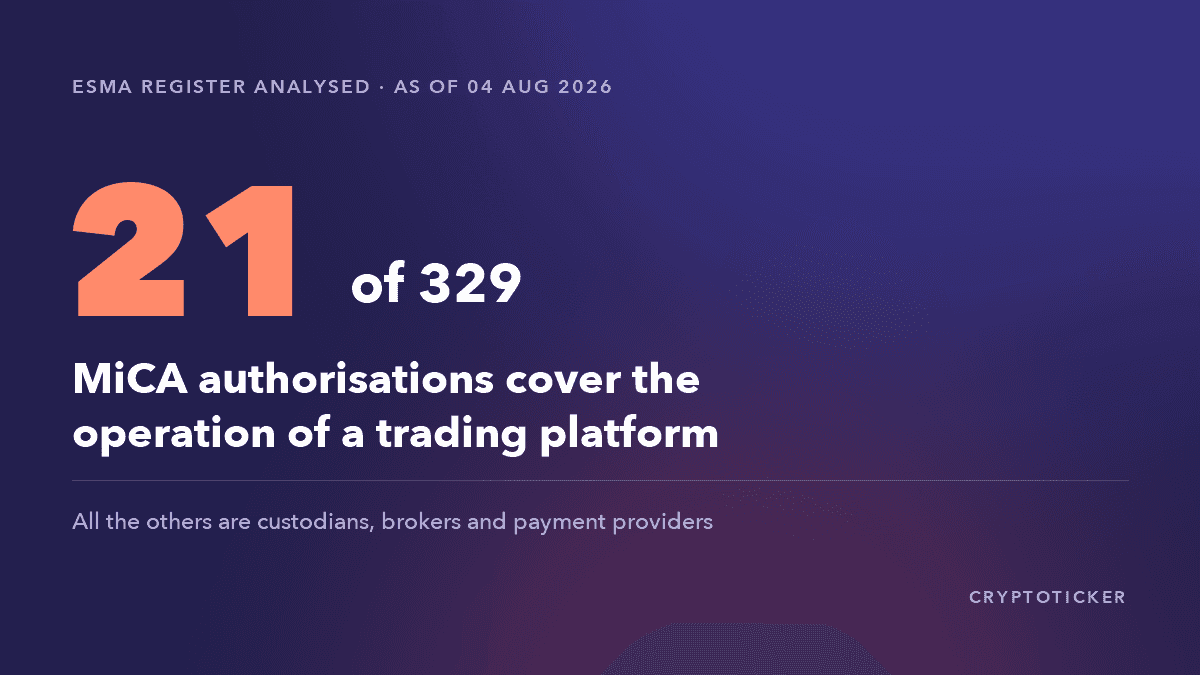
MiCA Register 2026: Only 21 of 329 Licences Are Real Exchanges
ESMA publishes the register of MiCA-authorised providers as an open file. We worked through all of it — and the result is not what the phrase “licensed crypto exchange” suggests.

June 30, 2026 11:20 PM

How to Switch from Binance to a MiCA Regulated Crypto Exchange
Binance is winding down EU services after missing the MiCA deadline. Here's why it's happening and how to move your funds to a regulated platform safely.

More from CryptoTicker