Latest · October 24, 2026The fourth quarter runs out in a good nine weeks, and the vote is still pending: TIP-899 continues to list post-quantum signatures as a draft. The path there is clearly described and has not been walked: the proposal requires an external audit with a published summary plus a bug bounty before any vote; none of that is reported as complete, and activation needs an on-chain vote of the 27 Super Representatives for each scheme. On the Nile testnet the schemes have run since July, with Falcon-512 as the default and ML-DSA-44 alongside it; the throughputs measured there, roughly 400 and 173 transactions per second, stand against about 2,000 for ECDSA. That price is the real hurdle. Justin Sun says the network could switch at any time; nothing is decided by that.
Tron in October 2026: the quiet stablecoin giant
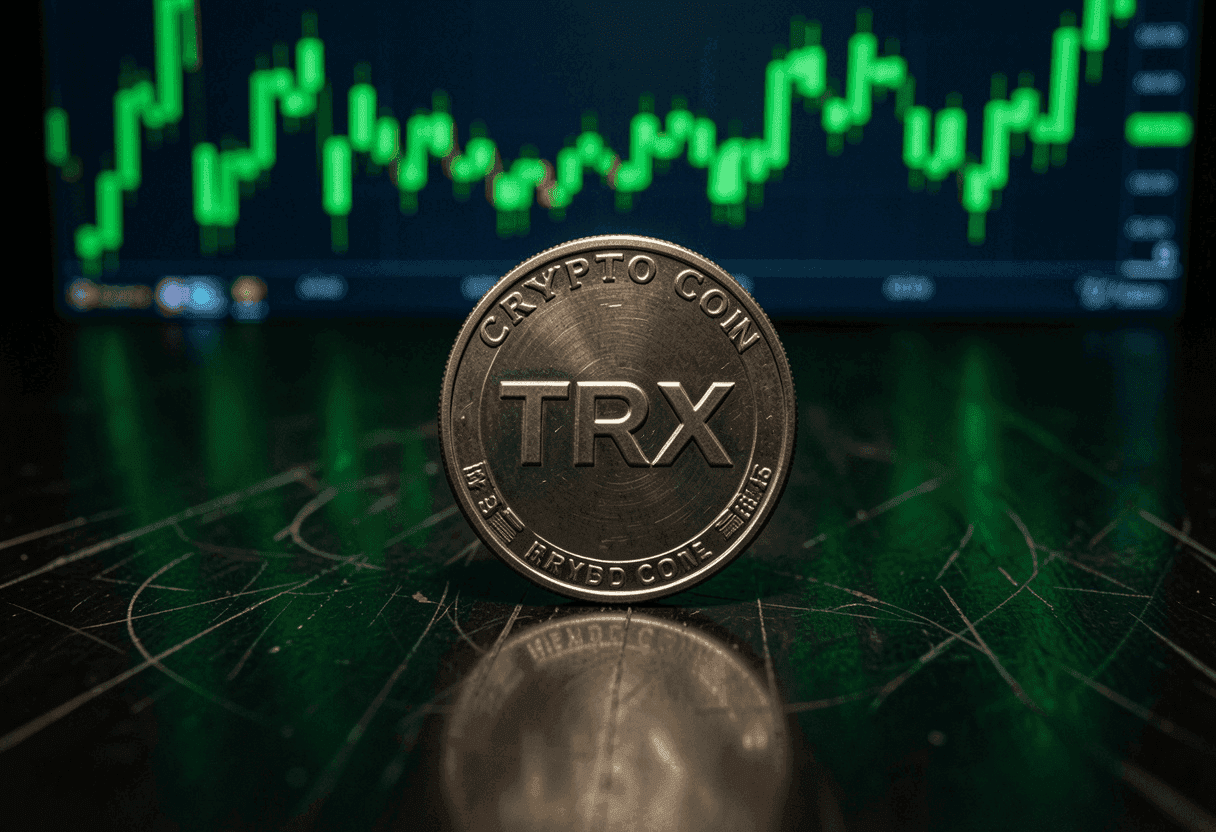
Tron is trading around $0.33 in October 2026, noticeably more stable than most altcoins. The reason is fundamental: a substantial share of global USDT payment volume runs over Tron; cheap, fast stablecoin transfers are the chain's core business and deliver real, cycle-independent usage.
TRX's distinguishing feature: low volatility, a clear niche
Unlike meme or tech coins, Tron depends less on waves of speculation. In exchange, its upside is more limited, and dependence on the stablecoin business (Tether above all) and on founder Justin Sun remains the structural risk.
What actually moves the TRON price
TRON has established itself as a settlement rail for stablecoin transfers. A substantial share of global USDT volume runs over the network, not because of technical superiority, but because of low fees and wide adoption in emerging markets. That usage is cycle-independent: people keep sending dollar stablecoins even when the crypto market is trading sideways.
In June 2026, TRON hit record levels for active accounts and transactions. July then brought inclusion in the S&P Pantera Index and the Democritus upgrade, which aligns its smart contracts more closely with Ethereum's behaviour.
The metrics we watch on TRON
- Stablecoin balances held on TRON: the most reliable usage measure, and the reason the network stays busy even in bear markets.
- Active addresses: shows whether usage is broadly distributed or carried by a handful of large addresses.
- Fees burned: TRON removes part of its transaction fees from circulation; between July 1 and October 16, 2026, however, burns covered only just under two thirds of new issuance, and supply grew on each of those 108 days.
- The regulatory environment around leadership: proceedings involving the founder's circle have directly moved the price in the past.
TRON's structural puzzle
Record network usage has so far translated into only limited price gains. The reason: anyone sending stablecoins needs TRX only for fees worth a few cents, not as a store of value. Value creation therefore doesn't automatically land with the token. Our forecast accounts for that with deliberately restrained targets despite strong fundamentals.
How this forecast could fail
If stablecoin volume shifts to cheaper or more favourably regulated chains, TRON loses its only real competitive advantage. Public perception is also heavily concentrated around a single person, a governance risk that cannot be diversified away.
Tron price prediction for October 2026: what the month can deliver
Tron enters October around $0.338, after a September that carried the price from $0.333 to $0.337, a gain of roughly 1.5 percent. The range the month is most likely to play out in sits between the monthly low of $0.322 and the September high at $0.349.
What opens the month to the upside: a sustained close above the September high of $0.349, set on September 22. Above that, our own 2026 range extends to $0.489.
What tips it over: a break of the September low of $0.322, set on September 2. Below it there would be room down to the lower end of our 2026 range at $0.228.
The dates that decide it: the US jobs report on October 2, consumer prices on October 14 and the Fed’s rate decision on October 28, this time without updated projections. The PCE deflator and the ECB’s rate decision follow on October 29.
Tron price prediction 2026 to 2033: the scenarios
Short term (2026): stability as a strength
As long as stablecoin volume keeps growing, the zone around $0.30 is well supported. The base case sees TRX moving sideways to moderately higher; a market turn would more likely drive the large beta coins than TRX.
Medium term (2027–2028): payments adoption versus competition
If the stablecoin market keeps growing (regulation, emerging markets), Tron benefits directly. Competition from cheaper alternatives (Solana, L2s, dedicated stablecoin chains) limits the upside, however; our ranges are deliberately narrower than for high-beta coins.
Long term (through 2033): a cash-flow chain
Tron generates real fee revenue and burns TRX, a rare fundamental anchor in the crypto market. The long-term scenario depends on whether this niche is defended.
Risks to the Tron forecast
Dependence on Tether, regulatory pressure on stablecoin transfers, key-person risk (Justin Sun), and the looming risk of losing top-10 status to faster-growing projects.
Disclaimer:
The forecasts above are based on current market trends and analyst opinions, and actual prices may vary due to unforeseeable factors. Investing in cryptocurrencies carries risk, and it is essential to conduct thorough research and seek professional advice before making financial decisions. We give no guarantee as to the accuracy or reliability of these forecasts, and users are encouraged to verify the information independently.