
Leverage trading in crypto: how margin and the liquidation price work
With leverage you move a larger crypto position than your stake would allow. We work through margin and liquidation price, show the leverage limits in the EU and which licensed providers offer leverage trading.





Which topics should we dive deeper into?
Select what genuinely interests you. Your picks feed directly into our editorial planning.
Crypto news that's actually worth your time.
Weekly. 60 seconds. Carefully curated by our editors: no hype, no promo flood, no spam.
Leverage trading means trading a larger position than your own capital would allow. With a $1,000 stake and ten times leverage, you move bitcoin worth $10,000: if the price rises 5 percent, you make $500 instead of $50. If it falls 9.5 percent, the exchange closes your position and the stake is gone. In Germany, leverage trading with cryptocurrencies is allowed but capped for retail clients: crypto CFDs may carry at most 2:1 leverage, while the perpetual futures of exchanges with EU authorization go up to ten times. This guide shows how to calculate margin, profit and liquidation price, and where you can trade with a licensed provider.
Leverage trading at a glance: the key numbers
- Leverage of 10 means $1,000 of collateral moves a $10,000 position.
- At ten times leverage, a counter-move of about 9.5 percent is enough for liquidation; at one hundred times, 0.5 percent.
- Since August 1, 2018, crypto CFDs in the EU have been capped at 2:1 leverage for retail clients.
- Since August 2017, retail clients in Germany can never lose more than their account balance on CFDs.
- A long position in the bitcoin perpetual on OKX paid about 1.5 percent of its value in funding from August 5 to November 2, 2026.
- Gains from futures, perpetuals and CFDs are taxed in Germany at the 25 percent flat withholding tax, with no holding period.
What is leverage trading? Leverage explained simply
Leverage is the ratio between the size of your position and the money you post as collateral for it. That collateral is called margin. The exchange or broker provides the rest of the position as long as your margin covers the losses. Leverage of 10, also written 10:1 or 10x, therefore means every dollar of margin stands for ten dollars of position.
With cryptocurrencies, leverage trading almost always runs through derivatives. You do not buy bitcoin but a contract whose value tracks the bitcoin price: a perpetual future, a future with an expiry date, or a CFD. Less common is margin trading on the spot market, where you actually borrow money or coins. All of these let you bet on rising prices, going long, or on falling prices, going short. How a short works in detail is covered in our guide to shorting crypto.
Leverage works equally hard in both directions. It turns a 1 percent price move into a 10 percent move in your stake, up or down. It does not improve your hit rate; it enlarges the size of every win and every mistake. Anyone trading with leverage therefore needs one thing above all: a clear idea of how much they lose when they are wrong.
How to calculate leverage: margin, position size and profit
Three formulas cover the maths. Position size is margin times leverage. Profit or loss is position size times the price change. And the return on your margin is leverage times the price change. The table runs this with $1,000 of margin and a bitcoin price of $77,358, the CoinGecko price at 6:12 p.m. on November 2, 2026. Fees and funding are not included.
| Leverage | Position | In bitcoin | Price +5% | Price −5% |
|---|---|---|---|---|
| 2x | $2,000 | 0.026 BTC | +$100 | −$100 |
| 3x | $3,000 | 0.039 BTC | +$150 | −$150 |
| 5x | $5,000 | 0.065 BTC | +$250 | −$250 |
| 10x | $10,000 | 0.129 BTC | +$500 | −$500 |
| 20x | $20,000 | 0.259 BTC | +$1,000 | liquidated, −$1,000 |
| 50x | $50,000 | 0.646 BTC | +$2,500 | liquidated, −$1,000 |
| 100x | $100,000 | 1.293 BTC | +$5,000 | liquidated, −$1,000 |
The table shows the core of the problem. From 20x upwards, you never experience a 5 percent move against you, because the position is closed before that. According to CoinGecko, bitcoin closed more than 5 percent above or below the previous day on 14 days in 2026 up to early November; on February 6 it was down 14.1 percent. Leverage that promises big gains on paper fails in practice against the normal swing of a single trading day.
A second point is often overlooked: leverage changes by itself. If your position goes into the red, the margin shrinks and the effective leverage rises, even though you have done nothing. A position therefore becomes riskier precisely when it is already losing.
How to calculate the liquidation price: what does 100x leverage mean?
The liquidation price is the price at which the exchange forcibly closes your position. It does so as soon as your margin only covers the maintenance margin, the minimum amount you must keep in place for an open position. For a long position with isolated margin, a close approximation is: liquidation price equals entry price times (1 minus 1 divided by leverage plus maintenance margin). For a short, the signs flip.
With a maintenance margin of 0.5 percent, that means for a long at $77,358: at ten times leverage, liquidation sits at about $70,009, or 9.5 percent below entry. At one hundred times leverage it is $76,971, only 0.5 percent below. 100x leverage therefore means that a move bitcoin often makes within minutes ends the position.
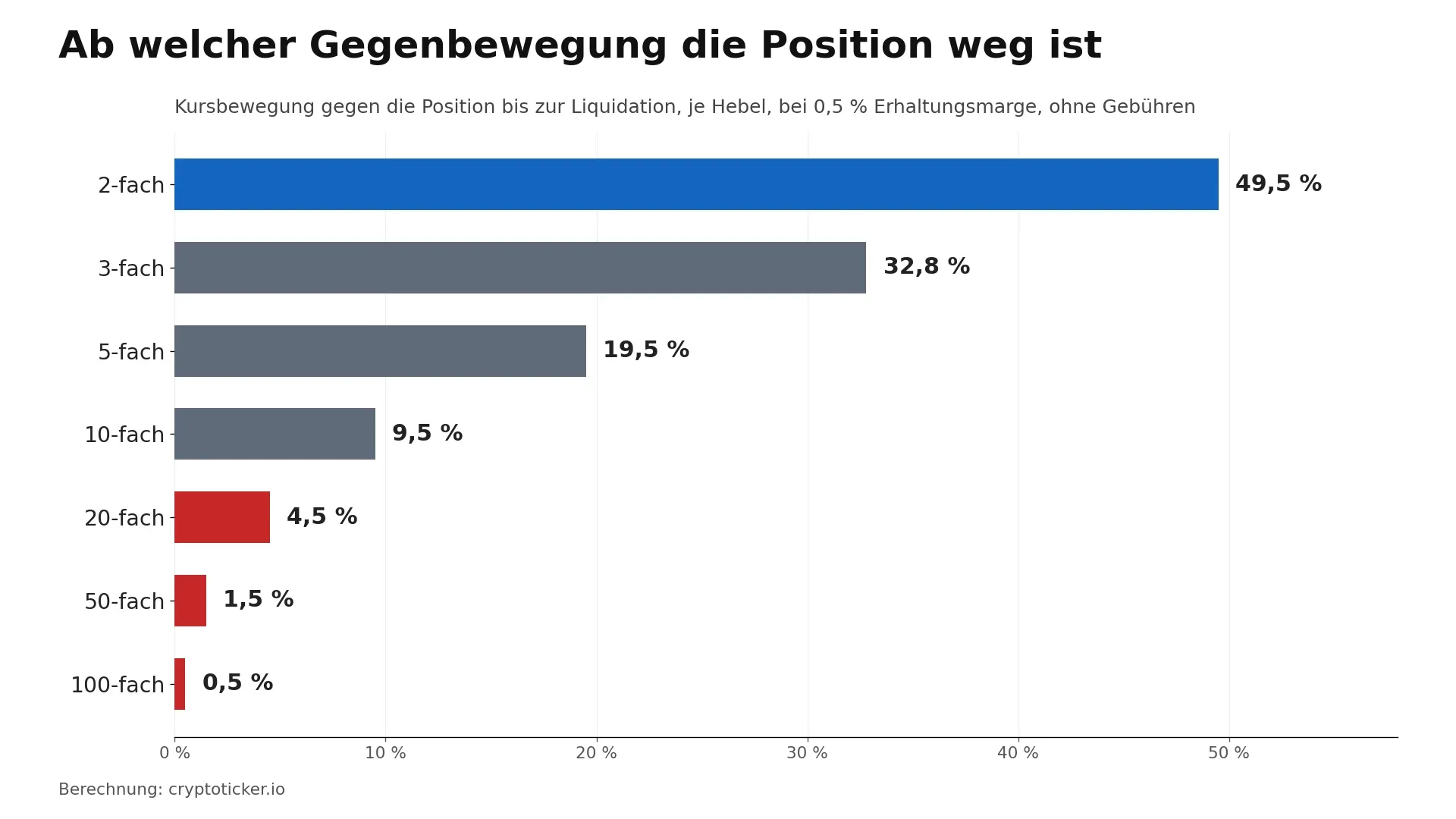
| Leverage | Long liquidation | Short liquidation | Distance from entry |
|---|---|---|---|
| 2x | $39,066 | $115,650 | 49.5% |
| 5x | $62,273 | $92,443 | 19.5% |
| 10x | $70,009 | $84,707 | 9.5% |
| 20x | $73,877 | $80,839 | 4.5% |
| 100x | $76,971 | $77,745 | 0.5% |
The actual figures at your exchange will differ slightly. The maintenance margin rises in tiers with position size, fees and funding eat into the margin, and what usually counts is not the last traded price but a mark price that the exchange derives from several venues. Every exchange shows you the liquidation price before you place the order. Read it before you confirm.
Isolated or cross margin: how far a loss can reach
With perpetual futures, you choose before each order how your margin is exposed. With isolated margin, only the amount you have allocated to that one position is at risk. If it is liquidated, the rest of your account is untouched. With cross margin, your entire balance serves as collateral for all open positions. That pushes liquidation further out because there is more buffer, but a sharp move can consume the whole account.
For individual trades, isolated margin is the safer choice because you know the maximum loss in advance. Cross margin makes sense when several positions hedge one another, for example a long in bitcoin and a short in ether. How a liquidation wave plays out in practice is described in our analysis of the October liquidations.

Six ways to trade crypto with leverage
Leverage is not a single product. For investors in Germany there are six routes, which differ markedly in maximum leverage, costs and protection.
| Route | Where, examples | Maximum leverage for retail clients | Running costs | Largest possible loss |
|---|---|---|---|---|
| Perpetual futures and five-year futures | Coinbase, Kraken, OKX, Gemini, Robinhood | 10x | Funding, hourly to every 8 hours depending on the exchange | Margin of the position with isolated margin |
| Dated futures on a futures exchange | CME and Eurex via a broker | Set by the exchange margin | Rolling into the next contract | Can exceed the stake, margin calls possible |
| Crypto CFD | CFD brokers | 2:1 | Overnight financing | Account balance, negative balance protection |
| Spot margin trading | Bybit EU, Bitpanda | 10x | Interest on the borrowed money | Margin, the exchange force-sells first |
| Knock-out certificates | Via your securities account, issuers such as Société Générale and Vontobel | Freely chosen via the knock-out barrier | Financing costs built into the price | Purchase price |
| Leveraged ETPs | SIX and other exchanges via a broker | 3x, reset daily | Management fee, around 2% a year | Purchase price |
Leveraged ETPs and knock-out products are bought like a share through your securities account. They have no margin, and you can never lose more than the purchase price. With leveraged ETPs, the daily rebalancing erodes value in sideways markets; our guide to the leveraged bitcoin ETF works through why. How a crypto CFD differs from buying coins directly is set out in our comparison crypto CFD vs buying coins. Regulated CFD providers and brokers are listed in our crypto broker comparison.
Is leverage trading legal in Germany? The limits for retail clients
Yes, leverage trading with cryptocurrencies is legal in Germany. Retail clients are, however, covered by protective rules that depend on the product. For contracts for difference, the European Securities and Markets Authority ESMA introduced tiered leverage limits effective August 1, 2018: 30:1 for major currency pairs, 20:1 for gold and major stock indices, 10:1 for other commodities, 5:1 for individual shares and 2:1 for cryptocurrencies. BaFin made these limits permanent with its general administrative act of July 23, 2019.
Three protective rules come on top of the leverage limits. The provider must close positions as soon as your balance falls below 50 percent of the required margin. Negative balance protection prevents you from losing more than your account balance; BaFin had already banned margin calls beyond the deposit for retail clients in 2017. And every advertisement must state the share of retail accounts that lose money with the provider.
The distinction from the crypto regulation MiCA matters. MiCA governs the buying, selling and custody of crypto assets, but not derivatives. Futures, perpetual futures and CFDs on crypto assets are financial instruments under the Markets in Financial Instruments Directive MiFID II. Anyone offering them needs authorization as an investment firm; a MiCA license alone is not enough. On February 24, 2026, ESMA also clarified that contracts marketed as perpetuals can also fall under the rules for contracts for difference. The background is covered in our explainer perpetual futures and the CFD rules.
Exchanges without EU authorization are not bound by these rules. Leverage of 50 or 100 is common there, and in a dispute there is no European supervisor you can turn to.
Where to trade crypto with leverage: providers with EU authorization
For perpetual futures with leverage, five crypto exchanges in Germany have their own EU entity and authorization as an investment firm: Coinbase and Kraken through entities in Cyprus, OKX and Gemini through entities in Malta, and Robinhood through an entity in Lithuania. All five allow up to ten times leverage on bitcoin. Coinbase and OKX structure their perpetuals as futures with a five-year term, to which the 2:1 cap does not apply because futures are exempt from the rules for contracts for difference. Entities, products and launch dates of all five are compared in our guide to crypto futures trading.
Without a derivative, you can get leverage through margin trading on the spot market. Bybit EU, licensed under MiCA by the Austrian Financial Market Authority, has offered it since August 2025 with up to ten times leverage; the group plans to add futures after obtaining investment firm authorization and filed the application in September 2025. At Bitpanda, margin trading lets you bet on rising prices with up to ten times leverage. In both cases you buy real coins with borrowed money.
To get started, we recommend the exchanges where you also buy and store coins: at OKX you trade the X-Perps alongside your spot account, and at Coinbase the futures sit in the same account as your spot holdings. Which exchanges hold MiCA authorization in the EU is shown in our comparison of regulated crypto exchanges.

Fees and funding: what leverage trading costs every day
The exchange charges fees on the value of the position, not on your margin. At ten times leverage, every 0.1 percent fee on the position therefore costs you 1 percent of your margin, on opening and again on closing. Frequent traders can quickly pay a double-digit share of their stake without the price having moved at all.
With perpetual futures there is also the funding rate, a payment between the long and short sides that keeps the contract price close to the spot price. We analyzed the 270 settlements of the bitcoin perpetual on OKX from August 5 to November 2, 2026: in 92 percent of cases, long positions paid. In total, a long position cost 1.51 percent of its value over those 90 days. With $1,000 of margin and ten times leverage, that is $151, or 15 percent of the stake, just for holding. How the funding rate is made up and how to calculate it for your position is explained in our guide to the funding rate; the full analysis is in our guide to crypto futures trading.
Risk management in leverage trading: five rules
Successful traders differ less in their hit rate than in how much they lose when they are wrong. Five rules have proved their worth.
- Risk a fixed small share per trade. A common rule of thumb is no more than 1 percent of the account per trade. With a €10,000 account and a stop-loss 5 percent below entry, the position may then be €2,000. Position size follows from the stop-loss, not from the leverage.
- Set the stop-loss before you enter. It belongs well ahead of the liquidation price. That way you decide on the exit, not the exchange.
- Stick to low leverage. Beginners are well advised to use 2x to 3x. The chart above shows why: at three times leverage, liquidation is about 33 percent away; at ten times, less than 10 percent.
- Use isolated margin for individual trades. That limits the loss on each position to its own margin instead of putting the whole account up as collateral.
- Expect outliers. In late October 2026, positions worth $1.54 billion were liquidated within 24 hours after a security incident at Binance became public (our analysis). Such days come without warning. Plan every trade so that it survives a 10 percent swing or ends at the stop-loss first.

Leverage trading and tax: how gains are taxed in Germany
Gains from perpetual futures, futures and CFDs count as income from forward transactions under Section 20(2) of the German Income Tax Act. They are subject to the 25 percent flat withholding tax, plus the solidarity surcharge and church tax where applicable. The one-year period after which gains on held coins become tax-free does not apply here: a four-minute trade and a four-month trade are treated the same. The saver's allowance of €1,000 applies to all capital income combined.
Losses from forward transactions can be offset against other capital income. The former cap of €20,000 a year was abolished by the Annual Tax Act 2024, for all cases still open. You cannot, however, offset them against gains from coins you have sold, because those belong to a different category of income. If you buy coins on the spot market with borrowed money, they remain purchased crypto assets to which the one-year period under Section 23 applies. Exchanges abroad do not withhold tax; you enter the results yourself in the capital income annex (Anlage KAP) of your return. The details are in our guide to tax on crypto futures, and our crypto tax calculator gives a first estimate. This section is not tax advice.
Our verdict: keep leverage trading in crypto deliberately small
Leverage is a tool, not a promise of returns. With 2x or 3x leverage at an exchange with EU authorization, you can make targeted use of price moves or hedge a holding against falling prices without every turbulent day knocking you out of the position. From 10x, trading becomes a race against liquidation, and from 50x a single swing decides the outcome.
Our recommendation: learn the maths with small amounts, use isolated margin and a fixed stop-loss, and trade only with providers supervised in the EU. There, leverage limits apply, your deposits are held separately, and in a dispute there is a supervisor you can turn to. If you want to hold bitcoin for the long term, you are better off without leverage: a purchase on a regulated exchange and storage in your own wallet carry no liquidation risk.
Leveraged products are complex and risky, and a total loss of the stake is possible. This guide is not investment advice. The links to OKX, Coinbase, Bitpanda and Bybit EU are partner links; they cost you nothing extra.
Frequently asked questions about leverage trading in crypto
Transparency note: This article was produced with the assistance of artificial intelligence and reviewed by our editorial team before publication. All figures and claims were checked against the primary sources linked in the text. The feature image was generated with AI.
Related articles
- How to Calculate Your Liquidation Price: When the Exchange Closes Your Leveraged Position
- $489 million in liquidations in one hour: where your leverage breaks first
- Bitcoin Price Prediction: What to Check on Levels, Holding Period and Leverage Before the October 28 Rate Decision
- Ethereum Price Analysis: Why is Ethereum Price Down?
- 17 of 20 top coins down, Ethereum at $2,380: where the sell-off is measured
Which topics should we dive deeper into?
Select what genuinely interests you. Your picks feed directly into our editorial planning.
Crypto news that's actually worth your time.
Weekly. 60 seconds. Carefully curated by our editors: no hype, no promo flood, no spam.

January 21, 2026 9:58 AM
Why Is Crypto Crashing? 3 Top Reasons Behind the Crypto Crash
The crypto market is facing a sharp correction. We analyze the top 3 reasons why Bitcoin and altcoins are crashing right now, from geopolitics to liquidations.

September 30, 2026 4:14 AM

Bitcoin Price Before the Core PCE at 14:30 CEST: Will the $82,735 Level Hold?
At 14:30 CEST today the Bureau of Economic Analysis publishes the core PCE deflator for August, the inflation gauge the Fed anchors its 28 October rate decision to. Bitcoin stands at $83,329, less than $600 above its daily low, and anyone holding on leverage decides this morning.

September 8, 2026 10:12 PM

Bitcoin at $78,741: How to Calculate When Your Crypto Loan Gets Liquidated
Anyone who borrowed against their Bitcoin instead of selling it faces the same question with every drop: at what price does the lender seize the collateral? We retrieved the published liquidation thresholds of eleven providers and show how to work out your own limit in two lines.

June 15, 2022 9:35 AM

Best Cryptocurrency Exchanges To Short Sell During the Crash and Make Money
This post is all about the best cryptocurrency exchanges to short sell during the crash. Let's take a look at it in more detail

August 24, 2021 10:33 AM
What are long and short positions in cryptocurrencies?
The concept of long and short is simple and easy to understand. The basic principle behind Crypto Trading is necessary for every trader. Long and short
October 30, 2026 6:27 PM

$1.54 billion in crypto liquidations: the next step for leveraged traders
Within 24 hours the crypto market lost leveraged positions worth more than $1.54 billion, spread across 237,314 accounts. What triggered the drop and which rules in Germany cap the loss.
September 3, 2026 11:37 AM

Standard Chartered Just Opened Institutional Bitcoin Trading in the UAE
Standard Chartered launches institutional Bitcoin and Ether spot trading in the UAE. Here is what it means for BTC and ETH prices right now.
April 15, 2026 12:00 PM
Bitcoin Price Corrects After $76,000 High: Is This a Consolidation or a Crash?
Bitcoin price faces a healthy correction after hitting $76,000. Learn how to trade consolidation phases and use support and resistance levels effectively.
March 27, 2026 9:45 PM
Bitcoin Price Crash: Why BTC Fell Below $68,000 Today
Bitcoin price faces a sharp slump below $68,000 as a $14 billion options expiry and Middle East geopolitical tensions trigger a wave of liquidations.
September 10, 2026 7:14 AM

Bitcoin Loan Liquidated: Tax Consequences in Austria
If a lender liquidates Bitcoin pledged as loan collateral, a taxable capital gain can arise in Austria. That holds even when the investor never chose to sell.
May 28, 2026 1:02 PM
Trump Attempts to Salvage Crypto with Bullish Promises, But Crypto Crashes Hard Anyway
Donald Trump made a major push to salvage crypto market sentiment by promising he will "never let crypto down," but Bitcoin and major altcoins crashed anyway.
September 24, 2026 10:38 AM
Fed Rate Hike in October: What to Check on Leverage, Liquidation and Holding Period After the PMI Jump
The flash US purchasing managers' index has jumped to 58.4 points, its highest level since July 2021, and input prices are rising at a pace last seen in October 2022. The futures market now prices a further Fed rate hike on October 28 at almost 70 percent, and the crypto market is falling broadly.
December 29, 2025 2:53 PM
Bitcoin Price Swings: Market Manipulation or Just How Trading Works?
Bitcoin’s sharp price swings spark manipulation claims, but traders see opportunity. Zooming out reveals how BTC volatility really works.
November 5, 2025 1:16 PM

$1 Trillion Wiped: Risk-Off Storm Engulfs Stocks & Crypto
Global markets plunge as tech stocks and crypto crash, wiping over $1 trillion in value amid AI bubble fears and investor risk-off panic.
August 22, 2024 9:00 PM

MAJOR Bitcoin News: Bitcoin Price SURGE Expected At This Level
Bitcoin and Ethereum are at critical junctures, with key resistance levels in sight. Are the markets poised for a breakout, or will bearish pressures prevail? Explore the latest analysis and insights.
October 29, 2023 6:54 AM
Is Bitcoin Price About to Make a Massive Move? The Bitcoin CME Gap Prediction That’s Turning Heads!
This gap is attributed to the non-stop trading of Bitcoin price on other platforms over the weekend, while the CME is closed.
January 21, 2026 5:32 PM

EU–US Economic Conflict Sparks Sharp Crypto Market Sell-Off
Crypto markets sold off sharply as EU–US economic tensions escalated, triggering volatility across Bitcoin, Ethereum, and major altcoins.
February 20, 2025 2:00 PM
Bitcoin Price Prediction: Is BTC Ready to Break $100K Again?
Bitcoin's price is showing signs of a strong rebound, hinting at a potential breakout past $100,000. With the entire crypto market inching higher, traders are eyeing key resistance levels for the next big move.
April 27, 2026 6:09 PM
Crypto News Today: Why Bitcoin Dropped Below $77K After Pumping to $79K
Bitcoin dropped below $77K after briefly pumping to $79K, as failed breakout momentum, liquidations, and weak altcoins pressured crypto.
July 26, 2024 9:22 AM
Bitcoin Price Prediction Following Anticipated TRUMP Speech At BTC Conference
Bitcoin price recovers ahead of Trump’s speech at the BTC Conference, but what to expect for Bitcoin price after the speech?
July 11, 2026 6:49 PM
Crypto Price Today: Bitcoin Holds $64K as Robinhood Lets AI Bots Trade Crypto
The market is green again as BTC clings to a key level — but the bigger shift is that AI bots may soon be placing your trades for you. Here's today's snapshot.
November 21, 2024 11:50 AM
Bitcoin Price Is 2% Away From $100,000: Is Today THE DAY?
With almost 2% away from breaking the Bitcoin $100,000 price mark, a historic milestone for the crypto market. Could Today be The Day?
July 12, 2024 3:46 PM
Why Only XRP Price Surge Amid Crypto Market Decline?
XRP emerges as the only major cryptocurrency in the green while Bitcoin and the broader crypto market face declines. What is driving this XRP price surge, and what to expect for other major Altcoins?
January 6, 2020 3:09 PM

Can the Bitcoin Price Explode Now?: Bitcoin Price Analysis
Bitcoin is the undisputed king of the Crypto world. There are currently almost 5000 cryptocurrencies, but Bitcoin holds almost 70% of the total market capitalization. As the Bitcoin price dominance continues to increase, this development may not be over yet. […]
August 5, 2024 10:58 AM

What Are The Reasons Driving The CRYPTO MARKET CRASH?
The recent crypto market crash, starting with the major fall of Bitcoin and followed by major Altcoins has been fueled by multiple factors...Here are the major ones...

More from CryptoTicker