
Bitcoin Price Before the Core PCE at 14:30 CEST: Will the $82,735 Level Hold?
At 14:30 CEST today the Bureau of Economic Analysis publishes the core PCE deflator for August, the inflation gauge the Fed anchors its 28 October rate decision to. Bitcoin stands at $83,329, less than $600 above its daily low, and anyone holding on leverage decides this morning.





Which topics should we dive deeper into?
Select what genuinely interests you. Your picks feed directly into our editorial planning.
Crypto news that's actually worth your time.
Weekly. 60 seconds. Carefully curated by our editors: no hype, no promo flood, no spam.
At 8:30 am Eastern time today the US statistics office publishes the figure that will shape October on the crypto markets more than any analyst opinion: the core PCE deflator for August. Bitcoin trades at $83,329, or €73,513, at this moment, just 0.71 percent above its 24-hour low. That is the narrowest gap to a confirmed support level since the weekend, and it runs into a release that has a track record of moving prices by whole percentage points.
The short answer to what today means for you: anyone holding bitcoin in their own wallet with no intention of selling needs to do nothing at all. Anyone holding a leveraged long has until 14:30 CEST to keep their liquidation price clear of the $82,735 level. And anyone who was going to sell anyway should check the purchase date first, because in Germany the one-year holding period decides whether the entire gain is tax free.
Core PCE: The Inflation Gauge the Fed Anchors Its Rate Decision To
The Personal Consumption Expenditures Price Index, or PCE, measures the change in prices of the goods and services that US households actually consume. The core rate, the core PCE, strips out food and energy, because those prices swing sharply and mask the underlying trend.
Why this gauge and not the better-known consumer price index? Because the Fed's Open Market Committee ties its two percent inflation target explicitly to the PCE. The CPI holds its basket largely fixed, while the PCE adjusts it continuously to shifting consumption and also captures spending that households do not pay for themselves, health insurance benefits among them. For a market betting on the next rate decision, the PCE is therefore the number that counts, and the CPI is closer to a preview of it.
For an investor in Europe the chain is short: a higher core rate means a Fed that stays restrictive for longer, that means higher real rates, and higher real rates pull capital out of non-yielding assets such as bitcoin or Ethereum. If the core rate comes in below expectations, the chain runs the other way.
The Release: Personal Income and Outlays on 30 September at 8:30 am ET
The Bureau of Economic Analysis, the statistical agency of the US Commerce Department, publishes the Personal Income and Outlays report for August today, 30 September 2026, at 8:30 am local time on the US east coast. In Germany that is 14:30 CEST. The core PCE deflator is part of that report and not a release of its own; anyone waiting for a separate announcement will wait in vain. The agency lists the date in its release calendar, and in the same minute it also publishes the third estimate of second-quarter gross domestic product. Two data sets in the same second means the first price reaction is often messy, because trading systems process both figures at once.
In practice that means the thinnest order books of the day meet the heaviest flow of news between roughly 14:30 and 14:45 CEST. The exact definitions of the series are documented by the Bureau of Economic Analysis for the core PCE itself.
The Last Confirmed Reading: Core Rate 3.3 Percent in July, 0.2 Percent Month on Month
The most recent published figure dates from 26 August 2026 and covered July: the core rate stood at 3.3 percent year on year and 0.2 percent against the previous month, as CNBC reported on the day of release. That is well above the central bank's two percent target, but it was not an upside outlier; it landed within what the market had expected.
That framing matters, because it sets the yardstick for today. A core rate rising above 3.3 percent year on year would be an acceleration, and therefore the scenario the market has priced in least.

Expectations for August: Why the Forecasts Range Between 0.3 and 0.5 Percent
Published expectations for the August core rate run between 0.3 and 0.5 percent against the previous month. Year on year, forecasts point to around 3.4 percent for the core rate and around 3.8 percent for the headline rate, which includes energy and food. The spread on the monthly rate is unusually wide, and it is the real reason this release is dangerous for leveraged positions: between 0.3 and 0.5 percent lies the difference between a Fed that can wait in October and a Fed that has to act again.
One note on framing, meant seriously: these are forecasts from research houses, not data. The only confirmed figure so far is the July reading. Anyone positioning today against an expected number is betting on an estimate whose own range exceeds the span of an ordinary trading day in bitcoin.
The central bank's direction is no secret. The Fed raised its policy rate by a quarter point at its September meeting, and a majority of the Open Market Committee members who submitted a projection expect at least one further step in 2026. The Federal Reserve's meeting calendar lists 27 and 28 October as the next date, followed by 8 and 9 December. Today's figure is therefore the last inflation reading of real weight before the October meeting.
A second pressure point runs in the background: the yield on ten-year US Treasuries touched around 5.27 percent this week, the highest level since June 2007. Rising bond yields and a stubborn core rate push in the same direction, and both reach bitcoin through the same channel, the real interest rate.
 Buy bitcoin at spot instead of on leverage
Bitcoin Price Today: $83,329 and a 24-Hour Low of $82,735
The state of play before the release, measured on two venues: bitcoin quotes at $83,329 and €73,513. The 24-hour range runs from $82,735 to $84,527 on one exchange and from $82,736 to $84,557 on the other. The two venues are therefore practically identical, which means the levels are real and not the artefact of a single thin order book.
Ethereum stands at $2,669 and €2,354, with a daily range between $2,651 and $2,748. Neither has moved much against the previous day; the market is waiting, and that is precisely what tends to make the move after the figure larger.
cryptoticker.io compiled this analysis itself on 30 September 2026. It rests on the daily values of four trading pairs across two venues, Kraken and Coinbase.
The Level That Decides October: $82,735 in Spot, €73,513 on Kraken
$82,735 is not a number out of a chart textbook but the actual low of the past 24 hours on both venues measured. Its value lies in the fact that it held across two independent order books. A break of that level after the release would be the first sign that the figure genuinely surprised the market, rather than mere noise.
On the upside the next confirmed level sits at $84,527, the daily high, roughly 1.44 percent above the current price. Between the two lies a span of a good two percent, and bitcoin has been moving inside it since the weekend. Anyone planning a position therefore has two confirmed points instead of one assumption.
Leverage and Liquidation: Germany Caps Crypto Leverage at 1:2
This is where an uneasy afternoon parts company with an expensive one. For retail clients in Germany, leverage on contracts for difference, or CFDs, on crypto assets is capped at 1:2. That corresponds to an initial margin of 50 percent. On top of that come a ban on additional margin calls and a mandatory negative balance protection, which ensures you can lose no more than the capital you put up. The legal basis is the BaFin general administrative act on contracts for difference, which made the European requirements a permanent part of German supervisory law.
That rule is why an inflation release rarely becomes existential at a regulated German provider and very much can at a platform without European authorisation. The difference is not a technicality but the gap between a buffer of fifty percent and one of two.

Liquidation Price: How Far a Long Position Carries From Today's Price
The liquidation price is the price at which the exchange closes your position by force because the collateral you posted is used up. The rough calculation for a long position without additional margin runs: entry price times one minus the reciprocal of the leverage. From the current level of $83,329 that produces the following distances, each before fees, funding costs and maintenance margin, which pull the actual threshold a little closer still:
- Leverage 1:2, the German ceiling for retail clients: buffer 50 percent, notional liquidation at around $41,700.
- Leverage 1:10: buffer 10 percent, liquidation at around $75,000.
- Leverage 1:20: buffer 5 percent, liquidation at around $79,200.
- Leverage 1:50: buffer 2 percent, liquidation at around $81,700.
- For comparison, the real daily range of the past 24 hours: roughly 2.2 percent between low and high.
The decisive line is the second to last. At leverage of 1:50 liquidation sits at about $81,700 and therefore inside the perfectly ordinary daily range this market produces even without a news event. On a day with an inflation release at 14:30, a position like that is not a bet on direction but on the sequence of the first few seconds. Anyone who buys at spot through a regulated crypto exchange never has the problem in the first place: without borrowed capital there is no liquidation price.

The One-Year Holding Period Under Section 23 EStG: Selling on Inflation Day Can Cost the Tax Exemption
The most expensive mistake on a volatile afternoon is rarely the price, it is the date. In Germany crypto assets held as private assets fall under the one-year holding period of Section 23 of the Income Tax Act: hold for more than a year and the gain is realised tax free. Sell within the year and the gain is taxed at your personal income tax rate as soon as the total of all private disposals in that year reaches the €1,000 threshold.
A threshold is not an allowance. At a gain of €999 everything stays tax free; at €1,000 the full amount becomes taxable, not merely the part above it. A panic sale at 14:32 on a position that would have turned a year old in November can therefore cost more than the price loss it was meant to avoid. The purchase date is in your exchange's transaction history, and looking it up takes less time than the first price reaction.
Buying in Germany: MiCA Authorisation, Spot Instead of Derivative, the €1,000 Threshold
Since 1 January 2026 providers without authorisation may no longer offer crypto services in Germany; supervision sits with BaFin and the framework is the European MiCA regulation. For a day like today that produces a very practical order of priority: a spot purchase at an authorised provider falls under the holding period and knows no liquidation. A derivative at the same provider falls under the 1:2 leverage cap and is taxed as a forward transaction, not under Section 23. A derivative at a platform without European authorisation knows neither the cap nor the negative balance protection.
On a quiet day these three routes produce similar outcomes. On a day with an inflation release they differ considerably, and they do so precisely at the moment when you no longer have time to read up on the difference.
Core PCE and Bitcoin: How to Proceed Now
- Look up the purchase date before the figure lands. Open your transaction history and check which of your positions have not yet cleared the one-year mark under Section 23 EStG. Anyone who wants that documented properly will find the providers that track holding periods automatically in our comparison of crypto tax software and portfolio trackers.
- Keep your liquidation price clear of $82,735. If your liquidation price sits above the daily low, your position is threatened by an ordinary daily move and not only by a surprise. Reduce the leverage or add collateral before 14:30 CEST. How funding rate, maintenance margin and liquidation interact on the individual platforms is set out in our overview of the best perp DEXs.
- Establish whether your own provider is authorised. Without European authorisation there is neither the 1:2 leverage cap nor the negative balance protection, and both are missing exactly when you need them. Which venues can demonstrate the permission is shown in our overview of the best regulated crypto exchanges.
(As of September 30, 2026. This article is not investment advice. Prices and fee structures change; check the terms with the provider before you buy.)
Frequently asked questions about the core PCE
Transparency note: This article was produced with the assistance of artificial intelligence and reviewed by our editorial team before publication. All figures and claims were checked against the primary sources linked in the text. The feature image was generated with AI.
More on Bitcoin: All Bitcoin news at a glance
Related articles
- Bitcoin Price Prediction: What to Check on Levels, Holding Period and Leverage Before the October 28 Rate Decision
- Fed Rate Hike in October: What to Check on Leverage, Liquidation and Holding Period After the PMI Jump
- 17 of 20 top coins down, Ethereum at $2,380: where the sell-off is measured
- Trump-Xi Summit at the White House: The Crypto Positions to Check Before the Meeting
- Chainlink Above the September High: What Open Interest, Funding Rate and Liquidation Risk Mean for LINK
Which topics should we dive deeper into?
Select what genuinely interests you. Your picks feed directly into our editorial planning.
Crypto news that's actually worth your time.
Weekly. 60 seconds. Carefully curated by our editors: no hype, no promo flood, no spam.

September 14, 2026 4:19 AM

Fed Rate Decision of September 16: What It Means for Your Bitcoin Savings Plan
Recap as of September 27, 2026: this article appeared before the US Federal Reserve's rate decision on September 16, 2026, when futures markets mostly expected a hike. It describes what a hike means for your monthly instalment, a running crypto loan and your holding periods.

September 24, 2026 1:34 PM

Cardano Slides Below $0.24: What ADA Holders Should Check on Leverage, Liquidation and Holding Period
Cardano has given back its move above $0.25 and trades around seven percent below the high of the past 24 hours. What that means for leveraged positions, the holding period of your tranches and the buying route under MiCA.

October 1, 2026 7:25 AM

US core inflation falls to 3.0 percent: what investors need to know before the Fed decision on October 28
US core inflation ran at 3.0 percent in August, clearly below the expected rate. That shifts expectations for the Fed meeting on October 28 and helps decide how much room the Bitcoin price gets in the fourth quarter.
September 24, 2026 10:36 PM

Ethereum Price Prediction: What to Check on Staking, Leverage and Where You Buy After Three Attempts at $2,800
Ether stands at $2,700 and has bounced off the zone around $2,800 three times in thirty days, without a single daily close above it. What our own count shows, and the three things to settle before the next attempt.

October 8, 2026 4:38 AM

Crypto Market Slides: Bitcoin Loses 4.2 Percent and $651 Million of Long Bets Are Liquidated
Bitcoin has lost 4.2 percent since Tuesday afternoon, and ether and XRP more still. Three reasons can be documented: outflows from the US ETFs, $651 million of forcibly closed long bets and Fed minutes holding out the prospect of another rate rise. A crash it is not, and what to check before buying more is set out here.
September 27, 2026 1:17 PM

Dogecoin Price: What to Check on Holding Period and Custody Before the Year End
The Dogecoin price stands at $0.0977 on September 27, 2026 and has barely moved in a day. That calm is exactly the moment to work through the holding period, the reporting duty from 2026 and custody without any time pressure.
September 12, 2026 10:11 PM

Crypto CFD or Buying Real Coins? How Leverage, Margin Calls and Tax Differ
With a crypto CFD you own a contract; with a direct purchase you own the crypto asset itself. From that one difference follow the 2:1 leverage cap, forced close-out, the tax burden and the question of who is liable for your money if things go wrong.
October 9, 2026 1:18 PM

Bitcoin Tax: One Year Past the $126,080 Peak, Losses No Longer Count
Bitcoin trades at $82,558 on Friday morning, 34.5 percent below an all-time high that is now a good year old. Anyone who bought back then loses more than the prospect of a quick recovery when the one-year period expires: the tax value of the loss goes with it.
September 25, 2026 7:24 PM

Bitcoin Forecast: What to Check on Levels, Holding Period and Buying Route Before the Quarter Ends
Bitcoin stands at $83,877 at 16:40 UTC on September 25, 2026, and the measured volatility of the past 30 days spans a band of $73,600 to $94,200 for the coming month. More important than that band before the quarter ends are three checks: holding period, buying route under MiCA and the reporting duty in force since January 2026.
October 14, 2026 7:40 PM

US inflation rises to 3.7 percent, core rate above forecast: what matters now for Bitcoin
US consumer prices rose 3.7 percent in September, and the core rate 2.6 percent. Both figures came in above forecast, two weeks before the Fed decision on October 28.
September 18, 2026 10:14 PM

Bitcoin Back Above $80,000: Buy More, Hold or Take Profits? What to Check Now
Bitcoin is back above $80,000, for the first time since September 7. Whether you buy more, hold or take profits depends less on the daily price than on three things you can check yourself: your holding period, the way you buy, and where your coins are kept.
September 20, 2026 1:11 PM

Bitcoin Golden Cross: What Twelve Signals Since 2014 Really Show
Bitcoin's 50-day line has crossed its 200-day line. We evaluated all twelve golden crosses since 2014 ourselves and measured what happened afterwards. The result argues against the common reading of the signal.
October 15, 2026 7:22 AM

Cardano breaks the $0.2439 level: ADA is falling more than twice as fast as Bitcoin
Cardano has lost 7.13 percent over 24 hours to $0.2207 and now stands at its lowest since September 18. Bitcoin gave up only 2.95 percent in the same period, and our own count shows 15 of the 20 largest coins falling harder than BTC.
October 5, 2026 10:14 AM

Solana price 108.46 euros: a 2.4 percent gain in euros, a 2.5 percent loss in dollars: what to check now
Solana is quoted at 108.46 euros and $121.30 on Monday morning. That leaves a gain of 2.4 percent for 2026 in euros and a loss of 2.5 percent in dollars. The difference comes purely from the exchange rate, and in Germany it decides the holding period, the tax threshold and the figure that ends up on the tax return.
September 24, 2026 1:24 PM

NEAR Falls Almost 8 Percent After a 62 Percent Week: What to Check on Perps, Buying Route and Holding Period
NEAR Protocol loses up to 7.9 percent on September 24, 2026 and is still more than 55 percent higher over the week. The rally was carried by a confidential perp offering via Hyperliquid, which raises questions of its own on buying route, leverage and holding period in Germany.
September 9, 2026 4:22 PM
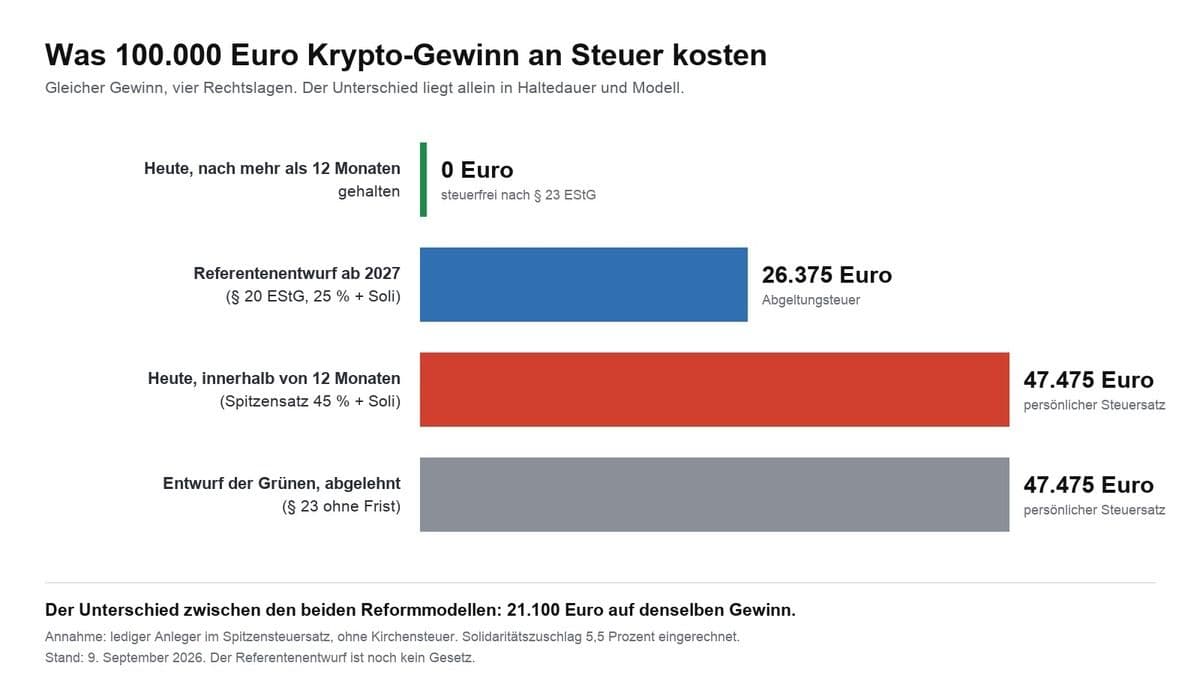
Crypto Tax in Germany: What Applies in 2026 and What Is Set to Change in 2027
Crypto gains are tax-free after twelve months; before that your personal tax rate of up to 45 percent applies. What triggers tax, how the holding period is calculated, what happens with staking and losses, and what the draft bill would change from 2027.
September 8, 2026 10:21 PM

Crypto Holding Period and Grandfathering: Why December 31, 2026 Becomes the Cut-Off in Germany's Draft Bill
A ministerial draft bill from Germany's finance ministry names a cut-off date for the first time: crypto assets acquired after December 31, 2026 are to fall under the flat-rate withholding tax. What that means for legacy holdings, running savings plans and staking income, and why nothing has been decided yet.
October 5, 2026 4:26 PM

Shiba Inu price up 4.4 percent: outperforms the market, but 88 trillion SHIB sit on exchanges
Shiba Inu adds 4.4 percent on Monday, making it the strongest of the six big names. At the same time 88.08 trillion SHIB worth $525 million sit on trading venues, almost five times a single day of turnover.
September 24, 2026 10:19 AM

Uniswap Falls 11.8 Percent After a 114 Percent Month: What to Check on Profit Taking, Holding Period and Leverage
UNI lost 11.75 percent on Wednesday morning but is still up 113.85 percent over the month. Anyone realising gains now almost certainly triggers a taxable disposal in Germany.
July 25, 2026 11:27 AM
Crypto Price Today: Market Slides Again as Bitcoin Fails at $67,000
Bitcoin slipped back under $64,000 after tapping $66,990. Oil, ETF outflows and Fed nerves are dragging the whole crypto market lower.
August 21, 2026 1:33 PM

Bitcoin With No Cost Basis: How Austria Taxes the Sale
Bitcoin purchase price no longer provable? How Austria works out the capital gains tax, when a flat-rate cost basis applies and what investors can do.
October 16, 2026 7:25 PM

Crypto holding period for Bitcoin: “That remains to be seen,” says the finance ministry
The federal cabinet did not adopt the draft abolishing the one-year crypto holding period on October 14, 2026; it is still stuck in inter-ministerial consultation. This overview sets out what applies today, which dates follow and why the December 31, 2026 cutoff has no force of law so far.
October 15, 2026 1:34 PM

$489 million in liquidations in one hour: where your leverage breaks first
Forced closures wiped out around $489 million within one hour on 15 October 2026, more than half the daily total of $942 million. Our analysis of OKX futures market data shows why Ether was hit harder than Bitcoin.
September 24, 2026 10:12 AM

XRP Falls 9.7 Percent: What to Check on Holding Period and Buying Route
XRP is down around 9.7 percent on the morning of September 24, twice as much as the typical large crypto asset. Our count of 18 coins shows who the pullback hits and which three things hold true regardless of the price.
September 14, 2026 10:23 AM

Take Ethereum Profits or Wait Out the Holding Period? What the Price Jump Means for Your Tax Bill
Ether reached its highest level since the end of January on September 11, 2026, and many are asking whether to sell now. In Germany the answer hangs on the purchase date first: we work out which tranches are tax free and which of them are showing a gain at all.
September 9, 2026 4:13 PM

Bitcoin 29 Percent Below Last Year: Which Crypto Losses You Can Still Use Before the One-Year Holding Period Expires
Nine out of ten major crypto assets trade lower today than exactly twelve months ago, Bitcoin alone by 29.2 percent. We measured the price series ourselves and show why the purchase date alone decides the tax value of your loss.
September 8, 2026 1:19 AM

Germany's Crypto Holding Period: What Happens Now Signing for Petition 201716 Closed on September 15
Recap as of September 27, 2026: the signature period for German parliamentary petition 201716, which asks for the one-year crypto holding period to be preserved, closed on September 15, 2026. This article explains what ended that day, how the petitions committee proceeds and why no investor has to sell because of it.
More from CryptoTicker