
Bitcoin Tax: One Year Past the $126,080 Peak, Losses No Longer Count
Bitcoin trades at $82,558 on Friday morning, 34.5 percent below an all-time high that is now a good year old. Anyone who bought back then loses more than the prospect of a quick recovery when the one-year period expires: the tax value of the loss goes with it.





Which topics should we dive deeper into?
Select what genuinely interests you. Your picks feed directly into our editorial planning.
Crypto news that's actually worth your time.
Weekly. 60 seconds. Carefully curated by our editors: no hype, no promo flood, no spam.
Bitcoin trades at $82,558, or €73,577, on Friday morning. The all-time high of $126,080 was set on October 6, 2025, which leaves the price 34.5 percent below that mark. Measured in euros, the gap to the record of €107,662 is 31.7 percent, because the dollar has weakened since. Prices are from CoinGecko.
That date is the reason to talk about bitcoin and tax today. October 6, 2025 is now more than twelve months ago. Anyone who bought on that Monday, or in the days that followed, has passed the one-year holding period under Section 23 of the German Income Tax Act. A sale would be tax-free from today. That sounds like an advantage, and with the price down by roughly a third it becomes the opposite: tax-free also means the tax office no longer recognizes the loss.
Bitcoin and Tax: What Section 23 of the Income Tax Act Governs in October 2026
Germany treats crypto assets as other economic goods. They therefore fall under the private disposal transactions of Section 23 of the Income Tax Act, not under the flat-rate withholding tax that applies to equities and funds. That produces the rule almost every investor knows: hold a bitcoin for more than a year and the sale is tax-free. Sell within the year and the gain is taxed at your personal income tax rate.
A private disposal transaction is not triggered only by a sale for euros. Swapping into another crypto asset counts as a disposal as well, and the coin received counts as acquired at the same moment. Its one-year clock starts over. Anyone who swapped bitcoin into ether in May triggered two taxable events, even though no euro changed hands.
The period is counted to the day. A purchase on January 15 starts the clock on January 16 and ends it on January 16 of the following year. What matters is the date of the contractual transaction, not the day the coins arrive in the wallet. On exchange purchases the two usually coincide; on transfers between wallets they do not.
The All-Time High of October 6, 2025: Since October 7 the Paper Loss Is Worthless for Tax
The holding period works in both directions, and that second half tends to get lost. Once the year has run, the transaction is irrelevant for tax. A gain stays tax-free, and a loss becomes unusable in return. It enters neither the loss carry-back nor the loss carry-forward, and it reduces not a single euro of tax.
For someone who bought at the record price on October 6, 2025, that means something specific. Up to October 6, 2026 a sale would have produced a loss the tax office recognizes. Since October 7, 2026 the same sale produces nothing at all. On a €10,000 stake and a 31.7 percent decline measured in euros, that is €3,170 of loss position gone.
The loss also has to be realized. A price decline inside the wallet is nothing for tax purposes. Only a sale or a swap turns a paper loss into a loss that a tax return knows about. Waiting for better prices and letting the deadline pass is itself a decision, even when it does not feel like one.

The €1,000 Exemption Limit: One Euro Above It Makes the Entire Gain Taxable
Gains from private disposal transactions stay tax-free as long as they add up to less than €1,000 in a calendar year. The figure was raised from €600 and applies per person per year. The important word is limit: this is not an allowance from which only the excess would be taxed. Reach the threshold and the whole gain becomes taxable, from the first euro.
The threshold counts across all private disposal transactions in a year, not only crypto. Anyone who sold a coin collection or gold at a profit inside the one-year window alongside a bitcoin gain has to add both together. Spouses are assessed separately, and each has their own threshold.
One sequence is easy to miss: the exemption limit is tested before an assessed loss carry-forward from earlier years is deducted. An old loss will not retroactively push you under the threshold. It reduces the taxable amount only in a second step.
FIFO and Individual Attribution: The Finance Ministry Circular of March 6, 2025 Calculates per Wallet
Anyone who bought in tranches faces the question of which bitcoin actually leave the house on a sale. The Finance Ministry circular of March 6, 2025, file reference IV C 1 - S 2256/00042/064/043, settles this point. The principle is individual attribution: where the separate acquisitions can be told apart, the holding actually sold is the one that counts.
Where individual attribution is not possible, the crypto assets of a trading designation acquired first count as sold first for the purpose of the holding period. Under margin numbers 61 and following, this first-in-first-out method may also be assumed to simplify the valuation. The assessment is wallet-specific. Within one wallet you have to keep the method you chose until every bitcoin in that wallet has been disposed of. Only then may you calculate differently on a new acquisition.
In practice FIFO decides whether a sale produces a loss or a gain. Someone who bought cheaply in 2023 and expensively in October 2025 sells the old, cheap holdings first under FIFO. Those are long past the one-year mark, the sale stays tax-free, and the expensive 2025 holding stays put along with its loss. Anyone who wants to lift that loss instead needs individual attribution, and therefore a wallet structure that supports it. A separate wallet per purchase period is laborious and solves the problem at the root. A tax tool with wallet attribution takes the arithmetic off your hands, but it does not replace the records behind it.
Offsetting Bitcoin Losses: Which Gains a Loss Can Be Set Against
A loss realized inside the one-year window is no blank cheque. It can be offset only against gains from other private disposal transactions, meaning crypto gains in the same year or gains from other assets under Section 23 of the Income Tax Act. Offsetting against employment income, against investment income from equities or interest, and against current income from staking and lending is ruled out.
If a negative figure remains after that offset, the law knows two routes. The carry-back goes into the immediately preceding year and reduces positive income from private disposal transactions there. The carry-forward runs into the future without a time limit and waits for matching gains. Both require the loss to be declared in the tax return and assessed separately by the tax office. A loss nobody declared does not exist for tax purposes.
The planned reform adds weight to this point. Should future crypto gains fall under Section 20 of the Income Tax Act, old losses from Section 23 could not be offset against them, because the two categories of income stay separate. A loss carry-forward assessed today could then only wait for private disposal transactions that would barely exist in that form.
 Crypto tax tools compared
A Worked Example at €73,577: What a Sale Inside the One-Year Window Costs
Suppose you bought half a bitcoin for €45,000 on February 15, 2026. This Friday that same half bitcoin stands at €36,789, a shortfall of €8,211. The one-year period runs until February 16, 2027, so the loss can still be lifted.
If you made a €6,000 gain elsewhere in the same year on a crypto sale inside the window, realizing the loss cuts that gain to zero. At a marginal tax rate of 42 percent you save roughly €2,520. The remaining €2,211 goes into the assessment and is available next year, or in a carry-back to 2025.
The same transaction with a purchase dated October 6, 2025 looks different. On half a bitcoin the loss would be around €17,000, and it has been unusable since October 7, 2026. The tax saving is zero. The one consolation: a later gain on that holding is tax-free as well, however large it turns out to be.
Four Cases for Bitcoin Holders: Bought in 2024, Bought at the Peak, Bought in 2026, Savings Plan Across the Year End
| Acquisition | One-year period | Loss usable | Gain tax-free |
|---|---|---|---|
| Bought in 2024 | expired | no | yes |
| Bought on October 6, 2025 | expired since October 7, 2026 | no | yes |
| Bought in 2026 | still running | yes, until the period ends | only after the period ends |
| Savings plan instalment after December 31, 2026 | would cease under the draft | open, draft not adopted | no, flat-rate withholding tax planned |
That fourth row is why savings plans deserve particular attention this quarter. Under the draft, a savings plan running across the year end would split into two groups: instalments up to December 31, 2026 would stay under the old law with its one-year period, and instalments from January 2027 would fall under the new one. A single position in the exchange app would then hold two tax regimes.

Records for the Tax Office: Documentation Duties and the Reporting Regime Since January 2026
The 2025 Finance Ministry circular contains, for the first time, its own section on cooperation and documentation duties, margin numbers 87 to 112. For each transaction you have to document the date, the type, the quantity and the euro value, plus any fees incurred and the attribution method chosen. Anyone using FIFO records that; anyone using individual attribution does the same. In advisory practice the platform, the wallet address and the transaction hash are added.
Since January 1, 2026 the reporting duties under the EU directive DAC8 also apply. Providers report transaction data to the tax administration, which can then reconcile it with your return. The era in which a crypto position simply did not show up is over. The reverse holds too: whatever gets reported, you should be able to explain cleanly yourself.
It becomes awkward with exchanges that have ceased operating, or where you have lost access. Anyone who cannot document the acquisition date of a holding will struggle to invoke an expired one-year period. For missing acquisition data, the ministerial draft provides for a flat 50 percent of the disposal proceeds as the tax base under the future withholding regime. Documenting legacy holdings therefore secures an advantage that cannot be recreated later. Before a sale it is worth looking at the routes for swapping bitcoin into euros, along with the question of which records each platform issues.
Staking and Lending: A Separate One-Year Period From the Inflow
Staking income matters less for bitcoin than for ethereum or solana, but it is not without relevance. Anyone earning income through wrapped-bitcoin constructions or through lending receives income that has to be recognized at its euro value at the time of inflow. For the tokens received, a separate one-year period begins, counted from that inflow.
Sell such tokens within twelve months of the inflow and the gain falls under Section 23 of the Income Tax Act. After that it is tax-free. The ongoing income itself is unaffected: it has to be declared in the year of inflow, even if you sold nothing. This double assessment is the most common error in home-made spreadsheets.
The Ministerial Draft and December 31, 2026: What Changes for New Purchases
On October 8, 2026 the Bundestag rejected the Greens' bill on the taxation of crypto assets, printed paper 21/5752, by 445 votes to 132 out of 577 cast. A Left Party motion on the same subject, printed paper 21/5824, also failed; the Greens voted for it, while the CDU/CSU, the AfD and the SPD voted against. The details are in the Bundestag's text archive and in our report on the vote on the crypto holding period.
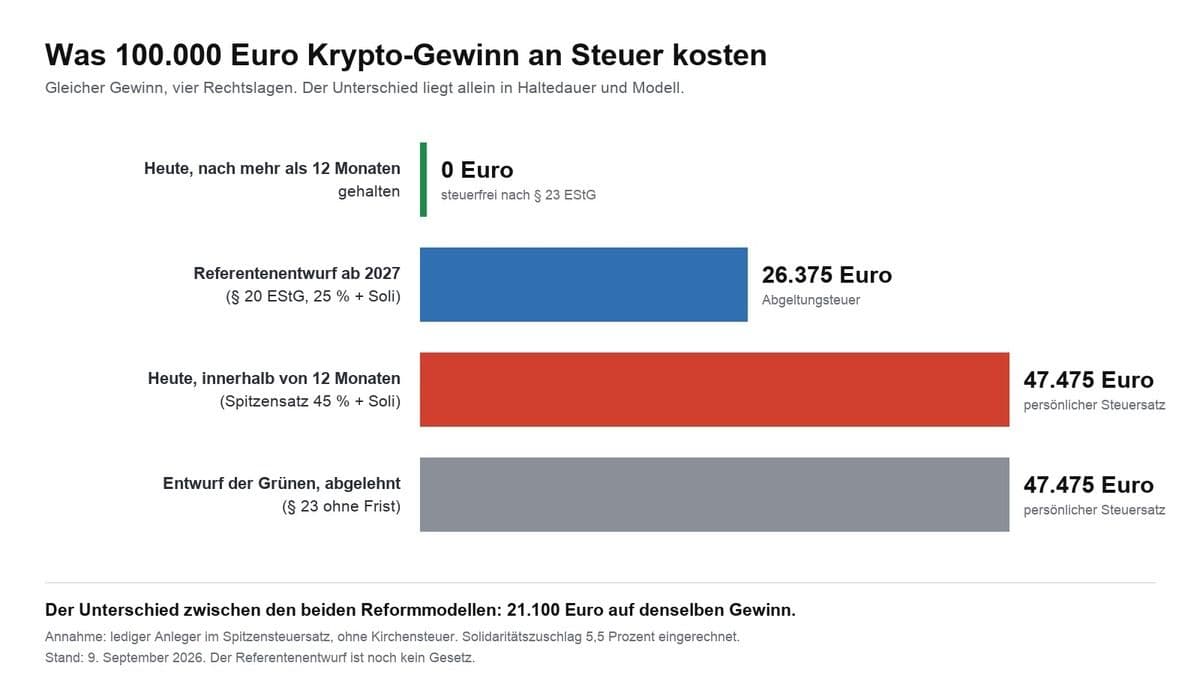
What matters for your planning, though, is the government's own draft. The Federal Ministry of Finance circulated it for consultation on September 30, 2026, associations had until October 6 to comment, and the cabinet is due to take it up on October 14, 2026. The plan is to assign bitcoin and other exchange crypto assets to investment income under Section 20 of the Income Tax Act. The one-year period would cease for newly acquired holdings, and tax would be charged regardless of holding period at 25 percent flat-rate withholding tax plus the solidarity surcharge, around 26.375 percent together. The ministry expects additional revenue of €350 million a year in the long run.
The draft puts the grandfathering cut-off at December 31, 2026. Anything acquired or received after that would fall under the new law. Older holdings would stay with Section 23 of the Income Tax Act and therefore tax-free after a year. Withholding at source by providers is not due to apply until January 1, 2028. None of this is settled: the Bundestag and the Bundesrat still have to pass the law, and cut-off dates have been pushed back more than once in the process. On October 12, 2026 the petitions committee also takes up the holding period in public.
Bitcoin Tax: Without a Sale by December 31 the Loss Expires
The one-year period is not a theoretical matter this autumn. It expires separately for every holding, and it takes the loss with it when it goes. Three steps make sense before the year ends:
- Sort your holdings by purchase date. Record the date, the quantity and the euro value for each acquisition, and mark which positions have not yet reached the one-year mark. A portfolio tracker with a tax function handles this through the exchange import; checking it stays your job.
- Go through your loss positions before the period ends. Anyone who bought in 2026 and is down can only realize the loss while the clock is still running. Which routes to a sale deliver the lowest fees and the best records decides the rest.
- Secure your records for grandfathering. Export the transaction history of every platform you have used and store it outside the exchange. When switching provider, exchanges with a complete tax report help you avoid later gaps.
(As of October 9, 2026. This article is not investment advice and not tax advice. Prices, draft legislation and fee structures change; check the terms with the provider before you buy, and check your own tax position with a tax adviser.)
 The best crypto exchanges compared
Frequently asked questions about bitcoin tax
Transparency note: This article was produced with the assistance of artificial intelligence and reviewed by our editorial team before publication. All figures and claims were checked against the primary sources linked in the text. The feature image was generated with AI.
Related articles
- Selling Bitcoin at a Loss and Buying It Straight Back: What That Does to Your Holding Period
- Borrowing Against Bitcoin Instead of Selling: When German Tax Still Applies
- German Crypto Holding Period Set to Go After All: A Separate Draft Targets Purchases From 2027
- Germany’s Crypto Holding Period Is Wobbling: What to Check Before December 31
- Bitcoin 29 Percent Below Last Year: Which Crypto Losses You Can Still Use Before the One-Year Holding Period Expires
Which topics should we dive deeper into?
Select what genuinely interests you. Your picks feed directly into our editorial planning.
Crypto news that's actually worth your time.
Weekly. 60 seconds. Carefully curated by our editors: no hype, no promo flood, no spam.

August 21, 2026 4:24 AM

Forced Sale on a Crypto Exchange: Which Moment Counts for the Holding Period and What You Must Document
At Luno, Kraken and Valour the deadlines are running out, after which the provider realises the remaining holding itself. For tax purposes that is a disposal, and what governs it is the exchange's timestamp.
September 16, 2026 1:20 PM

Crypto Loss Carryforward in Germany: What Happens to Old Losses Under the 2027 Tax Plan
Losses from crypto sales land in a ring-fenced pot and can only be set against gains of the same kind. The draft bill for 2027 moves future gains into a different pot, and we show you what that means for your assessed carryforward and what your tax notice should say.
September 8, 2026 1:19 AM

Germany's Crypto Holding Period: What Happens Now Signing for Petition 201716 Closed on September 15
Recap as of September 27, 2026: the signature period for German parliamentary petition 201716, which asks for the one-year crypto holding period to be preserved, closed on September 15, 2026. This article explains what ended that day, how the petitions committee proceeds and why no investor has to sell because of it.

September 27, 2026 1:17 PM

Dogecoin Price: What to Check on Holding Period and Custody Before the Year End
The Dogecoin price stands at $0.0977 on September 27, 2026 and has barely moved in a day. That calm is exactly the moment to work through the holding period, the reporting duty from 2026 and custody without any time pressure.
October 6, 2026 4:32 AM

Bitcoin for a gift card: what paying with crypto means for your holding period
Paying for a gift card with Bitcoin is a sale for tax purposes. What counts as the disposal proceeds, when the twelve-month holding period bites, and the four records the tax office expects.
August 11, 2026 9:13 PM

Germany's Crypto Holding Period Faces Abolition: What Petition 201716 and the Draft Bill Mean for Your Tax
Petition 201716 calls for the one-year holding period for crypto assets to be kept and will be heard in public by the Bundestag's Petitions Committee on 12 October 2026. Correction of 8 October: the reform was not decided by the cabinet in July. A draft bill of 30 September would end the holding period for crypto acquired after 31 December 2026, and the cabinet is due to take it up on 14 October.
September 25, 2026 10:26 PM

Selling bitcoin privately: the tax in Germany and the records you need
A direct sale to a private individual falls under the same one-year rule as an exchange sale, but there is no tax report to go with it. This guide walks through the calculation, the 1,000 euro threshold and the records the tax office wants to see.
September 8, 2026 10:21 PM

Crypto Holding Period and Grandfathering: Why December 31, 2026 Becomes the Cut-Off in Germany's Draft Bill
A ministerial draft bill from Germany's finance ministry names a cut-off date for the first time: crypto assets acquired after December 31, 2026 are to fall under the flat-rate withholding tax. What that means for legacy holdings, running savings plans and staking income, and why nothing has been decided yet.
September 9, 2026 4:22 PM
Crypto Tax in Germany: What Applies in 2026 and What Is Set to Change in 2027
Crypto gains are tax-free after twelve months; before that your personal tax rate of up to 45 percent applies. What triggers tax, how the holding period is calculated, what happens with staking and losses, and what the draft bill would change from 2027.
September 19, 2026 7:26 AM

Offsetting Crypto Losses Against Share Gains: What Is Really Allowed in Germany
Crypto losses and share gains sit in separate loss buckets in Germany, and there is no offsetting between them. Where the line runs, why crypto derivatives are the exception, and how you can still use losses through carryback and carryforward.
October 2, 2026 4:39 AM

Donating bitcoin: when does the full market value count, when only the purchase price?
A bitcoin donation to a charitable organisation is deductible as a donation in kind, and the donation itself produces no taxable gain. The size of the deduction turns solely on whether a sale would have been taxable on the day of the transfer.
September 14, 2026 10:23 AM

Take Ethereum Profits or Wait Out the Holding Period? What the Price Jump Means for Your Tax Bill
Ether reached its highest level since the end of January on September 11, 2026, and many are asking whether to sell now. In Germany the answer hangs on the purchase date first: we work out which tranches are tax free and which of them are showing a gain at all.
September 24, 2026 1:13 AM

Solana DEX Trades Overtake the NYSE: What to Check on Swaps, Tax and Oversight
Solana's decentralised exchanges settled roughly 208 million trades in a single week and overtook the New York Stock Exchange for the first time. The figure is real, but it measures something other than the comparison suggests, and for German investors it carries tax duties that no provider takes on.
August 12, 2026 9:12 AM

Bitcoin Losses and Dividends in Austria: How the Tax Offset Works
Can a Bitcoin loss be offset against dividends? This is how loss offsetting works in Austria. It also shows when a tax return is needed for it.
August 26, 2026 10:25 PM

Selling Bitcoin at a Loss: Loss Offsetting in Austria
Sold Bitcoin at a loss? Austria allows the loss to be offset against certain investment income. When loss offsetting is possible and which limits apply.
August 31, 2026 10:30 PM

Taxing Crypto Lending: Your Personal Rate Instead of Withholding Tax, and the Right Federal Fiscal Court Case Number
According to the only tax court ruling so far, income from crypto lending falls under Section 22(3) of the German Income Tax Act and therefore under your personal tax rate. The appeal is pending at the Federal Fiscal Court under VIII R 22/25, not under the case number given in many professional articles.
September 17, 2026 7:12 PM

Gifting Bitcoin to Children: Allowance, Holding Period and the Tax Office Report
Transferring Bitcoin to your child hands over your holding period and your entry price along with the coins. This guide sets out what really applies in Germany on the allowance, the reporting deadline, representation and custody.
September 26, 2026 7:29 PM

Coins Stolen in an Exchange Hack: What the German Tax Office Accepts as a Loss
After the attack on Bitget on September 24, a question the reports leave out arises for those affected in Germany: can a stolen balance be written off against tax? The answer hangs on a single term in the Income Tax Act, and it is decided by your records.
September 18, 2026 10:13 AM

Bitcoin and the German Exit Tax: What Applies When You Move Abroad
Anyone emigrating with Bitcoin expects an exit tax on unrealised gains and finds nothing of the sort in the statute. Where the real risks sit is decided at four points: residence, the holding period, the legal form of your investment, and automatic reporting from 2026.
October 2, 2026 1:33 PM

Crypto tax before the cabinet on October 14: “Comments are only possible until October 6”
Germany's Federal Ministry of Finance sent the draft bill on crypto taxation to the associations on September 30, 2026, and the cabinet is to decide on October 14. For your holdings one date counts above all: December 31, 2026.
September 22, 2026 10:13 AM

Circle Lends Against Bitcoin via cirBTC: Why the Wrapper Can Cost You the German Holding Period
Circle launched loans against deposited bitcoin on September 21, 2026. In Germany, the detour through the cirBTC token is very likely a swap, and a swap restarts your one-year holding period.
August 24, 2026 4:22 AM

Selling XRP After a 53 Percent Week: What the Holding Period Costs
XRP trades at $1.51 after a weekly gain of a good 50 percent, yet your net proceeds are decided by the purchase date. This article works through the holding period, the exemption limit and FIFO at measured reference-date prices.
August 14, 2026 6:23 AM

Bitcoin Savings Plan and Tax: How the Holding Period, FIFO and the Exemption Limit Interact on Monthly Buys
Every savings plan instalment is a separate acquisition for tax purposes, with a holding period of its own. How the exemption limit, the order of disposal and record-keeping duties interact on monthly Bitcoin buys, with the sources from the statute and the Ministry of Finance circular.
August 22, 2026 4:47 PM

Offsetting Bitcoin Losses Against Stock Gains in Austria
Offset bitcoin losses against gains on shares? Austria allows it in principle, but only under certain conditions and usually via the tax return.

August 20, 2024 3:00 PM

New US Senate Proposal Submitted For Crypto Tax Exemption
The US Senate has recently submitted a new proposal to exempt crypto transactions from federal taxes. Here are more details of this submission, and a list of exempted countries it could be joining...
August 18, 2026 7:13 AM

Bitcoin Tax Reporting in Austria 2026: What Applies
Bitcoin tax reporting in Austria: which data investors can request from crypto exchanges in 2026, and when the report matters for the tax return.
September 24, 2026 4:28 AM

Crypto Trading Bots and Tax: What Applies With Thousands of Trades a Year
A bot turns one investment decision into hundreds of disposals, and the tax office counts every single one. This guide explains the holding period, FIFO, the exemption limit and the record-keeping duties, and what to set up before the bot makes its first trade.
More from CryptoTicker