
Crypto Tax in Germany: What Applies in 2026 and What Is Set to Change in 2027
Crypto gains are tax-free after twelve months; before that your personal tax rate of up to 45 percent applies. What triggers tax, how the holding period is calculated, what happens with staking and losses, and what the draft bill would change from 2027.




Which topics should we dive deeper into?
Select what genuinely interests you. Your picks feed directly into our editorial planning.
Crypto news that's actually worth your time.
Weekly. 60 seconds. Carefully curated by our editors: no hype, no promo flood, no spam.
Gains from cryptocurrencies are tax-free in Germany when more than twelve months lie between purchase and sale. Sell earlier and you pay your personal income tax rate of up to 45 percent plus the solidarity surcharge. That still applies today, and it applies to your 2026 tax return as well. A draft bill from the Federal Ministry of Finance aims to change this from 2027, but nothing about it has been adopted.
This guide explains the legal position as it stands now: which events trigger tax at all, how to calculate the holding period correctly, what happens with staking and lending, and what the planned overhaul would mean for you.
The Key Points at a Glance
- Legal basis: held as private assets, crypto assets count as "other economic goods". Their sale is a private disposal under Section 23 of the German Income Tax Act.
- Holding period: after a holding period of more than twelve months the gain is tax-free, in full and without an upper limit.
- Within one year: your personal income tax rate applies, not the flat withholding tax of 25 percent.
- Exemption threshold: 1,000 euros of gains per year stay tax-free. One euro above that makes the entire gain taxable.
- Losses: they can only be offset against gains from other private disposals, not against share gains or employment income.
- From 2027: a draft bill provides for the flat withholding tax of 25 percent, for purchases made after December 31, 2026. The procedure is still running.
How Cryptocurrencies Are Taxed in Germany
For tax purposes Bitcoin, Ether and other cryptocurrencies are not securities. The Federal Fiscal Court confirmed this in its ruling of February 14, 2023 (case number IX R 3/22): crypto assets are economic goods, and their sale out of private assets falls under Section 23 EStG.
From that follows the difference that shapes the whole of German crypto taxation. Shares and funds are subject to the flat withholding tax: a blanket 25 percent plus the solidarity surcharge, regardless of how long you have held them. With cryptocurrencies the holding period decides instead, and the tax rate is your personal one.
The governing administrative instruction is the Federal Ministry of Finance circular of March 6, 2025 on individual questions of the income tax treatment of certain crypto assets. It replaced the earlier circular of May 10, 2022. Anyone who comes across guides online still citing the 2022 version is reading a superseded position.
What Actually Triggers Tax
The most common misconception concerns not the amount of tax but the moment it arises. What becomes taxable is not the gain on paper but its realisation. And more counts as realisation than most people expect.
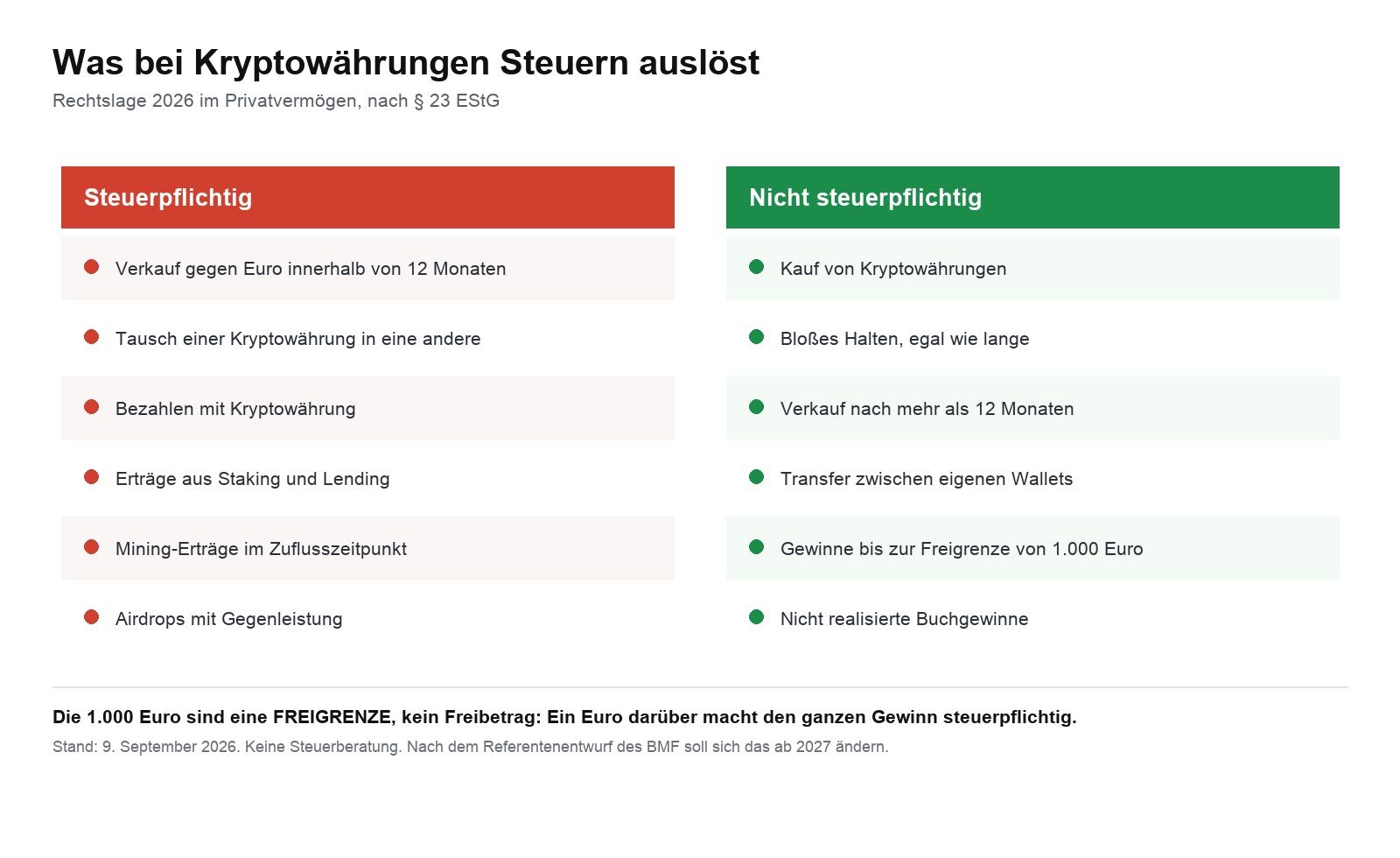
The second point gets expensive in particular. Swapping one cryptocurrency for another is a sale and a purchase at the same time for tax purposes. Anyone swapping Bitcoin for Ether realises the gain on the Bitcoin, even though not a single euro has moved. For the Ether received, a new twelve-month period starts at the same moment.
The same applies to paying with cryptocurrency. Anyone paying for an object with Bitcoin disposes of that Bitcoin for tax purposes.
Not taxable, by contrast, are the purchase itself, holding, and transfers between your own wallets. Moving funds from an exchange to a hardware wallet is not a disposal, it does not interrupt the holding period and it triggers no tax.
Calculating the Twelve-Month Holding Period Correctly
The period runs to the day from the date of acquisition and attaches to the individual position, not to your portfolio and not to the calendar year. Buy on March 15, 2026 and a sale from March 16, 2027 onwards is tax-free.
With several purchases of the same cryptocurrency it gets more complicated. The circular of March 6, 2025 first requires individual allocation: where you can prove which specific coins you are selling, their acquisition date counts. Where that is not possible, the crypto assets acquired first count as the ones disposed of first for the holding period, the so-called FiFo method. For valuation the average method is to be applied, though for reasons of simplification FiFo may be assumed there as well.
Two points are regularly overlooked in this. First, the assessment applies per wallet, so every address is considered on its own. Second, the method you choose binds you until the holding has been disposed of in full.
The ten-year period once feared no longer exists. For a long time it was unclear whether the holding period extends to ten years where crypto assets are used as a source of income, for instance in staking. The tax administration has expressly rejected this. Staked coins, too, can be disposed of tax-free after twelve months.
You do not have to count the days by hand: the free holding period and FIFO calculator from cryptoticker shows for every purchase the day from which it is tax-free and for every sale the taxable part. It is our own tool, and your files and entries stay in your browser.
How High the Tax Actually Turns Out
Within the twelve-month period the gain is added to your remaining income and charged at your personal tax rate. Anyone already earning well quickly lands in the top tax rate of 42 percent, and at 45 percent from around 278,000 euros of taxable income. On top comes the solidarity surcharge of 5.5 percent on the tax, and church tax where applicable.
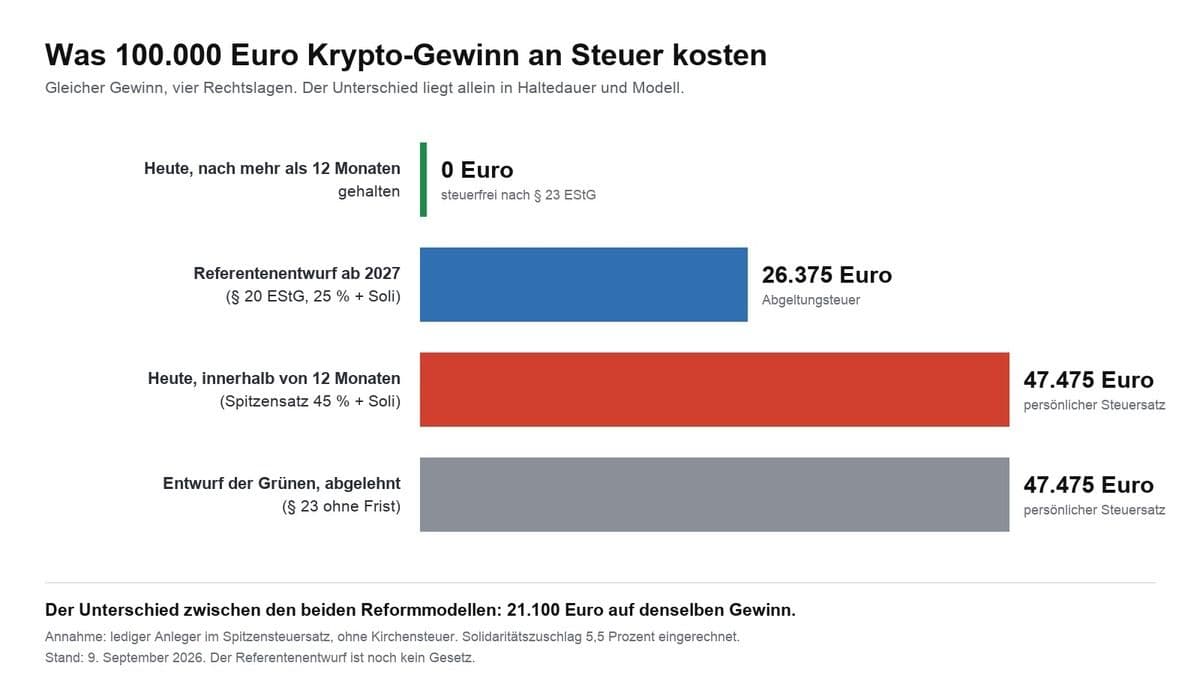
The same gain of 100,000 euros shows the spread clearly: after a holding period of twelve months you pay zero euros. Within the period and at the top tax rate it is 47,475 euros. Under the draft bill it would be 26,375 euros, regardless of the holding period.
The 1,000-euro exemption threshold deserves particular attention, because its name misleads. An exemption threshold is not an allowance. On a gain of 999 euros you pay nothing. On 1,001 euros you tax not the single euro above it but the full 1,001 euros. The threshold applies to all private disposals of a year taken together, so to gold or collectibles as well.
Staking, Lending, Mining and Airdrops
Income from staking and lending is not a disposal gain but income from other services under Section 22 number 3 EStG. It is recognised at market value at the moment it accrues and taxed at your personal rate. A separate exemption threshold of 256 euros per year applies to it, which has nothing to do with the 1,000 euros under Section 23.
The market value at the moment of accrual becomes the acquisition cost of the coins received at the same time. If you sell them later, a twelve-month period of their own starts for them from the moment they accrued.
With mining the scale is what matters. Occasional mining falls under Section 22 number 3, while sustained mining directed at profit is a commercial activity, with every consequence from trade tax to the obligation to keep books. For block rewards from running your own hardware the tax administration regularly assumes a commercial activity.
Airdrops are tax-free where you do nothing for them and provide no consideration. Where the provider requires an action, such as filling in a form or advertising on social networks, there is a service and the receipt is taxable.
Losses: The Pot That Stands on Its Own
Losses from crypto sales within the one-year period can only be offset against gains from other private disposals of the same year. Offsetting against employment income, rental income or share gains is ruled out. What remains can be carried back one year or carried forward into the following years without limit.
That is a genuine disadvantage compared with shares, where losses land in the investment income pot. It has a flip side, though: anyone realising crypto losses can use them to neutralise gains from other private disposals, from the sale of gold within the one-year period for example.
The loss determination matters. Losses you do not declare in Annex SO of your tax return are lost for the future. The tax office only determines them where they are declared.
What Is Set to Change From 2027
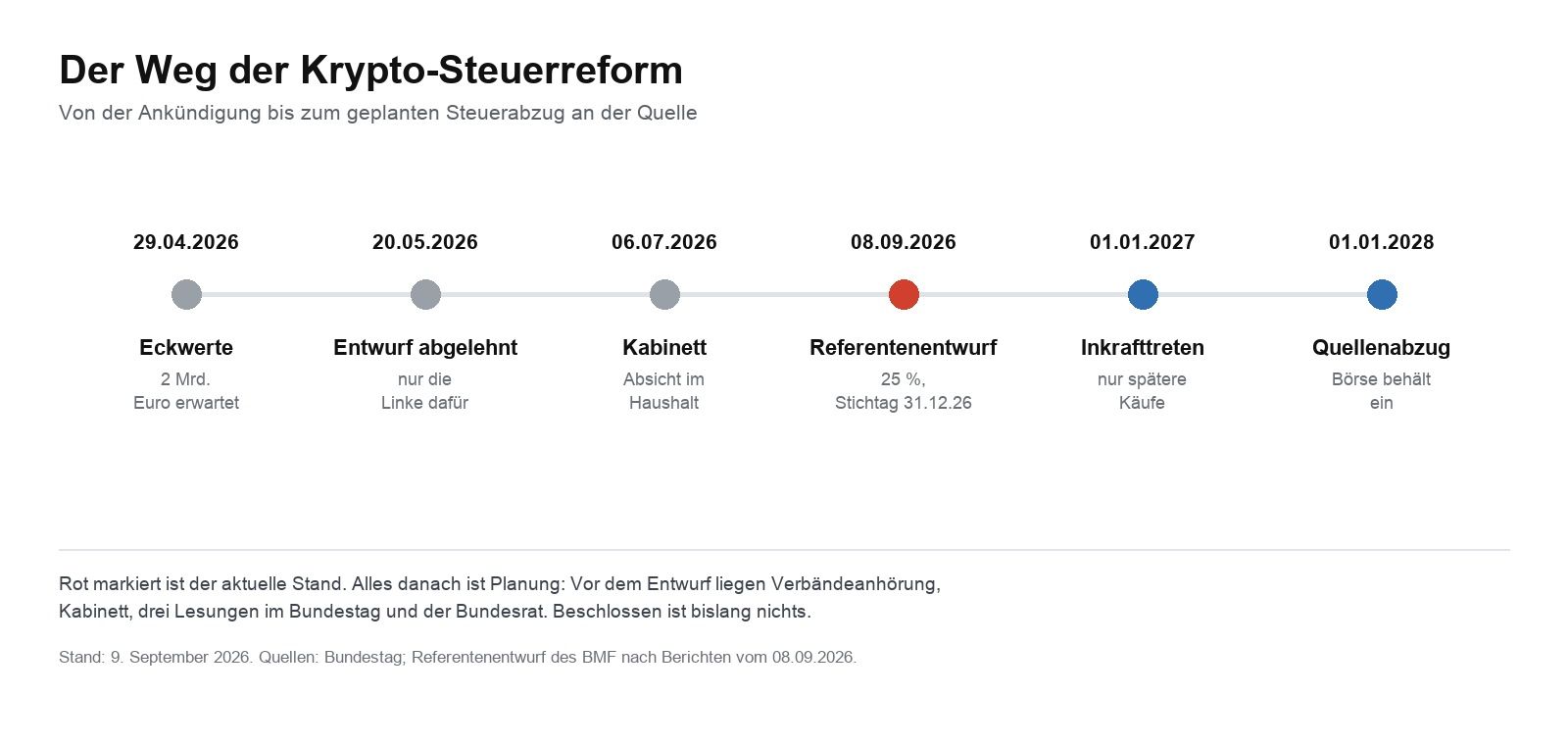
On September 8, 2026 the Federal Ministry of Finance sent a draft bill into interdepartmental coordination. It provides for crypto assets to be treated in future as investment income under Section 20 EStG: 25 percent flat withholding tax plus the solidarity surcharge, regardless of the holding period.
Four points of the draft are decisive for investors:
- The cut-off date lies in the future. Only crypto assets acquired after December 31, 2026 would be covered. What you buy up to then would remain, as the draft stands, under today's rules with the one-year period. The details are in our article on grandfathering and the cut-off date.
- Losses would become offsettable. The draft permits offsetting against shares and other securities, and the isolated pot of Section 23 would fall away.
- The exemption threshold would become an allowance. The saver's lump sum, which applies to all investment income taken together, would take the place of the 1,000-euro threshold.
- The tax deduction would come later. The law is to enter into force on January 1, 2027, with automatic deduction by service providers only from January 1, 2028.
None of this has been adopted. Ahead of the draft lie the hearing of the associations, the cabinet decision, three readings in the Bundestag and the Bundesrat. At every stage the tax rate and the cut-off date can still be changed. Which two models stood against each other in the debate, and why they differ by 21,100 euros on a gain of 100,000 euros, is something we broke down in our comparison of the two tax models. What the project is meant to bring in for the state is set out in our analysis of the 160 million euros in the federal budget.
 Crypto exchanges compared: where you can buy Bitcoin
What You Should Document Now
Regardless of how the reform turns out, your documentation decides your tax burden. From January 1, 2026 all centralised crypto service providers report to the tax administration under DAC8. So the tax office knows about your exchange accounts, retroactively as well through control notifications.
You need four pieces of information for every position, and permanently:
- Date and time of acquisition. The period runs to the day, and where several purchases fall on one day the time helps.
- Acquisition cost in euros, including fees.
- The wallet or exchange the position sits on, because the assessment is made per wallet.
- Every transfer between your own addresses, so that a move is not counted as a sale.
Once the tax is to be withheld at source from 2028, this becomes more important still: an exchange can only settle correctly where it knows your acquisition data. For holdings you deliver in from outside, it does not know them. The draft therefore provides for a flat assessment base where the acquisition cannot be established. That works out to your disadvantage.
Anyone with many transactions will not get far with a spreadsheet. A look at specialised tools is worth it: crypto tax tools and portfolio trackers compared.
The same rules apply to Bitcoin, but there are cases that only arise there: a savings plan with twelve separate periods, the differing taxation of ETPs and the question of commercial activity in mining. We have written those cases up separately in our article on Bitcoin and taxes in Germany.
Two questions follow on directly here. How to work out your gain in concrete terms, with a formula, a worked example and a tax table, is covered in our article on calculating crypto tax. Where in the tax return gains, losses and staking income are entered is clarified in our article on crypto in the tax return.
Frequently Asked Questions on Crypto Tax
How high is the tax on cryptocurrencies in Germany?
After a holding period of more than twelve months, zero percent. Within the period your personal income tax rate of 14 to 45 percent applies, plus the solidarity surcharge.
When are crypto gains tax-free?
When more than one year lies between acquisition and sale, or when your total gain from private disposals in the year stays below 1,000 euros.
Do I have to declare crypto in my tax return?
Taxable events belong in Annex SO. Sales after the one-year period has expired do not have to be declared. Losses should be declared, otherwise they are lost for the future.
Is swapping Bitcoin for Ether taxable?
Yes. The swap counts as a disposal of the coin given up. Where its purchase goes back less than twelve months, the gain is taxable.
Is the holding period extended to ten years for staking?
No. That worry stems from an earlier discussion and has been cleared up by the tax administration. Twelve months remains the rule.
What happens to my coins if the reform comes?
As the draft stands, nothing: it only covers acquisitions after December 31, 2026. That becomes legally binding only once a law has been adopted.
Does all of this apply in Austria too?
No. Austria abolished the holding period back in 2022 and taxes crypto gains at 27.5 percent capital gains tax, regardless of the holding period.
Sources
- Federal Fiscal Court, ruling of February 14, 2023, case number IX R 3/22, on the economic-good character of crypto assets
- Federal Ministry of Finance circular of March 6, 2025, individual questions on the income tax treatment of certain crypto assets, reference IV C 1 - S 2256/00042/064/043
- Section 23 and Section 22 number 3 of the German Income Tax Act
- German Bundestag, introduction of the 2027 federal budget on September 8, 2026: bundestag.de
- Bundestag printed paper 21/5752 on the Green party bill that the finance committee recommended rejecting on May 20, 2026: dserver.bundestag.de
- Details of the draft bill following the reporting of September 8, 2026. The full text has not been officially published so far.
- An entrepreneur's perspective: From 11.4 billion to 160 million
Correction (September 29, 2026): An earlier version described bill 21/5752 as rejected. The Bundestag's finance committee recommended rejecting it on May 20, 2026 (printed paper 21/6112); the full Bundestag has not voted on it to date.
For individual cryptocurrencies there are additional guides covering their particular features: Ethereum and taxes as well as XRP and taxes.
(As of September 9, 2026. This article is not tax advice and not investment advice. It does not replace advice on your individual case from a tax adviser, and the legal position can change.)
Transparency note: This article was produced with the assistance of artificial intelligence and reviewed by our editorial team before publication. All figures and claims were checked against the primary sources linked in the text.
Related articles
- Crypto holding period for Bitcoin: “That remains to be seen,” says the finance ministry
- Bitcoin Tax: One Year Past the $126,080 Peak, Losses No Longer Count
- Germany's Crypto Holding Period: What Happens Now Signing for Petition 201716 Closed on September 15
- Gifting Bitcoin to Children: Allowance, Holding Period and the Tax Office Report
- Bitcoin for a gift card: what paying with crypto means for your holding period
Which topics should we dive deeper into?
Select what genuinely interests you. Your picks feed directly into our editorial planning.
Crypto news that's actually worth your time.
Weekly. 60 seconds. Carefully curated by our editors: no hype, no promo flood, no spam.

September 9, 2026 4:13 PM

Bitcoin 29 Percent Below Last Year: Which Crypto Losses You Can Still Use Before the One-Year Holding Period Expires
Nine out of ten major crypto assets trade lower today than exactly twelve months ago, Bitcoin alone by 29.2 percent. We measured the price series ourselves and show why the purchase date alone decides the tax value of your loss.
August 11, 2026 9:13 PM

Germany's Crypto Holding Period Faces Abolition: What Petition 201716 and the Draft Bill Mean for Your Tax
Petition 201716 calls for the one-year holding period for crypto assets to be kept and will be heard in public by the Bundestag's Petitions Committee on 12 October 2026. Correction of 8 October: the reform was not decided by the cabinet in July. A draft bill of 30 September would end the holding period for crypto acquired after 31 December 2026, and the cabinet is due to take it up on 14 October.
September 16, 2026 7:12 PM

Borrowing Against Bitcoin Instead of Selling: When German Tax Still Applies
Posting Bitcoin as collateral for a loan is not a sale in Germany, because section 39 of the Fiscal Code keeps the coins attributed to you for tax purposes. Tax arises only when the collateral is liquidated, and then the one thing that decides the bill is how long you held the coins beforehand.
September 26, 2026 1:19 AM

Germany’s Crypto Holding Period Is Wobbling: What to Check Before December 31
A CDU member of the Bundestag makes it plain: the coalition agreement does not guarantee that the one-year holding period for crypto assets will survive. What that means for purchases made before the planned cutoff date of December 31, 2026.
September 25, 2026 10:26 PM

Selling bitcoin privately: the tax in Germany and the records you need
A direct sale to a private individual falls under the same one-year rule as an exchange sale, but there is no tax report to go with it. This guide walks through the calculation, the 1,000 euro threshold and the records the tax office wants to see.
September 17, 2026 10:22 PM

Selling Bitcoin at a Loss and Buying It Straight Back: What That Does to Your Holding Period
Germany has no wash sale rule: the loss stays deductible even if you buy back immediately. The buyback, however, restarts the one-year period for every new unit.
September 8, 2026 10:21 PM

Crypto Holding Period and Grandfathering: Why December 31, 2026 Becomes the Cut-Off in Germany's Draft Bill
A ministerial draft bill from Germany's finance ministry names a cut-off date for the first time: crypto assets acquired after December 31, 2026 are to fall under the flat-rate withholding tax. What that means for legacy holdings, running savings plans and staking income, and why nothing has been decided yet.
August 12, 2026 9:12 AM

Bitcoin Losses and Dividends in Austria: How the Tax Offset Works
Can a Bitcoin loss be offset against dividends? This is how loss offsetting works in Austria. It also shows when a tax return is needed for it.
August 18, 2026 7:13 AM

Bitcoin Tax Reporting in Austria 2026: What Applies
Bitcoin tax reporting in Austria: which data investors can request from crypto exchanges in 2026, and when the report matters for the tax return.

September 27, 2026 4:12 AM

Bitcoin ETF Inflows Turn 2026 Positive: How to Tell If the Demand Holds
US spot Bitcoin ETFs took in roughly $2.4 billion in the week to September 25, the strongest week since October 2025, and that turns the 2026 year-to-date balance positive. Why the daily inflow fell 87 percent within the same week, and what to check on buying route, holding period and custody.
September 9, 2026 1:15 AM

Germany's Crypto Tax: 160 Million Euros for a 555-Billion Budget
The German finance ministry's draft bill puts a figure on the crypto tax for the first time: 160 million euros from 2028. What that number means in the 2027 federal budget, how 11.4 billion became 160 million, and what investors can read from it.
October 15, 2026 4:13 AM

Crypto holding period: the cabinet date passes without a decision, December 31 stays the cut-off
Germany's federal cabinet did not adopt the expected decision of October 14, 2026 to abolish the one-year crypto holding period; the draft is still in interdepartmental consultation. Until new rules arrive, gains stay tax free after one year of holding, and the December 31, 2026 cut-off named in the draft separates old holdings from new ones.

August 20, 2024 3:00 PM

New US Senate Proposal Submitted For Crypto Tax Exemption
The US Senate has recently submitted a new proposal to exempt crypto transactions from federal taxes. Here are more details of this submission, and a list of exempted countries it could be joining...
August 21, 2026 4:24 AM

Forced Sale on a Crypto Exchange: Which Moment Counts for the Holding Period and What You Must Document
At Luno, Kraken and Valour the deadlines are running out, after which the provider realises the remaining holding itself. For tax purposes that is a disposal, and what governs it is the exchange's timestamp.
October 2, 2026 1:33 PM

Crypto tax before the cabinet on October 14: “Comments are only possible until October 6”
Germany's Federal Ministry of Finance sent the draft bill on crypto taxation to the associations on September 30, 2026, and the cabinet is to decide on October 14. For your holdings one date counts above all: December 31, 2026.
September 14, 2026 10:23 AM

Take Ethereum Profits or Wait Out the Holding Period? What the Price Jump Means for Your Tax Bill
Ether reached its highest level since the end of January on September 11, 2026, and many are asking whether to sell now. In Germany the answer hangs on the purchase date first: we work out which tranches are tax free and which of them are showing a gain at all.
September 7, 2026 7:22 AM

German Crypto Holding Period Set to Go After All: A Separate Draft Targets Purchases From 2027
Correction of 8 October 2026: The Income Tax Reform Act 2027, adopted by the German federal cabinet on 2 September, does not cover crypto assets. That did not mean the holding period stays. A separate draft bill from the Federal Ministry of Finance, dated 30 September, would abolish it for anything acquired after 31 December 2026. The cabinet is due to decide on 14 October.
October 6, 2026 1:23 AM

50 euros a month in Bitcoin, 118 instalments since 2017: savings plan vs lump sum
118 monthly instalments of 50 euros since January 2017 add up to €5,900 paid in and around €54,500 today. The same instalment since January 2024 is up only 14.5 percent, and since October 2025 the savings plan beats the lump sum by almost 39 percentage points.
September 24, 2026 10:19 PM

Bitcoin for Retirement: What Applies from 2027 and What You Decide Now
Bitcoin is not permitted in any state-subsidised retirement product, including the new retirement savings account from 2027. Anyone who still wants to use crypto assets for their own pension goes through private assets, and there a cutoff date at the end of 2026 is shifting the tax rules right now.
September 24, 2026 1:13 AM

Solana DEX Trades Overtake the NYSE: What to Check on Swaps, Tax and Oversight
Solana's decentralised exchanges settled roughly 208 million trades in a single week and overtook the New York Stock Exchange for the first time. The figure is real, but it measures something other than the comparison suggests, and for German investors it carries tax duties that no provider takes on.
August 27, 2026 10:16 AM
Bitcoin Tax Return in Austria: When You Must File
Even with a crypto exchange, a tax return can still be necessary in Austria. Foreign platforms, missing capital gains tax withholding and cross-provider losses are the typical triggers.
October 10, 2026 7:15 PM

ING and Bitcoin: Around 50 Crypto ETNs in the Portfolio, and What the Delivery Claim Means for Your Holding Period
Bitcoin can be bought at ING, but only as an exchange-traded note: around 50 crypto ETNs from five issuers, as a one-off purchase or a savings plan from one euro. What the offer really costs, and what the one-year holding period hangs on, is not in the advertising but in the key information document.
October 19, 2026 4:15 AM

Crypto FIFO across several exchanges: each wallet counts on its own in Germany
Hold bitcoin on several exchanges and in wallets of your own, and the holding period is calculated per pot, not across the total holding. What paragraph 62 of the BMF guidance orders, and why 31 December 2026 hangs on it.
September 22, 2026 1:28 PM

Selling Bitcoin and Cashing Out in Euros: How It Works in Germany
Between the sell order and the euros in your current account stand the exchange, your bank and the tax office. Knowing the order of events saves fees, waiting time and, in the best case, the entire tax on the gain.
September 24, 2026 10:11 PM

Bitcoin Price Prediction: What to Check on Levels, Holding Period and Leverage Before the October 28 Rate Decision
Bitcoin is trading at around $83,800, a third below its October 2025 high, while the sentiment index reads greed. Which dates, levels and deadlines over the coming weeks really decide your net gain, and which of them you steer yourself.

More from CryptoTicker