
50 euros a month in Bitcoin, 118 instalments since 2017: savings plan vs lump sum
118 monthly instalments of 50 euros since January 2017 add up to €5,900 paid in and around €54,500 today. The same instalment since January 2024 is up only 14.5 percent, and since October 2025 the savings plan beats the lump sum by almost 39 percentage points.





Which topics should we dive deeper into?
Select what genuinely interests you. Your picks feed directly into our editorial planning.
Crypto news that's actually worth your time.
Weekly. 60 seconds. Carefully curated by our editors: no hype, no promo flood, no spam.
Fifty euros a month is the figure most people start with when they first consider a Bitcoin savings plan. The short answer to whether it pays off: anyone who began in January 2017 and has bought 50 euros every month since has paid in €5,900 and holds 0.7137 Bitcoin for it. At the price on October 5, 2026 that is around €54,500, a good nine times the money paid in. Anyone who only started in January 2024 is up just 14.5 percent on the same instalments.
Both figures come out of the same calculation, and that is precisely the point: what a savings plan ends up delivering is decided above all by the entry date and the time in the market. This article works through five periods, sets each instalment plan against a lump sum of the same amount, and shows where fees and German tax law cut in. Bitcoin traded between €76,300 and €76,400 on Monday; every closing value below is calculated at that level.
What 118 instalments of 50 euros in Bitcoin since January 2017 produced
A savings plan buys a fixed amount on fixed dates, whatever the price. When Bitcoin is high, your 50 euros buy little; when it is low, they buy a lot. Across 118 monthly instalments since January 1, 2017 that works out at an average entry price of €8,267 per Bitcoin. Today a Bitcoin costs around €76,400, so 50 euros still buy 0.000655 BTC.
The table shows five entry dates. Each line assumes an instalment of 50 euros on the first of the month, and the value refers to October 5, 2026.
| Start | Instalments | Paid in | Bitcoin | Value today | Return | Average price |
|---|---|---|---|---|---|---|
| January 2017 | 118 | €5,900 | 0.71370 BTC | €54,514 | +824.0 percent | €8,267 |
| January 2021 | 70 | €3,500 | 0.08975 BTC | €6,855 | +95.9 percent | €38,998 |
| January 2022 | 58 | €2,900 | 0.07336 BTC | €5,603 | +93.2 percent | €39,531 |
| January 2024 | 34 | €1,700 | 0.02549 BTC | €1,947 | +14.5 percent | €66,689 |
| October 2025 | 13 | €650 | 0.00971 BTC | €742 | +14.2 percent | €66,909 |
The middle row stands out. Anyone who started in January 2022, shortly after the high of the time had broken, is almost exactly as well off today as someone who got in a year earlier. The reason is the average price: both sit at around €39,000, because the instalments paid during 2022 were executed at very low prices and dragged the average down.
Cost averaging: why the Bitcoin savings plan lands at an average price of €8,267
Cost averaging describes a plain mechanism: because the amount is fixed and the price moves, you automatically buy more units when prices are low than when they are high. Your average price therefore always sits below the arithmetic mean of every price in the period.
Across the 118 instalments since 2017 that difference is enormous. The average price of €8,267 did not exist on any single day. It comes about because the instalments paid between 2017 and 2019 bought at a few hundred to a few thousand euros per Bitcoin and still account for the bulk of the units held. The instalments from 2024 on cost ten times as much per unit and contribute correspondingly little to the quantity. We worked this effect through in detail on September 19, 2026, using an example with a 100 euro monthly instalment over twelve payments.
The effect has a flip side that rarely appears in marketing copy: it only lowers your entry price if the market actually falls along the way. In a market that rises from start to finish, the savings plan is the more expensive route, because every later instalment costs more than the first.
Bitcoin savings plan vs lump sum: when the monthly instalment is the worse route
The honest counter-test is the lump sum, where the same total is invested on the first day of the period instead of spread across months.
| Start | Same total | Savings plan today | Lump sum today | Ahead |
|---|---|---|---|---|
| January 2017 | €5,900 | €54,514 (+824.0 percent) | €475,019 (+7,951.2 percent) | Lump sum |
| January 2021 | €3,500 | €6,855 (+95.9 percent) | €11,063 (+216.1 percent) | Lump sum |
| January 2022 | €2,900 | €5,603 (+93.2 percent) | €5,283 (+82.2 percent) | Savings plan |
| January 2024 | €1,700 | €1,947 (+14.5 percent) | €3,245 (+90.9 percent) | Lump sum |
| October 2025 | €650 | €742 (+14.2 percent) | €491 (−24.5 percent) | Savings plan |
In three of the five periods the lump sum would have done better, in the longest one by a wide multiple. That is neither an accident nor an argument against savings plans. It follows from the fact that Bitcoin has risen steeply over ten years: invest everything early and you are invested for longer.
The catch in this comparison is that nobody in January 2017 knew it would turn out that way, and that hardly anyone puts €5,900 at once into an asset that had fallen by more than 80 percent twice in the years before. A savings plan does not buy you a higher return. It buys you the chance to start at all. We looked at the two routes side by side against the current market on October 3, 2026.

Since October 2025 the picture flips: plus 14.2 percent against minus 24.5 percent
The bottom row of the table is the most interesting case. On October 1, 2025 a Bitcoin cost around €101,100; today it is around €76,400. Anyone who had invested €650 in one go back then would be sitting on €491, a loss of 24.5 percent. Anyone who instead transferred 50 euros thirteen times holds €742 today and is up 14.2 percent.
The gap of almost 39 percentage points arises purely because the later instalments were executed at markedly lower prices. This is exactly the situation a savings plan is built for: a falling or sideways market. The reverse also holds. The lead melts away as soon as the price climbs back above the entry point.
 Compare Bitcoin savings plans
What a 1.5 percent spread costs a savings plan over 118 instalments
Crypto savings plans often advertise free execution. You still pay, only through the spread. The spread is the difference between the price at which a provider buys and the price at which it sells; it sits inside the quote and never appears as a separate line on a statement. We pulled together the terms nine providers disclose on this from their own fee pages on August 14, 2026.
How hard that bites can be shown on the 118 instalments above. The higher the mark-up per execution, the less Bitcoin lands in the account, and that shortfall in quantity grows along with the price.
| Mark-up per instalment | Total fees | Value today | Difference against zero |
|---|---|---|---|
| 0.0 percent | €0 | €54,514 | – |
| 1.0 percent | €59 | €53,969 | −€545 |
| 1.5 percent | €88 | €53,696 | −€818 |
| 2.0 percent | €118 | €53,423 | −€1,090 |
€88 in fees turns into €818 less in final value over nine years. The reason is that every fraction of a Bitcoin not bought takes no part in the whole subsequent rise. On an instalment of 50 euros this is the single most important cost lever, more important than account charges or withdrawal fees.
The claim that execution is free, and what it leaves out
"Free execution" only means that no order fee is charged. What matters is whether the provider names a reference price its own quote can be measured against. Without that figure you cannot establish the actual mark-up. A high-street bank or a broker may also offer a certificate or a debt security instead of coins, which is a different thing in law. Comdirect, for instance, lists 29 certificates with no order charge in its savings plan but not a single genuine coin, as we read out of its price list on October 4, 2026.
Minimum instalment, interval and execution day: the levers on a crypto savings plan
Three settings determine how a savings plan runs, and all three have a measurable effect.
The minimum instalment sits between one and 25 euros at most providers. At 50 euros a month you clear that bar everywhere. The more relevant question is whether the provider trades fractions: without fractions, a 50 euro instalment simply could not be executed at a price of €76,400.
The interval can be weekly, fortnightly or monthly. More frequent instalments smooth the entry price somewhat more, but they raise the number of executions and with it the sum of the spreads. For a fixed annual amount the difference in return over long periods is small; the fee side argues for less often, the smoothing for more often.
The execution day is often overstated. The calculations above use the first of the month. There is no systematically better day for Bitcoin, because the market runs seven days a week and has no settlement dates around which patterns could form.
Which providers in Germany run a genuine coin savings plan, and what the terms are, is in our comparison of Bitcoin savings plans. Check as well whether the provider holds a MiCA authorisation in the EU, because since 2025 crypto service providers may only operate here with that permission.

Holding period under section 23 EStG: every instalment has its own purchase date
Here lies the difference between a savings plan and a lump sum that shows up in no return table. Under current law Bitcoin counts as one of the other assets, and for those section 23 paragraph 1 number 2 of the German Income Tax Act sets a period of one year: disposals are only taxable if no more than one year lies between acquisition and sale. Once that year has passed the gain is tax free, however large it is.
A savings plan creates a separate acquisition with its own date for every instalment. Of the 118 instalments since 2017, 106 are now more than a year old. Those instalments account for 0.70448 Bitcoin and therefore for around €53,800 of the total value. The twelve younger instalments are worth about €704 between them and would fall into the tax net on a sale today.
The €1,000 threshold and the order of sale
A threshold applies to taxable gains: under section 23 paragraph 3 sentence 5 EStG gains stay tax free if the total gain from private disposals in the calendar year comes to less than €1,000. That is a threshold, not an allowance. Reach €1,000 or more and the entire gain is taxable, not merely the excess.
Which instalments count as sold in a partial disposal is determined in practice by the order of acquisition: the units bought first count as sold first. For a savings plan running over years that means the oldest and therefore tax-free instalments go first. Documenting that allocation cleanly is barely possible by hand across 118 separate purchases; that is what tax tools and portfolio trackers are for, reading the purchase dates straight out of the exchanges. We set out in more detail on August 11, 2026 how the holding period and a savings plan interact.
 Compare crypto tax software
The December 31, 2026 cut-off splits your Bitcoin savings plan in two
On September 30, 2026 the German Federal Ministry of Finance sent its draft bill on reforming the taxation of certain crypto assets held privately into interdepartmental consultation. The draft reassigns income from crypto assets to investment income, on which a tax deduction of 25 percent of the investment income is levied. Under article 2 of the draft the law is to take effect on January 1, 2027.
For a savings plan already running, the application provision is the decisive part. The explanatory note on item 7 reads: "The substantive changes in law are to be applied from January 1, 2027 and cover exchange crypto assets acquired or received after December 31, 2026." And further: "For legacy holdings, sections 22 and 23 EStG otherwise continue to apply unchanged."
Applied to an instalment of 50 euros on the first of the month, that means the instalments of October 1, November 1 and December 1, 2026 would be legacy holdings under the draft and would keep the one-year holding period. Every instalment from January 2027 would fall under the new rule. A savings plan that runs past the turn of the year would therefore consist of two tax-wise different parts inside the same holding, and that split would remain permanently.
The qualification matters: a departmental draft is not yet a law. The text passes through cabinet, Bundestag and Bundesrat and may change in its deadlines, cut-off dates and rates along the way. Basing a purchase decision on this cut-off alone would be a bet on a process whose outcome is open. We assessed on October 3, 2026 what the draft means for the choice between instalment, lump sum and certificate.
Custody: when 50 euros a month justify a move to your own wallet
A savings plan sits with the provider to begin with. As long as only a few hundred euros are held there, a withdrawal to your own wallet is often uneconomic, because the network fee for a Bitcoin transaction is charged regardless of the amount and weighs heavily in percentage terms on small sums.
A workable rule is not to withdraw every instalment separately but to bundle them at intervals. At 50 euros a month, transferring once a year moves €600 in one transaction instead of twelve. The holding at which a dedicated device pays for itself depends on what you are willing to spend on security; that class of device starts in the low double digits. Only one thing matters here: a transfer to your own address is not a sale and triggers no tax, as long as you remain the owner. The holding period of each individual instalment keeps running.
What argues against a 50 euro savings plan
Three objections deserve to be taken seriously. First, a standing order ties up money that is better kept as an emergency fund; anyone forced to sell in a bad market phase loses precisely the advantage the long run is meant to deliver. Second, the automation invites you never to review the position, even though providers, fees and the legal position all change. Third, Bitcoin remains an asset that has lost more than 70 percent several times in the past. The 14.5 percent gain on the 2024 instalments in the table above is a thin result after not quite three years, and it could just as easily have been a loss.
Bitcoin savings plan: the key points for your decision
Whether 50 euros a month pay off hangs on the time in the market, on the fees and on your own staying power. These three steps will take you further:
- Work out the mark-up before you set up the standing order. Compare a provider's execution price with a reference price and check whether it holds a MiCA authorisation. Our exchange comparison gives an overview of the authorised venues.
- Document every instalment with its date and price from the start. Across 118 separate purchases that is barely possible to reconstruct after the fact, and without those records the holding period cannot be proven. There are tax tools and portfolio trackers for it.
- Decide at what holding you will transfer out. Bundle the withdrawals instead of moving each instalment on its own, and settle beforehand where they go. The classes of device and how they differ are in our hardware wallet comparison.
(As of October 5, 2026. This article is not investment advice. Prices and fee structures change; check the terms with the provider before you buy.)
Frequently asked questions about Bitcoin savings plans
Transparency note: This article was produced with the assistance of artificial intelligence and reviewed by our editorial team before publication. All figures and claims were checked against the primary sources linked in the text. The feature image was generated with AI.
More on Bitcoin: All Bitcoin news at a glance
Related articles
- Buying More Bitcoin at $77,000: Savings Plan or Lump Sum
- Bitcoin for Retirement: What Applies from 2027 and What You Decide Now
- The Cost Average Effect with Bitcoin: What Twelve Instalments Really Deliver
- Ethereum savings plan: twelve instalments averaged 1,981 euros, the lump sum 3,318
- Investing in Bitcoin With a Savings Plan or a Lump Sum: What the December 31 Tax Cut-Off Changes
Which topics should we dive deeper into?
Select what genuinely interests you. Your picks feed directly into our editorial planning.
Crypto news that's actually worth your time.
Weekly. 60 seconds. Carefully curated by our editors: no hype, no promo flood, no spam.

September 18, 2026 10:14 PM

Bitcoin Back Above $80,000: Buy More, Hold or Take Profits? What to Check Now
Bitcoin is back above $80,000, for the first time since September 7. Whether you buy more, hold or take profits depends less on the daily price than on three things you can check yourself: your holding period, the way you buy, and where your coins are kept.

September 14, 2026 4:19 AM

Fed Rate Decision of September 16: What It Means for Your Bitcoin Savings Plan
Recap as of September 27, 2026: this article appeared before the US Federal Reserve's rate decision on September 16, 2026, when futures markets mostly expected a hike. It describes what a hike means for your monthly instalment, a running crypto loan and your holding periods.
August 24, 2026 10:26 AM
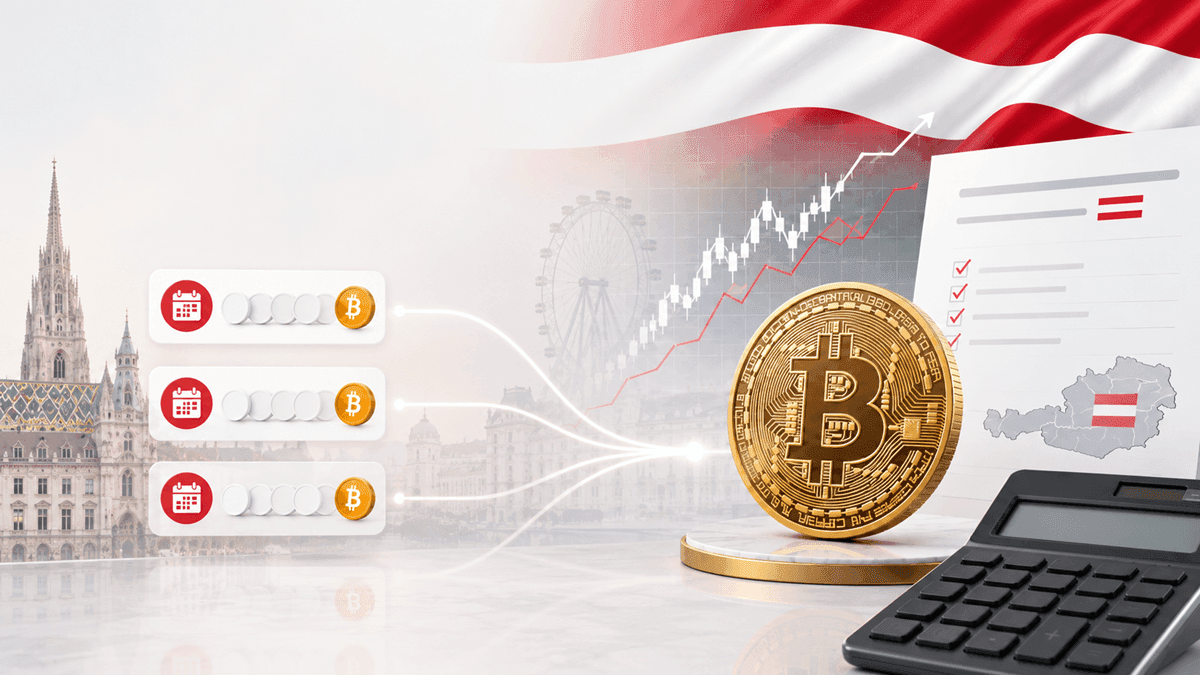
Bitcoin Savings Plan in Austria: How the Purchase Price Is Calculated
Bought bitcoin through a savings plan? For multiple purchases Austria applies the moving average price as a matter of principle when working out taxable gains.
October 6, 2026 4:32 AM
Bitcoin for a gift card: what paying with crypto means for your holding period
Paying for a gift card with Bitcoin is a sale for tax purposes. What counts as the disposal proceeds, when the twelve-month holding period bites, and the four records the tax office expects.
June 6, 2026 3:56 PM
DCA Crypto: How to Survive Crypto Crashes with Dollar Cost Averaging and Invest for the Long Term
Bitcoin from $120,000 to $60,000? With the DCA strategy, you invest step by step and use crypto crashes as an opportunity instead of selling in a panic.
October 10, 2026 7:15 PM

ING and Bitcoin: Around 50 Crypto ETNs in the Portfolio, and What the Delivery Claim Means for Your Holding Period
Bitcoin can be bought at ING, but only as an exchange-traded note: around 50 crypto ETNs from five issuers, as a one-off purchase or a savings plan from one euro. What the offer really costs, and what the one-year holding period hangs on, is not in the advertising but in the key information document.
September 26, 2026 1:19 AM

Germany’s Crypto Holding Period Is Wobbling: What to Check Before December 31
A CDU member of the Bundestag makes it plain: the coalition agreement does not guarantee that the one-year holding period for crypto assets will survive. What that means for purchases made before the planned cutoff date of December 31, 2026.
September 9, 2026 1:15 AM

Germany's Crypto Tax: 160 Million Euros for a 555-Billion Budget
The German finance ministry's draft bill puts a figure on the crypto tax for the first time: 160 million euros from 2028. What that number means in the 2027 federal budget, how 11.4 billion became 160 million, and what investors can read from it.
October 16, 2026 7:25 PM

Crypto holding period for Bitcoin: “That remains to be seen,” says the finance ministry
The federal cabinet did not adopt the draft abolishing the one-year crypto holding period on October 14, 2026; it is still stuck in inter-ministerial consultation. This overview sets out what applies today, which dates follow and why the December 31, 2026 cutoff has no force of law so far.
October 9, 2026 1:18 PM

Bitcoin Tax: One Year Past the $126,080 Peak, Losses No Longer Count
Bitcoin trades at $82,558 on Friday morning, 34.5 percent below an all-time high that is now a good year old. Anyone who bought back then loses more than the prospect of a quick recovery when the one-year period expires: the tax value of the loss goes with it.
September 8, 2026 1:19 AM

Germany's Crypto Holding Period: What Happens Now Signing for Petition 201716 Closed on September 15
Recap as of September 27, 2026: the signature period for German parliamentary petition 201716, which asks for the one-year crypto holding period to be preserved, closed on September 15, 2026. This article explains what ended that day, how the petitions committee proceeds and why no investor has to sell because of it.
September 17, 2026 7:12 PM

Gifting Bitcoin to Children: Allowance, Holding Period and the Tax Office Report
Transferring Bitcoin to your child hands over your holding period and your entry price along with the coins. This guide sets out what really applies in Germany on the allowance, the reporting deadline, representation and custody.
September 16, 2026 1:20 PM

Crypto Loss Carryforward in Germany: What Happens to Old Losses Under the 2027 Tax Plan
Losses from crypto sales land in a ring-fenced pot and can only be set against gains of the same kind. The draft bill for 2027 moves future gains into a different pot, and we show you what that means for your assessed carryforward and what your tax notice should say.
September 9, 2026 4:13 PM

Bitcoin 29 Percent Below Last Year: Which Crypto Losses You Can Still Use Before the One-Year Holding Period Expires
Nine out of ten major crypto assets trade lower today than exactly twelve months ago, Bitcoin alone by 29.2 percent. We measured the price series ourselves and show why the purchase date alone decides the tax value of your loss.
September 16, 2026 7:12 PM

Borrowing Against Bitcoin Instead of Selling: When German Tax Still Applies
Posting Bitcoin as collateral for a loan is not a sale in Germany, because section 39 of the Fiscal Code keeps the coins attributed to you for tax purposes. Tax arises only when the collateral is liquidated, and then the one thing that decides the bill is how long you held the coins beforehand.
September 7, 2026 7:22 AM

German Crypto Holding Period Set to Go After All: A Separate Draft Targets Purchases From 2027
Correction of 8 October 2026: The Income Tax Reform Act 2027, adopted by the German federal cabinet on 2 September, does not cover crypto assets. That did not mean the holding period stays. A separate draft bill from the Federal Ministry of Finance, dated 30 September, would abolish it for anything acquired after 31 December 2026. The cabinet is due to decide on 14 October.
August 21, 2026 1:33 PM

Bitcoin With No Cost Basis: How Austria Taxes the Sale
Bitcoin purchase price no longer provable? How Austria works out the capital gains tax, when a flat-rate cost basis applies and what investors can do.
September 25, 2026 10:26 PM

Selling bitcoin privately: the tax in Germany and the records you need
A direct sale to a private individual falls under the same one-year rule as an exchange sale, but there is no tax report to go with it. This guide walks through the calculation, the 1,000 euro threshold and the records the tax office wants to see.
September 24, 2026 1:13 AM

Solana DEX Trades Overtake the NYSE: What to Check on Swaps, Tax and Oversight
Solana's decentralised exchanges settled roughly 208 million trades in a single week and overtook the New York Stock Exchange for the first time. The figure is real, but it measures something other than the comparison suggests, and for German investors it carries tax duties that no provider takes on.
September 17, 2026 10:22 PM

Selling Bitcoin at a Loss and Buying It Straight Back: What That Does to Your Holding Period
Germany has no wash sale rule: the loss stays deductible even if you buy back immediately. The buyback, however, restarts the one-year period for every new unit.
August 14, 2026 6:23 AM

Bitcoin Savings Plan and Tax: How the Holding Period, FIFO and the Exemption Limit Interact on Monthly Buys
Every savings plan instalment is a separate acquisition for tax purposes, with a holding period of its own. How the exemption limit, the order of disposal and record-keeping duties interact on monthly Bitcoin buys, with the sources from the statute and the Ministry of Finance circular.
October 19, 2026 4:15 AM

Crypto FIFO across several exchanges: each wallet counts on its own in Germany
Hold bitcoin on several exchanges and in wallets of your own, and the holding period is calculated per pot, not across the total holding. What paragraph 62 of the BMF guidance orders, and why 31 December 2026 hangs on it.
October 19, 2026 7:22 AM

Bitcoin price at $82,769 after two days on a third of the turnover: the level that decides
Bitcoin opens the week at $82,769, 1.6 percent above Friday's close. The gain was built over two days running on a good third of the usual turnover, and that is exactly why the level at $81,501 now decides.
September 27, 2026 4:12 AM

Bitcoin ETF Inflows Turn 2026 Positive: How to Tell If the Demand Holds
US spot Bitcoin ETFs took in roughly $2.4 billion in the week to September 25, the strongest week since October 2025, and that turns the 2026 year-to-date balance positive. Why the daily inflow fell 87 percent within the same week, and what to check on buying route, holding period and custody.
September 12, 2026 10:11 PM

Crypto CFD or Buying Real Coins? How Leverage, Margin Calls and Tax Differ
With a crypto CFD you own a contract; with a direct purchase you own the crypto asset itself. From that one difference follow the 2:1 leverage cap, forced close-out, the tax burden and the question of who is liable for your money if things go wrong.
September 10, 2026 4:15 PM

BW-Bank Opens Bitcoin Trading Inside the Securities Account: What to Check Before Your First Buy
Since September 9, 2026, BW-Bank customers have been able to trade ten crypto assets through their securities account, executed and held in custody by Bitpanda. The familiar securities-account setting hides three points you should settle before your first order.
October 2, 2026 5:02 PM

Bitcoin or Ethereum in the fourth quarter of 2026: the two largest crypto-assets compared
Bitcoin is scarce by protocol rule, Ethereum only as scarce as its utilisation, and on access and tax in Germany the paths part again. This comparison puts the verifiable figures on supply, usage, staking and purchase route side by side, without making a price call.
More from CryptoTicker