
Selling bitcoin privately: the tax in Germany and the records you need
A direct sale to a private individual falls under the same one-year rule as an exchange sale, but there is no tax report to go with it. This guide walks through the calculation, the 1,000 euro threshold and the records the tax office wants to see.





Which topics should we dive deeper into?
Select what genuinely interests you. Your picks feed directly into our editorial planning.
Crypto news that's actually worth your time.
Weekly. 60 seconds. Carefully curated by our editors: no hype, no promo flood, no spam.
Selling bitcoin privately is not a special case under German tax law. The same rule applies as for a sale through a crypto exchange: if more than a year sits between purchase and sale, the gain is tax free under Section 23 of the German Income Tax Act. Sell inside the one-year window and the gain becomes taxable as soon as all private disposals in a single calendar year together exceed the threshold of 1,000 euros. Whether the money changes hands as cash across a café table, arrives by SEPA transfer or runs through the escrow of a peer-to-peer marketplace makes no difference to that calculation.
The difference from an exchange sale lies elsewhere, and it is the reason for this guide: an exchange gives you a transaction report at the end of the year showing the acquisition date, the sale price and the gain. On a direct sale of bitcoin to a private individual, that report does not exist. You build the chain of evidence for the tax office yourself, and the best day to do it is the day of the sale.
This article explains how to calculate the taxable gain on a peer-to-peer sale, which documents you need, when the threshold tips over, what anti-money-laundering law expects of you, and where the figures belong in your tax return.
What is taxed is the gain, not the sale price
A private disposal is the sale of another asset within one year of its acquisition. Under German income tax law, crypto assets such as bitcoin or ether count as these other assets, which is why Section 23 applies rather than the flat withholding tax on investment income. Only the gain is taxable.
The calculation is plain: sale price minus acquisition cost minus associated expenses. The sale price is the amount you actually receive, in euros. The acquisition cost is the purchase price of the coins sold plus the proportionate purchase fee. Associated expenses cover costs attributable to the individual sale, such as the network fee for the transfer to the buyer's wallet or a fee charged by the peer-to-peer marketplace.
Worked example: in March you bought 0.2 BTC for 16,000 euros and paid an 80 euro purchase fee. In September you sell those same 0.2 BTC privately for 19,000 euros and pay a 12 euro network fee for the transfer. Your disposal gain is 19,000 minus 16,080 minus 12, so 2,908 euros. That amount is taxable, because less than a year separated purchase from sale and the threshold has been exceeded.
The rate applied to that gain is your personal income tax rate, the same rate that applies to your salary or your business profit. Private disposals carry no flat 25 percent rate of the kind that applies to interest and dividends. The solidarity surcharge is added, as is church tax if you are liable for it. The term speculation tax, used colloquially for this charge, appears in no statute; what is always meant is income tax on a private disposal.
When is a bitcoin sale tax free? The one-year holding period under Section 23
Hold your coins for longer than a year and the gain on sale is entirely tax free, regardless of its size. A gain of 50,000 euros after fourteen months of holding triggers no tax at all. This one-year speculation period is the most effective lever a private investor has on crypto assets under German tax law. The statutory text sits in Section 23 of the German Income Tax Act.
The period runs to the exact day. What counts is the acquisition date, meaning the day you acquired the coins, and the date of disposal. A purchase on May 14 means that a sale from May 15 of the following year onwards falls outside the one-year window. Deliver one day too early on a peer-to-peer sale and you lose the tax exemption for the coins concerned in full.
What does not extend or interrupt the one-year period
A transfer between your own wallets is not a disposal and does not restart the clock. You can therefore move your coins from an exchange to a hardware wallet before selling without touching the holding period. Staking and lending are a different matter: where coins are made available to third parties for use, the treatment of the holding period was contested for a long time, and the Federal Ministry of Finance dropped the earlier extension to ten years as far back as its 2022 version. If part of your holding comes back from staking, it is worth checking your own history before you sell.
The 1,000 euro threshold is not an allowance
Gains from private disposals within the one-year window are subject to a threshold of 1,000 euros per calendar year. It has sat at this level since the 2024 assessment period, having previously been 600 euros. The distinction between a threshold and an allowance decides the entire tax charge, and the two are regularly confused.
A threshold works on an all-or-nothing basis: stay below it and the gain remains entirely tax free. Exceed it by even a single euro and the whole gain becomes taxable, not merely the part above the line. An allowance, by contrast, would always be deducted. In concrete terms: a 999 euro gain from peer-to-peer sales is tax free, while a 1,001 euro gain is taxable on the full 1,001 euros.
Important for planning: the threshold applies to all private disposals in a year taken together. If you also sell gold inside the one-year window in the same year, or a collection, or other cryptocurrencies, those gains count towards the same pot. Losses from such transactions can be offset, which may push the total below the threshold. A loss inside the one-year window is only usable for that purpose, however, if you declare it in your tax return.

Cash, bank transfer or escrow: the payment method does not change the tax liability
German tax law grants no privilege to cash payment. Anyone swapping 0.1 BTC for a bundle of notes inside the one-year window has carried out the same taxable transaction as someone selling through a regulated platform. The gain arises at the moment of disposal, and receipt of the purchase price in cash is a receipt.
The same holds for a swap. If you hand over bitcoin in a direct deal and receive another coin or a stablecoin in return, that too is a disposal. It is valued at the market value in euros at the time of the swap. For the asset received, a fresh one-year period begins at that same moment. Paying for goods with bitcoin between private individuals is likewise a sale for tax purposes.
Selling to friends and family
A sale to people you know remains a sale, even at a friendly price. Sell noticeably below market value and the tax office may treat part of the transaction as a gift. A genuine gift, on the other hand, is not a private disposal: the recipient steps into your shoes and takes over your acquisition date and your acquisition cost. For the gift itself, the rules on gift tax may apply depending on the value and the family relationship, with allowances of their own.
 Crypto tax software compared
FIFO and acquisition costs: which coins you hand over in a peer-to-peer sale
Bitcoin is divisible and carries no individual marking. Anyone who has bought at different prices over the years therefore has to determine which acquisition costs belong to the sale. That is the purpose of the FIFO method: first in, first out means the coins bought first count as the ones sold first. The method decides two things at once, because it fixes both the gain and the holding period of the units sold.
An example: you bought 0.3 BTC in January 2024 for 18,000 euros and a further 0.3 BTC in June 2026 for 30,000 euros. If you now sell 0.3 BTC privately, first in, first out treats the January 2024 coins as disposed of. The gain comes out larger, because the older acquisition costs were lower, yet it is tax free, because those coins were held for more than a year. Anyone who does not know the sequence either gives away a tax exemption or declares too much.
The Federal Ministry of Finance set out how this applies in its circular of March 6, 2025 (file reference IV C 1 - S 2256/00042/064/043), which replaces the earlier circular of May 10, 2022. Under that circular, a wallet-based or address-based view governs crypto assets held privately, and FIFO is permitted as the consumption sequence per wallet. In practice that means you account separately for each wallet and each exchange account. How that looks with old holdings scattered across several places is covered at length in our article on calculating acquisition costs and gains on a purchase made years ago.
Are crypto gains reported to the tax office?
New reporting obligations have applied to crypto-asset service providers since January 1, 2026. The German Crypto Asset Tax Transparency Act transposes the EU directive DAC8 into German law and requires reporting providers to send user and transaction data to the Federal Central Tax Office, which passes the data on to local tax offices and to other states. The first reporting period is the 2026 calendar year, with transmission taking place the year after. The obligation falls on the provider, not on you as a user.
From that follows a particularity that is often misread in peer-to-peer trading. A deal you settle directly with another person, with no service provider involved, appears in none of these reports. That does not make the gain tax free. The tax liability arises from statute, not from a report, and your duty to declare exists regardless of what any platform reports. Anyone failing to declare a taxable gain risks a tax shortfall with the consequences that follow.
On top of that, both sides of a peer-to-peer deal leave traces. The blockchain transaction is permanently public, the counterparty may well have bought or sold through an exchange, and the arrival of the purchase price in your bank account is documented. The notion that a direct sale is an unobserved event does not hold up in practice.

Your chain of evidence on a peer-to-peer sale: which records the tax office expects
The circular of March 6, 2025 devotes its own section to the duties of declaration, cooperation and record-keeping, and makes clear that these cooperation duties apply to crypto assets held privately as well. Where a platform supplies a tax report, the tax authority examines whether it is plausible, internally consistent and not obviously incomplete, and whether the settings are apparent, such as the prices applied and the consumption sequence used. On a private sale there is no such report, so you have to produce the same traceability yourself.
A sensible approach is your own schedule, drawn up on the day of the deal and kept. It should contain:
- Date and time of the sale and of the original purchase, each with supporting documents
- Quantity in coins, to the full decimal place
- Sale price in euros and the form of payment
- The price applied and its source, where the price differs from market value
- Transaction ID of the blockchain transfer, sending and receiving address
- Network and platform fees paid, as associated expenses
- Details of the counterparty and, for a larger amount, a written agreement signed by both sides
A short sale confirmation on paper takes ten minutes and saves considerable effort in any later audit. The transaction history of the exchange where you originally bought the coins belongs in the archive too, because exchanges close, and access that works today is not guaranteed in five years. If you would rather not keep the document collection by hand, our comparison of crypto tax software and portfolio trackers covers software that can record your own transactions, including peer-to-peer deals you enter yourself, and output them as a tax report.
Anti-money-laundering law and due care when selling to strangers
Alongside tax, a private sale raises a second legal question that has nothing to do with the tax office. Anyone taking coins from an unknown person, or handing them over for cash of unclear origin, can end up in money-laundering proceedings, because negligent conduct alone can suffice where circumstances point to an illegal source. For you as the seller, the reverse applies: cash from a sale that you later deposit at a bank can prompt questions.
Questions of that kind discharge a statutory duty of the bank, which has to monitor business relationships on an ongoing basis and establish the plausibility of the origin of assets. They can be answered with exactly the documents from the previous section: purchase record, transaction history, sale confirmation. Sensible precautions during the deal itself are a public meeting place, the identity of the counterparty, a traceable payment trail, and declining any deal where the other side demands unusual haste or anonymity.
Anyone unwilling to carry that effort sells through a supervised provider. Platforms providing crypto-asset services to customers in the EU have required authorisation since the MiCA regulation took effect; which providers can show such a permission is set out in our overview of regulated crypto exchanges. The drawback is the identity check, the benefit is the report you receive at the end of the year.
 Crypto exchanges with EU authorisation
Where disposal gains belong in the tax return
Gains from private disposals of crypto assets go into Anlage SO of the income tax return, in the section for private disposals. A gain exceeding the threshold must be declared, and a loss is worth declaring too, because it can be offset against other gains of the same income category and carried forward. Gains that are tax free because the one-year period has elapsed do not belong in Anlage SO, but should stay documented.
What has to be stated is the acquisition and disposal dates, the acquisition cost, the disposal price and the associated expenses. Where there are several transactions, attaching a schedule is advisable rather than entering totals with no derivation: a traceable table answers questions before they arise. The individual lines and boxes are explained in our article on where crypto gains are entered in the tax return.
Deadlines: the tax return for a calendar year is in principle due by July 31 of the following year. Anyone instructing a tax adviser or an income tax assistance association has considerably longer. Where the history across several years is hard to follow, where the trading takes on commercial features, or where the amounts are larger, tax advice is worth the money; this guide is no substitute for it.
When private trading becomes a business
The rules in this article apply to crypto assets held as private assets. Anyone trading at high frequency, working with other people's capital, presenting themselves outwardly as a dealer, or building an organisation for the purpose, can move close to a commercial activity. Different provisions then apply: the one-year period falls away, the gains become business income, and bookkeeping duties arrive along with trade tax depending on the circumstances.
A private investor selling coins a few times a year is a long way from that. Anyone regularly acting as counterparty for others, however, and earning an income from the spread between purchase and sale, should have the classification examined professionally before the tax office does it for them. Mining and commercial brokering likewise fall into a different category from the occasional private sale.
What could still change in crypto taxation
The one-year holding period is politically contested. The draft federal budget of July 3, 2026 contains a proposal to treat gains from crypto assets like investment income in future, meaning like interest, dividends and share gains. That would end the tax exemption after one year and bring a flat rate instead. As at the time of this article, the proposal is a political plan.
For your decision today, then, the law as it stands applies: for as long as Section 23 remains in its current form, a gain after more than a year of holding stays tax free. Anyone holding a larger position with unrealised gains should keep an eye on the legislation without letting a draft drive them into a hasty sale that breaks the holding period and thereby triggers exactly the tax it was meant to avoid.
Common mistakes when selling bitcoin privately
Four patterns recur in practice, and all four are avoidable:
- Selling shortly before the anniversary. A few days of patience decide whether the gain is entirely tax free. Every sale deserves a look at the purchase date of the units concerned.
- Assuming cash is invisible. The transaction is taxable, and depositing cash at the bank creates a documentation duty of its own.
- The forgotten swap. Anyone exchanging coin for coin in a direct deal has sold, even without seeing a single euro.
- Missing documentation of the purchase. Without evidence of the acquisition cost, the tax office can estimate the gain, and an estimate rarely lands in your favour.
Selling bitcoin privately: what to take away
- Check the purchase date first, then the price. Use first in, first out per wallet to work out which units you are handing over and how long they have been held. If the purchase is more than a year back, the gain is tax free; if it is less, calculate the gain and compare it with the 1,000 euro threshold. Tools for that are covered in our comparison of crypto tax software and portfolio trackers.
- Build the chain of evidence on the day of the sale. Purchase record, transaction ID, quantity, price, fees and a short written confirmation from the counterparty. If you would rather skip that effort, sell through a supervised provider from our overview of regulated crypto exchanges, which will supply you with an annual report.
- Enter the gain in Anlage SO, and a loss as well. A declared loss reduces the tax on other disposal gains in the same year. Which selling routes exist alongside a private deal, and what they cost, is shown in our comparison on how to sell bitcoin.
(As of September 25, 2026. This article is not investment advice. Prices and fee structures change; check the terms with the provider before you buy.)
Transparency note: This article was produced with the assistance of artificial intelligence and reviewed by our editorial team before publication. All figures and claims were checked against the primary sources linked in the text. The feature image was generated with AI.
More on Bitcoin: All Bitcoin news at a glance
Related articles
- Bitcoin for a gift card: what paying with crypto means for your holding period
- Bitcoin 29 Percent Below Last Year: Which Crypto Losses You Can Still Use Before the One-Year Holding Period Expires
- Selling Bitcoin at a Loss and Buying It Straight Back: What That Does to Your Holding Period
- Borrowing Against Bitcoin Instead of Selling: When German Tax Still Applies
- Germany's Crypto Holding Period: What Happens Now Signing for Petition 201716 Closed on September 15
Which topics should we dive deeper into?
Select what genuinely interests you. Your picks feed directly into our editorial planning.
Crypto news that's actually worth your time.
Weekly. 60 seconds. Carefully curated by our editors: no hype, no promo flood, no spam.

September 27, 2026 1:17 PM
Dogecoin Price: What to Check on Holding Period and Custody Before the Year End
The Dogecoin price stands at $0.0977 on September 27, 2026 and has barely moved in a day. That calm is exactly the moment to work through the holding period, the reporting duty from 2026 and custody without any time pressure.

September 17, 2026 7:12 PM

Gifting Bitcoin to Children: Allowance, Holding Period and the Tax Office Report
Transferring Bitcoin to your child hands over your holding period and your entry price along with the coins. This guide sets out what really applies in Germany on the allowance, the reporting deadline, representation and custody.
September 14, 2026 10:23 AM

Take Ethereum Profits or Wait Out the Holding Period? What the Price Jump Means for Your Tax Bill
Ether reached its highest level since the end of January on September 11, 2026, and many are asking whether to sell now. In Germany the answer hangs on the purchase date first: we work out which tranches are tax free and which of them are showing a gain at all.
September 7, 2026 7:22 AM

German Crypto Holding Period Set to Go After All: A Separate Draft Targets Purchases From 2027
Correction of 8 October 2026: The Income Tax Reform Act 2027, adopted by the German federal cabinet on 2 September, does not cover crypto assets. That did not mean the holding period stays. A separate draft bill from the Federal Ministry of Finance, dated 30 September, would abolish it for anything acquired after 31 December 2026. The cabinet is due to decide on 14 October.
September 19, 2026 7:26 AM

Offsetting Crypto Losses Against Share Gains: What Is Really Allowed in Germany
Crypto losses and share gains sit in separate loss buckets in Germany, and there is no offsetting between them. Where the line runs, why crypto derivatives are the exception, and how you can still use losses through carryback and carryforward.
August 24, 2026 4:22 AM

Selling XRP After a 53 Percent Week: What the Holding Period Costs
XRP trades at $1.51 after a weekly gain of a good 50 percent, yet your net proceeds are decided by the purchase date. This article works through the holding period, the exemption limit and FIFO at measured reference-date prices.
September 8, 2026 10:21 PM

Crypto Holding Period and Grandfathering: Why December 31, 2026 Becomes the Cut-Off in Germany's Draft Bill
A ministerial draft bill from Germany's finance ministry names a cut-off date for the first time: crypto assets acquired after December 31, 2026 are to fall under the flat-rate withholding tax. What that means for legacy holdings, running savings plans and staking income, and why nothing has been decided yet.
September 24, 2026 4:28 AM

Crypto Trading Bots and Tax: What Applies With Thousands of Trades a Year
A bot turns one investment decision into hundreds of disposals, and the tax office counts every single one. This guide explains the holding period, FIFO, the exemption limit and the record-keeping duties, and what to set up before the bot makes its first trade.
August 28, 2026 10:15 AM

Selling Bitcoin Privately: What Tax Applies in Austria
Selling bitcoin directly to another person? In Austria, private sales can still trigger 27.5 percent tax on the realised gain.
October 9, 2026 1:18 PM

Bitcoin Tax: One Year Past the $126,080 Peak, Losses No Longer Count
Bitcoin trades at $82,558 on Friday morning, 34.5 percent below an all-time high that is now a good year old. Anyone who bought back then loses more than the prospect of a quick recovery when the one-year period expires: the tax value of the loss goes with it.
September 16, 2026 1:20 PM

Crypto Loss Carryforward in Germany: What Happens to Old Losses Under the 2027 Tax Plan
Losses from crypto sales land in a ring-fenced pot and can only be set against gains of the same kind. The draft bill for 2027 moves future gains into a different pot, and we show you what that means for your assessed carryforward and what your tax notice should say.
August 21, 2026 4:24 AM

Forced Sale on a Crypto Exchange: Which Moment Counts for the Holding Period and What You Must Document
At Luno, Kraken and Valour the deadlines are running out, after which the provider realises the remaining holding itself. For tax purposes that is a disposal, and what governs it is the exchange's timestamp.
August 11, 2026 9:13 PM

Germany's Crypto Holding Period Faces Abolition: What Petition 201716 and the Draft Bill Mean for Your Tax
Petition 201716 calls for the one-year holding period for crypto assets to be kept and will be heard in public by the Bundestag's Petitions Committee on 12 October 2026. Correction of 8 October: the reform was not decided by the cabinet in July. A draft bill of 30 September would end the holding period for crypto acquired after 31 December 2026, and the cabinet is due to take it up on 14 October.
September 26, 2026 1:19 AM

Germany’s Crypto Holding Period Is Wobbling: What to Check Before December 31
A CDU member of the Bundestag makes it plain: the coalition agreement does not guarantee that the one-year holding period for crypto assets will survive. What that means for purchases made before the planned cutoff date of December 31, 2026.
September 24, 2026 1:13 AM

Solana DEX Trades Overtake the NYSE: What to Check on Swaps, Tax and Oversight
Solana's decentralised exchanges settled roughly 208 million trades in a single week and overtook the New York Stock Exchange for the first time. The figure is real, but it measures something other than the comparison suggests, and for German investors it carries tax duties that no provider takes on.
October 15, 2026 4:13 AM

Crypto holding period: the cabinet date passes without a decision, December 31 stays the cut-off
Germany's federal cabinet did not adopt the expected decision of October 14, 2026 to abolish the one-year crypto holding period; the draft is still in interdepartmental consultation. Until new rules arrive, gains stay tax free after one year of holding, and the December 31, 2026 cut-off named in the draft separates old holdings from new ones.
September 9, 2026 4:22 PM
Crypto Tax in Germany: What Applies in 2026 and What Is Set to Change in 2027
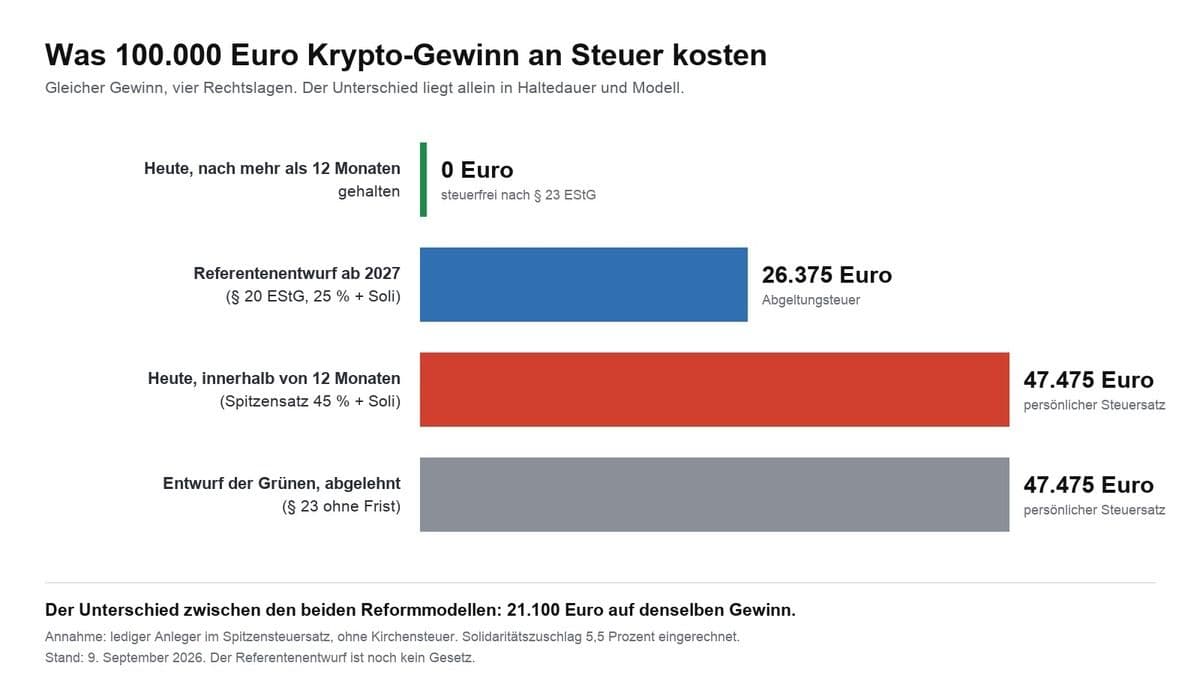
Crypto gains are tax-free after twelve months; before that your personal tax rate of up to 45 percent applies. What triggers tax, how the holding period is calculated, what happens with staking and losses, and what the draft bill would change from 2027.
September 22, 2026 10:13 AM

Circle Lends Against Bitcoin via cirBTC: Why the Wrapper Can Cost You the German Holding Period
Circle launched loans against deposited bitcoin on September 21, 2026. In Germany, the detour through the cirBTC token is very likely a swap, and a swap restarts your one-year holding period.
August 14, 2026 6:23 AM

Bitcoin Savings Plan and Tax: How the Holding Period, FIFO and the Exemption Limit Interact on Monthly Buys
Every savings plan instalment is a separate acquisition for tax purposes, with a holding period of its own. How the exemption limit, the order of disposal and record-keeping duties interact on monthly Bitcoin buys, with the sources from the statute and the Ministry of Finance circular.
September 10, 2026 1:13 AM

Staking Taxes in Germany: The Inflow, the 256-Euro Threshold and the Holding Period
Staking is taxed twice: once when the reward arrives and once when you sell it later. This article explains both moments, the threshold of 256 euros, the separate twelve-month period and what applies to liquid staking, restaking and staking ETPs.
October 5, 2026 10:14 AM
Solana price 108.46 euros: a 2.4 percent gain in euros, a 2.5 percent loss in dollars: what to check now
Solana is quoted at 108.46 euros and $121.30 on Monday morning. That leaves a gain of 2.4 percent for 2026 in euros and a loss of 2.5 percent in dollars. The difference comes purely from the exchange rate, and in Germany it decides the holding period, the tax threshold and the figure that ends up on the tax return.
September 7, 2026 10:24 AM

Gifting Bitcoin to Children: Tax Rules in Austria
Giving bitcoin to your children? When a gift notification is required in Austria, and which acquisition costs the child takes over.
August 21, 2026 1:42 PM

Writing Off a Total Crypto Loss: When the Tax Office Recognises Worthless Coins
A token that has collapsed only reduces your tax once you actually dispose of it. What applies to delisting, exchange insolvency and worthless holdings under Section 23 of the German Income Tax Act, and how you offset losses.
September 18, 2026 10:13 AM

Bitcoin and the German Exit Tax: What Applies When You Move Abroad
Anyone emigrating with Bitcoin expects an exit tax on unrealised gains and finds nothing of the sort in the statute. Where the real risks sit is decided at four points: residence, the holding period, the legal form of your investment, and automatic reporting from 2026.
August 16, 2026 6:14 AM
Crypto Credit Card Tax in Germany: Why Every Payment Is a Disposal
Paying with a crypto credit card means disposing of your coins for tax purposes. What that means for the holding period, the exemption threshold and your record-keeping duties, and which card design keeps the effort small.
October 6, 2026 10:24 PM

Germany's Crypto Holding Period Before the Petitions Committee on October 12: What Matters Now
The Bundestag's petitions committee debates the crypto holding period on Monday, October 12, 2026, from 12 noon in a public sitting, with federal government representatives on hand for questions. Two days later the cabinet is to decide on the draft bill that removes the one-year period for purchases from 2027.
August 24, 2026 10:16 AM

Crypto Tax: Why You Have to Secure Your Transaction History Before the Exchange Closes Your Account
Deadlines run out at several crypto exchanges by early September, after which accounts close and holdings are sold off by force. Anyone who does not export the trading record beforehand faces the tax return with no proof of acquisition date and purchase price.
More from CryptoTicker