
Crypto Tax: Why You Have to Secure Your Transaction History Before the Exchange Closes Your Account
Deadlines run out at several crypto exchanges by early September, after which accounts close and holdings are sold off by force. Anyone who does not export the trading record beforehand faces the tax return with no proof of acquisition date and purchase price.





Which topics should we dive deeper into?
Select what genuinely interests you. Your picks feed directly into our editorial planning.
Crypto news that's actually worth your time.
Weekly. 60 seconds. Carefully curated by our editors: no hype, no promo flood, no spam.
Anyone forced to close an account at a crypto exchange should download the full transaction history before the cut-off date. The reason is crypto tax: it is up to you to prove to the tax office when you bought and what you paid. Once the account is closed, the trading record is as a rule no longer retrievable, and the burden of proof still sits with you.
This is not a theoretical question at the moment. Over the coming weeks, several trading venues reach deadlines after which accounts are closed, balances are sold off by force, or individual tokens are pulled from trading. It also catches investors who did nothing wrong and simply happened to be at the wrong exchange.
Crypto Tax and the Duty of Proof: Why the Exchange Does Not Keep Your Records for You
A crypto exchange is not a German credit institution. It issues no annual tax certificate, it withholds no capital gains tax, and once the business relationship ends it owes you nothing beyond the statutory minimum. What is left of your trading year is whatever you secured yourself.
With a securities account in Germany, the bank does this work. It knows your acquisition costs, offsets losses and reports the result. In crypto, that automatic process does not exist. For private investors, gains from selling Bitcoin or other crypto assets fall under other income and are declared on the Anlage SO form, using figures that you supply.
That shifts the risk. If you sit down to your tax return next April and discover the exchange has been offline for seven months, you do not have an evidence problem with the exchange. You have one with the tax office.
What the Tax Authorities Want to See on Private Disposals
A private disposal means a sale within the statutory period whose gain is taxable. For crypto assets, Section 23 (1) sentence 1 no. 2 of the German Income Tax Act applies, the rule for other economic assets. It turns on whether no more than one year lies between acquisition and disposal.
The entire data requirement follows from that one sentence. To show that a sale took place after the one-year period expired, you need the acquisition date. To calculate a gain, you need the acquisition cost in euros. And to prove that you stayed below the exemption threshold, you need every transaction of the calendar year, not only the large ones. Under the wording of the law, the total gain from private disposals stays tax-free only if it came to less than 1,000 euros in the calendar year.
An exemption threshold is a different thing from an allowance: once it is exceeded, the entire gain becomes taxable and not merely the part above it. Someone who ends the year at 1,050 euros pays tax on 1,050 euros. That is exactly why completeness matters and an approximate overview does not.
Five Deadlines Before the End of September: Which Accounts Are Closing Now
What prompted this article are deadlines already running, not a forecast. According to the notices of the respective providers and consistent reports in the trade press, five dates fall before the end of September that concern German investors directly:
- BitMart ends trading on August 26, 2026 at 01:00 UTC; by its own account, the exchange accepts withdrawal requests only until 05:00 UTC the same day.
- Kraken has set a withdrawal deadline of August 27, 2026 at 14:00 UTC for a series of delisted tokens; remaining balances are liquidated by the exchange itself thereafter.
- Bitfinex permits withdrawals for 13 affected tokens until August 31, 2026 at 10:00 UTC.
- Luno closes its EU accounts on September 1, 2026; selling and euro withdrawals are possible only until August 31.
- BitMEX, following its own delisting notice in August, has announced the closure of the entire exchange for September 23, 2026.
A detailed list of these dates with the respective times can be found in our overview of crypto exchange deadlines. For the tax question, one point is decisive that rarely appears in the announcements: all of these notices govern how long you can withdraw your money. None of them says how long you will still reach your data afterwards.

Transaction History, Tax Report and Account Statement: What Separates the Terms
These three things get mixed up in everyday use, even though they are worth very different amounts.
Transaction history
The transaction history is the raw file of every movement on your account, usually a CSV with timestamp, trading pair, quantity, price and fee. It is awkward to read and at the same time the most valuable thing you can take with you, because everything else can be reconstructed from it.
Tax report
A tax report is an already processed summary that calculates gains and losses by a particular method. It is convenient, but only as good as the assumptions behind it, and it is hard to verify without the underlying raw data.
Account statement
The account statement shows deposits and withdrawals in euros. It proves that money moved, but says nothing about which coins were bought when and at what price. As the sole basis for crypto tax it will not do.
If you have to choose between the three formats, take the raw data. A finished report can be produced from it at any time, for instance with one of the programs in our comparison of crypto tax tools and portfolio trackers. The other way round does not work.
 Crypto Tax Tools and Portfolio Trackers Compared
Section 90 of the Fiscal Code: Why “the Exchange No Longer Exists” Is Not an Excuse
There is a provision that fits precisely this case, and in the debate about crypto tax it usually falls by the wayside. Section 90 of the German Fiscal Code obliges the parties involved to cooperate in establishing the facts. For matters abroad, subsection 2 requires them to exhaust every legal and factual possibility to clarify the facts and obtain evidence.
The uncomfortable part for you sits at the end of that subsection: nobody can invoke a lack of means to clarify matters if they could have secured those means through the way they arranged their own affairs. Someone who knew their account would close at the end of the month and still did not pull the export is therefore in a worse position than someone whose exchange collapsed without warning.
In practice this leads to estimation. If the tax office cannot determine the tax base, it may estimate it under Section 162 of the Fiscal Code, and an estimate rarely turns out in your favor. In the worst case an acquisition price of zero is assumed, so that the entire disposal proceeds count as gain.
FIFO and the Holding Period: Which Data Decide Tax Exemption
FIFO stands for “first in, first out” and means that where several holdings of the same kind exist, the ones acquired first count as sold first. The law prescribes this order expressly for equivalent foreign currency amounts, and the tax authorities apply the same thinking to crypto holdings held per wallet or per exchange.
The tax exemption of a sale therefore hangs on one very specific piece of information: the date of the oldest acquisition in each case. Anyone who has been buying regularly for years has dozens of such dates. They sit in the transaction history and nowhere else.
An example makes the difference tangible. Suppose you bought Bitcoin in small amounts over three years and sell part of it in the fall. If the matched purchase lies more than a year back, the gain stays tax-free under current law. If you cannot document the date, the exemption counts as unproven, because the burden of establishing circumstances that reduce tax sits with you. The same applies to holdings in Ethereum or any other coin.
Forced Liquidation and Delisting: Why an Enforced Sale Is Still Taxable
Many of the current cases do not end with someone selling voluntarily. In a delisting followed by liquidation, the exchange sells the remaining holdings itself and credits the customer with the proceeds. For tax purposes that is a disposal like any other. The fact that you did not trigger it changes nothing about that.
An awkward combination follows from this. The taxable event and the loss of access to the data fall on the same date. The disposal you have to declare in the following year therefore takes place at exactly the moment when the records for it disappear. How such a forced sale plays out in detail is something we set out in our piece on the forced sale at a crypto exchange.
On top of that come costs that eat into the proceeds. Several venues winding down charge fees on balances left behind after the cut-off date; what that adds up to we have collected in our text on residual balances after an exchange closes.
DAC8 and the Crypto Asset Tax Transparency Act: What the Tax Office Will Soon See Anyway
Alongside these wind-downs, the information available to the tax offices is changing. Under the EU directive DAC8, implemented in Germany through the Crypto Asset Tax Transparency Act, providers of crypto asset services become subject to reporting duties. The competent authority is the Federal Central Tax Office, which receives the data and passes it on according to taxing rights. The stated aim is to uncover cross-border arrangements.
For you this has one immediate consequence. Part of your trading data will in future reach the tax office without any action on your part, and it will do so from the exchange's point of view. If your own record then diverges from the reported one, you have to be able to explain the divergence. That works with complete raw data and fails with an estimate from memory.
The scope matters here: the providers carry the reporting duty, you do not. The report does not replace your tax return and does not necessarily contain the acquisition data that matters for the holding period. Above all it raises the likelihood that a gap is noticed.

Which Exchange Delivers What: Why You Should Check This Beforehand
How much a trading venue hands over varies widely, and it can hardly be compared reliably from the outside: the help centers of the large providers are largely blocked against automated retrieval, and what is written there often applies only to certain countries. A dependable list of who issues a finished German tax report and who supplies only a CSV file is therefore something we cannot present at this point.
What can be said: a full raw data export is common at most established venues, whereas a finished report under German tax law is the exception. Check this inside your account while you still have one. When choosing a new venue, this point is worth as close a look as the fees; our overview of regulated crypto exchanges classifies the providers licensed in the EU.
 Regulated Crypto Exchanges Compared
What Exactly to Export Before Access Ends
The following order is sorted by importance. If time is short, work through it from top to bottom.
The complete trading record
All trades since the account was opened, not only the current year. Make sure the export period really reaches back to the first purchase; many interfaces propose only the last twelve months by default. If an annual limit applies, pull the file several times, year by year.
Deposits and withdrawals in euros as well as all crypto transfers
These movements connect your bank account with the exchange account and your exchange account with your wallet. Without them there is no way to show later where a holding came from. Transfers between your own addresses are not a disposal, but you must be able to prove that the addresses were your own.
Staking, interest and bonus payments
These inflows are treated differently for tax purposes than a sale and frequently appear in a separate list that the standard export leaves out. Check whether your venue reports them separately, and download that file as well.
Fee statements and the final balance
Trading and withdrawal fees reduce the gain and should therefore be documented. A screenshot of the balance on the last day costs you fifteen seconds and is a serviceable anchor later, should a figure become disputed.
Save everything twice, in two different places, and do not change the file names. An unaltered original file with the name the exchange gave it looks more credible in a query than a table you named yourself.
If Access Is Already Gone: Which Routes Remain
If you are reading this text too late, not everything is lost. Contacting support is worth it even after the closure, because many providers have to retain data for a while for regulatory reasons, even when the interface has been switched off. A request for access under Article 15 of the General Data Protection Regulation is a legitimate way to obtain the data held about you.
Beyond that, your own traces help: bank statements show deposits and withdrawals with date and amount, old confirmation emails often contain individual trades, and transfers to your own wallet can be traced on the blockchain. Whatever you rebuild from this you should label as a reconstruction and document the method. How to proceed in such a case is described in our piece on crypto taxes without a complete history.
For larger amounts, or if you are unsure whether a gap might be judged reckless, going to a tax adviser with crypto experience is the more sober choice than trying to patch the matter up yourself.
Retention: How Long You Really Need the Data
A statutory retention period of the kind that applies to merchants does not apply to you as a private investor. What is relevant in practice are the periods within which a tax assessment can still be amended. The regular assessment period for income tax is four years and only begins at the end of the year in which the return was filed. In cases of tax evasion it extends to ten years.
There is a second reason, though, that reaches further than any deadline: the holding period itself. As long as you hold a position, you need its acquisition date, even if the purchase was ten years ago. Someone who bought in 2017 and never sold needs the records from 2017 in the year they decide to sell. The rule of thumb is therefore simply this: keep the acquisition data for as long as you hold the coins, and the sale data for at least five years afterwards.
If you are moving your holdings to a new venue anyway, that is a good moment to set up your filing cleanly once and for all. Which providers come into question is shown by our comparison of crypto exchanges.
Securing Crypto Tax Records: What to Take Away
- Pull the complete export before the deadline of your trading venue expires. Trading record since the account was opened, deposits and withdrawals, transfers, staking inflows and fees, as the original file and backed up twice. Whether your provider is affected at all is answered by a look at the list of regulated crypto exchanges.
- Bring the raw data into a form you will still understand in the spring. A CSV file on its own helps you little if you open it again only in April. A program from the comparison of crypto tax tools and portfolio trackers works out the holding periods and the gain on each sale from it.
- When you next open an account, check what the provider will hand over to you later. Export function, period and format belong among the selection criteria, not the fee alone. The crypto exchange comparison is the starting point for that.
(As of August 24, 2026. This article is not investment advice. Prices and fee structures change; check the terms with the provider before you buy.)
Transparency note: This article was produced with the assistance of artificial intelligence and reviewed by our editorial team before publication. All figures and claims were checked against the primary sources linked in the text. The feature image was generated with AI.
Related articles
- Writing Off a Total Crypto Loss: When the Tax Office Recognises Worthless Coins
- Bitcoin Savings Plan and Tax: How the Holding Period, FIFO and the Exemption Limit Interact on Monthly Buys
- Bitcoin 29 Percent Below Last Year: Which Crypto Losses You Can Still Use Before the One-Year Holding Period Expires
- Borrowing Against Bitcoin Instead of Selling: When German Tax Still Applies
- Selling XRP After a 53 Percent Week: What the Holding Period Costs
Which topics should we dive deeper into?
Select what genuinely interests you. Your picks feed directly into our editorial planning.
Crypto news that's actually worth your time.
Weekly. 60 seconds. Carefully curated by our editors: no hype, no promo flood, no spam.

October 17, 2026 4:30 PM

Does swapping Bitcoin for WBTC restart the one-year holding period?
Converting Bitcoin into WBTC triggers a private disposal transaction under one reading and restarts the one-year clock. Under the other the transaction stays tax-neutral: what the statute says, what the Finance Ministry leaves open and which records count either way.
September 25, 2026 10:26 PM

Selling bitcoin privately: the tax in Germany and the records you need
A direct sale to a private individual falls under the same one-year rule as an exchange sale, but there is no tax report to go with it. This guide walks through the calculation, the 1,000 euro threshold and the records the tax office wants to see.
September 17, 2026 7:12 PM

Gifting Bitcoin to Children: Allowance, Holding Period and the Tax Office Report
Transferring Bitcoin to your child hands over your holding period and your entry price along with the coins. This guide sets out what really applies in Germany on the allowance, the reporting deadline, representation and custody.
September 24, 2026 4:28 AM

Crypto Trading Bots and Tax: What Applies With Thousands of Trades a Year
A bot turns one investment decision into hundreds of disposals, and the tax office counts every single one. This guide explains the holding period, FIFO, the exemption limit and the record-keeping duties, and what to set up before the bot makes its first trade.
September 16, 2026 1:20 PM

Crypto Loss Carryforward in Germany: What Happens to Old Losses Under the 2027 Tax Plan
Losses from crypto sales land in a ring-fenced pot and can only be set against gains of the same kind. The draft bill for 2027 moves future gains into a different pot, and we show you what that means for your assessed carryforward and what your tax notice should say.
September 18, 2026 10:13 AM

Bitcoin and the German Exit Tax: What Applies When You Move Abroad
Anyone emigrating with Bitcoin expects an exit tax on unrealised gains and finds nothing of the sort in the statute. Where the real risks sit is decided at four points: residence, the holding period, the legal form of your investment, and automatic reporting from 2026.
August 21, 2026 4:24 AM

Forced Sale on a Crypto Exchange: Which Moment Counts for the Holding Period and What You Must Document
At Luno, Kraken and Valour the deadlines are running out, after which the provider realises the remaining holding itself. For tax purposes that is a disposal, and what governs it is the exchange's timestamp.
September 14, 2026 10:23 AM

Take Ethereum Profits or Wait Out the Holding Period? What the Price Jump Means for Your Tax Bill
Ether reached its highest level since the end of January on September 11, 2026, and many are asking whether to sell now. In Germany the answer hangs on the purchase date first: we work out which tranches are tax free and which of them are showing a gain at all.
October 19, 2026 4:15 AM

Crypto FIFO across several exchanges: each wallet counts on its own in Germany
Hold bitcoin on several exchanges and in wallets of your own, and the holding period is calculated per pot, not across the total holding. What paragraph 62 of the BMF guidance orders, and why 31 December 2026 hangs on it.
September 9, 2026 4:22 PM
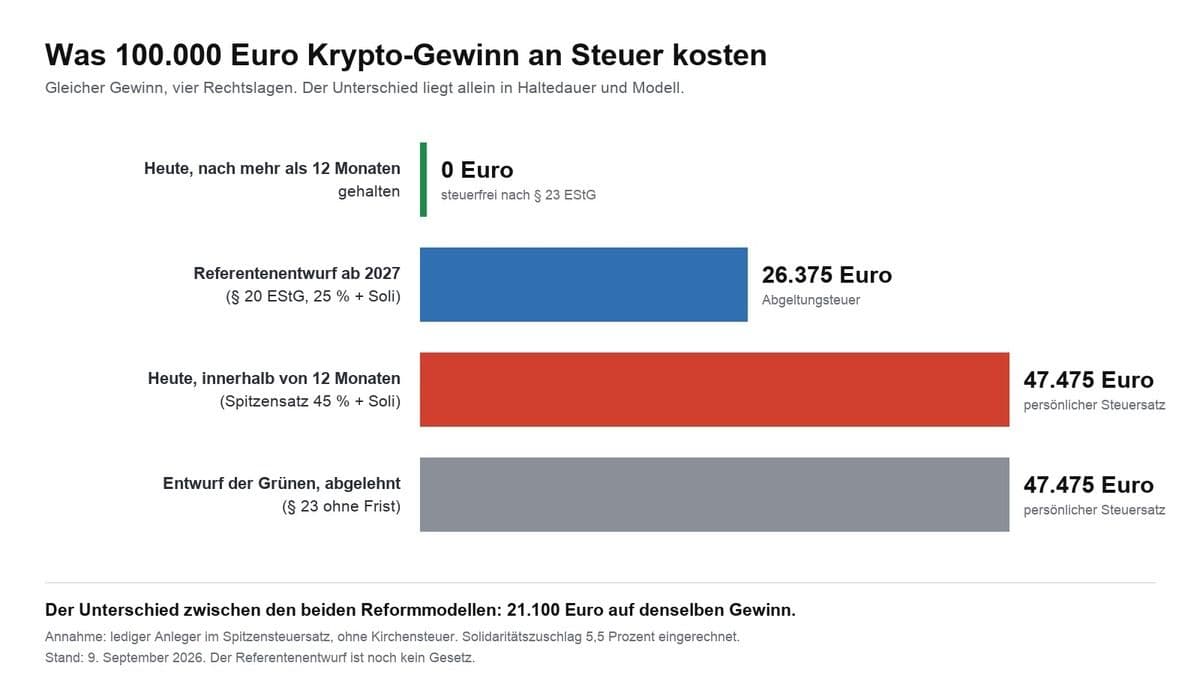
Crypto Tax in Germany: What Applies in 2026 and What Is Set to Change in 2027
Crypto gains are tax-free after twelve months; before that your personal tax rate of up to 45 percent applies. What triggers tax, how the holding period is calculated, what happens with staking and losses, and what the draft bill would change from 2027.
September 7, 2026 7:22 AM

German Crypto Holding Period Set to Go After All: A Separate Draft Targets Purchases From 2027
Correction of 8 October 2026: The Income Tax Reform Act 2027, adopted by the German federal cabinet on 2 September, does not cover crypto assets. That did not mean the holding period stays. A separate draft bill from the Federal Ministry of Finance, dated 30 September, would abolish it for anything acquired after 31 December 2026. The cabinet is due to decide on 14 October.
September 23, 2026 10:32 AM

Switching crypto exchange: what happens to the holding period and the tax when you transfer
A transfer to another exchange or to your own wallet triggers no tax and does not reset the one-year period. What does get lost is the acquisition data, and that is exactly what you need later as evidence.
August 16, 2026 6:14 AM
Crypto Credit Card Tax in Germany: Why Every Payment Is a Disposal
Paying with a crypto credit card means disposing of your coins for tax purposes. What that means for the holding period, the exemption threshold and your record-keeping duties, and which card design keeps the effort small.
September 26, 2026 1:19 AM

Germany’s Crypto Holding Period Is Wobbling: What to Check Before December 31
A CDU member of the Bundestag makes it plain: the coalition agreement does not guarantee that the one-year holding period for crypto assets will survive. What that means for purchases made before the planned cutoff date of December 31, 2026.
September 27, 2026 10:35 AM

Crypto Exchange Tax Report Wrong: How to Correct It Before the Tax Office Does
Missing acquisition costs, transfers booked as sales, holding periods restarted: your exchange's report is an aid and not proof. How to check it, how to correct it and which deadline is running.
September 17, 2026 10:22 PM

Selling Bitcoin at a Loss and Buying It Straight Back: What That Does to Your Holding Period
Germany has no wash sale rule: the loss stays deductible even if you buy back immediately. The buyback, however, restarts the one-year period for every new unit.
September 8, 2026 10:21 PM

Crypto Holding Period and Grandfathering: Why December 31, 2026 Becomes the Cut-Off in Germany's Draft Bill
A ministerial draft bill from Germany's finance ministry names a cut-off date for the first time: crypto assets acquired after December 31, 2026 are to fall under the flat-rate withholding tax. What that means for legacy holdings, running savings plans and staking income, and why nothing has been decided yet.
September 9, 2026 1:15 AM

Germany's Crypto Tax: 160 Million Euros for a 555-Billion Budget
The German finance ministry's draft bill puts a figure on the crypto tax for the first time: 160 million euros from 2028. What that number means in the 2027 federal budget, how 11.4 billion became 160 million, and what investors can read from it.
October 7, 2026 10:54 PM

Two Routes Out of an Exchange Insolvency: Coins Back, or a Dividend in Euros
If the same coins come back after an exchange insolvency, the holding period from the year of acquisition runs on. If a dividend is paid out in money instead, the position is open, and the evidence question decides the case.
October 16, 2026 7:25 PM

Crypto holding period for Bitcoin: “That remains to be seen,” says the finance ministry
The federal cabinet did not adopt the draft abolishing the one-year crypto holding period on October 14, 2026; it is still stuck in inter-ministerial consultation. This overview sets out what applies today, which dates follow and why the December 31, 2026 cutoff has no force of law so far.
October 9, 2026 10:50 AM

Crypto holding period: the Bundestag rejects abolition by 445 votes to 132: what investors need to know
On 8 October the Bundestag rejected the Greens' bill to abolish the crypto holding period in a recorded vote, and the Left's motion fell too. The result by parliamentary group, the official speech from the media centre, and why it was the SPD that gave investors the real signal in the debate.
October 15, 2026 4:13 AM

Crypto holding period: the cabinet date passes without a decision, December 31 stays the cut-off
Germany's federal cabinet did not adopt the expected decision of October 14, 2026 to abolish the one-year crypto holding period; the draft is still in interdepartmental consultation. Until new rules arrive, gains stay tax free after one year of holding, and the December 31, 2026 cut-off named in the draft separates old holdings from new ones.
September 11, 2026 10:18 AM

Bitcoin Tax Audit: What Proof Austria Requires
Which bitcoin records can the Austrian tax office examine? Purchase dates, wallet transfers, acquisition costs and sale proceeds are what count.

October 5, 2026 4:26 PM

Shiba Inu price up 4.4 percent: outperforms the market, but 88 trillion SHIB sit on exchanges
Shiba Inu adds 4.4 percent on Monday, making it the strongest of the six big names. At the same time 88.08 trillion SHIB worth $525 million sit on trading venues, almost five times a single day of turnover.
October 5, 2026 10:14 AM
Solana price 108.46 euros: a 2.4 percent gain in euros, a 2.5 percent loss in dollars: what to check now
Solana is quoted at 108.46 euros and $121.30 on Monday morning. That leaves a gain of 2.4 percent for 2026 in euros and a loss of 2.5 percent in dollars. The difference comes purely from the exchange rate, and in Germany it decides the holding period, the tax threshold and the figure that ends up on the tax return.
September 8, 2026 1:19 AM

Germany's Crypto Holding Period: What Happens Now Signing for Petition 201716 Closed on September 15
Recap as of September 27, 2026: the signature period for German parliamentary petition 201716, which asks for the one-year crypto holding period to be preserved, closed on September 15, 2026. This article explains what ended that day, how the petitions committee proceeds and why no investor has to sell because of it.
September 27, 2026 1:17 PM
Dogecoin Price: What to Check on Holding Period and Custody Before the Year End
The Dogecoin price stands at $0.0977 on September 27, 2026 and has barely moved in a day. That calm is exactly the moment to work through the holding period, the reporting duty from 2026 and custody without any time pressure.
More from CryptoTicker