
Switching crypto exchange: what happens to the holding period and the tax when you transfer
A transfer to another exchange or to your own wallet triggers no tax and does not reset the one-year period. What does get lost is the acquisition data, and that is exactly what you need later as evidence.





Which topics should we dive deeper into?
Select what genuinely interests you. Your picks feed directly into our editorial planning.
Crypto news that's actually worth your time.
Weekly. 60 seconds. Carefully curated by our editors: no hype, no promo flood, no spam.
Anyone sending their coins from one trading platform to another, or to their own wallet, loses neither the holding period nor triggers a tax. A transfer between addresses that belong to you is not a disposal, because nobody pays anything for it and the asset does not change owner. The one-year period of Section 23 of the German Income Tax Act keeps running without interruption.
The switch still gets expensive, just in a different place: the acquisition data breaks off during the transfer. The new platform does not know when you bought and at what price. Anyone not securing that beforehand faces, come the following spring, a holding with no provenance and has to explain to the tax office why the holding period is supposed to have elapsed. This article shows you what really happens for tax purposes, where the wallet-based approach bites, and which records to pull before you hit send.
Switching exchange: what the transfer triggers for tax
The short answer: nothing. Neither on sending nor on arrival does a taxable event arise, as long as sender and recipient are the same person. That follows directly from the structure of the private disposal transaction.
In its circular of March 6, 2025 on individual questions of the income tax treatment of certain crypto assets, the German Federal Ministry of Finance describes in margin number 54 what an acquisition and what a disposal is. An acquisition is the acquisition from third parties for consideration. Mirroring that, the transfer of the acquired asset to third parties for consideration constitutes a disposal. Both features are absent in a transfer to your own address: there is no third party, and no consideration flows.
Under the same margin number, a disposal arises from the exchange of crypto assets into units of a state currency such as the euro, into goods or services, and into other crypto assets. That is exactly where the distinction that matters lies. Anyone sending Bitcoin from one platform to the next has exchanged it for nothing at all. Anyone switching into a different coin along the way has sold.
Why the blockchain entry is not the moment that counts for tax
A widespread misunderstanding holds that every movement on the blockchain is relevant for tax because it is publicly visible. In margin number 20 the ministry expressly clarifies that the recorded inflow and outflow of crypto assets need not coincide with the acquisition or disposal date relevant for income tax.
The same margin number supplies the background: crypto assets are regularly traded via central trading platforms, being first transferred to the platform's personalised account and only booked back into the user's own wallet at a later point. What is then decisive is the time of the trade via the platform, not the time of the booking. The same applies where you use no wallet of your own at all and hold and trade exclusively via a platform.
For a change of platform that means: the deposit booking on the new exchange is not an acquisition date. Your acquisition date remains the day on which you originally bought the coins, and that holds even where the new platform's tax report claims otherwise.
The holding period keeps running: what that means for your year
Under Section 23 (1) sentence 1 no. 2 of the Income Tax Act, a private disposal transaction in other assets is taxable where no more than one year lies between acquisition and disposal. Once that year has elapsed, the gain remains tax free, no matter its size.
Because the transfer is not a disposal, it does not reset that period. An example makes it tangible. You buy coins on platform A on February 4. On September 20 you send them to platform B, and on December 3 onward to a hardware wallet. If you sell on February 10 of the following year, the sale falls outside the one-year period and the gain remains tax free. February 4 is the only date that counts.
Within the one-year period the threshold of Section 23 (3) sentence 5 of the Income Tax Act applies on top: gains from all private disposal transactions of a calendar year remain tax free if their total comes to less than 1,000 euros. Up to and including the 2023 assessment period this limit stood at 600 euros. Here too: once the amount is reached, the entire gain is taxable.

Ten-year holding period: why the extension does not bite with coins
A stubborn rumour says that anyone lending out their coins or earning income with them extends the holding period from one year to ten. That worry keeps many from moving their holdings at all.
Margin number 63 of the BMF circular clears it up: with currency or payment tokens, the extension of the disposal period under Section 23 (1) sentence 1 no. 2 sentence 4 of the Income Tax Act does not apply. The tax authorities took that position in the predecessor circular already and confirmed it in March 2025. For the common coins it therefore stays at one year, even where income was earned in the meantime.
 Crypto exchanges compared
The real trap: the wallet-based approach
If the transfer itself is harmless, why all the care? Because the ministry prescribes how it is to be determined which coins you actually sold. And that rule is tied to the individual wallet.
Individual identification comes first
Margin number 61 names the principle: for determining the order of use of the crypto assets disposed of, individual identification applies. So where you can attribute precisely which unit you bought when and sold again when, that is the governing route.
Where individual identification is not possible, the crypto assets of a trading designation acquired first are deemed to have been disposed of for the purposes of the holding period, and for the valuation the average method is to be applied. The ministry relies here on a judgment of the Federal Fiscal Court of November 24, 1993. For reasons of simplification it may be assumed for the valuation that the crypto assets acquired first were disposed of first, in other words the familiar FiFo method.
Where the wallet boundary runs
Then comes the sentence that becomes decisive when changing platform: a wallet-based approach applies. Within a wallet the chosen method must be retained until all crypto assets of that trading designation in that wallet have been disposed of in full. Only after a complete disposal and a subsequent fresh acquisition may the method be changed. Where crypto assets with differing trading designations are held via one wallet, a separate election exists for each.
In practice that means: spread the same coin across three addresses and you have three separate accounting circles. The order of consumption is not formed across your total holding, but per wallet. Anyone shifting holdings back and forth builds themselves a set of books that can later only be reconstructed with software and complete exports.

What really gets lost in the transfer: the acquisition data
A trading platform knows only what happened on it. When a holding arrives from outside, it sees a deposit with no prior history. Purchase price, purchase date and the order of consumption applied so far do not travel with it.
The ministry has seen this problem. On the plausibility of tax reports, margin number 90 states that adjustments and corrections do not as a rule stand in the way of plausibility where they are marked as such and substantiated comprehensibly, expressly naming as an example: because of missing acquisition costs or acquisition data on transfers to other trading platforms.
That is a relief with a condition. You may add the data later, but you have to mark the correction and be able to substantiate it. Without documents from the old platform only an estimate remains, and an estimate rarely falls in your favour. A tax tool only helps if you feed it the exports from both platforms; an overview of the providers is given by our comparison of crypto tax tools and portfolio trackers.
What to download before you send
Pull the complete transaction export from the old platform as a structured file, not as a PDF. That includes all purchases with date, quantity and price, all sales, all fees, and the withdrawal itself with transaction hash and destination address. Also secure the balance at year end: margin number 104 expressly names wallet holdings on key dates such as December 31 of the assessment period and of the previous year as details the tax authority can request.
The reason for the haste is mundane. Platforms close accounts after inactivity, withdraw from regions or disappear altogether. The export you pull today with two clicks can be a support case in a foreign language two years from now.
The special case: when the switch is a sale after all
Three variants of a platform change are taxable events after all, and to the user they look almost exactly like a harmless transfer.
The detour via a stablecoin. Anyone selling the coin on the old platform, transferring the proceeds as a stablecoin and swapping back on the new platform has triggered two disposals. Both exchanges are disposals under margin number 54, and the holding period starts afresh for the repurchased holding.
The change of wrapper. Where a coin is swapped into a wrapped variant or a network representation during the transfer, an exchange into a different crypto asset regularly exists. Whether asset identity holds in the individual case is a question of the specific design, and in case of doubt the tax authorities will assume an exchange.
The sale on delisting. Where a platform removes an asset from trading and you sell at short notice instead of transferring, that is an entirely ordinary sale with all its consequences. How tight those windows can be is something our editorial team worked through using the example of transferring delisted tokens to a fallback exchange.
 Hardware wallets compared
Network, fees and minimum amounts: the technical part
The tax side is one half. The other is the transfer itself, and that is where the losses happen that can no longer be corrected.
The network first, then the address
The same coin often exists on several networks, and the address formats look confusingly alike. Anyone sending to the wrong network gets their balance back at best after a support case, and at worst not at all. So check first which network the destination platform supports for that asset, and select it explicitly on the sending side. Which mistakes happen most often is shown in our article on why the wrong network when sending so frequently leads to total loss.
The test transfer
Send a small amount first, wait for it to be credited, and only then send the rest. The double network fee is the cheapest insurance premium you can pay in this context. Watch the minimum withdrawal amount on the sending side and the minimum deposit amount on the receiving side, because amounts below the threshold vanish without comment into the accounting on some platforms.
What transaction fees are for tax purposes
Fees incurred on purchase form part of the incidental acquisition costs. Transaction fees expended in connection with a disposal are to be taken into account as income-related expenses under margin number 59. The plain network fee for a transfer between your own addresses, by contrast, is attributed to neither event, because nothing is bought or sold in between. Record it all the same, so that your holding adds up arithmetically after the transfer.
Where you also change the type of custody
Many change platform not because of the fees, but because they want to get their holdings off a platform altogether. That step markedly changes the legal position in the event of insolvency, because with self-custody you hold the keys yourself and depend on no segregation claim.
For tax purposes what was said above still holds: the route to a hardware wallet is also a transfer without consideration and without a third party. What changes is the evidence. On a platform the history sits in the account; with self-custody it sits with you. From that day on you are the bookkeeping yourself, and margin number 103 expressly requires documentation of reallocations within wallets for the wallet-based application of the average or FiFo method.
The checklist for the switch
Work through the points in this order and nothing gets left behind.
- Pull the complete transaction export from the old platform as a structured file and store it outside the platform.
- Note the year-end holdings of the assets concerned, for the current and the preceding year.
- Match the network on both sides and check the minimum amounts.
- Send a test transfer, wait for it to be credited, then transfer the rest.
- Record the transaction hash, destination address, date and network fee of every transfer.
- Document the chosen order of consumption for the new wallet and do not change it again while a holding of that trading designation sits there.
- Reconcile the holding after the transfer against the export before the old platform is closed.
Switching exchange and the holding period: what to take away
The transfer costs you neither tax nor holding period. It costs you traceability if you trigger it unprepared.
- Secure the history before you send. The old platform's export is the only evidence of when you bought. Without it you cannot demonstrate that the one-year period has elapsed. Which platforms deliver usable exports is shown in our exchange comparison.
- Keep the order of consumption per wallet and stick with it. The wallet-based approach is not a recommendation but the requirement from margin number 61. A tax tool calculates that cleanly if you read in both sides, see our comparison of tax tools.
- If you are moving anyway, move properly. Holdings you intend to keep for more than a year belong at an address whose keys you control yourself. Which devices are suitable for that is set out in our hardware wallet comparison.
(As of September 23, 2026. This article is not investment advice. Prices and fee structures change; check the terms with the provider before you buy.)
Transparency note: This article was produced with the assistance of artificial intelligence and reviewed by our editorial team before publication. All figures and claims were checked against the primary sources linked in the text. The feature image was generated with AI.
Related articles
- Forced Sale on a Crypto Exchange: Which Moment Counts for the Holding Period and What You Must Document
- Airdrop tax: when free coins are taxable in Germany
- Crypto Tax: Why You Have to Secure Your Transaction History Before the Exchange Closes Your Account
- Selling XRP After a 53 Percent Week: What the Holding Period Costs
- Bitcoin From a Foreign Exchange to Austria: Which Tax Data You Need
Which topics should we dive deeper into?
Select what genuinely interests you. Your picks feed directly into our editorial planning.
Crypto news that's actually worth your time.
Weekly. 60 seconds. Carefully curated by our editors: no hype, no promo flood, no spam.

October 7, 2026 10:54 PM

Two Routes Out of an Exchange Insolvency: Coins Back, or a Dividend in Euros
If the same coins come back after an exchange insolvency, the holding period from the year of acquisition runs on. If a dividend is paid out in money instead, the position is open, and the evidence question decides the case.
August 14, 2026 6:23 AM

Bitcoin Savings Plan and Tax: How the Holding Period, FIFO and the Exemption Limit Interact on Monthly Buys
Every savings plan instalment is a separate acquisition for tax purposes, with a holding period of its own. How the exemption limit, the order of disposal and record-keeping duties interact on monthly Bitcoin buys, with the sources from the statute and the Ministry of Finance circular.
October 5, 2026 10:14 AM
Solana price 108.46 euros: a 2.4 percent gain in euros, a 2.5 percent loss in dollars: what to check now
Solana is quoted at 108.46 euros and $121.30 on Monday morning. That leaves a gain of 2.4 percent for 2026 in euros and a loss of 2.5 percent in dollars. The difference comes purely from the exchange rate, and in Germany it decides the holding period, the tax threshold and the figure that ends up on the tax return.
September 8, 2026 1:19 AM

Germany's Crypto Holding Period: What Happens Now Signing for Petition 201716 Closed on September 15
Recap as of September 27, 2026: the signature period for German parliamentary petition 201716, which asks for the one-year crypto holding period to be preserved, closed on September 15, 2026. This article explains what ended that day, how the petitions committee proceeds and why no investor has to sell because of it.
September 9, 2026 1:15 AM

Germany's Crypto Tax: 160 Million Euros for a 555-Billion Budget
The German finance ministry's draft bill puts a figure on the crypto tax for the first time: 160 million euros from 2028. What that number means in the 2027 federal budget, how 11.4 billion became 160 million, and what investors can read from it.
October 8, 2026 4:17 AM

Crypto Holding Period: Without a Purchase Record the Tax Withheld Runs Ten Times Too High
The consultation on Germany's crypto tax bill closed on October 6 and the cabinet is to adopt it on October 14, with tax advisers, banks and the Bitcoin Bundesverband having filed their objections. The sharpest concerns everyone whose purchase data the selling platform does not hold: one adviser calculates a withholding ten times the tax owed.
August 21, 2026 1:42 PM

Writing Off a Total Crypto Loss: When the Tax Office Recognises Worthless Coins
A token that has collapsed only reduces your tax once you actually dispose of it. What applies to delisting, exchange insolvency and worthless holdings under Section 23 of the German Income Tax Act, and how you offset losses.
September 16, 2026 1:20 PM

Crypto Loss Carryforward in Germany: What Happens to Old Losses Under the 2027 Tax Plan
Losses from crypto sales land in a ring-fenced pot and can only be set against gains of the same kind. The draft bill for 2027 moves future gains into a different pot, and we show you what that means for your assessed carryforward and what your tax notice should say.
September 18, 2026 10:13 AM

Bitcoin and the German Exit Tax: What Applies When You Move Abroad
Anyone emigrating with Bitcoin expects an exit tax on unrealised gains and finds nothing of the sort in the statute. Where the real risks sit is decided at four points: residence, the holding period, the legal form of your investment, and automatic reporting from 2026.
September 14, 2026 10:23 AM

Take Ethereum Profits or Wait Out the Holding Period? What the Price Jump Means for Your Tax Bill
Ether reached its highest level since the end of January on September 11, 2026, and many are asking whether to sell now. In Germany the answer hangs on the purchase date first: we work out which tranches are tax free and which of them are showing a gain at all.
September 9, 2026 4:13 PM

Bitcoin 29 Percent Below Last Year: Which Crypto Losses You Can Still Use Before the One-Year Holding Period Expires
Nine out of ten major crypto assets trade lower today than exactly twelve months ago, Bitcoin alone by 29.2 percent. We measured the price series ourselves and show why the purchase date alone decides the tax value of your loss.
September 16, 2026 7:12 PM

Borrowing Against Bitcoin Instead of Selling: When German Tax Still Applies
Posting Bitcoin as collateral for a loan is not a sale in Germany, because section 39 of the Fiscal Code keeps the coins attributed to you for tax purposes. Tax arises only when the collateral is liquidated, and then the one thing that decides the bill is how long you held the coins beforehand.
September 27, 2026 10:35 AM

Crypto Exchange Tax Report Wrong: How to Correct It Before the Tax Office Does
Missing acquisition costs, transfers booked as sales, holding periods restarted: your exchange's report is an aid and not proof. How to check it, how to correct it and which deadline is running.
October 8, 2026 1:37 AM

MyNearWallet Closes on October 31: What It Means for Your NEAR Coins
MyNearWallet shuts down on October 31, 2026, and its feature set starts shrinking in October. Your NEAR stay onchain, but browser access falls away: what to know about migration, the staking unbonding period, phishing and the holding period.
September 17, 2026 10:22 PM

Selling Bitcoin at a Loss and Buying It Straight Back: What That Does to Your Holding Period
Germany has no wash sale rule: the loss stays deductible even if you buy back immediately. The buyback, however, restarts the one-year period for every new unit.
September 9, 2026 4:22 PM
Crypto Tax in Germany: What Applies in 2026 and What Is Set to Change in 2027
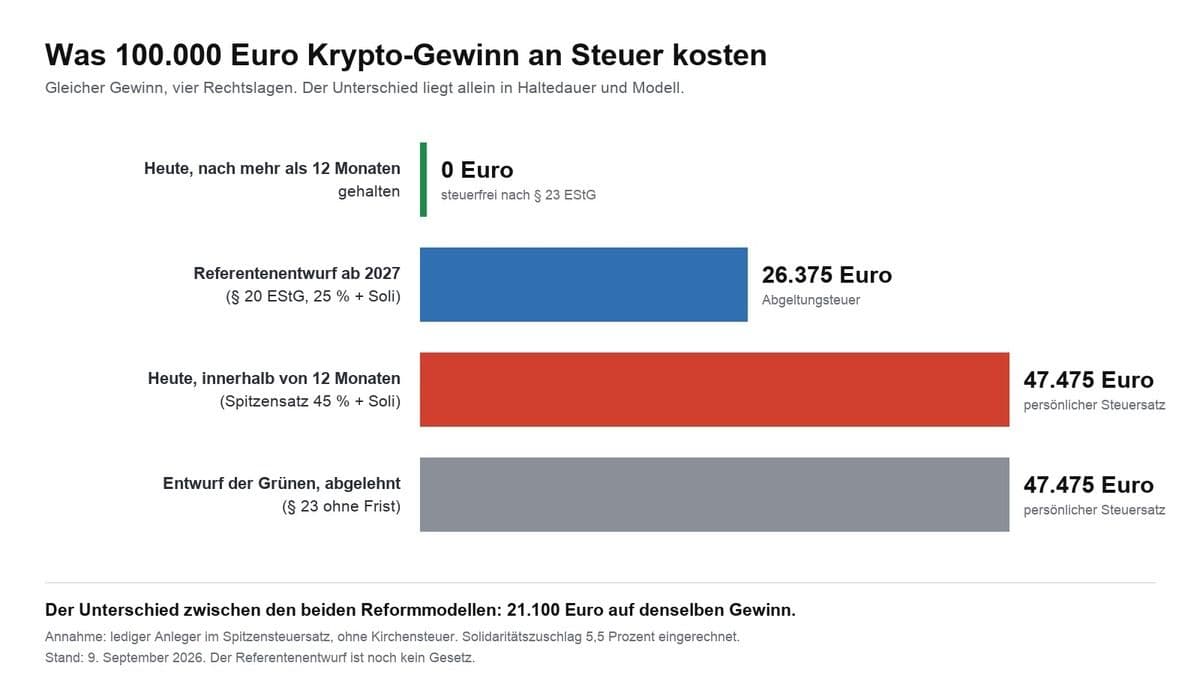
Crypto gains are tax-free after twelve months; before that your personal tax rate of up to 45 percent applies. What triggers tax, how the holding period is calculated, what happens with staking and losses, and what the draft bill would change from 2027.
September 24, 2026 4:28 AM

Crypto Trading Bots and Tax: What Applies With Thousands of Trades a Year
A bot turns one investment decision into hundreds of disposals, and the tax office counts every single one. This guide explains the holding period, FIFO, the exemption limit and the record-keeping duties, and what to set up before the bot makes its first trade.
September 26, 2026 1:19 AM

Germany’s Crypto Holding Period Is Wobbling: What to Check Before December 31
A CDU member of the Bundestag makes it plain: the coalition agreement does not guarantee that the one-year holding period for crypto assets will survive. What that means for purchases made before the planned cutoff date of December 31, 2026.
September 29, 2026 10:40 AM
“We have created the essential conditions …”: bitcoin.de has stood still for three months, the MiCAR licence is missing
Bitcoin Group SE published its half-year report on September 29, 2026: trading on bitcoin.de has been idle since the end of June because the MiCAR authorisation is missing. The new platform is finished, but no launch date is set.

September 26, 2026 7:40 AM

The RAIN Token After the Enlivex Termination: What to Check on Access, Forced Sale and Holding Period
Enlivex terminated a share placement of 66,666,667 shares payable in RAIN tokens on September 22, 2026. The token sits 46.4 percent below its all-time high, and at Kraken the withdrawal deadline expired long ago.
September 25, 2026 10:26 PM

Selling bitcoin privately: the tax in Germany and the records you need
A direct sale to a private individual falls under the same one-year rule as an exchange sale, but there is no tax report to go with it. This guide walks through the calculation, the 1,000 euro threshold and the records the tax office wants to see.
September 19, 2026 4:26 PM

Crypto Mining and Tax: When the Tax Office Treats Your Mining as a Business
Anyone mining crypto-assets earns taxable income from the very first reward; according to the Federal Ministry of Finance, mining is never private asset management. This guide uses the margin numbers of the Ministry's circular to show when your mining becomes commercial and what you can deduct.
September 8, 2026 10:21 PM

Crypto Holding Period and Grandfathering: Why December 31, 2026 Becomes the Cut-Off in Germany's Draft Bill
A ministerial draft bill from Germany's finance ministry names a cut-off date for the first time: crypto assets acquired after December 31, 2026 are to fall under the flat-rate withholding tax. What that means for legacy holdings, running savings plans and staking income, and why nothing has been decided yet.
September 24, 2026 10:19 PM

Bitcoin for Retirement: What Applies from 2027 and What You Decide Now
Bitcoin is not permitted in any state-subsidised retirement product, including the new retirement savings account from 2027. Anyone who still wants to use crypto assets for their own pension goes through private assets, and there a cutoff date at the end of 2026 is shifting the tax rules right now.
September 24, 2026 1:34 PM

Cardano Slides Below $0.24: What ADA Holders Should Check on Leverage, Liquidation and Holding Period
Cardano has given back its move above $0.25 and trades around seven percent below the high of the past 24 hours. What that means for leveraged positions, the holding period of your tranches and the buying route under MiCA.
September 23, 2026 10:11 AM
Kraken: 45 coins are on cancel only, 21 were announced – what to check when trading pairs are blocked
On September 23, 2026 we counted the public market directories of three trading venues. At Kraken, 82 of 1,450 trading pairs are listed as cancel only, a state in which an order can only be cancelled and no longer executed. The 45 underlying assets affected include just 21 that appear in the delisting notice we reported on September 3.
October 1, 2026 10:44 AM

German crypto tax reform: without a receipt, half the sale price is taxed
The Federal Ministry of Finance's draft bill goes to the cabinet on October 14. Anyone who cannot prove their acquisition cost pays tax on 50 percent of the sale proceeds under the substitute assessment.
More from CryptoTicker