
Airdrop tax: when free coins are taxable in Germany
Whether you have to pay tax on an airdrop is decided by a single question: did you do something for the coins? This guide takes you through both cases, the valuation at the market price, and the records the tax office has demanded since the 2025 assessment period.





Which topics should we dive deeper into?
Select what genuinely interests you. Your picks feed directly into our editorial planning.
Crypto news that's actually worth your time.
Weekly. 60 seconds. Carefully curated by our editors: no hype, no promo flood, no spam.
Whether you have to pay tax on an airdrop hangs on a single question: did you do something for the coins? If you had to post on a social network, fill in a form or hand over data going beyond your wallet address, you have other income from services, and that is subject to income tax from 256 euros in a calendar year. If, by contrast, the coins landed in your wallet without any action on your part, the inflow itself is not worth any income tax, but it can fall under gift tax law. That distinction does not come from a law firm's reading, it is set out word for word in the current circular of the German Federal Ministry of Finance on crypto assets.
This article takes you through both cases, shows you which price to use for the valuation, what happens on a later sale, and which records the tax office has expected of you since the 2025 assessment period.
Airdrop and tax: the short answer first
For tax purposes an airdrop is not a category of its own. The Income Tax Act has no word for it. Instead every airdrop is sorted into one of the existing drawers, and which one it is depends solely on the relationship between you and the project handing out the coins.
Three outcomes are possible. First: you rendered a service, in which case the coins are recorded on receipt as other income under Section 22 No. 3 of the Income Tax Act, valued at the market price at the time of acquisition. Second: you did nothing, in which case a gift comes into consideration, governed by inheritance and gift tax law rather than income tax. Third: the airdrop belongs to a business, in which case it is business income. For private investors the first two cases are the rule.
The second step is the important one, and many overlook it. Selling the coins is a separate event with its own rules. Whether it becomes a taxable private disposal transaction depends on whether the inflow was an acquisition at all. That switch is thrown on receipt, not on sale.
What an airdrop is: the German finance ministry's definition
Airdrop denotes the free distribution of crypto assets to a large number of addresses. The Federal Ministry of Finance describes this in its circular of March 6, 2025 on individual questions of the income tax treatment of certain crypto assets (margin number 29) as a marketing exercise whose design can vary widely.
The circular expressly names four variants there. Participants must fill in several online forms so that customer data can be collected. Or they are meant to promote the project on social networks. With larger airdrops, sometimes only a portion of those who meet all the conditions actually receive coins, for instance after a random selection. And finally, an airdrop can take place entirely without any action by the holder of a public key.
Those four variants are not there for illustration; they form the map by which the tax office sorts your case. If you are later asked to show which variant your airdrop fell into, you will need exactly the conditions that applied at the time. This article returns to that in the section on record-keeping obligations.
The circular of March 6, 2025 replaced the older BMF circular of May 10, 2022, incidentally, and is the first to use the term crypto assets instead of virtual currencies and other tokens. Anyone still working with the 2022 version is working from a superseded text. An overview of all current airdrops and the conditions of the individual projects can be found in our airdrop overview.
The key question: did you have to do anything for the airdrop?
The term everything hangs on is service. In tax law it is drawn more widely than everyday usage suggests. Any active, passive or non-economic conduct of whatever kind can qualify as a service. A reciprocal contractual relationship between you and the project is expressly not required.
Active conduct on social media
In margin number 70 the ministry names the clearest case: where interested parties have to render a service, in particular active conduct such as naming the airdrop or the project's initiator in social media posts, other income arises. The marketing character of the exercise changes nothing about that. Anyone posting, working through a task list or recommending a project is rendering a service within the meaning of the law.
The same paragraph covers a second case that is often overlooked in practice: anyone uploading their own images, photos or videos to a platform and receiving crypto assets for it is likewise rendering a service. That applies even where ownership of those images stays with you.
Personal data beyond the public key
Margin number 71 draws a line that is easy to remember. For the mere allocation of an airdrop, your wallet's public key is technically enough. Everything beyond that is a service. If the allocation depends on you making data about yourself available that goes beyond the information required for the technical allocation, that handing over of data is your service, for which you receive crypto assets in return.
That is to be assumed at any rate where you are obliged, or have to declare yourself willing, to make personal data available. The ministry expressly distinguishes this from classic discount schemes and prize draws, where a postal address is needed for identification purposes anyway. With an airdrop it is not.
In practice that means: the email address in the sign-up form, filling in a profile, linking a social media account, stating your country and date of birth. Every one of those steps turns the supposed gift into consideration.

Airdrop in return for something: other income under Section 22 No. 3 of the Income Tax Act
Once it is established that you rendered a service, Section 22 No. 3 of the Income Tax Act applies. The coins are to be recorded in the year in which they accrued to you, in other words the moment at which you can dispose of them. The sale plays no role in this first act of taxation. That is the point at which airdrops regularly become an unpleasant surprise: the tax arises on a value that you do not yet hold in euros at that time.
The value to be applied is the market price at the time of acquisition. That amount goes into your income tax return and is charged at your personal tax rate. At the top rate that can be well over forty percent of the inflow value, while the token itself may lose value in the weeks that follow. Precisely this divergence between the moment of taxation and the moment of sale is the real risk with airdrops.
The 256 euro threshold and why it breaks sooner than you think
Section 22 No. 3 sentence 2 of the Income Tax Act contains a relief: income from services is not subject to income tax if, together with other income from services, it amounts to less than 256 euros in a calendar year.
Two features of that limit are regularly misunderstood. First, it is an exemption threshold and not an allowance. Stay below it and everything remains tax free. Reach 256 euros and the entire amount is taxable, not merely the excess. A single euro decides here whether the complete amount is taxed.
Second, it applies to all service income of a year taken together. Several airdrops add up. And they also add up with service income that has nothing to do with crypto, such as the occasional letting of movable property or other occasional intermediary services. Anyone taking part in five airdrops spread over the year and receiving coins worth sixty euros each time lands at 300 euros and is therefore fully within the scope of taxation.
 Crypto tax tools compared
Airdrop with nothing given in return: a gift rather than income tax
The second basic case is the airdrop that appears in the wallet without any action on your part. Where the allocation is not economically connected to a service, margin number 74 of the BMF circular states that a gift comes into consideration, for which the gift tax rules are to be observed.
For income tax that means: nothing happens. No inflow of service income, no 256 euro limit, no line in the annex for other income. Gift tax follows different rules with allowances of its own, which depend on the relationship between donor and recipient and apply for a period of ten years at a time. At the usual amounts of a marketing airdrop this remains practically without consequence, but the inflow has not thereby fallen into a legal vacuum.
This case is rarer than it appears in forums. The vast majority of airdrops are tied to some condition or other, even if only the linking of an account. The classic unconditional case is the token that an unrelated project distributes unprompted to a large number of active addresses without the recipients knowing about it beforehand.
Caution with tokens sent unprompted
If an unknown token turns up in your wallet with no recognisable occasion, the tax question is usually the smaller problem. Such deliveries are a common lure: the attempt to sell or swap the token leads to a doctored interface or demands an approval that makes your remaining holdings reachable. Leave tokens sent unprompted untouched and check them via a blockchain explorer first.
The element of chance: why a draw changes the calculation
Between the two basic cases lies a constellation that the ministry regulates separately. Many large airdrops work with a random selection among everyone who met the conditions. So not every participant receives coins.
On this, margin number 72 says: where the airdrop is designed so that, alongside a service, chance also decides on the receipt of crypto assets, the attribution link between service and consideration is interrupted or overlaid by the element of chance.
Translated: where chance has a say, the straight line between your conduct and the inflow that Section 22 No. 3 of the Income Tax Act presupposes is missing. That can mean that no other income arises despite a service having been rendered. Whether that holds in your case depends on how the exercise was specifically designed, which is exactly why you should secure the terms of participation while the project page is still online.
Which price to value at, and when zero euros is permissible
Where other income arises, the crypto assets are to be recognised at the market price at the time of acquisition. That is a snapshot, not an average and not a year-end closing price.
Which price source the tax office accepts
Under margin number 43, the price of a trading platform or of a web-based price list may be applied as the market price. The ministry names as examples the Börse Stuttgart Digital Exchange, Kraken, Coinbase and Bitpanda, as well as the price lists of CoinMarketCap and CoinGecko. What matters is that you document the source you choose and do not switch from one transaction to the next depending on which price happens to look more favourable.
The special case: no ascertainable market price
Freshly distributed tokens often have no tradable price at all at the moment of inflow. For that case, margin number 73 contains an express non-objection rule: where no market price can be ascertained at the time of acquisition, no objection is raised if the crypto assets received in the course of an airdrop are recognised at zero euros.
That is the most important practical relief in the whole section. Anyone receiving coins before they are listed anywhere applies a value of zero, and the later rise in value only becomes relevant on sale. The condition, however, is that you can evidence the state of affairs: the time of the inflow, the time of the first listing, a screenshot or an export file. Without that evidence, your assertion later stands against the price list the tax office calls up itself.

The sale afterwards: holding period, acquisition costs and the 1,000 euro threshold
The second moment of taxation arrives when you sell the coins, swap them into Bitcoin or another crypto asset, or pay for something with them. Each of those events is a disposal. Whether it becomes a taxable private disposal transaction is decided by a prior question: was the inflow an acquisition?
Airdrop with a service: an acquisition exists
Margin number 75 is unambiguous here. Where the allocation is made on the basis of a service within the meaning of Section 22 No. 3 of the Income Tax Act, an acquisition also exists. The acquisition costs are to be recognised at the value of the data given up or the action carried out, whereby it may be rebuttably presumed that this value corresponds to the market price of the consideration.
From the inflow onwards, the one-year holding period of Section 23 of the Income Tax Act therefore runs. Sell within a year and the gain is taxable, in other words the difference between the sale proceeds and the acquisition costs applied. Sell after the year has elapsed and the gain remains tax free. The first act of taxation under Section 22 No. 3 is unaffected by that; it already happened on inflow.
The threshold of Section 23 (3) sentence 5 of the Income Tax Act applies on top here: gains from private disposal transactions remain tax free if the total of all gains realised in the calendar year comes to less than 1,000 euros. Up to and including the 2023 assessment period this limit stood at 600 euros. This too is an exemption threshold, not an allowance.
Airdrop without a service: acquisition free of charge
Where the inflow was not consideration, you acquired the coins free of charge. In that case, under the same subsection and Section 23 (1) sentence 3 of the Income Tax Act, the acquisition by the legal predecessor is decisive. For tax purposes you step into the position of whoever acquired the coins before you, together with their acquisition date and acquisition costs.
In the practice of a marketing airdrop those details about the predecessor are next to never ascertainable. That is precisely why the question of the service is not merely a formality at the outset, but determines whether you can present a clean tax base at all when you sell. Anyone without records here ends up negotiating an estimate with the tax office.
 Crypto exchanges compared
Record-keeping obligations: what you have had to document since the 2025 assessment period
The BMF circular of March 6, 2025 contains, for the first time, a section of its own on obligations to cooperate, to keep records and to retain them. Under the application rule in margin number 106, the circular applies from its publication in the Federal Tax Gazette Part I to all open cases. Records that depart from the new requirements are no longer objected to only for assessment periods up to and including 2024. For the current year the new standard applies.
Margin number 103 lists what the tax offices can request. For airdrops there is one point there that follows directly from everything set out above: to be stated are the time of acquisition, the quantity acquired and the nature of the acquisition process, and specifically, in the case of an airdrop, expressly for the purpose of determining whether a service exists, a description of the conditions that were decisive for the allocation of the crypto assets.
The evidence list for every single airdrop
From that requirement a list can be derived which you should draw up on the day you take part, and not in the spring of the following year. The compilation comprises the name of the project and the address of the smart contract, the terms of participation in their wording as a screenshot or saved page, a note of which data or actions were demanded of you, the time of the inflow with the transaction hash, the wallet address used, and the market price together with the source, or the evidence that no price was available at that time.
In addition, margin number 103 requires documentation of the chosen order of use, in other words whether you apply individual identification, the average method or FiFo, and that for the respective wallet. Anyone who has chosen a method once should not switch it from year to year. Software takes the arithmetic off your hands; an overview of tested providers is given by our comparison of crypto tax tools and portfolio trackers. No software, however, can reconstruct the conditions of the airdrop for you once the project page has been taken down.
Where airdrop income ends up in the tax return
Other income from services under Section 22 No. 3 of the Income Tax Act belongs in Annex SO of the income tax return, in the section for services. There you enter the total of the values that accrued; you can set costs against it, such as transaction fees you incurred in collecting the coins.
Private disposal transactions from the later sale likewise belong in Annex SO, but in a different section. Both events stand side by side and concern the same holding at different points in time. A frequent error consists in forgetting the inflow and declaring only the sale, or conversely in recognising the inflow value a second time as a gain although it already forms the acquisition costs.
Losses from private disposal transactions may be offset only against gains from the same type of income, not against your employment income. Something similar applies to losses from services under Section 22 No. 3.
Four mistakes that get expensive with airdrops
The inflow is ignored because nothing was sold. The tax under Section 22 No. 3 arises at the moment of inflow. Anyone waiting until they sell declares the wrong year and risks a correction plus interest.
The terms of participation are not secured. Projects disappear, announcement pages are deleted, channels are closed. Without the conditions you can later show neither that no service was rendered nor that chance had a say.
The 256 euro limit is treated as an allowance. With 260 euros of service income it is not four euros that are taxable, but 260.
The coins are left on a trading platform with no usable export. If you cannot later pull the movements as a file, every review turns into manual work. Anyone taking part in airdrops regularly should use a platform that provides complete transaction overviews as a structured file for download, and should not try the export for the first time in the spring of the following year.
Airdrop tax: what to take away
The rules are more complicated than the picture of a gift that many projects paint. They remain manageable all the same, provided you do three things in this order.
- Settle the service question for every airdrop and put it in writing. Note on the day you take part what was demanded, and secure the conditions as a screenshot. That single note decides income tax, holding period and acquisition costs. Which trading platform will let you sell the coins at all later is best clarified beforehand, for instance via our exchange comparison.
- Record the inflow value in the year of the inflow, not in the year of the sale. Apply the market price from a source you use consistently, or document that there was no price yet. A tax tool takes over the valuation and the order of use automatically, see our comparison of tax tools.
- Move the holdings to where you can evidence them. Put coins you intend to hold for more than a year into a wallet whose keys you control yourself, and document the transfer. Which devices are suitable for that is set out in our hardware wallet comparison.
(As of September 23, 2026. This article is not investment advice. Prices and fee structures change; check the terms with the provider before you buy.)
Transparency note: This article was produced with the assistance of artificial intelligence and reviewed by our editorial team before publication. All figures and claims were checked against the primary sources linked in the text. The feature image was generated with AI.
Related articles
- Crypto Mining and Tax: When the Tax Office Treats Your Mining as a Business
- Bitcoin Savings Plan and Tax: How the Holding Period, FIFO and the Exemption Limit Interact on Monthly Buys
- Forced Sale on a Crypto Exchange: Which Moment Counts for the Holding Period and What You Must Document
- Switching crypto exchange: what happens to the holding period and the tax when you transfer
- Germany’s Crypto Holding Period Is Wobbling: What to Check Before December 31
Which topics should we dive deeper into?
Select what genuinely interests you. Your picks feed directly into our editorial planning.
Crypto news that's actually worth your time.
Weekly. 60 seconds. Carefully curated by our editors: no hype, no promo flood, no spam.

October 1, 2026 10:44 AM

German crypto tax reform: without a receipt, half the sale price is taxed
The Federal Ministry of Finance's draft bill goes to the cabinet on October 14. Anyone who cannot prove their acquisition cost pays tax on 50 percent of the sale proceeds under the substitute assessment.
September 8, 2026 1:19 AM

Germany's Crypto Holding Period: What Happens Now Signing for Petition 201716 Closed on September 15
Recap as of September 27, 2026: the signature period for German parliamentary petition 201716, which asks for the one-year crypto holding period to be preserved, closed on September 15, 2026. This article explains what ended that day, how the petitions committee proceeds and why no investor has to sell because of it.
September 9, 2026 1:15 AM

Germany's Crypto Tax: 160 Million Euros for a 555-Billion Budget
The German finance ministry's draft bill puts a figure on the crypto tax for the first time: 160 million euros from 2028. What that number means in the 2027 federal budget, how 11.4 billion became 160 million, and what investors can read from it.
October 8, 2026 4:17 AM

Crypto Holding Period: Without a Purchase Record the Tax Withheld Runs Ten Times Too High
The consultation on Germany's crypto tax bill closed on October 6 and the cabinet is to adopt it on October 14, with tax advisers, banks and the Bitcoin Bundesverband having filed their objections. The sharpest concerns everyone whose purchase data the selling platform does not hold: one adviser calculates a withholding ten times the tax owed.
September 17, 2026 7:12 PM

Gifting Bitcoin to Children: Allowance, Holding Period and the Tax Office Report
Transferring Bitcoin to your child hands over your holding period and your entry price along with the coins. This guide sets out what really applies in Germany on the allowance, the reporting deadline, representation and custody.
September 16, 2026 1:20 PM

Crypto Loss Carryforward in Germany: What Happens to Old Losses Under the 2027 Tax Plan
Losses from crypto sales land in a ring-fenced pot and can only be set against gains of the same kind. The draft bill for 2027 moves future gains into a different pot, and we show you what that means for your assessed carryforward and what your tax notice should say.
October 9, 2026 1:18 PM

Bitcoin Tax: One Year Past the $126,080 Peak, Losses No Longer Count
Bitcoin trades at $82,558 on Friday morning, 34.5 percent below an all-time high that is now a good year old. Anyone who bought back then loses more than the prospect of a quick recovery when the one-year period expires: the tax value of the loss goes with it.
September 18, 2026 10:13 AM

Bitcoin and the German Exit Tax: What Applies When You Move Abroad
Anyone emigrating with Bitcoin expects an exit tax on unrealised gains and finds nothing of the sort in the statute. Where the real risks sit is decided at four points: residence, the holding period, the legal form of your investment, and automatic reporting from 2026.
October 6, 2026 4:32 AM

Bitcoin for a gift card: what paying with crypto means for your holding period
Paying for a gift card with Bitcoin is a sale for tax purposes. What counts as the disposal proceeds, when the twelve-month holding period bites, and the four records the tax office expects.
September 16, 2026 7:12 PM

Borrowing Against Bitcoin Instead of Selling: When German Tax Still Applies
Posting Bitcoin as collateral for a loan is not a sale in Germany, because section 39 of the Fiscal Code keeps the coins attributed to you for tax purposes. Tax arises only when the collateral is liquidated, and then the one thing that decides the bill is how long you held the coins beforehand.
September 7, 2026 7:22 AM

German Crypto Holding Period Set to Go After All: A Separate Draft Targets Purchases From 2027
Correction of 8 October 2026: The Income Tax Reform Act 2027, adopted by the German federal cabinet on 2 September, does not cover crypto assets. That did not mean the holding period stays. A separate draft bill from the Federal Ministry of Finance, dated 30 September, would abolish it for anything acquired after 31 December 2026. The cabinet is due to decide on 14 October.
September 27, 2026 10:35 AM

Crypto Exchange Tax Report Wrong: How to Correct It Before the Tax Office Does
Missing acquisition costs, transfers booked as sales, holding periods restarted: your exchange's report is an aid and not proof. How to check it, how to correct it and which deadline is running.
October 2, 2026 4:39 AM

Donating bitcoin: when does the full market value count, when only the purchase price?
A bitcoin donation to a charitable organisation is deductible as a donation in kind, and the donation itself produces no taxable gain. The size of the deduction turns solely on whether a sale would have been taxable on the day of the transfer.
September 17, 2026 10:22 PM

Selling Bitcoin at a Loss and Buying It Straight Back: What That Does to Your Holding Period
Germany has no wash sale rule: the loss stays deductible even if you buy back immediately. The buyback, however, restarts the one-year period for every new unit.
August 24, 2026 4:22 AM

Selling XRP After a 53 Percent Week: What the Holding Period Costs
XRP trades at $1.51 after a weekly gain of a good 50 percent, yet your net proceeds are decided by the purchase date. This article works through the holding period, the exemption limit and FIFO at measured reference-date prices.
October 2, 2026 1:33 PM

Crypto tax before the cabinet on October 14: “Comments are only possible until October 6”
Germany's Federal Ministry of Finance sent the draft bill on crypto taxation to the associations on September 30, 2026, and the cabinet is to decide on October 14. For your holdings one date counts above all: December 31, 2026.
September 22, 2026 10:13 AM

Circle Lends Against Bitcoin via cirBTC: Why the Wrapper Can Cost You the German Holding Period
Circle launched loans against deposited bitcoin on September 21, 2026. In Germany, the detour through the cirBTC token is very likely a swap, and a swap restarts your one-year holding period.
August 11, 2026 9:13 PM

Germany's Crypto Holding Period Faces Abolition: What Petition 201716 and the Draft Bill Mean for Your Tax
Petition 201716 calls for the one-year holding period for crypto assets to be kept and will be heard in public by the Bundestag's Petitions Committee on 12 October 2026. Correction of 8 October: the reform was not decided by the cabinet in July. A draft bill of 30 September would end the holding period for crypto acquired after 31 December 2026, and the cabinet is due to take it up on 14 October.
September 9, 2026 4:22 PM
Crypto Tax in Germany: What Applies in 2026 and What Is Set to Change in 2027
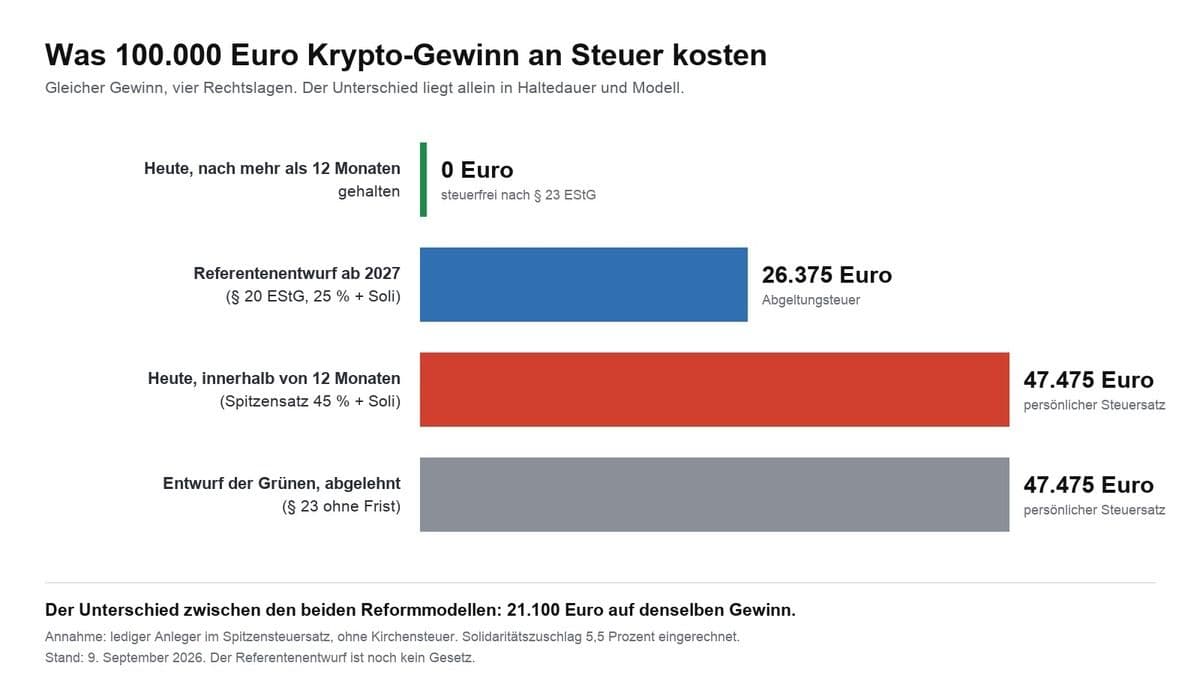
Crypto gains are tax-free after twelve months; before that your personal tax rate of up to 45 percent applies. What triggers tax, how the holding period is calculated, what happens with staking and losses, and what the draft bill would change from 2027.
September 8, 2026 10:21 PM

Crypto Holding Period and Grandfathering: Why December 31, 2026 Becomes the Cut-Off in Germany's Draft Bill
A ministerial draft bill from Germany's finance ministry names a cut-off date for the first time: crypto assets acquired after December 31, 2026 are to fall under the flat-rate withholding tax. What that means for legacy holdings, running savings plans and staking income, and why nothing has been decided yet.
October 7, 2026 10:54 PM

Two Routes Out of an Exchange Insolvency: Coins Back, or a Dividend in Euros
If the same coins come back after an exchange insolvency, the holding period from the year of acquisition runs on. If a dividend is paid out in money instead, the position is open, and the evidence question decides the case.
September 24, 2026 10:19 PM

Bitcoin for Retirement: What Applies from 2027 and What You Decide Now
Bitcoin is not permitted in any state-subsidised retirement product, including the new retirement savings account from 2027. Anyone who still wants to use crypto assets for their own pension goes through private assets, and there a cutoff date at the end of 2026 is shifting the tax rules right now.
October 11, 2026 7:26 PM

Stablecoin swaps: France plans the tax Germany has had for years
Swapping bitcoin into a stablecoin in France carries no tax so far. That is set to change from 2027, with the finance committee of the National Assembly having given its approval. In Germany such a swap has long been a taxable event, with one consequence many investors miss: the holding period starts again.
October 9, 2026 10:50 AM

Crypto holding period: the Bundestag rejects abolition by 445 votes to 132: what investors need to know
On 8 October the Bundestag rejected the Greens' bill to abolish the crypto holding period in a recorded vote, and the Left's motion fell too. The result by parliamentary group, the official speech from the media centre, and why it was the SPD that gave investors the real signal in the debate.
September 22, 2026 7:23 AM

Gifting Bitcoin to Your Spouse: Allowance, Holding Period and the Report to the Tax Office
Thanks to a 500,000 euro allowance, a gift to a spouse is almost always free of gift tax, and it is not a disposal either. What matters is what travels with it: your purchase date, your purchase price and with them the state of the one-year holding period.
August 21, 2026 1:42 PM

Writing Off a Total Crypto Loss: When the Tax Office Recognises Worthless Coins
A token that has collapsed only reduces your tax once you actually dispose of it. What applies to delisting, exchange insolvency and worthless holdings under Section 23 of the German Income Tax Act, and how you offset losses.
September 26, 2026 7:29 PM

Coins Stolen in an Exchange Hack: What the German Tax Office Accepts as a Loss
After the attack on Bitget on September 24, a question the reports leave out arises for those affected in Germany: can a stolen balance be written off against tax? The answer hangs on a single term in the Income Tax Act, and it is decided by your records.
More from CryptoTicker