
Crypto tax before the cabinet on October 14: “Comments are only possible until October 6”
Germany's Federal Ministry of Finance sent the draft bill on crypto taxation to the associations on September 30, 2026, and the cabinet is to decide on October 14. For your holdings one date counts above all: December 31, 2026.





Which topics should we dive deeper into?
Select what genuinely interests you. Your picks feed directly into our editorial planning.
Crypto news that's actually worth your time.
Weekly. 60 seconds. Carefully curated by our editors: no hype, no promo flood, no spam.
Germany's Federal Ministry of Finance sent the draft bill on the new taxation of crypto-assets to the industry associations on September 30, 2026. It carries the title "Act to reform the taxation of certain crypto-assets held as private assets", and it ends the one-year holding period for everything that enters your wallet from January 1, 2027. An exception applies to the holdings you have today, and it comes with a date: whatever is acquired by December 31, 2026 stays tax free after one year of holding.
The timetable is tight. Frank Schäffler, the FDP member of the Bundestag who made the mailing public, wrote about it on X: "The Ministry of Finance has sent the draft bill on crypto taxation to the associations. The cabinet is to adopt it on October 14. Comments are only possible until October 6, so six days." He accompanied the post of September 30, 2026 with a summary of the key points.
That puts a date in your calendar which has nothing to do with the price. Bitcoin trades at around $86,300 on October 2, 2026 (CoinGecko), Ether at around $2,750. Whether those figures stand higher or lower in three months changes nothing about the fact that December 31, 2026 decides how your holdings are taxed for years to come.
What the draft bill on crypto taxation contains
A draft bill is the version of a law that a ministry has written itself and sends to the affected associations for comment before the cabinet decision. It is not yet a law and can change during the procedure, but it shows the ministry's intention in the form of statutory provisions.
The heart of the draft is a reclassification. Gains from the sale of cryptocurrencies currently fall under the private disposals of Section 23 of the German Income Tax Act. There the rule is: hold for at least one year and you pay no tax on the gain. In future these gains are to belong to income from capital assets under Section 20 of the German Income Tax Act, and there is no holding period there.
The draft calls the affected group "exchange crypto-assets". What is meant are the crypto-assets serving as a means of exchange and payment, so Bitcoin, Ether and the great majority of tradeable coins. According to the summaries of the draft, the ministry reckons with around 350 million euros in additional annual revenue.
Schäffler points out that nothing has changed in substance compared with the September version and that the ministry has merely added the figures. He criticises the cost side sharply: the costs for citizens and business still appear in the draft as "to follow".
Section 20 instead of Section 23 of the Income Tax Act: crypto gains become capital income
The shift from Section 23 to Section 20 sounds technical and is the actual lever. With it the holding period disappears as a planning option, and in its place comes the system that investors in shares and funds know: every realised gain is taxable, regardless of how long the position was held.
That has two sides. The holding period falls away, and that costs money. At the same time Section 20 opens up loss offsetting within capital income, which under today's Section 23 is confined to private disposals. How far that offsetting will reach, and whether the saver's allowance is applicable to crypto gains, is left open by the draft according to the summaries available. Those are among the points the associations are likely to target in their comments by October 6.
What this means for current positions
A position you hold today is not placed in a worse position retroactively by the reform. The draft attaches to the time of acquisition, not the time of sale. A bitcoin you bought in 2024 and sell in 2029 stays under the old law according to the logic of the draft. What is decisive, therefore, is whether you can prove when you bought. Clean documentation of your purchases is the difference between grandfathering and a lack of evidence, and there are tax tools and portfolio trackers compared for that.
The cut-off date of December 31, 2026: which holdings keep the holding period
Grandfathering means that for an existing holding the law continues to apply that was in force when it was acquired. The draft sets this cut at December 31, 2026. Everything acquired or received up to that day keeps the one-year holding period. Everything added from January 1, 2027 falls into the new system.
What arises from that for you is a calendar problem and not a question about the price. Anyone planning to build a position anyway has until the end of the year to acquire it under the old law. Anyone not planning that need do nothing. An acquisition purely because of the cut-off date is an investment decision carrying price risk, and that risk does not disappear because the tax rule is more favourable.
The cut-off date becomes awkward in practice with everything that does not look like a straightforward purchase. Additions from staking rewards, from airdrops, from a swap of one coin into another or from a transfer between your own wallets all need a provable date. On a swap the rule is: the coin received in exchange is an acquisition with its own date, and not a continuation of the old position.

25 percent withholding tax plus the solidarity surcharge: the new burden
For acquisitions from 2027, gains are to be charged 25 percent capital gains tax plus the solidarity surcharge, as set out in the summaries of the draft. That is the rate which also applies to interest, dividends and gains on shares. Church tax comes on top if you are liable to it.
The comparison with today depends on your personal tax rate. Anyone selling coins inside a year currently pays their own income tax rate on the gain. If that rate is above 25 percent, the new rate is more favourable for short-term sales. Anyone holding for more than a year, by contrast, pays nothing today and 25 percent plus surcharges in future. For holders with a long-term orientation the reform is therefore unambiguously a deterioration, and for active traders rather a relief.
 Compare crypto tax software
Staking and lending become capital income
The draft also pulls the proceeds from staking and lending into income from capital assets. Staking means that you deposit coins in the network and receive new coins as a reward for it. Lending means that you lend coins out in return for a fee.
Today such proceeds are as a rule treated as other income and charged at the personal tax rate, and the coins received then start a holding period of their own. If these proceeds move into Section 20, the same rate applies to them as to sale gains. Anyone drawing rewards regularly thereby gets many small additions, each with its own timing and its own market value, and every single one has to be valued. How the providers represent that differs considerably. What is decisive for you is the question of which annual statement you actually get from your platform and whether every addition appears in it with a date and a market value.
Tax deduction by the exchange from 2028 and the sale without consent
The draft introduces the automatic tax deduction through the platforms only from the year 2028. Until then the tax remains a matter for your tax return. After that the exchange is to withhold and remit the tax directly, the way a bank does today with dividends.
One point about it deserves attention: according to the summaries of the draft, platforms are to be allowed to sell coins without the customer's consent in order to cover the tax due. So anyone wanting to see the tax paid in euros from the settlement account has to keep a balance there. If it is missing, the platform reaches into the holding. For holders who deliberately do not touch their coins this is a new mechanic, and it concerns only holdings sitting on an exchange. Which providers are under German and European supervision and how they run settlement accounts is shown by the overview of crypto exchanges compared.
The substitute tax base: 50 percent of the sale price without a purchase record
A substitute tax base is a flat value the tax office applies when the actual value cannot be proved. The draft provides that if the acquisition price cannot be documented, 50 percent of the sale proceeds are taxed as the gain.
In practice that hits precisely the cases which occur most often. Coins from an exchange that no longer exists. Purchases from 2017 whose confirmation emails sit in an old mailbox. Transfers between your own wallets with no note. In all these cases the tax is measured through a flat rate which, on an investment that has done well, lies far above the real gain.
Dr Ingo Heuel, a lawyer and tax adviser and a member of the tax law committee of the Federal Chamber of Tax Advisers, considers this flat rate too harshly set, because comparable rules in capital income law work with a lower flat percentage.

Double taxation where bitcoin is paid as salary: the gap in Section 20(4b) of the Income Tax Act
Heuel has pointed publicly to a gap in the draft that can be described cleanly. The planned Section 20(4b) of the German Income Tax Act applies acquisition costs of zero euros to certain crypto-assets received. An express exception for coins whose value has already been taxed as income is missing.
His example makes the consequence tangible. Someone receiving bitcoin worth 50,000 euros as salary pays tax on those 50,000 euros as employment income. If he later sells the coins for 60,000 euros, then on the wording of the draft it would not be the 10,000 euros of increase that is taxed, but the full 60,000 euros. The 50,000 euros already taxed would thereby be captured twice.
He puts his demand briefly: what counts as income on receipt of the bitcoin has to be taken into account as the starting value on the later sale. Affected would be everyone receiving crypto-assets as consideration, so employees with part of their pay in coins, landlords and self-employed people paid in crypto. The detailed account of the case is publicly documented. Whether the legislature closes the gap is open; it is one of the points a comment by October 6 can address.
 Compare crypto exchanges and fees
Six days for comments: the timetable up to the cabinet decision
The sequence is short. On September 30, 2026 the draft went to the associations. Until October 6, 2026 they can comment. On October 14, 2026 the cabinet is to adopt the draft. After that the Bundestag and the Bundesrat take up the procedure, and the text can still change there.
Six days is a tight deadline for a comment on a tax law, and that is exactly what Schäffler's criticism targets. For you as an investor no pressure to act arises on October 6. What matters is October 14: only with the cabinet decision does a ministry paper become a government bill, and only then is December 31, 2026 halfway reliable as a cut-off date.
Until then today's law applies unchanged. Anyone selling now settles under Section 23 of the German Income Tax Act, with the holding period and with the exemption threshold that applies there. The reform has no effect before it is passed.
Purchase records and acquisition dates: how to check your holdings
The greater part of the work arising from this reform is documentation. The effort pays off regardless of how the law ends up looking, because both the grandfathering and the avoidance of the 50 percent flat rate hang on evidence.
What makes sense is a complete export of all transactions from every exchange you have ever used, while the accounts still exist. That includes the purchase date, the quantity, the price in euros and the fees. For wallet additions you need the transaction identifier and the date. With staking rewards every addition counts individually, at the price on the day it was received.
Where it gets stuck in practice
Three places stand out from experience: exchanges where you can no longer log in, because the account has been closed or the provider has vanished from the market. Swaps inside a wallet that never appear in any statement. And coins you received from a person years ago without any record of it. For the last case there is no clean solution other than a traceable record of your own, which you present to the tax office together with everything else.
Whether a sale before the end of the year is tax-wise sensible is a question for the individual case and not a rule. Anyone sitting on losses in the portfolio works both systems through against each other before a sale, the old one and the new one. That is the point at which tax advice is worth more than any checklist on the internet.
Crypto tax reform: the key points for your decision
- Secure the acquisition dates. Export all transactions from all exchanges and note the date and transaction identifier for every wallet addition. Without that evidence the flat rate of 50 percent applies in case of doubt. Which tools bring that together automatically is shown by the comparison of crypto tax tools.
- Record staking additions individually. Every reward is an addition of its own with its own date and its own market value. Check which statement your provider delivers at the end of the year, and compare that with the staking platforms in overview.
- Check the settlement account and the supervision. From 2028 the exchange is to withhold the tax and may sell coins without consent for it if no euro balance is available. Anyone wanting to avoid that keeps a balance ready and picks a provider under European supervision from the regulated crypto exchanges.
(As of October 2, 2026. This article is not investment advice. Prices and fee structures change; check the terms with the provider before you buy.)
Frequently asked questions about the crypto tax reform
Transparency note: This article was produced with the assistance of artificial intelligence and reviewed by our editorial team before publication. All figures and claims were checked against the primary sources linked in the text. The feature image was generated with AI.
Related articles
- Crypto Holding Period and Grandfathering: Why December 31, 2026 Becomes the Cut-Off in Germany's Draft Bill
- Crypto holding period for Bitcoin: “That remains to be seen,” says the finance ministry
- Germany’s Crypto Holding Period Is Wobbling: What to Check Before December 31
- Crypto holding period: the cabinet date passes without a decision, December 31 stays the cut-off
- Germany's Crypto Tax: 160 Million Euros for a 555-Billion Budget
Which topics should we dive deeper into?
Select what genuinely interests you. Your picks feed directly into our editorial planning.
Crypto news that's actually worth your time.
Weekly. 60 seconds. Carefully curated by our editors: no hype, no promo flood, no spam.

September 9, 2026 4:22 PM
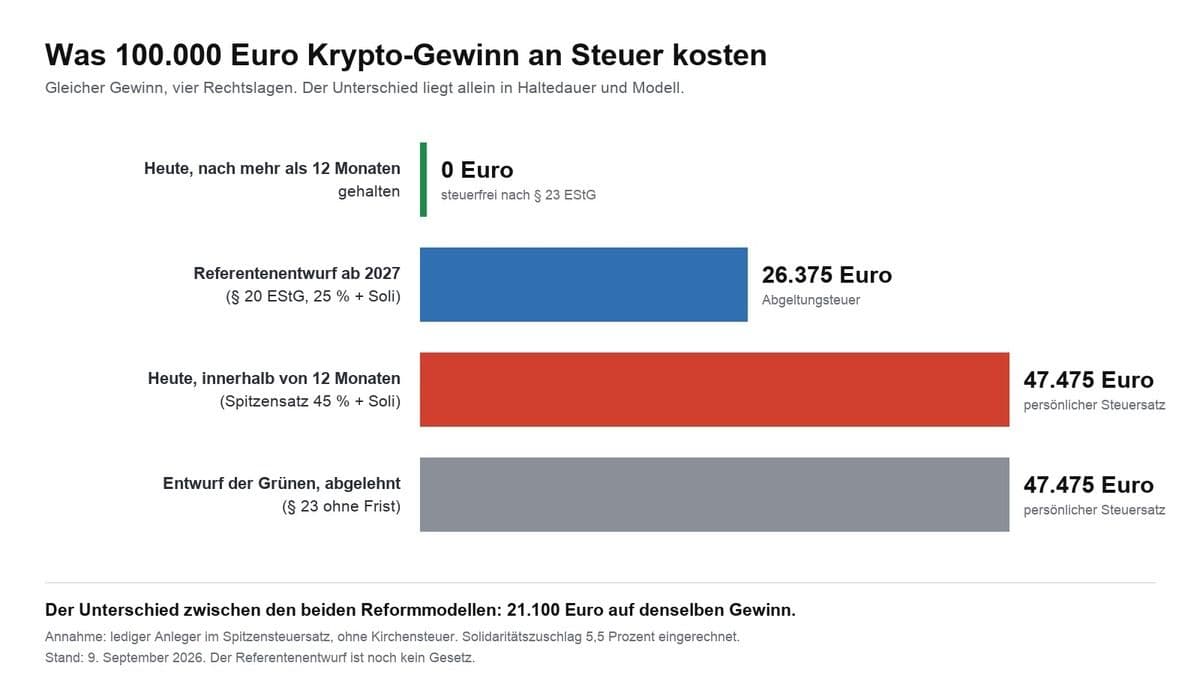
Crypto Tax in Germany: What Applies in 2026 and What Is Set to Change in 2027
Crypto gains are tax-free after twelve months; before that your personal tax rate of up to 45 percent applies. What triggers tax, how the holding period is calculated, what happens with staking and losses, and what the draft bill would change from 2027.
October 9, 2026 1:18 PM

Bitcoin Tax: One Year Past the $126,080 Peak, Losses No Longer Count
Bitcoin trades at $82,558 on Friday morning, 34.5 percent below an all-time high that is now a good year old. Anyone who bought back then loses more than the prospect of a quick recovery when the one-year period expires: the tax value of the loss goes with it.
August 21, 2026 4:24 AM

Forced Sale on a Crypto Exchange: Which Moment Counts for the Holding Period and What You Must Document
At Luno, Kraken and Valour the deadlines are running out, after which the provider realises the remaining holding itself. For tax purposes that is a disposal, and what governs it is the exchange's timestamp.
September 16, 2026 7:12 PM

Borrowing Against Bitcoin Instead of Selling: When German Tax Still Applies
Posting Bitcoin as collateral for a loan is not a sale in Germany, because section 39 of the Fiscal Code keeps the coins attributed to you for tax purposes. Tax arises only when the collateral is liquidated, and then the one thing that decides the bill is how long you held the coins beforehand.
September 7, 2026 7:22 AM

German Crypto Holding Period Set to Go After All: A Separate Draft Targets Purchases From 2027
Correction of 8 October 2026: The Income Tax Reform Act 2027, adopted by the German federal cabinet on 2 September, does not cover crypto assets. That did not mean the holding period stays. A separate draft bill from the Federal Ministry of Finance, dated 30 September, would abolish it for anything acquired after 31 December 2026. The cabinet is due to decide on 14 October.
September 17, 2026 10:22 PM
Selling Bitcoin at a Loss and Buying It Straight Back: What That Does to Your Holding Period
Germany has no wash sale rule: the loss stays deductible even if you buy back immediately. The buyback, however, restarts the one-year period for every new unit.
September 8, 2026 1:19 AM

Germany's Crypto Holding Period: What Happens Now Signing for Petition 201716 Closed on September 15
Recap as of September 27, 2026: the signature period for German parliamentary petition 201716, which asks for the one-year crypto holding period to be preserved, closed on September 15, 2026. This article explains what ended that day, how the petitions committee proceeds and why no investor has to sell because of it.

October 20, 2026 1:33 PM

60.6 percent down in twelve months and only 12th by market value: what to check before your purchase anniversary
Dogecoin has lost 60.6 percent over twelve months, more than twice as much as Bitcoin, and now ranks only 12th by market value. For investors in Germany the calendar matters more than the next price level: the anniversary of the purchase decides whether a gain stays tax free and whether a loss still counts at all.
September 14, 2026 10:23 AM

Take Ethereum Profits or Wait Out the Holding Period? What the Price Jump Means for Your Tax Bill
Ether reached its highest level since the end of January on September 11, 2026, and many are asking whether to sell now. In Germany the answer hangs on the purchase date first: we work out which tranches are tax free and which of them are showing a gain at all.
September 9, 2026 4:13 PM

Bitcoin 29 Percent Below Last Year: Which Crypto Losses You Can Still Use Before the One-Year Holding Period Expires
Nine out of ten major crypto assets trade lower today than exactly twelve months ago, Bitcoin alone by 29.2 percent. We measured the price series ourselves and show why the purchase date alone decides the tax value of your loss.
August 11, 2026 9:13 PM

Germany's Crypto Holding Period Faces Abolition: What Petition 201716 and the Draft Bill Mean for Your Tax
Petition 201716 calls for the one-year holding period for crypto assets to be kept and will be heard in public by the Bundestag's Petitions Committee on 12 October 2026. Correction of 8 October: the reform was not decided by the cabinet in July. A draft bill of 30 September would end the holding period for crypto acquired after 31 December 2026, and the cabinet is due to take it up on 14 October.
October 20, 2026 10:18 AM

Coinbase converts USDT and DAI into USDC on October 30: the swap restarts the one-year holding period
On October 30 Coinbase will convert the remaining USDT, DAI and PYUSD balances in the European Economic Area into USDC. The swap counts as a disposal under section 23 of the German Income Tax Act, and the one-year clock starts again for the new balance.
September 17, 2026 7:12 PM

Gifting Bitcoin to Children: Allowance, Holding Period and the Tax Office Report
Transferring Bitcoin to your child hands over your holding period and your entry price along with the coins. This guide sets out what really applies in Germany on the allowance, the reporting deadline, representation and custody.
September 24, 2026 1:13 AM

Solana DEX Trades Overtake the NYSE: What to Check on Swaps, Tax and Oversight
Solana's decentralised exchanges settled roughly 208 million trades in a single week and overtook the New York Stock Exchange for the first time. The figure is real, but it measures something other than the comparison suggests, and for German investors it carries tax duties that no provider takes on.
October 6, 2026 4:32 AM
Bitcoin for a gift card: what paying with crypto means for your holding period
Paying for a gift card with Bitcoin is a sale for tax purposes. What counts as the disposal proceeds, when the twelve-month holding period bites, and the four records the tax office expects.
October 19, 2026 4:15 AM

Crypto FIFO across several exchanges: each wallet counts on its own in Germany
Hold bitcoin on several exchanges and in wallets of your own, and the holding period is calculated per pot, not across the total holding. What paragraph 62 of the BMF guidance orders, and why 31 December 2026 hangs on it.
September 25, 2026 10:26 PM

Selling bitcoin privately: the tax in Germany and the records you need
A direct sale to a private individual falls under the same one-year rule as an exchange sale, but there is no tax report to go with it. This guide walks through the calculation, the 1,000 euro threshold and the records the tax office wants to see.
September 27, 2026 10:14 AM

Shiba Inu Price Prediction: What to Check on SHIB Before the December 31 Deadline
SHIB trades at $0.00000592 on September 27, 2026, around 93 percent below its all-time high. For German investors one date matters more than the chart right now: December 31, 2026.
October 7, 2026 4:28 PM

Shiba Inu Price at $0.00000538, Down 8.6 Percent in a Day: Hold or Sell?
Shiba Inu loses 8.6 percent on Wednesday afternoon and trades at $0.00000538. Whether a sale makes sense is decided in Germany less by the chart than by the purchase date of the individual tranche, because the one-year period hangs on it.

October 5, 2026 4:26 PM

Shiba Inu price up 4.4 percent: outperforms the market, but 88 trillion SHIB sit on exchanges
Shiba Inu adds 4.4 percent on Monday, making it the strongest of the six big names. At the same time 88.08 trillion SHIB worth $525 million sit on trading venues, almost five times a single day of turnover.
October 5, 2026 10:14 AM
Solana price 108.46 euros: a 2.4 percent gain in euros, a 2.5 percent loss in dollars: what to check now
Solana is quoted at 108.46 euros and $121.30 on Monday morning. That leaves a gain of 2.4 percent for 2026 in euros and a loss of 2.5 percent in dollars. The difference comes purely from the exchange rate, and in Germany it decides the holding period, the tax threshold and the figure that ends up on the tax return.
September 27, 2026 1:17 PM
Dogecoin Price: What to Check on Holding Period and Custody Before the Year End
The Dogecoin price stands at $0.0977 on September 27, 2026 and has barely moved in a day. That calm is exactly the moment to work through the holding period, the reporting duty from 2026 and custody without any time pressure.
October 8, 2026 4:17 AM

Crypto Holding Period: Without a Purchase Record the Tax Withheld Runs Ten Times Too High
The consultation on Germany's crypto tax bill closed on October 6 and the cabinet is to adopt it on October 14, with tax advisers, banks and the Bitcoin Bundesverband having filed their objections. The sharpest concerns everyone whose purchase data the selling platform does not hold: one adviser calculates a withholding ten times the tax owed.
October 1, 2026 7:36 PM

Crypto tax and withholding at source from 2028: what to check now
The German Federal Ministry of Finance’s draft bill goes to cabinet on October 14, 2026. The underexposed part of it is the deduction of tax from 2028: which providers are to withhold the tax on investment income, why self-custody and foreign platforms stay exempt from it, and what you should document by December 31.
August 31, 2026 10:30 PM

Taxing Crypto Lending: Your Personal Rate Instead of Withholding Tax, and the Right Federal Fiscal Court Case Number
According to the only tax court ruling so far, income from crypto lending falls under Section 22(3) of the German Income Tax Act and therefore under your personal tax rate. The appeal is pending at the Federal Fiscal Court under VIII R 22/25, not under the case number given in many professional articles.
August 21, 2026 1:42 PM

Writing Off a Total Crypto Loss: When the Tax Office Recognises Worthless Coins
A token that has collapsed only reduces your tax once you actually dispose of it. What applies to delisting, exchange insolvency and worthless holdings under Section 23 of the German Income Tax Act, and how you offset losses.
September 16, 2026 1:20 PM

Crypto Loss Carryforward in Germany: What Happens to Old Losses Under the 2027 Tax Plan
Losses from crypto sales land in a ring-fenced pot and can only be set against gains of the same kind. The draft bill for 2027 moves future gains into a different pot, and we show you what that means for your assessed carryforward and what your tax notice should say.
More from CryptoTicker