
Taxing Crypto Lending: Your Personal Rate Instead of Withholding Tax, and the Right Federal Fiscal Court Case Number
According to the only tax court ruling so far, income from crypto lending falls under Section 22(3) of the German Income Tax Act and therefore under your personal tax rate. The appeal is pending at the Federal Fiscal Court under VIII R 22/25, not under the case number given in many professional articles.





Which topics should we dive deeper into?
Select what genuinely interests you. Your picks feed directly into our editorial planning.
Crypto news that's actually worth your time.
Weekly. 60 seconds. Carefully curated by our editors: no hype, no promo flood, no spam.
Anyone who lends out Bitcoin or other crypto assets in return for a fee pays their personal income tax rate on it, not the flat withholding tax, according to the only ruling by a German tax court so far. The Cologne Tax Court decided this on September 10, 2025, under case number 3 K 194/23. The taxpayer has appealed on a point of law, the proceedings are with the Federal Fiscal Court, and until a decision comes down there the question stays open.
For you this has two very practical consequences. The income belongs on a different line of your tax return than many investors assume. And if your tax office assesses it the way the Cologne Tax Court has laid out, you can lodge an objection and have the proceedings suspended until the Federal Fiscal Court has ruled. For that, however, you need the right case number, and this is exactly where it goes wrong: a number is circulating in the professional literature for these appeal proceedings that belongs to a completely different case.
That is why cryptoticker.io counted the Federal Fiscal Court's database of pending proceedings in full on August 31, 2026. The result is set out below and it is unambiguous.
Crypto lending explained: what you are actually doing for tax purposes
Crypto lending means that you hand over crypto assets to someone else for their use for a set period and receive a previously agreed fee for it, usually paid out in the same cryptocurrency. You remain the economic owner but give up control temporarily. It is precisely this construction, the transfer of use for consideration, that decides the tax classification.
In everyday speech the whole thing is often called interest. In tax law that term is the core of the problem, because interest within the meaning of the Income Tax Act presupposes a monetary claim. How such a transfer works economically, and which risks beyond tax hang on it, we have written up in our overview of interest and risks in crypto lending. Here the sole subject is what the tax office does with your income.
Section 20(1)(7) or Section 22(3) of the Income Tax Act: the dispute over the category of income
Two provisions come into consideration, and they lead to very different tax burdens.
Section 20(1)(7) of the Income Tax Act covers income from other monetary claims of any kind. If income falls under it, the separate tax rate for investment income under Section 32d(1) applies, that is the withholding tax of 25 percent plus the solidarity surcharge. On top of that comes the saver's allowance.
Section 22(3) of the Income Tax Act covers income from services, insofar as it cannot be assigned to another category of income, expressly including income from occasional brokerage and from letting movable property. Anyone falling under this pays at their personal income tax rate, which in the upper progression zone lies well above the withholding tax rate.
The difference is no trifle. With identical income, the classification decides whether a flat rate or your individual marginal rate applies. For small amounts, Section 22(3) can even be more favourable, because a separate exemption threshold applies there. For larger amounts and high other income it is the other way round.
Cologne Tax Court 3 K 194/23: what the court decided on September 10, 2025
In the year in dispute, 2020, the claimant had lent out Bitcoin through the platforms Crypto.com, Hodlnaut and LEDN and received fees for it. The amount of the income was not in dispute between him and the tax office. The sole point at issue was which provision it falls under. The claimant wanted the withholding tax; the tax office applied the personal rate.
The 3rd Senate of the Cologne Tax Court dismissed the claim and assigned the income to Section 22(3). The load-bearing reasoning is linguistically unremarkable and far-reaching in substance. A monetary claim within the meaning of Section 20(1)(7) must be directed at a payment of money, that is at legal tender. The judgment puts it in these words: "Bitcoin do not represent claims directed at a payment of money, that is at legal tender within the meaning of domestic or foreign statutory currencies."
The court expressly refused to interpret the concept of money economically. The mere similarity of a transaction to the cases a provision covers is not, on this reading, enough to apply it. Anyone wanting to read the full text will find it in the decisions database of the North Rhine-Westphalian judiciary: judgment of the Cologne Tax Court of September 10, 2025, 3 K 194/23.
Important for the classification: the senate allowed an appeal on a point of law on grounds of fundamental significance under Section 115(2)(1) of the Fiscal Court Code. A court does that when it considers the legal question to need clarification. The judgment is therefore expressly not a full stop.
What the judgment does not address
The judgment says nothing about the exemption threshold in Section 22(3), nothing about deductible expenses, and nothing about the question once debated of whether a transfer of use extends the holding period for private disposal transactions. Anyone drawing conclusions on these points goes beyond what the court decided.

Annex SO instead of Annex KAP: where lending income goes on the tax return
The practical part follows from the assignment to Section 22(3). Income from services belongs in Annex SO, not in Annex KAP, where investment income is declared. Anyone who has so far entered their lending fees under investment income has them, on the Cologne line, in the wrong annex.
In practice that means you need, for each item of income, the date of receipt, the quantity received and the euro price at the time of receipt. Many platforms pay out daily or weekly, so several hundred individual entries quickly add up. A tax and portfolio tool takes this conversion off your hands and delivers a schedule you can put before the tax office. Even if you end up disagreeing with your tax office on the classification, you need this basis.
A remark for completeness, because it often gets lost: the fee is usually paid out in cryptocurrency. This receipt is an acquisition in its own right for the units received. If you sell them later, a separate holding period applies to those units, counted from the day of receipt. How categories of income are delimited from one another in crypto is also shown by our piece on when mining counts as private, commercial or other income.
The 256-euro exemption threshold under Section 22(3): what it means and what it does not
Section 22(3) sentence 2 of the Income Tax Act contains an exemption threshold: income from services is not subject to income tax if it came to less than 256 euros in the calendar year. The word threshold is to be taken literally here and differs from an allowance. If you stay below it, the entire amount is tax-free. If you reach 256 euros or more, the full amount is taxable, and not just the excess.
The threshold applies to all income from services taken together, not separately per platform and not separately per cryptocurrency. Anyone earning 100 euros through each of three providers is at 300 euros and therefore above the threshold. No saver's allowance is available here, because that belongs to investment income.
Offsetting losses against other income: the restriction hardly anyone knows about
Section 22(3) brings with it a restriction that usually gets lost in the debate about the tax rate. Losses from services may not be offset against income from other categories. They can only be set against surpluses of the same kind, and then in the same year, in the previous year or in future years.
For lending income this matters when a platform fails and holdings do not come back. Whether such a failure even leads to a loss within the meaning of this provision is a separate question that the Cologne judgment does not answer. All that is certain is that the offsetting is narrower than for investment income. Anyone selecting offers by their yield should think the default question through as well; a comparison of lending providers shows how differently collateral and terms are structured.
 Documenting crypto tax properly
Our own analysis: which crypto proceedings are really pending at the Federal Fiscal Court
cryptoticker.io carried out this analysis itself on August 31, 2026.
Method in one sentence: we retrieved the public database of pending proceedings at the Federal Fiscal Court in full, that is all 308 results pages individually, and searched the entries listed there for proceedings on crypto assets.
Objects examined: 3,077 entries. They are spread across 2,234 proceedings at the Federal Fiscal Court itself and across proceedings at other courts that the Federal Fiscal Court also lists, among them 273 at the Court of Justice of the European Union, 351 at the General Court of the European Union, 214 at the Federal Constitutional Court, plus individual proceedings at the European Court of Human Rights and at the Joint Senate of the Supreme Federal Courts.
Result: exactly two of these entries concern crypto assets.
VIII R 22/25, added to the database on January 20, 2026. The relevant provisions are given as Section 20(1)(7) and Section 22(3) of the Income Tax Act. The legal questions there read: whether income from crypto lending is to be assigned to income under Section 20(1)(7) or to income under Section 22(3), and whether cryptocurrencies such as Bitcoin are comparable to foreign currencies. The judgment of the Cologne Tax Court of September 10, 2025 (3 K 194/23) is named as the lower instance, the appellant is the taxpayer, and the appeal was allowed by the tax court. This is the case in question: entry on VIII R 22/25 in the Federal Fiscal Court's database.
IX R 27/21, added on December 20, 2021. Here the question was whether a cryptocurrency falls under the element of another asset within the meaning of Section 23(1) sentence 1 no. 2 sentence 1 of the Income Tax Act, and whether there is a structural enforcement deficit at platforms abroad. The lower instance was the Baden-Württemberg Tax Court with its judgment of June 11, 2021 (5 K 1996/19). The database entry notes: proceedings concluded by withdrawal of the appeal.
Of the two crypto cases, therefore, only one is still open.
What this analysis cannot do
Three limits belong with it. First, the case descriptions in the results list are shown truncated; a case that mentions crypto assets only in the cut-off part can escape a keyword search. We therefore additionally went through individually all 30 appeal proceedings of the VIII Senate with case numbers from the 2025 and 2026 years, because this senate is responsible for investment income. Second, the database only lists proceedings that the Federal Fiscal Court considers to be of general significance; it is not a complete register of all appeals received. Third, it is continuously updated.
VIII R 22/25 instead of VIII R 23/25: why the right case number decides the suspension
Here lies the practically most important point of this article. In several professional articles on the Cologne judgment, the appeal proceedings are given the case number VIII R 23/25. That case number exists, but it belongs to a different case.
Under VIII R 23/25 the Federal Fiscal Court is running proceedings that were added to the database on August 20, 2026 and that concern the question of whether contributions to the value credit on a working time account held by a controlling shareholder-managing director are to be assigned to investment income or to income from employment. The provisions given there are Section 20(1)(1) sentence 2 and Section 11(1) sentence 1 of the Income Tax Act, the lower instance is the Saxon Tax Court with its judgment of May 7, 2024 (1 K 1826/15), and the appellant is the administration. This case has nothing to do with crypto assets.
How the mix-up came about cannot be established from outside, and we assert nothing about it. For you, only the consequence counts: anyone applying in an objection for suspension of the proceedings by reference to VIII R 23/25 is naming a case in which their own legal question is not being heard at all. A tax office that reads the application closely can therefore reject it. So take the case number from the source that maintains it, and not from a professional article.

Objection and suspension of proceedings under Section 363(2) sentence 2 of the Fiscal Code: how it works
The sequence is manageable once you know the order.
First the deadline. You can lodge an objection against a tax assessment within one month of notification. Notification is not the day you open the letter, but the point in time laid down by law after posting. Once the deadline has passed, the assessment becomes final, and a later ruling by the Federal Fiscal Court will no longer help you for that year.
Then the suspension. Under Section 363(2) sentence 2 of the Fiscal Code, objection proceedings are suspended by operation of law insofar as proceedings on the constitutionality of a legal provision or on a legal question are pending at the Court of Justice of the European Union, at the Federal Constitutional Court or at a supreme federal court, and the objection is based on them. The Federal Fiscal Court is a supreme federal court, and VIII R 22/25 is such pending proceedings.
In practice that means the objection has to name the legal question and the case on which it relies. Your assessment then stays open until the Federal Fiscal Court has ruled. If the decision goes in your favour, it takes effect on your open case. One point that should not be suppressed: suspension does not mean a stay of enforcement. The tax assessed initially remains due unless you additionally apply for a stay of enforcement, and that application has requirements of its own.
Because deadlines and wording come together here, this is the point at which tax advice usually pays for itself. This article does not replace it.
What is settled and what remains open in crypto lending
What is settled is the state of the case law: a tax court has decided that income from crypto lending falls under Section 22(3), and has allowed an appeal. It is also settled that this appeal is being heard at the Federal Fiscal Court under VIII R 22/25, with the Cologne decision as the lower instance.
What is open is how the Federal Fiscal Court will decide. Open with it is the second question raised there, whether cryptocurrencies are comparable to foreign currencies; answering it reaches beyond lending. No date for the oral hearing is noted in the database, and how long appeal proceedings take cannot be predicted seriously.
Also open is how the tax administration handles the question. The Federal Ministry of Finance's circular on the income tax treatment of crypto assets of March 6, 2025 is the basis the offices go by. Whether and how it will be adjusted after a decision by the Federal Fiscal Court is currently not foreseeable. Anyone wanting to see how uncertain such classification questions are with new products will find a related example in our piece on tokenised stocks and their taxation in Germany.
What you should not derive from all this: that waiting pays. The assessment for a year becomes final regardless of how a case on the same question later turns out.
Staking, airdrops and mining: why the answer there can be a different one
The Cologne decision concerns the transfer of use for consideration. It cannot be transferred without more to every other form of income, even where platforms group them under a common name such as Earn.
With staking you lock your units in the protocol in order to support the security of a network; in the basic case there is no contracting party to whom you hand them over for use. With delegated staking through a provider, the contractual arrangement can move closer to a transfer again. With mining the classification hangs on the scale and organisation of the operation and reaches as far as commercial activity. For your own return that means: check for each product what you are actually doing contractually, instead of relying on the name the platform gives it. Which providers offer which form of income is shown by an overview of staking platforms.
The question of whether a transfer of use extends the holding period for private disposal transactions to ten years has been defused in practice since the Federal Ministry of Finance's circular of March 6, 2025. It still crops up in older guides, and anyone reading it there should check the date of the text.
 Lending providers compared
DAC8 and data matching: why the question becomes practical from 2026
Until recently the classification of lending income was a theoretical question for many, because the tax administration often simply did not learn of the income. That is changing. Since January 1, 2026, the reporting obligation for crypto-asset service providers has applied in the European Union, based on the DAC8 directive and implemented in Germany through the Crypto Asset Tax Transparency Act. Regulated providers report customer data and transactions to the tax authorities, who can match them against tax returns.
For you that shifts the order of the questions. What counts first now is whether a declared item is classified correctly. Whether it comes to light at all has become the weaker question. A position sitting in the wrong annex is more likely to stand out in a data match than one that sits correctly and whose classification you are keeping open by objection.
Taxing crypto lending: what to take away
Three steps, in this order.
- Draw up your income in full. For every year affected, pull the lending receipts with the date, quantity and euro price at the time of receipt. If you stay below 256 euros in the calendar year, the exemption threshold in Section 22(3) sentence 2 applies and the question of the tax rate settles itself for that year. If you are above it, you need the schedule anyway. A crypto tax and portfolio tool takes on the conversion and delivers a schedule that will withstand a query.
- Declare it in the right annex. According to the only tax court decision so far, the income belongs in Annex SO as income from services and not with investment income in Annex KAP. Bear in mind that the units received are acquired at the same time and that a separate holding period begins for them. Which providers still offer lending to private customers at all, and on what terms, is shown by our comparison of lending providers.
- Check the assessment and keep an eye on the deadline. If the tax office applies your personal rate and you want to keep that open, lodge an objection within one month of notification and apply for suspension under Section 363(2) sentence 2 of the Fiscal Code by reference to the case pending at the Federal Fiscal Court, VIII R 22/25. Not VIII R 23/25, which is a different case. If you also do not want to pay for the time being, you additionally need an application for a stay of enforcement. Whether your income even comes from lending or from staking is something you clarify beforehand from your contractual terms; an overview of staking providers helps with the distinction.
(As of August 31, 2026. This article is not investment advice and not tax advice. Prices and fee structures change; check the terms with the provider before you buy.)
Transparency note: This article was produced with the assistance of artificial intelligence and reviewed by our editorial team before publication. All figures and claims were checked against the primary sources linked in the text. The feature image was generated with AI.
Related articles
- Germany’s Crypto Holding Period Is Wobbling: What to Check Before December 31
- Bitcoin Tax: One Year Past the $126,080 Peak, Losses No Longer Count
- Forced Sale on a Crypto Exchange: Which Moment Counts for the Holding Period and What You Must Document
- Borrowing Against Bitcoin Instead of Selling: When German Tax Still Applies
- German Crypto Holding Period Set to Go After All: A Separate Draft Targets Purchases From 2027
Which topics should we dive deeper into?
Select what genuinely interests you. Your picks feed directly into our editorial planning.
Crypto news that's actually worth your time.
Weekly. 60 seconds. Carefully curated by our editors: no hype, no promo flood, no spam.

September 19, 2026 7:26 AM

Offsetting Crypto Losses Against Share Gains: What Is Really Allowed in Germany
Crypto losses and share gains sit in separate loss buckets in Germany, and there is no offsetting between them. Where the line runs, why crypto derivatives are the exception, and how you can still use losses through carryback and carryforward.
September 17, 2026 10:22 PM

Selling Bitcoin at a Loss and Buying It Straight Back: What That Does to Your Holding Period
Germany has no wash sale rule: the loss stays deductible even if you buy back immediately. The buyback, however, restarts the one-year period for every new unit.
September 19, 2026 7:12 PM

Bitcoin Sold Without Austrian Tax Withheld: What to Do Next
Sold Bitcoin but no Austrian capital gains tax was withheld? That does not make the sale tax free. When investors have to declare the gain themselves at 27.5 percent.
September 8, 2026 10:21 PM

Crypto Holding Period and Grandfathering: Why December 31, 2026 Becomes the Cut-Off in Germany's Draft Bill
A ministerial draft bill from Germany's finance ministry names a cut-off date for the first time: crypto assets acquired after December 31, 2026 are to fall under the flat-rate withholding tax. What that means for legacy holdings, running savings plans and staking income, and why nothing has been decided yet.
September 9, 2026 4:22 PM
Crypto Tax in Germany: What Applies in 2026 and What Is Set to Change in 2027
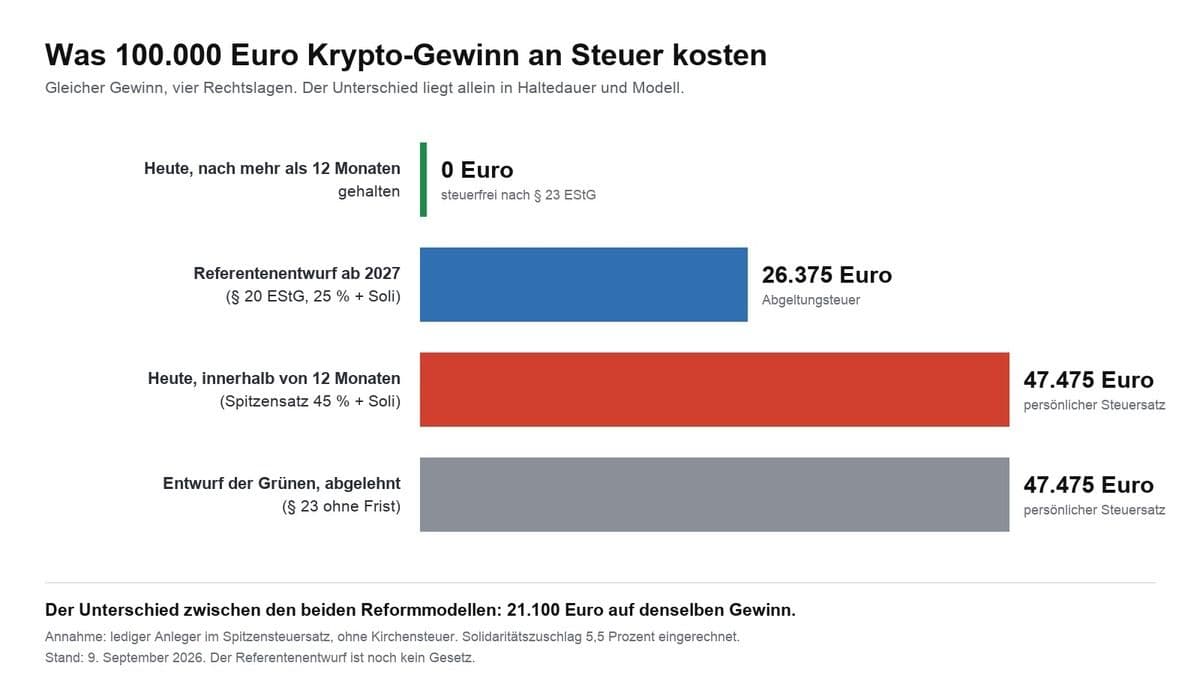
Crypto gains are tax-free after twelve months; before that your personal tax rate of up to 45 percent applies. What triggers tax, how the holding period is calculated, what happens with staking and losses, and what the draft bill would change from 2027.
September 25, 2026 10:26 PM

Selling bitcoin privately: the tax in Germany and the records you need
A direct sale to a private individual falls under the same one-year rule as an exchange sale, but there is no tax report to go with it. This guide walks through the calculation, the 1,000 euro threshold and the records the tax office wants to see.
September 9, 2026 7:11 PM
Crypto in Your Tax Return: Where Gains, Losses and Staking Go
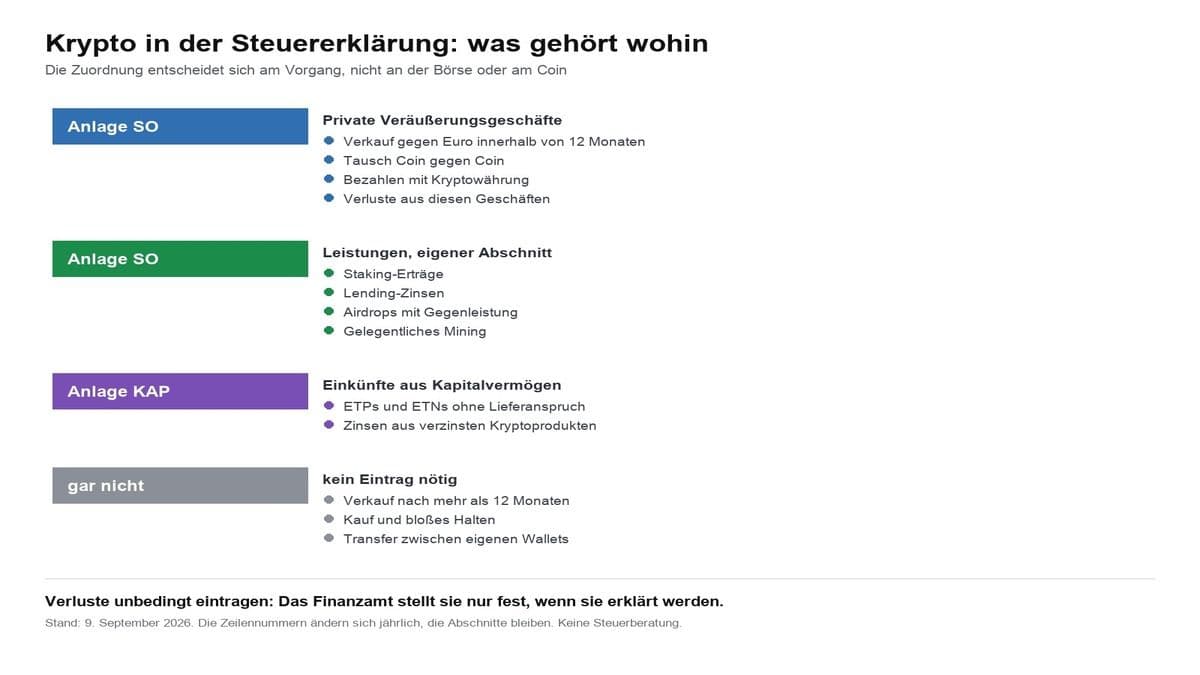
Crypto belongs in Annex SO, but in two different sections. When you have to declare at all, where gains, losses and staking income go, and why line numbers from older guides lead you astray.
August 26, 2026 10:25 PM

Selling Bitcoin at a Loss: Loss Offsetting in Austria
Sold Bitcoin at a loss? Austria allows the loss to be offset against certain investment income. When loss offsetting is possible and which limits apply.
August 31, 2026 10:23 AM

Bitcoin Abroad: The Tax Duty Austrian Investors Carry Themselves
Sold bitcoin through a foreign platform? When Austrian investors have to declare gains themselves and account for the 27.5 percent tax rate.
August 22, 2026 4:47 PM

Offsetting Bitcoin Losses Against Stock Gains in Austria
Offset bitcoin losses against gains on shares? Austria allows it in principle, but only under certain conditions and usually via the tax return.
October 1, 2026 7:36 PM

Crypto tax and withholding at source from 2028: what to check now
The German Federal Ministry of Finance’s draft bill goes to cabinet on October 14, 2026. The underexposed part of it is the deduction of tax from 2028: which providers are to withhold the tax on investment income, why self-custody and foreign platforms stay exempt from it, and what you should document by December 31.
September 26, 2026 7:29 PM

Coins Stolen in an Exchange Hack: What the German Tax Office Accepts as a Loss
After the attack on Bitget on September 24, a question the reports leave out arises for those affected in Germany: can a stolen balance be written off against tax? The answer hangs on a single term in the Income Tax Act, and it is decided by your records.

February 13, 2026 9:07 PM

Netherlands Approves 36% Tax on Unrealized Crypto Gains starting 2028
The Dutch House of Representatives has officially passed a controversial 36% tax on unrealized gains for crypto and stocks, effective January 2028.
September 16, 2026 1:20 PM

Crypto Loss Carryforward in Germany: What Happens to Old Losses Under the 2027 Tax Plan
Losses from crypto sales land in a ring-fenced pot and can only be set against gains of the same kind. The draft bill for 2027 moves future gains into a different pot, and we show you what that means for your assessed carryforward and what your tax notice should say.
October 2, 2026 1:33 PM

Crypto tax before the cabinet on October 14: “Comments are only possible until October 6”
Germany's Federal Ministry of Finance sent the draft bill on crypto taxation to the associations on September 30, 2026, and the cabinet is to decide on October 14. For your holdings one date counts above all: December 31, 2026.
August 11, 2026 9:13 PM

Germany's Crypto Holding Period Faces Abolition: What Petition 201716 and the Draft Bill Mean for Your Tax
Petition 201716 calls for the one-year holding period for crypto assets to be kept and will be heard in public by the Bundestag's Petitions Committee on 12 October 2026. Correction of 8 October: the reform was not decided by the cabinet in July. A draft bill of 30 September would end the holding period for crypto acquired after 31 December 2026, and the cabinet is due to take it up on 14 October.
August 10, 2026 5:15 PM

Bitcoin Lending in Austria: When Tax Falls Due
Lending Bitcoin and earning interest: when lending income is taxed at 27.5 percent in Austria and which exchange rate counts.
October 2, 2026 4:39 AM

Donating bitcoin: when does the full market value count, when only the purchase price?
A bitcoin donation to a charitable organisation is deductible as a donation in kind, and the donation itself produces no taxable gain. The size of the deduction turns solely on whether a sale would have been taxable on the day of the transfer.
September 24, 2026 1:13 AM

Solana DEX Trades Overtake the NYSE: What to Check on Swaps, Tax and Oversight
Solana's decentralised exchanges settled roughly 208 million trades in a single week and overtook the New York Stock Exchange for the first time. The figure is real, but it measures something other than the comparison suggests, and for German investors it carries tax duties that no provider takes on.
October 6, 2026 4:32 AM

Bitcoin for a gift card: what paying with crypto means for your holding period
Paying for a gift card with Bitcoin is a sale for tax purposes. What counts as the disposal proceeds, when the twelve-month holding period bites, and the four records the tax office expects.
September 8, 2026 1:19 AM

Germany's Crypto Holding Period: What Happens Now Signing for Petition 201716 Closed on September 15
Recap as of September 27, 2026: the signature period for German parliamentary petition 201716, which asks for the one-year crypto holding period to be preserved, closed on September 15, 2026. This article explains what ended that day, how the petitions committee proceeds and why no investor has to sell because of it.
September 9, 2026 1:15 AM

Germany's Crypto Tax: 160 Million Euros for a 555-Billion Budget
The German finance ministry's draft bill puts a figure on the crypto tax for the first time: 160 million euros from 2028. What that number means in the 2027 federal budget, how 11.4 billion became 160 million, and what investors can read from it.
September 9, 2026 4:13 PM

Bitcoin 29 Percent Below Last Year: Which Crypto Losses You Can Still Use Before the One-Year Holding Period Expires
Nine out of ten major crypto assets trade lower today than exactly twelve months ago, Bitcoin alone by 29.2 percent. We measured the price series ourselves and show why the purchase date alone decides the tax value of your loss.
August 27, 2026 10:16 AM
Bitcoin Tax Return in Austria: When You Must File
Even with a crypto exchange, a tax return can still be necessary in Austria. Foreign platforms, missing capital gains tax withholding and cross-provider losses are the typical triggers.
August 20, 2024 3:00 PM

New US Senate Proposal Submitted For Crypto Tax Exemption
The US Senate has recently submitted a new proposal to exempt crypto transactions from federal taxes. Here are more details of this submission, and a list of exempted countries it could be joining...
August 27, 2026 7:21 AM

Crypto Gains 2026: Why the September 10 Advance Tax Payment Decides Your Interest Bill
The third income tax advance payment falls due on September 10, yet for most crypto investors none was ever set. We checked four provisions in full text and show when the interest period for 2026 starts and how you can shrink it yourself.

More from CryptoTicker