
Tokenized Stocks and Tax in Germany: When the One-Year Holding Period Applies and When the Flat Tax Bites
If you buy a tokenized stock, you often apply the crypto rule: hold for a year, then the gain is tax-free. For these products that assumption usually does not hold, and this article shows from the wording of the law which feature decides the tax regime and how to find it in the issuer documents.





Which topics should we dive deeper into?
Select what genuinely interests you. Your picks feed directly into our editorial planning.
Crypto news that's actually worth your time.
Weekly. 60 seconds. Carefully curated by our editors: no hype, no promo flood, no spam.
If you buy a tokenized Tesla or Apple share through a crypto app, you probably start from a rule you know from Bitcoin: hold for a year and the gain is tax-free. Carrying that rule across is the most expensive mistake in this product segment. Whether the one-year holding period applies is decided by the category of income a gain has to be assigned to. For tokenized stocks that assignment regularly comes out differently than it does for a cryptocurrency.
This article sorts the two regimes that come into consideration using the wording of the law. It does not replace tax advice in an individual case, because the classification hangs on how the particular token is structured contractually.
Tokenized stocks: what sits behind the token, and why the legal wrapper decides the tax treatment
The term “tokenized stock” does not describe a uniform product. What is meant is a token recorded on a blockchain whose value tracks the price of a real, existing share. How that link is established differs from provider to provider.
In practice you will mainly meet two designs. In the first, a custodian holds the underlying shares and issues a token that securitises a claim against the issuer. In the second, the token merely replicates the price movement. In both cases you are, as a rule, not a shareholder in company law terms: voting rights are not part of the package, and the claim runs against the issuer of the token, not against the company whose name is on the product.
That contractual construction is precisely where tax law takes hold. The Income Tax Act knows no category called “token”. It asks whether the gain stems from the disposal of an asset or from a capital claim that promises you repayment. Which description fits follows from the issuer documents and not from the label the app files the instrument under.
Which trading venues offer such products in Europe at all is set out in our overview of exchanges for real world assets and tokenized stocks. Which provider suits the way you invest is covered in the comparison of the best crypto brokers.
The one-year holding period under Section 23 EStG covers “other assets” only
The rule Bitcoin investors have in mind sits in Section 23(1) sentence 1 no. 2 of the German Income Tax Act (EStG). What it captures there are “disposal transactions in other assets where the period between acquisition and disposal is no more than one year”. Hold for longer and you no longer meet the elements of the provision at all, so the gain stays out of the calculation.
Two details of this norm are regularly overlooked. First, under sentence 4 of the same provision a period of ten years applies instead of one if the asset generates “income in at least one calendar year”. Second, under Section 23(3) sentence 5 the gain is only tax-free if the total gain from all private disposal transactions in the calendar year came to less than 1,000 euros. That is an exemption limit and not an allowance: at a total gain of 1,000 euros the full amount is taxable, not just the excess. You can read Section 23 EStG in the original wording directly at the Federal Ministry of Justice.
The decisive point for tokenized stocks lies in the opening feature. Section 23 presupposes an “other asset”, meaning an item that is precisely not already captured by a category of income that takes precedence. As soon as a product has to be classified as a capital claim, it leaves that scope, and the holding period loses its significance entirely.
A repayment claim against the issuer: the feature that brings tokenized stocks under Section 20 EStG
Section 20(1) no. 7 EStG captures “income from other capital claims of any kind where repayment of the capital or a consideration for letting the capital be used has been promised or granted”. The disposal of such claims is captured through Section 20(2) sentence 1 no. 7. Alongside it, no. 3 covers the gain from forward transactions “through which the taxpayer obtains a cash settlement or an amount of money or advantage determined by the value of a variable reference figure”. The full text of Section 20 EStG shows how far that catalogue reaches.
The element that in practice almost always decides the matter for tokenized stocks is the promised repayment. If the issuer undertakes contractually to redeem the token against the deposited share or against its cash equivalent, much speaks for a capital claim. If instead the token only maps a price movement and the claim is for a cash settlement, classification as a forward transaction moves to the fore. Both routes lead out of Section 23.
An editorial assessment: because the structure differs from product to product, the classification cannot be settled in blanket form for the whole product group. What is solid is the reverse statement, and for your planning it usually suffices. The assumption that after twelve months the gain is automatically tax-free does not hold for these products.
Flat tax of 25 percent under Section 32d EStG: what falls due on investment income from tokenized stocks
If the gain falls under Section 20 EStG, the separate tax rate applies. Section 32d(1) sentence 1 EStG provides: “The income tax on income from capital assets that does not fall under Section 20(8) is 25 percent.” On top of that come the solidarity surcharge and, if you are liable to church tax, the church tax; for the latter, sentence 3 of the provision provides for a reduction.
The practical difference from the crypto world reaches further than the bare percentage suggests. With an asset under Section 23 EStG the holding period decides whether any tax arises at all; where it does fall due, it is measured by your personal income tax rate. With investment income the tax arises regardless of the holding period, but at a fixed rate.
Exemption limit and saver’s allowance: two amounts of 1,000 euros each that have nothing to do with one another
This is where confusion arises particularly often in practice, because the figure 1,000 turns up in both systems. The amounts are constructed differently, though, and cannot be set off against one another.
- Exemption limit under Section 23(3) sentence 5 EStG: gains from private disposal transactions stay tax-free if the total gain in the calendar year came to less than 1,000 euros. Once the threshold is reached, the entire gain is taxable.
- Saver’s allowance under Section 20(9) EStG: for income from capital assets an amount of 1,000 euros is deducted as income-related expenses; spouses assessed jointly are entitled to a combined allowance of 2,000 euros. It works as a genuine deduction rather than as an all-or-nothing threshold.
If you disposed of both Bitcoin and tokenized stocks in the same year, you have to keep the two calculations apart. An unused saver’s allowance does nothing for the gain from the crypto sale, and a gain below the exemption limit of Section 23 does not reduce the tax on investment income. A look at the comparison of crypto tax tools and portfolio trackers is worth it above all when your transactions are spread across several platforms.
Loss offsetting: why losses on tokenized stocks do not run against Bitcoin gains
The separation of the two systems shows most clearly when something goes wrong. For private disposal transactions, Section 23(3) sentence 7 EStG provides that losses “may be offset only up to the amount of the gain the taxpayer realised from private disposal transactions in the same calendar year”. A loss from a crypto sale within the one-year period therefore stays in its own bucket.
The same applies in reverse: a loss from a product governed by the investment income rules cannot be set against a gain from a private disposal transaction. If you want to tidy up your portfolio at year-end, you should therefore know beforehand which bucket each position sits in. Which events trigger tax on other crypto products is broken down in our article on stablecoins and taxes.
Annex KAP or Annex SO: which part of the tax return the gain on tokenized stocks belongs in
The assignment to a category of income follows through directly to where the transaction lands in the tax return. Income from capital assets under Section 20 EStG is entered in Annex KAP. Private disposal transactions under Section 23 EStG count as other income and therefore belong in Annex SO.
You do not set this switch as you see fit; it follows the classification of the product. Entering the same transaction in both places to be on the safe side creates a double entry that prompts queries. Which records you should gather for both annexes is set out in our overview of the documents for the crypto tax return.

The review path: how the issuer documents tell you which regime governs your tokenized stocks
The classification cannot be derived from the product name, nor from the category an app files the instrument under. What counts are the documents the issuer provides. Work through them in this order.
- Identify the issuer. Establish who your claim runs against. The name on the product is that of the company whose price is being tracked; the contractual counterparty is someone else.
- Look for repayment or redemption. Check whether you are promised a return against the deposited share or against its cash equivalent. This feature is the point of attachment for Section 20(1) no. 7 EStG.
- Read the key information document. Where a key information document is provided for the product, you will find the product type described there in standardised form.
- Check voting rights and dividends. Establish whether distributions are passed through. For tax purposes these are separate events that do not form part of the disposal gain.
- Document the result. Record what you base your classification on and file the documents with the purchase receipt. If a query comes, the burden of explanation is yours.
- Ask when it stays unclear. If the structure is still open after you have read the documents, that is a case for tax advice and not for an estimate.
How to recognise a reliable answer
A sound classification names the contractual clause it follows from. Information pages that speak in general terms about “crypto taxes” and treat the one-year period as settled miss the question.
Foreign issuer and no tax withheld: why the filing duty for tokenized stocks stays with you
Many tokenized stocks are traded through platforms that are not a domestic paying agent. No withholding tax is then deducted, and the transaction appears in no annual tax certificate.
Section 32d(3) sentence 1 EStG is unambiguous at this point: “Taxable investment income that has not been subject to withholding tax must be declared by the taxpayer in their income tax return.” Under sentence 3, an assessment is to be carried out in that case. A missing deduction at source is therefore the trigger for a duty of your own and not a sign that there is nothing to declare.
If you trade across several platforms, you should therefore check whether the provider supplies a usable annual statement. Which trading venues deliver documented exports is listed in the comparison of the best crypto exchanges.
What to take away on tokenized stocks
- Check first whether repayment is promised to you. This one feature decides whether the one-year period comes into consideration at all. Which providers keep their product documents accessible is shown in the comparison of the best crypto brokers.
- Keep two separate schedules. Private disposal transactions and investment income are calculated separately, offset separately and declared in different annexes. Software that keeps the two areas cleanly apart is covered in the comparison of crypto tax tools and portfolio trackers.
- Secure the documents at the time of purchase. Download the product description and the annual statement while your access to the platform still exists. Which trading venues deliver reliable exports is shown in the comparison of the best crypto exchanges.
(As of August 9, 2026. This article is not investment advice. Prices and fee structures change; check the terms with the provider before you buy.)
Transparency note: This article was produced with the assistance of artificial intelligence and reviewed by our editorial team before publication. All figures and claims were checked against the primary sources linked in the text. The feature image was generated with AI.
Related articles
- Crypto Holding Period and Grandfathering: Why December 31, 2026 Becomes the Cut-Off in Germany's Draft Bill
- Germany's Crypto Holding Period: What Happens Now Signing for Petition 201716 Closed on September 15
- Bitcoin 29 Percent Below Last Year: Which Crypto Losses You Can Still Use Before the One-Year Holding Period Expires
- Germany's Crypto Holding Period Faces Abolition: What Petition 201716 and the Draft Bill Mean for Your Tax
- German Crypto Holding Period Set to Go After All: A Separate Draft Targets Purchases From 2027
Which topics should we dive deeper into?
Select what genuinely interests you. Your picks feed directly into our editorial planning.
Crypto news that's actually worth your time.
Weekly. 60 seconds. Carefully curated by our editors: no hype, no promo flood, no spam.

October 6, 2026 10:24 PM

Germany's Crypto Holding Period Before the Petitions Committee on October 12: What Matters Now
The Bundestag's petitions committee debates the crypto holding period on Monday, October 12, 2026, from 12 noon in a public sitting, with federal government representatives on hand for questions. Two days later the cabinet is to decide on the draft bill that removes the one-year period for purchases from 2027.
October 6, 2026 4:32 AM

Bitcoin for a gift card: what paying with crypto means for your holding period
Paying for a gift card with Bitcoin is a sale for tax purposes. What counts as the disposal proceeds, when the twelve-month holding period bites, and the four records the tax office expects.
September 24, 2026 1:13 AM

Solana DEX Trades Overtake the NYSE: What to Check on Swaps, Tax and Oversight
Solana's decentralised exchanges settled roughly 208 million trades in a single week and overtook the New York Stock Exchange for the first time. The figure is real, but it measures something other than the comparison suggests, and for German investors it carries tax duties that no provider takes on.
September 22, 2026 10:13 AM

Circle Lends Against Bitcoin via cirBTC: Why the Wrapper Can Cost You the German Holding Period
Circle launched loans against deposited bitcoin on September 21, 2026. In Germany, the detour through the cirBTC token is very likely a swap, and a swap restarts your one-year holding period.
September 26, 2026 1:19 AM

Germany’s Crypto Holding Period Is Wobbling: What to Check Before December 31
A CDU member of the Bundestag makes it plain: the coalition agreement does not guarantee that the one-year holding period for crypto assets will survive. What that means for purchases made before the planned cutoff date of December 31, 2026.
September 25, 2026 10:26 PM

Selling bitcoin privately: the tax in Germany and the records you need
A direct sale to a private individual falls under the same one-year rule as an exchange sale, but there is no tax report to go with it. This guide walks through the calculation, the 1,000 euro threshold and the records the tax office wants to see.

September 27, 2026 1:17 PM
Dogecoin Price: What to Check on Holding Period and Custody Before the Year End
The Dogecoin price stands at $0.0977 on September 27, 2026 and has barely moved in a day. That calm is exactly the moment to work through the holding period, the reporting duty from 2026 and custody without any time pressure.
October 9, 2026 1:18 PM

Bitcoin Tax: One Year Past the $126,080 Peak, Losses No Longer Count
Bitcoin trades at $82,558 on Friday morning, 34.5 percent below an all-time high that is now a good year old. Anyone who bought back then loses more than the prospect of a quick recovery when the one-year period expires: the tax value of the loss goes with it.
September 18, 2026 10:13 AM

Bitcoin and the German Exit Tax: What Applies When You Move Abroad
Anyone emigrating with Bitcoin expects an exit tax on unrealised gains and finds nothing of the sort in the statute. Where the real risks sit is decided at four points: residence, the holding period, the legal form of your investment, and automatic reporting from 2026.
August 21, 2026 4:24 AM

Forced Sale on a Crypto Exchange: Which Moment Counts for the Holding Period and What You Must Document
At Luno, Kraken and Valour the deadlines are running out, after which the provider realises the remaining holding itself. For tax purposes that is a disposal, and what governs it is the exchange's timestamp.
September 16, 2026 7:12 PM

Borrowing Against Bitcoin Instead of Selling: When German Tax Still Applies
Posting Bitcoin as collateral for a loan is not a sale in Germany, because section 39 of the Fiscal Code keeps the coins attributed to you for tax purposes. Tax arises only when the collateral is liquidated, and then the one thing that decides the bill is how long you held the coins beforehand.
September 16, 2026 1:20 PM

Crypto Loss Carryforward in Germany: What Happens to Old Losses Under the 2027 Tax Plan
Losses from crypto sales land in a ring-fenced pot and can only be set against gains of the same kind. The draft bill for 2027 moves future gains into a different pot, and we show you what that means for your assessed carryforward and what your tax notice should say.
September 17, 2026 10:22 PM
Selling Bitcoin at a Loss and Buying It Straight Back: What That Does to Your Holding Period
Germany has no wash sale rule: the loss stays deductible even if you buy back immediately. The buyback, however, restarts the one-year period for every new unit.
September 10, 2026 1:13 AM

Staking Taxes in Germany: The Inflow, the 256-Euro Threshold and the Holding Period
Staking is taxed twice: once when the reward arrives and once when you sell it later. This article explains both moments, the threshold of 256 euros, the separate twelve-month period and what applies to liquid staking, restaking and staking ETPs.
September 27, 2026 10:35 AM

Crypto Exchange Tax Report Wrong: How to Correct It Before the Tax Office Does
Missing acquisition costs, transfers booked as sales, holding periods restarted: your exchange's report is an aid and not proof. How to check it, how to correct it and which deadline is running.
September 15, 2026 4:12 AM

Using Hyperliquid from Germany: What Applies to Your Funds Without a MiCA Licence
Hyperliquid is not entered in any EU register as an authorised crypto-asset service provider, and for perpetual futures a MiCA licence would be the wrong paperwork anyway. Here is what that means in concrete terms for your funds, your keys and your tax return.
October 2, 2026 4:39 AM

Donating bitcoin: when does the full market value count, when only the purchase price?
A bitcoin donation to a charitable organisation is deductible as a donation in kind, and the donation itself produces no taxable gain. The size of the deduction turns solely on whether a sale would have been taxable on the day of the transfer.
October 1, 2026 10:44 AM

German crypto tax reform: without a receipt, half the sale price is taxed
The Federal Ministry of Finance's draft bill goes to the cabinet on October 14. Anyone who cannot prove their acquisition cost pays tax on 50 percent of the sale proceeds under the substitute assessment.
September 19, 2026 7:26 AM

Offsetting Crypto Losses Against Share Gains: What Is Really Allowed in Germany
Crypto losses and share gains sit in separate loss buckets in Germany, and there is no offsetting between them. Where the line runs, why crypto derivatives are the exception, and how you can still use losses through carryback and carryforward.
August 16, 2026 6:14 AM

Crypto Credit Card Tax in Germany: Why Every Payment Is a Disposal
Paying with a crypto credit card means disposing of your coins for tax purposes. What that means for the holding period, the exemption threshold and your record-keeping duties, and which card design keeps the effort small.
August 13, 2026 6:18 AM

Revolut Delists USDT: Forced Conversion on August 31, 2026 Counts as a Sale
Revolut is taking USDT off the table on August 31, 2026: purchases have already stopped, deposits are blocked, and anyone who fails to act before the deadline faces an automatic conversion that counts as a sale for tax purposes. This article explains the deadlines, the tax treatment under section 23 of the German Income Tax Act and what you can do now.
September 9, 2026 4:22 PM
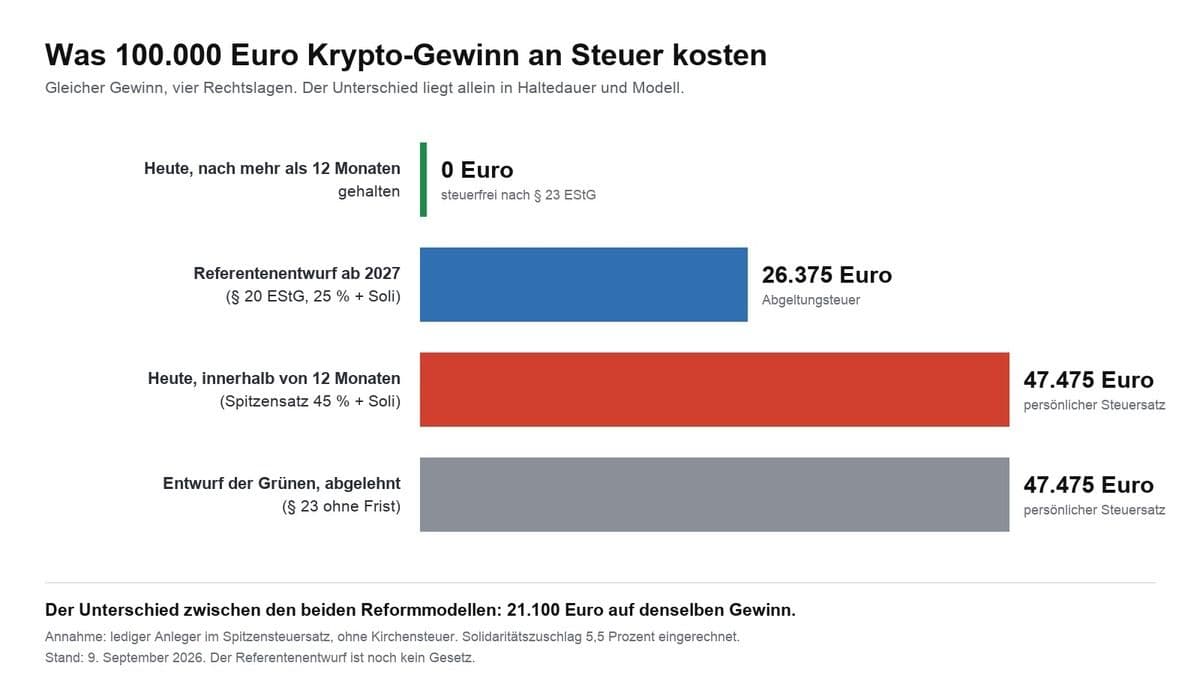
Crypto Tax in Germany: What Applies in 2026 and What Is Set to Change in 2027
Crypto gains are tax-free after twelve months; before that your personal tax rate of up to 45 percent applies. What triggers tax, how the holding period is calculated, what happens with staking and losses, and what the draft bill would change from 2027.
October 9, 2026 7:21 AM

Ethereum savings plan: twelve instalments averaged 1,981 euros, the lump sum 3,318
Twelve monthly instalments of 100 euros in Ether worked out at an average price of 1,981 euros, while a lump sum on the starting day cost 3,318 euros. The twelve-month calculation, the two quirks that set it apart from a Bitcoin savings plan, and the tax consequences of twelve separate purchases a year.
September 25, 2026 4:20 AM

Crypto as a Down Payment for a German Mortgage: What Banks Require
Since April 2023 a house in Germany can no longer be paid for in Bitcoin; section 16a of the Money Laundering Act bans it outright. Your crypto holdings still work as a down payment, provided you take the route through the euro and prove the origin without gaps.

September 24, 2026 10:19 AM

Uniswap Falls 11.8 Percent After a 114 Percent Month: What to Check on Profit Taking, Holding Period and Leverage
UNI lost 11.75 percent on Wednesday morning but is still up 113.85 percent over the month. Anyone realising gains now almost certainly triggers a taxable disposal in Germany.
September 22, 2026 10:25 PM
Binance Buys Into Circle: What the USDC Deal Means for Your Balance
Binance is taking a $100 million stake in Circle and extending the USDC agreement by five years. For investors in Germany, the sum matters less than the question of who earns money from stablecoins left sitting idle.
September 9, 2026 1:15 AM

Germany's Crypto Tax: 160 Million Euros for a 555-Billion Budget
The German finance ministry's draft bill puts a figure on the crypto tax for the first time: 160 million euros from 2028. What that number means in the 2027 federal budget, how 11.4 billion became 160 million, and what investors can read from it.
More from CryptoTicker