
Using Hyperliquid from Germany: What Applies to Your Funds Without a MiCA Licence
Hyperliquid is not entered in any EU register as an authorised crypto-asset service provider, and for perpetual futures a MiCA licence would be the wrong paperwork anyway. Here is what that means in concrete terms for your funds, your keys and your tax return.





Which topics should we dive deeper into?
Select what genuinely interests you. Your picks feed directly into our editorial planning.
Crypto news that's actually worth your time.
Weekly. 60 seconds. Carefully curated by our editors: no hype, no promo flood, no spam.
The short answer first: if you trade on Hyperliquid as a private individual in Germany, you are not committing an offence. The EU's authorisation requirement is addressed to firms that offer services, not to the users who take them up. The price is still yours to pay. Where there is no authorisation, none of the safeguards that European crypto law attaches to one apply to your funds either. This article shows you what you can look up for yourself, what the law actually says, and what the tax office expects from you.
Is Hyperliquid legal in Germany? The answer separates users from providers
The question is almost always framed the wrong way. What matters is not whether you are allowed to use a trading venue, but whether a firm is allowed to offer it to you in the EU. The law treats those two sides separately.
The text that governs this is Regulation (EU) 2023/1114, better known as MiCA. Article 59(1) reads: "A person shall not provide crypto-asset services within the Union unless that person has been authorised […] as a crypto-asset service provider", or belongs to one of the financial undertakings expressly named, such as credit institutions and investment firms. Paragraph 2 adds a registered office in a member state, a place of effective management in the Union and at least one director resident in the Union.
That is an obligation on the provider. For you as an investor, MiCA contains no prohibition that makes trading on an unauthorised venue a punishable act. What is missing is something else: the entire protective apparatus that authorisation triggers in the first place. That is what the sections below are about.
Crypto-asset service is a defined legal term here. MiCA counts among them the custody and administration of crypto-assets on behalf of clients, the operation of a trading platform for crypto-assets and the exchange of crypto-assets for funds. Anyone carrying out one of these activities commercially for clients in the Union needs the authorisation under Article 59.
What a MiCA licence covers, and why perpetual futures fall outside it
Here is the point that hardly any German-language text separates cleanly. Hyperliquid is not primarily a spot exchange but a marketplace for perpetual futures. These are derivatives with no expiry date: you are not buying the coin, you are entering into a contract whose value is derived from the price of an underlying asset and which is settled in cash. To stop such a contract drifting away from the spot price for good, long and short positions pay each other the funding rate at fixed intervals, a balancing payment between the two sides of the market.
And contracts of exactly that kind are carved out of MiCA by MiCA itself. Article 2(4)(a) states: "This Regulation does not apply to crypto-assets that qualify as one or more of the following: (a) financial instruments". Derivatives on an underlying are financial instruments within the meaning of MiFID II, the European markets in financial instruments directive. In its guidance note on financial instruments, the German supervisor BaFin describes derivatives as forward or option transactions to be settled with a time delay and whose value is derived directly or indirectly from the price of an underlying; the definition applies equally under the German Banking Act and the Securities Institutions Act.
The practical consequence is inconvenient: a MiCA authorisation would not be the right paperwork for perpetual futures trading at all. Anyone who commercially arranges or deals in derivatives for clients in Germany operates under the licensing regime for securities institutions, not under the crypto-asset regime. Searching for a MiCA entry therefore comes up empty even when you do it correctly. This classification is a legal assessment, not investment advice and not legal advice; which permission a specific offering needs is for the supervisor to decide case by case on the full contractual documentation.
What you can take from this: two different rulebooks, two different registers, two different answers. If all you have in mind is buying the HYPE token on the spot market, MiCA is the right rulebook. As soon as leverage is involved, it is the wrong one.

Looking up the ESMA register yourself: 346 authorised crypto-asset service providers, 89 of them German
You do not have to rely on anyone's summary, including this one. ESMA, the European Securities and Markets Authority, maintains a public register of all authorised crypto-asset service providers and publishes it as a freely downloadable CSV file. We pulled it for this article on September 15, 2026 and counted it ourselves.
The position on that day: 346 authorised providers across the EU. The authorisations run up to August 31, 2026, so the list is being kept current. By home member state they break down as follows:
- Germany: 89 providers — by some distance the largest home state, among them institutions such as Trade Republic Bank, flatexDEGIRO and Börse Stuttgart Digital Custody.
- France: 35, the Netherlands: 29, Cyprus: 25, Malta: 22, Spain: 15.
No entry in that list contains the string "Hyperliquid". Nor does the platform appear on the second list ESMA maintains alongside it, the register of non-compliant entities, which held 167 entries that day. Both findings are register positions, no more and no less, and in light of the previous section they are hardly surprising, because a derivatives market does not belong in a crypto-asset register. When we last went through the register in the summer, it held only 21 trading platforms with that permission, so the numbers are growing quickly.
Here is how to go about it yourself if you want to check any platform. The register files are published openly on ESMA's crypto regulation pages; for firms authorised in Germany, BaFin additionally runs its company database with a "crypto-asset service provider" category. Always check the name of the legal entity, not the brand name of the app, because the two come apart routinely.
 Perp DEX platforms compared
Article 61 MiCA: why the own-initiative exemption gives you no protection
At this point a reassuring-sounding term turns up in forums with some regularity: reverse solicitation. What is meant is the exemption in Article 61 MiCA, which provides that the authorisation requirement under Article 59 does not bite where a client established or situated in the Union initiates "at its own exclusive initiative" the provision of a crypto-asset service by a third-country firm.
Anyone reading that as a general permission has not read the provision to the end. The second subparagraph immediately narrows the exemption again: a service is not deemed to be provided at the client's own initiative where the third-country firm solicits clients or prospective clients in the Union, and that applies "regardless of any communication means used for solicitation, promotion or advertising in the Union", and also where another entity acts on the firm's behalf. Advertising, affiliate programmes and outreach through social networks all count.
The third subparagraph is blunter still. It states expressly that contractual and disclaimer clauses change nothing about this, including clauses stipulating that the service is to be regarded as provided at the client's own initiative. A tick box in the terms of use, in other words, does not turn a solicited client relationship into one you sought out. And paragraph 2 makes clear that a single request does not entitle the firm to market new types of crypto-assets or services to you.
For you as an investor the decisive insight is that Article 61 is not a client protection provision at all. The rule relieves the firm of the authorisation requirement in an individual case and gives you not a single claim, no compensation and no supervision in return. You can read the full wording in the Official Journal: Regulation (EU) 2023/1114 on EUR-Lex.
Without a MiCA licence you have no route of complaint: what applies to your funds in practice
What you actually give up by trading on a venue that is not authorised in the EU can be set out concretely. None of these points is a supposition about any particular firm; they are the legal consequences that a missing authorisation carries in general.
- No deposit guarantee. The statutory deposit guarantee of 100,000 euros covers bank deposits, not crypto-assets and not margin balances on a trading venue. It does not apply at authorised providers either, and the difference lies in the obligations that apply instead.
- No supervised segregation of your assets. Authorised providers have to hold client funds and client crypto-assets separately from their own holdings and to account for them. Without authorisation there is no authority checking that.
- No complaints procedure and no supervision. With an authorised provider you can turn to the competent supervisor, in Germany BaFin. Against a firm with no authorisation in the EU, that route does not exist.
- Enforcement is difficult. With no registered office and no management in the Union, the question of which court has jurisdiction and how a judgment would be enforced is close to unanswerable in practice.
- No tax withheld at source. A foreign platform withholds no capital gains tax. The declaration is entirely down to you, and there is more on that below.
If that catalogue feels too abstract, a comparison helps: our overview of regulated crypto exchanges with EU authorisation shows which providers actually meet the obligations listed.
Who holds the keys: self-custody, the bridge and the on-chain order book
One objection comes up regularly at this point, and it is a fair one. If everything runs fully on chain, why would you need a custodian at all? The answer is more nuanced than either camp would like.
Hyperliquid runs its own layer 1 blockchain with an on-chain order book. That is a technical departure from most first-generation decentralised exchanges: there, an automated market maker derives the price arithmetically from liquidity pools, while here a matching engine runs a classic limit order book whose orders and fills sit in the network as transactions. What such a marketplace actually is and how it differs from a centralised exchange is explained in our primer What is a perp DEX?.
To use it you connect a crypto wallet and keep your private keys yourself; you do not go through a classic KYC procedure with identity checks. That is the honest advantage of this design. The catch is that to trade at all you have to deposit funds into the network across a bridge, and your margin then sits in the protocol. Self-custody protects you from the failure of a custodian, but not from a flaw in the protocol, not from a hole in the bridge, and not from a leveraged position being liquidated while you sleep.
Technical transparency and regulatory safety are two different things. Having every order publicly visible is no substitute for a capital requirement or a complaints body. Confusing those two levels draws the wrong conclusion from a genuine merit.

Leverage, funding rate and liquidation: what the trading venue actually offers today
Rather than passing on market reports, we queried the platform's public programming interface ourselves on September 15, 2026. These are the figures from that call, and they describe a snapshot, not a Hyperliquid price forecast.
- 234 perpetual markets were tradable.
- Total open interest, meaning the sum of all open positions, stood at around $10.4 billion.
- Trading volume over the preceding 24 hours added up to roughly $6.5 billion.
- The largest single market was the BTC contract at around $2.8 billion of open interest, followed by the ETH contract at $2.6 billion and the HYPE contract at $1.7 billion.
More revealing than the size is the leverage the protocol allows on each market. That sits in the same interface: the BTC contract permitted up to 40 times leverage, the ETH contract up to 25 times. Four further markets reached 20 times, 35 markets 10 times, 63 markets 5 times, and at 130 of the 234 markets, meaning the majority, the ceiling was 3 times.
That tiering is not accidental but risk management by the protocol: the thinner a market, the lower the leverage allowed. For you it means the reverse, that the spectacular leverage figures from the advertising are not available at all on niche markets. And at every level of leverage the same mechanics apply. A move of a few percent against a position geared 20 times wipes out the stake. Order types such as a stop-loss are meant to cap that in principle, but in a price gap they may only trigger below your mark. For comparing providers in this segment we keep a separate overview of perp DEX platforms with their fees and leverage tiers.
 Crypto exchanges with an EU licence compared
Crypto tax in Germany: perpetual futures are forward transactions under Section 20 EStG
This is the part that costs the most money in practice, and it has nothing to do with the authorisation question. The tax office is not interested in where a platform is based, but in what kind of contract you have entered into.
A forward transaction is a transaction under which you obtain a cash settlement or a sum of money determined by the value of a variable reference figure. That is precisely the wording of Section 20(2) sentence 1 no. 3(a) of the German Income Tax Act. On that definition, perpetual futures are routinely classified as forward transactions by the tax authorities and by tax advisers, because they are settled in cash and never lead to delivery of a coin.
The difference from a spot purchase is severe, and it usually works against you:
- On a spot purchase of a coin, Section 23 EStG applies. After a holding period of one year the gain is tax free.
- On a forward transaction, Section 20 EStG applies. There is no holding period and no tax exemption after a year, but the flat withholding rate of 25 percent plus solidarity surcharge and, where applicable, church tax, regardless of whether you held the position for a minute or for two years.
Because a foreign platform withholds no capital gains tax, you have to declare this income yourself in the Anlage KAP annex to your tax return. That is not a formality: anyone who fails to declare gains from forward transactions risks criminal tax proceedings. How funding payments are to be classified in detail has not been settled conclusively, and where meaningful sums are involved that is a case for a tax adviser. For gathering your records, the tools in our comparison of crypto tax software and portfolio trackers will help.
Loss offsetting: the 20,000 euro cap on forward transactions has been scrapped
One rule that still appears in many older guides no longer applies, and that is in your favour. Until the 2024 Annual Tax Act, losses from forward transactions formed their own offsetting pot: they could be set only against gains from transactions of the same kind, and then only up to 20,000 euros a year. Someone who made 100,000 euros and lost 90,000 euros in the same year could end up with a tax assessment on a gain they had never economically made.
The legislature struck those sentences after the Federal Fiscal Court expressed serious constitutional doubts. In the current wording of Section 20 EStG, paragraph 6 no longer contains a separate offsetting pot for forward transactions; the restriction that remains in sentence 4 concerns only losses on the disposal of shares. Losses from forward transactions can therefore once again be set against all investment income.
For you that means two things. First, old loss carry-forwards from forward transactions are worth more than you may think. Second, offsettable does not mean harmless. The losses stay trapped in the pot of investment income and still reduce no income from any other category.
What regulated alternatives deliver, and where their limit lies
If you are not willing to carry the drawbacks listed, the question is what an authorised provider in Germany offers instead. Answered honestly: protection, but less choice.
Authorised firms are subject to ongoing supervision, have to segregate client assets, handle complaints and meet disclosure obligations. On spot trading and savings plans you get the same product there as anywhere else, only with a supervisor behind it. Coins bought in spot trading also fall under the one-year rule in Section 23 EStG.
Where the limit lies: you will not find highly leveraged perpetual futures in this form at a German provider serving retail clients. That is not an oversight but the intention of European investor protection, which has capped retail leverage on contracts for difference sharply for years. Anyone looking for these products is leaving the protected space. That is a deliberate decision and should be taken as one, rather than out of ignorance. How quickly the terms in this segment can change was shown most recently by our analysis of the dilution from the HYPE unlocks.
Using Hyperliquid from Germany: what to take away
- Check the legal entity before you deposit money. Look the name up in the ESMA register and in BaFin's company database, and accept no brand name as evidence. Which providers pass that check is set out in our overview of regulated crypto exchanges.
- Decide deliberately between protection and product range. If spot buying and savings plans are what you are after, there is no reason to leave the protected space. If derivatives are what you are after, compare the terms soberly using our overview of perp DEX platforms, and commit only capital whose total loss you can absorb.
- Collect your records from the first position onwards. Forward transactions belong in the Anlage KAP, and a foreign platform reports nothing to the tax office. Set up a complete record from your first trade, for instance with a tool from our comparison of crypto tax software.
(As of September 15, 2026. This article is not investment advice. Prices and fee structures change; check the terms with the provider before you buy.)
Transparency note: This article was produced with the assistance of artificial intelligence and reviewed by our editorial team before publication. All figures and claims were checked against the primary sources linked in the text. The feature image was generated with AI.
Related articles
- Solana DEX Trades Overtake the NYSE: What to Check on Swaps, Tax and Oversight
- Five of nine BaFin warnings cite the Crypto Markets Supervision Act: "This is a case of identity misuse"
- Cardano Slides Below $0.24: What ADA Holders Should Check on Leverage, Liquidation and Holding Period
- NEAR Falls Almost 8 Percent After a 62 Percent Week: What to Check on Perps, Buying Route and Holding Period
- Crypto Futures Tax in Germany: 25 Percent From the First Trade, No One-Year Rule
Which topics should we dive deeper into?
Select what genuinely interests you. Your picks feed directly into our editorial planning.
Crypto news that's actually worth your time.
Weekly. 60 seconds. Carefully curated by our editors: no hype, no promo flood, no spam.

October 13, 2026 10:37 PM

ESMA will supervise only 10 to 15 of 360 crypto firms: your exchange stays with its home regulator
On October 9, 2026 EU finance ministers agreed to place only the largest crypto service providers under direct ESMA supervision. For the vast majority of the roughly 360 authorised firms, the national authority stays in charge, in Germany BaFin.
August 11, 2026 5:24 PM

Perp DEX Explained: How Funding Rate, Liquidation and Taxes Work on Perpetual Futures
Perpetual contracts run without an expiry date, and in exchange you pay funding for as long as you hold them. This article explains the mechanics behind perp DEX, the liquidation thresholds and the regulatory and tax framework in Germany.
August 18, 2026 7:13 AM

Bitcoin Tax Reporting in Austria 2026: What Applies
Bitcoin tax reporting in Austria: which data investors can request from crypto exchanges in 2026, and when the report matters for the tax return.
October 21, 2026 4:14 AM

Pump.fun launches perpetual futures with 40x leverage: what to watch now
Pump.fun has traded perpetual futures on Bitcoin and Ethereum since October 16, 2026, with leverage of up to 40 times and Hyperliquid as the technical operator. At that leverage a 2.5 percent price move is enough for liquidation, and a MiCA licence for the EU market is missing.
August 16, 2026 6:14 AM
Crypto Credit Card Tax in Germany: Why Every Payment Is a Disposal
Paying with a crypto credit card means disposing of your coins for tax purposes. What that means for the holding period, the exemption threshold and your record-keeping duties, and which card design keeps the effort small.
August 13, 2026 6:18 AM

Revolut Delists USDT: Forced Conversion on August 31, 2026 Counts as a Sale
Revolut is taking USDT off the table on August 31, 2026: purchases have already stopped, deposits are blocked, and anyone who fails to act before the deadline faces an automatic conversion that counts as a sale for tax purposes. This article explains the deadlines, the tax treatment under section 23 of the German Income Tax Act and what you can do now.
August 21, 2026 10:27 AM

Complaining About a Crypto Exchange: the Deadlines Article 71 MiCAR Sets and Why BaFin Will Not Decide Your Case
Authorised crypto providers have to run a formal complaints procedure, and Delegated Regulation (EU) 2025/294 sets a hard limit of two months for it. Our own analysis of the ESMA list shows at the same time that no complaints link is on file for Germany to this day.
August 21, 2026 7:17 AM

Checking a MiCAR White Paper: What the First Published MiCA Penalty Against Bitpanda Means for Investors
Austria's FMA has fined Bitpanda GmbH 70,000 euros because a crypto-asset white paper was filed late and advertised before it had been published. We explain what rights this mandatory document gives you, and called up all 972 white papers held in the ESMA register to see whether they can be reached at all.

October 13, 2026 10:26 AM

Hyperliquid falls 5.9 percent while Bitcoin loses 0.8: $1.66 billion of leverage sits on HYPE
HYPE drops to $82.61 while Bitcoin gives up only 0.8 percent. An own survey of the exchange shows why: $1.66 billion of open leveraged positions stand against $611 million of daily turnover.
September 30, 2026 4:45 PM
CFTC Registers Coinbase Clearing for Fully Collateralised Derivatives: What Matters for Investors in Europe
The US regulator CFTC registered Coinbase Clearing as a clearing house on September 28, but only for fully collateralised contracts without leverage. For investors in Europe another decision counts for more: ESMA's CFD classification of perpetual futures.
August 6, 2026 3:05 PM
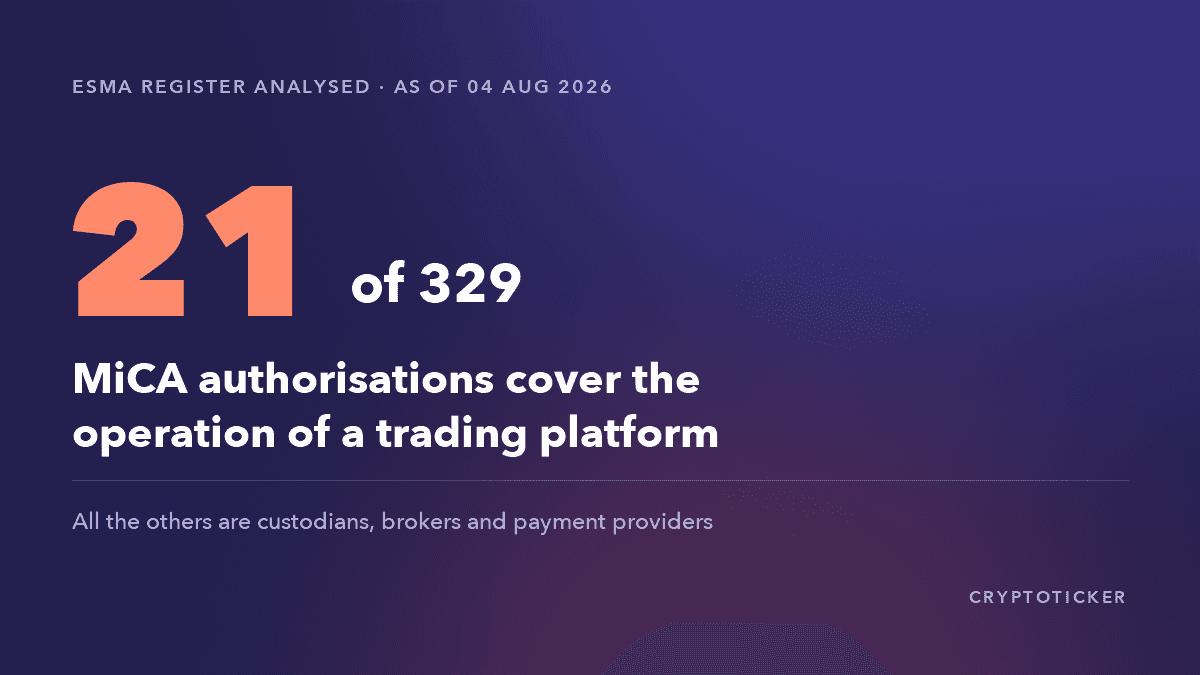
MiCA Register 2026: Only 21 of 329 Licences Are Real Exchanges
ESMA publishes the register of MiCA-authorised providers as an open file. We worked through all of it — and the result is not what the phrase “licensed crypto exchange” suggests.
August 12, 2026 6:24 PM

Tokenized Stocks and Tax in Germany: When the One-Year Holding Period Applies and When the Flat Tax Bites
If you buy a tokenized stock, you often apply the crypto rule: hold for a year, then the gain is tax-free. For these products that assumption usually does not hold, and this article shows from the wording of the law which feature decides the tax regime and how to find it in the issuer documents.
September 8, 2026 10:21 PM

Crypto Holding Period and Grandfathering: Why December 31, 2026 Becomes the Cut-Off in Germany's Draft Bill
A ministerial draft bill from Germany's finance ministry names a cut-off date for the first time: crypto assets acquired after December 31, 2026 are to fall under the flat-rate withholding tax. What that means for legacy holdings, running savings plans and staking income, and why nothing has been decided yet.
August 21, 2026 1:42 PM

Writing Off a Total Crypto Loss: When the Tax Office Recognises Worthless Coins
A token that has collapsed only reduces your tax once you actually dispose of it. What applies to delisting, exchange insolvency and worthless holdings under Section 23 of the German Income Tax Act, and how you offset losses.
August 11, 2026 9:13 PM

Germany's Crypto Holding Period Faces Abolition: What Petition 201716 and the Draft Bill Mean for Your Tax
Petition 201716 calls for the one-year holding period for crypto assets to be kept and will be heard in public by the Bundestag's Petitions Committee on 12 October 2026. Correction of 8 October: the reform was not decided by the cabinet in July. A draft bill of 30 September would end the holding period for crypto acquired after 31 December 2026, and the cabinet is due to take it up on 14 October.
September 16, 2026 7:12 PM

Borrowing Against Bitcoin Instead of Selling: When German Tax Still Applies
Posting Bitcoin as collateral for a loan is not a sale in Germany, because section 39 of the Fiscal Code keeps the coins attributed to you for tax purposes. Tax arises only when the collateral is liquidated, and then the one thing that decides the bill is how long you held the coins beforehand.
September 7, 2026 7:22 AM

German Crypto Holding Period Set to Go After All: A Separate Draft Targets Purchases From 2027
Correction of 8 October 2026: The Income Tax Reform Act 2027, adopted by the German federal cabinet on 2 September, does not cover crypto assets. That did not mean the holding period stays. A separate draft bill from the Federal Ministry of Finance, dated 30 September, would abolish it for anything acquired after 31 December 2026. The cabinet is due to decide on 14 October.
September 19, 2026 7:26 AM

Offsetting Crypto Losses Against Share Gains: What Is Really Allowed in Germany
Crypto losses and share gains sit in separate loss buckets in Germany, and there is no offsetting between them. Where the line runs, why crypto derivatives are the exception, and how you can still use losses through carryback and carryforward.

July 2, 2026 8:59 PM

Binance Is Out of the EU: How to Move to a MiCA-Regulated Exchange
Binance has left the EU market. Which exchanges hold a MiCA licence, how to verify an authorisation is real, and how to move your holdings across step by step.
August 20, 2026 10:24 PM

MiCA Review: What the European Commission Could Change About the EU Crypto Rules
The European Commission has reopened MiCA for review after barely two years and is asking 86 questions covering the stablecoin interest ban, staking, lending and DeFi. Brussels is taking responses until September 30, 2026.
October 18, 2026 7:15 PM

“To effectively combat cross-border tax evasion”: Bundestag opens crypto tax reporting to non-EU states
On 8 October 2026 the Bundestag passed the treaty act on the international reporting framework for crypto-assets, opening the exchange of tax data to states outside the EU. This piece sets out which details flow, from when they flow, and what records a data match requires.
October 6, 2026 10:24 PM

Germany's Crypto Holding Period Before the Petitions Committee on October 12: What Matters Now
The Bundestag's petitions committee debates the crypto holding period on Monday, October 12, 2026, from 12 noon in a public sitting, with federal government representatives on hand for questions. Two days later the cabinet is to decide on the draft bill that removes the one-year period for purchases from 2027.
October 2, 2026 4:39 AM

Donating bitcoin: when does the full market value count, when only the purchase price?
A bitcoin donation to a charitable organisation is deductible as a donation in kind, and the donation itself produces no taxable gain. The size of the deduction turns solely on whether a sale would have been taxable on the day of the transfer.
October 6, 2026 4:32 AM
Bitcoin for a gift card: what paying with crypto means for your holding period
Paying for a gift card with Bitcoin is a sale for tax purposes. What counts as the disposal proceeds, when the twelve-month holding period bites, and the four records the tax office expects.
September 29, 2026 10:33 AM

ESMA puts reverse solicitation on its 2027 watch list: what investors need to know about exchanges without an EU licence
ESMA presented its work programme for 2027 on September 28, 2026 and made reverse solicitation a supervisory priority. What that means if your coins sit with a provider without EU authorisation, and which three steps make sense now.
September 22, 2026 10:13 AM

Circle Lends Against Bitcoin via cirBTC: Why the Wrapper Can Cost You the German Holding Period
Circle launched loans against deposited bitcoin on September 21, 2026. In Germany, the detour through the cirBTC token is very likely a swap, and a swap restarts your one-year holding period.
September 8, 2026 1:19 AM

Germany's Crypto Holding Period: What Happens Now Signing for Petition 201716 Closed on September 15
Recap as of September 27, 2026: the signature period for German parliamentary petition 201716, which asks for the one-year crypto holding period to be preserved, closed on September 15, 2026. This article explains what ended that day, how the petitions committee proceeds and why no investor has to sell because of it.
More from CryptoTicker