
CFTC Registers Coinbase Clearing for Fully Collateralised Derivatives: What Matters for Investors in Europe
The US regulator CFTC registered Coinbase Clearing as a clearing house on September 28, but only for fully collateralised contracts without leverage. For investors in Europe another decision counts for more: ESMA's CFD classification of perpetual futures.




Which topics should we dive deeper into?
Select what genuinely interests you. Your picks feed directly into our editorial planning.
Crypto news that's actually worth your time.
Weekly. 60 seconds. Carefully curated by our editors: no hype, no promo flood, no spam.
The US derivatives regulator CFTC registered the company Coinbase Clearing LLC as a derivatives clearing organization on September 28, 2026. The licence permits exactly one kind of business: fully collateralised futures, options on futures and swaps. Leveraged contracts, that is the part of derivatives trading that carries most of the volume worldwide, are expressly not covered. For you as an investor in Europe the decision changes nothing about your portfolio directly, and that is precisely the point the headlines lose.
The news becomes interesting only when you place it next to the European legal framework. Coinbase has offered futures contracts in the EU since March 2026 as well, but through an entirely different company, under a different supervisor and with different limits. Anyone reading the US announcement and drawing conclusions about their own account is confusing two sets of rules.
What the CFTC approved on September 28
The Commodity Futures Trading Commission, CFTC for short, is the US federal authority for commodity futures and derivatives markets. By commission order the agency granted the registration of Coinbase Clearing LLC as a derivatives clearing organization. The company had filed the application in November 2025, together with a draft rulebook and documents on its corporate structure. Between application and registration, then, lay a good ten months.
The scope is in the register entry and it is narrowly drawn. Only fully collateralised contracts may be cleared. That is not a formality but the substantive limit of the entire licence.
Derivatives clearing organization: what a DCO actually does
A derivatives clearing organization, in plain terms a clearing house or central counterparty, inserts itself between the buyer and the seller of a futures contract. That entity becomes the legal contracting party for both sides and guarantees performance. If one side defaults, the clearing house steps in with the collateral lodged and its default fund.
That is why the function requires a licence. A clearing house bundles the counterparty risk of an entire market in one place. If it collapses, it pulls the connected firms down with it. Until this registration, Coinbase had its futures contracts settled at an outside clearing house and paid fees to third parties for it.
Why this is a cost question
Clearing is a pass-through business with thin margins and high volumes. Run it yourself and you save the service provider's margin and control the settlement times. Whether any of that reaches end customers is decided in the fee schedules, not in the press release. Which spreads actually arise in daily use you see most readily in a direct comparison of crypto brokers and their fee models.
Fully collateralised means no leverage and no margin call
A fully collateralised contract is a futures transaction in which the maximum possible loss is lodged in advance and in full. Buy a collateralised call option and the premium amount sits there. You cannot lose more than that stake, and no additional demand can come.
That is the opposite of ordinary futures trading. There you lodge an initial payment, the margin, which makes up only a fraction of the contract value. If the market moves against you, the broker demands more or closes the position by force. It is precisely this mechanism that the new licence does not cover.
For the market that means Coinbase may now settle the conservative half of the derivatives business entirely in house in the US. The margin-driven half, which accounts for the bulk of trading volume, stays outside. Extending the registration would be a new application with its own review.

FCM, DCM, DCO: the three licence tiers under one roof
With the registration, Coinbase holds all three CFTC-regulated functions in its own companies for the first time. That can be read off the corporate names.
- Coinbase Financial Markets, Inc. is the futures commission merchant, that is the broker through which customer orders run and which holds customer funds.
- Coinbase Derivatives, LLC is the designated contract market, the exchange on which the contracts are listed and traded.
- Coinbase Clearing LLC has been the clearing house since September 28, settling and guaranteeing the trades.
Listing, broking, settling: those three steps now run inside the same group. The company's general counsel, Molly Abraham, described the licence as the completion of an end-to-end derivatives chain with native stablecoin collateral and round-the-clock settlement.
From a supervisory point of view this bundling is not unproblematic, and the authorities know it. Separating exchange, broker and clearing house was historically a safeguard against conflicts of interest. That a regulator permits it in the fully collateralised segment but not in the leveraged one follows the same logic: where no margin call threatens, the damage from a conflict is limited.
 Crypto brokers compared
USDC as collateral and the 24-hour settlement
The technical core of the matter is the collateral currency. Coinbase describes the clearing house as built around USDC, that is the dollar stablecoin the company issues jointly with Circle. Collateral is posted in USDC and moves on blockchain rails rather than through bank accounts.
The practical difference lies in time. Classic clearing houses hang on the opening hours of the banking system: margin calls are issued at fixed times and have to be met through payment systems that stand still at the weekend. Crypto markets trade continuously. Between Friday evening and Monday morning a gap therefore opens in which risk accumulates that nobody can square off.
Collateral in a stablecoin closes that gap technically. In exchange it takes on a different dependency, namely on the issuer and on the backing of its reserves. That a supervisory authority accepts this model for fully collateralised contracts is the genuinely remarkable part of the decision. You can look the entry up in the CFTC register of licensed clearing houses.
Coinbase Financial Services Europe: the MiFID route for European investors
Here the worlds part. Coinbase Clearing LLC, Coinbase Derivatives and Coinbase Financial Markets are US companies under US supervision. Those products are aimed at US customers. As an investor in Europe you do not trade there.
The European route runs through a Cypriot company, Coinbase Financial Services Europe, licensed under the financial markets directive MiFID II. Through it the company launched futures contracts in 26 European countries in March 2026, among them contracts on Bitcoin, on other large crypto assets and on equity indices. This European structure is entirely separate from the US chain: the American clearing settles no European customer positions.
The acquired derivatives exchange Deribit likewise does not belong to the EU company; it sits under supervision in Dubai. Anyone trading with a group licensed in several jurisdictions at once should therefore know which company is on their contract. That determines which supervisor is responsible and which investor protection applies.

ESMA and the CFD classification of perpetual futures
For the European framework another decision matters more than the one from Washington. The European securities regulator ESMA published a public statement on February 24, 2026, classifying derivatives marketed as perpetual futures or perpetual contracts.
A perpetual future is a futures contract without an expiry date, held at the spot price through regular balancing payments between buyers and sellers, the funding rate. ESMA finds that such products are likely to fall under the existing national product intervention measures for contracts for difference, provided they meet the definition of a CFD. What counts, it says, is the economic design and not the product name.
Where that applies to a product, the requirements of the CFD regime bite for retail investors: leverage caps, a prescribed risk warning, automatic close-out when a margin threshold is breached, and protection against a negative account balance. For positions on cryptocurrencies the leverage cap in the CFD regime is 2:1. Whether an individual product falls under it is assessed by the competent national supervisor, in Germany BaFin. The classification is in the ESMA notice on the CFD product intervention measures.
In practice that means the leverage figures you see at a provider do not yet tell you what applies to you as a retail investor. What governs is the classification of your account and the licence of the company with which you conclude the contract. If you are considering decentralised venues, a close look at their liquidation rules is worthwhile, because the consumer protection described here is precisely what does not apply there.
 Perp DEX platforms compared
MiCA covers spot and custody, not the derivatives
A widespread misconception holds that the European crypto regulation MiCA governs the whole of crypto trading. That is not the case. MiCA captures crypto assets that are not financial instruments within the meaning of MiFID II, that is at its core spot trading, custody and the issuance of stablecoins.
Derivatives on crypto assets are financial instruments and fall under MiFID II. For you that means two different levels of protection at one and the same provider: buy Bitcoin directly and the MiCA regime applies with its custody and information duties. Trade a futures contract on Bitcoin and securities law applies, with suitability assessment, cost transparency and the product intervention rules. What a MiCA authorisation demands in detail is set out in our overview of the MiCA licensing obligations for crypto companies.
For a spot purchase you can check the licence yourself: BaFin and ESMA maintain public registers of authorised providers. A firm that does not appear there may not offer the business in Germany.
Tax: why crypto derivatives do not fall under the holding period
The difference between a spot purchase and a futures transaction is drawn sharply in Germany for tax purposes too, and depending on the situation it costs or saves a lot of money.
Spot purchase: private disposal transaction
Buy a cryptocurrency directly and hold it, and the sale is a private disposal transaction under Section 23 of the Income Tax Act. If more than a year lies between purchase and sale, the gain remains tax free. Within the year it is taxed at your personal income tax rate, with an exemption threshold applying to the sum of all private disposal transactions in a year.
Derivatives: investment income
A futures contract is something else. Gains from it count as investment income under Section 20 of the Income Tax Act and are subject to the flat withholding tax of 25 percent plus solidarity surcharge and, where applicable, church tax. There is no holding period here. Hold a futures position for ten years and you pay the same rate at the end as after ten days.
On loss offsetting the position has changed in investors' favour. For forward transactions a ceiling of €20,000 per year applied, up to which losses could be offset. That restriction in Section 20 paragraph 6 sentences 5 and 6 of the Income Tax Act was repealed by the Annual Tax Act 2024, and through the transitional rule in Section 52 for all cases still open as well. Losses from forward transactions are therefore offsettable without limit against gains of the same income category.
Anyone running both, a spot holding and futures positions, is in effect keeping two separate tax circles. Cleanly separated records here are not pedantry but the precondition for the return adding up at all. Software that keeps the two income categories apart from the outset helps.
Liquidation and margin calls: the difference from a spot purchase
The most dangerous difference between the two worlds is the moment at which a loss becomes final. Hold coins in your portfolio and you decide yourself when you sell. A price fall of 60 percent hurts, but it forces nothing on you.
With a leveraged futures position that is no longer your decision but the margin calculation's. If the collateral falls below the maintenance threshold, the position is closed out, regardless of whether the price comes back two hours later. At leverage of 10, a counter-move in the single-digit percentage range is arithmetically enough for that. This is exactly why the leverage question hangs so closely on consumer protection.
A fully collateralised contract of the kind the new US clearing house may settle knows no such mechanism. The stake is lodged in full, there is nothing to add and nothing to close out by force. That makes it structurally less dangerous for retail investors and uninteresting for traders who want leverage.
Coinbase Clearing: Your next three steps
- Establish which company is on your contract. Open the contract documents or the imprint of your trading account and look up which company and which supervisor are named there. A US registration does not apply to a European contract. Which firms hold a European authorisation is shown in the comparison of regulated crypto exchanges.
- Separate spot holdings and futures positions in your records. The two are subject to different tax rules, and the holding period applies only to the spot holding. Keep the records apart while the year is running; suitable tools are in the comparison of crypto tax tools.
- Check your account's actual leverage cap before you open a futures position. A provider's advertised ceiling and what applies to you as a retail investor can diverge. The terms and liquidation rules of the venues are in the comparison of perp DEX platforms.
(As of September 30, 2026. This article is not investment advice. Prices and fee structures change; check the terms with the provider before you buy.)
Frequently asked questions about Coinbase Clearing
Transparency note: This article was produced with the assistance of artificial intelligence and reviewed by our editorial team before publication. All figures and claims were checked against the primary sources linked in the text. The feature image was generated with AI.
Related articles
- Binance Launches FX Perpetuals With 100x Leverage: What Is Allowed in Germany
- Perp DEX Explained: How Funding Rate, Liquidation and Taxes Work on Perpetual Futures
- ESMA Places Perpetual Futures Inside the CFD Perimeter: 2:1 Leverage for Retail Clients in the EU
- Using Hyperliquid from Germany: What Applies to Your Funds Without a MiCA Licence
- Pump.fun launches perpetual futures with 40x leverage: what to watch now
Which topics should we dive deeper into?
Select what genuinely interests you. Your picks feed directly into our editorial planning.
Crypto news that's actually worth your time.
Weekly. 60 seconds. Carefully curated by our editors: no hype, no promo flood, no spam.

May 31, 2026 12:25 PM
HYPE Token Hits $70 All-Time High: 4 Reasons for the Surge
Hyperliquid ($HYPE) hit a $70 all-time high, entering the top 10 cryptos. Here are the regulatory changes and revenue fundamentals driving the pump.

September 30, 2026 10:13 PM

Robinhood Announces Perp Futures With 10x Leverage for US Customers: “Markets don’t work without traders”
Robinhood plans to offer eligible US customers perpetual futures on eight cryptocurrencies, with up to 10x leverage on Bitcoin and Ethereum. Nothing is tradable yet, and a different leverage cap applies in Europe.

September 24, 2026 1:34 PM

Cardano Slides Below $0.24: What ADA Holders Should Check on Leverage, Liquidation and Holding Period
Cardano has given back its move above $0.25 and trades around seven percent below the high of the past 24 hours. What that means for leveraged positions, the holding period of your tranches and the buying route under MiCA.
August 20, 2026 10:28 AM

Coinbase International Exchange merges into Deribit: what happens to open positions and collateral
Coinbase merges its derivatives venue International Exchange into Deribit on 9 September 2026. Anyone unwilling to come along has to exit as early as the end of August, because the move cancels orders and forcibly settles positions.
October 13, 2026 10:26 AM

Hyperliquid falls 5.9 percent while Bitcoin loses 0.8: $1.66 billion of leverage sits on HYPE
HYPE drops to $82.61 while Bitcoin gives up only 0.8 percent. An own survey of the exchange shows why: $1.66 billion of open leveraged positions stand against $611 million of daily turnover.
October 20, 2026 10:18 AM
Coinbase converts USDT and DAI into USDC on October 30: the swap restarts the one-year holding period
On October 30 Coinbase will convert the remaining USDT, DAI and PYUSD balances in the European Economic Area into USDC. The swap counts as a disposal under section 23 of the German Income Tax Act, and the one-year clock starts again for the new balance.
September 22, 2026 7:13 PM

CME Lists Bitcoin Cash and Uniswap Futures From October 19: What Retail Investors Must Check With Their Broker
CME Group brings futures on Bitcoin Cash and Uniswap to market on October 19, and BCH jumps 24 percent on the news. For retail investors in Germany, however, a BaFin order decides whether they may trade the contracts at all.
August 16, 2023 7:46 PM
Crypto News: Coinbase Approved for Crypto Futures Trading in US
Crypto News: Coinbase has recently received the green light to delve into the futures market within the United States.
October 9, 2026 1:28 PM

Coinbase Pro Returns With 10x Spot Margin, and Germany's CFD Rules Decide What Lands
Coinbase has completed the Deribit acquisition on the technical side and is bringing Coinbase Pro back by the end of the year, with spot margin of up to ten times leverage. How much of that arrives in Germany turns on whether supervisors classify such products as contracts for difference.
September 24, 2026 1:24 PM

NEAR Falls Almost 8 Percent After a 62 Percent Week: What to Check on Perps, Buying Route and Holding Period
NEAR Protocol loses up to 7.9 percent on September 24, 2026 and is still more than 55 percent higher over the week. The rally was carried by a confidential perp offering via Hyperliquid, which raises questions of its own on buying route, leverage and holding period in Germany.

March 28, 2023 6:21 AM
Binance and CEO Changpeng Zhao Hit with CFTC Charges for Operating Illegal Crypto Derivatives Platform
The Commodity Futures Trading Commission (CFTC) has announced a civil enforcement action against Binance and its CEO, Changpeng Zhao.
August 26, 2026 7:34 AM

Coinbase Delisting on August 26: Ten Perpetual Futures Go, Open Positions Are Settled
Coinbase is removing ten perpetual futures from trading on August 26, 2026, among them the contracts on The Sandbox, Axie Infinity and Blur. Anyone leaving a position open does not sell it themselves but is settled at an average price from the final hour of trading.
August 14, 2026 6:18 PM

Bitcoin From a Foreign Exchange to Austria: Which Tax Data You Need
Transferring Bitcoin from a foreign exchange to an Austrian platform: which tax data can be missing for the withholding tax. And what investors need to watch out for.
October 12, 2026 7:17 PM
Crypto Futures Tax in Germany: 25 Percent From the First Trade, No One-Year Rule
Crypto futures and perpetuals fall under Section 20 of the German Income Tax Act and therefore a flat 26.375 percent, with no holding period and no 1,000-euro exemption. Since the Annual Tax Act 2024, losses on them can again be offset without limit.
August 6, 2026 3:05 PM
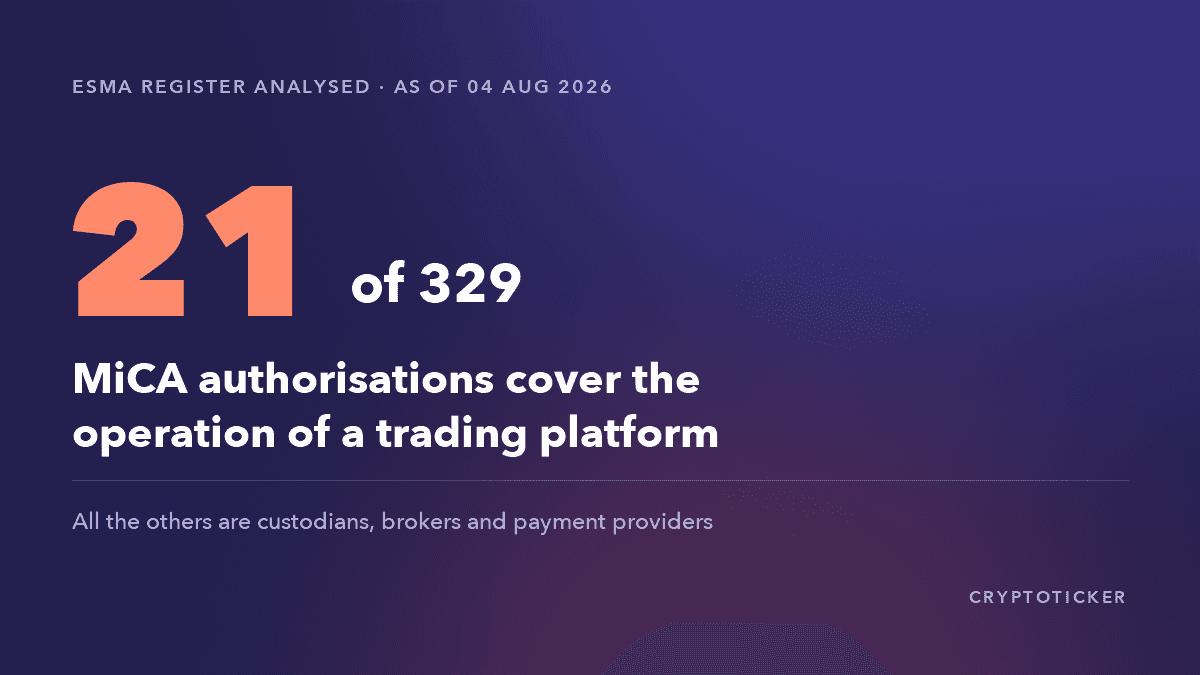
MiCA Register 2026: Only 21 of 329 Licences Are Real Exchanges
ESMA publishes the register of MiCA-authorised providers as an open file. We worked through all of it — and the result is not what the phrase “licensed crypto exchange” suggests.
July 2, 2026 8:59 PM
Binance Is Out of the EU: How to Move to a MiCA-Regulated Exchange
Binance has left the EU market. Which exchanges hold a MiCA licence, how to verify an authorisation is real, and how to move your holdings across step by step.
October 16, 2026 1:22 PM

CME lists Uniswap futures on October 19: why UNI is up 8.3 percent three days out
CME Group opens trading in futures on Uniswap on Monday, October 19. Three days ahead the UNI price stands at $7.49, well below the level it reached right after the announcement.
September 24, 2026 1:13 AM

Solana DEX Trades Overtake the NYSE: What to Check on Swaps, Tax and Oversight
Solana's decentralised exchanges settled roughly 208 million trades in a single week and overtook the New York Stock Exchange for the first time. The figure is real, but it measures something other than the comparison suggests, and for German investors it carries tax duties that no provider takes on.
September 29, 2026 10:33 AM

ESMA puts reverse solicitation on its 2027 watch list: what investors need to know about exchanges without an EU licence
ESMA presented its work programme for 2027 on September 28, 2026 and made reverse solicitation a supervisory priority. What that means if your coins sit with a provider without EU authorisation, and which three steps make sense now.
August 13, 2026 6:18 AM

Revolut Delists USDT: Forced Conversion on August 31, 2026 Counts as a Sale
Revolut is taking USDT off the table on August 31, 2026: purchases have already stopped, deposits are blocked, and anyone who fails to act before the deadline faces an automatic conversion that counts as a sale for tax purposes. This article explains the deadlines, the tax treatment under section 23 of the German Income Tax Act and what you can do now.
August 11, 2026 9:18 AM

Your Crypto Exchange Is Telling You to Withdraw: How to Spot Phishing After the MiCA Deadline
Unauthorised crypto providers now have to tell their EU customers to withdraw, which leaves fraudsters an easy run with faked requests. Here is how to check in two minutes whether the message is genuine.
October 20, 2026 4:17 AM

Stablecoin interest: MiCA article 50 bans it, and lending yield is taxable from 256 euros
No issuer in Europe pays interest on the token itself, and article 50 of MiCA expressly forbids it. Where a quoted yield actually comes from and how the tax office treats it.
October 19, 2026 7:51 AM

Euro balances on a crypto exchange: what to watch after the ESMA answer on MiCA article 70
The European securities regulator ESMA spelled out on October 16, 2026 where a crypto asset service provider may hold your euro balance. A payment service provider without a banking licence is only a staging post of at most one business day.
October 16, 2026 10:41 AM
Bitcoin futures at 5 BTC per contract: what to watch on margin and the expiry date
A Bitcoin future gives you a price and a date, not coins. What contract size, margin and expiry on the last Friday of the month mean for your account, and why the route to the futures market in Germany runs through the broker.
September 26, 2026 7:40 AM

The RAIN Token After the Enlivex Termination: What to Check on Access, Forced Sale and Holding Period
Enlivex terminated a share placement of 66,666,667 shares payable in RAIN tokens on September 22, 2026. The token sits 46.4 percent below its all-time high, and at Kraken the withdrawal deadline expired long ago.
August 15, 2026 9:31 PM

Crypto Exchange Shutting Down: What to Do Before the Deadline Passes
Binance, BitMart, Luno and Revolut have ended or cut back their European business within seven weeks. This guide shows which deadline expires first, how a forced sale is treated for tax, and what to secure before the account closes.
More from CryptoTicker