
IoTeX on Coinbase: What IOTX Holders Should Know After the September 23 Trading Halt
Recap as of September 27, 2026: Coinbase had announced it would halt trading in IOTX on September 23, 2026, and eight days earlier Trust Wallet dropped the IoTeX network from the app. Our own query of the Coinbase API on September 27 shows IOTX-USD as delisted. This article describes the situation before the deadline.



Which topics should we dive deeper into?
Select what genuinely interests you. Your picks feed directly into our editorial planning.
Crypto news that's actually worth your time.
Weekly. 60 seconds. Carefully curated by our editors: no hype, no promo flood, no spam.
Coinbase will halt trading in IoTeX (IOTX) on September 23, 2026. Your balance stays where it is and you can still withdraw. What goes away is the option to sell IOTX on Coinbase. Eight days earlier, on September 15, the IoTeX network also disappears from the standard view in Trust Wallet. Anyone holding IOTX therefore has two dates in the same month, and each of them affects a different part of their holdings.
This piece sorts both dates, separates confirmed information from figures merely doing the rounds, and describes the order in which to work through your holdings. One thing up front: in both cases this is about access to your coins, not about owning them. That is precisely the distinction that regularly gets lost in reports about delistings.
What Happens to IOTX on Coinbase on September 23, 2026
Coinbase announced in late August that it would suspend trading in IOTX. According to the announcement by Coinbase Markets, it affects Coinbase.com with Simple Trade and Advanced Trade, plus Coinbase Exchange and Coinbase Prime. The exchange gives the timing as September 23, 2026 at around 2 p.m. New York time.
For you that converts to 8 p.m. central European summer time. A second time, however, is circulating in the coverage: individual aggregators write 2 p.m. UTC, which is 4 p.m. central European time. The difference is four hours. If you still want to sell on the day itself, you are well advised to go by the earlier figure and be finished before 4 p.m. central European time. An order book that has already closed knows no leniency.
As its reason Coinbase cites the regular review of listed assets against its own listing standards. The exchange has published no specific rationale for IOTX. That is the usual wording in decisions of this kind and allows no conclusion about any particular incident at the project.
Trading Halt or Delisting: The Difference That Decides What Happens to Your Balance
A trading halt means an exchange closes a trading pair while still allowing deposits and withdrawals of the coin. A delisting in the narrower sense removes the asset from the platform entirely, usually with its own deadline for the final withdrawal.
On Coinbase's own account, IOTX is the first case. The exchange states that balances remain accessible and withdrawals remain possible. Your money is therefore not at risk; your ability to sell at this particular exchange is. How a full delisting plays out and how to spot the deadlines is something we set out in our explainer on delisting at a crypto exchange.
In practice that means you have two routes after September 23. Either you sell on Coinbase beforehand, or you move the tokens to another platform or into your own wallet and decide later. Both routes are legitimate; they differ in cost and in time pressure.
Limit-Only: What the State of Your Order Book Already Tells You Today
Limit-only is an operating state in which you can only place and cancel limit orders, while market orders are blocked. Exchanges put an order book into this state before closing it for good. Executions still happen, but only when a counterparty shows up at the price you set.
This state can be verified without having to take anyone's word for it. Coinbase's public products interface returns the current status for every trading pair. A query on September 4, 2026 at 06:37 UTC shows IOTX-USD with the status online while the limit-only flag is set at the same time. Trading is running, then, but in throttled mode.
For you that has one immediate consequence: a sell order without a limit no longer works on this pair. You have to set a price, and that price is only filled if a buyer accepts it. On an asset with a thin order book that can take a while. Anyone who waits until the last day is negotiating with ever fewer counterparties.
The Euro Pair IOTX-EUR Has Already Been Removed
The point that matters most for German holders is older than the August announcement. The same query of the Coinbase interface shows IOTX-EUR with the status delisted and trading disabled. A direct exit into euros on Coinbase therefore no longer exists for IOTX as of today.
Anyone who still wants to sell on Coinbase now goes via the US dollar or via a stablecoin and converts into euros afterwards. That costs an additional trading step, an additional fee, and brings an exchange rate into play. On a holding in the low three-figure euro range, that chain can eat noticeably into the proceeds. What the individual providers charge in fees and where euro pairs are available at all is shown in our crypto exchange comparison.
Incidentally, the query shows that IOTX is not an isolated case: STORJ-USD is also on limit-only in the same measurement. Both assets come from the same wave of announcements in late August. For STORJ and BADGER we have already described the September 28 deadline in detail. IOTX falls five days earlier, and that gap is precisely the reason for this piece.
The Second Date: Trust Wallet Drops the IoTeX Network on September 15
Eight days before the Coinbase date, native support for 25 networks ends in Trust Wallet. Cryptobriefing reported on August 18, citing the provider, that the list runs from Agoric, Aurora and Boba through Moonbeam, MultiversX, Polygon zkEVM, Viction and Wanchain. IoTeX is on that list too; we went through the full roster on August 31 in our piece on the sunsetting of the 25 networks.
What matters is exactly what happens here. According to the provider, all balances stay put on their blockchains. What disappears is convenient access: the networks concerned no longer show up in the app's standard network list. Viewing, sending, swapping — none of that works through the standard interface any more.
The Way Back Is Called a Custom Network
A custom network is a network you enter into a wallet yourself, supplying the technical connection details by hand. That includes an RPC endpoint, the address of a server through which your wallet talks to the blockchain. Trust Wallet points out explicitly that those affected can make their networks available again this way.
September 15 is therefore not a date on which anything is lost, but a date on which convenience is. Anyone who does nothing loses nothing, but can no longer reach holdings on that chain through the app until the network is added back. Anyone who has cleanly backed up their access data in the form of a seed phrase can also restore the wallet in another application at any time.
Eight Days, Two Dates: The Order in Which to Check
The two deadlines affect different places where your coins may sit. That is why the first step is not the decision but the inventory.
Step 1: Where Are Your IOTX in the First Place?
If they sit in a Coinbase account, September 23 concerns you. If they sit in Trust Wallet on the IoTeX chain, September 15 concerns you. If they sit on a hardware wallet or at another exchange, neither date concerns you for now. Many holders have partial balances in several places, especially after years of changing providers.
Step 2: The Earlier Date First
September 15 comes first and is the calmer of the two. Before that date, check whether Trust Wallet holds a balance on one of the affected chains, and note down which ones. If it does, either add the network back as a custom network in good time or move the holdings beforehand onto a chain that remains supported.
Step 3: The Decision for September 23
For a balance held at Coinbase there are three sensible options: sell, transfer to another exchange, or take it into your own custody. The third option means self-custody, that is, storage with a private key that only you control. Which devices are suitable and what matters when setting them up is covered in our hardware wallet comparison.
A transfer costs network fees, and a withdrawal may cost an additional flat fee charged by the exchange. On small holdings that sum can amount to a substantial share of the value. Work that out before the decision rather than discovering it afterwards.
Where IOTX Can Still Be Traded After September 23
IOTX does not vanish from the market with the Coinbase date. A query of the trading pairs at CoinGecko on September 4, 2026 at 06:39 UTC lists 49 active pairs at venues such as Binance, KuCoin, Gate, MEXC and WhiteBIT. Trading there runs overwhelmingly against the stablecoin USDT.
What is notable is what the list lacks: no euro pair appears among the 49 pairs recorded. A German holder wanting to sell IOTX directly for euros will find no venue for it in this roster. The route runs via a stablecoin or the US dollar and from there into euros.
Anyone moving their holding to another exchange for that reason should check two things beforehand: whether the provider is authorised in the European Economic Area at all, and whether it supports the IoTeX chain for deposits. A deposit on the wrong chain is the most expensive mistake in this entire chain of dates.
 Hardware Wallets Compared: Hold Your Coins Yourself
What IoTeX Is and Why Small Networks Get Dropped From Listings
IoTeX is an Ethereum-compatible blockchain launched in 2019 that targets the connection of physical devices and is today usually assigned to the DePIN category. DePIN stands for decentralised physical infrastructure networks, meaning projects that coordinate real-world devices such as sensors or hotspots through token incentives. IOTX is the associated network token.
The market figures explain the decision better than any announcement. At CoinGecko, IOTX was quoted on September 4, 2026 at around €0.0027, with a market capitalisation of about €25.3 million and rank 658 in the overall market. Circulating supply is around 9.44 billion tokens, and the distance from the all-time high is about 98.8 percent.
For a large trading platform an asset like that is above all work: every trading pair ties up monitoring, market maintenance and regulatory review. Once turnover falls below an internal threshold, the pair is closed. That is a commercial decision by the exchange and not a verdict on the project's technology. The reverse also holds, though: an asset that several providers weed out at the same time loses liquidity, and thin order books make exit prices worse still.
What This Case Says About Your Choice of Exchange and Wallet
Two dates in eight days for a single token are a good occasion to review your own set-up. Three questions help with that.
First, accessibility: can you reach each of your holdings without depending on one particular app? Anyone who owns their seed phrase is independent of a wallet provider's product policy. Anyone who does not is not.
Second, exit routes: does a direct euro route exist for your positions, or does selling hang on a chain of several steps? On small holdings that is a cost question you can answer in advance. A look at the exchange comparison shows which providers carry euro pairs across the board.
Third, custody: balances at an exchange hang on that exchange's decisions, from product selection through to account management. Holdings in your own custody hang on your own diligence. Both have drawbacks, but they arrive at different moments. The range of devices and how they differ is described in the hardware wallet comparison.
If You Sell: The Tax Side Note
A sale before the deadline is a private disposal transaction in Germany. What matters there is the one-year holding period: where coins are disposed of after more than a year of holding, the gain remains tax-free under current law, and below that the exemption threshold for private disposal transactions applies.
In practice that means two things. First, you need the acquisition date for every position. Second, a swap into a stablecoin is already a tax-relevant event, not just the payout into euros. Anyone who works through a chain of several swap steps because of a trading halt thereby creates several events that have to be documented. Tools that record such events automatically can be found in our overview of crypto tax software and portfolio trackers. This classification is no substitute for tax advice in an individual case.
Checking the IOTX Trading Halt: What to Take Away
- Take stock before you decide. Check by September 15 whether your IOTX sit at Coinbase, in Trust Wallet or somewhere else. For comparing possible new venues including euro pairs, the exchange comparison helps.
- Work through the earlier date first. Add affected networks back as a custom network in good time, or move the holdings. If you want to take on custody yourself for the long run, the device options are in the hardware wallet comparison.
- Calculate the costs and the holding period before you sell. Fees, exchange rate and acquisition date belong in the same calculation. Suitable tools for that are in the overview of crypto tax software and portfolio trackers.
(As of September 4, 2026. This article is not investment advice. Prices and fee structures change; check the terms with the provider before you buy.)
Transparency note: This article was produced with the assistance of artificial intelligence and reviewed by our editorial team before publication. All figures and claims were checked against the primary sources linked in the text. The feature image was generated with AI.
Related articles
- Trust Wallet Drops 25 Networks: What Users Should Know After September 15
- OKX delists ICX, STORJ and ELF: by when you have to trade or withdraw
- Kraken: 45 coins are on cancel only, 21 were announced – what to check when trading pairs are blocked
- Binance Delisting on August 17: ACX, HFT, PIVX, PYR, VANRY and VIC Leave Spot Trading
- Writing Off a Total Crypto Loss: When the Tax Office Recognises Worthless Coins
Which topics should we dive deeper into?
Select what genuinely interests you. Your picks feed directly into our editorial planning.
Crypto news that's actually worth your time.
Weekly. 60 seconds. Carefully curated by our editors: no hype, no promo flood, no spam.

August 21, 2026 4:24 AM

Forced Sale on a Crypto Exchange: Which Moment Counts for the Holding Period and What You Must Document
At Luno, Kraken and Valour the deadlines are running out, after which the provider realises the remaining holding itself. For tax purposes that is a disposal, and what governs it is the exchange's timestamp.
September 23, 2026 10:32 AM
Switching crypto exchange: what happens to the holding period and the tax when you transfer
A transfer to another exchange or to your own wallet triggers no tax and does not reset the one-year period. What does get lost is the acquisition data, and that is exactly what you need later as evidence.
October 11, 2026 1:24 AM
Three Mistakes When Setting Up Trust Wallet: The Twelve Words Never Belong on the Phone
Trust Wallet is set up in five minutes, yet three mistakes in those minutes regularly cost the entire balance. This guide covers the six steps, the real cost of a swap, and what applies in Germany on the holding period and supervision.
August 30, 2026 10:13 PM
Coinbase Halts STORJ and BADGER Trading on September 28: What Holders Must Check Now
Coinbase is ending trading in Badger DAO and Storj on September 28, 2026, and both order books have run in limit-only mode since the announcement on August 28. Withdrawals remain possible; selling at Coinbase does not.
August 24, 2026 4:22 AM

Selling XRP After a 53 Percent Week: What the Holding Period Costs
XRP trades at $1.51 after a weekly gain of a good 50 percent, yet your net proceeds are decided by the purchase date. This article works through the holding period, the exemption limit and FIFO at measured reference-date prices.
September 9, 2026 4:22 PM
Crypto Tax in Germany: What Applies in 2026 and What Is Set to Change in 2027
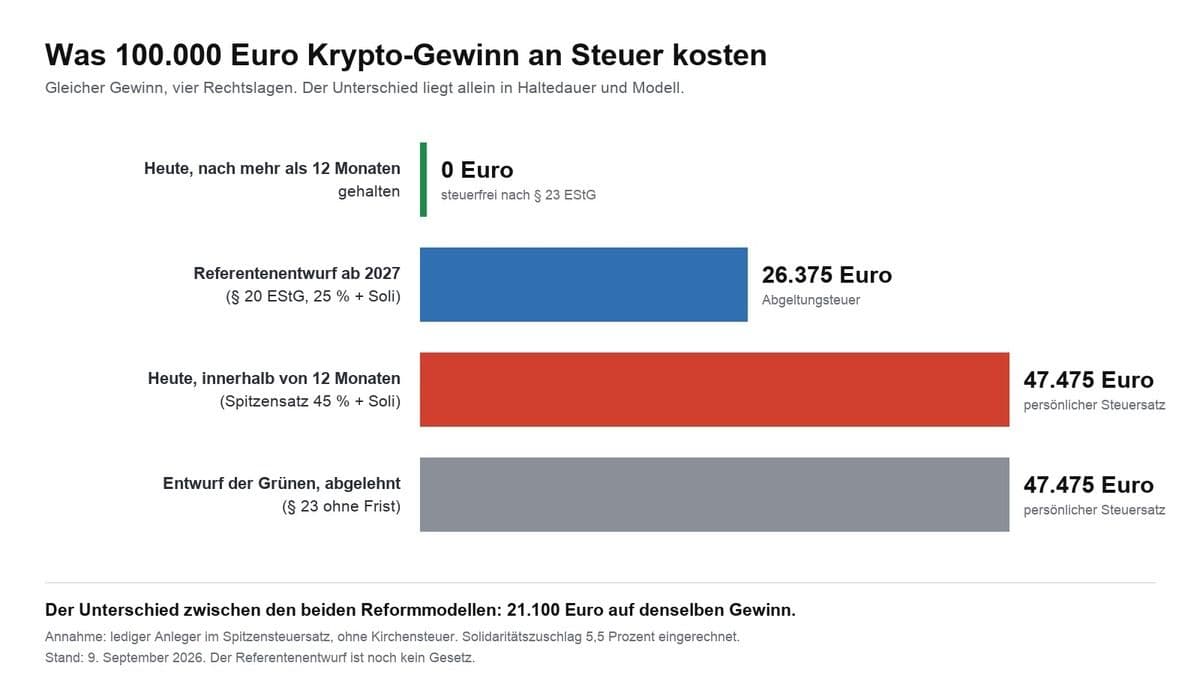
Crypto gains are tax-free after twelve months; before that your personal tax rate of up to 45 percent applies. What triggers tax, how the holding period is calculated, what happens with staking and losses, and what the draft bill would change from 2027.
September 24, 2026 4:28 AM
Crypto Trading Bots and Tax: What Applies With Thousands of Trades a Year
A bot turns one investment decision into hundreds of disposals, and the tax office counts every single one. This guide explains the holding period, FIFO, the exemption limit and the record-keeping duties, and what to set up before the bot makes its first trade.
September 26, 2026 1:19 AM
Germany’s Crypto Holding Period Is Wobbling: What to Check Before December 31
A CDU member of the Bundestag makes it plain: the coalition agreement does not guarantee that the one-year holding period for crypto assets will survive. What that means for purchases made before the planned cutoff date of December 31, 2026.
September 29, 2026 10:40 AM
“We have created the essential conditions …”: bitcoin.de has stood still for three months, the MiCAR licence is missing
Bitcoin Group SE published its half-year report on September 29, 2026: trading on bitcoin.de has been idle since the end of June because the MiCAR authorisation is missing. The new platform is finished, but no launch date is set.

September 26, 2026 7:40 AM
The RAIN Token After the Enlivex Termination: What to Check on Access, Forced Sale and Holding Period
Enlivex terminated a share placement of 66,666,667 shares payable in RAIN tokens on September 22, 2026. The token sits 46.4 percent below its all-time high, and at Kraken the withdrawal deadline expired long ago.
September 8, 2026 10:21 PM

Crypto Holding Period and Grandfathering: Why December 31, 2026 Becomes the Cut-Off in Germany's Draft Bill
A ministerial draft bill from Germany's finance ministry names a cut-off date for the first time: crypto assets acquired after December 31, 2026 are to fall under the flat-rate withholding tax. What that means for legacy holdings, running savings plans and staking income, and why nothing has been decided yet.
September 24, 2026 1:34 PM

Cardano Slides Below $0.24: What ADA Holders Should Check on Leverage, Liquidation and Holding Period
Cardano has given back its move above $0.25 and trades around seven percent below the high of the past 24 hours. What that means for leveraged positions, the holding period of your tranches and the buying route under MiCA.
October 11, 2026 7:26 PM

Stablecoin swaps: France plans the tax Germany has had for years
Swapping bitcoin into a stablecoin in France carries no tax so far. That is set to change from 2027, with the finance committee of the National Assembly having given its approval. In Germany such a swap has long been a taxable event, with one consequence many investors miss: the holding period starts again.
October 9, 2026 10:50 AM

Crypto holding period: the Bundestag rejects abolition by 445 votes to 132: what investors need to know
On 8 October the Bundestag rejected the Greens' bill to abolish the crypto holding period in a recorded vote, and the Left's motion fell too. The result by parliamentary group, the official speech from the media centre, and why it was the SPD that gave investors the real signal in the debate.
August 20, 2026 4:24 PM
Bitcoin Across Multiple Wallets: How Austria Works Out the Acquisition Cost
Bitcoin spread across several wallets? How Austria works out the acquisition cost and the rolling average price for tax purposes.
October 8, 2026 7:18 PM

Kraken delisting on October 23: what you can do about the 14 removed tokens
Kraken halts trading in 14 crypto assets on October 23, 2026, with withdrawals running until the end of January 2027. Eleven of the assets have a euro pair, and across all eleven together only around 22,300 euros changed hands in a single day.
October 7, 2026 4:28 PM

Shiba Inu Price at $0.00000538, Down 8.6 Percent in a Day: Hold or Sell?
Shiba Inu loses 8.6 percent on Wednesday afternoon and trades at $0.00000538. Whether a sale makes sense is decided in Germany less by the chart than by the purchase date of the individual tranche, because the one-year period hangs on it.
October 5, 2026 10:14 AM
Solana price 108.46 euros: a 2.4 percent gain in euros, a 2.5 percent loss in dollars: what to check now
Solana is quoted at 108.46 euros and $121.30 on Monday morning. That leaves a gain of 2.4 percent for 2026 in euros and a loss of 2.5 percent in dollars. The difference comes purely from the exchange rate, and in Germany it decides the holding period, the tax threshold and the figure that ends up on the tax return.

September 26, 2026 10:12 AM

Canton Jumps 15.6 Percent to $0.13: What to Check on Trading Volume Before You Order
Canton (CC) gains 15.64 percent in 24 hours to $0.13443, making it the strongest mover in the top 25. Our own count shows that CC trades at just 0.94 percent of its market capitalisation, a fifth of the median.
September 8, 2026 1:19 AM

Germany's Crypto Holding Period: What Happens Now Signing for Petition 201716 Closed on September 15
Recap as of September 27, 2026: the signature period for German parliamentary petition 201716, which asks for the one-year crypto holding period to be preserved, closed on September 15, 2026. This article explains what ended that day, how the petitions committee proceeds and why no investor has to sell because of it.
August 24, 2026 10:29 AM
Buying More Bitcoin at $77,000: Savings Plan or Lump Sum
Bitcoin stands at $77,256 after gaining 22.78 percent in a week. This guide shows you how to buy more cleanly at this price and which method fits which starting position.
September 9, 2026 1:15 AM

Germany's Crypto Tax: 160 Million Euros for a 555-Billion Budget
The German finance ministry's draft bill puts a figure on the crypto tax for the first time: 160 million euros from 2028. What that number means in the 2027 federal budget, how 11.4 billion became 160 million, and what investors can read from it.
October 8, 2026 4:17 AM

Crypto Holding Period: Without a Purchase Record the Tax Withheld Runs Ten Times Too High
The consultation on Germany's crypto tax bill closed on October 6 and the cabinet is to adopt it on October 14, with tax advisers, banks and the Bitcoin Bundesverband having filed their objections. The sharpest concerns everyone whose purchase data the selling platform does not hold: one adviser calculates a withholding ten times the tax owed.
October 9, 2026 1:18 PM

Bitcoin Tax: One Year Past the $126,080 Peak, Losses No Longer Count
Bitcoin trades at $82,558 on Friday morning, 34.5 percent below an all-time high that is now a good year old. Anyone who bought back then loses more than the prospect of a quick recovery when the one-year period expires: the tax value of the loss goes with it.
September 18, 2026 10:13 AM

Bitcoin and the German Exit Tax: What Applies When You Move Abroad
Anyone emigrating with Bitcoin expects an exit tax on unrealised gains and finds nothing of the sort in the statute. Where the real risks sit is decided at four points: residence, the holding period, the legal form of your investment, and automatic reporting from 2026.
September 16, 2026 1:20 PM

Crypto Loss Carryforward in Germany: What Happens to Old Losses Under the 2027 Tax Plan
Losses from crypto sales land in a ring-fenced pot and can only be set against gains of the same kind. The draft bill for 2027 moves future gains into a different pot, and we show you what that means for your assessed carryforward and what your tax notice should say.
September 14, 2026 10:23 AM

Take Ethereum Profits or Wait Out the Holding Period? What the Price Jump Means for Your Tax Bill
Ether reached its highest level since the end of January on September 11, 2026, and many are asking whether to sell now. In Germany the answer hangs on the purchase date first: we work out which tranches are tax free and which of them are showing a gain at all.
More from CryptoTicker