
Forced Sale on a Crypto Exchange: Which Moment Counts for the Holding Period and What You Must Document
At Luno, Kraken and Valour the deadlines are running out, after which the provider realises the remaining holding itself. For tax purposes that is a disposal, and what governs it is the exchange's timestamp.





Which topics should we dive deeper into?
Select what genuinely interests you. Your picks feed directly into our editorial planning.
Crypto news that's actually worth your time.
Weekly. 60 seconds. Carefully curated by our editors: no hype, no promo flood, no spam.
Anyone holding a balance on a trading platform these weeks knows the notices: a deadline is set, after which the provider realises the remaining holding itself. Our deadline overview of August 16, 2026 counts seven such cut-off dates at seven providers before August 31 alone. Luno is closing its EU accounts on September 1, with sales and euro payouts possible only until August 31, 2026, as we reported on August 9. At Valour a compulsory redemption of a crypto ETP traded on Xetra is under way, and the last date for the redemption notice is September 1, 2026, reported in our piece of August 18. Kraken has announced a liquidation window for delisted tokens in September; our report on that dates from August 14, 2026.
All these texts answer the same question: by when you have to act. None of them answers in full the question that follows, and it is the more expensive one. What happens for tax purposes if you miss the deadline and the platform sells, converts or settles your holding itself?
The short answer already appears as a subordinate clause in many of our reports. The longer answer sits in two documents, both public, which together explain which day counts, which rate has to be applied and which records you need if the platform that triggered the sale no longer exists six months later. This text works through both. It is no substitute for tax advice, and for your own case a tax adviser remains the right address.
Forced sale, forced liquidation and forced conversion: what the exchange does with your holding in each case
The terms are used interchangeably, but three different processes sit behind them, and for tax purposes they differ on one point that becomes important further down.
Forced liquidation: the platform sells for euros or a stablecoin
The most common case with delistings. Once the withdrawal deadline expires, the provider sells the remaining holding on the market and credits the proceeds to the account. Kraken has announced this route for the delisted tokens and pointed out in the same notice that little or no proceeds may result, as we reported on August 14, 2026.
Forced conversion: one token becomes another
Here no euro lands in the account; the holding is converted into another crypto asset. Revolut announced this for USDT, and several migrations to new networks follow the same pattern. For tax purposes this case is the more awkward one, because no euro flows from which the tax could be paid.
Compulsory redemption: the issuer takes a security back
With exchange-traded products such as a crypto ETP the process originates with the issuer and not with the trading platform. The holder receives a cash settlement or, if they apply in time, delivery of the underlying crypto assets. This case follows different tax rules from a directly held token, because an ETP is a debt security. The BMF circular treats debt securities separately and refers, depending on their structure, to Section 20 of the German Income Tax Act. The remainder of this text deals with the first two cases, that is, directly held crypto assets in private assets.
Disposal under Section 23 of the Income Tax Act: why a forced sale counts like one you triggered yourself
Under the case law of the Federal Fiscal Court, crypto assets are other assets within the meaning of Section 23(1) sentence 1 no. 2 of the German Income Tax Act. The Federal Ministry of Finance adopted this classification in its circular of March 6, 2025 and there expressly invokes the Federal Fiscal Court judgment of February 14, 2023, case reference IX R 3/22. A gain from the sale of such assets is taxable where no more than one year lies between acquisition and disposal.
What is decisive for our question is how the circular frames the term disposal. Margin number 54 states that, as the mirror image of an acquisition, the transfer of the acquired asset to third parties for consideration constitutes a disposal. The exchange of crypto assets for a state currency, for goods, for services or for other crypto assets accordingly likewise results in a disposal.
The whole matter hangs on that definition, and so a qualification belongs at this point: the BMF circular nowhere mentions the forced sale expressly. It attaches to the transaction, that is, to the transfer for consideration, and imposes no condition regarding who triggered it. On our reading it follows that a forced liquidation and a forced conversion fall under the same provision as a sale order you place yourself. Anyone who needs this classification to be legally watertight for their own case should clarify it with a tax adviser before making it the basis of a tax return.
In practice this means that voluntariness is not a feature on which anything can be pinned. The circumstance that you did not choose the moment yourself does not appear in Section 23 of the Income Tax Act, nor does it appear in the BMF circular as an exception. How the one-year holding period for crypto assets works in the normal case we have explained separately; the forced case changes nothing in the mechanics, it merely takes from you the control over the moment it is triggered.

The one-year holding period in a forced liquidation: why the timestamps recorded by the trading platform decide
This is the point at which most accounts stop, and the point at which matters first become interesting for those affected. If the exchange sells within a window of several days, you initially have no idea on which day your holding came up. Yet exactly that determines whether the one-year period has been breached.
Margin number 55 of the BMF circular answers it: for the purpose of determining the one-year period, where an acquisition or disposal takes place via a central trading platform, the moments recorded there are the ones to rely on. What is decisive, then, is the timestamp the exchange keeps in its own records, and not the day on which you noticed the entry in your account.
That has two consequences. First, you cannot move the day after the fact, not even through a later payout. Second, you have to get hold of that timestamp while the account is still open. An account statement or a transaction overview showing the date and time of the sale is the evidence that matters.
In the same margin number the circular permits a second route: where the underlying obligation under the law of contract is to govern whether the one-year period has been exceeded, taxpayers must prove the moment the contract was concluded through suitable records. With a forced liquidation that is a difficult path, because you concluded no contract you could produce. The realistic route runs via the platform's records.
So if you are facing a running deadline, the order is clear: first check whether your holdings still fall within the one-year period, then decide whether to sell or withdraw yourself beforehand. Which dates are currently running we have compiled in our overview of exchange cut-off dates.
 Crypto Tax Tools Compared
Liquidation windows spanning several days: how the BMF circular permits valuation with daily rates
The timestamp settles the deadline. It does not yet settle the rate. With a forced conversion into another crypto asset there is no euro amount from which the proceeds could be read off, and with a liquidation spread over a window of several days the rate on the first and on the last day can lie far apart.
Margin number 58 of the circular provides that, on an exchange of crypto assets for other crypto assets, the market rate of the crypto assets received at the moment of the exchange is to be applied as the disposal proceeds. Where no market rate can be determined for the assets received, the same margin number raises no objection to the market rate of the crypto assets given up being applied instead.
Where the exact time is missing, margin number 91 helps further. Where market rates are valued not at the moment of acquisition or of the exchange transaction but with daily rates determined according to documented parameters, the tax authority may recognise these as a basis of taxation until further notice, as long as consistent valuation is assured. The daily average rate, the daily spot rate and the daily closing rate all qualify as a daily rate.
The condition of consistency matters more than it sounds. As a counter-example the circular expressly names the case where acquisition costs are applied using the rate source with the highest market rates and disposal proceeds using the source with the lowest. Anyone who draws on a different source for the purchase than for the forced sale loses recognition for both figures. If you use tax reports from several providers, each report is to be assessed separately under margin number 91.
The 1,000 euro exemption threshold, FIFO and income-related expenses: how the gain from a forced sale is calculated
Under Section 23(3) sentence 1 of the Income Tax Act, the gain follows from the disposal price less the acquisition costs and the income-related expenses. Margin number 59 of the BMF circular makes clear that transaction fees incurred in connection with the disposal are to be taken into account as income-related expenses. Fees a platform retains for the realisation or for paying out the proceeds therefore reduce the taxable gain, provided they are evidenced.
The transaction remains tax-free under Section 23(3) sentence 5 of the Income Tax Act where the total gain achieved from all private disposal transactions in the calendar year came to less than 1,000 euros. Up to the 2023 assessment period this figure stood at 600 euros. It is an exemption threshold and not an allowance: once it is reached, the entire gain is taxable and not merely the excess.
On the question of which units count as sold, margin number 61 applies the principle of individual assessment first. Where individual assessment is not possible, for the purposes of the holding period the crypto assets of one trading designation acquired first count as disposed of. The circular expressly takes a wallet-based view here, and the method once chosen is to be retained within a wallet until the holding is fully disposed of. Anyone who has bought across several accounts and wallets therefore cannot work out the result of a forced sale with a blanket calculation over the total holding.
An extension of the disposal period to ten years does not apply to currency and payment tokens under margin number 63. The concern one occasionally reads, that staking or lending would extend the period for these tokens to ten years, is thereby settled.
Losses from a forced sale: why Section 23(3) of the Income Tax Act restricts offsetting
With a delisting the more frequent outcome is not a gain. A token no longer listed by any large exchange is often sold in a forced realisation far below the purchase price. The loss is real, and many of those affected expect to be able to set it against gains from other investments.
That works only to a limited extent. Under Section 23(3) sentence 7 of the Income Tax Act, losses may be offset only up to the amount of the gain the taxpayer achieved in the same calendar year from private disposal transactions; a deduction under Section 10d of the Income Tax Act as a general loss deduction is excluded. Sentence 8 of the provision does permit a carry-back to the immediately preceding assessment period and a carry-forward to subsequent ones, but again only against income from private disposal transactions.
A loss from a forced liquidation therefore cannot be offset against employment income or against investment income from a securities account. It stays in its own pot. Anyone who realised crypto gains within the one-year period in the same year can set it off there; anyone who has none carries it forward.
The evidence position from margin number 57 applies in the loss case as well: income-related expenses are to be apportioned between taxable and non-taxable private disposal transactions. A transaction taking place outside the one-year period is non-taxable. A forced sale after more than a year of holding therefore produces neither a taxable gain nor a usable loss.

Extended duty to cooperate under Section 90 of the Fiscal Code: what applies additionally at foreign trading platforms
Almost all providers with deadlines currently running are based outside Germany. That has a consequence which hardly ever features in reporting on delistings.
Margin number 89 of the BMF circular records that where crypto assets are acquired or disposed of via central trading platforms run by a foreign operator, this gives rise to an extended duty of the taxpayer to cooperate under Section 90(2) of the Fiscal Code. Beyond disclosing the material facts, in these cases you have to establish the circumstances and obtain the necessary evidence yourself. Under the same margin number this covers in particular the regular and complete retrieval of the transaction overviews of central trading platforms.
The word regular does not stand there by accident. It describes an ongoing duty and not a task that can be postponed to the moment of the tax return. With a platform switching off in a few weeks, the two coincide.
 Regulated Crypto Exchanges Compared
Data loss after an exchange shuts down: why missing records count against you
The sentence that can cost the most money in this whole question likewise sits in margin number 89 and reads: missing records and data losses, for example because of the insolvency of the trading platform or as a result of a hacker attack, are borne by the taxpayer.
That makes the position on a wind-down unambiguous. When an exchange ceases operations and the account history can no longer be retrieved, the risk is carried neither by the provider nor by the tax office, but by you. Margin number 87 grounds this in the fact that with central platforms individual transactions are as a rule not documented in the blockchain but only in the trading platform's records of the holdings in user accounts, and that this information too falls within the taxpayer's sphere.
Where the tax authority cannot determine the bases of taxation for that reason, it estimates under Section 162 of the Fiscal Code. Margin number 92 records two points on this that cut both ways: the aim of an estimate is to come as close as possible to the actual circumstances, and an estimate must not serve to penalise taxpayers. Where only isolated details are missing, the records otherwise submitted are to be appraised as part of the estimate. Anyone who has part of their evidence should therefore submit it rather than wait for a flat figure.
In practice this means the export of the trading history belongs before the withdrawal of the balance and not after it. Once the account is closed, there is no second attempt.
Documentation before the cut-off date: which details the BMF circular requires for each disposal
Margin number 102 describes what a schedule has to achieve: the evidence is to ensure that every private disposal transaction can be traced individually and on its own terms, and must therefore at least show the plain name or the ticker along with the number of crypto assets concerned in each case, the gain stating the acquisition costs and the disposal proceeds, or rather the moment and the respective rate of the purchases and sales, as well as the holding period.
Margin number 103 becomes more concrete still and lists what the tax offices may request beyond that. For the forced case, four positions from that list are the decisive ones:
- The moment of acquisition, the quantity acquired and the type of acquisition transaction, together with the trading platform used.
- The acquisition costs, incidental acquisition costs such as transaction fees and other costs in euros, plus the market rate and its source where the acquisition was not made in euros.
- The moment of disposal, the quantity disposed of and the type of disposal transaction, together with the trading platform used.
- The disposal proceeds and disposal costs in euros, again with the market rate and its source where settlement was not made in euros.
- The documentation of the chosen order of use, that is, of the method under margin number 61.
Under margin number 101 the tax authority may, to verify individual details, also request screenshots from a wallet or from the account at a central trading platform, once it has exhausted its own means of investigation. With a provider that is switching off, a screenshot of the account balance on the last day is therefore worth more than a later attempt at explanation.
Margin number 90 finally describes when a tax report counts as plausible. It has to be coherent in itself and must carry no indications of incompleteness, such as the obvious absence of individual acquisition costs, wallets or trading platforms. Extracts of the report settings are regularly required as well, meaning the rates applied and the cost-flow method used. Anyone looking for a tool for this will find the common providers in our comparison of crypto tax software and portfolio trackers; what matters is that the tool outputs the settings and not merely a total.
Our own count: what eleven deadline articles say about the tax consequence, and what none of them says
cryptoticker.io compiled this analysis itself on August 18, 2026. Method: we retrieved all German-language published articles from our own stock created since August 1, 2026 whose slug points to a specific cut-off date at a provider, and searched their body text programmatically for search terms. Eleven articles were examined.
The result falls into two halves. The basic statement is well covered: eight of the eleven articles name Section 23 of the Income Tax Act, seven name the 1,000 euro exemption threshold. That a forced sale is a sale for tax purposes even appears in a subheading of its own in seven of the eleven texts.
The execution, by contrast, is missing throughout. Not one of the eleven articles mentions that the moments recorded by the trading platform govern the one-year period. Not one mentions the extended duty to cooperate under Section 90(2) of the Fiscal Code at foreign platforms. Not one mentions that the fees of the realisation are deductible as income-related expenses. The BMF circular itself appears in one of eleven texts, and the restriction on loss offsetting likewise in one.
What this count does not achieve belongs alongside it: what is measured is the occurrence of search terms in the body text, not the substantive quality of a passage. An article can explain the matter in substance without citing the reference, and would show up in this count as a miss. Only our own stock is covered, moreover; the count says nothing about the reporting of other publishers. Anyone affected should therefore not rely on the completeness of a news report but read the margin numbers named here in the original text. The BMF circular of March 6, 2025 is publicly available for retrieval from the Federal Ministry of Finance.
Forced sales and tax: what to take away
- Pull the history before you pull the balance. The transaction overview, the account statement and a screenshot of the holding belong secured while the account is still open; under margin number 89 of the BMF circular, later data losses are borne by you. A tool that outputs the report settings as well can be found in our comparison of crypto tax software and portfolio trackers.
- Check the holding period before every running deadline. If the purchase lies less than a year back, the moment of sale recorded by the exchange decides on the tax liability, and in a forced liquidation you no longer determine that. Anyone intending to switch platforms anyway should check the terms beforehand, for instance in the comparison of regulated crypto exchanges.
- Consider whether the holding needs to sit on the platform at all. Anyone holding in self-custody cannot be forced into a sale by any provider's deadline; the documentation duty, however, stays the same. The common devices are listed in the crypto hardware wallet comparison.
(As of August 18, 2026. This article is not investment advice. Prices and fee structures change; check the terms with the provider before you buy.)
Transparency note: This article was produced with the assistance of artificial intelligence and reviewed by our editorial team before publication. All figures and claims were checked against the primary sources linked in the text. The feature image was generated with AI.
Related articles
- Borrowing Against Bitcoin Instead of Selling: When German Tax Still Applies
- Germany’s Crypto Holding Period Is Wobbling: What to Check Before December 31
- Selling Bitcoin at a Loss and Buying It Straight Back: What That Does to Your Holding Period
- Crypto holding period for Bitcoin: “That remains to be seen,” says the finance ministry
- Crypto holding period: the cabinet date passes without a decision, December 31 stays the cut-off
Which topics should we dive deeper into?
Select what genuinely interests you. Your picks feed directly into our editorial planning.
Crypto news that's actually worth your time.
Weekly. 60 seconds. Carefully curated by our editors: no hype, no promo flood, no spam.

October 9, 2026 1:18 PM

Bitcoin Tax: One Year Past the $126,080 Peak, Losses No Longer Count
Bitcoin trades at $82,558 on Friday morning, 34.5 percent below an all-time high that is now a good year old. Anyone who bought back then loses more than the prospect of a quick recovery when the one-year period expires: the tax value of the loss goes with it.
September 7, 2026 7:22 AM

German Crypto Holding Period Set to Go After All: A Separate Draft Targets Purchases From 2027
Correction of 8 October 2026: The Income Tax Reform Act 2027, adopted by the German federal cabinet on 2 September, does not cover crypto assets. That did not mean the holding period stays. A separate draft bill from the Federal Ministry of Finance, dated 30 September, would abolish it for anything acquired after 31 December 2026. The cabinet is due to decide on 14 October.
October 20, 2026 10:18 AM

Coinbase converts USDT and DAI into USDC on October 30: the swap restarts the one-year holding period
On October 30 Coinbase will convert the remaining USDT, DAI and PYUSD balances in the European Economic Area into USDC. The swap counts as a disposal under section 23 of the German Income Tax Act, and the one-year clock starts again for the new balance.
September 26, 2026 7:29 PM

Coins Stolen in an Exchange Hack: What the German Tax Office Accepts as a Loss
After the attack on Bitget on September 24, a question the reports leave out arises for those affected in Germany: can a stolen balance be written off against tax? The answer hangs on a single term in the Income Tax Act, and it is decided by your records.
September 8, 2026 10:21 PM

Crypto Holding Period and Grandfathering: Why December 31, 2026 Becomes the Cut-Off in Germany's Draft Bill
A ministerial draft bill from Germany's finance ministry names a cut-off date for the first time: crypto assets acquired after December 31, 2026 are to fall under the flat-rate withholding tax. What that means for legacy holdings, running savings plans and staking income, and why nothing has been decided yet.
October 19, 2026 4:15 AM

Crypto FIFO across several exchanges: each wallet counts on its own in Germany
Hold bitcoin on several exchanges and in wallets of your own, and the holding period is calculated per pot, not across the total holding. What paragraph 62 of the BMF guidance orders, and why 31 December 2026 hangs on it.

September 26, 2026 7:40 AM

The RAIN Token After the Enlivex Termination: What to Check on Access, Forced Sale and Holding Period
Enlivex terminated a share placement of 66,666,667 shares payable in RAIN tokens on September 22, 2026. The token sits 46.4 percent below its all-time high, and at Kraken the withdrawal deadline expired long ago.
September 25, 2026 10:26 PM

Selling bitcoin privately: the tax in Germany and the records you need
A direct sale to a private individual falls under the same one-year rule as an exchange sale, but there is no tax report to go with it. This guide walks through the calculation, the 1,000 euro threshold and the records the tax office wants to see.
September 8, 2026 1:19 AM

Germany's Crypto Holding Period: What Happens Now Signing for Petition 201716 Closed on September 15
Recap as of September 27, 2026: the signature period for German parliamentary petition 201716, which asks for the one-year crypto holding period to be preserved, closed on September 15, 2026. This article explains what ended that day, how the petitions committee proceeds and why no investor has to sell because of it.
October 20, 2026 1:33 PM

60.6 percent down in twelve months and only 12th by market value: what to check before your purchase anniversary
Dogecoin has lost 60.6 percent over twelve months, more than twice as much as Bitcoin, and now ranks only 12th by market value. For investors in Germany the calendar matters more than the next price level: the anniversary of the purchase decides whether a gain stays tax free and whether a loss still counts at all.
September 9, 2026 4:13 PM

Bitcoin 29 Percent Below Last Year: Which Crypto Losses You Can Still Use Before the One-Year Holding Period Expires
Nine out of ten major crypto assets trade lower today than exactly twelve months ago, Bitcoin alone by 29.2 percent. We measured the price series ourselves and show why the purchase date alone decides the tax value of your loss.
August 11, 2026 9:13 PM

Germany's Crypto Holding Period Faces Abolition: What Petition 201716 and the Draft Bill Mean for Your Tax
Petition 201716 calls for the one-year holding period for crypto assets to be kept and will be heard in public by the Bundestag's Petitions Committee on 12 October 2026. Correction of 8 October: the reform was not decided by the cabinet in July. A draft bill of 30 September would end the holding period for crypto acquired after 31 December 2026, and the cabinet is due to take it up on 14 October.
September 24, 2026 1:13 AM

Solana DEX Trades Overtake the NYSE: What to Check on Swaps, Tax and Oversight
Solana's decentralised exchanges settled roughly 208 million trades in a single week and overtook the New York Stock Exchange for the first time. The figure is real, but it measures something other than the comparison suggests, and for German investors it carries tax duties that no provider takes on.
October 6, 2026 4:32 AM

Bitcoin for a gift card: what paying with crypto means for your holding period
Paying for a gift card with Bitcoin is a sale for tax purposes. What counts as the disposal proceeds, when the twelve-month holding period bites, and the four records the tax office expects.
October 17, 2026 10:16 PM

Shiba Inu ten days before its record turns five: what matters now is the holding period
On October 27 the all-time high of Shiba Inu turns five years old, and the price stands 94.2 percent below it. For holders in Germany nothing about that date hinges on the price; it hinges on the one-year deadline in section 23 of the Income Tax Act.
October 7, 2026 10:54 PM

Two Routes Out of an Exchange Insolvency: Coins Back, or a Dividend in Euros
If the same coins come back after an exchange insolvency, the holding period from the year of acquisition runs on. If a dividend is paid out in money instead, the position is open, and the evidence question decides the case.
September 9, 2026 4:22 PM
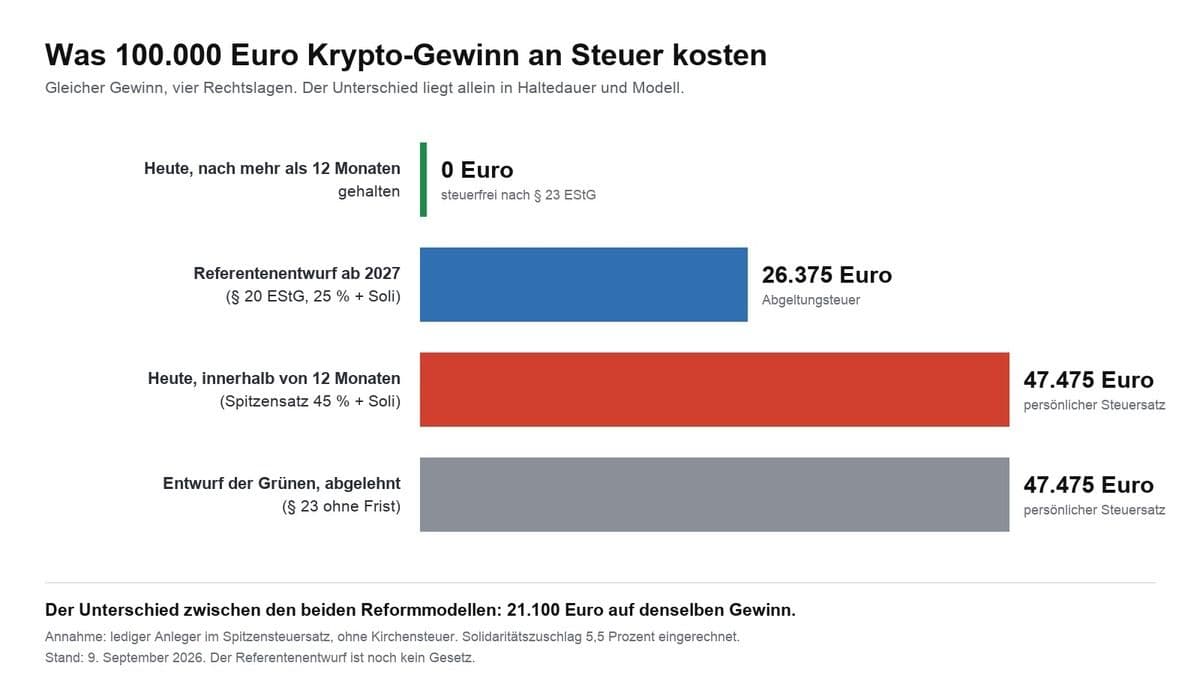
Crypto Tax in Germany: What Applies in 2026 and What Is Set to Change in 2027
Crypto gains are tax-free after twelve months; before that your personal tax rate of up to 45 percent applies. What triggers tax, how the holding period is calculated, what happens with staking and losses, and what the draft bill would change from 2027.

September 27, 2026 1:17 PM

Dogecoin Price: What to Check on Holding Period and Custody Before the Year End
The Dogecoin price stands at $0.0977 on September 27, 2026 and has barely moved in a day. That calm is exactly the moment to work through the holding period, the reporting duty from 2026 and custody without any time pressure.
August 31, 2026 10:30 PM

Taxing Crypto Lending: Your Personal Rate Instead of Withholding Tax, and the Right Federal Fiscal Court Case Number
According to the only tax court ruling so far, income from crypto lending falls under Section 22(3) of the German Income Tax Act and therefore under your personal tax rate. The appeal is pending at the Federal Fiscal Court under VIII R 22/25, not under the case number given in many professional articles.
August 21, 2026 1:42 PM

Writing Off a Total Crypto Loss: When the Tax Office Recognises Worthless Coins
A token that has collapsed only reduces your tax once you actually dispose of it. What applies to delisting, exchange insolvency and worthless holdings under Section 23 of the German Income Tax Act, and how you offset losses.
September 16, 2026 1:20 PM

Crypto Loss Carryforward in Germany: What Happens to Old Losses Under the 2027 Tax Plan
Losses from crypto sales land in a ring-fenced pot and can only be set against gains of the same kind. The draft bill for 2027 moves future gains into a different pot, and we show you what that means for your assessed carryforward and what your tax notice should say.
October 2, 2026 1:33 PM

Crypto tax before the cabinet on October 14: “Comments are only possible until October 6”
Germany's Federal Ministry of Finance sent the draft bill on crypto taxation to the associations on September 30, 2026, and the cabinet is to decide on October 14. For your holdings one date counts above all: December 31, 2026.
September 16, 2026 1:12 PM
Bitvavo Delisting of Kava, Nano and Ravencoin: What to Do Before Friday, 2 p.m.
Bitvavo drops KAVA, XNO and RVN on September 18, 2026, and three deadlines expire in a single afternoon. Nano has no withdrawal route at all, and the automatic euro conversion on September 28 counts as a sale for tax purposes.
September 17, 2026 7:12 PM

Gifting Bitcoin to Children: Allowance, Holding Period and the Tax Office Report
Transferring Bitcoin to your child hands over your holding period and your entry price along with the coins. This guide sets out what really applies in Germany on the allowance, the reporting deadline, representation and custody.
October 6, 2026 10:24 PM

Germany's Crypto Holding Period Before the Petitions Committee on October 12: What Matters Now
The Bundestag's petitions committee debates the crypto holding period on Monday, October 12, 2026, from 12 noon in a public sitting, with federal government representatives on hand for questions. Two days later the cabinet is to decide on the draft bill that removes the one-year period for purchases from 2027.
October 2, 2026 4:39 AM

Donating bitcoin: when does the full market value count, when only the purchase price?
A bitcoin donation to a charitable organisation is deductible as a donation in kind, and the donation itself produces no taxable gain. The size of the deduction turns solely on whether a sale would have been taxable on the day of the transfer.
September 19, 2026 4:26 PM

Crypto Mining and Tax: When the Tax Office Treats Your Mining as a Business
Anyone mining crypto-assets earns taxable income from the very first reward; according to the Federal Ministry of Finance, mining is never private asset management. This guide uses the margin numbers of the Ministry's circular to show when your mining becomes commercial and what you can deduct.
More from CryptoTicker