
Shiba Inu ten days before its record turns five: what matters now is the holding period
On October 27 the all-time high of Shiba Inu turns five years old, and the price stands 94.2 percent below it. For holders in Germany nothing about that date hinges on the price; it hinges on the one-year deadline in section 23 of the Income Tax Act.





Which topics should we dive deeper into?
Select what genuinely interests you. Your picks feed directly into our editorial planning.
Crypto news that's actually worth your time.
Weekly. 60 seconds. Carefully curated by our editors: no hype, no promo flood, no spam.
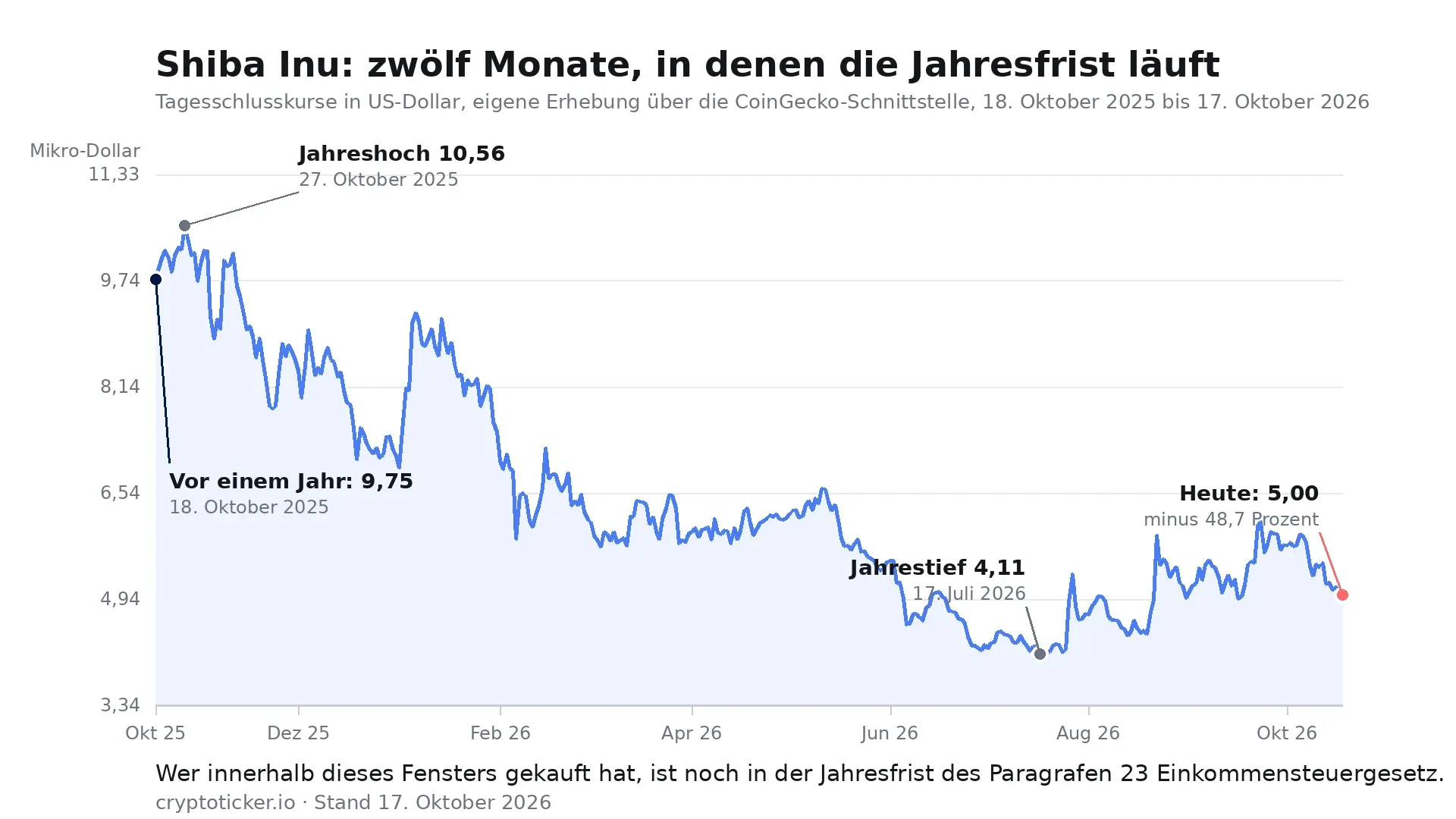
On October 27 the all-time high of Shiba Inu turns five years old. The price stood at $0.00000500 on Saturday evening, 94.2 percent below that record. For investors in Germany the anniversary raises a deadline question rather than a price question. Anyone selling SHIB settles the tax on the acquisition date, not on the price level, and the dividing line sits at twelve months. The price series of the past twelve months shows how much is at stake.
What happened on October 27, 2021
At 19:54 UTC on October 27, 2021, SHIB traded at $0.00008616. That is still the highest level ever recorded, according to the price database CoinGecko, which is also the source of every other price figure in this article. In euros, the peak that same day came to 0.00007424 euros.
From the record to Saturday evening, 94.2 percent has been lost. That is the best-known figure about Shiba Inu and at the same time the one that supports the fewest conclusions. The record describes a period in which the vast majority of today's holders were not invested at all.
The price on Saturday evening: range, turnover, market value
On Saturday evening, as of October 17, one SHIB costs $0.00000500 or 0.00000445 euros. Over the past 24 hours the price moved between $0.00000495 and $0.00000511, a gap of a good three percent between the daily low and the daily high. The market value of all circulating tokens stands at $2.95 billion, which places SHIB 37th among all crypto assets. Within 24 hours, SHIB worth $34.2 million changed hands.
Over longer periods the picture is mixed. On a seven-day view there is a loss of 8.6 percent, over 30 days 3.3 percent, while over 60 days there is a gain of 12.3 percent. Over twelve months a loss of 48.6 percent remains. August and September therefore absorbed part of the spring collapse without making up for it.
What has changed since October 16
On October 16 we reported here on the 42.48 billion SHIB on the Solana blockchain, worth around $218,000 at that point. Since then the price has moved little and the direction not at all: the closing price on October 16 was $0.00000512, and the current level sits 2.4 percent below it.
The level that served as the lower bound of the October range in that article is therefore still holding. More telling than the move is what failed to happen. Saturday's turnover of $34.2 million is in the same order of magnitude as on the preceding days. The figures show no sign of a fresh wave of buyers or sellers.
Supply explains part of the gap to the record
Part of the distance to the record lies in the supply rather than in the price. Of an initial one quadrillion tokens, CoinGecko today still lists 589.50 trillion as the total supply, of which 589.24 trillion are in circulation. The gap of roughly 410 trillion tokens goes back largely to 2021, when most of the amount transferred to Ethereum co-founder Vitalik Buterin was destroyed.
For the market value that means the $2.95 billion is spread across a far smaller supply than at the launch of the project. A price comparison over five years therefore sets two different calculations against each other. To measure the development cleanly, take the market value and not the price per token.
The ongoing burns funded by fees on the Shibarium blockchain do little to change that order of magnitude. The volume has run at a few hundred million tokens a month for weeks; measured against 589 trillion in circulation, that is a fraction of less than a tenth of a percent a year.
The one-year deadline sits in section 23 of the German Income Tax Act
For tax purposes, crypto assets count as other economic goods. Germany's Federal Fiscal Court ruled so on February 14, 2023 in case IX R 3/22 for Bitcoin, Ether and Monero, confirming the classification the Federal Ministry of Finance has taken since 2022. The consequence sits in section 23 (1) sentence 1 no. 2 of the German Income Tax Act: a private disposal transaction arises where the period between acquisition and disposal is no more than one year.
A private disposal transaction is the taxable event that arises when an economic good held privately is bought and sold again inside that period. A disposal is not only the swap back into euros; under the Federal Fiscal Court ruling it also covers an exchange into another crypto asset. Swapping SHIB for USDT triggers the same event as a sale for euros.
Which tranche counts as sold first where there have been several purchases is set out in the statute only for comparable amounts of foreign currency, where the first amount acquired counts as the first disposed of. For crypto assets, the Finance Ministry circular of March 6, 2025, file reference IV C 1 - S 2256/00042/064/043, governs the details of allocation and record keeping. It replaced the circular of May 10, 2022 and introduces the collective term crypto assets.
 Find a tax tool that tracks your holding periods
Day 365 and day 366: the tax dividing line
The deadline is a hard one, and it cuts both ways. Inside the twelve months a gain is taxable, and at the personal income tax rate rather than the 25 percent flat withholding tax. A loss inside the twelve months is usable for tax purposes in return.
Once the twelve months have passed, the sign of the advantage flips. A gain is then entirely tax free, whatever its size. A loss, however, has no tax effect: it arises outside a private disposal transaction and can be set against nothing.
That is precisely where a price series becomes instructive. An investor who bought for $1,000 on October 18, 2025 received roughly 102.5 million SHIB at a price of $0.00000975. That holding is worth $513 on Saturday evening, a loss of $487. For this purchase the one-year deadline runs out in the coming days. Sell before it does and a usable loss of $487 arises. Sell afterwards and nothing arises for tax purposes at all.
The calculation is in dollars because the price series is in dollars. The tax office counts the euro amount at the exchange rate of the day, which comes from an exchange tax report or a portfolio tool. Which providers show the holding period cleanly for each tranche is set out in our comparison of crypto tax software.
The 1,000 euro threshold is a cliff, not an allowance
Section 23 (3) sentence 5 puts it literally: gains remain tax free where the total gain from private disposal transactions in the calendar year came to less than 1,000 euros. The threshold has stood at 1,000 euros since 2024; before that it was 600 euros.
Two details decide the tax bill. First, it is the total gain from all private disposal transactions of the calendar year that counts, not the individual sale. An investor who sells gold or a collection at a gain inside the deadline alongside SHIB puts everything into one pot. Second, it is a cliff. At a total gain of 999 euros everything stays tax free; at 1,000 euros the full amount becomes taxable, not merely the one euro above the line.
For small SHIB positions that has a reassuring consequence. Anyone who stays below the threshold across the whole year does not have to hit the deadline to the day. The record-keeping obligation is untouched by this, because whether the threshold held has to be evidenced if it is questioned.

Losses from 2026: what they can be set against
A loss from a private disposal transaction does not travel into the general loss pot. Subsection 3 sentence 7 limits it expressly: losses may be offset only up to the amount of the gain the taxpayer realised from private disposal transactions in the same calendar year. A SHIB loss cannot be set against salary, rental income or equity gains.
Anything left over is not forfeited, under sentence 8. The remainder reduces income from private disposal transactions in the immediately preceding year or in the years that follow. A loss from 2026 can therefore be carried back into 2025 where gains of the same kind stood there, and otherwise carried forward without a time limit. The remaining amount is assessed by the tax office, and for that it has to be declared in the Anlage SO form.
The difference from a total loss matters here, as in a project that has been wound up or a wallet that has been lost. The deadline does not bite in the same way there, because there is no disposal. What applies in those cases is set out in our article on the tax treatment of a total loss.
The cut-off date for all of this is December 31, 2026. A sale on January 2 falls into a new calendar year and meets other gains there, or none at all.
 Compare exchanges with a clean tax export
A reform of the holding period is still outstanding
The twelve months are not a law of nature. Berlin has been discussing scrapping or extending the holding period for crypto assets for years, and the point resurfaces with every parliamentary term. Were a change to come, it would move the very line this article is about.
Reliable statements are not available so far. We track where the matter stands, which wordings are in circulation and what has been heard from the Finance Ministry on our page on the status of the crypto holding period reform. Until something else stands there, the law as it is applies, and the law as it is knows the one-year deadline.
Our assessment: the gap to the record is the loudest figure
In the view of this newsroom, the 94.2 percent gap to the record is the most frequently quoted and the least useful figure on Shiba Inu. The value measures a five-year period over which the circulating supply, the market and the body of holders have all changed. The evidence stands above: 589.24 trillion tokens in circulation against an initial supply of one quadrillion, and a market value of $2.95 billion that is composed differently from 2021.
The twelve-month window, by contrast, is useful, because it coincides with the tax deadline. There stands a loss of 48.6 percent, a one-year high of $0.00001056 on October 27, 2025 and a one-year low of $0.00000411 on July 17, 2026. Anyone who bought inside that window has a decision to take, and it has a date. Anyone who bought earlier has nothing left to decide for tax purposes.
Against that it has to be said that tax should never decide a sale on its own. A loss realised only so that it can be offset is a real loss and not an accounting trick. And the threshold means the question simply does not arise for many positions.
SHIB holding period: after a year the loss no longer counts
- Pull the tax report or the transaction export from your own exchange and note the acquisition date for each tranche. Which venues deliver a usable export is set out in our comparison of crypto exchanges.
- Mark which tranches will still be under twelve months on December 31, 2026. Only for those is a sale a taxable event at all.
- Check whether there are other gains from private disposal transactions in 2026 against which a loss could be offset. A portfolio tool takes that calculation off your hands; the duty to keep evidence remains.
(As of October 17, 2026. This article is not investment advice. It is not tax advice either. Prices and fee structures change; check the terms with the provider before you buy. A total loss of the capital invested is possible with crypto assets.)
Frequently asked questions about Shiba Inu and the holding period
Transparency note: This article was produced with the assistance of artificial intelligence and reviewed by our editorial team before publication. All figures and claims were checked against the primary sources linked in the text. The feature image was generated with AI.
Related articles
- Germany’s Crypto Holding Period Is Wobbling: What to Check Before December 31
- Crypto holding period for Bitcoin: “That remains to be seen,” says the finance ministry
- Shiba Inu price up 4.4 percent: outperforms the market, but 88 trillion SHIB sit on exchanges
- Crypto holding period: the cabinet date passes without a decision, December 31 stays the cut-off
- Shiba Inu Price Prediction: What to Check on SHIB Before the December 31 Deadline
Which topics should we dive deeper into?
Select what genuinely interests you. Your picks feed directly into our editorial planning.
Crypto news that's actually worth your time.
Weekly. 60 seconds. Carefully curated by our editors: no hype, no promo flood, no spam.

October 3, 2026 10:33 AM

Shiba Inu 93.4 Percent Below Its Record: 31 December 2026 Splits Old and New SHIB
Shiba Inu trades at $0.00000568 on 3 October, 93.4 percent below its record. More important than the day is the German draft bill on crypto tax: it splits your SHIB into grandfathered and new holdings on 31 December 2026.
October 9, 2026 1:18 PM

Bitcoin Tax: One Year Past the $126,080 Peak, Losses No Longer Count
Bitcoin trades at $82,558 on Friday morning, 34.5 percent below an all-time high that is now a good year old. Anyone who bought back then loses more than the prospect of a quick recovery when the one-year period expires: the tax value of the loss goes with it.
August 21, 2026 4:24 AM
Forced Sale on a Crypto Exchange: Which Moment Counts for the Holding Period and What You Must Document
At Luno, Kraken and Valour the deadlines are running out, after which the provider realises the remaining holding itself. For tax purposes that is a disposal, and what governs it is the exchange's timestamp.
October 7, 2026 4:28 PM
Shiba Inu Price at $0.00000538, Down 8.6 Percent in a Day: Hold or Sell?
Shiba Inu loses 8.6 percent on Wednesday afternoon and trades at $0.00000538. Whether a sale makes sense is decided in Germany less by the chart than by the purchase date of the individual tranche, because the one-year period hangs on it.
September 16, 2026 7:12 PM

Borrowing Against Bitcoin Instead of Selling: When German Tax Still Applies
Posting Bitcoin as collateral for a loan is not a sale in Germany, because section 39 of the Fiscal Code keeps the coins attributed to you for tax purposes. Tax arises only when the collateral is liquidated, and then the one thing that decides the bill is how long you held the coins beforehand.
September 7, 2026 7:22 AM

German Crypto Holding Period Set to Go After All: A Separate Draft Targets Purchases From 2027
Correction of 8 October 2026: The Income Tax Reform Act 2027, adopted by the German federal cabinet on 2 September, does not cover crypto assets. That did not mean the holding period stays. A separate draft bill from the Federal Ministry of Finance, dated 30 September, would abolish it for anything acquired after 31 December 2026. The cabinet is due to decide on 14 October.
September 17, 2026 10:22 PM
Selling Bitcoin at a Loss and Buying It Straight Back: What That Does to Your Holding Period
Germany has no wash sale rule: the loss stays deductible even if you buy back immediately. The buyback, however, restarts the one-year period for every new unit.

October 1, 2026 7:25 PM

Shiba Inu price prediction before the October 4 triangle apex: which levels decide now
Shiba Inu is quoted at 5.73 millionths of a dollar on Thursday afternoon, and the triangle of rising lows and falling highs runs out on October 4 according to an analysis by Blockchain.News. Which levels follow from that, what October seasonality really offers, and which deadline German SHIB holders should still meet before the turn of the year.
September 28, 2026 1:26 PM
Shiba Inu Price Below Six Millionths of a Dollar: 477 Million Burned Tokens Are 0.000081 Percent of Supply
The Shiba Inu price stands at $0.0000056 on September 28, 2026 and has lost a good 6 percent in 24 hours, although 476.96 million SHIB were destroyed over the past 30 days. The arithmetic behind it explains why the burn does not carry the price, and what counts for holders in Germany on tax before the year turns.
August 11, 2026 9:13 PM

Germany's Crypto Holding Period Faces Abolition: What Petition 201716 and the Draft Bill Mean for Your Tax
Petition 201716 calls for the one-year holding period for crypto assets to be kept and will be heard in public by the Bundestag's Petitions Committee on 12 October 2026. Correction of 8 October: the reform was not decided by the cabinet in July. A draft bill of 30 September would end the holding period for crypto acquired after 31 December 2026, and the cabinet is due to take it up on 14 October.
October 2, 2026 4:39 AM
Donating bitcoin: when does the full market value count, when only the purchase price?
A bitcoin donation to a charitable organisation is deductible as a donation in kind, and the donation itself produces no taxable gain. The size of the deduction turns solely on whether a sale would have been taxable on the day of the transfer.
September 8, 2026 10:21 PM
Crypto Holding Period and Grandfathering: Why December 31, 2026 Becomes the Cut-Off in Germany's Draft Bill
A ministerial draft bill from Germany's finance ministry names a cut-off date for the first time: crypto assets acquired after December 31, 2026 are to fall under the flat-rate withholding tax. What that means for legacy holdings, running savings plans and staking income, and why nothing has been decided yet.
October 1, 2026 1:37 AM

Shiba Inu Forecast: 589 Trillion Tokens and What Matters Now for the Price Target
One cent per SHIB would equal 5.89 trillion dollars in market value, three and a half times Bitcoin. What the circulating supply says about realistic price targets, and which tax deadline is now running for investors in Germany.

October 14, 2026 4:27 PM
Bitcoin price 25 percent below its level a year ago: what you can do now
A year ago one Bitcoin cost 99,310 euros, today it is 74,239 euros. For the October 2025 vintage the speculative period now expires, and that changes the calculation behind every sale.
September 8, 2026 1:19 AM

Germany's Crypto Holding Period: What Happens Now Signing for Petition 201716 Closed on September 15
Recap as of September 27, 2026: the signature period for German parliamentary petition 201716, which asks for the one-year crypto holding period to be preserved, closed on September 15, 2026. This article explains what ended that day, how the petitions committee proceeds and why no investor has to sell because of it.
September 27, 2026 1:17 PM
Dogecoin Price: What to Check on Holding Period and Custody Before the Year End
The Dogecoin price stands at $0.0977 on September 27, 2026 and has barely moved in a day. That calm is exactly the moment to work through the holding period, the reporting duty from 2026 and custody without any time pressure.
September 26, 2026 7:29 PM
Coins Stolen in an Exchange Hack: What the German Tax Office Accepts as a Loss
After the attack on Bitget on September 24, a question the reports leave out arises for those affected in Germany: can a stolen balance be written off against tax? The answer hangs on a single term in the Income Tax Act, and it is decided by your records.
September 18, 2026 10:13 AM
Bitcoin and the German Exit Tax: What Applies When You Move Abroad
Anyone emigrating with Bitcoin expects an exit tax on unrealised gains and finds nothing of the sort in the statute. Where the real risks sit is decided at four points: residence, the holding period, the legal form of your investment, and automatic reporting from 2026.
September 9, 2026 4:13 PM

Bitcoin 29 Percent Below Last Year: Which Crypto Losses You Can Still Use Before the One-Year Holding Period Expires
Nine out of ten major crypto assets trade lower today than exactly twelve months ago, Bitcoin alone by 29.2 percent. We measured the price series ourselves and show why the purchase date alone decides the tax value of your loss.
October 6, 2026 10:24 PM

Germany's Crypto Holding Period Before the Petitions Committee on October 12: What Matters Now
The Bundestag's petitions committee debates the crypto holding period on Monday, October 12, 2026, from 12 noon in a public sitting, with federal government representatives on hand for questions. Two days later the cabinet is to decide on the draft bill that removes the one-year period for purchases from 2027.
September 24, 2026 1:13 AM

Solana DEX Trades Overtake the NYSE: What to Check on Swaps, Tax and Oversight
Solana's decentralised exchanges settled roughly 208 million trades in a single week and overtook the New York Stock Exchange for the first time. The figure is real, but it measures something other than the comparison suggests, and for German investors it carries tax duties that no provider takes on.
October 6, 2026 4:32 AM
Bitcoin for a gift card: what paying with crypto means for your holding period
Paying for a gift card with Bitcoin is a sale for tax purposes. What counts as the disposal proceeds, when the twelve-month holding period bites, and the four records the tax office expects.
September 22, 2026 10:13 AM

Circle Lends Against Bitcoin via cirBTC: Why the Wrapper Can Cost You the German Holding Period
Circle launched loans against deposited bitcoin on September 21, 2026. In Germany, the detour through the cirBTC token is very likely a swap, and a swap restarts your one-year holding period.
October 11, 2026 4:15 PM

Shiba Inu: 65 billion tokens to exchanges are $349,700: What to watch now
CryptoQuant reports a net inflow of 65 billion tokens to exchanges for Shiba Inu. At the price on October 11 that is $349,700, and 0.75 percent of daily turnover.
September 25, 2026 10:26 PM

Selling bitcoin privately: the tax in Germany and the records you need
A direct sale to a private individual falls under the same one-year rule as an exchange sale, but there is no tax report to go with it. This guide walks through the calculation, the 1,000 euro threshold and the records the tax office wants to see.
October 7, 2026 10:24 AM

4.79 percent down with a turnover ratio of 2.53 percent: the level that decides the Shiba Inu price prediction
Shiba Inu stands at $0.00000557 and loses 4.79 percent in 24 hours, more than any other of the six large coins. Dogecoin gives up 3.66 percent while being traded three times as intensively relative to its size, which makes an exit from SHIB the dearer one.
October 1, 2026 10:44 AM

German crypto tax reform: without a receipt, half the sale price is taxed
The Federal Ministry of Finance's draft bill goes to the cabinet on October 14. Anyone who cannot prove their acquisition cost pays tax on 50 percent of the sale proceeds under the substitute assessment.
More from CryptoTicker