
Coinbase converts USDT and DAI into USDC on October 30: the swap restarts the one-year holding period
On October 30 Coinbase will convert the remaining USDT, DAI and PYUSD balances in the European Economic Area into USDC. The swap counts as a disposal under section 23 of the German Income Tax Act, and the one-year clock starts again for the new balance.





Which topics should we dive deeper into?
Select what genuinely interests you. Your picks feed directly into our editorial planning.
Crypto news that's actually worth your time.
Weekly. 60 seconds. Carefully curated by our editors: no hype, no promo flood, no spam.
If you still hold USDT, DAI or PYUSD at Coinbase in the European Economic Area, you face a decision with two different tax outcomes. On October 30, 2026 the exchange will automatically convert the remaining balances of these stablecoins into USDC. Under German law this forced swap counts as a disposal: it realises a gain or a loss, and for the USDC you receive, the one-year holding period starts from scratch. Withdraw the tokens yourself beforehand and you keep your original acquisition date. This article sets out what each route triggers, how a gain on a stablecoin arises at all, and which records the tax office wants to see.
The news itself has been on this site since October 10: Coinbase delists USDT and DAI on October 30, with the deadlines and the affected list. What that article leaves open is the question that follows, and it decides real money: whether a taxable event ends up in your return for the year, and when the clock starts running for the new balance.
Coinbase converts the remaining balances into USDC on October 30
For customers in the European Economic Area, buying, selling and swapping the affected stablecoins is already blocked. One action remains: withdrawal to your own address or to another provider. That option closes on October 30, 2026. Whatever is still in the account after that, Coinbase says it will convert into USDC at the market rate applying on the day. Tokens arriving after the cut-off will no longer be credited to the account, nor included in the conversion.
According to the provider's own breakdown, fourteen assets are affected, among them USDT, DAI, PYUSD, GUSD, PAX and GYEN. That list is the company's classification, not a regulator's. One definition first: a stablecoin is a token whose price is pegged to a fixed reference value, usually the US dollar. An e-money token in the sense of the European regulation on markets in crypto-assets is such a token whose issuer holds an authorisation for it in the European Union. That is precisely where the delisted assets fall short, and it is why only the European Economic Area is affected.
The framework behind it is the MiCA regulation and the obligations it places on crypto companies. For this topic that framework is context, not substance: the tax effect of the swap does not depend on why the exchange carries it out.
A coin-for-coin swap is a private disposal under section 23 of the Income Tax Act
Under German income tax law, crypto-assets held privately rank as other assets. They fall under section 23 of the Income Tax Act, the provision governing private disposals. The decisive term is disposal, and it reaches further than many assume: it covers any transfer to another party for consideration, and that includes swapping one token for another. The Federal Ministry of Finance circular of March 6, 2025 on individual questions of the income tax treatment of crypto-assets states expressly that the disposal period begins anew after every swap.
That the swap is involuntary makes no difference. What counts is the economic event, not the reason for it. We have traced the same line twice in our archive, most recently on the question of which timestamp applies when an exchange liquidates a position. The answer there: the moment the exchange books the transfer, not the day you find out about it.
For October 30, that means every converted balance is a closed event. If the USDT was bought more than a year earlier, the gain realised is tax free. If it was bought later than that, the gain belongs to the taxable private disposals of 2026.
With a stablecoin, the gain comes from the euro-dollar rate
This is where the obvious calculation goes wrong. Swapping USDT for USDC means trading one dollar value for another; both stand at roughly a dollar. The conclusion "no price difference, so no gain" is still false, because a German tax return is calculated in euros. Gain or loss follows from the difference between the euro equivalent at purchase and the euro equivalent on the day of the conversion. What moved in between was mainly the euro-dollar pair.
A worked example shows the order of magnitude. Suppose someone bought 10,000 USDT in May 2026, when one euro cost $1.05. The acquisition cost was therefore around 9,524 euros. If the euro stands at $1.15 on October 30, the same 10,000 dollars are worth only about 8,696 euros, which produces a loss of a good 800 euros. Reverse the move and a gain of a similar size appears in the same place. The figures are an example rather than a quotation, and the principle holds either way: the lever is the currency, not the token.
A loss is not bad news in itself. Losses from private disposals can be set against gains from other private disposals in the same year, and beyond that carried back or forward. If you realised gains on crypto sales this year, a minus from the conversion can be offset against them, provided the event falls inside the one-year period at all. Which records this requires, and which programs gather them automatically, is in our comparison of crypto tax software and portfolio trackers.

The 1,000 euro exemption limit covers all private disposals of one year together
Gains from private disposals stay tax free as long as they add up to less than 1,000 euros in the calendar year. That limit has applied since the 2024 assessment period; before that it was 600 euros. Two of its features are regularly overlooked, and both bite hardest in a forced swap.
First, it is an exemption limit and not an allowance. Exceed it and the entire gain becomes taxable, not merely the part above the line. One euro over the threshold turns 999 tax-free euros into a fully taxable amount. Second, it applies to all private disposals of a year jointly, not per position and not per exchange. Sales of other crypto-assets count towards it, as do gains from other transactions caught by the same provision.
An uncomfortable possibility follows. A forced swap can push someone over the threshold whose other transactions sat just below it, and so make gains already realised taxable after the event. Anyone close to the 1,000 euros this year is better off doing the arithmetic before October 30 than wondering afterwards.
 Find a crypto tax tool for your swaps
For the USDC you receive, the one-year period restarts on October 30
The second half of the consequence concerns not the year now ending but the future of the balance. The conversion extinguishes the old position and creates a new one: USDC, acquired on October 30, 2026, at the euro equivalent applying that day. For this position the one-year holding period runs from the swap date, not from the original purchase. The earliest tax-free sale would therefore fall after October 30, 2027.
Withdrawing the USDT to your own address beforehand changes none of that. A transfer between your own addresses is not a disposal, the acquisition date survives, and a one-year period that has already expired stays expired. That is the whole difference between the two routes, and a single question settles it: does the asset change, or only where it is kept?
Where the same token was bought several times on the same exchange, the wallet-by-wallet view applies under the first-in, first-out method. The oldest units therefore count as converted first. That can work in your favour if it is precisely the oldest holdings that have already passed the one-year mark.
The December 31, 2026 cut-off in the draft bill separates old holdings from new
Now comes the circumstance that did not exist in the comparable case back in August. The Federal Ministry of Finance has a draft bill dated September 30, 2026 that would move crypto-assets into investment income and abolish the one-year period for new acquisitions. The draft draws its line at December 31, 2026: anything acquired up to that date would remain an old holding with the one-year period, anything added afterwards would fall under the new rule.
Two points matter here, and both argue against acting out of fear. First, this is a draft and not law in force. The federal cabinet did not adopt it on October 14, 2026; we have documented the current status of the holding period reform, and no new date has been set. Second, October 30 sits sixty-two days ahead of that line. The USDC from the conversion would in any case still be an old holding and would keep the one-year period, merely with an acquisition date pushed back by months.
Wait until mid-December to restructure, by contrast, and you come dangerously close to the line. That is no reason to rush, but it is a reason to keep an eye on the calendar.
Withdrawing yourself and letting it run lead to two different acquisition dates
The two routes can be set side by side. Route one, withdrawal before October 30: the tokens move to your own wallet or to another provider that still carries them. No taxable event arises, the acquisition date stands, the exemption limit is untouched. In return you take on responsibility for custody and pay network fees. Route two, let the conversion happen: you need do nothing, the balance stays with a regulated provider and ends up in a token that meets the European requirements. In return a disposal arises with all the consequences described above, and the one-year period starts again.
Which route fits better hangs on three quantities: how long the balance has been held, how close the year's other disposals sit to the exemption limit, and whether there is any appreciable euro difference between purchase and today at all. For a few hundred euros held for more than a year, the question is academic. For five-figure balances bought this year, it is not.

Without proof of acquisition date and rate, the tax office estimates
The conversion creates one line in the 2026 tax return, and nobody gathers the evidence for it on your behalf. Four pieces of information are worth securing before the cut-off, because they are harder to obtain later: the acquisition date and acquisition price of the affected tokens, the balance as at October 30, the conversion statement with quantity and exchange rate, and the euro reference rate for that day.
The reason is unglamorous. Anyone unable to document acquisition data must expect the tax office to estimate the basis of taxation, and an estimate rarely falls in the taxpayer's favour. In practice that means downloading the account statements and the transaction history now, while access to these assets still exists, rather than in the spring when the return is due.
One note on reading the numbers: tax software often records a conversion as two events, a sale of the old token and a purchase of the new one. That is correct for tax purposes, but it does mean the event shows up twice in summaries. If you check the figures by hand, expect it.
 Compare exchanges with an EU licence
ESMA sets the outer limit at January 8, 2027, and Coinbase moves earlier
Some context, without which the date reads wrongly: the European Securities and Markets Authority published an opinion on October 8, 2026 giving trading venues three months to wind down holdings of unauthorised stablecoins. The outer limit therefore falls on January 8, 2027. We have already covered the ESMA deadline and the exit from USDT.
With October 30, Coinbase sits a good two months ahead of that limit and is acting sooner than required. Other providers in the European Economic Area may work to different dates, and so far no national supervisor has said publicly how it intends to apply the opinion. If you hold balances on several platforms, check each deadline separately rather than relying on the date you know from one exchange.
Our assessment: withdrawing before the cut-off is the route you can document
In the editorial team's view, more speaks for withdrawing before October 30 than for waiting, and for a reason that has nothing to do with prices: withdrawal is the event whose evidence you hold yourself. You choose the moment, you see the transaction, the acquisition date stays as it is, and no line arises that has to be explained later. The conversion, by contrast, happens without your involvement, at a rate you do not choose, and it creates precisely the documentation duty that makes work in the spring.
An equally solid argument points the other way: move the tokens to your own address and you take on responsibility for the private key, and a lost key costs more than any holding period. For balances held longer than a year, whose gain is tax free anyway, waiting is the more convenient choice and not the worse one. The records still matter in that case: tax free does not mean proof free. None of this is a recommendation to buy or sell crypto, and a total loss is always possible with crypto-assets.
Stablecoin forced conversion: from October 30 the one-year period runs again
Until October 30, 2026 the choice between two routes with different acquisition dates remains open. After that the exchange decides, and it decides the same way for every remaining balance. Three steps put the situation in order:
- Establish the balance and the holding period. Look in the transaction history for when the affected tokens were bought and at what euro equivalent. If the purchase is more than a year old, a gain is tax free and the decision becomes a matter of convenience alone. If you intend to withdraw the tokens, you first need an address you control; the differences between the devices are in our comparison of crypto hardware wallets.
- Check the destination before you transfer. Not every provider in the European Economic Area still carries the affected stablecoins, and some have set deadlines of their own. Which platforms hold an authorisation under the European regulation is shown in our overview of regulated crypto exchanges.
- Secure the records, whichever route you take. Download the transaction history and account statements while access lasts, and record the date, quantity and exchange rate of the conversion. Which programs log all this automatically and carry it into the tax return is in our comparison of crypto tax software.
The details on the deadline and the process come from the provider's help page on restricted stablecoins. This article is no substitute for tax advice; judging an individual case belongs in the hands of a tax adviser.
(As of October 20, 2026. This article is not investment advice. Prices and fee structures change; check the terms with the provider before you buy.)
Frequently asked questions about the stablecoin forced conversion
Transparency note: This article was produced with the assistance of artificial intelligence and reviewed by our editorial team before publication. All figures and claims were checked against the primary sources linked in the text. The feature image was generated with AI.
Related articles
- Forced Sale on a Crypto Exchange: Which Moment Counts for the Holding Period and What You Must Document
- Germany’s Crypto Holding Period Is Wobbling: What to Check Before December 31
- Crypto holding period for Bitcoin: “That remains to be seen,” says the finance ministry
- Crypto holding period: the cabinet date passes without a decision, December 31 stays the cut-off
- Bitcoin Tax: One Year Past the $126,080 Peak, Losses No Longer Count
Which topics should we dive deeper into?
Select what genuinely interests you. Your picks feed directly into our editorial planning.
Crypto news that's actually worth your time.
Weekly. 60 seconds. Carefully curated by our editors: no hype, no promo flood, no spam.

September 16, 2026 7:12 PM

Borrowing Against Bitcoin Instead of Selling: When German Tax Still Applies
Posting Bitcoin as collateral for a loan is not a sale in Germany, because section 39 of the Fiscal Code keeps the coins attributed to you for tax purposes. Tax arises only when the collateral is liquidated, and then the one thing that decides the bill is how long you held the coins beforehand.
September 7, 2026 7:22 AM

German Crypto Holding Period Set to Go After All: A Separate Draft Targets Purchases From 2027
Correction of 8 October 2026: The Income Tax Reform Act 2027, adopted by the German federal cabinet on 2 September, does not cover crypto assets. That did not mean the holding period stays. A separate draft bill from the Federal Ministry of Finance, dated 30 September, would abolish it for anything acquired after 31 December 2026. The cabinet is due to decide on 14 October.
September 17, 2026 10:22 PM
Selling Bitcoin at a Loss and Buying It Straight Back: What That Does to Your Holding Period
Germany has no wash sale rule: the loss stays deductible even if you buy back immediately. The buyback, however, restarts the one-year period for every new unit.
September 24, 2026 1:13 AM

Solana DEX Trades Overtake the NYSE: What to Check on Swaps, Tax and Oversight
Solana's decentralised exchanges settled roughly 208 million trades in a single week and overtook the New York Stock Exchange for the first time. The figure is real, but it measures something other than the comparison suggests, and for German investors it carries tax duties that no provider takes on.
September 8, 2026 10:21 PM

Crypto Holding Period and Grandfathering: Why December 31, 2026 Becomes the Cut-Off in Germany's Draft Bill
A ministerial draft bill from Germany's finance ministry names a cut-off date for the first time: crypto assets acquired after December 31, 2026 are to fall under the flat-rate withholding tax. What that means for legacy holdings, running savings plans and staking income, and why nothing has been decided yet.
September 8, 2026 1:19 AM

Germany's Crypto Holding Period: What Happens Now Signing for Petition 201716 Closed on September 15
Recap as of September 27, 2026: the signature period for German parliamentary petition 201716, which asks for the one-year crypto holding period to be preserved, closed on September 15, 2026. This article explains what ended that day, how the petitions committee proceeds and why no investor has to sell because of it.

September 27, 2026 1:17 PM
Dogecoin Price: What to Check on Holding Period and Custody Before the Year End
The Dogecoin price stands at $0.0977 on September 27, 2026 and has barely moved in a day. That calm is exactly the moment to work through the holding period, the reporting duty from 2026 and custody without any time pressure.
September 16, 2026 1:20 PM

Crypto Loss Carryforward in Germany: What Happens to Old Losses Under the 2027 Tax Plan
Losses from crypto sales land in a ring-fenced pot and can only be set against gains of the same kind. The draft bill for 2027 moves future gains into a different pot, and we show you what that means for your assessed carryforward and what your tax notice should say.
September 9, 2026 4:13 PM

Bitcoin 29 Percent Below Last Year: Which Crypto Losses You Can Still Use Before the One-Year Holding Period Expires
Nine out of ten major crypto assets trade lower today than exactly twelve months ago, Bitcoin alone by 29.2 percent. We measured the price series ourselves and show why the purchase date alone decides the tax value of your loss.
October 20, 2026 4:17 AM

Stablecoin interest: MiCA article 50 bans it, and lending yield is taxable from 256 euros
No issuer in Europe pays interest on the token itself, and article 50 of MiCA expressly forbids it. Where a quoted yield actually comes from and how the tax office treats it.
October 6, 2026 4:32 AM

Bitcoin for a gift card: what paying with crypto means for your holding period
Paying for a gift card with Bitcoin is a sale for tax purposes. What counts as the disposal proceeds, when the twelve-month holding period bites, and the four records the tax office expects.
August 11, 2026 9:13 PM

Germany's Crypto Holding Period Faces Abolition: What Petition 201716 and the Draft Bill Mean for Your Tax
Petition 201716 calls for the one-year holding period for crypto assets to be kept and will be heard in public by the Bundestag's Petitions Committee on 12 October 2026. Correction of 8 October: the reform was not decided by the cabinet in July. A draft bill of 30 September would end the holding period for crypto acquired after 31 December 2026, and the cabinet is due to take it up on 14 October.
October 19, 2026 4:15 AM

Crypto FIFO across several exchanges: each wallet counts on its own in Germany
Hold bitcoin on several exchanges and in wallets of your own, and the holding period is calculated per pot, not across the total holding. What paragraph 62 of the BMF guidance orders, and why 31 December 2026 hangs on it.

September 26, 2026 7:40 AM

The RAIN Token After the Enlivex Termination: What to Check on Access, Forced Sale and Holding Period
Enlivex terminated a share placement of 66,666,667 shares payable in RAIN tokens on September 22, 2026. The token sits 46.4 percent below its all-time high, and at Kraken the withdrawal deadline expired long ago.
September 25, 2026 10:26 PM

Selling bitcoin privately: the tax in Germany and the records you need
A direct sale to a private individual falls under the same one-year rule as an exchange sale, but there is no tax report to go with it. This guide walks through the calculation, the 1,000 euro threshold and the records the tax office wants to see.
October 17, 2026 10:16 PM

Shiba Inu ten days before its record turns five: what matters now is the holding period
On October 27 the all-time high of Shiba Inu turns five years old, and the price stands 94.2 percent below it. For holders in Germany nothing about that date hinges on the price; it hinges on the one-year deadline in section 23 of the Income Tax Act.
September 27, 2026 7:22 AM

CoinEx Forced Conversion: Withdraw Non-USDT Balances by September 29
On September 29 at 02:00 UTC spot trading ends at CoinEx, and all holdings outside USDT are sold or delisted after that. What this means for your holding period, your tax bill and your withdrawal.
September 24, 2026 10:19 AM

Uniswap Falls 11.8 Percent After a 114 Percent Month: What to Check on Profit Taking, Holding Period and Leverage
UNI lost 11.75 percent on Wednesday morning but is still up 113.85 percent over the month. Anyone realising gains now almost certainly triggers a taxable disposal in Germany.
August 31, 2026 10:30 PM

Taxing Crypto Lending: Your Personal Rate Instead of Withholding Tax, and the Right Federal Fiscal Court Case Number
According to the only tax court ruling so far, income from crypto lending falls under Section 22(3) of the German Income Tax Act and therefore under your personal tax rate. The appeal is pending at the Federal Fiscal Court under VIII R 22/25, not under the case number given in many professional articles.
October 2, 2026 1:33 PM

Crypto tax before the cabinet on October 14: “Comments are only possible until October 6”
Germany's Federal Ministry of Finance sent the draft bill on crypto taxation to the associations on September 30, 2026, and the cabinet is to decide on October 14. For your holdings one date counts above all: December 31, 2026.
August 13, 2026 6:18 AM

Revolut Delists USDT: Forced Conversion on August 31, 2026 Counts as a Sale
Revolut is taking USDT off the table on August 31, 2026: purchases have already stopped, deposits are blocked, and anyone who fails to act before the deadline faces an automatic conversion that counts as a sale for tax purposes. This article explains the deadlines, the tax treatment under section 23 of the German Income Tax Act and what you can do now.
September 9, 2026 4:22 PM
Crypto Tax in Germany: What Applies in 2026 and What Is Set to Change in 2027
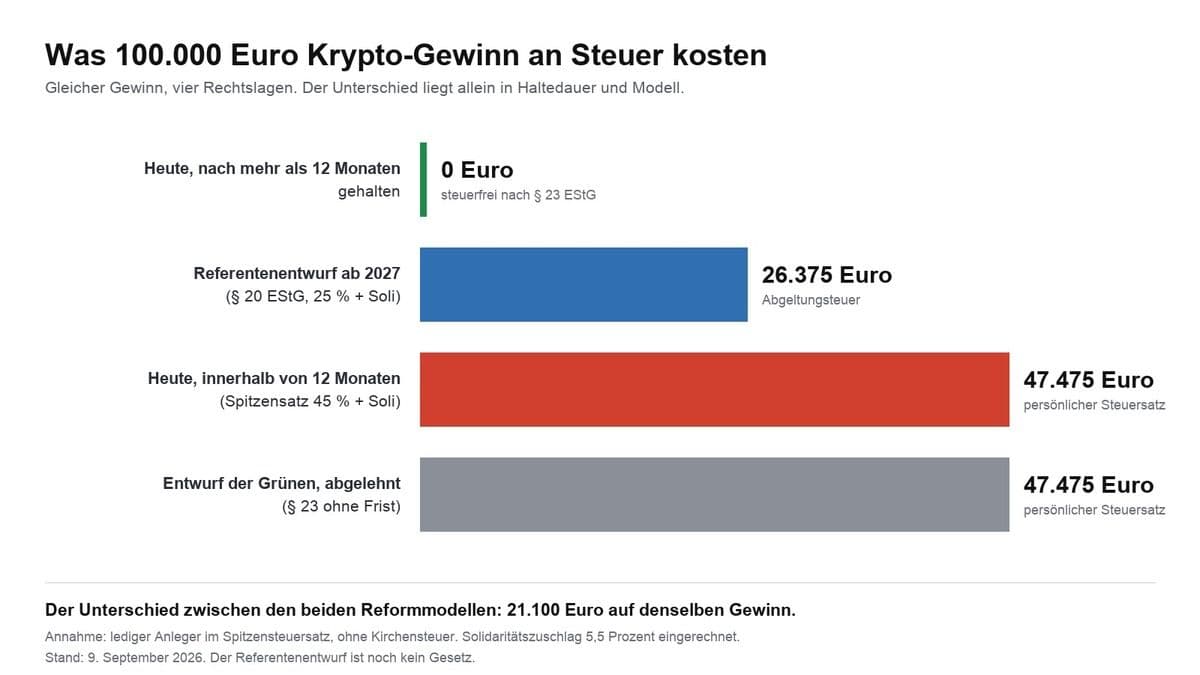
Crypto gains are tax-free after twelve months; before that your personal tax rate of up to 45 percent applies. What triggers tax, how the holding period is calculated, what happens with staking and losses, and what the draft bill would change from 2027.
October 2, 2026 4:39 AM

Donating bitcoin: when does the full market value count, when only the purchase price?
A bitcoin donation to a charitable organisation is deductible as a donation in kind, and the donation itself produces no taxable gain. The size of the deduction turns solely on whether a sale would have been taxable on the day of the transfer.
September 24, 2026 1:11 PM

Stellar Becomes a Payment Rail at Mastercard's BVNK: What XLM Holders Should Check on Buying Route, Memo and Holding Period
BVNK has switched on Stellar as a payment rail for business customers in more than 130 countries. On the same trading day XLM falls by around seven percent — we separate what the news means from what the pullback means for your portfolio.
October 1, 2026 10:44 AM

German crypto tax reform: without a receipt, half the sale price is taxed
The Federal Ministry of Finance's draft bill goes to the cabinet on October 14. Anyone who cannot prove their acquisition cost pays tax on 50 percent of the sale proceeds under the substitute assessment.
September 24, 2026 1:34 PM

Cardano Slides Below $0.24: What ADA Holders Should Check on Leverage, Liquidation and Holding Period
Cardano has given back its move above $0.25 and trades around seven percent below the high of the past 24 hours. What that means for leveraged positions, the holding period of your tranches and the buying route under MiCA.
September 16, 2026 1:12 PM
Bitvavo Delisting of Kava, Nano and Ravencoin: What to Do Before Friday, 2 p.m.
Bitvavo drops KAVA, XNO and RVN on September 18, 2026, and three deadlines expire in a single afternoon. Nano has no withdrawal route at all, and the automatic euro conversion on September 28 counts as a sale for tax purposes.
More from CryptoTicker