
Dogecoin Price: What to Check on Holding Period and Custody Before the Year End
The Dogecoin price stands at $0.0977 on September 27, 2026 and has barely moved in a day. That calm is exactly the moment to work through the holding period, the reporting duty from 2026 and custody without any time pressure.




Which topics should we dive deeper into?
Select what genuinely interests you. Your picks feed directly into our editorial planning.
Crypto news that's actually worth your time.
Weekly. 60 seconds. Carefully curated by our editors: no hype, no promo flood, no spam.
Dogecoin trades at $0.0977, or €0.0857, on September 27, 2026 at 11:42 am German time. Almost nothing has moved in the 24 hours before that; the gain comes to 0.64 percent. Days like this one are the most useful days you get, because whatever you work out now about your holding period, your route to buying and your custody, you work out without pressure.
The figures in this article come from CoinGecko. That is 11:42 am Central European Summer Time.
Dogecoin price on September 27, 2026: the numbers and their source
DOGE is quoted at $0.097699. The range of the past 24 hours ran from $0.095327 to $0.098670, which is roughly 3.5 percent between the low and the high. In euro terms the price stands at €0.085717, with a daily range of €0.083686 to €0.086621.
Market capitalisation comes to $15.24 billion, or €13.38 billion. Circulating supply is 156.09 billion DOGE. Trading volume over the past 24 hours stands at $698.1 million, which is 4.6 percent of market capitalisation. That ratio is the number to watch if you intend to move larger amounts: it tells you how much stock actually changes hands on an average day.
DOGE sits 86.6 percent below its all-time high of $0.731578. That figure is not a price target in either direction. What it gives you is the order of magnitude you need when you value an old position from the peak phase and ask yourself whether a loss from a private disposal is still capable of being offset at all.
Why a quiet Dogecoin price makes the better day for the maths
On days with double-digit swings, investors decide quickly and check little. On a day that moves 0.64 percent, nobody has a decision forced out of their hands. The calendar keeps working regardless, and this autumn it is working on three fronts at once.
First, the 2026 tax year is running towards December 31, and with it the question of which of your Dogecoin holdings satisfy the one-year rule. Second, 2026 is the first year in which crypto service providers have to collect their customers' data for the later report to the Federal Central Tax Office. Third, since January 1, 2026 the transition period for providers without a European authorisation has been over. None of the three has anything to do with the price and everything to do with the date.
Crypto holding period under Section 23 of the German Income Tax Act: counted by the day
For tax purposes, Dogecoin is another asset within the meaning of Section 23(1) sentence 1 no. 2 of the German Income Tax Act. A gain on sale is a private disposal if no more than one year lies between acquisition and disposal. You will find the wording in the full text of Section 23 EStG.
The most common error of reasoning sits in the way the deadline is calculated. The one-year period runs from the day of acquisition, not from the start of the year. If you bought on September 27, 2025, your period ends with the close of September 27, 2026, so a sale from September 28, 2026 onwards no longer falls under Section 23. Buy today and the earliest you leave the period behind is September 28, 2027.
From that follows a very concrete check for this autumn. If you want to unwind a position tax-free while still in 2026, the day of acquisition has to have been December 30, 2025 at the latest. Anything you bought in January 2026 or later is inside the period until New Year's Eve. So look at your purchase records and write the date, the quantity and the acquisition cost of every purchase into a list. Without that list, every further calculation is an estimate.
One point matters for anyone who lends out DOGE or holds it in a product that yields a return: for payment tokens of this kind, the tax authorities do not assume the period is extended to ten years. The Federal Ministry of Finance circular of March 6, 2025, which replaced the version of May 10, 2022, is the governing administrative instruction here. It is also the first to carry its own sections on record-keeping and cooperation duties. We set out the debate over whether the one-year rule survives politically in a separate piece on the holding period on September 25, 2026.

The 1,000 euro exemption limit: one cent decides the whole amount
Section 23(3) EStG leaves gains from private disposals untaxed where the total gain in the calendar year comes to less than 1,000 euros. The word total is meant seriously: all private disposals in the year count together, so the gold you sold and the bitcoin you sold count too, not only your Dogecoin.
What matters is the difference between an exemption limit and an allowance. With an allowance, the base amount would stay untaxed and only the excess would be taxable. With an exemption limit, the entire gain tips into taxability the moment the threshold is reached. Make 999 euros of gains in the calendar year and you pay nothing. Make 1,000 euros and you are taxed on the full 1,000 euros at your personal income tax rate.
A worked example at today's price: 50,000 DOGE at €0.085717 are worth roughly 4,286 euros. Whether that turns into a gain of 300 euros or of 1,400 euros depends solely on your acquisition cost. If you are just over the threshold, the nearest lever is not the price but the split: a partial sale this year, the rest next year. Nothing is lost that way, and in the favourable case it saves the full claim on the whole amount.

FIFO and partial sales: which Dogecoin you sell in December
Anyone who has bought in instalments over several years does not own a single position but a sequence of acquisitions with different dates and prices. On a partial sale the question is which of those tranches counts as sold. In practice the consumption sequence applied is first in, first out: the oldest units count as disposed of first.
In practical terms that means two things. The oldest tranches are usually the ones that have come out of the period, so a partial sale hits the tax-free holding first. At the same time they are often the ones with the lowest acquisition cost, which is where the calculated gain is largest. Together those two points decide whether a December sale is harmless for tax purposes or whether it carries you over the exemption limit.
If your holdings are spread across several providers and several wallets, you need to consolidate them for that. A portfolio tracker that carries acquisition dates along and shows the deadline for each tranche saves you the sheet of paper. Which programs manage that for the German legal framework is set out in our comparison of crypto tax software. Do not rely on any of them blindly: you are the one signing the tax return.
Crypto reporting from 2026: what your provider reports to the BZSt by July 2027
Since January 1, 2026, providers of crypto-asset services with customers in the European Union have been subject to a new collection duty. The basis is Directive (EU) 2023/2226, known in the trade as DAC8, which Germany implements through the Crypto Asset Tax Transparency Act. The first reporting period is the current 2026 calendar year. The first report goes to the Federal Central Tax Office by July 31, 2027.
What gets reported is master data such as name, address, date of birth and tax identification number, along with transaction data: purchases, sales, exchanges, transfers, amounts and timestamps. Exchanges, custodians, wallet providers and transfer services are covered. The private sheet of paper with your recovery words is not.
For you this has a practical consequence that has nothing to do with secrecy and everything to do with reconciliation. What the provider reports is a movement figure and not your taxable gain. Where your tax return diverges from what the tax office already knows from the report, questions follow. We took apart why the reported gross amount and the taxable gain are two different numbers in a piece on the crypto reporting duty.
The task for this autumn is therefore small and concrete. Check that the master data held by your provider is correct, the tax identification number above all. If it is missing or wrongly recorded, the provider will ask in case of doubt and can restrict accounts until the details are complete.
Buying under MiCA: since January 2026 your provider needs an authorisation
The European regulation on markets in crypto-assets has governed the authorisation and supervision of crypto-asset service providers since the end of 2024. The national transitional arrangement has expired: since January 1, 2026 it has been unlawful to provide crypto-asset services in Germany without an authorisation or a valid notification. Supervision is carried out by BaFin, on crypto-asset services.
You can check this yourself, and it takes two minutes. Authorised providers appear in BaFin's company database, and the Europe-wide register is kept by the securities regulator ESMA. A provider that will not name its supervisory authority, or that is absent from the register, is the wrong address for a purchase out of Germany, however attractive the fees look. How the authorised houses differ on fees, deposit routes and withdrawal times is shown in our comparison of crypto exchanges.

Custody: Dogecoin is its own chain, not a token on Ethereum
This point costs money regularly because it sounds so banal. DOGE runs on a blockchain of its own and is not a token under the Ethereum standard. An address intended for ether or for a token on Ethereum will not accept Dogecoin. Send there anyway and the amount is as a rule gone for good, and no provider can reverse it.
Before you withdraw holdings from an exchange, check three things on the device itself. Does your wallet support Dogecoin as its own chain. Does the receiving address begin with the D that is typical for Dogecoin. Does the address your hardware device shows on its own display match the address in the browser window. The third point is the most important one, because it is the only one that malware on the computer cannot forge. Which devices carry Dogecoin and how they differ in daily use is set out in the hardware wallet comparison; on checking against the display we published a separate piece on blind signing after the last device update.
A side effect of self-custody concerns tax. A transfer between your own addresses is not a sale and does not trigger a disposal. It therefore does not interrupt the holding period. Document it with the date and the transaction ID all the same, because your schedule has to explain later why a holding left the exchange without a gain arising.
 Document holding periods and gains cleanly
Issuance and network security: 5.26 billion new DOGE a year
Dogecoin has no cap on its money supply. Each block pays out 10,000 DOGE, and the target block time is one minute. That produces a fixed annual new issuance of around 5.256 billion DOGE.
cryptoticker.io compiled this analysis itself on September 27, 2026: we set the circulating supply of 156.09 billion DOGE from CoinGecko against the fixed block reward. The method in one sentence: 10,000 DOGE per block times 525,600 minutes in the year gives 5.256 billion new DOGE, and divided by the circulating supply that is 3.4 percent of growth in the current year. We verified exactly one quantity, namely the circulating supply at that moment. It remains unknown how many of those DOGE are permanently lost, because no reliable public figure exists for it.
The share falls year by year, because absolute issuance stays constant while the stock grows. No statement about the price follows from that, but an expectation does: hold DOGE and you hold an asset whose quantity grows by design. A scarcity story of the kind Bitcoin has does not carry here.
The network is secured through proof of work with an additional mechanism that has allowed simultaneous mining alongside Litecoin since 2014. The bulk of the hash rate comes from that merged mining. It makes the network more stable than Dogecoin's size alone would deliver, but it ties the network's security to the economics of mining a second chain.
Leverage and liquidation: why perpetuals do not rescue the period anyway
Dogecoin is traded on many venues as a perpetual futures contract. Trade that way and you own no DOGE. You hold a position on the price, with funding costs that fall due several times a day depending on market conditions.
That has two consequences you should know before you think about leverage. For tax purposes, Section 23 EStG does not apply to a transaction of this kind. It falls into the area of futures transactions, with rules of their own that are in part less favourable. The one-year period you can use when holding directly does not exist there. On the practical side, today's daily range comes to roughly 3.5 percent. At tenfold leverage that is 35 percent of movement on the capital you put up, on a day the market counts as quiet.
If you use futures products, work out the liquidation threshold before you open the position rather than afterwards. And keep it separate from the holding on which you are tracking the one-year period, or you will mix two calculations that have nothing to do with each other in tax terms.
Levels above and below: what the calculation orients itself on
On the downside, the nearest point of orientation is the daily low at $0.095327. Fall below it and the day's range has been left on the downside; that level says no more than that. Above sits the daily high at $0.098670, and beyond it the round ten-cent mark, which in dollar terms is a good two percent away.
Round levels are not a technical statement about a network. Such levels work because many market participants place their orders there, and that is enough to make them noticeable in practice. For the questions in this article they are secondary in any case: your holding period does not turn out differently because DOGE stands short of ten cents or beyond it. The period only helps decide how large the gain is that you weigh against the exemption limit.
The distance to the all-time high of $0.731578 is the third figure that belongs in a sober stocktake. Anyone who bought at the peak in 2021 is sitting on a paper loss that arose well outside the one-year period. A sale there would no longer produce an offsettable loss from a private disposal, because the period applies to losses too.
Dogecoin before the year end: what to take away
- Gather your purchase dates and mark the deadlines. Write down the date, the quantity and the acquisition cost for each purchase and mark which tranches were acquired before December 30, 2025. A tool that carries the deadline for each tranche is in the comparison of crypto tax software.
- Check your provider against the register and complete your master data. Since January 1, 2026 your trading venue needs an authorisation, and from the same date it collects your data for the 2027 report. Check the tax identification number on file and compare fees and withdrawal routes in the comparison of crypto exchanges.
- Match the receiving address on the device before your next withdrawal. Dogecoin needs a wallet that carries its own chain, and the address shown belongs on the device's display, not only in the browser. Which models manage that is set out in the hardware wallet comparison.
(As of September 27, 2026. This article is not investment advice. Prices and fee structures change; check the terms with the provider before you buy. Tax information is no substitute for advice in an individual case.)
Transparency note: This article was produced with the assistance of artificial intelligence and reviewed by our editorial team before publication. All figures and claims were checked against the primary sources linked in the text. The feature image was generated with AI.
Related articles
- Selling bitcoin privately: the tax in Germany and the records you need
- German Crypto Holding Period Set to Go After All: A Separate Draft Targets Purchases From 2027
- Bitcoin for a gift card: what paying with crypto means for your holding period
- Take Ethereum Profits or Wait Out the Holding Period? What the Price Jump Means for Your Tax Bill
- Bitcoin Tax: One Year Past the $126,080 Peak, Losses No Longer Count
Which topics should we dive deeper into?
Select what genuinely interests you. Your picks feed directly into our editorial planning.
Crypto news that's actually worth your time.
Weekly. 60 seconds. Carefully curated by our editors: no hype, no promo flood, no spam.

September 24, 2026 1:13 AM

Solana DEX Trades Overtake the NYSE: What to Check on Swaps, Tax and Oversight
Solana's decentralised exchanges settled roughly 208 million trades in a single week and overtook the New York Stock Exchange for the first time. The figure is real, but it measures something other than the comparison suggests, and for German investors it carries tax duties that no provider takes on.
September 8, 2026 10:21 PM

Crypto Holding Period and Grandfathering: Why December 31, 2026 Becomes the Cut-Off in Germany's Draft Bill
A ministerial draft bill from Germany's finance ministry names a cut-off date for the first time: crypto assets acquired after December 31, 2026 are to fall under the flat-rate withholding tax. What that means for legacy holdings, running savings plans and staking income, and why nothing has been decided yet.

September 24, 2026 10:19 AM

Uniswap Falls 11.8 Percent After a 114 Percent Month: What to Check on Profit Taking, Holding Period and Leverage
UNI lost 11.75 percent on Wednesday morning but is still up 113.85 percent over the month. Anyone realising gains now almost certainly triggers a taxable disposal in Germany.
September 9, 2026 4:13 PM

Bitcoin 29 Percent Below Last Year: Which Crypto Losses You Can Still Use Before the One-Year Holding Period Expires
Nine out of ten major crypto assets trade lower today than exactly twelve months ago, Bitcoin alone by 29.2 percent. We measured the price series ourselves and show why the purchase date alone decides the tax value of your loss.
September 8, 2026 1:19 AM

Germany's Crypto Holding Period: What Happens Now Signing for Petition 201716 Closed on September 15
Recap as of September 27, 2026: the signature period for German parliamentary petition 201716, which asks for the one-year crypto holding period to be preserved, closed on September 15, 2026. This article explains what ended that day, how the petitions committee proceeds and why no investor has to sell because of it.
September 24, 2026 4:28 AM
Crypto Trading Bots and Tax: What Applies With Thousands of Trades a Year
A bot turns one investment decision into hundreds of disposals, and the tax office counts every single one. This guide explains the holding period, FIFO, the exemption limit and the record-keeping duties, and what to set up before the bot makes its first trade.
August 24, 2026 4:22 AM

Selling XRP After a 53 Percent Week: What the Holding Period Costs
XRP trades at $1.51 after a weekly gain of a good 50 percent, yet your net proceeds are decided by the purchase date. This article works through the holding period, the exemption limit and FIFO at measured reference-date prices.

September 25, 2026 7:24 PM

Bitcoin Forecast: What to Check on Levels, Holding Period and Buying Route Before the Quarter Ends
Bitcoin stands at $83,877 at 16:40 UTC on September 25, 2026, and the measured volatility of the past 30 days spans a band of $73,600 to $94,200 for the coming month. More important than that band before the quarter ends are three checks: holding period, buying route under MiCA and the reporting duty in force since January 2026.
September 26, 2026 1:19 AM
Germany’s Crypto Holding Period Is Wobbling: What to Check Before December 31
A CDU member of the Bundestag makes it plain: the coalition agreement does not guarantee that the one-year holding period for crypto assets will survive. What that means for purchases made before the planned cutoff date of December 31, 2026.
October 16, 2026 7:25 PM

Crypto holding period for Bitcoin: “That remains to be seen,” says the finance ministry
The federal cabinet did not adopt the draft abolishing the one-year crypto holding period on October 14, 2026; it is still stuck in inter-ministerial consultation. This overview sets out what applies today, which dates follow and why the December 31, 2026 cutoff has no force of law so far.
October 15, 2026 4:13 AM

Crypto holding period: the cabinet date passes without a decision, December 31 stays the cut-off
Germany's federal cabinet did not adopt the expected decision of October 14, 2026 to abolish the one-year crypto holding period; the draft is still in interdepartmental consultation. Until new rules arrive, gains stay tax free after one year of holding, and the December 31, 2026 cut-off named in the draft separates old holdings from new ones.
September 24, 2026 10:12 AM
XRP Falls 9.7 Percent: What to Check on Holding Period and Buying Route
XRP is down around 9.7 percent on the morning of September 24, twice as much as the typical large crypto asset. Our count of 18 coins shows who the pullback hits and which three things hold true regardless of the price.
October 15, 2026 1:27 PM
Dogecoin loses 8.6 percent in seven days, Bitcoin only 2: why DOGE falls more than four times as hard
Dogecoin falls to $0.0801 on Thursday and loses 8.6 percent over the week, while Bitcoin gives up only 2.0 percent. What decides is the zone around $0.0789, where the price already stopped on 16 September.
August 11, 2026 9:13 PM

Germany's Crypto Holding Period Faces Abolition: What Petition 201716 and the Draft Bill Mean for Your Tax
Petition 201716 calls for the one-year holding period for crypto assets to be kept and will be heard in public by the Bundestag's Petitions Committee on 12 October 2026. Correction of 8 October: the reform was not decided by the cabinet in July. A draft bill of 30 September would end the holding period for crypto acquired after 31 December 2026, and the cabinet is due to take it up on 14 October.
September 24, 2026 4:16 AM
Trump-Xi Summit at the White House: The Crypto Positions to Check Before the Meeting
Xi Jinping is on a state visit to Donald Trump today, and the crypto market comes into the meeting carrying the gains of an exceptionally strong week. What to check on leverage, holding period and custody before the first headline runs.
September 18, 2026 10:13 AM

Bitcoin and the German Exit Tax: What Applies When You Move Abroad
Anyone emigrating with Bitcoin expects an exit tax on unrealised gains and finds nothing of the sort in the statute. Where the real risks sit is decided at four points: residence, the holding period, the legal form of your investment, and automatic reporting from 2026.
September 17, 2026 10:22 PM
Selling Bitcoin at a Loss and Buying It Straight Back: What That Does to Your Holding Period
Germany has no wash sale rule: the loss stays deductible even if you buy back immediately. The buyback, however, restarts the one-year period for every new unit.
September 16, 2026 7:12 PM

Borrowing Against Bitcoin Instead of Selling: When German Tax Still Applies
Posting Bitcoin as collateral for a loan is not a sale in Germany, because section 39 of the Fiscal Code keeps the coins attributed to you for tax purposes. Tax arises only when the collateral is liquidated, and then the one thing that decides the bill is how long you held the coins beforehand.
August 21, 2026 4:24 AM

Forced Sale on a Crypto Exchange: Which Moment Counts for the Holding Period and What You Must Document
At Luno, Kraken and Valour the deadlines are running out, after which the provider realises the remaining holding itself. For tax purposes that is a disposal, and what governs it is the exchange's timestamp.
September 27, 2026 4:32 AM

Hester Peirce Leaves the SEC: What Now Applies to Your Custody in Germany
The most crypto-friendly voice at the US securities regulator goes on October 2, 2026, and the commission shrinks to two members. For investors in Germany it is still the European rulebook that decides, and there a deadline falls in July 2027.
September 27, 2026 10:16 PM

Dogecoin Price Prediction: Which Levels Decide the Fourth Quarter
Dogecoin trades at $0.0973 on September 27 and has gained 12.2 percent in seven days. Which three measured levels frame the fourth quarter, how accurate the circulating price targets proved in September, and which four checks are due before the quarter turns.
October 15, 2026 7:29 AM

17 of 20 top coins down, Ethereum at $2,380: where the sell-off is measured
Ether loses 5.41 percent over 24 hours and falls to a daily low of $2,332.43. Our own count of the 25 largest cryptocurrencies shows how broadly the sell-off really carries.
October 6, 2026 10:24 PM

Germany's Crypto Holding Period Before the Petitions Committee on October 12: What Matters Now
The Bundestag's petitions committee debates the crypto holding period on Monday, October 12, 2026, from 12 noon in a public sitting, with federal government representatives on hand for questions. Two days later the cabinet is to decide on the draft bill that removes the one-year period for purchases from 2027.
September 30, 2026 4:14 AM
Bitcoin Price Before the Core PCE at 14:30 CEST: Will the $82,735 Level Hold?
At 14:30 CEST today the Bureau of Economic Analysis publishes the core PCE deflator for August, the inflation gauge the Fed anchors its 28 October rate decision to. Bitcoin stands at $83,329, less than $600 above its daily low, and anyone holding on leverage decides this morning.
September 27, 2026 10:14 AM
Shiba Inu Price Prediction: What to Check on SHIB Before the December 31 Deadline
SHIB trades at $0.00000592 on September 27, 2026, around 93 percent below its all-time high. For German investors one date matters more than the chart right now: December 31, 2026.
September 24, 2026 1:34 PM
Cardano Slides Below $0.24: What ADA Holders Should Check on Leverage, Liquidation and Holding Period
Cardano has given back its move above $0.25 and trades around seven percent below the high of the past 24 hours. What that means for leveraged positions, the holding period of your tranches and the buying route under MiCA.
September 9, 2026 4:22 PM
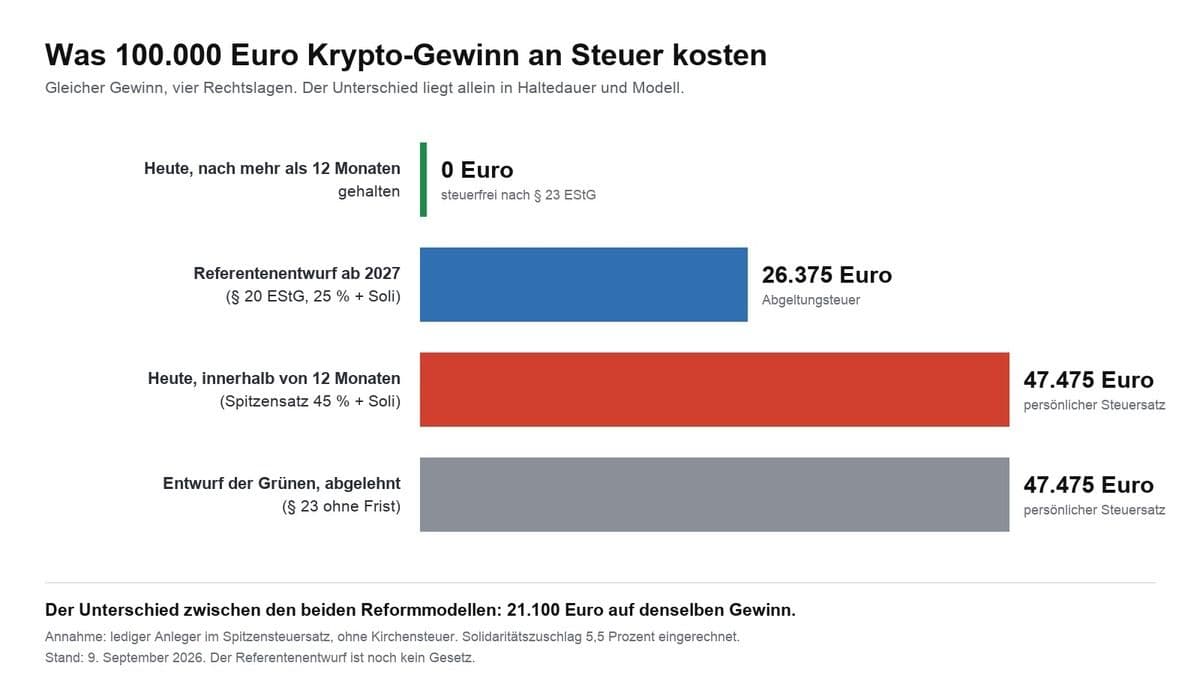
Crypto Tax in Germany: What Applies in 2026 and What Is Set to Change in 2027
Crypto gains are tax-free after twelve months; before that your personal tax rate of up to 45 percent applies. What triggers tax, how the holding period is calculated, what happens with staking and losses, and what the draft bill would change from 2027.
More from CryptoTicker