
XRP Falls 9.7 Percent: What to Check on Holding Period and Buying Route
XRP is down around 9.7 percent on the morning of September 24, twice as much as the typical large crypto asset. Our count of 18 coins shows who the pullback hits and which three things hold true regardless of the price.




Which topics should we dive deeper into?
Select what genuinely interests you. Your picks feed directly into our editorial planning.
Crypto news that's actually worth your time.
Weekly. 60 seconds. Carefully curated by our editors: no hype, no promo flood, no spam.
XRP has fallen between 9.3 and 9.7 percent over the past 24 hours, depending on when the data was pulled, and trades at around $1.49, or roughly €1.31, on the morning of September 24, 2026. The wider market gave up far less over the same period: Bitcoin lost 3.8 percent. Anyone minded to act today is not really deciding on the price level. Three things settle the matter independently of the price: the day you bought, the route you bought through, and whether an open leveraged position sits in the way.
This article places the pullback in context using our own figures, then sets out what you can actually check. The current price action and the chart levels are tracked continuously on our XRP price prediction.
XRP Falls 9.7 Percent: The Numbers for September 24, 2026
CoinGecko data from September 24, 2026 gives the following picture. XRP trades at $1.49. The daily range runs from $1.48 at the low end to $1.64 at the high end, which puts the price close to its daily low. Volume over 24 hours stands at $5.46 billion and market capitalisation at $93.94 billion, leaving XRP in fifth place among the largest crypto assets.
Two figures take the edge off the first shock. Over seven days XRP is up between 14.8 and 14.9 percent. Over 30 days the figure is minus 1.2 percent, which is effectively where it stood at the end of August. The pullback therefore claws back part of a strong week, but it does not turn the month around.
XRP sits 59.0 percent below its all-time high of $3.65, set on July 17, 2025. That number matters more for the tax discussion further down than it first appears: it shows that a substantial share of the holdings sitting in German brokerage accounts and wallets comes from purchases that are underwater today.
XRP Against the Top 25: Our Count of 18 Coins
To establish whether XRP is simply falling with the market or giving up more than its share, we counted the daily change across every asset in the top 25 by market capitalisation. We stripped out stablecoins along with exchange and platform tokens that have no free market price; 18 coins remained.
The result: the median of the 18 assets checked is minus 4.87 percent. XRP, down 9.7 percent, is falling roughly twice as hard as the typical member of that group. Only three of the 18 coins fell further, namely Uniswap at 12.0 percent, Dogecoin at 9.9 percent and Stellar at 9.9 percent. Of the 18 assets, 15 are in the red on the day, while 17 of the 18 are up on the week.
This analysis was compiled by cryptoticker.io on September 24, 2026. Basis: CoinGecko market data for the 25 largest crypto assets including 24-hour and 7-day change, followed by a count and a median across the 18 remaining assets. The basis contains no data on liquidation volumes at the derivatives venues, no order book depth and no attribution of selling to individual addresses. Statements about the cause of the pullback would be speculation, so we make none.
Why a Pullback After a Positive Week Works Differently From a Crash
The distinction matters for what you should do. A price loss that follows a losing stretch hits holdings that were already underwater. A price loss that follows a positive week hits mainly those who bought during that week. That is precisely the group that has spent the past seven days building positions whose holding period has only just started.
From that follows a practical point that often gets lost: selling quickly out of nerves costs you, in Germany, not only the possible recovery but also the tax treatment that kicks in after a year. If you sell at a loss today, you may well have good reason to. If you sell at a profit today because you got in long ago, do the arithmetic first.
Weekly and Daily Performance Are Two Different Metrics
Price reports almost always quote the 24-hour change, because it produces the biggest number. For a buying decision it is the least reliable of the three time frames. The 7-day figure shows whether a move has staying power; the 30-day figure shows whether anything has changed at all. For XRP all three values are available at the same time this morning, and they tell three different stories.
 Where to buy XRP in euros
Crypto Capital Gains Holding Period Under Section 23 EStG: Why Your Purchase Date Decides Your Tax
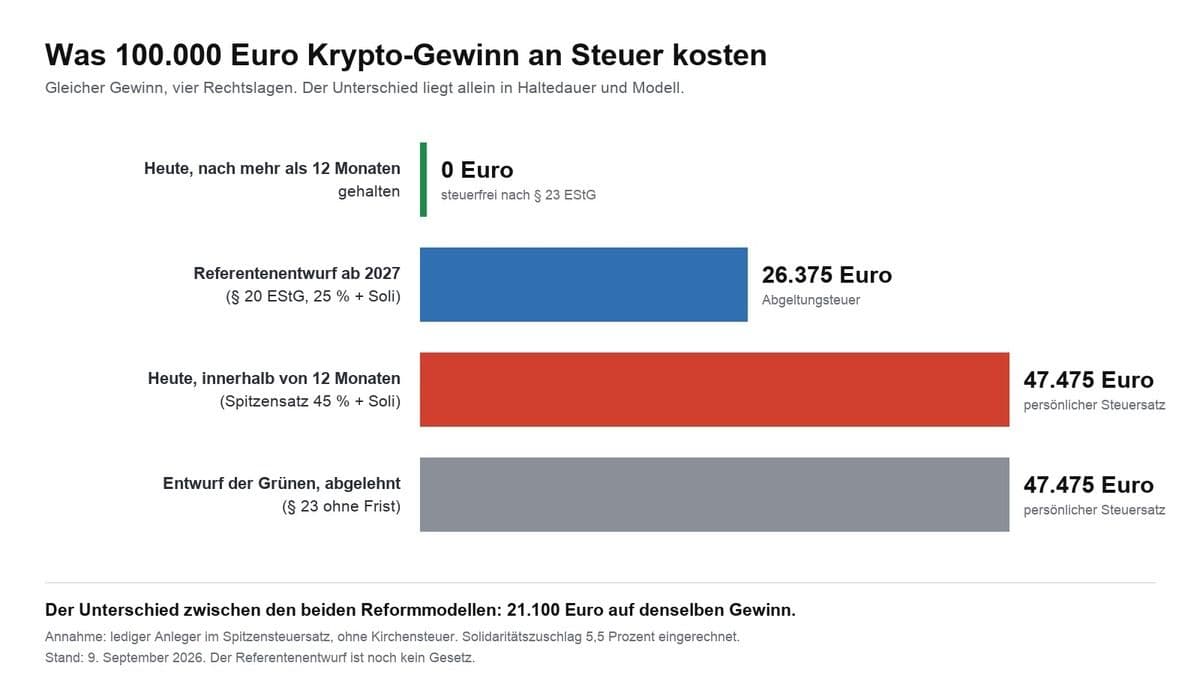
In Germany, crypto assets held in private wealth count as other economic goods. A sale is a private disposal transaction under Section 23 of the German Income Tax Act. The central variable is the one-year holding period: if more than twelve months lie between acquisition and disposal, the gain is tax free. If fewer than twelve months lie between them, the gain is taxed at your personal income tax rate.
On top of that sits an exemption limit. If total gains from all private disposal transactions in a calendar year stay below 1,000 euros, no tax is due. The term exemption limit is to be read literally: once the amount is exceeded, the entire gain becomes taxable, not just the excess. A sale that nudges you narrowly over that threshold can therefore cost more than you expect.
In practice, for this morning, that means: before you react to the price level, look up when you bought. Purchases made during last week's rally carry a holding period that ends in September 2027. Purchases from the summer of 2025, when XRP was running towards its all-time high, are long past the one-year mark.

FIFO: Which Coins Count as Sold
If you have bought XRP several times at different points, the question is which units a sale affects. For crypto assets the tax authorities accept the first in, first out method, or FIFO: the units acquired first count as the ones sold first. In a situation like today's that means a partial sale typically hits the oldest and therefore possibly tax-free holdings, not the freshly bought ones. Anyone who wants to shed the young positions specifically will get nowhere with a single wallet address.
Documentation Is the Real Work
Proving the acquisition date and the acquisition cost is on you. If you trade across several exchanges and wallets, there is no way round a clean set of records. Which tools read in a transaction history and produce a usable statement is something we have broken down in our comparison of crypto tax software and portfolio trackers.
Loss Offsetting: What Selling at a Loss Actually Buys You
If your position is underwater after the pullback and the purchase is less than a year old, a sale counts for tax purposes as a loss from a private disposal transaction. Such losses cannot be offset against employment income, interest or dividends. They reduce gains from other private disposal transactions in the same year and nothing else; beyond that, a carry-back to the previous year and a carry-forward to coming years are possible.
The converse matters: a loss realised after the one-year deadline has expired is worthless for tax purposes, because the transaction behind it is no longer taxable at all. If you have held a position deeply underwater for more than a year, selling gains you nothing on the tax side. Hardly anyone is aware of that asymmetry, and after a year like the last one it applies to a great many XRP holdings.
Buying XRP Under MiCA: Exchange, Custody and Destination Tag
If you want to use the pullback to buy more, the first decision is the route. Since Regulation (EU) 2023/1114 on markets in crypto assets, known as MiCA, became applicable in the parts covering service providers, firms addressing customers in the EU need authorisation as a crypto asset service provider. For you this is not a formality: authorisation brings obligations on segregating client assets, on handling complaints and on disclosing fees.
Which houses can evidence that authorisation, and how fees, spreads and deposit routes differ, is set out in our overview of the best crypto exchanges; if you want to filter specifically by supervisory status, the list of regulated crypto exchanges sits alongside it.
Destination Tag: The One Mistake That Costs Money With XRP
XRP has a quirk that Bitcoin and Ethereum lack. Many exchanges pool customer balances on a single XRP address and allocate incoming payments using a numeric code, the destination tag. If that code is missing from a deposit, the balance lands on the pooled address without being assigned to your account. Recovery is possible, but it takes time and depends on support playing along. Check the tag before every transfer, including a repeat transfer to the same address.
Minimum Reserve on the Ledger
A second peculiarity concerns self-custody. An address on the XRP Ledger has to hold a reserve in XRP for it to be active at all; that amount is locked and cannot be spent. If you are sending small sums to a freshly created wallet of your own, factor that in, or a noticeable share of the transfer will be tied up.
 Document your holding period and gains cleanly
Leverage and Liquidation: Why XRP Positions Break Sooner Than BTC Positions
The numbers from our count have a direct consequence for leveraged positions. If the median of the large crypto assets sits at minus 4.9 percent and XRP at minus 9.7, then with XRP half the leverage is enough to produce the same loss. A position at ten times leverage is arithmetically wiped out by a ten percent move against it, before fees and funding costs are taken into account at all.
Then there is the funding rate on perpetual futures, the so-called perpetuals. It is settled at short intervals between the long and the short side and typically runs against the long side after a phase of gains. If you hold a long position open over several days in that configuration, you pay continuously, whichever way the price goes.

Derivatives Are a Separate Tax Chapter
Gains from futures transactions do not fall under the one-year deadline of Section 23 EStG but are treated as investment income. Separate and narrower rules apply to offsetting losses from futures transactions. If you hold spot positions and derivatives in the same account, you are effectively running two distinct tax calculations. That is one reason not to mix the two where it can be avoided.
Levels Above and Below: Which Price Zones XRP Now Has in View
To the downside the first zone is the daily low at $1.48, which the price came close to on the morning of September 24. To the upside the first zone is the daily high at $1.64; the distance there from the current level is around ten percent. Both figures come from the same pull as the rest of the numbers in this article and are not a forecast but the documented range of the past 24 hours.
For the medium-term picture the 30-day figure of minus 1.2 percent is the soberest number: XRP stands roughly where it stood a month ago. What happened in between was movement without net change. If you are looking to build a position, the inference is that timing and haste have bought little over the month.
For a sense of market breadth it is worth a look at the largest asset: Bitcoin trades at $83,860 and has given up 3.8 percent; we track the action and the relevant levels there continuously in our Bitcoin price prediction.
What the Pullback Does Not Prove
An interpretation is only worth as much as its limits. What follows from the figures to hand is that XRP is losing more on this day than the typical large crypto asset. What does not follow is that a particular event is responsible, that a trend has been broken, or that the move will continue. If you come across an explanation online that names a single cause, ask what data supports it. We had no such data this morning, and we therefore assert nothing about it.
XRP Price Drop: What to Take Away
- Look at your purchase history first, not at the price. Note the acquisition date for every XRP position and check which holdings have already passed the one-year deadline under Section 23 EStG. A tool that reads in your transactions and tracks the deadlines is in our comparison of crypto tax software and portfolio trackers.
- Check the buying route before you buy more. Establish whether your provider can evidence MiCA authorisation as a crypto asset service provider, how large the actual spread is when you buy, and whether deposits and withdrawals in euros work without a detour. The side-by-side sits in our overview of the best crypto exchanges.
- Keep holdings and leverage apart. Check whether an open futures position is forcing a decision on you that you would not have to take on the holding alone. If you hold spot only, a ten percent daily loss brings no liquidation pressure. Which providers offer which products is shown in the overview of regulated crypto exchanges.
(As of September 24, 2026. This article is not investment advice. Prices and fee structures change; check the terms with the provider before you buy.)
Transparency note: This article was produced with the assistance of artificial intelligence and reviewed by our editorial team before publication. All figures and claims were checked against the primary sources linked in the text. The feature image was generated with AI.
More on XRP: All XRP news at a glance
Related articles
- Stellar Becomes a Payment Rail at Mastercard's BVNK: What XLM Holders Should Check on Buying Route, Memo and Holding Period
- Dogecoin Price: What to Check on Holding Period and Custody Before the Year End
- Chainlink Jumps Above $12: What LINK Holders Should Check Now
- Shiba Inu price up 4.4 percent: outperforms the market, but 88 trillion SHIB sit on exchanges
- Hester Peirce Leaves the SEC: What Now Applies to Your Custody in Germany
Which topics should we dive deeper into?
Select what genuinely interests you. Your picks feed directly into our editorial planning.
Crypto news that's actually worth your time.
Weekly. 60 seconds. Carefully curated by our editors: no hype, no promo flood, no spam.

September 21, 2026 4:13 AM
How to Buy XRP in Germany: Exchange, Destination Tag and Tax
Buying XRP works through a crypto exchange with MiCA authorisation, through a broker, or through an ETP in your securities account. This guide shows what matters on fees, the destination tag, custody and the German holding period.
September 27, 2026 10:14 AM
Shiba Inu Price Prediction: What to Check on SHIB Before the December 31 Deadline
SHIB trades at $0.00000592 on September 27, 2026, around 93 percent below its all-time high. For German investors one date matters more than the chart right now: December 31, 2026.

September 24, 2026 1:34 PM
Cardano Slides Below $0.24: What ADA Holders Should Check on Leverage, Liquidation and Holding Period
Cardano has given back its move above $0.25 and trades around seven percent below the high of the past 24 hours. What that means for leveraged positions, the holding period of your tranches and the buying route under MiCA.
September 9, 2026 4:22 PM
Crypto Tax in Germany: What Applies in 2026 and What Is Set to Change in 2027
Crypto gains are tax-free after twelve months; before that your personal tax rate of up to 45 percent applies. What triggers tax, how the holding period is calculated, what happens with staking and losses, and what the draft bill would change from 2027.

October 12, 2026 4:28 PM

XRP price prediction: $160 million behind Solana, 13 weeks of inflows against a 9 percent weekly loss
The XRP funds are only $160 million behind the Solana funds and have been taking in fresh money for 13 weeks. Why the price is falling anyway at $1.38, and what that means for the $2.80 year-end target.
September 26, 2026 7:40 AM
The RAIN Token After the Enlivex Termination: What to Check on Access, Forced Sale and Holding Period
Enlivex terminated a share placement of 66,666,667 shares payable in RAIN tokens on September 22, 2026. The token sits 46.4 percent below its all-time high, and at Kraken the withdrawal deadline expired long ago.
September 24, 2026 4:16 AM
Trump-Xi Summit at the White House: The Crypto Positions to Check Before the Meeting
Xi Jinping is on a state visit to Donald Trump today, and the crypto market comes into the meeting carrying the gains of an exceptionally strong week. What to check on leverage, holding period and custody before the first headline runs.
September 24, 2026 1:13 AM

Solana DEX Trades Overtake the NYSE: What to Check on Swaps, Tax and Oversight
Solana's decentralised exchanges settled roughly 208 million trades in a single week and overtook the New York Stock Exchange for the first time. The figure is real, but it measures something other than the comparison suggests, and for German investors it carries tax duties that no provider takes on.
August 21, 2026 4:24 AM

Forced Sale on a Crypto Exchange: Which Moment Counts for the Holding Period and What You Must Document
At Luno, Kraken and Valour the deadlines are running out, after which the provider realises the remaining holding itself. For tax purposes that is a disposal, and what governs it is the exchange's timestamp.
September 8, 2026 10:21 PM

Crypto Holding Period and Grandfathering: Why December 31, 2026 Becomes the Cut-Off in Germany's Draft Bill
A ministerial draft bill from Germany's finance ministry names a cut-off date for the first time: crypto assets acquired after December 31, 2026 are to fall under the flat-rate withholding tax. What that means for legacy holdings, running savings plans and staking income, and why nothing has been decided yet.
September 25, 2026 7:24 PM

Bitcoin Forecast: What to Check on Levels, Holding Period and Buying Route Before the Quarter Ends
Bitcoin stands at $83,877 at 16:40 UTC on September 25, 2026, and the measured volatility of the past 30 days spans a band of $73,600 to $94,200 for the coming month. More important than that band before the quarter ends are three checks: holding period, buying route under MiCA and the reporting duty in force since January 2026.
September 24, 2026 1:24 PM

NEAR Falls Almost 8 Percent After a 62 Percent Week: What to Check on Perps, Buying Route and Holding Period
NEAR Protocol loses up to 7.9 percent on September 24, 2026 and is still more than 55 percent higher over the week. The rally was carried by a confidential perp offering via Hyperliquid, which raises questions of its own on buying route, leverage and holding period in Germany.
October 6, 2026 4:32 AM
Bitcoin for a gift card: what paying with crypto means for your holding period
Paying for a gift card with Bitcoin is a sale for tax purposes. What counts as the disposal proceeds, when the twelve-month holding period bites, and the four records the tax office expects.
October 6, 2026 1:34 AM

93.56 million dollars out of the Zcash ETF in one week: what changes for ZEC holders in Europe
The Grayscale Zcash ETF lost money for the first time since launch in the week to October 5, 2026, a net $93.56 million. What the figure says about demand and what it means for ZEC holders in Europe.
October 5, 2026 10:14 AM

Solana price 108.46 euros: a 2.4 percent gain in euros, a 2.5 percent loss in dollars: what to check now
Solana is quoted at 108.46 euros and $121.30 on Monday morning. That leaves a gain of 2.4 percent for 2026 in euros and a loss of 2.5 percent in dollars. The difference comes purely from the exchange rate, and in Germany it decides the holding period, the tax threshold and the figure that ends up on the tax return.
September 24, 2026 10:11 PM
Bitcoin Price Prediction: What to Check on Levels, Holding Period and Leverage Before the October 28 Rate Decision
Bitcoin is trading at around $83,800, a third below its October 2025 high, while the sentiment index reads greed. Which dates, levels and deadlines over the coming weeks really decide your net gain, and which of them you steer yourself.
September 22, 2026 7:20 PM

ETH Price Prediction: What to Check at the $2,800 Mark Now
Ether stands at $2,735.96 on September 22, 2026, right below the zone at which it has failed repeatedly. Instead of a target number, you get four checks that count before your next order: holding period, buying route, the staking line and the distance to liquidation.
September 26, 2026 1:19 AM
Germany’s Crypto Holding Period Is Wobbling: What to Check Before December 31
A CDU member of the Bundestag makes it plain: the coalition agreement does not guarantee that the one-year holding period for crypto assets will survive. What that means for purchases made before the planned cutoff date of December 31, 2026.
October 7, 2026 4:28 PM

Shiba Inu Price at $0.00000538, Down 8.6 Percent in a Day: Hold or Sell?
Shiba Inu loses 8.6 percent on Wednesday afternoon and trades at $0.00000538. Whether a sale makes sense is decided in Germany less by the chart than by the purchase date of the individual tranche, because the one-year period hangs on it.
October 6, 2026 10:14 AM

$3.8 Million Back From the Attacker: Why the NEAR Price Is Up 7.8 Percent
The attacker has sent back the full $3.8 million from the NEAR Intents exploit, and the NEAR price is up 7.8 percent at $5.23. What is behind the recovery, what role the Bitwise NRR ETF plays, and what follows from it for buying route, holding period and custody.
September 27, 2026 4:12 AM
Bitcoin ETF Inflows Turn 2026 Positive: How to Tell If the Demand Holds
US spot Bitcoin ETFs took in roughly $2.4 billion in the week to September 25, the strongest week since October 2025, and that turns the 2026 year-to-date balance positive. Why the daily inflow fell 87 percent within the same week, and what to check on buying route, holding period and custody.
September 26, 2026 7:14 AM
Cardano Before the RealFi Launch on October 1: What ADA Holders Should Check on USDr, MiCA and Tax
On October 1, 2026 the stablecoin platform RealFi goes live on the Cardano mainnet, and ADA has gained 14.67 percent in a week. What is documented about the yield-bearing dollar token USDr, and what investors should settle beforehand.
September 25, 2026 7:14 PM

Chainlink Above the September High: What Open Interest, Funding Rate and Liquidation Risk Mean for LINK
Chainlink stands at $13.86, 11.2 percent higher than 24 hours ago. Our own query at OKX and Hyperliquid shows funding at the baseline rate, and what that means for leverage, buying route and tax.
September 24, 2026 10:19 AM

Uniswap Falls 11.8 Percent After a 114 Percent Month: What to Check on Profit Taking, Holding Period and Leverage
UNI lost 11.75 percent on Wednesday morning but is still up 113.85 percent over the month. Anyone realising gains now almost certainly triggers a taxable disposal in Germany.
September 20, 2026 4:13 AM
Zcash Above $1,500: What ZEC Holders Should Check on Tax and Custody
Zcash rose above $1,500 on September 19 for the first time since 2016 and, after an intraday high of $1,590.80, trades back at around $1,474. For German holders three questions hang on that jump: the one-year holding period, the planned year-end cut-off and the EU anti-money-laundering regulation from July 2027.
September 19, 2026 1:38 AM
Uniswap jumps above $9: what UNI holders should check on the fee switch now
The UNI price gains 18.67 percent within 24 hours, driven by the active fee switch and a new exemption from the US securities regulator. What of that can be recalculated, what remains pure expectation, and which three things you should settle now as an investor in Germany.
September 18, 2026 10:14 PM

Bitcoin Back Above $80,000: Buy More, Hold or Take Profits? What to Check Now
Bitcoin is back above $80,000, for the first time since September 7. Whether you buy more, hold or take profits depends less on the daily price than on three things you can check yourself: your holding period, the way you buy, and where your coins are kept.
More from CryptoTicker