
How to Buy XRP in Germany: Exchange, Destination Tag and Tax
Buying XRP works through a crypto exchange with MiCA authorisation, through a broker, or through an ETP in your securities account. This guide shows what matters on fees, the destination tag, custody and the German holding period.


Which topics should we dive deeper into?
Select what genuinely interests you. Your picks feed directly into our editorial planning.
Crypto news that's actually worth your time.
Weekly. 60 seconds. Carefully curated by our editors: no hype, no promo flood, no spam.
If you want to buy XRP in Germany, there are three routes: a crypto exchange with MiCA authorisation, a broker or neobroker app, or an exchange-traded product on XRP held in your securities account. Only the first two give you real tokens that you can move to an address of your own on the XRP Ledger. The third merely tracks the XRP price inside your brokerage account.
This page walks you through the entire purchase of Ripple: choosing the platform, checking its authorisation in the public register, fees and spread, the quirk known as the destination tag, custody, and German tax. Those are the points where beginners lose money, not the question of which app has the prettiest interface.
Buy XRP in Germany: the three available routes
The three methods do not differ in the price you get. They differ in what you end up owning and who holds it for you. That governs the fees, the tax, and whether you ever have your tokens in your own hands.
Crypto exchange: real tokens and the option of self-custody
On a crypto exchange you trade XRP directly against the euro. You can then withdraw the amount you bought to an address of your own on the network and take it out of the platform's custody. Providers available in Germany with authorisation under the European MiCA regulation include Bitpanda, Bitvavo, Kraken and Coinbase; Börse Stuttgart Digital sits behind the BISON app. Which provider suits you depends on trading fees, volume and payment methods. For an overview of what the individual platforms cost, see our crypto exchange comparison.
Brokers and neobrokers: convenient, with less control
Brokers and neobroker apps bundle equities, ETFs and cryptocurrencies into a single interface. Buying there usually takes two clicks, but a withdrawal to your own crypto wallet is often not provided for at all. For investors who intend to leave their tokens on the platform anyway, that is convenient. Anyone who wants to take custody themselves should check before opening an account whether the provider supports withdrawals to the XRP network at all.
XRP ETPs: a securities account instead of a crypto account
Exchange-traded products on XRP are listed on Xetra and other European venues, from issuers such as 21Shares and WisdomTree. These products are physically backed with XRP and are bought like a security through your ordinary brokerage account, with some brokers even offering savings plans. What you acquire, however, is not a token you can transfer yourself, and you pay an ongoing management fee. For tax purposes a product of this kind is also a different matter from directly held tokens; clarify the treatment with your tax adviser before you buy.
What is XRP, and what does Ripple Labs have to do with it?
XRP is the token of the XRP Ledger, a public blockchain that has been running since 2012 and whose software is open source. Ripple Labs, by contrast, is a San Francisco company that helped develop the technology and sells payment products to banks and other financial institutions. Ripple and XRP get mixed up in everyday usage, but they refer to two different things: the company and the token.
The network confirms transactions without mining. It uses the Ripple Protocol Consensus Algorithm, in which a list of trusted validators agrees at short intervals on the next state of the ledger. Neither proof of work nor proof of stake is involved, a ledger closes within seconds, and the network fee per transfer sits in the range of fractions of a cent. Classic staking, as you know it from other chains, therefore does not exist on the XRP Ledger.
The circulating supply stems from a one-off creation of 100 billion XRP at launch; a substantial share of that sits with Ripple in escrow contracts and is released under fixed rules. Anyone seeking to make sense of XRP's market capitalisation should know about these releases, because they change the tradable supply over the years.
One point that drove the price for years has been settled: the legal dispute between the US Securities and Exchange Commission and Ripple Labs ended in August 2025, according to consistent reports, when both sides withdrew their appeals. A civil penalty of 125 million dollars for institutional sales remained in place. For you as a buyer in Germany, however, that case changes nothing about the rules that apply here, which are set out further down.
Crypto exchange with MiCA authorisation: how to check a provider in five minutes
The EU's MiCA regulation has applied in full since 30 December 2024. Under it, any platform providing crypto-asset services to customers in the EU needs authorisation as a crypto-asset service provider. The German grandfathering arrangement for incumbent providers expired on 31 December 2025. Since 1 January 2026, then, only an authorised company may serve you in Germany. What the authorisation demands in detail is set out in our overview of the MiCA obligations for crypto companies.
You can check this yourself, in three places. The public register of the European Securities and Markets Authority lists every authorised provider in the Union. BaFin's company database shows what permission a provider based in Germany holds; the supervisory authority explains the particulars on its page on crypto-asset services. And third, every reputable platform names its authorisation and its supervisory authority in the imprint or the legal notices.
What matters just as much is what an authorisation does not deliver. No deposit guarantee comes with it, the permission does not protect against price losses, and it certainly does not turn XRP into a safe investment. What it does is bind the provider to requirements on capital, custody, complaints procedures and disclosure. That is worth a great deal when something goes wrong, and it is worth nothing at all when the market falls. A selection of regulated crypto exchanges sorted by authorisation can be found in our comparison of trading venues.
Fees, spread and volume: what the price of buying Ripple really depends on
The quoted price is rarely the price you end up paying. Three cost blocks work together, and the largest of them usually does not appear on the invoice.
Trading fees are the visible part: a percentage of the order volume, often tiered by trading volume over the past 30 days. The spread is the invisible part, meaning the difference between the buying and the selling price. At providers advertising with the formula “no fees”, the margin almost always sits precisely there. And the deposit method decides the rest: a SEPA transfer is free at most platforms, while credit card or PayPal can cost several percent depending on the provider.
A fourth factor only becomes apparent once you compare several platforms: the volume in the respective trading pair. An order book with plenty of volume leads to tighter spreads, while a thin order book moves against you even at medium order sizes. The XRP Ledger's own network fee, by contrast, is negligible; a withdrawal only becomes expensive if the platform adds a flat charge of its own.
Buying step by step: from verification to your first order
The process is similar at all authorised providers, because the rules are the same. Allow about half an hour for the initial setup, plus the time your transfer takes to arrive.
- Open and verify an account. Have your identity document ready and complete the identity check by video or app. Nothing happens at a licensed provider without this step; buying anonymously is not provided for in the EU.
- Switch on two-factor authentication. Preferably via an authenticator app rather than by SMS. This single step prevents the bulk of account takeovers.
- Deposit funds. By SEPA transfer if you do not need the price immediately, by card if it has to be fast and the fee is worth the time saved.
- Place the order. In the trading section, select the XRP against euro pair, enter the quantity or the euro amount, set the order type, check the preview and confirm.
- Save the record. Export the purchase date, quantity, price and fee, or file them as a PDF. You will need this data years later for your tax return, and platforms disappear faster than tax offices ask questions.
Market order or limit order?
A market order is executed immediately at the next available price. That is simple and unproblematic in quiet phases. In periods of high volatility, though, such as immediately after a news event, the execution price can deviate noticeably from the one displayed. A limit order, by contrast, sets a maximum price and is only executed if the market gets there. For a first purchase the limit order is the calmer method, because you know the outcome in advance.

Destination tag: why a missing identifier can cost you XRP
A destination tag is a number you supply alongside the recipient address when sending XRP. It is needed because exchanges often operate just a single address on the XRP Ledger for their entire customer base. The tag assigns the incoming payment to the right account. The network's developer documentation describes this mechanism under Source and Destination Tags.
If you send XRP without a tag to a pooled address, the money lands in the platform's account without being assigned to any customer. The transaction is confirmed and visible on the blockchain, yet your balance is not there. Recovery then runs through support, takes days to weeks depending on the provider, costs a processing fee at some platforms and does not succeed in every case. How to check the identifier before you hit send is set out in our guide to checking the destination tag.
Two habits reduce this risk to almost zero. First: always copy the address and the tag from the receiving platform's deposit page, never from an older note. Second: with larger amounts, send a small test transfer first and wait for it to be credited. The network fee for that runs to fractions of a cent, the possible damage to your entire amount.
Storing XRP: exchange, software wallet or cold wallet
After the purchase, XRP initially sits with the platform. That is convenient and defensible for small amounts, but it means a third-party company holds the keys. Anyone intending to hold larger balances for the long term moves them to an address of their own. A software wallet on a smartphone is enough for that in many cases; for larger sums cold wallets are the better choice, because the private key never leaves the device there. Which devices are available in Germany is shown in our hardware wallet comparison.
The XRP Ledger adds a peculiarity that no other large chain has: the reserve. Every activated address must permanently hold a minimum amount, currently 1 XRP as the base reserve, after validators lowered the previous figure of 10 XRP at the end of 2024. For every additional object your address creates in the ledger, another 0.2 XRP is added. This portion is locked for as long as the address exists; the documentation on reserves explains the calculation in detail.
In practice that means: if you transfer exactly your entire holding to a fresh address, the transaction fails if it does not cover the reserve. Factor the amount in before you send. And back up your wallet's recovery phrase on paper or metal, in two separate places, never as a photo or in the cloud.
Tax in Germany: holding period, exemption limit and the reporting duty since 2026
The sale of XRP in Germany falls under private disposal transactions pursuant to Section 23 of the Income Tax Act. Three rules follow from this, and they make the difference between tax-free and taxable.
The holding period. If you sell your tokens more than one year after buying them, the gain is tax-free, regardless of its size. Within the year it is taxable, and at your personal income tax rate rather than at the flat withholding tax rate. Exactly how the period runs is explained in our article on the holding period for cryptocurrencies.
The exemption limit. For gains within the one-year period, an exemption limit of 1,000 euros per person and calendar year has applied since 2024. The word is to be taken literally: at a gain of 999 euros you pay nothing, at 1,001 euros the entire amount becomes taxable, not just the excess.
The disposal sequence. If you buy several times at different prices, the order applied in practice is that the tokens bought first count as the ones sold first, assessed per wallet or account. A swap of XRP into another cryptocurrency counts as a sale, and a new period begins for the holding received in exchange. A portfolio tracker takes this bookkeeping off your hands; suitable tools are listed in our comparison of crypto tax tools.
What is new is the transparency behind it. Under the German implementation of the EU's DAC8 directive, platforms, brokers and custodians have been reporting their customers' master data and aggregated transactions to the tax authorities since 1 January 2026. The first reporting period is the 2026 calendar year, and submission is due by 31 July 2027. Declaring it in your tax return is therefore no longer a question of the odds of being found out.
Can I still buy XRP now? What price forecasts can and cannot do
This question ranks high in every search for XRP, and it can only be answered honestly like this: nobody knows the future price, and every figure you encounter as a price target for 2030 is an opinion with a calculation behind it, not a measurement. Credible analyst views are recognisable by being attributed by name and by disclosing their assumptions. Anyone quoting a price target without a source is quoting nobody.
What can be named are the factors the price hangs on: demand for the token in payments over RippleNet, the release of holdings from the escrow contracts, the general market situation, which is heavily tied to Bitcoin, and regulatory decisions in the United States and in the EU. How these factors have played out most recently is something we pull together continuously in the Bitcoin forecast.
That leaves the risk that appears in no forecast. XRP is highly volatile, double-digit daily moves have occurred in both directions, and a total loss of the amount invested is possible. Invest only money whose loss would not touch your everyday life, and never work a purchase out on credit.
Buying XRP: what to take away
- Check the authorisation first, then open the account. A look at the ESMA register and the BaFin database takes five minutes. Which providers are eligible for German customers is set out in the exchange comparison.
- Clarify the address, the destination tag and the reserve before your first withdrawal. A small test transfer costs fractions of a cent and spares you the support case. For permanent custody, the hardware wallet comparison is worth a look.
- Document from your first purchase onwards. Purchase date, quantity, price and fees belong in a record from day one, because the holding period and the exemption limit cannot otherwise be proven. Tools for this can be found under crypto tax tools.
(As of September 21, 2026. This article is not investment advice. Prices and fee structures change; check the terms with the provider before you buy.)
Transparency note: This article was produced with the assistance of artificial intelligence and reviewed by our editorial team before publication. All figures and claims were checked against the primary sources linked in the text. The feature image was generated with AI.
More on XRP: All XRP news at a glance
Related articles
- XRP Falls 9.7 Percent: What to Check on Holding Period and Buying Route
- Memecoin Rally: Why Memecoins Are Rising and What to Check Before You Buy
- Hester Peirce Leaves the SEC: What Now Applies to Your Custody in Germany
- Dogecoin Price: What to Check on Holding Period and Custody Before the Year End
- Sending XRP with a Destination Tag: What to Check Before Every Exchange Transfer
Which topics should we dive deeper into?
Select what genuinely interests you. Your picks feed directly into our editorial planning.
Crypto news that's actually worth your time.
Weekly. 60 seconds. Carefully curated by our editors: no hype, no promo flood, no spam.

April 4, 2026 11:00 AM

XRP News Today: Ripple RLUSD Expansion and the CLARITY Act Impact
XRP faces technical pressure while Ripple’s RLUSD stablecoin gains global traction. Explore how the CLARITY Act could redefine the XRP Ledger ecosystem.
September 23, 2024 8:44 AM
Is it a Good Idea to Buy XRP below $0.60?
With recent XRP price drops positioning it below the $0.60 mark, investors are left pondering. Is it a good idea to buy XRP below $0.60?

September 25, 2026 1:12 PM

XRP Jumps to $1.56: What Holders Should Check on Buying Route, Holding Period and Leverage
XRP trades at $1.56 on September 25, 2026, up 6.85 percent on the day and 16.64 percent on the week. What the on-chain data and the US ETF inflows actually show, and what investors in Germany should check now on buying route, holding period, leverage and custody.

October 7, 2026 4:16 PM

XRP Price Prediction, $1.4445 and a Delayed XRPN Market Debut: What to Watch Now
XRP stands at $1.4445 on October 7, 4.4 percent below the previous day. Three dates shape the week: the XRPN market debut on October 12, the holding-period hearing on the same day and the cabinet session on October 14.
March 7, 2026 12:59 PM
XRP Price Prediction: Can Ripple Reclaim $1.50 Amid Record Low Liquidity?
XRP faces a critical 60% valuation reset. As exchange liquidity hits record lows, will Ripple's native token bounce back to $1.50 or sink further?
September 20, 2026 10:17 AM
XRP Ledger Explained: How the Network Behind XRP Works
The XRP Ledger is the blockchain behind XRP: consensus without mining, confirmation in three to five seconds and a fee of 0.00001 XRP that is destroyed. This explainer shows how validators and the UNL work, what the DEX, AMM, escrow and Multi-Purpose Tokens do and which amendments went live up to October 2026.
September 25, 2026 10:26 PM
Selling bitcoin privately: the tax in Germany and the records you need
A direct sale to a private individual falls under the same one-year rule as an exchange sale, but there is no tax report to go with it. This guide walks through the calculation, the 1,000 euro threshold and the records the tax office wants to see.
September 24, 2026 1:13 AM
Solana DEX Trades Overtake the NYSE: What to Check on Swaps, Tax and Oversight
Solana's decentralised exchanges settled roughly 208 million trades in a single week and overtook the New York Stock Exchange for the first time. The figure is real, but it measures something other than the comparison suggests, and for German investors it carries tax duties that no provider takes on.
September 8, 2026 10:21 PM
Crypto Holding Period and Grandfathering: Why December 31, 2026 Becomes the Cut-Off in Germany's Draft Bill
A ministerial draft bill from Germany's finance ministry names a cut-off date for the first time: crypto assets acquired after December 31, 2026 are to fall under the flat-rate withholding tax. What that means for legacy holdings, running savings plans and staking income, and why nothing has been decided yet.
October 6, 2026 4:32 AM
Bitcoin for a gift card: what paying with crypto means for your holding period
Paying for a gift card with Bitcoin is a sale for tax purposes. What counts as the disposal proceeds, when the twelve-month holding period bites, and the four records the tax office expects.
September 25, 2026 7:24 PM

Bitcoin Forecast: What to Check on Levels, Holding Period and Buying Route Before the Quarter Ends
Bitcoin stands at $83,877 at 16:40 UTC on September 25, 2026, and the measured volatility of the past 30 days spans a band of $73,600 to $94,200 for the coming month. More important than that band before the quarter ends are three checks: holding period, buying route under MiCA and the reporting duty in force since January 2026.

September 24, 2026 1:11 PM
Stellar Becomes a Payment Rail at Mastercard's BVNK: What XLM Holders Should Check on Buying Route, Memo and Holding Period
BVNK has switched on Stellar as a payment rail for business customers in more than 130 countries. On the same trading day XLM falls by around seven percent — we separate what the news means from what the pullback means for your portfolio.
September 22, 2026 4:12 PM
Nearly $1 Billion Into Bitcoin ETFs: What to Check on ETNs, Portfolio and Holding Period
US spot bitcoin ETFs took in a net $999 million on September 21, the third consecutive day of inflows. German investors cannot reach these funds: what ETNs, the holding period and your buying route mean for you.
September 19, 2026 7:17 AM
Chainlink Jumps Above $12: What LINK Holders Should Check Now
Chainlink trades at $12.34, 7.4 percent higher than yesterday. What part of the move is the broad market rally, what Chainlink itself contributes, and the three things you should check as a LINK holder.
September 17, 2026 7:12 PM
Gifting Bitcoin to Children: Allowance, Holding Period and the Tax Office Report
Transferring Bitcoin to your child hands over your holding period and your entry price along with the coins. This guide sets out what really applies in Germany on the allowance, the reporting deadline, representation and custody.
September 26, 2026 1:19 AM
Germany’s Crypto Holding Period Is Wobbling: What to Check Before December 31
A CDU member of the Bundestag makes it plain: the coalition agreement does not guarantee that the one-year holding period for crypto assets will survive. What that means for purchases made before the planned cutoff date of December 31, 2026.
September 9, 2026 4:22 PM
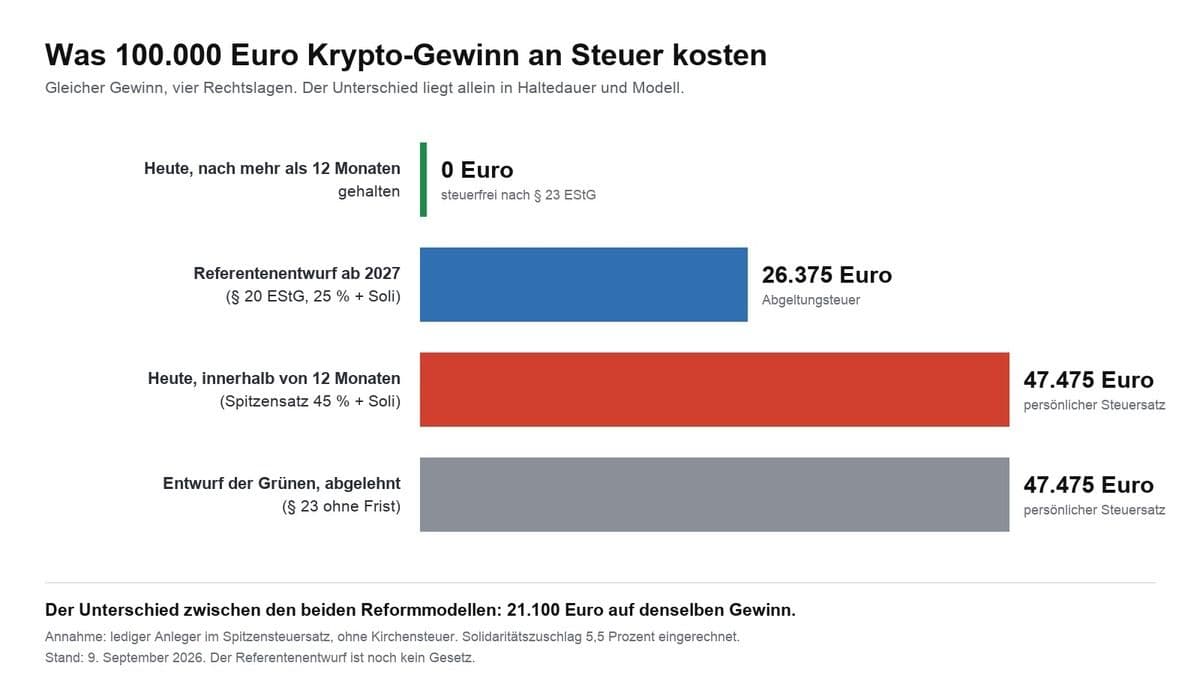
Crypto Tax in Germany: What Applies in 2026 and What Is Set to Change in 2027
Crypto gains are tax-free after twelve months; before that your personal tax rate of up to 45 percent applies. What triggers tax, how the holding period is calculated, what happens with staking and losses, and what the draft bill would change from 2027.
May 15, 2026 9:47 AM
Top 10 Altcoins to Buy in May 2026 as Bitcoin Recovers
Here are the top 10 altcoins to buy in May 2026 as Bitcoin rebounds near $80K and market momentum shifts.
March 23, 2025 1:08 PM
XRP vs ADA in 2025: Which Crypto Will Lead the Next Bull Run?
ADA and XRP are both making headlines in 2025 with big price moves and bullish predictions. Which crypto will lead the next bull run?
February 9, 2025 4:31 PM

Ripple CEO Brad Garlinghouse’s Potential Role in Trump’s Crypto Advisory Council – Impact on XRP and Market Outlook
Ripple CEO Brad Garlinghouse is reportedly being considered for a seat on Donald Trump’s newly formed Crypto Advisory Council. Will XRP reach new highs in 2025?
March 8, 2025 1:00 PM
Top 3 Altcoins to Buy in March After the Crypto Summit’s Market Drop
The crypto market reacted negatively after the much-anticipated Crypto Summit. As the dust settles, here are the top 3 altcoins to buy once the price correction stabilizes.
October 6, 2026 4:16 AM

13 exchanges list MemeCore, not one euro pair: hold or sell M?
Not one of the 14 markets that list MemeCore trades against the euro: every exit runs through Tether or USDC. What the thin order book, the monthly tranche of 56.1 million M and the holding period mean for your M position.
October 5, 2026 4:42 PM

deBridge DBR: 618 million tokens come free on October 17, ten trading days of turnover at once
At deBridge the lock-up on 618.3 million DBR ends on October 17, 2026, the eighth quarterly tranche since the token launch. This piece sets the tranche against daily turnover, shows the six pots behind it and places trading and tax for investors in Germany.
October 1, 2026 7:38 AM

Buying Ethereum with PayPal: a 72-hour withdrawal lock is the real price of the convenience
PayPal does not trade crypto-assets in Germany, yet it still works as a deposit route at a crypto exchange. What arrives in ether out of 100 euros, why the fee appears only on the final page and what the 72-hour lock means for your ETH.
September 27, 2026 4:12 AM
Bitcoin ETF Inflows Turn 2026 Positive: How to Tell If the Demand Holds
US spot Bitcoin ETFs took in roughly $2.4 billion in the week to September 25, the strongest week since October 2025, and that turns the 2026 year-to-date balance positive. Why the daily inflow fell 87 percent within the same week, and what to check on buying route, holding period and custody.
September 24, 2026 4:20 PM
Litecoin Jumps by Double Digits While the Market Falls: Check Buy Route, Holding Period and Leverage Now
Litecoin gains 11.29 percent in a day while Bitcoin, Ether and XRP give ground. What sits behind the jump, and the three points you as an investor in Germany should check right now.
September 22, 2026 7:23 AM
Gifting Bitcoin to Your Spouse: Allowance, Holding Period and the Report to the Tax Office
Thanks to a 500,000 euro allowance, a gift to a spouse is almost always free of gift tax, and it is not a disposal either. What matters is what travels with it: your purchase date, your purchase price and with them the state of the one-year holding period.
More from CryptoTicker