
Gifting Bitcoin to Children: Allowance, Holding Period and the Tax Office Report
Transferring Bitcoin to your child hands over your holding period and your entry price along with the coins. This guide sets out what really applies in Germany on the allowance, the reporting deadline, representation and custody.





Which topics should we dive deeper into?
Select what genuinely interests you. Your picks feed directly into our editorial planning.
Crypto news that's actually worth your time.
Weekly. 60 seconds. Carefully curated by our editors: no hype, no promo flood, no spam.
When you gift your child Bitcoin, you transfer two things at once: today's value and the tax history. The value decides whether any gift tax arises at all. For your own children, 400,000 euros per parent stay free of tax within a ten-year period, and very few transfers ever come close. The history decides what happens when your child sells the coins later: the acquisition date and the acquisition cost travel with them. Your child therefore takes over your holding period and your entry price.
That is the short answer, and it sounds more relaxed than practice is. Between the allowance and the sale sit a three-month reporting deadline, the question of who may hold the keys, and a less noticed side effect: a gain in the child's hands can touch free family health insurance. This article works through the points in order, each of them under German law.
Gifting Bitcoin to children: what actually transfers for tax purposes
For tax purposes, crypto assets are economic assets. They count as neither currency nor securities. An economic asset is any advantage with a monetary value that can be valued on its own. The German Federal Ministry of Finance confirmed this classification in its circular of 6 March 2025 and cited the Federal Fiscal Court, which had established it for Bitcoin and comparable coins in its judgment of 14 February 2023 (IX R 3/22).
Everything else follows from that classification. Because Bitcoin is an economic asset, a transfer without consideration falls under the Inheritance and Gift Tax Act. And because it is an other economic asset within the meaning of income tax law, the one-year rule for private sale transactions applies to any later sale. The two statutes run alongside each other and do not exclude one another. A gift can be free of gift tax and still trigger an income tax liability for the child years afterwards.
If you want to read up on the general rules for transfers without consideration, our overview of crypto gifts and inheritance covers them. Here the focus is the special case left out there: the minor recipient.
Gift tax: the 400,000 euro allowance applies per parent
The personal allowance is the amount up to which an acquisition stays free of tax. It depends on the family relationship between donor and recipient, not on wealth. For children the statute names 400,000 euros, for grandchildren 200,000 euros and for spouses 500,000 euros.
Two details matter more in practice than the figure itself. First, the allowance applies per donating person. Father and mother can therefore transfer 800,000 euros in total to the same child without gift tax arising, provided each parent gives out of their own assets. Second, the allowance replenishes over ten years. All acquisitions by the same person from the same person within ten years are added together; once the period has elapsed, the full amount is available again.
For Bitcoin, the sober conclusion is that gift tax is a non-issue at ordinary amounts. Anyone transferring coins worth a few thousand euros to their child stays far below every threshold. The allowance only becomes relevant when crypto forms part of a larger transfer of wealth alongside real estate or company shares, and at that point the whole arrangement belongs in expert hands.
How the tax office determines the value of gifted Bitcoin
What counts is the common value on the day the gift is executed. The common value is the price that could be achieved in ordinary business dealings. For Bitcoin that is the market price at the time of transfer. Your entry price is irrelevant here, as is an average across the year.
The gift is executed once your child has obtained the power of disposal. With an on-chain transfer, that is the moment the transaction was confirmed in a block and the coins sit at an address your child can dispose of. This is exactly where a threshold lies that many parents underestimate: as long as you alone keep control of the keys, it is questionable under civil law whether anything was transferred at all.
What you should document
Record which quantity of coins went to which address and when, which price applied on that day, and which source that price is based on. A short written gift agreement costs nothing and spares you the later discussion about whether it was a gift, a loan or mere custody. Without evidence, the person relying on the version that favours them bears the consequences in case of doubt.
Step into the shoes: why your child inherits your holding period
The step-into-the-shoes principle describes the rule that someone who acquires an asset without consideration steps into the tax position of their predecessor. Section 23 paragraph 1 sentence 3 of the Income Tax Act puts it this way: in the case of acquisition without consideration, the acquisition by the legal predecessor is attributed to the singular successor. The Federal Ministry of Finance applies this sentence expressly to crypto assets in margin number 73 of its circular.
The practical effect is considerable, and it usually works in the family's favour. If you have already held your Bitcoin for more than a year, the holding period is met at your child's level immediately. Should they sell the coins the day after the gift, the gain stays free of income tax, because more than a year lies between your acquisition and the disposal. A gift is not itself a disposal, so it does not reset the clock.
The reverse applies just as much. If you bought only three months ago, your child starts with three months of the period already run and has to wait another nine months to sell tax free. For calculating the period, the Federal Ministry of Finance relies on the times recorded at centralised trading venues, and on the times from the wallet in the case of direct transfers. So pass on the purchase records along with the coins.
A third figure travels along as well: the acquisition cost. Your child later calculates against your original purchase price rather than the price on the day of the gift. Anyone who bought cheaply in 2019 shifts hidden reserves along with the coins, which helps with the holding period question while making the starting point for the size of the gain within the period less favourable.

Reporting duty under section 30 ErbStG: three months, and for both sides
Section 30 of the Inheritance and Gift Tax Act requires every taxable acquisition to be reported in writing to the competent tax office within three months of becoming aware of it. With a gift between living persons, the person from whose assets the acquisition originates is obliged to report it as well. So it catches both sides: the child receiving the gift, represented by the parents, and the donating parent.
A widespread misunderstanding holds that nothing needs to be reported below the allowance. The reporting duty attaches to the acquisition, not to the amount of tax. It only falls away in the cases named in the statute, for example where the gift was notarised and the court or the notary takes over the report. With an on-chain transfer between parent and child, that is regularly not the case.
The report itself is informal. A letter with names, addresses, the family relationship, the date of execution, the quantity of coins transferred and the value applied is enough. The report is not a tax assessment, and it is no admission of debt. It is the basis on which the tax office decides whether to request a return. Anyone who omits it risks the accusation of a tax irregularity at larger amounts, and that accusation is considerably more unpleasant than the report itself.
 Keep your crypto tax under control
Who gets to decide about the child's Bitcoin
A gift to a minor child is uncomplicated under civil law, as long as it brings the child nothing but a legal advantage. Under section 107 of the German Civil Code, a minor needs the consent of their legal representative only for declarations through which they obtain something more than a purely legal advantage. Simply receiving Bitcoin without conditions does not fall under that.
Joint representation under section 1629 BGB
From the moment the coins belong to the child, the parents may no longer dispose of them freely. Parental responsibility does include representing the child, and under section 1629 paragraph 1 BGB the parents represent the child jointly. What that means, though, is acting together, in the child's interest, with someone else's assets. A parent who sells the child's coins alone in order to pay a bill of their own is not acting within the scope of that representation.
Prudent asset management under section 1642 BGB
Rarely cited, but relevant here: section 1642 BGB obliges parents to invest the child's money under their management according to the principles of prudent asset management. The catalogue of transactions that additionally require approval from the family court is set out in section 1643 BGB in conjunction with sections 1850 ff. BGB and names land, registered ships, inheritance matters and commercial businesses. Crypto assets do not appear there.
An approval requirement for selling a child's Bitcoin therefore cannot be derived from the wording. The standard of section 1642 BGB nevertheless remains in place, and with a volatile asset it is anything but a formality. Anyone managing a larger sum for a child should do so with legal advice and be able to justify their decisions.
Account, custody account and wallet for minors: what works in practice
Legally, a child can own Bitcoin. In practice it usually fails at access to the trading venue. Crypto exchanges regularly admit only customers of full age in their terms of use, and the identity check under anti-money-laundering law is tailored to people with an ID document and full legal capacity. Check the provider's terms before you set out to open an account in your child's name; only what is written there in black and white is reliable.
That leaves two routes in practice. The first is a transfer to a wallet whose keys are held for the child, without any account at a provider being necessary. The second is to keep the coins in a clearly separated position until the child comes of age and to execute the gift only then; in that case, however, only this later point in time counts for the allowance and for the common value, and the ten-year period begins correspondingly later. If you are buying regularly anyway, a Bitcoin savings plan is the simpler foundation, because it documents every purchase with a date and a price and lets you hand the records on cleanly later.
Custody: whoever holds the key must be able to justify the attribution
For tax purposes, an economic asset is attributed to whoever exercises actual control over it. With Bitcoin that is whoever has the private key. For a gift to a child this creates a tension that cannot be defined away: an eight-year-old cannot secure a seed phrase, but if the parents keep the key and dispose of it freely, the transfer looks from the outside like an internal rebooking within their own holdings.
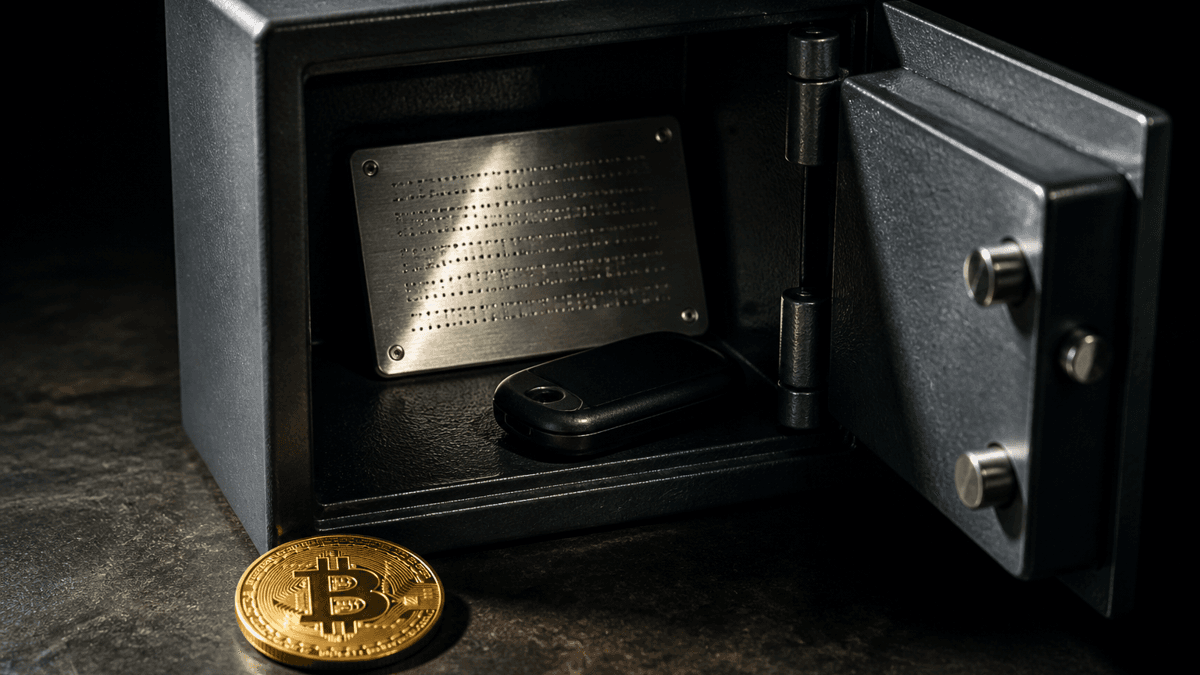
Separation and documentation resolve this. Use a dedicated wallet for the child's coins that has nothing to do with your other holdings, and never mix your own coins in. That also makes sense for a technical reason: the Federal Ministry of Finance prescribes a wallet-based view for the order of use. Anyone mixing holdings makes the later allocation of acquisition dates harder for everyone involved. Also record in writing that you hold the keys in trust for your child and from when they are to dispose of them themselves.
When your child sells: exemption limit, basic allowance and their own tax return
If your child sells the gifted Bitcoin at a gain within the one-year period they took over, a private sale transaction arises. The gain is the difference between the sale proceeds and the acquisition cost taken over. The child is liable for the tax, not you, because income is attributed to whoever earns it.
Two amounts provide relief here. The exemption limit in section 23 paragraph 3 sentence 5 of the Income Tax Act makes gains tax free if the total gain from all private sale transactions in the calendar year comes to less than 1,000 euros. An exemption limit is not an allowance: once it is exceeded, the entire gain is taxable, not merely the excess part. Above that sits the basic allowance, which stands at 12,348 euros in 2026 and applies to the younger generation just as it does to everyone else. A child without other income therefore pays no income tax in the end even on a gain of several thousand euros, but still has to declare the transaction.
Anyone wanting to keep periods and cost bases clean over the years will hardly get by without software once more than a handful of transactions accumulate. When choosing, check whether the program can depict acquisition data taken over from a gift at all; many interfaces only know your own purchase. Also note the warning from the Finance Ministry circular: the tax reports offered by private providers resemble a bank's tax certificate from the outside, yet they are nothing of the kind. Responsibility for the declared figures stays with the taxpayer.
 Keep the child's Bitcoin in separate custody
Family insurance, maintenance and student aid: where crypto gains show up
The point that surprises people most often in advisory conversations has nothing to do with tax. Children are covered by free family insurance in the statutory health insurance system as long as their regular total income does not exceed a limit. For 2026, the association of substitute health insurance funds names 565 euros a month, or 603 euros in the case of marginal employment.
Whether and how a one-off disposal gain enters this total income depends on how the health insurance funds interpret it and on whether the income counts as regular. There is no blanket answer here, and anyone who reads one should become sceptical. If a noteworthy gain is coming up for your child, ask the health insurance fund in writing beforehand how they will treat the transaction. The same caution applies to student aid applications, where the trainee's assets are counted separately, and to maintenance questions, where the child's own assets can play a role.
With child benefit the situation is more relaxed: there has been no income limit for children of full age in training since the 2012 reform. A crypto gain therefore does not endanger the entitlement.
The pocket money rule: what teenagers may do with their own money
Many parents stumble over the reverse question: the child bought on their own, out of their own pocket money. Section 110 BGB, known as the pocket money rule, provides that a contract concluded by a minor without consent is effective from the outset if they effect performance with means placed at their disposal for that purpose or for free use.
On the wording, the provision can be applied to a Bitcoin purchase out of pocket money, provided the money really was at free disposal and the purchase is paid in full. That does nothing to change the fact that the provider can terminate the contract on grounds of minority under its own terms and close the account. And for tax the rule holds without qualification: if your child makes a gain on these coins within a year, they are themselves obliged to declare it, pocket money or not.
Common mistakes when gifting Bitcoin to children
- The report is forgotten because the value lies far below the allowance. The three-month period runs anyway, and it hangs on the acquisition, not on the tax burden.
- The purchase records stay with the parents. Without them, the child can prove neither the holding period taken over nor the acquisition cost years later, and both are needed at exactly the moment they want to sell tax free.
- The child's coins and your own coins sit in the same wallet. That makes the wallet-based allocation vulnerable to challenge and lets the gift look like an internal rebooking.
- The gift is taken back because the price has risen or money is needed. Transferred assets belong to the child; a later grab is no correction, it is a separate transaction with consequences of its own.
- Conditions are agreed verbally. A gift subject to conditions is no longer purely legally advantageous and can affect validity under civil law.
Gifting Bitcoin to children: what to take away
- Document before the transfer, not afterwards. Record the quantity of coins, the target address, the date, the price on the day and your original purchase records in one file, and give a copy to the child's custody. Which software carries acquisition data taken over cleanly forward is shown by the comparison of crypto tax tools.
- Set up separate custody for the child. A separate wallet, never mixed with your own holdings, and a written note that you hold the keys in trust. Which devices are suitable for long-term separated custody is covered in the hardware wallet comparison.
- Report the gift within three months and plan the sale only afterwards. An informal letter to the tax office, and before any sale, check the one-year period taken over against the purchase date. Where your child will be able to sell the coins at all once they come of age is shown by the overview of the best crypto exchanges.
You can look up the two legal bases that matter yourself: the allowance in section 16 ErbStG and the treatment of crypto assets in the Finance Ministry circular of 6 March 2025, there especially margin numbers 53 ff. and 73.
This text does not replace tax advice in an individual case. As soon as larger amounts, several children or a planned succession of wealth are involved, the matter belongs in the hands of a tax adviser or a specialist lawyer before any transfer.
(As of September 17, 2026. This article is not investment advice. Prices and fee structures change; check the terms with the provider before you buy.)
Transparency note: This article was produced with the assistance of artificial intelligence and reviewed by our editorial team before publication. All figures and claims were checked against the primary sources linked in the text. The feature image was generated with AI.
More on Bitcoin: All Bitcoin news at a glance
Related articles
- Gifting Bitcoin to Your Spouse: Allowance, Holding Period and the Report to the Tax Office
- Selling bitcoin privately: the tax in Germany and the records you need
- Borrowing Against Bitcoin Instead of Selling: When German Tax Still Applies
- Gifting Bitcoin to Children: Tax Rules in Austria
- Bitcoin for a gift card: what paying with crypto means for your holding period
Which topics should we dive deeper into?
Select what genuinely interests you. Your picks feed directly into our editorial planning.
Crypto news that's actually worth your time.
Weekly. 60 seconds. Carefully curated by our editors: no hype, no promo flood, no spam.

September 9, 2026 4:13 PM

Bitcoin 29 Percent Below Last Year: Which Crypto Losses You Can Still Use Before the One-Year Holding Period Expires
Nine out of ten major crypto assets trade lower today than exactly twelve months ago, Bitcoin alone by 29.2 percent. We measured the price series ourselves and show why the purchase date alone decides the tax value of your loss.
September 17, 2026 10:22 PM

Selling Bitcoin at a Loss and Buying It Straight Back: What That Does to Your Holding Period
Germany has no wash sale rule: the loss stays deductible even if you buy back immediately. The buyback, however, restarts the one-year period for every new unit.
October 26, 2026 3:21 PM

Swapping Bitcoin for gold: what it means for your holding period and tax
Swapping Bitcoin directly for gold bars is a sale in tax terms. Whether tax is due depends solely on how long you held the coins, and a fresh period starts for the gold on the swap date.
August 25, 2026 10:13 AM

Gifting Bitcoin in Austria: When You Must Report the Gift
Austria levies no general gift tax on bitcoin. Above certain value thresholds, however, a notification to the tax office can be required.
October 16, 2026 7:25 PM

Crypto holding period for Bitcoin: “That remains to be seen,” says the finance ministry
The federal cabinet did not adopt the draft abolishing the one-year crypto holding period on October 14, 2026; it is still stuck in inter-ministerial consultation. This overview sets out what applies today, which dates follow and why the December 31, 2026 cutoff has no force of law so far.
October 9, 2026 1:18 PM

Bitcoin Tax: One Year Past the $126,080 Peak, Losses No Longer Count
Bitcoin trades at $82,558 on Friday morning, 34.5 percent below an all-time high that is now a good year old. Anyone who bought back then loses more than the prospect of a quick recovery when the one-year period expires: the tax value of the loss goes with it.
September 8, 2026 1:19 AM

Germany's Crypto Holding Period: What Happens Now Signing for Petition 201716 Closed on September 15
Recap as of September 27, 2026: the signature period for German parliamentary petition 201716, which asks for the one-year crypto holding period to be preserved, closed on September 15, 2026. This article explains what ended that day, how the petitions committee proceeds and why no investor has to sell because of it.
August 21, 2026 1:42 PM

Writing Off a Total Crypto Loss: When the Tax Office Recognises Worthless Coins
A token that has collapsed only reduces your tax once you actually dispose of it. What applies to delisting, exchange insolvency and worthless holdings under Section 23 of the German Income Tax Act, and how you offset losses.
August 21, 2026 4:24 AM

Forced Sale on a Crypto Exchange: Which Moment Counts for the Holding Period and What You Must Document
At Luno, Kraken and Valour the deadlines are running out, after which the provider realises the remaining holding itself. For tax purposes that is a disposal, and what governs it is the exchange's timestamp.
September 26, 2026 1:19 AM

Germany’s Crypto Holding Period Is Wobbling: What to Check Before December 31
A CDU member of the Bundestag makes it plain: the coalition agreement does not guarantee that the one-year holding period for crypto assets will survive. What that means for purchases made before the planned cutoff date of December 31, 2026.
September 24, 2026 10:19 PM

Bitcoin for Retirement: What Applies from 2027 and What You Decide Now
Bitcoin is not permitted in any state-subsidised retirement product, including the new retirement savings account from 2027. Anyone who still wants to use crypto assets for their own pension goes through private assets, and there a cutoff date at the end of 2026 is shifting the tax rules right now.
August 24, 2026 4:22 AM

Selling XRP After a 53 Percent Week: What the Holding Period Costs
XRP trades at $1.51 after a weekly gain of a good 50 percent, yet your net proceeds are decided by the purchase date. This article works through the holding period, the exemption limit and FIFO at measured reference-date prices.
September 8, 2026 10:21 PM

Crypto Holding Period and Grandfathering: Why December 31, 2026 Becomes the Cut-Off in Germany's Draft Bill
A ministerial draft bill from Germany's finance ministry names a cut-off date for the first time: crypto assets acquired after December 31, 2026 are to fall under the flat-rate withholding tax. What that means for legacy holdings, running savings plans and staking income, and why nothing has been decided yet.
October 17, 2026 4:30 PM

Does swapping Bitcoin for WBTC restart the one-year holding period?
Converting Bitcoin into WBTC triggers a private disposal transaction under one reading and restarts the one-year clock. Under the other the transaction stays tax-neutral: what the statute says, what the Finance Ministry leaves open and which records count either way.
August 14, 2026 6:23 AM

Bitcoin Savings Plan and Tax: How the Holding Period, FIFO and the Exemption Limit Interact on Monthly Buys
Every savings plan instalment is a separate acquisition for tax purposes, with a holding period of its own. How the exemption limit, the order of disposal and record-keeping duties interact on monthly Bitcoin buys, with the sources from the statute and the Ministry of Finance circular.
September 22, 2026 1:28 PM

Selling Bitcoin and Cashing Out in Euros: How It Works in Germany
Between the sell order and the euros in your current account stand the exchange, your bank and the tax office. Knowing the order of events saves fees, waiting time and, in the best case, the entire tax on the gain.
September 22, 2026 1:37 AM

Swapping Bitcoin for Gold: What Happens for Tax in Germany
Moving from coins into gold is a sale in the eyes of the tax office, and the one-year period decides the bill. Where bars, gold ETCs and tokenised gold diverge for tax, and which records you need.
October 27, 2026 3:16 AM

Buying Bitcoin under 18 in Germany: what parents and exchanges can do
Under 18 there is no account of your own at the large crypto exchanges in Germany, and a purchase without parental consent stays provisionally invalid. This guide shows what the pocket-money rule covers, how a gift to a child works and who pays the tax in the end.
September 9, 2026 1:15 AM

Germany's Crypto Tax: 160 Million Euros for a 555-Billion Budget
The German finance ministry's draft bill puts a figure on the crypto tax for the first time: 160 million euros from 2028. What that number means in the 2027 federal budget, how 11.4 billion became 160 million, and what investors can read from it.
September 11, 2026 10:18 AM

Bitcoin Tax Audit: What Proof Austria Requires
Which bitcoin records can the Austrian tax office examine? Purchase dates, wallet transfers, acquisition costs and sale proceeds are what count.
October 15, 2026 4:13 AM

Crypto holding period: the cabinet date passes without a decision, December 31 stays the cut-off
Germany's federal cabinet did not adopt the expected decision of October 14, 2026 to abolish the one-year crypto holding period; the draft is still in interdepartmental consultation. Until new rules arrive, gains stay tax free after one year of holding, and the December 31, 2026 cut-off named in the draft separates old holdings from new ones.

September 27, 2026 1:17 PM

Dogecoin Price: What to Check on Holding Period and Custody Before the Year End
The Dogecoin price stands at $0.0977 on September 27, 2026 and has barely moved in a day. That calm is exactly the moment to work through the holding period, the reporting duty from 2026 and custody without any time pressure.
August 28, 2026 10:15 AM

Selling Bitcoin Privately: What Tax Applies in Austria
Selling bitcoin directly to another person? In Austria, private sales can still trigger 27.5 percent tax on the realised gain.

October 20, 2026 1:33 PM

60.6 percent down in twelve months and only 12th by market value: what to check before your purchase anniversary
Dogecoin has lost 60.6 percent over twelve months, more than twice as much as Bitcoin, and now ranks only 12th by market value. For investors in Germany the calendar matters more than the next price level: the anniversary of the purchase decides whether a gain stays tax free and whether a loss still counts at all.
August 18, 2026 7:13 AM
Bitcoin Tax Reporting in Austria 2026: What Applies
Bitcoin tax reporting in Austria: which data investors can request from crypto exchanges in 2026, and when the report matters for the tax return.
September 16, 2026 1:20 PM

Crypto Loss Carryforward in Germany: What Happens to Old Losses Under the 2027 Tax Plan
Losses from crypto sales land in a ring-fenced pot and can only be set against gains of the same kind. The draft bill for 2027 moves future gains into a different pot, and we show you what that means for your assessed carryforward and what your tax notice should say.
September 18, 2026 10:13 AM

Bitcoin and the German Exit Tax: What Applies When You Move Abroad
Anyone emigrating with Bitcoin expects an exit tax on unrealised gains and finds nothing of the sort in the statute. Where the real risks sit is decided at four points: residence, the holding period, the legal form of your investment, and automatic reporting from 2026.
More from CryptoTicker