
Bitcoin for Retirement: What Applies from 2027 and What You Decide Now
Bitcoin is not permitted in any state-subsidised retirement product, including the new retirement savings account from 2027. Anyone who still wants to use crypto assets for their own pension goes through private assets, and there a cutoff date at the end of 2026 is shifting the tax rules right now.





Which topics should we dive deeper into?
Select what genuinely interests you. Your picks feed directly into our editorial planning.
Crypto news that's actually worth your time.
Weekly. 60 seconds. Carefully curated by our editors: no hype, no promo flood, no spam.
Bitcoin is not allowed in any state-subsidised retirement product. That is what certification law says, and it is not a matter of interpretation: neither a Riester pension, nor a Rürup basic pension, nor the new retirement savings account that launches on January 1, 2027 may hold crypto assets. Anyone who wants to use Bitcoin for their own retirement therefore has exactly one route: unrestricted private assets, with no top-up, no tax relief and no provider liability.
That route is permitted, and until recently it carried a tax advantage no fund account offers: after a holding period of one year, gains were entirely tax free, whatever their size. That very advantage is now up for review. A draft bill from the German Federal Ministry of Finance would tax crypto gains at a flat 25 percent from 2027, regardless of how long they were held, and it protects only holdings bought by December 31, 2026. For anyone planning across thirty years, that is the most important figure in this article.
Why Bitcoin appears in no state-subsidised retirement product
Subsidised retirement provision in Germany works through certification. A provider submits its contract to the Federal Central Tax Office, and only once that office has cleared it under the Retirement Contracts Certification Act may it be sold as a Riester or Rürup contract. Certification does not mean an assessment of return prospects. The state enforces minimum standards: diversification of capital, a cap on costs, a lock-up until retirement age, and a payout structured as a lifelong pension.
The exclusion follows from those minimum standards almost automatically. An asset that can lose half its value in a single year cannot be packaged into a product meant to promise a plannable minimum benefit at retirement age. The legislator settled that trade-off in the text of the law rather than leaving it to the individual provider. The framework can be read in the Retirement Contracts Certification Act itself.
For you that means a clear separation worth keeping in mind from the outset: the subsidised layer of your provision and the crypto layer are two separate pots, with separate rules, separate taxation and separate availability. Anyone who blurs them mentally credits themselves with top-ups or tax breaks that do not exist on the crypto side.
The retirement savings account from 2027: which investments are permitted and which are not
The Altersvorsorgedepot, or retirement savings account, is a state-subsidised securities account intended to replace the Riester contract as the standard private provision product, and in which the saver chooses from an approved list. The Bundestag passed the reform act at the end of March 2026, the Bundesrat approved it on May 8, 2026, and it is due to be available from January 1, 2027.
Permitted are funds and ETFs in risk classes one to five out of seven in total, bonds issued by EU states, German federal states and municipalities, and long-term European investment funds in the ELTIF category. Explicitly excluded are individual shares, certificates, leveraged products, warrants and crypto assets such as Bitcoin or Ether. The company Bitcoin keeps here is notable: the share of a single solid industrial company is barred from the account as well. The legislator is not shutting out the crypto asset class out of mistrust, but every position capable of narrowing an account down to a single price risk.
What that means for your savings contributions from 2027
In practice that means your subsidised savings contribution in 2027 goes into funds, while your Bitcoin savings plan runs alongside it on an ordinary trading account. Both can serve the same goal. They will never appear in a single statement, though, and only one pot receives allowances.

Rürup, Riester and occupational pensions: why certification shuts crypto assets out
With the Rürup pension, officially the basic pension, the exclusion stands out particularly clearly. This product is attractive for tax purposes because contributions are deductible as special expenses, and in return it is tied to hard conditions: no lump-sum payout, no cancellation, no inheritability without an additional module. The insurer determines how the capital is invested within its investment regulation, and crypto assets are not a permissible asset for the guarantee fund there.
Occupational pension provision sits further away still. It is built through five legally defined implementation routes, and in each of them a third party manages the money: a direct insurance policy, a pension fund, a pension trust, a relief fund, or the employer itself through a direct commitment. In every case a promise of a specific benefit stands behind it, and anyone promising a benefit cannot build it on an asset whose value is not plannable in the calculation behind that promise.
There are providers advertising with a crypto angle in the retirement space. In such cases, check very carefully what is actually being sold: as a rule it is a unit-linked insurance policy holding a fund of shares in companies from the crypto sector, not Bitcoin itself. That is a different risk with a different price history, and the cost ratio of an insurance wrapper comes on top.
Will Bitcoin gains stay tax free after a year? The December 31, 2026 cutoff
The position today: Bitcoin counts for tax purposes as an other asset, and a sale is a private disposal under Section 23 of the German Income Tax Act, so a taxable event only within a holding period. That period is one year. Sell after it and the gain is tax free, with no cap. Sell before it and an exemption limit of €1,000 in the calendar year applies, deciding everything or nothing: at a gain of €1,000 the entire amount is taxable, not just a part of it; below that it stays tax-free. Until 2023 that threshold stood at €600.
Correction (30 September 2026): An earlier version said the entire gain only becomes taxable once it exceeds 1,000 euros. Under section 23(3) sentence 5 of the German Income Tax Act, total gains from private disposals remain tax-free only if they amount to less than 1,000 euros in the calendar year; from 1,000 euros the entire gain is taxable.
The finance ministry's draft bill would rework that system. Crypto assets would in future count as investment income and be subject to a flat-rate withholding tax of 25 percent, meaning a flat tax rate that applies at source irrespective of personal income. The holding period would then no longer matter. The draft projects tax revenue of €160 million for 2028 and €350 million for 2030.
What is decisive for your planning is the grandfathering. Under the draft, the new rule would cover only crypto assets acquired after December 31, 2026. Whatever you bought before that stays in the old system with its one-year period. One caveat has to be factored in, and it is no formality: a draft bill is a ministry's working version, not yet the legal position. It has to survive interdepartmental coordination, then pass through the Bundestag and the Bundesrat, and deadlines and cutoff dates change regularly along the way. We have broken down the details of the planned grandfathering and the cutoff date in our analysis of the holding period and grandfathering.
What follows from that in practice? Anyone who intended to build a long-term crypto position anyway has a substantive reason not to push the entry into 2027 without cause. Anyone still unsure whether crypto belongs in their provision at all should not let a cutoff date answer that question. A tax deadline is an argument about sequence, never about suitability.
 Bitcoin savings plans compared
Direct purchase or crypto ETP: two tax routes with different outcomes
Two routes are open for retirement purposes, and to this day they differ markedly on tax. With a direct purchase you hold the coins yourself, either at a trading platform or in your own custody, and the sale falls under Section 23 of the German Income Tax Act with its one-year period. A crypto ETP, by contrast, is an exchange-traded debt security that tracks the price of a coin and runs through your normal securities account. Gains from it are investment income and subject to the flat-rate withholding tax, however long you have held.
To this day that is the core of the difference: the direct purchase could become tax free after a year, the ETP never. In return the ETP offers two advantages that count in retirement provision. It sits in the ordinary account at your bank or broker, so it is settled together with your other positions, and the bank remits the tax automatically. You do not have to declare anything yourself, do not have to document anything yourself, and in the event of death the estate finds the position on an account statement. Which product types are available in Germany at all, and how ETP, ETN and ETF differ, is set out in our overview of crypto ETFs in Germany.
Should the draft bill become law in its current form, the tax difference between the two routes largely melts away for new acquisitions. The custody question then takes the place of the tax question: do you want to control the coins yourself, or hand the administration to a bank? That is a question of your own diligence and your own nerves over decades, and it has no generally correct answer.
How much Bitcoin can a retirement portfolio take? The question of position size
The honest answer is that there is no robustly derivable percentage figure, and anyone who names one has guessed it. What can be derived is a limit from the other side. Ask yourself what amount you could lose entirely without changing your standard of living in retirement. That amount is your ceiling. It may be zero, and that is a legitimate result.
A second test helps with implementation. The subsidised and statutory layers of your provision should cover the basics, meaning housing, health and food. Whatever goes beyond that is the layer in which a volatile position becomes defensible at all. As long as the basics are not covered, building a crypto position turns into a bet with exactly the money meant to carry those basics.
On the building phase itself, the mechanics argue for regular purchases rather than a single lump sum. A savings plan promises no higher return. It takes the timing of the purchase out of the decision and thereby avoids the most common mistake: buying in after a rally and selling out after a slump. Which providers in Germany offer automated purchases and on what terms is shown in our comparison of Bitcoin savings plans. Pay particular attention there to the execution fee in percent, because it bites harder on small monthly amounts than any custody fee.
Withdrawal risk: why the timing of retirement decides the outcome
In long-term saving, attention almost always goes to the accumulation phase. For retirement provision, though, the withdrawal phase is the more critical part, and there is a technical term for it: sequence of returns risk describes how two portfolios with an identical average return can end up entirely differently, depending on whether the bad years fall at the start or at the end of the withdrawal period.
The reason is simple. Anyone forced to sell in the first year of retirement while the price is low sells more units for the same euro, permanently taking substance out of the portfolio that is then missing in the later recovery. With a broadly diversified equity fund that effect is unpleasant. With an asset that has in the past sat well below its peak for years at a time, it can take a withdrawal plan apart.
From this follows a concrete rule for handling a crypto position in a retirement portfolio: such a position must not be a building block whose sale you depend on in any particular year. Planning it so that it is unwound flexibly over several years and only at tolerable prices takes the edge off the risk. A withdrawal plan with a fixed monthly amount drawn from a volatile position does the opposite.
Custody over decades: hardware wallet, estate and the heirs' access
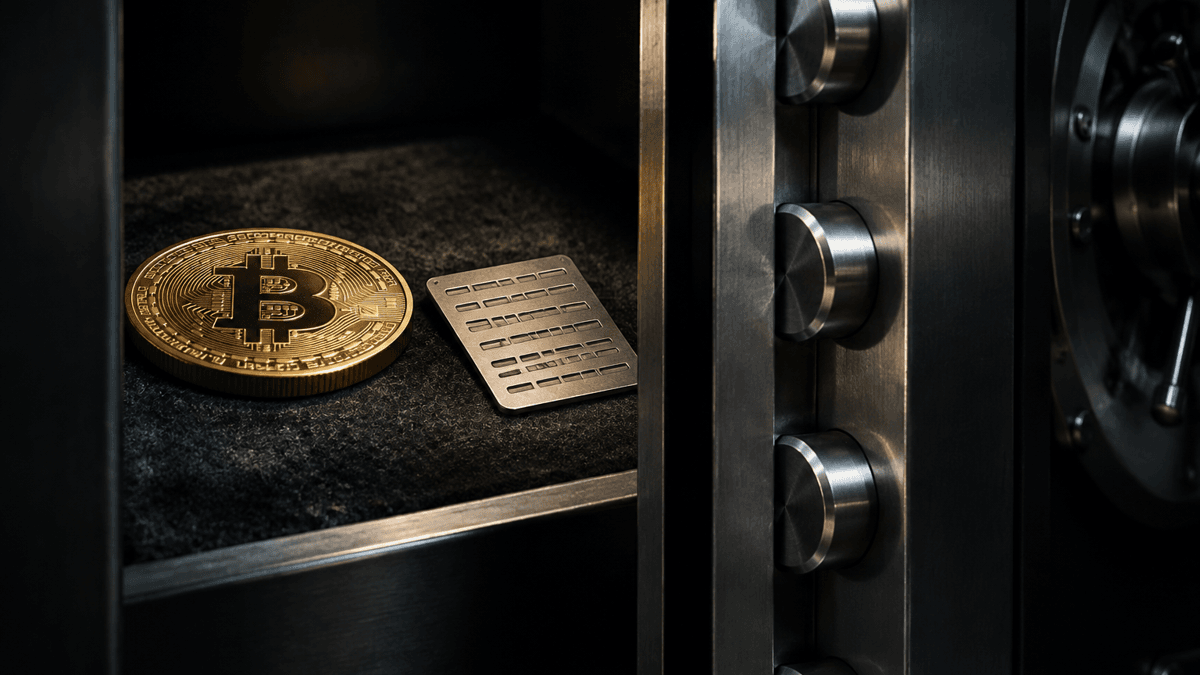
A retirement horizon of thirty years places demands on custody that nobody has to consider with a fund account, because the bank carries them there. With self-custody, meaning keeping the keys in your own hands without a service provider involved, you carry three tasks alone: the device has to remain functional or replaceable over decades, the recovery words have to sit somewhere that survives fire, water and house moves, and there has to be a person who even knows this position exists in the event of your death.
That last point is where it fails in practice. An estate finds a bank relationship through the account enquiry procedure. Coins in a hardware wallet in a cupboard are found by nobody, and without the recovery words they are irretrievably lost, even for lawful heirs holding a complete certificate of inheritance. How to arrange access so that heirs find the position without the words lying around openly during your lifetime is something we have described in a separate guide on passing crypto assets on.
Securing recovery words over decades
On storage itself: recovery words on paper survive thirty years only in good conditions. Anyone planning on that horizon should consider a steel or titanium plate, and two copies kept in separate places. A screenshot, a notes app or cloud storage explicitly do not belong there, because every service with online access eventually suffers a data breach over thirty years.
 Document your crypto tax cleanly
Costs that make the difference over thirty years: spread, savings plan fee, custody
Over a retirement horizon, costs work differently than on a trade. A fee of one percent on every savings contribution sounds harmless and costs a substantial share of the final portfolio over thirty years, because every euro deducted takes its own later growth with it. So the crypto share of your provision deserves the same sober look at the cost structure that has long been standard with a fund account.
Three items belong in the calculation. First the spread, meaning the difference between the buying and selling price that a platform retains, and which is the actual source of cost at providers with no stated order fee. Second the execution fee of the savings plan, often calculated as a percentage of the contribution. Third, with an ETP, the annual management fee, which is taken from the product's assets on an ongoing basis and which you never see as a debit.
A fourth item is regularly overlooked and is precisely relevant in retirement provision: the withdrawal costs. Anyone saving for thirty years sells at the end, and fees arise for the disposal and for the transfer to their own account. Check a provider's terms for selling before you start saving there. A platform with a cheap entry and an expensive exit is the worse choice for a retirement purpose.
Proof over decades: the transaction history
And finally the documentation. With a direct purchase you have to be able to evidence the acquisition date and acquisition cost of every single tranche over decades, because that is exactly what the tax office asks about on a sale. With a thirty-year savings plan that means several hundred individual purchases. Anyone intending to assemble that evidence only in the year of sale will not recover the trading history of a platform that has ceased to exist in the meantime. Export the transaction history at least once a year and file it with your tax records.
Bitcoin in retirement provision: what to take away
- Separate the pots and do not count on subsidies. Your subsidised provision runs through certified products in which crypto assets are not legally permitted, including the retirement savings account from 2027. The crypto share is an additional, unrestricted layer with no allowances, no special expense deduction and no provider liability. How that layer is taxed, and which tools document it over the years, is in our overview of crypto tax tools and portfolio trackers.
- Settle custody before the amount gets large. Over thirty years, access is the greater risk than the price. Decide on one route, write the recovery words onto a durable medium, make two copies kept in separate places, and make sure a person you trust knows the position exists. Which devices suit that purpose is shown in the hardware wallet comparison.
- Check the costs at the exit, not only at the entry. Compare the spread, the savings plan fee and the withdrawal terms of the same provider in a single calculation, and look at whether it is regulated in the EU. For retirement purposes, a provider's resilience over decades counts for more than a promotion for new customers. A side-by-side view is in the crypto exchange comparison.
(As of September 24, 2026. This article is not investment advice. Prices and fee structures change; check the terms with the provider before you buy.)
Transparency note: This article was produced with the assistance of artificial intelligence and reviewed by our editorial team before publication. All figures and claims were checked against the primary sources linked in the text. The feature image was generated with AI.
More on Bitcoin: All Bitcoin news at a glance
Related articles
- Crypto Loss Carryforward in Germany: What Happens to Old Losses Under the 2027 Tax Plan
- 50 euros a month in Bitcoin, 118 instalments since 2017: savings plan vs lump sum
- Germany’s Crypto Holding Period Is Wobbling: What to Check Before December 31
- Crypto Holding Period and Grandfathering: Why December 31, 2026 Becomes the Cut-Off in Germany's Draft Bill
- Germany's Crypto Tax: 160 Million Euros for a 555-Billion Budget
Which topics should we dive deeper into?
Select what genuinely interests you. Your picks feed directly into our editorial planning.
Crypto news that's actually worth your time.
Weekly. 60 seconds. Carefully curated by our editors: no hype, no promo flood, no spam.

September 8, 2026 1:19 AM

Germany's Crypto Holding Period: What Happens Now Signing for Petition 201716 Closed on September 15
Recap as of September 27, 2026: the signature period for German parliamentary petition 201716, which asks for the one-year crypto holding period to be preserved, closed on September 15, 2026. This article explains what ended that day, how the petitions committee proceeds and why no investor has to sell because of it.
September 17, 2026 7:12 PM

Gifting Bitcoin to Children: Allowance, Holding Period and the Tax Office Report
Transferring Bitcoin to your child hands over your holding period and your entry price along with the coins. This guide sets out what really applies in Germany on the allowance, the reporting deadline, representation and custody.
September 9, 2026 4:22 PM
Crypto Tax in Germany: What Applies in 2026 and What Is Set to Change in 2027
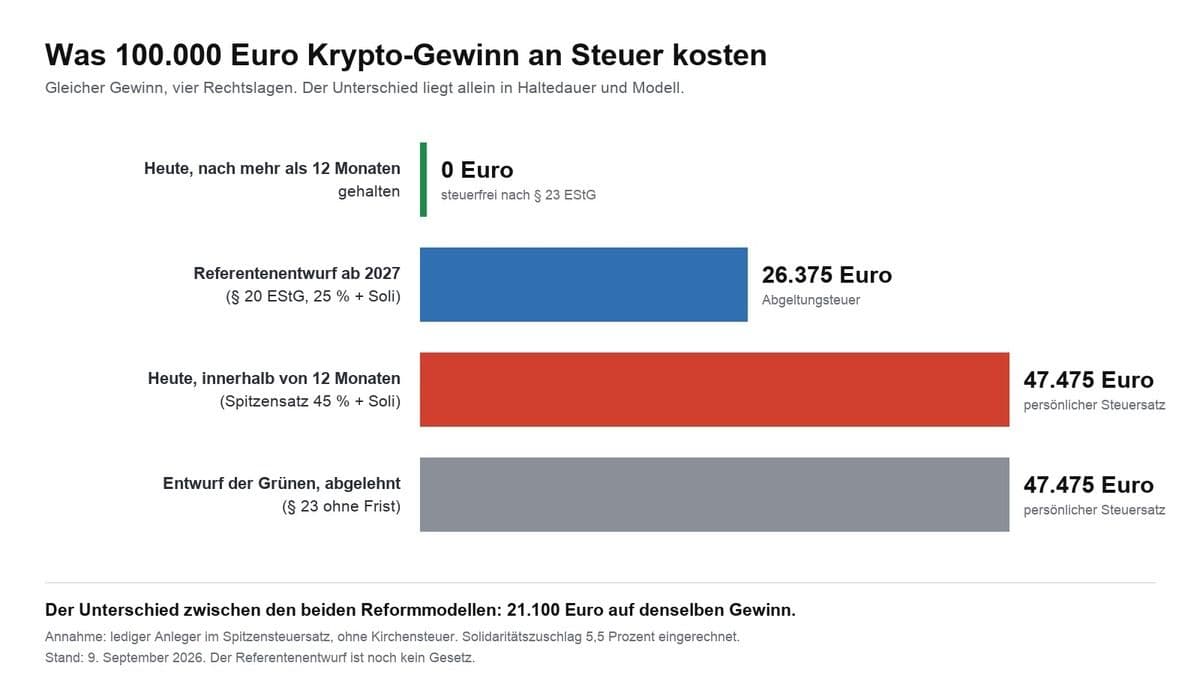
Crypto gains are tax-free after twelve months; before that your personal tax rate of up to 45 percent applies. What triggers tax, how the holding period is calculated, what happens with staking and losses, and what the draft bill would change from 2027.
October 3, 2026 4:40 PM

Investing in Bitcoin With a Savings Plan or a Lump Sum: What the December 31 Tax Cut-Off Changes
Anyone putting money into Bitcoin now chooses between a lump sum, a monthly instalment and an ETN in a securities account. The German finance ministry’s draft bill would keep the one-year holding period only for holdings bought by December 31, 2026.

September 18, 2026 10:14 PM

Bitcoin Back Above $80,000: Buy More, Hold or Take Profits? What to Check Now
Bitcoin is back above $80,000, for the first time since September 7. Whether you buy more, hold or take profits depends less on the daily price than on three things you can check yourself: your holding period, the way you buy, and where your coins are kept.
September 10, 2026 4:15 PM

BW-Bank Opens Bitcoin Trading Inside the Securities Account: What to Check Before Your First Buy
Since September 9, 2026, BW-Bank customers have been able to trade ten crypto assets through their securities account, executed and held in custody by Bitpanda. The familiar securities-account setting hides three points you should settle before your first order.
October 15, 2026 4:13 AM

Crypto holding period: the cabinet date passes without a decision, December 31 stays the cut-off
Germany's federal cabinet did not adopt the expected decision of October 14, 2026 to abolish the one-year crypto holding period; the draft is still in interdepartmental consultation. Until new rules arrive, gains stay tax free after one year of holding, and the December 31, 2026 cut-off named in the draft separates old holdings from new ones.
October 9, 2026 1:18 PM

Bitcoin Tax: One Year Past the $126,080 Peak, Losses No Longer Count
Bitcoin trades at $82,558 on Friday morning, 34.5 percent below an all-time high that is now a good year old. Anyone who bought back then loses more than the prospect of a quick recovery when the one-year period expires: the tax value of the loss goes with it.
August 24, 2026 10:26 AM
Bitcoin Savings Plan in Austria: How the Purchase Price Is Calculated
Bought bitcoin through a savings plan? For multiple purchases Austria applies the moving average price as a matter of principle when working out taxable gains.
October 8, 2026 4:17 AM

Crypto Holding Period: Without a Purchase Record the Tax Withheld Runs Ten Times Too High
The consultation on Germany's crypto tax bill closed on October 6 and the cabinet is to adopt it on October 14, with tax advisers, banks and the Bitcoin Bundesverband having filed their objections. The sharpest concerns everyone whose purchase data the selling platform does not hold: one adviser calculates a withholding ten times the tax owed.
October 6, 2026 4:32 AM
Bitcoin for a gift card: what paying with crypto means for your holding period
Paying for a gift card with Bitcoin is a sale for tax purposes. What counts as the disposal proceeds, when the twelve-month holding period bites, and the four records the tax office expects.
September 9, 2026 4:13 PM

Bitcoin 29 Percent Below Last Year: Which Crypto Losses You Can Still Use Before the One-Year Holding Period Expires
Nine out of ten major crypto assets trade lower today than exactly twelve months ago, Bitcoin alone by 29.2 percent. We measured the price series ourselves and show why the purchase date alone decides the tax value of your loss.
September 16, 2026 7:12 PM

Borrowing Against Bitcoin Instead of Selling: When German Tax Still Applies
Posting Bitcoin as collateral for a loan is not a sale in Germany, because section 39 of the Fiscal Code keeps the coins attributed to you for tax purposes. Tax arises only when the collateral is liquidated, and then the one thing that decides the bill is how long you held the coins beforehand.
September 7, 2026 7:22 AM

German Crypto Holding Period Set to Go After All: A Separate Draft Targets Purchases From 2027
Correction of 8 October 2026: The Income Tax Reform Act 2027, adopted by the German federal cabinet on 2 September, does not cover crypto assets. That did not mean the holding period stays. A separate draft bill from the Federal Ministry of Finance, dated 30 September, would abolish it for anything acquired after 31 December 2026. The cabinet is due to decide on 14 October.

August 20, 2024 3:00 PM

New US Senate Proposal Submitted For Crypto Tax Exemption
The US Senate has recently submitted a new proposal to exempt crypto transactions from federal taxes. Here are more details of this submission, and a list of exempted countries it could be joining...
September 25, 2026 10:26 PM

Selling bitcoin privately: the tax in Germany and the records you need
A direct sale to a private individual falls under the same one-year rule as an exchange sale, but there is no tax report to go with it. This guide walks through the calculation, the 1,000 euro threshold and the records the tax office wants to see.
September 17, 2026 10:22 PM

Selling Bitcoin at a Loss and Buying It Straight Back: What That Does to Your Holding Period
Germany has no wash sale rule: the loss stays deductible even if you buy back immediately. The buyback, however, restarts the one-year period for every new unit.
August 24, 2026 4:22 AM

Selling XRP After a 53 Percent Week: What the Holding Period Costs
XRP trades at $1.51 after a weekly gain of a good 50 percent, yet your net proceeds are decided by the purchase date. This article works through the holding period, the exemption limit and FIFO at measured reference-date prices.
October 10, 2026 7:15 PM

ING and Bitcoin: Around 50 Crypto ETNs in the Portfolio, and What the Delivery Claim Means for Your Holding Period
Bitcoin can be bought at ING, but only as an exchange-traded note: around 50 crypto ETNs from five issuers, as a one-off purchase or a savings plan from one euro. What the offer really costs, and what the one-year holding period hangs on, is not in the advertising but in the key information document.
August 14, 2026 6:23 AM

Bitcoin Savings Plan and Tax: How the Holding Period, FIFO and the Exemption Limit Interact on Monthly Buys
Every savings plan instalment is a separate acquisition for tax purposes, with a holding period of its own. How the exemption limit, the order of disposal and record-keeping duties interact on monthly Bitcoin buys, with the sources from the statute and the Ministry of Finance circular.
September 22, 2026 1:28 PM

Selling Bitcoin and Cashing Out in Euros: How It Works in Germany
Between the sell order and the euros in your current account stand the exchange, your bank and the tax office. Knowing the order of events saves fees, waiting time and, in the best case, the entire tax on the gain.
August 24, 2026 10:29 AM

Buying More Bitcoin at $77,000: Savings Plan or Lump Sum
Bitcoin stands at $77,256 after gaining 22.78 percent in a week. This guide shows you how to buy more cleanly at this price and which method fits which starting position.
August 26, 2026 10:25 PM

Selling Bitcoin at a Loss: Loss Offsetting in Austria
Sold Bitcoin at a loss? Austria allows the loss to be offset against certain investment income. When loss offsetting is possible and which limits apply.
September 19, 2026 7:12 PM

Bitcoin Sold Without Austrian Tax Withheld: What to Do Next
Sold Bitcoin but no Austrian capital gains tax was withheld? That does not make the sale tax free. When investors have to declare the gain themselves at 27.5 percent.
August 21, 2026 1:33 PM

Bitcoin With No Cost Basis: How Austria Taxes the Sale
Bitcoin purchase price no longer provable? How Austria works out the capital gains tax, when a flat-rate cost basis applies and what investors can do.
September 27, 2026 10:14 AM

Shiba Inu Price Prediction: What to Check on SHIB Before the December 31 Deadline
SHIB trades at $0.00000592 on September 27, 2026, around 93 percent below its all-time high. For German investors one date matters more than the chart right now: December 31, 2026.

More from CryptoTicker