
Inheriting Crypto: How Your Heirs Actually Get Access, and Why the Seed Does Not Belong in a Will
The German Federal Court of Justice made clear in 2018 that digital accounts are inherited like everything else. With self-custodied coins succession law still achieves nothing: no key, no access. And anyone who writes the seed into a will has a court send it to every party involved.




Which topics should we dive deeper into?
Select what genuinely interests you. Your picks feed directly into our editorial planning.
Crypto news that's actually worth your time.
Weekly. 60 seconds. Carefully curated by our editors: no hype, no promo flood, no spam.
The information provided in this article is for informational purposes only and does not constitute financial advice. Investing in cryptocurrencies carries a high level of risk.
Passing on crypto rarely fails because of the law. It fails because the heirs hold a claim to the assets without knowing they exist, or know about them and cannot reach them. The legal position in Germany has been settled for years. The practical one has not.
The decisive dividing line does not run between Bitcoin and shares but between an exchange account and a self-custodied wallet. With an exchange account there is a contracting party you can write to with proof of inheritance. With self-custodied coins there is nobody, only a private key that either can be found or cannot.
Inheriting crypto: the key points
- On 12 July 2018 the German Federal Court of Justice (case III ZR 183/17) ruled that a contract for a user account with a social network passes to the heirs under section 1922 of the Civil Code. Digital content is treated no differently from analogue content.
- With exchange accounts the route runs through a death certificate, proof of inheritance and a fresh identity check on the heirs.
- With self-custodied coins no court can help. Without access to the private key the balance is out of reach, lawful heirs included.
- The seed does not belong in a will. Under section 357 of the FamFG anyone who credibly asserts a legal interest may inspect a disposition once it has been opened.
- A Shamir backup under SLIP-39 splits the backup into shares. Below the defined threshold a single share reveals nothing.
- For inheritance tax the value on the date of death is what counts. We have written up those rules separately.
Inheriting crypto: what heirs receive in law
Under section 1922 of the German Civil Code the estate passes to the heirs as a whole. In 2018 the Federal Court of Justice held, in a case about a blocked Facebook account, that contractual relationships with online services are covered as well: the heirs step into the contract and are entitled to access the account together with the communications stored there. There is no reason, the court found, to treat digital messages differently from letters and diaries.
Applied to crypto that means a balance held at an exchange is a claim against that company, and the claim is inheritable in the same way as a bank balance. Coins in a self-custodied wallet likewise form part of the estate.
The catch sits inside the word "claim". A claim is directed at someone. With your own wallet that someone does not exist.
Inheriting crypto that sits at an exchange
Here the classic route works, and it takes time. Providers typically require the following:
| Step | What is required | Why |
|---|---|---|
| Reporting the death | Official death certificate | The account is frozen, trading and withdrawals stop |
| Proof of inheritance | Certificate of inheritance under section 2353 of the Civil Code, or a European Certificate of Succession | The provider has to know who it is paying out to |
| Identity check on the heirs | Identity document, video or photo ident | Anti-money-laundering rules apply in an estate case too |
| Distribution | Transfer to a new account held by the heirs, or a payout | Varies by provider and country |
Coinbase, for instance, runs a dedicated process for accounts of deceased users and asks for estate documents, the official death certificate, valid photo identification for the authorised person and a signed instruction on where the assets should go. By its own account the provider does not support beneficiary designations for personal accounts, so the route runs through the estate. The documents named there follow US succession law; in Germany the certificate of inheritance takes their place.
What you can do during your lifetime is mundane and still rarely done: a list of where anything is held at all. No passwords and no login details, only the names of the providers and the email address the accounts run under. Without that list heirs often never learn an account existed.
Inheriting crypto from your own wallet: the real bottleneck
With self-custody there is no support desk to write to. There are only the recovery words. Once they are gone the balance is gone, and the heirs can prove ownership in full while never reaching it.
At the same time access must not be too easy during your lifetime. A slip of paper with twelve words in a desk drawer is access for anyone who walks into the flat. The task therefore reads: findable for exactly one person at exactly one moment, useless to everyone else.
Three designs that manage it:
Split backup under SLIP-39
A Shamir backup breaks the wallet secret into several shares with a threshold, three of five for example. Each share consists of its own words and carries metadata on the threshold, the group structure and a checksum. Anyone holding fewer than the threshold learns nothing about the secret, as the specification states in as many words. Trezor supports the procedure directly on the device in the Model T and the Safe series.
In practice: one share with you, one with a person you trust, one with a notary or in a safe deposit box. The succession works while a break-in at any one of the three locations does not.
Multisig
A wallet that demands two of three keys to spend. You hold two, a third party holds one. During your lifetime your two are enough; after death the key held by the trusted person plus one from the estate will do. More work to set up, and free of the delicate moment in which a complete secret is lying around somewhere.
Sealed envelope with instructions
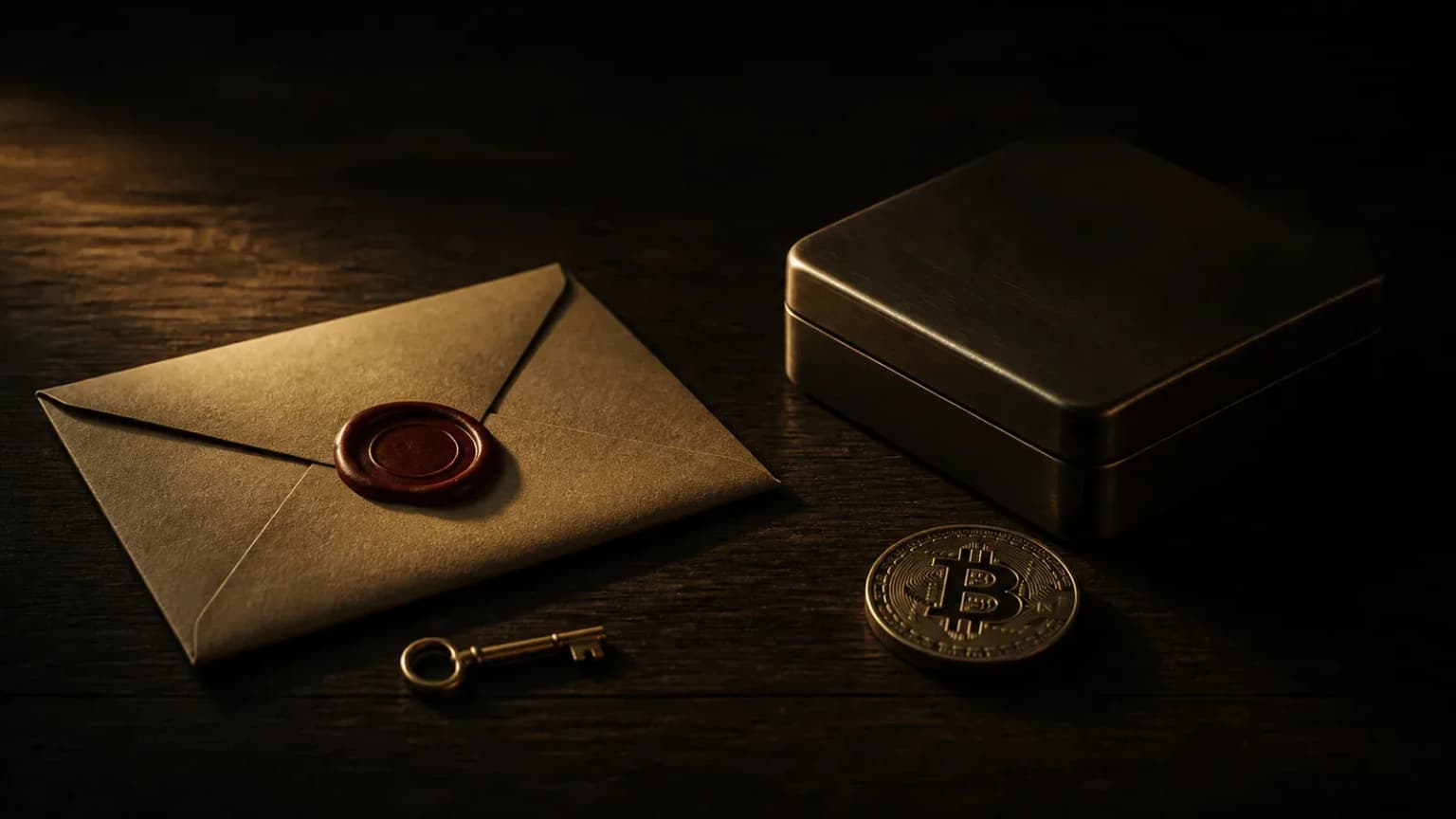
The simplest route, and often sufficient for small amounts: instructions on where the words are and how to use them, deposited under seal with a notary or in a safe deposit box. The important part is the addition almost everyone forgets, namely how to restore a wallet. Heirs who have never carried out a recovery otherwise founder on twelve words they are holding in their hands.
Which form of storage suits which amount is worked through in our guide to storing a seed phrase safely, where a steel plate, a passphrase and multisig each solve a different problem.
Why the seed never belongs in a will
This is the mistake that turns out most expensive, because it is well meant.
A will is not a private document. Under section 348 of the FamFG the probate court opens a testamentary disposition held or delivered to it as soon as it learns of the death. It may set a date and summon the statutory heirs and other parties concerned; those present are told the content orally. Anyone who was absent is notified in writing of the part that concerns them.
A party concerned is not everyone who appears somewhere in the will, but anyone the disposition grants a right to or takes one away from, and even they receive only the part that concerns them. That still does not save your secret. Under section 357 of the FamFG anyone who credibly asserts a legal interest may inspect the opened disposition: passed-over statutory heirs, those entitled to a compulsory share, creditors of the estate.
Then there is the path the document itself travels. It is opened, recorded, copied and added to the probate file. Twelve recovery words in a will are therefore twelve words in an official file, over a period of weeks in which nobody is moving the coins.
The right approach is separation. A will should say who inherits and where something can be found. The secret itself belongs somewhere else. A sentence such as "the access documents for my crypto assets are deposited with notary X" serves its purpose in full without giving the key away.
Inheriting crypto and tax
For inheritance tax the value of the coins on the date of death counts rather than the value at a later sale. With volatile assets that is a real difference, and it is why heirs should document the holdings as early as they can instead of waiting.
Which allowances apply, how lifetime gifts work and what applies when the heirs later sell is set out at length in our article on the tax rules for crypto gifts and inheritance. For taking stock itself a portfolio tracker that reports historical prices on the relevant date helps, and we have compared the usual tools in our crypto tax software comparison. This article replaces neither legal nor tax advice; with larger holdings both belong in the picture.
Frequently asked questions
Can heirs have a wallet opened if the seed is missing? No. There is no body that could reset a private key, and that is how the system works rather than a gap in service. Providers who promise it against advance payment are running a scam.
Is it enough if my partner knows the passcode to my phone? For an app wallet often yes, as long as the device still works and has not been replaced. As the only provision it falls short: if the phone is lost or breaks, the recovery words are needed all the same.
What about a passphrase on top of the seed? It has to be passed on as well, otherwise the twelve or 24 words lead into an empty wallet. That is the most common silent total loss, with the heirs holding a correct backup in their hands and seeing nothing.
Do I even need to mention crypto in my will? In law it falls into the estate anyway. In practice mentioning it still matters, because otherwise heirs do not know they have to look. A pointer to its existence and its storage location is enough.
How do exchanges handle an estate when the provider sits abroad? The process is similar while the required evidence differs. With EU providers the European Certificate of Succession helps, although Denmark and Ireland do not take part in the underlying EU succession regulation, and Ireland of all places is home to several large crypto providers. Outside the EU a certified translation of the certificate of inheritance may become necessary.
Sources
- German Federal Court of Justice, judgment of 12 July 2018, case III ZR 183/17 – references and citations at dejure.org
- Section 1922 BGB, universal succession
- Section 348 FamFG, opening of testamentary dispositions
- Section 357 FamFG, inspection of opened testamentary dispositions
- Sections 9 and 11 ErbStG, when the tax arises and the valuation date
- European e-Justice Portal: succession law and the European Certificate of Succession (non-participation of Denmark and Ireland)
- Coinbase Help, article "Claim a decedent's Coinbase account" (help.coinbase.com). The procedure described there follows US succession law
- SatoshiLabs: SLIP-0039, Shamir's Secret-Sharing for Mnemonic Codes (specification)
(As of August 15, 2026. This article is not investment advice. Prices and fee structures change; check the terms with the provider before you buy.)
 Crypto tax tools compared: document what you hold
Transparency note: This article was produced with the assistance of artificial intelligence and reviewed by our editorial team before publication. All figures and claims were checked against the primary sources linked in the text.
Related articles
- 90 Crypto Kidnappings and Robberies in 7 Months: Why France Is the Most Dangerous Country for Bitcoin Holders
- Phantom Wallet and Solscan: What a Solana Transfer Really Costs and Where It Fails
- D'CENT App Wallet: How to Tell If Your Recovery Phrase Has to Move Now
- Breaking: Trust Wallet Chrome Extension Hack Drains $7M, Full Reimbursements Promised
- North Korean Hackers Drain 7,000 Crypto Wallets: What to Check on Job Offers and Coding Tests
Which topics should we dive deeper into?
Select what genuinely interests you. Your picks feed directly into our editorial planning.
Crypto news that's actually worth your time.
Weekly. 60 seconds. Carefully curated by our editors: no hype, no promo flood, no spam.

August 18, 2026 7:14 PM
Two-Factor Authentication on a Crypto Exchange: Why SMS Is the Weakest Option
SMS codes are the most common form of two-factor authentication on crypto exchanges, and the weakest. The problem is not only SIM swapping, which the FBI has recorded falling for three years. It is real-time phishing, and against that neither SMS nor an authenticator app helps.
August 25, 2026 10:31 PM

Crypto Wallet Phishing by Letter: Why the QR Code From Your Postbox Wants Your Recovery Phrase
Letters carrying a QR code urge a supposedly urgent wallet update on grounds of quantum resistance and lead to a page that asks for the recovery phrase. The Federal Office for Cybersecurity reported the ploy on August 18, 2026.
August 20, 2026 4:24 PM

Bitcoin Across Multiple Wallets: How Austria Works Out the Acquisition Cost
Bitcoin spread across several wallets? How Austria works out the acquisition cost and the rolling average price for tax purposes.

September 10, 2026 9:13 AM
Trezor Hack Scare: That STM32 Entropy Email Is a Phishing Attack
Trezor users received a fake STM32 entropy warning sent from a real Trezor address. Here is what happened and what to do if you clicked.
August 22, 2026 4:13 AM

SafePal Data Breach: 39,798 Customers Exposed With Names, Addresses and Phone Numbers
SafePal confirmed a data breach on August 16, 2026: the names, delivery addresses, phone numbers and order details of 39,798 customers were exposed. Seed phrases and private keys were not affected, but the phishing risk is substantial.
August 18, 2026 10:14 PM

Sent Crypto to the Wrong Address: What Still Works and What Is Gone for Good
A sent transaction cannot be recalled. That is true, but it is only half the story. Whether your money is gone depends on who holds the key to the destination address. Six cases, cleanly separated: four of them are recoverable.
September 14, 2026 1:27 PM
Bitcoin Lost to a Scam: What Counts as a Tax Loss in Austria
Lost bitcoin to a scam? Why Austria generally does not recognise the damage as a tax loss for privately held assets, and when compensation payments start to matter.
May 15, 2024 12:04 PM

Crypto Scams: How to Protect Your Cryptos?
With the rise of crypto scams, and while international efforts are still working to combat these threats and protect investors, some recent tactics have been identified, and here is your full guide.
September 11, 2026 10:18 AM

Bitcoin Tax Audit: What Proof Austria Requires
Which bitcoin records can the Austrian tax office examine? Purchase dates, wallet transfers, acquisition costs and sale proceeds are what count.
September 3, 2026 10:21 AM
Bitcoin Lost in a Wallet Hack: What Tax Applies in Austria?
Bitcoin lost to hackers? In Austria, the theft of privately held coins generally does not create a capital loss you can use for tax. Only a later payout can change that.
March 31, 2026 5:13 PM

Quantum Threat to Bitcoin? Google Research Sparks Urgent Crypto Security Debate
Google’s quantum breakthrough raises fears for Bitcoin security. Can crypto survive quantum attacks—or is an upgrade urgent?
September 16, 2026 7:12 PM

Borrowing Against Bitcoin Instead of Selling: When German Tax Still Applies
Posting Bitcoin as collateral for a loan is not a sale in Germany, because section 39 of the Fiscal Code keeps the coins attributed to you for tax purposes. Tax arises only when the collateral is liquidated, and then the one thing that decides the bill is how long you held the coins beforehand.
September 23, 2026 10:32 AM

Switching crypto exchange: what happens to the holding period and the tax when you transfer
A transfer to another exchange or to your own wallet triggers no tax and does not reset the one-year period. What does get lost is the acquisition data, and that is exactly what you need later as evidence.
September 23, 2026 4:12 AM
How to Set Up a Crypto Wallet: Securing Your Coins in Seven Steps
Your own crypto wallet is set up in twenty minutes, yet a single step decides everything that follows. This guide takes you through wallet type, recovery words and the test amount, and sets out what BaFin and the tax office expect.
August 24, 2026 1:22 PM
Phantom Wallet Ends Sui and Monad Support: What to Do Before the Deadlines
Phantom Wallet removes Monad from its app on August 26 and Sui on September 24. The balances are not lost, but only one of the two ways out leaves your tax position untouched.
April 25, 2024 11:44 AM

Beware of New Ethereum Node Scam: USDT Fraud Exposed
Crypto Scammers exploit Ethereum nodes and USDT to deceive crypto users. How are they pulling it off and what essential tips can help you protect yourself against these crypto scams?
August 31, 2026 7:20 AM
Browser Extensions as Wallet Thieves: How a Sports App Became a Seed Phrase Collector
In August 2026 the security firm Socket disclosed two separate campaigns: 40 confirmed malicious Firefox extensions and 19 for Chrome and Edge, all of them from the official marketplaces. Nine of them were harmless sports apps that only turned into wallet thieves through an update.
August 11, 2026 1:32 PM
How to Store a Seed Phrase Safely: What Steel, a Passphrase and Multisig Do for Your Wallet Backup
The Coldcard case pushed the manufacturer question to the front, while barely touching on where the backup is kept. This guide places paper, steel, the passphrase and splitting methods against the BIP-39 and SLIP-0039 standards.
September 20, 2026 4:15 PM

Crypto Phishing After a Data Breach: The Warning Signs in a Fake Exchange Email
After every major data breach, the number of phishing emails sent in the name of crypto exchanges and wallet manufacturers rises. This article shows you how to recognise such a message, which data a reputable provider never requests by email, and what to do in the first hour after a click.
September 1, 2026 7:27 AM

Clipboard Attack: How Malware Swaps the Wallet Address You Copied
A clipper replaces the receiving address between copying and pasting with the attacker’s, and your wallet’s checksum notices nothing. What Microsoft and the Federal Office for Cybersecurity have documented, and which check really makes the attack come to nothing.
August 13, 2026 4:59 PM

Trezor Data Breach: First 13,689 Customers, Then Roughly 67,000 More Exposed
A breach at Trezor shipping partner ShipMonk exposed names, phone numbers and home addresses of 13,689 customers in August; in September Trezor reported roughly 67,000 more in the US. Devices are safe, phishing risk is not.

April 27, 2026 10:30 AM
Win $5,000 in BTC: Tangem Launches Exclusive 2026 Prize Draw
Tangem announces a massive prize draw with $5,000 in BTC and iPhone 17s up for grabs. Secure your crypto and enter today using our exclusive link.

December 22, 2020 3:49 PM

Crypto Wallet Provider Ledger Hacked: Data Leak Results in Phishing Scams
Ledger, a cryptocurrency wallet provider has encountered a data breach. The official Twitter account of the hardware wallet tweeted that they have been alerted to the dump of a client database.
April 25, 2026 9:55 AM

France Crypto Kidnappings Crisis: Pavel Durov Blasts Data Leaks and New Surveillance Laws
Pavel Durov exposes a surge in crypto-related kidnappings in France, blaming tax data leaks and warning against new social media surveillance laws.
August 22, 2026 4:16 PM
Stolen Crypto: Where You Actually File a Report and What Counts in the First Hours
After a theft most people google first and preserve the evidence last, when the right order is the other way round. What you have to record in the first hours, where private individuals actually turn, and where the limit of what is possible lies.
October 5, 2026 10:32 AM

Joint bitcoin wallet: who owns the coins for tax purposes?
Bitcoin on a joint marital wallet: for tax purposes it is not access to the wallet alone that decides, but who the coins are economically attributable to.
October 2, 2026 10:36 AM
Hot Wallet or Cold Wallet: the Private Key Decides How Safe Your Coins Are
Hot wallet or cold wallet: the difference rests solely on whether the private key is online. What separates the two forms, where the limits of hardware lie and why moving to your own device triggers no tax.
More from CryptoTicker