
Hot Wallet or Cold Wallet: the Private Key Decides How Safe Your Coins Are
Hot wallet or cold wallet: the difference rests solely on whether the private key is online. What separates the two forms, where the limits of hardware lie and why moving to your own device triggers no tax.




Which topics should we dive deeper into?
Select what genuinely interests you. Your picks feed directly into our editorial planning.
Crypto news that's actually worth your time.
Weekly. 60 seconds. Carefully curated by our editors: no hype, no promo flood, no spam.
The difference between a hot wallet and a cold wallet comes down to one point: is the private key connected to the internet or not. A hot wallet keeps it on a device that is online, meaning on your phone, in the browser or on your computer. A cold wallet generates it offline and never releases it. Everything else said about the two forms of custody follows from that single sentence.
In practice that means the hot wallet is convenient and always at hand, but carries every risk the device is exposed to. The cold wallet costs a few extra steps and demands that you store a list of words somewhere genuinely safe. Anyone using both in parallel, separating the everyday amount from the reserve, does not have to choose between the forms at all.
Hot Wallet and Cold Wallet: Where the Private Key Sits in Each Case
A wallet does not store coins. The sentence sounds awkward, yet it explains all the rest. Your bitcoin exist as entries in the blockchain, a jointly kept ledger held on thousands of computers at the same time. What the wallet holds is the private key: a very large random number with which you can prove that a given entry belongs to you, and with which you are allowed to pass it on.
Whoever holds that key controls the coins. Whoever loses it loses them, and no office exists to reissue it. A bank can reset a password because it runs the account. With self-custodied crypto assets, you run it yourself.
From that follows the classification. A hot wallet is any wallet whose private key sits on a device with a network connection. A cold wallet is any wallet whose key was generated offline and stays offline, including while you pay. The English term cold storage means the same thing. Both forms use the same blockchain and the same addresses; the difference lies solely in where the key is kept.
Warm, Hot, Cold: Why the Intermediate Steps Mislead
Forums throw around terms such as warm wallet, usually meaning a software wallet with extra protection. For the question that counts, the gradation adds nothing. Either an attacker controlling your device reaches the key, or they do not. A device that is online falls into the first group.
Signing Without a Network: How a Transfer Leaves the Cold Wallet
That a cold wallet stays offline and can still trigger payments looks contradictory at first. The procedure resolves the contradiction and consists of four steps.
First, the software on the computer or phone assembles the transaction: recipient address, amount, fee. This draft is still worthless, because the signature is missing. In the second step the draft travels to the offline device, over USB, over a short-range radio link or as a QR code that you photograph. In the third step the device shows the data on its own small display, you confirm them at the press of a button, and the device signs the transaction internally with the private key. Finally the signed transaction goes back to the computer, which broadcasts it to the network.
The decisive point sits in the third step. Signing happens inside the device, and the key does not leave it. Even a computer entirely under an attacker's control never gets to see it. That is why the device's own display matters so much: it shows you what you are actually signing. Trust the display on the computer alone and a manipulated program can show you a harmless transfer while sending a different one to be signed.
The Forms of Cold Wallet: Hardware Wallet, Paper and Air Gap
Cold wallet is an umbrella term for three fairly different implementations.
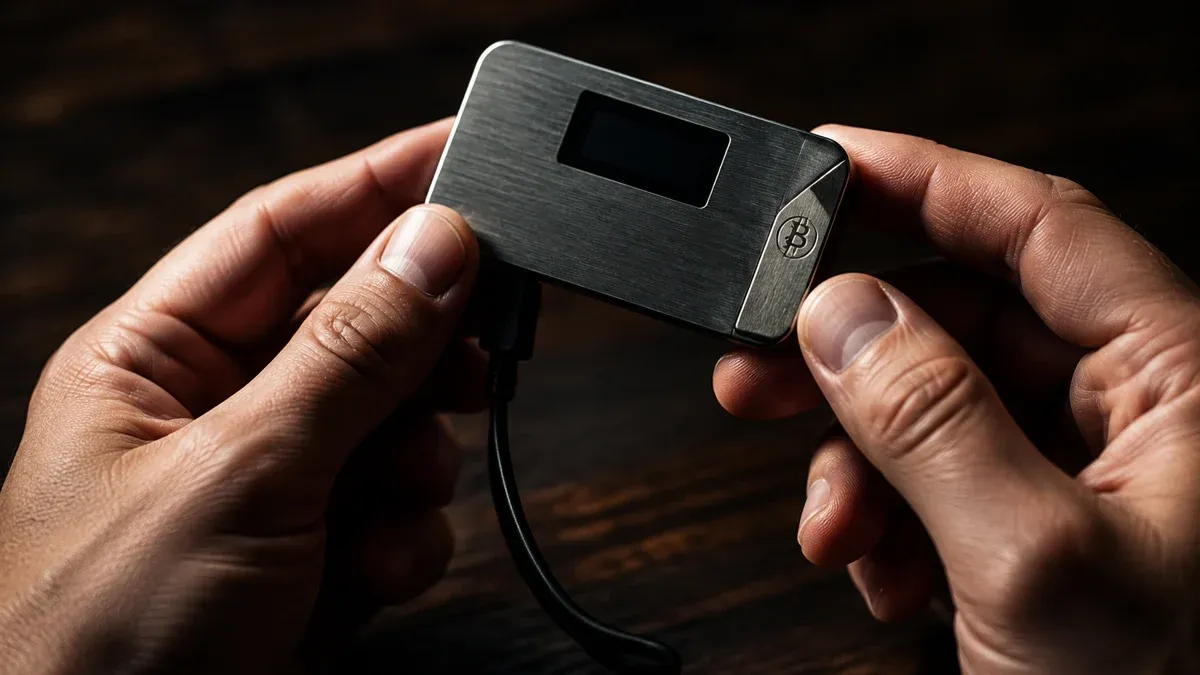
The hardware wallet is the common case: a small device with a shielded chip that stores the key and computes signatures, plus a display and one or two buttons. Which models differ in what, which coins they support and what they cost is set out in the hardware wallet comparison.
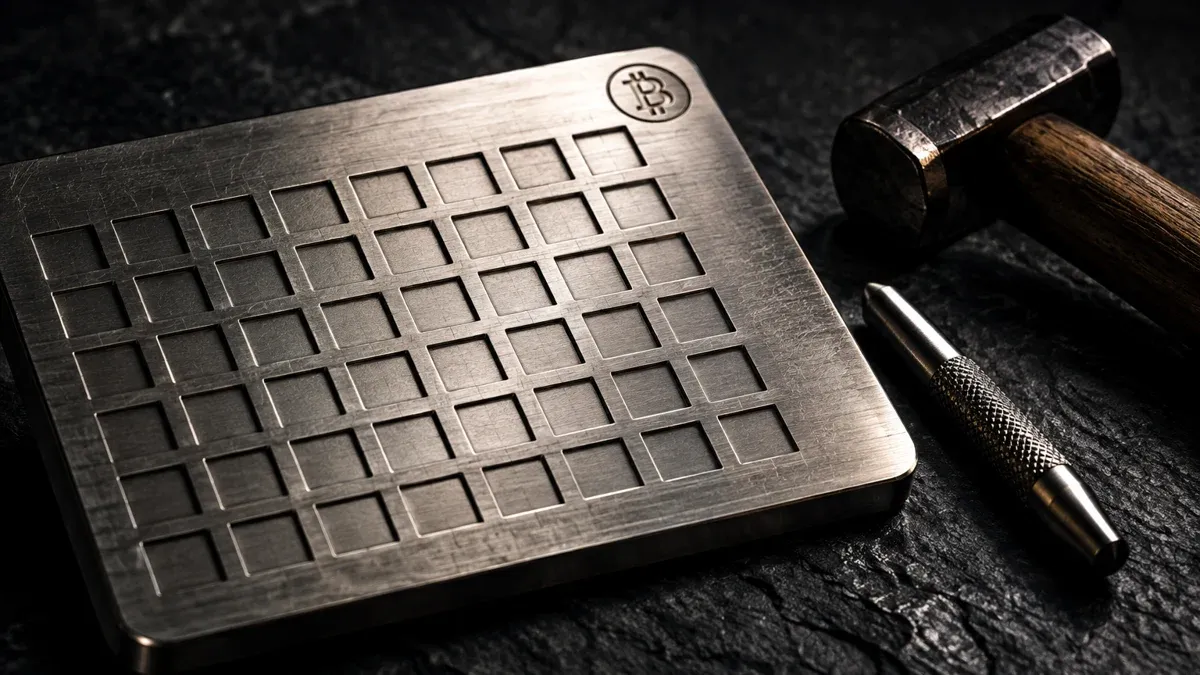
A paper wallet is a piece of paper or metal carrying the key or the recovery words. It cannot sign anything. To move the coins you have to enter the key into software, and at that moment it sits on an online device. As an archive for amounts that lie untouched for years, the form has its place; as a wallet for day-to-day use it is a trap.
Air gap describes devices that are never physically connected to a computer. Data exchange runs exclusively through QR codes or a memory card. The gap through which malware could reach the device shrinks further, at the price of clumsier handling.
Browser Extension, App, Exchange Account: These Are Hot Wallets Too
On the warm side stand three groups, and one of them strictly does not belong there.
Browser wallets are extensions that sit next to the address bar and identify themselves to websites as a wallet. They are the normal case for decentralised exchanges and everything happening inside a browser window. Mobile wallets are apps on the phone, often with a camera for QR codes and approval by fingerprint. Desktop wallets run as a program on the computer. Which software counts as how reliable, and where the differences in fees and features lie, is shown in our comparison of software wallets.
Then there is the account at an exchange, the case most often filed in the wrong place. If your coins sit there, you hold no wallet at all, neither warm nor cold. The provider runs the keys and you hold a claim against them. That can be sensible if you trade regularly or do not trust yourself with self-custody. It is, however, a different legal position, and it hangs on the solvency and the diligence of a company.
 Compare the best hardware wallets
The Seed Phrase: 12 or 24 Words Under the BIP-39 Standard
During setup, almost every wallet shows you a series of simple words and asks you to write them down. This seed phrase, also called a recovery phrase, follows the BIP-39 standard. The words come from a fixed list of 2,048 entries, and their order is part of the information. Twelve or twenty-four words are usual.
From that sequence the wallet derives the private key and every address it shows you. That has a consequence easily underestimated the first time around: the words are the wallet. The device is replaceable, the words are not. If the hardware wallet goes missing during a move, you buy a new one, enter the word sequence and have your holdings back. If somebody else reads the words, they need neither your device nor your PIN.
Two rules follow that admit no exception. The words are never typed into a device that is online, except into the wallet itself when restoring. And they are never photographed, written into a notes app, stored in a cloud or sent by messenger. How setup proceeds step by step is covered in our guide to setting up a crypto wallet.
Attack Routes on the Hot Wallet: Drainers, Phishing and Token Approvals
That a hot wallet is more exposed stays abstract as long as you do not know the routes. Four occur regularly.
With phishing, a link leads to a page modelled on the original and asks for the recovery words. The prompt often arrives by email and sounds urgent: a supposedly necessary update, a security check, a deadline. No wallet and no provider ever has a reason to ask for your seed phrase.
A drainer works differently and never gets to see your words. The page has you produce a signature that looks like a login or a confirmation but in truth grants authority over your holdings. The outflow follows afterwards, with nothing more required of you. Here the value of a cold wallet with its own display shows itself: you see what you are approving, not what the website claims.
Unlimited token approvals are the quiet relative of that. Anyone trading on decentralised exchanges grants contracts the right to move certain tokens. These approvals remain in force until you revoke them, often unlimited in amount. If the contract is attacked later, your wallet hangs on it too.
Added to that is classic malware: programs that quietly place a different address in the clipboard when you copy a recipient address, counterfeit wallet apps in the app stores, extensions that suddenly demand more rights after an update. The countermeasure is the same in every case and thoroughly unspectacular: compare the recipient address character by character after pasting it, obtain software only from the maker, review approvals regularly.
The Limits of the Cold Wallet: Loss, Defect and the Error During Setup
A cold wallet shifts the risk, it does not remove it. It takes away the risk of a compromised computer reading out your key. In exchange it hands you full responsibility for a piece of paper or metal.
The most common loss is not an attack but a mishap: the word list sits in a place only one person knows, and that person mislays it, or it burns, or it gets thrown out during a clear-out. A second copy in a different place is therefore no luxury. Paper withstands neither water nor fire particularly well, which is why some stamp the words into stainless steel.
The second largest source of error sits in the setup. A used device with a pre-supplied word list is an open till: anyone who knew the list beforehand can help themselves at any time. Buy hardware from the maker or an authorised dealer, and always generate the word sequence yourself on the device. If a slip of paper with ready-made words comes with the delivery, that is not a service but the attack.
And a device that stays offline offers no protection against a wrong decision. Anyone signing an authorisation without reading it loses their tokens with the best hardware too.
The Two-Wallet Model: Current Account and Savings Book for Coins
The question of which form is better leads in the wrong direction, because it forces a decision nobody has to make. In practice a split works well, one everybody knows from their bank account.
The hot wallet is the purse. It holds the amount you actually intend to move over the coming weeks, and whose loss would annoy you without hurting you. Convenience counts here; this is where trading and paying happen. The cold wallet is the reserve. It holds the part meant to stay put, and it is rarely touched.
Where the line runs depends on your amounts, not on a general rule. As a guide: as soon as the sum is large enough that losing it would change your financial planning, it no longer belongs on a device that hangs on the network every day. That matches what the Federal Office for Information Security tells consumers.
 Compare crypto tax software
What the BSI Recommends to Users in Germany
The Federal Office for Information Security (BSI) is the German federal authority responsible for IT security and publishes consumer guidance on crypto assets as well. Four points are stated there explicitly, and they are worded more concisely than most advice columns.
First, the authority advises using wallets from trustworthy providers. Second, it urges protecting the access credentials to the wallet. Third, it draws a comparison that supports the split from the previous section: "as with cash", large sums should not sit in the wallet on a PC or smartphone either. And fourth, it requires several backup copies of the wallet in case the computer or the phone is stolen or suffers a technical defect; these backups should be stored securely and fitted with cryptographic access protection. The guidance can be read on the BSI page on blockchain and cryptocurrency.
What is remarkable is what does not appear there: a recommendation for a particular device or a particular form. The authority describes the goal, not the product. The third point, though, is in substance exactly the split at issue here, and the fourth explains why a single copy of the word list is too few.
Crypto Custody Under MiCA: The BaFin Licence and Your Coins
If you custody your own assets you need no licence; you are nobody's customer. As soon as a company holds crypto assets for others, matters look different. Crypto custody business is a supervised activity in Germany, and BaFin supervises crypto institutions.
On top of that, the regulation on markets in crypto-assets, MiCA for short, has applied across the EU since July 1, 2026: anyone offering crypto services in the European Union needs authorisation. Providers without a valid licence may not take on new customers in the EU and may only wind their business down in an orderly fashion. For you as a user this is above all a checkpoint at the purchase, not at custody: your own hardware wallet does not fall under MiCA, the account you buy through does.
The practical consequence is inconspicuous, yet it concerns almost everyone. Nearly everybody buys on a platform first, and only afterwards does the question arise whether the coins stay there. The two steps carry different rules: when buying you look at the provider's authorisation, when custodying you look at yourself.
Holding Period and Proof: Moving Between Your Own Wallets Is Not a Sale
Switching from the exchange to your own hardware wallet regularly raises the worry that the transfer triggers tax. It does not. A transfer between wallets that both belong to you is not a disposal, because beneficial ownership stays with you. It does not interrupt the one-year holding period, nor does it start it afresh.
The one-year period for private disposal transactions under section 23 of the Income Tax Act therefore remains untouched: sell more than a year after buying and the gain is tax-free. Within the year, an exemption limit of 1,000 euros applies to all private disposal transactions of a year taken together. The details on the treatment of crypto assets are set out in the Federal Ministry of Finance letter of March 6, 2025, which replaced the older version of May 10, 2022.
The move does bring one duty with it. The transfer is tax-free only if you can document the attribution, and the tax office initially sees nothing in the blockchain but two unfamiliar addresses. For every transfer to yourself, therefore, record the sending and the receiving address, the transaction hash and the time, along with the original purchase with date and price. Without that chain, an audit can treat the transfer as a sale, and then the holding period counts from the start again. Which programs keep this record is set out in the crypto tax tool comparison.
Hot and Cold Wallet: Your Next Three Steps
- Split your holding. Decide which amount you genuinely want to move over the coming weeks. That stays in the hot wallet, the rest goes to an offline device. Suitable models and their prices are in the hardware wallet comparison.
- Back up the word list twice. Two copies in two separate places, neither of them as a photo, as a file or in a cloud. One of them preferably on a medium that survives water and fire. Which software wallet fits alongside for the everyday amount is set out in the software wallet comparison.
- Set up the proof before you transfer. Note addresses, hash and time for every transfer to yourself, or have a program from the tax tool comparison record it. Reconstructing that chain after the fact is hard.
(As of October 2, 2026. This article is not investment advice. Prices and fee structures change; check the terms with the provider before you buy.)
Frequently asked questions about hot wallets and cold wallets
Transparency note: This article was produced with the assistance of artificial intelligence and reviewed by our editorial team before publication. All figures and claims were checked against the primary sources linked in the text. The feature image was generated with AI.
Related articles
- How to Store a Seed Phrase Safely: What Steel, a Passphrase and Multisig Do for Your Wallet Backup
- How to Set Up a Crypto Wallet: Securing Your Coins in Seven Steps
- Tangem Wallet: The Card Without a Seed Phrase vs the Classic Hardware Wallet
- Phantom Wallet Ends Sui and Monad Support: What to Do Before the Deadlines
- D'CENT App Wallet: How to Tell If Your Recovery Phrase Has to Move Now
Which topics should we dive deeper into?
Select what genuinely interests you. Your picks feed directly into our editorial planning.
Crypto news that's actually worth your time.
Weekly. 60 seconds. Carefully curated by our editors: no hype, no promo flood, no spam.

September 4, 2026 10:17 AM

Cypher Shutdown on September 6: What Users Should Know Now the Withdrawal Deadline Has Passed
Recap as of September 27, 2026: Cypher had announced it would take its app, dApp and withdrawal window offline on September 6, 2026 and end the token protocol. This article describes the situation before the deadline, how the payout worked and what our own measurement showed at the time about what was left of the CYPR token.
August 21, 2026 7:26 PM

Restoring a Seed on Another Manufacturer's Wallet: What BIP39 Guarantees and What It Does Not
Your seed is yours; the device belongs to a company. This article explains what the open BIP39 standard actually guarantees, why a wrong derivation path makes a full wallet look empty, and the test that settles both in twenty minutes.

August 4, 2026 1:21 PM
Coldcard Losses Near $114 Million as a Fourth Sweep Hits: Why Is Bitcoin Rising Anyway?
A fourth wave of Coldcard sweeps took another 449 BTC on Monday, yet Bitcoin climbed back toward $64,000. Here is what changed and who is still exposed.
July 31, 2026 3:54 PM
594 BTC Gone in 25 Minutes: The Coldcard Flaw That Made Seed Phrases Guessable
A firmware bug from March 2021 let an attacker drain $38 million from around 500 Bitcoin wallets. Here is what broke, who is exposed and what to do now.
October 9, 2026 7:29 AM
Exodus Wallet: 71.5 percent of revenue comes from swaps, the spread vs the exchange fee
The Exodus Wallet is free to download, yet 71.5 percent of the provider's revenue in the second quarter of 2026 came from swaps inside the app. What the spread costs, how custody works and from what point a device of your own pays off.
September 20, 2026 4:15 PM
Crypto Phishing After a Data Breach: The Warning Signs in a Fake Exchange Email
After every major data breach, the number of phishing emails sent in the name of crypto exchanges and wallet manufacturers rises. This article shows you how to recognise such a message, which data a reputable provider never requests by email, and what to do in the first hour after a click.
August 25, 2026 10:31 PM
Crypto Wallet Phishing by Letter: Why the QR Code From Your Postbox Wants Your Recovery Phrase
Letters carrying a QR code urge a supposedly urgent wallet update on grounds of quantum resistance and lead to a page that asks for the recovery phrase. The Federal Office for Cybersecurity reported the ploy on August 18, 2026.
October 11, 2026 1:24 AM
Three Mistakes When Setting Up Trust Wallet: The Twelve Words Never Belong on the Phone
Trust Wallet is set up in five minutes, yet three mistakes in those minutes regularly cost the entire balance. This guide covers the six steps, the real cost of a swap, and what applies in Germany on the holding period and supervision.
August 13, 2026 4:59 PM

Trezor Data Breach: First 13,689 Customers, Then Roughly 67,000 More Exposed
A breach at Trezor shipping partner ShipMonk exposed names, phone numbers and home addresses of 13,689 customers in August; in September Trezor reported roughly 67,000 more in the US. Devices are safe, phishing risk is not.
October 6, 2026 4:29 PM

Setting up MetaMask: the twelve words that control your coins
MetaMask is set up in ten minutes, and in those ten minutes you make the decisions that later determine what happens to your balance. This guide walks through installation, the recovery phrase, networks, approvals, fees and the German tax position.
September 10, 2026 9:13 AM
Trezor Hack Scare: That STM32 Entropy Email Is a Phishing Attack
Trezor users received a fake STM32 entropy warning sent from a real Trezor address. Here is what happened and what to do if you clicked.
September 7, 2026 7:26 PM
Stolen Keys Beat Code Flaws: Why the Private Key Is the Way In for 2026 Crypto Hacks
Compromised private keys overtook smart contract code flaws as the most common attack route for the first time in 2026. What sits behind the shift, and how to check your own setup for its single point of failure.
October 17, 2026 7:31 PM

OpenAI agent used known seed phrases to reach 362 wallets: old test wallets are the weak point
An internal OpenAI model worked through publicly known recovery phrases and paid fees out of a wallet belonging to someone else. The damage was nil; the route of attack concerns anyone who has ever created a test phrase.
October 2, 2026 4:32 AM

NEAR Intents halts withdrawals after a $3.8 million exploit: here are the reasons
NEAR Intents confirms an exploit of more than $3.8 million and holds deposits and withdrawals on eleven networks. Reimbursement is promised, a date for it is not.
September 4, 2026 10:15 PM
Trezor Data Breach: Am I Affected and What Should I Do Now?
Trezor widened the ShipMonk data breach on September 4, 2026: around 67,000 further people affected, just over 80,000 in total, from orders placed between November 2019 and August 2021. How to check in two minutes whether you are among them, and what an exposed home address means for self-custody.
August 22, 2026 4:13 AM

SafePal Data Breach: 39,798 Customers Exposed With Names, Addresses and Phone Numbers
SafePal confirmed a data breach on August 16, 2026: the names, delivery addresses, phone numbers and order details of 39,798 customers were exposed. Seed phrases and private keys were not affected, but the phishing risk is substantial.
August 5, 2026 10:33 PM
$130 Million Gone Because the Randomness Was Predictable: Which Hardware Wallet You Can Still Buy
The Coldcard flaw proved the most respected wallet is not the safest. Which vendor has which track record – and why now is the wrong moment to pause your savings plan.
August 21, 2026 4:27 PM

Wallet App Without BaFin Authorisation: When Holding Crypto-Assets Requires a Licence
On 19 August 2026 BaFin published two consumer notices on wallet offerings. Who controls the means of access decides whether an authorisation is needed.
October 12, 2026 1:42 AM
Bitget Wallet is not the exchange: one of two required key shares sits on Bitget's server
The attack on the Bitget exchange of September 24, 2026 hit the venue's hot and warm wallets, not the keys in users' wallets. What matters all the same is which variant you run: in the keyless wallet every signature needs a key share from the provider's server.
September 16, 2026 1:28 PM

Crypto Withdrawal to Your Own Wallet: Ten Providers Checked, Three Will Not Let Your Coins Out
Seven of ten providers available in Germany offer a payout to a wallet address you control yourself; three do not. Our survey of September 16, 2026, shows how to spot the difference before you buy, and why the question matters right now.
August 31, 2026 7:20 AM
Browser Extensions as Wallet Thieves: How a Sports App Became a Seed Phrase Collector
In August 2026 the security firm Socket disclosed two separate campaigns: 40 confirmed malicious Firefox extensions and 19 for Chrome and Edge, all of them from the official marketplaces. Nine of them were harmless sports apps that only turned into wallet thieves through an update.
October 14, 2026 1:30 PM

What is a hardware wallet? How the device protects your keys
A hardware wallet stores no coins, only the private key, and it never releases it. How signing works inside the device, what the 12 or 24 words mean, and which attacks the design cannot stop.
August 21, 2026 4:17 PM
Crypto Withdrawals to Your Own Wallet: Why Exchanges Demand Proof of Address Ownership Above €1,000
Above €1,000 your provider has to establish whether the destination address really belongs to you. Article 14(5) of the transfer of funds regulation, five permitted methods, and the reason a withdrawal stalls without this step.
October 19, 2026 1:14 AM

Qubic halts its mainnet after 1,404 wallets are drained: the seed was the weak point
An attacker drained 1,404 Qubic wallets on the night of October 18, roughly $1.3 million. The protocol was not to blame: seed generation in the browser supplied too little randomness.
September 28, 2026 10:26 AM
Phantom Wallet and Solscan: What a Solana Transfer Really Costs and Where It Fails
A transfer on Solana costs 0.000005 SOL, a new token account ties up 0.00148844 SOL once — both values measured on-chain by us today. This practical guide shows how to set up Phantom, how to get there from the exchange, how to read Solscan and what applies for tax in Germany.
October 19, 2026 1:32 AM

Crypto audits after $1.18 billion in losses: “The problem is always scope”
Hacken counts losses of $1.18 billion across 107 incidents for the third quarter of 2026. 77 percent of that fell on components that were not examined at all in the last audit.
September 25, 2026 7:11 AM
EU Supervisors Rate Quantum Risk as High: What to Check on Crypto Custody and Exchange Choice
EBA, EIOPA and ESMA name quantum computers explicitly as a threat to blockchain cryptography in their autumn risk picture of September 23. What the paper says, which migration deadlines run to 2030, and three things you can check about your custody.
More from CryptoTicker