
Bitcoin Fork: What Happens to Your Coins When the Chain Splits
On October 31, 2026 a new chain called ECX splits off from Bitcoin, and every holder is credited automatically. Who actually receives the coins depends on the private keys, on voluntary replay protection and on a tax rule many overlook.




Which topics should we dive deeper into?
Select what genuinely interests you. Your picks feed directly into our editorial planning.
Crypto news that's actually worth your time.
Weekly. 60 seconds. Carefully curated by our editors: no hype, no promo flood, no spam.
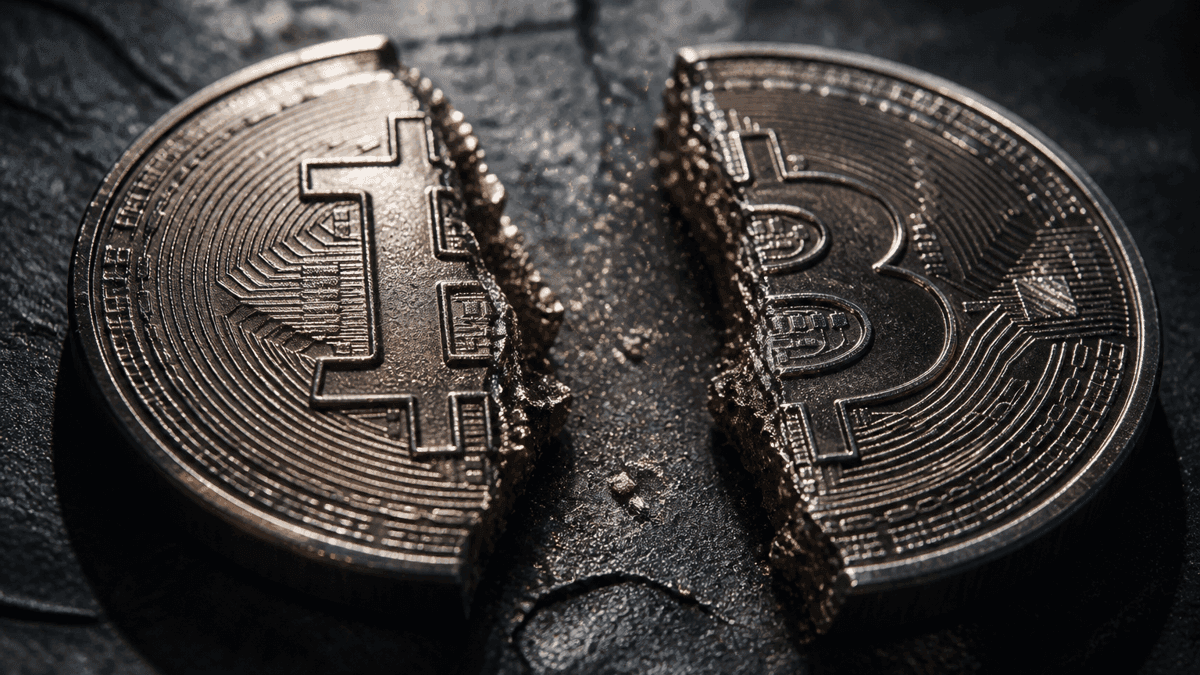
When a blockchain splits, your bitcoin does not disappear. After the split you hold it on both chains at once, because both chains share the same history up to the point of separation. One balance becomes two. Whether you actually receive the second balance, and whether you can move it safely, comes down to two questions: who holds the private keys, and is there any protection against transactions that are valid twice over. This article answers both, explains the terms involved and works through the German tax position.
The occasion is concrete. A permanent split from the Bitcoin blockchain is scheduled for October 31, 2026, carrying the name eCash and the ticker ECX. It concerns everyone who holds bitcoin, whether or not they have ever heard of the project. Before turning to this particular case, the principle behind it is worth setting out, because it repeats at every chain split.
What is a Bitcoin fork, and why do your coins sit on two chains afterwards?
A fork is a change to the rules by which a network accepts valid blocks. That is the one-sentence definition, and it already explains the consequence: where participants disagree about the new rules, they continue the chain differently from a given block onwards. From that point two blockchains exist, identical block for block up to the split.
The decisive part lies in that shared history. A bitcoin balance is not an object sitting somewhere; it is an entry in the chain's ledger. Copy the ledger and you copy the entries. Anyone holding two bitcoin before the split appears in both books afterwards with two units. The technical term for this automatic crediting is the fork airdrop: an allocation of new coins that nobody has to claim or apply for, because it follows from the copied ledger.
Your bitcoin itself is untouched by this. The Bitcoin network is not altered by a split; it carries on under its existing rules. What comes into being is a second chain alongside it, with its own software, its own miners and its own market price. That price can be high, low, or absent altogether, because no trading venue lists the new unit.
Hard fork and soft fork: only one of the two creates a second blockchain
The distinction is often muddled, although it is straightforward.
A soft fork tightens the rules. Whatever is valid under the new rules was also valid under the old ones. Older software therefore continues to accept the new blocks, and the network remains a single chain. Nothing visible happens to you as a holder, and no new coins arise.
A hard fork loosens or changes the rules so that old software rejects the new blocks. Each camp regards its own blocks as correct. That is what produces the permanent split into two chains and two balances. Every case in which you suddenly find a new coin credited to you is a hard fork.
A hard fork does not necessarily prevail. It can also end up as a side chain that hardly anyone uses. For the question of what happens to your balance, that makes no immediate difference: the credit appears on both chains, regardless of which one later succeeds.
The ECX fork on October 31, 2026: drivechain, block height and three launch stages
Behind the planned split stands Paul Sztorc, founder of LayerTwo Labs and for years an advocate of a concept called a drivechain. A drivechain is a side chain into which coins can be transferred from the main chain and later brought back, without the main chain needing a counterparty of its own for the purpose. Sztorc proposed the concept in 2015 and later submitted it formally to the Bitcoin developers as BIP300 and BIP301. It was not adopted there. The new chain is an attempt to implement it without that consent.
On August 7, 2026 the schedule changed. Instead of a single launch date there are now three stages, each tied to a fixed block height. A block height is simply the sequential number of a block in the chain, and it is a more reliable trigger than a clock time, because it applies regardless of how fast mining happens to be running.
- Alpha: August 23, 2026, block 963,648. A first version, expressly provisional.
- Beta: September 20, 2026, block 967,680.
- Permanent launch: October 31, 2026, block 973,728. The date is symbolic: it is the eighteenth anniversary of the publication of the Bitcoin white paper.
According to the project, the preliminary stages are meant to resemble the final version as closely as possible; units from the test phases are to be destroyed later and exchangeable for real ECX. Sztorc gives as reasons for the staging the clearing of software faults, early price formation in the market, and the ability to correct course should a larger problem emerge.
One point in the design is contested and belongs in any account of it: the chain does not carry forward every bitcoin balance without exception. Coins attributed to Satoshi Nakamoto are excluded from the credit. Critics in the developer community regard that intervention as a break with the principle that a copy of the ledger has to be exactly that, a copy; that is an assessment, not a finding of fact. For your own balance the dispute changes nothing.
A note on the name: eCash is not a new term in the industry. An older project already trades under a very similar name with a different ticker. Anyone searching for prices or trading pairs is better off checking the ticker than the name.

Snapshot and block height: the moment your balance counts for the fork
The snapshot is the picture of the ledger that serves as the basis for the credit. It is fixed to a block height, not to a clock time. What stands at your address at that block determines what is attributed to you on the new chain.
Two practical points follow. First, there is no need to rush shortly before the date as long as your bitcoin sits in your own custody: the snapshot finds you there without any action on your part. Second, buying shortly before and selling shortly after does not help if your coins are held at a trading venue during that window, because there it is the provider's address, not yours, that stands in the chain's ledger.
This is precisely where it is decided who receives the fork airdrop. The next section takes up that question.
 Hardware Wallets Compared
Private keys decide: why bitcoin on an exchange often comes away empty in a fork
A private key is the secret number with which a transaction is signed; whoever has it controls the coins. If your bitcoin sits with a trading venue, the key belongs to the provider. It is the provider's address that stands in the chain's ledger, and the credit from a fork accordingly lands there.
Whether you see anything of it is purely a commercial decision by the provider. It can book the new unit and make it tradable, it can book it and leave it locked, and it can decide not to support the fork at all. It is obliged to do none of these. In practice the decision turns on whether the new chain proves technically stable and whether the effort pays off.
How awkward that can become is shown by a current case from an adjacent area: when the ICON network moved to SODA, everything for customers of centralised venues depended on whether their provider carried out the migration. Some did so without any action by customers, while others announced an ordinary delisting instead. The specifics and the deadlines involved are in our article on the ICX migration and its deadline. The pattern at a fork is the same; only the trigger differs.
If you want to know what happens when a provider removes a coin from trading altogether, the mechanics of the individual restriction stages are set out in our article on what a delisting means for your tokens. Both cases come down to the same lesson: a balance in someone else's custody follows someone else's decisions.
The reverse holds just as plainly. Hold the keys yourself and you need nobody's consent. The new chain recognises your address because it uses the same cryptographic basis. Whether you ever touch the resulting balance is for you alone to decide. If you are reconsidering your custody arrangements anyway, a sober look at the terms in the crypto exchange comparison helps, because custody practice differs considerably between providers.
 CoinbaseAdvertisement
Buy bitcoin on an exchange regulated in the EU
Coinbase is regulated in the EU under MiCA and lists more than 310 cryptocurrencies. Through our link, new customers receive 15 euros in bitcoin for their first trade. The provider states that the offer runs until December 31, 2026.
Open an account and secure 15 € in bitcoin →Crypto is highly risky and a total loss is possible. Partner link.
Hardware wallet or software wallet: where your bitcoin survives a chain split safely
For the credit itself the type of wallet is immaterial. For everything that follows it is not.
A hardware wallet is a standalone device that stores the private key and signs transactions on the device, without ever releasing the key to the computer. At a fork that is valuable for a specific reason: getting at the new chain often requires unfamiliar, freshly released software. A device that does not surrender the key limits the damage if that software fails to do what the project promises. An overview of the common devices, with prices and supported coins, is in the hardware wallet comparison.
A software wallet on a computer or phone does the same thing in principle, but keeps the key in an environment offering considerably more surface for attack. Anyone wanting to try a fork wallet should on no account do so on the same device that holds the seed phrase of their main holdings.
The seed phrase is the sequence of words from which all the private keys of a wallet can be derived. That makes it the real prize in every attack around forks, and under no circumstances does it belong in new software whose origin you have not verified.
Tax on a hard fork: what the German ministry letter of March 6, 2025 says about acquisition costs
Here lies the part that German investors regularly miss, and it works out favourably for the most part. The governing document is the Federal Ministry of Finance letter on the income tax treatment of crypto assets of March 6, 2025.
Three of its determinations are decisive for you.
- The credit itself triggers no tax. A hard fork does not give rise to income under section 22 number 3 of the Income Tax Act. The fact that new units are suddenly attributed to you is not in itself a taxable event.
- The acquisition date carries over. The new crypto assets count as acquired at the moment you acquired the original coins. Your holding period therefore does not start afresh.
- The acquisition costs are apportioned. The acquisition costs of the crypto assets held before the fork are divided between the old and the new units, in the ratio of their market prices at the time of the fork.
If you sell the new units, the gain is a private disposal transaction under section 22 number 2 in conjunction with section 23(1) sentence 1 number 2 of the Income Tax Act, provided no more than a year lies between the acquisition of the original coins and the sale.
The practical consequence is notable: if you have already held your bitcoin for more than a year, the fork coins arising from it fall outside the one-year period from the outset, because the acquisition date travels with them. Anyone who bought only recently, by contrast, sells within the period and is taxed. Because apportioning the acquisition costs presupposes a market price at the time of the fork, you need clean records as evidence; the common tools for that are in the crypto tax software comparison. None of this replaces tax advice in an individual case.
Replay protection is optional at ECX: what a replay attack does to your transaction
A replay attack means that a transaction you sign on one chain is submitted a second time on the other chain and is valid there as well. This is possible because after the split both chains use the same addresses and the same signature scheme. A signature that fits on one chain fits on the other.
The damage is tangible. You intend to move bitcoin, and the same movement is carried out unintentionally on the new chain too. Anyone who regards the new unit as worthless may lose little by it; anyone who meant to keep it loses it to the recipient without noticing.
Replay protection is a technical measure that makes transactions on the two chains distinguishable, so that a signature is valid on only one of them. Earlier splits built it in as standard. At ECX it is, according to the project, optional: the new chain's official wallet applies it and warns users before sending, but it is not mandatory. Sztorc has put this bluntly, in effect saying that anyone who ignores the warning will find their transactions repeated. The supporting material is in the account of the split's three-stage launch.
For you this means that around the three key dates, sitting still is the least risky stance. Anyone who has nothing to move in those days moves nothing.
 Crypto Exchanges Compared
What became of Bitcoin Cash and other earlier Bitcoin forks
History supplies the soberest measure for expectations. On August 1, 2017, Bitcoin Cash split from Bitcoin in a dispute over block size and thus over the route to more transactions. In October of the same year Bitcoin Gold followed, with an altered mining procedure. In November 2018 Bitcoin SV in turn split from Bitcoin Cash, again after a dispute over direction.
None of these chains displaced Bitcoin, and in each case that was the stated ambition. Some have held their own as independent networks, others have slipped into irrelevance. In every case the market value of the split-off unit stood well below that of the main chain after a short time.
Two patterns repeat. Ahead of the date, attention and demand pick up, because the prospect of a free allocation attracts interest. Shortly after the date, the price of the new unit often falls sharply, because many recipients sell what they never wanted to buy. Neither is a forecast for ECX; both are observations of past cases, and how any single fork develops cannot be determined in advance.
Fake fork wallets: how to spot a seed phrase trap in time
Every announced fork brings forth a wave of offers promising to simplify the claiming of the new coins. Some are well meant, some are designed to get at your seed phrase. The sequence varies little.
Warning signs at which you should break off:
- A website or app asks you to enter your seed phrase or a private key in order to "unlock" the new coins. For a credit that stems from the copied ledger, that is never technically necessary.
- You are told to send a small amount of bitcoin to an address first, to prove your entitlement.
- The date is charged up with tight deadlines and countdown displays, although a fork credit hangs on a block height and does not expire.
- The software is distributed through a link on social networks rather than through the source named by the project itself.
- A support account contacts you unprompted and offers help with claiming.
The countermeasure is unspectacular and effective: wait. A fork credit does not lapse. Anyone who checks only weeks later whether the new chain proves usable loses nothing but time, and sidesteps the entire first wave of attacks.
Surviving a Bitcoin fork: what to take away
- Move your bitcoin into your own custody before October 31, 2026 if you genuinely want the fork coins. Only those who hold the private keys receive the credit independently of any provider's decision. A suitable device is in the hardware wallet comparison.
- Establish in advance how your provider will handle the split if you leave your balance there. An undertaking exists only in writing in the provider's own announcement, and the absence of an announcement is the most common answer. The custody and fee models of the large houses are in the exchange comparison.
- Record acquisition dates and prices before you sell anything. Because the acquisition date of the old coins passes to the new ones and the acquisition costs are apportioned by market price, your records determine the tax burden. The common programs for this are in the tax tool comparison.
(As of August 20, 2026. This article is not investment advice. Prices and fee structures change; check the terms with the provider before you buy.)
Transparency note: This article was produced with the assistance of artificial intelligence and reviewed by our editorial team before publication. All figures and claims were checked against the primary sources linked in the text. The feature image was generated with AI.
More on Bitcoin: All Bitcoin news at a glance
Related articles
- ECX Bitcoin fork on October 30: what investors need to know before the snapshot
- Bitcoin Fork with BLAKE2b: What the September 1, 2026 Launch Means for Your Bitcoin
- How to Set Up a Crypto Wallet: Securing Your Coins in Seven Steps
- Coldcard Losses Near $114 Million as a Fourth Sweep Hits: Why Is Bitcoin Rising Anyway?
- Bitcoin Across Multiple Wallets: How Austria Works Out the Acquisition Cost
Which topics should we dive deeper into?
Select what genuinely interests you. Your picks feed directly into our editorial planning.
Crypto news that's actually worth your time.
Weekly. 60 seconds. Carefully curated by our editors: no hype, no promo flood, no spam.

August 22, 2026 4:13 AM

SafePal Data Breach: 39,798 Customers Exposed With Names, Addresses and Phone Numbers
SafePal confirmed a data breach on August 16, 2026: the names, delivery addresses, phone numbers and order details of 39,798 customers were exposed. Seed phrases and private keys were not affected, but the phishing risk is substantial.

July 31, 2026 3:54 PM
594 BTC Gone in 25 Minutes: The Coldcard Flaw That Made Seed Phrases Guessable
A firmware bug from March 2021 let an attacker drain $38 million from around 500 Bitcoin wallets. Here is what broke, who is exposed and what to do now.
October 17, 2026 10:44 PM
Creating a Bitcoin wallet: the first ten minutes decide who has access
A Bitcoin wallet is set up in ten minutes, and that is precisely the danger. Which four steps every setup runs through, why the first transfer should be a test amount, and which five mistakes cost the most.

September 2, 2026 10:31 PM
ECX Fork of Bitcoin: When the Snapshot at Block 973,728 Really Lands
Layertwo Labs is copying Bitcoin's ledger onto a new chain and crediting every bitcoin with one ECX. Our own measurement shows the three fork stages hang on difficulty periods, and the snapshot reported for October 31 will most likely fall on November 1.
August 11, 2026 1:32 PM

How to Store a Seed Phrase Safely: What Steel, a Passphrase and Multisig Do for Your Wallet Backup
The Coldcard case pushed the manufacturer question to the front, while barely touching on where the backup is kept. This guide places paper, steel, the passphrase and splitting methods against the BIP-39 and SLIP-0039 standards.
August 25, 2026 10:31 PM
Crypto Wallet Phishing by Letter: Why the QR Code From Your Postbox Wants Your Recovery Phrase
Letters carrying a QR code urge a supposedly urgent wallet update on grounds of quantum resistance and lead to a page that asks for the recovery phrase. The Federal Office for Cybersecurity reported the ploy on August 18, 2026.

January 14, 2022 8:58 AM
What are Bitcoin Forks? Here’s a Deep Dive into what Forks are
In this article, we will be looking into Bitcoin Forks and the entire fork in the history of the digital asset. What are Bitcoin Forks?
August 24, 2026 10:29 AM
Buying More Bitcoin at $77,000: Savings Plan or Lump Sum
Bitcoin stands at $77,256 after gaining 22.78 percent in a week. This guide shows you how to buy more cleanly at this price and which method fits which starting position.
October 5, 2026 1:36 PM
Paper Wallet with a Single Key: The Printed Storage Method Compared with the Seed Phrase
A paper wallet carries a single private key on paper, and that is exactly where its weaknesses lie: printers, change, misread characters. What the storage method achieves, where it fails and how to wind up an old sheet safely.
October 2, 2026 10:36 AM
Hot Wallet or Cold Wallet: the Private Key Decides How Safe Your Coins Are
Hot wallet or cold wallet: the difference rests solely on whether the private key is online. What separates the two forms, where the limits of hardware lie and why moving to your own device triggers no tax.
September 30, 2026 7:16 AM
Tangem Wallet: The Card Without a Seed Phrase vs the Classic Hardware Wallet
The Tangem Wallet secures crypto with two or three identical cards instead of 24 words. What the sets cost, what the EAL6+ chip delivers and why losing every card is final.
September 28, 2026 10:26 AM
Phantom Wallet and Solscan: What a Solana Transfer Really Costs and Where It Fails
A transfer on Solana costs 0.000005 SOL, a new token account ties up 0.00148844 SOL once — both values measured on-chain by us today. This practical guide shows how to set up Phantom, how to get there from the exchange, how to read Solscan and what applies for tax in Germany.
September 10, 2026 9:13 AM
Trezor Hack Scare: That STM32 Entropy Email Is a Phishing Attack
Trezor users received a fake STM32 entropy warning sent from a real Trezor address. Here is what happened and what to do if you clicked.
September 20, 2026 4:15 PM
Crypto Phishing After a Data Breach: The Warning Signs in a Fake Exchange Email
After every major data breach, the number of phishing emails sent in the name of crypto exchanges and wallet manufacturers rises. This article shows you how to recognise such a message, which data a reputable provider never requests by email, and what to do in the first hour after a click.
October 13, 2026 1:16 AM

Ledger Confirms Implant in a Hardware Wallet as Reports Reach Europe: What Is Behind It
Ledger confirms an unauthorised additional circuit board in a tampered device and traces the confirmed cases to a reseller in South-East Asia. One report from European retail is still open, which makes the purchase route of your own device the criterion.
October 11, 2026 4:50 AM
90 Crypto Kidnappings and Robberies in 7 Months: Why France Is the Most Dangerous Country for Bitcoin Holders
France logged 90 crypto kidnappings, extortions and violent thefts this year, one every 2.5 days. Leaked tax data is to blame. Here is how to protect yourself.
September 19, 2026 1:23 AM
Hardware wallet lost: how to rescue your coins and what the tax office accepts
Your hardware wallet is gone, your coins are still on the blockchain: all that matters is whether you still have your recovery phrase. What goes wrong during a restore, and why the tax office as a rule does not recognise permanently lost access as a loss under Section 23 of the Income Tax Act.
September 10, 2026 1:14 PM
Phishing Email From the Real Sender Address: How to Check a Wallet Security Warning
An alleged security warning to wallet customers travelled through the manufacturer's genuine sending channel and passed every technical authenticity check. The test that still holds costs you four minutes.
August 21, 2026 7:26 PM

Restoring a Seed on Another Manufacturer's Wallet: What BIP39 Guarantees and What It Does Not
Your seed is yours; the device belongs to a company. This article explains what the open BIP39 standard actually guarantees, why a wrong derivation path makes a full wallet look empty, and the test that settles both in twenty minutes.
September 11, 2026 10:18 AM

Bitcoin Tax Audit: What Proof Austria Requires
Which bitcoin records can the Austrian tax office examine? Purchase dates, wallet transfers, acquisition costs and sale proceeds are what count.
October 5, 2026 10:32 AM

Joint bitcoin wallet: who owns the coins for tax purposes?
Bitcoin on a joint marital wallet: for tax purposes it is not access to the wallet alone that decides, but who the coins are economically attributable to.
September 14, 2026 1:27 PM
Bitcoin Lost to a Scam: What Counts as a Tax Loss in Austria
Lost bitcoin to a scam? Why Austria generally does not recognise the damage as a tax loss for privately held assets, and when compensation payments start to matter.
September 3, 2026 10:21 AM
Bitcoin Lost in a Wallet Hack: What Tax Applies in Austria?
Bitcoin lost to hackers? In Austria, the theft of privately held coins generally does not create a capital loss you can use for tax. Only a later payout can change that.
September 17, 2026 4:14 PM
D'CENT App Wallet: How to Tell If Your Recovery Phrase Has to Move Now
Manufacturer IoTrust reports suspicious asset transfers in the D'CENT app wallet and asks users to move their holdings. One question decides the matter: has your recovery phrase ever been entered into the app?
September 27, 2021 2:58 PM
What Is Bitcoin? Bitcoin Explained: Halving, Supply and How to Buy
Analysis: What Bitcoin is and how it works, explained simply with current figures on supply, halving and hash rate, plus how to buy, store and tax bitcoin and our view on the risks.
October 14, 2026 1:30 PM

What is a hardware wallet? How the device protects your keys
A hardware wallet stores no coins, only the private key, and it never releases it. How signing works inside the device, what the 12 or 24 words mean, and which attacks the design cannot stop.
October 9, 2026 5:36 PM
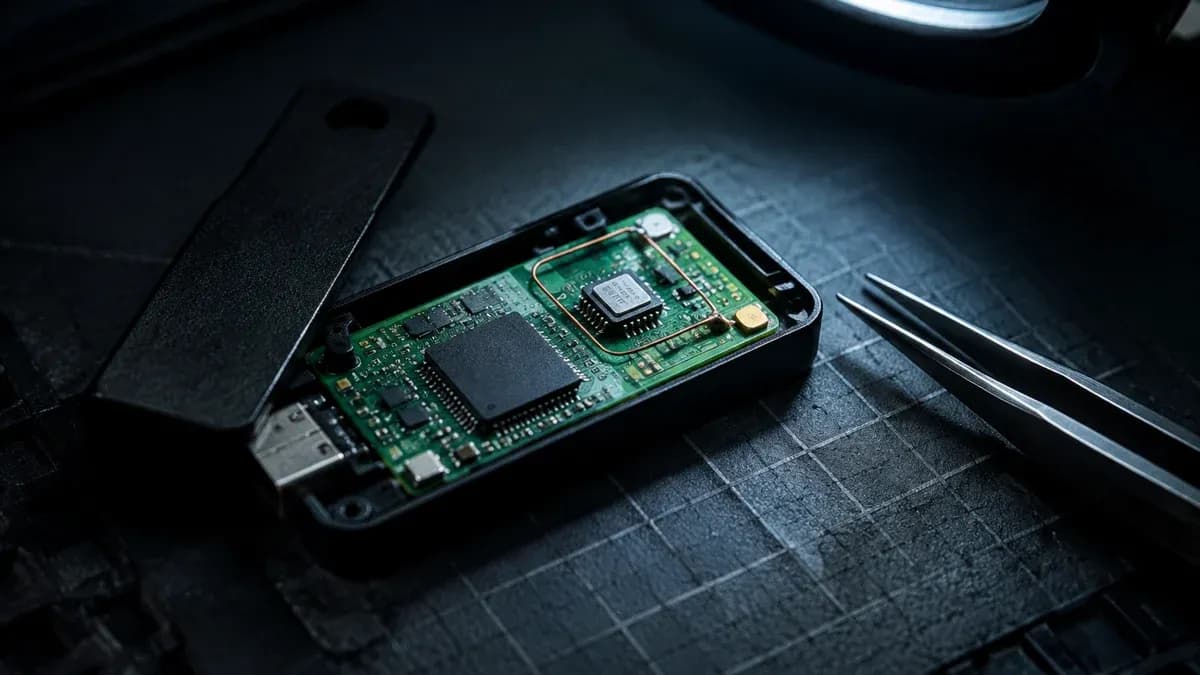
Ledger Hack? $86 Million Drained: What Is Behind the Tampered Wallets From Southeast Asia
Since Friday, Ledger users in Southeast Asia have been reporting empty wallets, and analysts count more than $86 million. Ledger has halted the reseller CryptoBilis. An implant inside the device reportedly reads the seed phrase. What is known, what CZ advises and what you should do now.
More from CryptoTicker