
Buying More Bitcoin at $77,000: Savings Plan or Lump Sum
Bitcoin stands at $77,256 after gaining 22.78 percent in a week. This guide shows you how to buy more cleanly at this price and which method fits which starting position.




Which topics should we dive deeper into?
Select what genuinely interests you. Your picks feed directly into our editorial planning.
Crypto news that's actually worth your time.
Weekly. 60 seconds. Carefully curated by our editors: no hype, no promo flood, no spam.
The short answer first: you can buy more bitcoin at a price of around $77,000, but not every method is the right one at this level. If you are already invested, a bitcoin savings plan is the calmer route, because it smooths out the weekly and daily swings. If you have been standing on the sidelines for months and want to invest a fixed amount, a lump sum purchase is statistically no worse, and more often than not it is better. The useful question is therefore not which method wins in general, but which one suits your starting position and the amount you have in mind. That is what this text is about.
It is Sunday, August 24, 2026. Bitcoin gained 22.78 percent in the week from August 16 to 23 and, according to a CoinMarketCap reading taken on August 23, stands at $77,256.75. Trading volume over the past 24 hours came to $27.80 billion. It is the strongest bitcoin week since March 2024 and the first price level above $77,000 since the spring.
How to Buy More Bitcoin Cleanly at $77,000
The easiest way to get your head around the topic is to look at a concrete amount. Take 6,000 euros that you will not need in the next three to five years. That gives you three basic options. First: you invest everything today. Second: you spread the 6,000 euros over twelve months at 500 euros each and let a savings plan run. Third: you combine the two, buying part of it today in one go and the rest gradually. All three routes are legitimate, all three carry different risks. There is no single correct answer, but there is one that fits the reality of your life.
The underlying assumption matters: you buy bitcoin only with money you can absorb losing. Bitcoin regularly moves 20 to 30 percent up or down within a month. Anyone who cannot stomach that should halve the amount rather than switch strategy.
What Pushed the Bitcoin Price Up 22 Percent This Week
Last week's rise hangs on several events whose timing added up. On August 19, US President Donald Trump received the leadership of the crypto industry and its regulators at the White House and there publicly called for the Clarity Act to be passed. The bill is meant to end the turf war between the SEC and the CFTC and to classify crypto assets as either a security or a commodity depending on how they are built. It already passed the House of Representatives in 2025 and has been stuck in the US Senate for months.
On the same day, US spot bitcoin ETFs recorded net inflows of $517 million, the strongest day in three and a half months. Of that, $284.7 million went to the iShares Bitcoin Trust. Inflows into Ethereum came to $189 million. On top of that came the announcement by US Treasury Secretary Scott Bessent that buyback limits for long-dated bonds would be doubled. That pushes long-term rates down and shifts capital into real assets, a category many investors count bitcoin among.
The point for your decision: the lift comes from a regulatory promise and from macro-driven reallocation, not from any new application. Whether the Clarity Act clears the Senate in 2026 is open. Prediction markets currently give it around a 16 percent chance, and the cloture vote in the Senate is scheduled after the return from recess on September 15. Anyone buying today is buying ahead of a regulatory promise that has yet to be delivered.
Lump Sum or Savings Plan: Which Strategy Suits Which Investor
A lump sum purchase means you swap your amount into bitcoin on a single day. The advantage: you are invested immediately, you pay the order fee only once, and you lock in the starting point of the next price move. The drawback: if the price falls ten percent the day after your purchase, you carry a visible paper loss, and that hits most investors emotionally harder than a quiet run of losses spread over weeks.
A bitcoin savings plan breaks the amount into equally sized portions and buys them at fixed intervals. The advantage: you smooth the swings, you never hit the single worst entry day, and you relieve yourself of the psychological question of whether today is the moment. The drawback: in rising markets a savings plan systematically lags the lump sum purchase, because later purchases are made at higher prices.
Academic work from Vanguard's research arm in the US shows that over long periods a lump sum purchase beats the savings plan in two out of three cases on average, because markets rise more often than they fall. For bitcoin the rule does not hold quite as neatly: price moves are more violent and recovery phases longer. That is why the bitcoin savings plan is usually the calmer choice for beginners, though it is not automatically the higher-returning one.
 Build Bitcoin Through a Savings Plan
How a Bitcoin Savings Plan Works Technically and What It Costs
A crypto savings plan is a recurring chain of purchase orders at a provider of your choice. You set which day of the month a given sum is debited from your reference account and swapped into bitcoin at the market price. For this the provider charges you either a fixed order fee, a percentage markup on the market price, or it earns through the spread between the buying and selling price.
The cost range in Germany runs from roughly 0.5 percent per execution at the cheapest broker savings plans to more than 1.5 percent at convenient app solutions. Anyone saving 500 euros a month pays 60 euros a year at a fee of one percent. Over five years that is 300 euros flowing into the provider's margin instead of into bitcoin. If you are torn between two providers, the fee is the first criterion you may stop worrying about once it sits below one percent. Our comparison of regulated crypto exchanges provides an overview.
Which intervals work in practice
Monthly is the most common choice and works for most savers, because salary and outgoings are on a monthly rhythm. Weekly smooths the price swings more strongly, but triples the number of executions and with it the total fee, provided the provider bills per execution. Daily makes little sense at most German providers, because minimum amounts and per-execution fees bite. A two-week rhythm is a solid compromise where your broker allows it.
Why You Should Not Rule Out a Lump Sum Purchase at This Price
A widespread reflex says: after a rally you do not go in with a lump sum. That sounds sensible but is empirically questionable. If you examine bitcoin weeks with a gain of more than 20 percent since 2018, the price four weeks later was higher in the majority of cases, not lower. The reason lies in the structure of the bitcoin market: in many cycles rallies mark the transition into a momentum phase rather than the end of one.

What the Cost Average Effect and Volatility Really Mean for Your Calculation
The cost average effect is the mathematical consequence of the savings plan. If you invest the same euro amount every month, you buy less bitcoin at high prices and more at low ones. Your average entry price ends up below the arithmetic mean of all monthly prices. This is no magic effect but a consequence of the harmonic mean, which mathematically is always smaller than or equal to the arithmetic one.
Volatility, meaning the typical price movement over time, currently sits at around 60 percent a year for bitcoin. Equity indices such as the DAX move at around 20 percent. In everyday terms bitcoin therefore swings three to four times as much as a broad equity market. For the savings plan that is an advantage, because large swings amplify the cost average effect. For the lump sum purchase it is a risk, because the chance of a false start of 15 to 30 percent within a month is real.
 Secure Storage With a Hardware Wallet
How Large the Amount Should Be and When You Are Better Off Doing Nothing
A workable rule of thumb for the size of your bitcoin share of total assets sits between two and ten percent. Below two percent, bitcoin will not move your portfolio noticeably whatever happens. Above ten percent, a single asset class carries your financial wellbeing, and with an asset running 60 percent annual volatility that is careless. Anyone putting all their savings into bitcoin is speculating, however the order is structured.
There are moments when you are better off buying nothing. If you have no liquid emergency cushion of three to six months of net salary, your next euro belongs in an instant access savings account rather than in bitcoin. If you are servicing a loan at more than four percent interest, paying it down is the better return. And if you first heard of bitcoin within the past seven days, give yourself a week to think before you trigger an order.
Which German Providers Come Into Question for Savings Plans and Lump Sum Purchases
German investors have several routes. Regulated crypto exchanges based or licensed in the EU offer both lump sum purchases and savings plans, often with BaFin-registered custody solutions. Neobrokers from the traditional securities world offer crypto savings plans as ETP-like constructs, where you hold bitcoin economically without holding the coins yourself. Pure crypto apps offer the lowest entry amounts, often from one euro, but the highest percentage fees.
Which route suits you depends less on the provider's name than on two questions: do you want to transfer the coins to your own wallet later, or is custody at the provider enough for you? And do you trust yourself with a seed phrase and a private key, or should a third party handle custody? Anyone wanting to hold the coins themselves picks an exchange that allows withdrawals to a hardware wallet. Anyone taking the convenient route picks a neobroker with a crypto savings plan.

What the Clarity Act and the ETF Tailwind Mean for Your Timing
Regulatory impulses have repeatedly triggered short-term price jumps in recent years, but they have rarely determined the long-term direction on their own. Should it become law, the Clarity Act would give US trading venues more legal certainty in handling crypto assets. Institutional inflows through ETFs could accelerate. Should the bill fail in September or October, a price setback is likely, because part of the rally rests on that expectation.
For your savings plan both outcomes are irrelevant, because by construction it absorbs either case. For a lump sum purchase the following applies: anyone timing their purchase date around a political vote accepts the corresponding headline risk. Anyone setting that date independently is buying a position in the running cycle, with no special expectation attached.
How to Factor Tax and the Holding Period In at the Point of Purchase
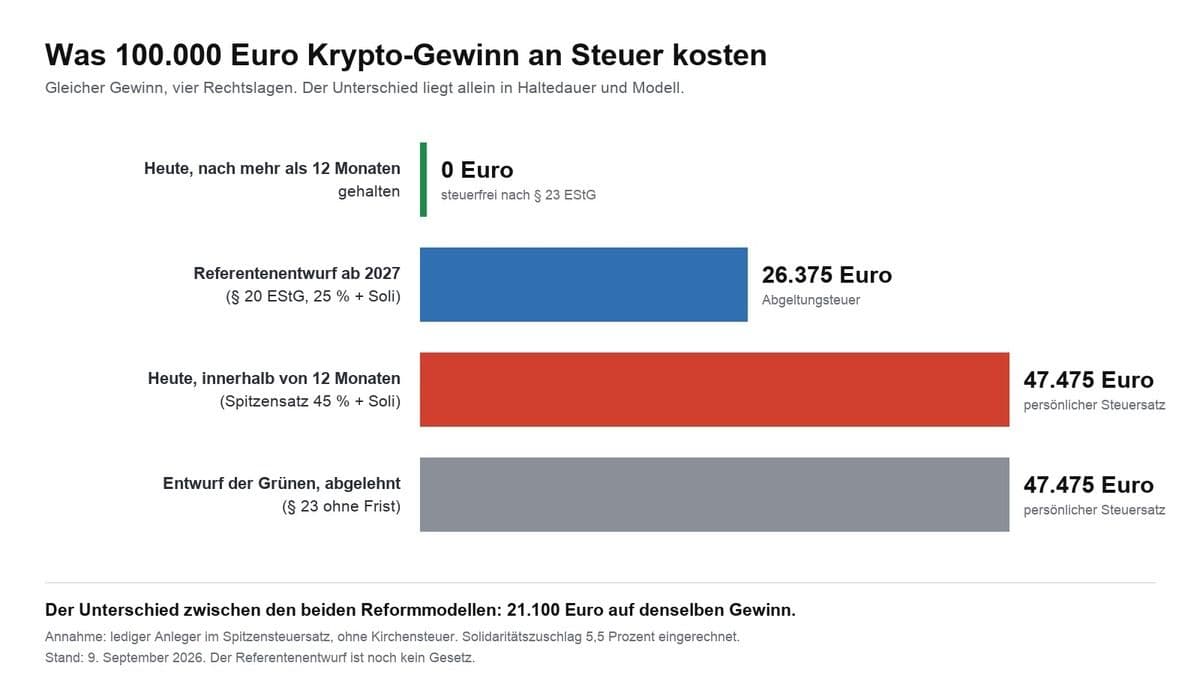
In Germany, bitcoin counts as a private economic asset under Section 23 of the Income Tax Act. Price gains from a sale are tax-free after a holding period of twelve months, provided you hold them as private assets. If you buy on August 24, 2026, a sale from August 25, 2027 onwards will be tax-free, assuming the current legal position holds. Within the holding period the gain is charged at your personal income tax rate plus the solidarity surcharge and, where applicable, church tax, once annual gains exceed 1,000 euros. Losses within the year can be offset against other private disposals.
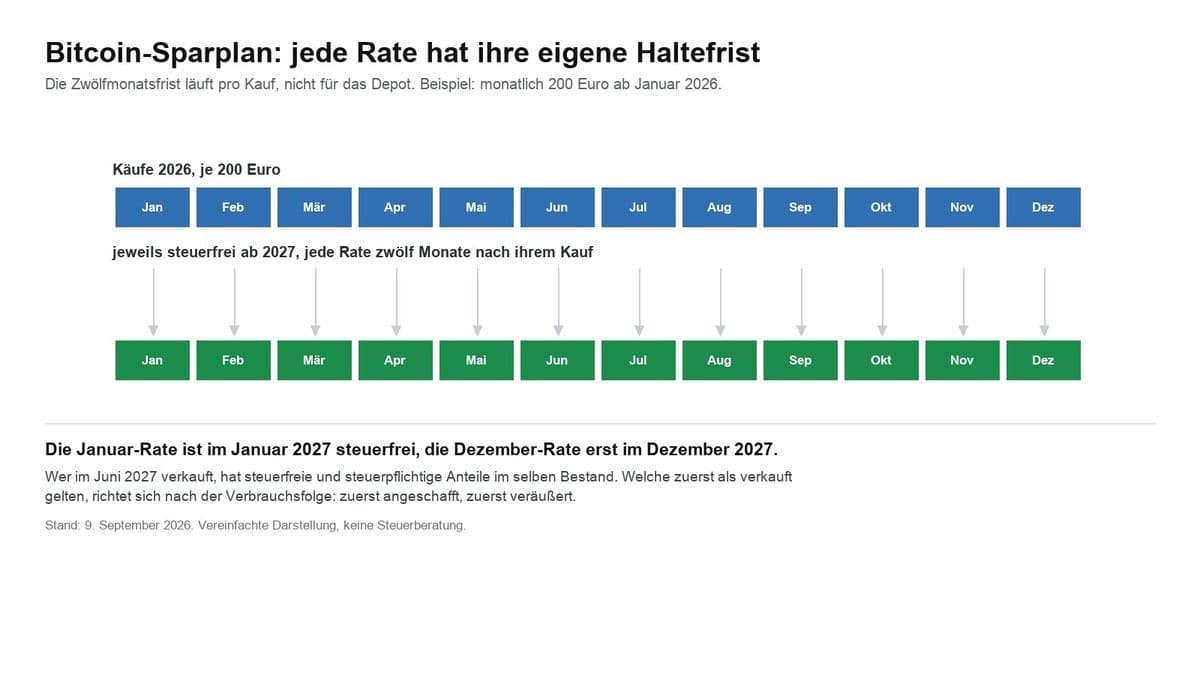
With a savings plan, every monthly tranche has its own holding period. The tranche from August 2026 becomes tax-free in August 2027, the tranche from September 2026 in September 2027. Your broker should manage these tranches automatically using the first-in-first-out method. For the tax report, using a crypto tax tool from the outset pays off, so that a later partial sale does not force you to sort order CSVs retrospectively.
Buying More Bitcoin: What to Take Away
Three numbered steps with which you can make the decision today.
- Set your budget before choosing a provider. Define the bitcoin share of your total assets at between two and ten percent and work out what that means in euros. Halve the figure if a loss of 30 percent would cost you sleep. Only then do you compare the exchanges that fit.
- Choose the method that suits your starting position. If you are already invested and want to top up, a bitcoin savings plan is the calmer route. If you have been waiting for months and the move is getting on your nerves anyway, buy three quarters of your target position today in one go and put the rest into a savings plan. You will find the providers for that in the savings plan comparison.
- Think about custody and tax from the start. Small amounts may sit at the exchange, larger holdings belong in your own wallet. Anyone planning to hold for the long run picks capable hardware. The overview is in the hardware wallet comparison.
For context on this week and the triggers of the price jump, see our article Bitcoin Price Above $75,000: 3 Reasons for the Rally. If you want to go deeper into the macro-financial framework, the connection between the dollar, gold and bitcoin is in our analysis Dollar at a Two and a Half Month Low, Gold Above $4,400, Bitcoin Up 8 Percent.
Two market reports serve as primary sources for this text: the overview by CNBC on the White House meeting and the inflow data on spot bitcoin ETFs at The Block.
(As of August 24, 2026. This article is not investment advice. Prices and fee structures change; check the terms with the provider before you buy.)
Transparency note: This article was produced with the assistance of artificial intelligence and reviewed by our editorial team before publication. All figures and claims were checked against the primary sources linked in the text. The feature image was generated with AI.
More on Bitcoin: All Bitcoin news at a glance
Related articles
- 50 euros a month in Bitcoin, 118 instalments since 2017: savings plan vs lump sum
- Bitcoin Across Multiple Wallets: How Austria Works Out the Acquisition Cost
- Investing in Bitcoin With a Savings Plan or a Lump Sum: What the December 31 Tax Cut-Off Changes
- The Cost Average Effect with Bitcoin: What Twelve Instalments Really Deliver
- Bitcoin Savings Plan and Tax: How the Holding Period, FIFO and the Exemption Limit Interact on Monthly Buys
Which topics should we dive deeper into?
Select what genuinely interests you. Your picks feed directly into our editorial planning.
Crypto news that's actually worth your time.
Weekly. 60 seconds. Carefully curated by our editors: no hype, no promo flood, no spam.

September 24, 2026 10:19 PM

Bitcoin for Retirement: What Applies from 2027 and What You Decide Now
Bitcoin is not permitted in any state-subsidised retirement product, including the new retirement savings account from 2027. Anyone who still wants to use crypto assets for their own pension goes through private assets, and there a cutoff date at the end of 2026 is shifting the tax rules right now.
August 24, 2026 10:26 AM
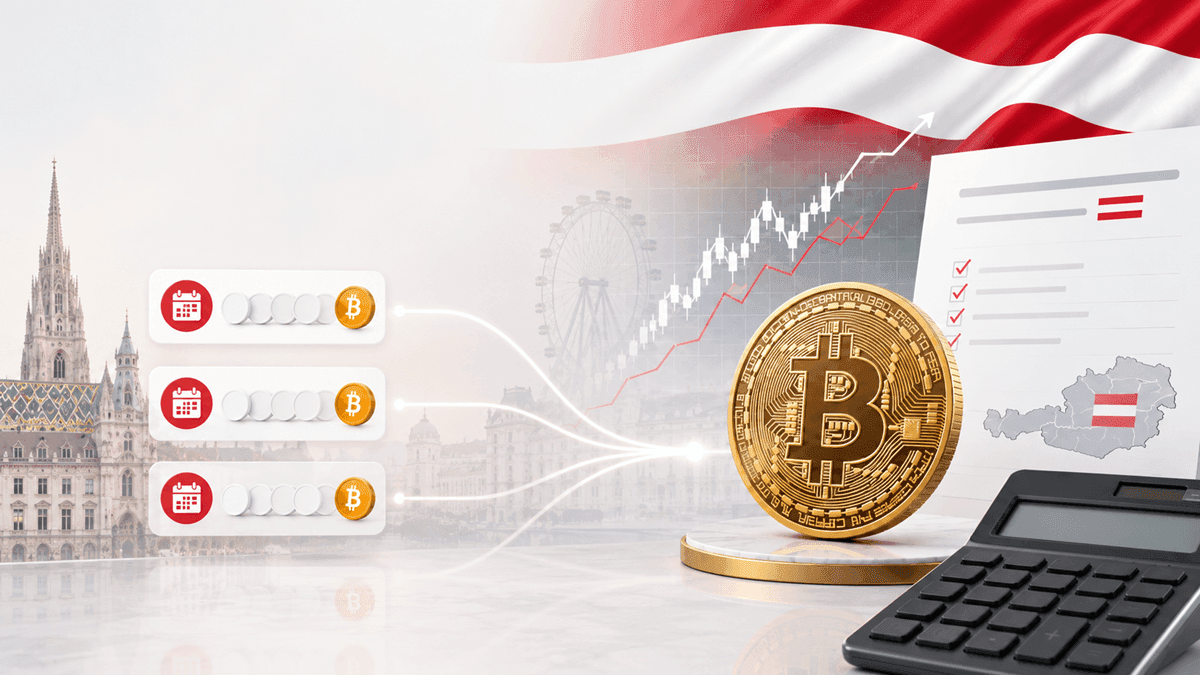
Bitcoin Savings Plan in Austria: How the Purchase Price Is Calculated
Bought bitcoin through a savings plan? For multiple purchases Austria applies the moving average price as a matter of principle when working out taxable gains.
October 6, 2026 4:32 AM
Bitcoin for a gift card: what paying with crypto means for your holding period
Paying for a gift card with Bitcoin is a sale for tax purposes. What counts as the disposal proceeds, when the twelve-month holding period bites, and the four records the tax office expects.
October 19, 2026 4:15 AM

Crypto FIFO across several exchanges: each wallet counts on its own in Germany
Hold bitcoin on several exchanges and in wallets of your own, and the holding period is calculated per pot, not across the total holding. What paragraph 62 of the BMF guidance orders, and why 31 December 2026 hangs on it.
September 9, 2026 4:22 PM
Crypto Tax in Germany: What Applies in 2026 and What Is Set to Change in 2027
Crypto gains are tax-free after twelve months; before that your personal tax rate of up to 45 percent applies. What triggers tax, how the holding period is calculated, what happens with staking and losses, and what the draft bill would change from 2027.

September 22, 2026 4:12 PM

Nearly $1 Billion Into Bitcoin ETFs: What to Check on ETNs, Portfolio and Holding Period
US spot bitcoin ETFs took in a net $999 million on September 21, the third consecutive day of inflows. German investors cannot reach these funds: what ETNs, the holding period and your buying route mean for you.
October 9, 2026 7:21 AM

Ethereum savings plan: twelve instalments averaged 1,981 euros, the lump sum 3,318
Twelve monthly instalments of 100 euros in Ether worked out at an average price of 1,981 euros, while a lump sum on the starting day cost 3,318 euros. The twelve-month calculation, the two quirks that set it apart from a Bitcoin savings plan, and the tax consequences of twelve separate purchases a year.
September 18, 2026 10:14 PM

Bitcoin Back Above $80,000: Buy More, Hold or Take Profits? What to Check Now
Bitcoin is back above $80,000, for the first time since September 7. Whether you buy more, hold or take profits depends less on the daily price than on three things you can check yourself: your holding period, the way you buy, and where your coins are kept.
September 14, 2026 4:19 AM

Fed Rate Decision of September 16: What It Means for Your Bitcoin Savings Plan
Recap as of September 27, 2026: this article appeared before the US Federal Reserve's rate decision on September 16, 2026, when futures markets mostly expected a hike. It describes what a hike means for your monthly instalment, a running crypto loan and your holding periods.
October 16, 2026 7:25 PM

Crypto holding period for Bitcoin: “That remains to be seen,” says the finance ministry
The federal cabinet did not adopt the draft abolishing the one-year crypto holding period on October 14, 2026; it is still stuck in inter-ministerial consultation. This overview sets out what applies today, which dates follow and why the December 31, 2026 cutoff has no force of law so far.
October 9, 2026 10:50 AM

Crypto holding period: the Bundestag rejects abolition by 445 votes to 132: what investors need to know
On 8 October the Bundestag rejected the Greens' bill to abolish the crypto holding period in a recorded vote, and the Left's motion fell too. The result by parliamentary group, the official speech from the media centre, and why it was the SPD that gave investors the real signal in the debate.
October 9, 2026 1:18 PM

Bitcoin Tax: One Year Past the $126,080 Peak, Losses No Longer Count
Bitcoin trades at $82,558 on Friday morning, 34.5 percent below an all-time high that is now a good year old. Anyone who bought back then loses more than the prospect of a quick recovery when the one-year period expires: the tax value of the loss goes with it.
September 8, 2026 1:19 AM

Germany's Crypto Holding Period: What Happens Now Signing for Petition 201716 Closed on September 15
Recap as of September 27, 2026: the signature period for German parliamentary petition 201716, which asks for the one-year crypto holding period to be preserved, closed on September 15, 2026. This article explains what ended that day, how the petitions committee proceeds and why no investor has to sell because of it.
August 5, 2026 10:33 PM
$130 Million Gone Because the Randomness Was Predictable: Which Hardware Wallet You Can Still Buy
The Coldcard flaw proved the most respected wallet is not the safest. Which vendor has which track record – and why now is the wrong moment to pause your savings plan.
September 9, 2026 4:29 PM
Bitcoin and Taxes in Germany: Holding Period, Savings Plan, ETP and Mining
Bitcoin gains are tax-free after twelve months. What that means for a savings plan with twelve deadlines, why ETPs are taxed differently, and what applies to mining, gifts and losses.
September 17, 2026 7:12 PM

Gifting Bitcoin to Children: Allowance, Holding Period and the Tax Office Report
Transferring Bitcoin to your child hands over your holding period and your entry price along with the coins. This guide sets out what really applies in Germany on the allowance, the reporting deadline, representation and custody.
October 2, 2026 4:39 AM

Donating bitcoin: when does the full market value count, when only the purchase price?
A bitcoin donation to a charitable organisation is deductible as a donation in kind, and the donation itself produces no taxable gain. The size of the deduction turns solely on whether a sale would have been taxable on the day of the transfer.
October 19, 2026 10:42 PM

Crypto GmbH: 25.6 percent tax from the first sale, nothing privately after a year: what matters now
A crypto GmbH pays 25.6 to 33.3 percent on every gain, from day one. Held privately, the same gain stays tax-free after a year. We work through both routes and show where the GmbH wins regardless.
September 18, 2026 10:13 AM

Bitcoin and the German Exit Tax: What Applies When You Move Abroad
Anyone emigrating with Bitcoin expects an exit tax on unrealised gains and finds nothing of the sort in the statute. Where the real risks sit is decided at four points: residence, the holding period, the legal form of your investment, and automatic reporting from 2026.
September 22, 2026 10:13 AM

Circle Lends Against Bitcoin via cirBTC: Why the Wrapper Can Cost You the German Holding Period
Circle launched loans against deposited bitcoin on September 21, 2026. In Germany, the detour through the cirBTC token is very likely a swap, and a swap restarts your one-year holding period.
September 9, 2026 4:13 PM

Bitcoin 29 Percent Below Last Year: Which Crypto Losses You Can Still Use Before the One-Year Holding Period Expires
Nine out of ten major crypto assets trade lower today than exactly twelve months ago, Bitcoin alone by 29.2 percent. We measured the price series ourselves and show why the purchase date alone decides the tax value of your loss.
August 11, 2026 9:13 PM

Germany's Crypto Holding Period Faces Abolition: What Petition 201716 and the Draft Bill Mean for Your Tax
Petition 201716 calls for the one-year holding period for crypto assets to be kept and will be heard in public by the Bundestag's Petitions Committee on 12 October 2026. Correction of 8 October: the reform was not decided by the cabinet in July. A draft bill of 30 September would end the holding period for crypto acquired after 31 December 2026, and the cabinet is due to take it up on 14 October.
September 16, 2026 7:12 PM

Borrowing Against Bitcoin Instead of Selling: When German Tax Still Applies
Posting Bitcoin as collateral for a loan is not a sale in Germany, because section 39 of the Fiscal Code keeps the coins attributed to you for tax purposes. Tax arises only when the collateral is liquidated, and then the one thing that decides the bill is how long you held the coins beforehand.
October 5, 2026 1:40 AM

Crypto at comdirect: 29 certificates with no order fee in a savings plan, but not a single coin
comdirect puts crypto into your securities account as a certificate, not as a coin. Our count of October 4, 2026 shows 29 securities from five issuers on 12 cryptocurrencies. On a one-off purchase the minimum fee of 9.90 euros amounts to 9.90 percent on 100 euros invested; in a savings plan the 1.5 percent is waived until the end of 2027.
September 26, 2026 1:19 AM

Germany’s Crypto Holding Period Is Wobbling: What to Check Before December 31
A CDU member of the Bundestag makes it plain: the coalition agreement does not guarantee that the one-year holding period for crypto assets will survive. What that means for purchases made before the planned cutoff date of December 31, 2026.
September 27, 2026 10:35 AM

Crypto Exchange Tax Report Wrong: How to Correct It Before the Tax Office Does
Missing acquisition costs, transfers booked as sales, holding periods restarted: your exchange's report is an aid and not proof. How to check it, how to correct it and which deadline is running.
September 25, 2026 10:26 PM

Selling bitcoin privately: the tax in Germany and the records you need
A direct sale to a private individual falls under the same one-year rule as an exchange sale, but there is no tax report to go with it. This guide walks through the calculation, the 1,000 euro threshold and the records the tax office wants to see.
More from CryptoTicker