
Investing in Bitcoin With a Savings Plan or a Lump Sum: What the December 31 Tax Cut-Off Changes
Anyone putting money into Bitcoin now chooses between a lump sum, a monthly instalment and an ETN in a securities account. The German finance ministry’s draft bill would keep the one-year holding period only for holdings bought by December 31, 2026.





Which topics should we dive deeper into?
Select what genuinely interests you. Your picks feed directly into our editorial planning.
Crypto news that's actually worth your time.
Weekly. 60 seconds. Carefully curated by our editors: no hype, no promo flood, no spam.
Anyone putting money into Bitcoin today decides first on the form: a single amount all at once, a fixed monthly instalment or an exchange-traded security in a securities account. In October 2026 this decision about investing in Bitcoin has an additional reason to be looked at closely. The German finance ministry’s draft bill on crypto taxation provides that the one-year holding period continues to apply only to holdings acquired by December 31, 2026. Whatever is bought after that is to fall under the flat-rate withholding tax. The cabinet is due to adopt the draft on October 14.
This article recalculates the three routes against the prices of the past ten years, explains the German tax position for each of them and names what can go wrong on each route. It gives no buy recommendation and names no price target. You will find the current level and the analyst views on Bitcoin on our prediction page.
Investing in Bitcoin: These Three Routes Are Open in Germany
All three routes lead to a stake in the price performance of Bitcoin, but they differ in what you own at the end and in how the tax authorities treat it.
The direct purchase means that you acquire real Bitcoin and either leave it with the trading platform or transfer it to a wallet of your own. A wallet is not a purse but the management of a cryptographic key pair with which you can dispose of a blockchain address. Whether you deploy the whole amount at once or a monthly instalment is, on this route, purely a question of timing.
The savings plan is a standing order for a direct purchase: a provider buys Bitcoin at a fixed rhythm for a fixed euro amount, regardless of the price. The technical term for this is dollar-cost averaging. It describes the fact that a fixed instalment buys more Bitcoin at low prices than at high ones, and that the average price therefore lies below the mean of the prices. How this effect behaves in a slump is something we worked through in June 2026 under dollar-cost averaging in a crypto crash.
The security is the third route. In the EU there is no Bitcoin fund under UCITS rules, because a fund of that kind may not put its entire assets into a single asset. What is offered in Germany as a Bitcoin ETF is therefore almost always an ETN or ETP, that is, an exchange-traded debt security collateralised with Bitcoin. Which products these are and what you have to watch out for with them is collected in our overview of crypto ETFs in Germany.
The December 31, 2026 Cut-Off and the One-Year Holding Period
Today, Section 23 of the German Income Tax Act applies to privately held Bitcoin: anyone who holds for longer than a year sells tax-free, regardless of the size of the gain. Anyone who sells earlier pays their personal income tax rate on the gain as soon as the total of all private disposal gains in the calendar year reaches 1,000 euros. Those 1,000 euros are an exemption limit and not an allowance: from one euro above it, the entire gain is taxable, not just the excess part.
The draft bill, which according to the Bitcoin portal Blocktrainer the cabinet is due to take up on October 14, would end this system for new purchases. Crypto assets acquired after December 31, 2026 are to be subject to the flat-rate withholding tax, that is, a fixed rate regardless of the holding period. For everything that was in the portfolio before that, grandfathering is provided for: there the one-year period would be preserved.
For your decision that is the decisive difference between the two direct-purchase variants. A lump sum paid in October or November falls entirely under the old law. A savings plan that starts in October and is meant to run for two years is spread across the cut-off: the instalments from 2026 would be protected, those from 2027 onwards would not. In tax terms, two groups of holdings thus arise within the same savings plan, and they have to be treated separately.
One thing remains important: the draft is a draft. Until promulgation in the Federal Law Gazette the cut-off date can shift, and the consultation period for the industry associations ended, according to the same report, as early as October 6, six days after it was sent out. What ends up in the law is decided by the Bundestag and the Bundesrat.

Exemption Limit, Record-Keeping Duty and the Reports From Trading Venues
Quite apart from the draft, the enforcement side shifted in 2026. Since January 1, 2026 the reporting obligations from the EU directive DAC8 have applied, implemented in Germany through the Crypto Tax Transparency Act. Providers domiciled or authorised in the EU report their customers’ accounts and transactions to the tax administration. For you that means: the assumption that a sale within the one-year period goes unnoticed no longer holds.
From that follows a practical duty which weighs more heavily with a savings plan than with a one-off purchase. Every single instalment is its own acquisition event with its own date and its own price. With a monthly instalment and a five-year term that is sixty events which you have to allocate on sale under the first-in-first-out method, that is, in the order in which they were bought. Anyone who does not have these records has an additional problem under the draft bill: without proof of the acquisition cost, a flat 50 percent of the sale proceeds is to count as the tax base. What this substitute assessment means in detail is something we wrote up on October 1, 2026 under crypto acquisition costs and substitute assessment.
A further point in the draft concerns the years from 2028 onwards: trading venues are then to pay over the tax directly, the way banks do with shares. The details and what the deduction means for your liquidity are in our article on withholding tax at crypto exchanges of October 1, 2026.
 Start a Bitcoin savings plan that suits you
Lump Sum Against Savings Plan: The Calculation Over Ten, Five and One Year
The question of which of the two direct routes would have made more out of the same money can be recalculated against the actual prices. We evaluated the weekly prices of the Bitcoin against euro pair on the Kraken trading platform going back to 2013 and took the opening price for the start of each month. Two variants with identical contributions are compared: once 100 euros per month over the whole period, once the entire sum on the first day. Both are valued at the October 2026 opening price of 73,775 euros.
| Period from October | Contribution | Price at the start | Savings plan at the end | Lump sum at the end |
|---|---|---|---|---|
| 2016, ten years | 12,000 euros | 550 euros | 138,300 euros | 1,608,500 euros |
| 2021, five years | 6,000 euros | 47,800 euros | 11,105 euros | 9,260 euros |
| 2023, three years | 3,600 euros | 26,448 euros | 4,339 euros | 10,042 euros |
| 2024, two years | 2,400 euros | 54,902 euros | 2,395 euros | 3,225 euros |
| 2025, one year | 1,200 euros | 101,066 euros | 1,331 euros | 876 euros |
The picture is not uniform, and that is precisely where the message lies. Over ten years the lump sum beats the savings plan by more than elevenfold, because the 12,000 euros at 550 euros per Bitcoin bought a quantity that no later instalment could reach. Over five years from October 2021 the relationship reverses: there the starting price of 47,800 euros was close to the high of the time, the savings plan bought into the subsequent slump and ends up 1,845 euros ahead of the lump sum. Over the past year the gap is clearest. Anyone who deployed 1,200 euros at once in October 2025 at 101,066 euros holds Bitcoin worth 876 euros today, 27 percent less. The same sum in twelve monthly instalments produced 1,331 euros, a gain of just under 11 percent.
Why the Lump Sum Came Out Ahead in 88 of 98 Five-Year Windows
A single period can be luckily or unluckily chosen. We therefore ran the same calculation over every possible five-year window the price series allows: 98 windows, each 60 monthly instalments against a single payment of 6,000 euros, valued at the end of the respective window. In 88 of these 98 cases the lump sum came out ahead, in 10 the savings plan.
The reason lies in the direction of the market, not in a property of the savings plan. Bitcoin has risen across the entire price series so far. In a rising market, money that is invested earlier is invested for longer, and quantities bought early never become cheaper again at any point. The savings plan by definition holds back part of the capital and buys it in later at subsequent, on average higher, prices.
The ten windows in which the savings plan won share one property: their starting month lay shortly before one of the big slumps in each case. That is the real reading of this figure. The lump sum wins more often, but it also loses more clearly when the entry point is badly placed, and it demands a decision that nobody can secure in advance with data. The savings plan, by contrast, buys the uncertainty along with it and takes the question of the right day out of your hands. Which of the two kinds of risk you are more willing to bear is a question for you and not for the price series.
Two limits of this survey belong with it. The calculation is made without fees and without the spread, that is, without the gap between the buy and sell price, and without taxes. Both weigh more heavily on the savings plan, because it consists of many small purchases. And it values only today’s level. Any other valuation day delivers different figures.
Instalment, Interval and Fees: What a Bitcoin Savings Plan Depends On
If the decision falls on the savings plan, three levers determine how much of the money paid in actually ends up in Bitcoin. The minimum instalment at the providers available in Germany lies, according to the surveys by the comparison portals, between one cent and ten euros, and at most of the large houses at one euro. The interval ranges from weekly to quarterly, with a shorter interval strengthening the averaging effect and at the same time producing more individual events for the tax return.
What is decisive is the cost side, and it consists of two parts that have to be stated separately: the order fee and the spread. A fixed order fee of one euro is a side issue on an instalment of 500 euros; on an instalment of 25 euros it is four percent of the purchase amount, missing immediately. The spread comes on top and is not always described as a fee. Anyone who wants to invest a small instalment should therefore calculate the total costs as a percentage of their own instalment and not compare the advertised fee figure. The current terms of the providers are in our comparison of Bitcoin savings plans.
Since the EU regulation MiCA took effect at the end of December 2024, choosing the provider itself involves a hard checkpoint: a trading venue serving retail clients in the EU needs authorisation as a crypto-asset service provider. The authorisation says nothing about price performance, but it governs own funds, custody and complaint channels. Which houses hold it we list under regulated crypto exchanges. Fee structures change frequently, so it is worth looking at the provider’s price list on the day you sign up.

Crypto ETNs in a Securities Account: The Delivery Claim Decides the Tax Rule
The third route does not run through a crypto platform but through the securities account at a bank or broker. What is traded are ETNs, that is, collateralised debt securities on the Bitcoin price. In practice that has advantages: no key of your own, no additional account, purchase and savings plan through the familiar securities account screen, and the settlement lands automatically in the annual tax statement.
In tax terms this route is the most complicated, and the distinction hangs on a single feature: the delivery claim. If the product gives you the securitised right to demand delivery of the deposited Bitcoin, there is much to be said for treating it like direct ownership, that is, with the one-year period under Section 23. If that right is missing, what exists is a pure claim, and the income counts as investment income with flat-rate withholding tax, the solidarity surcharge and, where applicable, church tax, without any holding period. There is no conclusive determination by the tax administration binding for all products, and the classification will in the end depend on the specific prospectus. With larger sums that is the point at which a trip to a tax adviser pays for itself.
On top of that comes a risk the direct purchase does not have: issuer risk. You hold a claim against the issuing company. If the collateral is held separately in trust, that risk is small, but it is not zero, and it belongs in the trade-off against the risk of losing a key of your own.
 Find the right crypto tax tool
Custody After the Purchase: Whoever Holds the Key Holds the Bitcoin
With a direct purchase the purchase is not the last step. If you leave the Bitcoin in the trading account, you hold a credit against the provider, and that provider’s solvency and security architecture are part of your risk. If you transfer it to a wallet of your own, you no longer carry that risk, but you do carry full responsibility for the key. There is no body that replaces a lost recovery phrase.
The size of the amount helps with the decision. On an instalment of 25 euros a month, a hardware device costs more in the first year than the holding it protects; there an account with an authorised provider is a defensible interim solution, as long as you do not run the two-factor protection over SMS. As soon as the holding grows into the four-figure range, the relationship shifts. A hardware device keeps the key permanently separated from the internet and releases payments only after confirmation on the device. In tax terms the transfer to your own wallet is not a sale and triggers no tax, as long as you remain the owner.
Position Size and Total Loss: The Risk Side of the Decision
Over its history Bitcoin has repeatedly lost more than 70 percent from its high and recovered afterwards. That this will happen again is not a forecast but the description of a property: this market knows slumps of that order. A total loss is possible, and it is covered neither by deposit insurance nor by a compensation fund. A bank’s 100,000 euros of deposit insurance applies to balances in euros, not to crypto assets.
From that follows no advice on the amount, but a test calculation you can carry out yourself: take the amount you want to invest and subtract 80 percent of it. If the difference remains an amount that does not touch your rent, your emergency reserve or a foreseeable expense, the position size is sustainable. If it does touch them, it is too large, regardless of which of the three routes you decide on. Anyone working on credit or with leverage leaves this calculation entirely, because there even a setback can lead to forced liquidation, long before a price recovers.
A final point on timing. The December 31, 2026 cut-off is a tax advantage for purchases that take place by then, but it is no reason to bring forward a decision you have not yet made on the merits. A holding that turns out too large under time pressure costs more in the next slump than the holding period ever brings in.
Investing in Bitcoin: Your Next Three Steps
- Settle the route and the amount before you open an account. Decide first whether you want to deploy a sum at once or a monthly instalment, and check the figure with the test calculation from the previous section. Only after that does the provider question become concrete: terms and minimum instalments are in the comparison of Bitcoin savings plans.
- Collect records from the very first transaction. File the date, quantity, price and fee for every purchase, ideally automatically. Anyone who only catches up on this at the point of sale pays tax, under the draft, on half the proceeds in case of doubt. Which programmes take over the allocation is shown by our overview of crypto tax tools and portfolio trackers.
- Let the custody grow with the holding. Set a threshold above which you transfer the holding from the trading account to a wallet of your own, and stick to it. The devices and their differences are in the hardware wallet comparison.
(As of October 3, 2026. This article is not investment advice. Prices and fee structures change; check the terms with the provider before you buy.)
Frequently asked questions about investing in Bitcoin
Transparency note: This article was produced with the assistance of artificial intelligence and reviewed by our editorial team before publication. All figures and claims were checked against the primary sources linked in the text. The feature image was generated with AI.
More on Bitcoin: All Bitcoin news at a glance
Related articles
- 50 euros a month in Bitcoin, 118 instalments since 2017: savings plan vs lump sum
- Buying More Bitcoin at $77,000: Savings Plan or Lump Sum
- Bitcoin for Retirement: What Applies from 2027 and What You Decide Now
- Bitcoin Savings Plan and Tax: How the Holding Period, FIFO and the Exemption Limit Interact on Monthly Buys
- Crypto Tax in Germany: What Applies in 2026 and What Is Set to Change in 2027
Which topics should we dive deeper into?
Select what genuinely interests you. Your picks feed directly into our editorial planning.
Crypto news that's actually worth your time.
Weekly. 60 seconds. Carefully curated by our editors: no hype, no promo flood, no spam.

September 10, 2026 4:15 PM

BW-Bank Opens Bitcoin Trading Inside the Securities Account: What to Check Before Your First Buy
Since September 9, 2026, BW-Bank customers have been able to trade ten crypto assets through their securities account, executed and held in custody by Bitpanda. The familiar securities-account setting hides three points you should settle before your first order.
September 14, 2026 4:19 AM

Fed Rate Decision of September 16: What It Means for Your Bitcoin Savings Plan
Recap as of September 27, 2026: this article appeared before the US Federal Reserve's rate decision on September 16, 2026, when futures markets mostly expected a hike. It describes what a hike means for your monthly instalment, a running crypto loan and your holding periods.
October 16, 2026 7:25 PM

Crypto holding period for Bitcoin: “That remains to be seen,” says the finance ministry
The federal cabinet did not adopt the draft abolishing the one-year crypto holding period on October 14, 2026; it is still stuck in inter-ministerial consultation. This overview sets out what applies today, which dates follow and why the December 31, 2026 cutoff has no force of law so far.
September 9, 2026 4:29 PM
Bitcoin and Taxes in Germany: Holding Period, Savings Plan, ETP and Mining
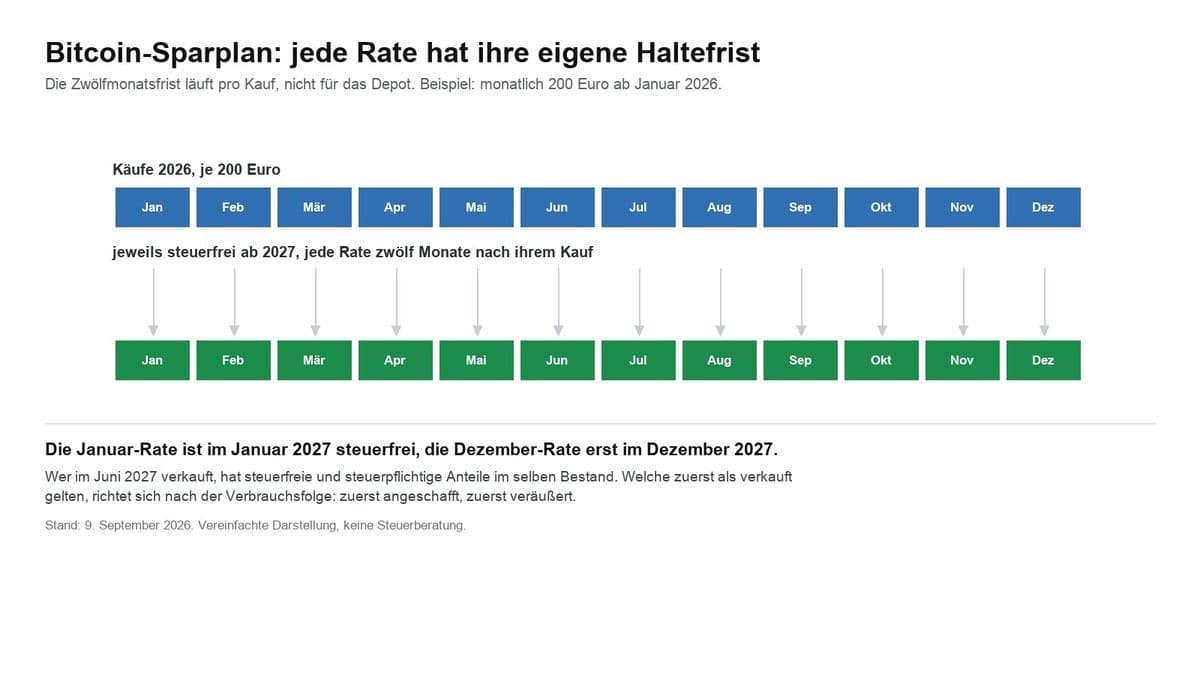
Bitcoin gains are tax-free after twelve months. What that means for a savings plan with twelve deadlines, why ETPs are taxed differently, and what applies to mining, gifts and losses.
October 10, 2026 7:15 PM

ING and Bitcoin: Around 50 Crypto ETNs in the Portfolio, and What the Delivery Claim Means for Your Holding Period
Bitcoin can be bought at ING, but only as an exchange-traded note: around 50 crypto ETNs from five issuers, as a one-off purchase or a savings plan from one euro. What the offer really costs, and what the one-year holding period hangs on, is not in the advertising but in the key information document.
October 2, 2026 4:39 AM

Donating bitcoin: when does the full market value count, when only the purchase price?
A bitcoin donation to a charitable organisation is deductible as a donation in kind, and the donation itself produces no taxable gain. The size of the deduction turns solely on whether a sale would have been taxable on the day of the transfer.

September 27, 2026 4:12 AM

Bitcoin ETF Inflows Turn 2026 Positive: How to Tell If the Demand Holds
US spot Bitcoin ETFs took in roughly $2.4 billion in the week to September 25, the strongest week since October 2025, and that turns the 2026 year-to-date balance positive. Why the daily inflow fell 87 percent within the same week, and what to check on buying route, holding period and custody.
August 11, 2026 9:13 PM

Germany's Crypto Holding Period Faces Abolition: What Petition 201716 and the Draft Bill Mean for Your Tax
Petition 201716 calls for the one-year holding period for crypto assets to be kept and will be heard in public by the Bundestag's Petitions Committee on 12 October 2026. Correction of 8 October: the reform was not decided by the cabinet in July. A draft bill of 30 September would end the holding period for crypto acquired after 31 December 2026, and the cabinet is due to take it up on 14 October.
September 18, 2026 10:14 PM

Bitcoin Back Above $80,000: Buy More, Hold or Take Profits? What to Check Now
Bitcoin is back above $80,000, for the first time since September 7. Whether you buy more, hold or take profits depends less on the daily price than on three things you can check yourself: your holding period, the way you buy, and where your coins are kept.
September 22, 2026 4:12 PM

Nearly $1 Billion Into Bitcoin ETFs: What to Check on ETNs, Portfolio and Holding Period
US spot bitcoin ETFs took in a net $999 million on September 21, the third consecutive day of inflows. German investors cannot reach these funds: what ETNs, the holding period and your buying route mean for you.
October 9, 2026 10:50 AM

Crypto holding period: the Bundestag rejects abolition by 445 votes to 132: what investors need to know
On 8 October the Bundestag rejected the Greens' bill to abolish the crypto holding period in a recorded vote, and the Left's motion fell too. The result by parliamentary group, the official speech from the media centre, and why it was the SPD that gave investors the real signal in the debate.
October 9, 2026 1:18 PM

Bitcoin Tax: One Year Past the $126,080 Peak, Losses No Longer Count
Bitcoin trades at $82,558 on Friday morning, 34.5 percent below an all-time high that is now a good year old. Anyone who bought back then loses more than the prospect of a quick recovery when the one-year period expires: the tax value of the loss goes with it.
September 8, 2026 1:19 AM

Germany's Crypto Holding Period: What Happens Now Signing for Petition 201716 Closed on September 15
Recap as of September 27, 2026: the signature period for German parliamentary petition 201716, which asks for the one-year crypto holding period to be preserved, closed on September 15, 2026. This article explains what ended that day, how the petitions committee proceeds and why no investor has to sell because of it.
August 11, 2026 5:14 AM

Bitcoin Bought Before March 2021: Is the Sale Tax-Free in Austria?
Bought Bitcoin before March 2021? Why legacy holdings can still be sold tax-free in Austria in 2026, and which exceptions apply.
August 24, 2026 10:26 AM
Bitcoin Savings Plan in Austria: How the Purchase Price Is Calculated
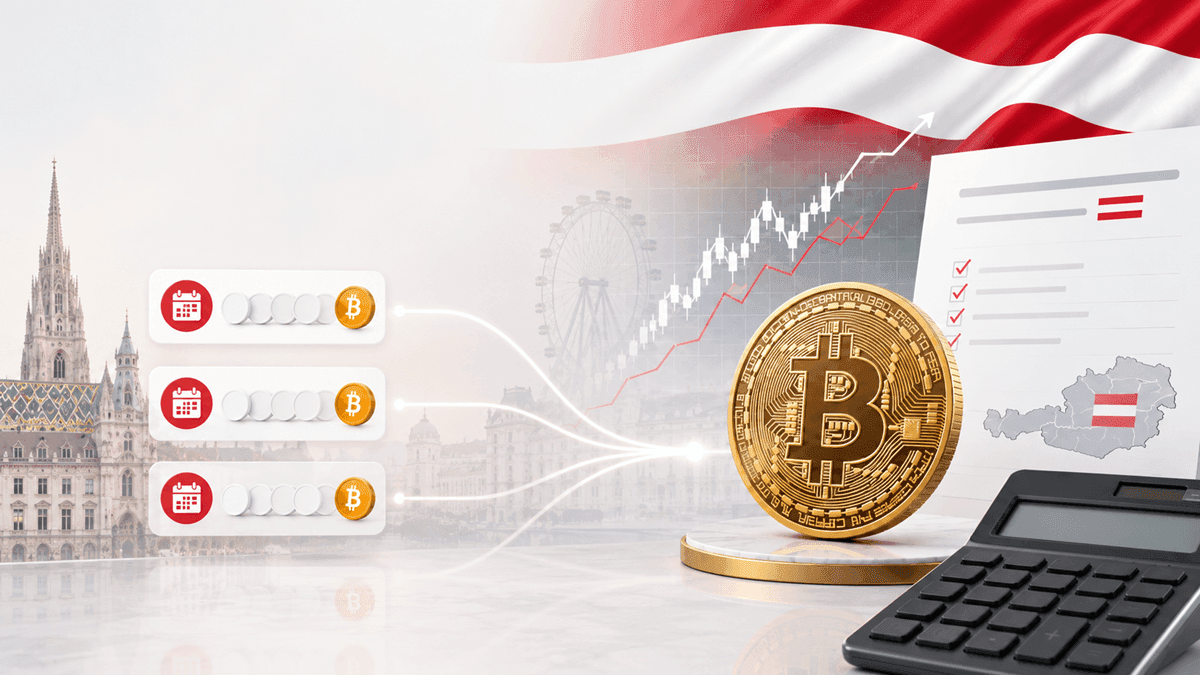
Bought bitcoin through a savings plan? For multiple purchases Austria applies the moving average price as a matter of principle when working out taxable gains.
September 17, 2026 7:12 PM

Gifting Bitcoin to Children: Allowance, Holding Period and the Tax Office Report
Transferring Bitcoin to your child hands over your holding period and your entry price along with the coins. This guide sets out what really applies in Germany on the allowance, the reporting deadline, representation and custody.
October 6, 2026 4:32 AM
Bitcoin for a gift card: what paying with crypto means for your holding period
Paying for a gift card with Bitcoin is a sale for tax purposes. What counts as the disposal proceeds, when the twelve-month holding period bites, and the four records the tax office expects.
October 19, 2026 10:42 PM

Crypto GmbH: 25.6 percent tax from the first sale, nothing privately after a year: what matters now
A crypto GmbH pays 25.6 to 33.3 percent on every gain, from day one. Held privately, the same gain stays tax-free after a year. We work through both routes and show where the GmbH wins regardless.
September 18, 2026 10:13 AM

Bitcoin and the German Exit Tax: What Applies When You Move Abroad
Anyone emigrating with Bitcoin expects an exit tax on unrealised gains and finds nothing of the sort in the statute. Where the real risks sit is decided at four points: residence, the holding period, the legal form of your investment, and automatic reporting from 2026.
September 22, 2026 10:13 AM

Circle Lends Against Bitcoin via cirBTC: Why the Wrapper Can Cost You the German Holding Period
Circle launched loans against deposited bitcoin on September 21, 2026. In Germany, the detour through the cirBTC token is very likely a swap, and a swap restarts your one-year holding period.
September 9, 2026 4:13 PM

Bitcoin 29 Percent Below Last Year: Which Crypto Losses You Can Still Use Before the One-Year Holding Period Expires
Nine out of ten major crypto assets trade lower today than exactly twelve months ago, Bitcoin alone by 29.2 percent. We measured the price series ourselves and show why the purchase date alone decides the tax value of your loss.
September 16, 2026 7:12 PM

Borrowing Against Bitcoin Instead of Selling: When German Tax Still Applies
Posting Bitcoin as collateral for a loan is not a sale in Germany, because section 39 of the Fiscal Code keeps the coins attributed to you for tax purposes. Tax arises only when the collateral is liquidated, and then the one thing that decides the bill is how long you held the coins beforehand.

May 15, 2026 9:47 AM

Top 10 Altcoins to Buy in May 2026 as Bitcoin Recovers
Here are the top 10 altcoins to buy in May 2026 as Bitcoin rebounds near $80K and market momentum shifts.
September 25, 2026 10:26 PM

Selling bitcoin privately: the tax in Germany and the records you need
A direct sale to a private individual falls under the same one-year rule as an exchange sale, but there is no tax report to go with it. This guide walks through the calculation, the 1,000 euro threshold and the records the tax office wants to see.
September 17, 2026 10:22 PM
Selling Bitcoin at a Loss and Buying It Straight Back: What That Does to Your Holding Period
Germany has no wash sale rule: the loss stays deductible even if you buy back immediately. The buyback, however, restarts the one-year period for every new unit.
October 17, 2026 4:30 PM

Does swapping Bitcoin for WBTC restart the one-year holding period?
Converting Bitcoin into WBTC triggers a private disposal transaction under one reading and restarts the one-year clock. Under the other the transaction stays tax-neutral: what the statute says, what the Finance Ministry leaves open and which records count either way.
October 9, 2026 7:21 AM

Ethereum savings plan: twelve instalments averaged 1,981 euros, the lump sum 3,318
Twelve monthly instalments of 100 euros in Ether worked out at an average price of 1,981 euros, while a lump sum on the starting day cost 3,318 euros. The twelve-month calculation, the two quirks that set it apart from a Bitcoin savings plan, and the tax consequences of twelve separate purchases a year.
More from CryptoTicker