
BW-Bank Opens Bitcoin Trading Inside the Securities Account: What to Check Before Your First Buy
Since September 9, 2026, BW-Bank customers have been able to trade ten crypto assets through their securities account, executed and held in custody by Bitpanda. The familiar securities-account setting hides three points you should settle before your first order.




Which topics should we dive deeper into?
Select what genuinely interests you. Your picks feed directly into our editorial planning.
Crypto news that's actually worth your time.
Weekly. 60 seconds. Carefully curated by our editors: no hype, no promo flood, no spam.
Since September 9, 2026, customers of BW-Bank have been able to buy and sell crypto assets through their existing securities account. Access runs through BW Nextbroker, while execution and custody sit with the Austrian provider Bitpanda. Anyone planning to use it should settle three questions first: who the contractual counterparty is, where the crypto assets actually sit, and who declares the tax. All three answers turn out differently from what the familiar securities-account setting suggests.
What BW-Bank has offered since September 9, 2026
The LBBW group is extending its work with Bitpanda Enterprise into retail banking. Until now the partnership, agreed in April 2024, covered corporate banking, with custody and trading for companies. After a pilot phase that started in late July 2026 and was open to selected retail clients at first, the offering is now open to BW-Bank retail customers in Germany.
Rainer Zeeb, head of the securities department at BW-Bank, is quoted in the release of September 9 saying the cooperation gives customers convenient access to crypto assets. Nadeem Ladki, Global Head of Bitpanda Enterprise, places digital assets as a fixed part of the investment world. Bitpanda supplies the technical infrastructure for trading and custody through the relevant group company.
The move stands out because this is a Landesbank, a German state bank, and not a neobroker. Crypto custody is a licensed activity in Germany, and since MiCA has applied in full across the EU, only authorised providers may offer crypto services. Bitpanda says it has held a MiCA licence from BaFin since January 2025. The bank therefore does not act as custodian; it opens a route inside its own interface.
The ten crypto assets available in BW Nextbroker
BW-Bank's product page names the tradable assets. There are ten of them: Bitcoin (BTC), Ethereum (ETH), Ripple (XRP), Solana (SOL), Litecoin (LTC), Chainlink (LINK), Cardano (ADA), Tron (TRX), Polkadot (DOT) and Hedera (HBAR).
That selection is small next to what specialist trading venues list. For most investors it covers the bulk of the market by market capitalisation. Anyone who wants to hold one particular smaller token will not find it here and will still need an account with a specialist crypto exchange. Whether the list will be extended, the bank does not say.
The route in comes with conditions. You need a securities account at BW-Bank and an activated Nextbroker login. From Nextbroker you are forwarded to the integrated Bitpanda platform, where buying, selling and administration take place. The bank's regular Nextbroker page, incidentally, does not carry crypto assets in its own list of products; it names equities, bonds, ETFs, funds and certificates. Crypto sits there as a separate menu item of its own.
Your counterparty is Bitpanda, not the bank: what that means for you
The most important sentence in the whole offering stands in the bank's own notes. The contractual counterparty for the crypto business is Bitpanda GmbH, or a group company named in its terms of business. BW-Bank is explicitly not a party to that agreement.
This is not a formality. It answers the question of whom you turn to in a dispute. With a faulty securities order the bank is your counterpart, and the familiar routes of complaint and arbitration apply. With a crypto order in the same interface it is the crypto service provider. The term that describes this is intermediation: the bank provides the access, the contract forms between you and the provider.
In practice that means reading Bitpanda's terms of business before you place your first order, not your bank's. They set out which law applies, which entity you are dealing with and how complaints are handled. That the same construction now turns up at several German institutions is something we worked through on September 6 for Sparkasse and Volksbank; the fee models there differ considerably from trading on an exchange.
Custody without your own wallet: who holds your keys
Bitpanda holds the crypto assets you buy. That puts the private key with the provider, not with you. In technical terms this is custodial storage: a third party holds the keys and keeps internal records of who is owed what amount. The counterpart would be self-custody on a hardware wallet of your own, where nobody but you has access.
For many newcomers custody by a provider is the more comfortable route, because no key can go missing. The price for that is counterparty risk: if the custodian runs into difficulty, access to your holding hangs on how that is wound up. Anyone who does not want that needs the option of moving holdings out to an address of their own.
And this is exactly where a question stays open. BW-Bank's product page says nothing about withdrawals to an external wallet. It describes buying, selling and administration within the platform. Whether a transfer to an address you control is possible, and on what terms, is something you have to clarify with the bank or in the provider's conditions before your first purchase. For self-custody that is the decisive question.
Order limits in the securities account: 1 euro minimum, 50,000 euros per trade
The bank names clear amount limits for crypto trading. The minimum stake per order is 1 euro. At the top end a single order is capped at 50,000 euros, and 500,000 euros are possible per day.
The low minimum amount is practical for small, regular purchases. The daily cap will never become an issue for the vast majority of retail investors. More relevant is the limit per order for anyone who wants to move larger amounts in one go: a position of 120,000 euros cannot be built in a single step but breaks into several orders, each with its own transaction fee and its own execution price.
Anyone who wants to buy on an ongoing basis should also check whether an automated savings plan is offered or whether every instalment has to be triggered by hand. The product page describes single orders; it does not list a crypto savings plan.
What the transaction fee costs, and why the bank does not name it
For every executed crypto order, buy as well as sell, BW-Bank says a transaction fee is charged by Bitpanda. The bank does not give a figure for it. It points to the provider's fee page.
That is an important difference from the securities business, where the bank's schedule of prices and services fixes the costs. With crypto assets, pricing authority sits with the provider, and a fee schedule can change without the bank having to change anything. So take the fee page in hand yourself shortly before your first purchase instead of lifting a figure from a review.
Watch two items that can arise separately: the stated transaction fee and the spread, meaning the gap between the buying and the selling price. The spread appears in no fee table as a percentage, yet it works like a mark-up on the price. With the offerings from Sparkassen and Volksbanken it was exactly this combination of commission and spread that made up the gap to a specialist trading platform.
Deposit protection and crypto assets: why the securities-account setting gives no cover here
Because the access sits inside the securities account, a mistaken assumption suggests itself: that crypto assets thereby fall under the same protection as cash balances and securities. That is not the case. Deposit protection covers bank balances, meaning money in an account. Securities in a custody account are segregated assets and belong to you anyway, not to the bank.
Crypto assets are neither the one nor the other. They are not a bank balance and so are not captured by deposit protection. What happens if the custodian becomes insolvent hangs on its custody model and on the legal system it is subject to. BW-Bank points out explicitly that crypto assets can be subject to extreme price swings that may lead to the total loss of the capital invested.
That is not an argument against the offering, but it is an argument for not treating the holding as safer just because it turns up next to equities and funds in the same view. The interface is shared; the legal position is not.

Crypto capital gains tax at a bank: why nothing is withheld at source
With equities and funds in the custody account of a German bank, taxation runs largely automatically: the institution withholds capital gains tax and passes it on. With crypto assets, under the law as it stands, that is different. Gains from a sale count as private disposal transactions under section 23 of the Income Tax Act, and there is no tax withheld at source.
Concretely, that means you declare the transactions yourself in your tax return, in the Anlage SO schedule. For that you need the acquisition date, acquisition cost, disposal date and disposal proceeds for each position. The bank and the provider explicitly do not provide tax advice, and a ready-made tax certificate of the kind you get in the securities business is not envisaged for this part.
Anyone holding crypto assets through several routes, say through the bank access and additionally at an exchange, should bring the records together from the start. After the fact, acquisition dates can often only be reconstructed laboriously, and those are exactly what decides tax exemption. A portfolio tracker with a tax function takes that bookkeeping off your hands. That a securities-account setting means no automatic withholding is something we already took apart on August 27 using the example of equity accounts at crypto exchanges; the direction there is reversed, the risk of confusion the same.
 Crypto tax tools and portfolio trackers at a glance
The December 31, 2026 cut-off: why the acquisition date counts
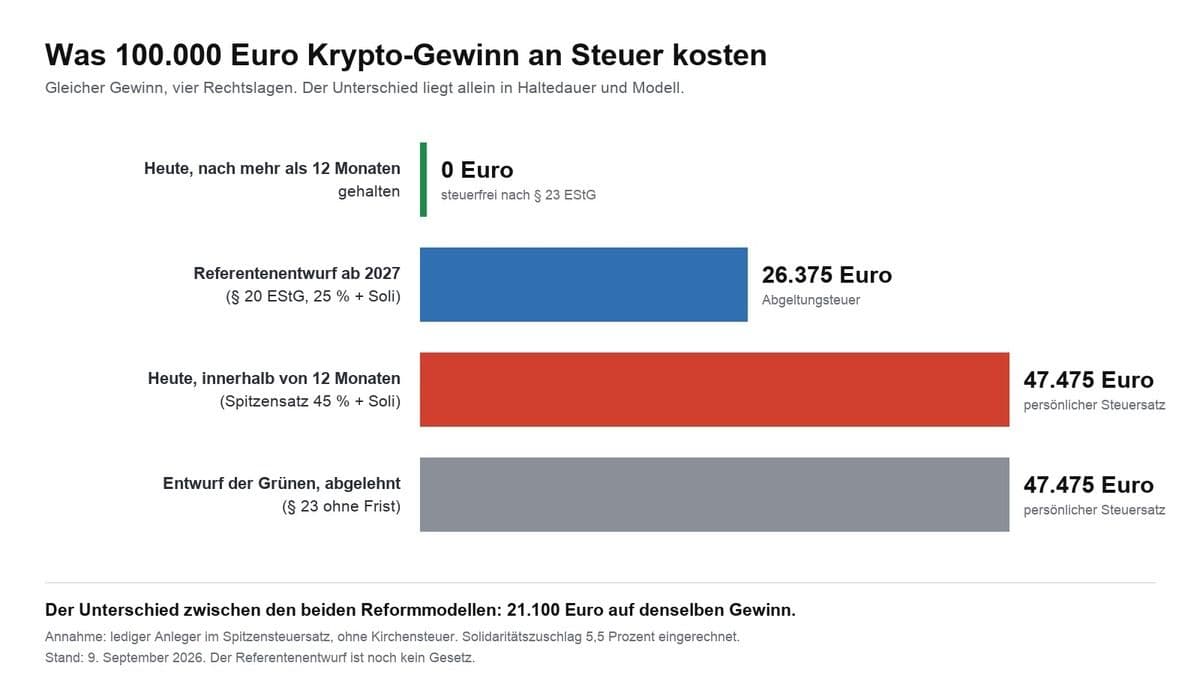
The taxation of crypto assets is currently being decided anew, and the timing of your purchase could become the decisive factor in it. A departmental draft from the Federal Ministry of Finance dated September 8, 2026 would treat crypto assets in future as income from capital assets, with flat-rate withholding tax regardless of the holding period. Under the draft this would capture only crypto assets acquired after December 31, 2026.
None of that is settled. The draft is in early coordination within the federal government, no bill is before the Bundestag, and the one-year holding period under section 23 of the Income Tax Act continues to apply unchanged. What is known about it we wrote up in detail on September 8 under the title "Crypto holding period and grandfathering".
For you, what follows from that is no rush to buy, but care in documenting. Record the date, quantity and price for every acquisition, whatever route you buy through. Should a cut-off date become law, this record is exactly what decides which regime applies to which position.
Bank or crypto exchange: the questions to settle before your first purchase
Access through your own bank has a real advantage: one interface, one login, a known counterpart for the rest of your investments. Against that stand points you have to check actively, because the familiar setting hides them.
cryptoticker.io compiled this assessment itself on September 10, 2026. It rests on the publicly available BW-Bank product page on the crypto cooperation and its Nextbroker page, plus the release of September 9, 2026. Five points were checked: tradable assets, access requirements, contractual counterparty, custody and amount limits. Not verifiable were the actual level of the transaction fee, the spread and the question of whether withdrawals to an external wallet are possible; on all three the product page gives no information.
Four questions to your bank or to the provider are therefore worth asking before your first purchase: how high is the transaction fee for the order size you are planning? How wide is the spread at the moment of execution? Is a transfer to a wallet address of your own possible? And what statement do you get at the end of the year in order to declare the transactions in the Anlage SO schedule?
Checking the BW-Bank crypto securities account: what to take away
- Settle who your counterpart is before you order. The contractual counterparty is the crypto service provider; the bank explicitly is not. Read its terms, and compare the cost frame with what a specialist trading platform charges for the same order.
- Ask about withdrawals to an address of your own. If they are not offered, your holding stays in third-party custody permanently. Anyone who wants to hold the keys themselves needs a different route for that and a suitable hardware wallet.
- Keep clean acquisition records from the start. No withholding at source means the burden of proof sits with you. A tax and portfolio tool collects the acquisition date and cost for each position while the data is still retrievable.
Sources to read up on: the BW-Bank product page on the crypto cooperation and the report of September 9, 2026 in IT-Finanzmagazin.
(As of September 10, 2026. This article is not investment advice. Prices and fee structures change; check the terms with the provider before you buy.)
Transparency note: This article was produced with the assistance of artificial intelligence and reviewed by our editorial team before publication. All figures and claims were checked against the primary sources linked in the text. The feature image was generated with AI.
More on Bitcoin: All Bitcoin news at a glance
Related articles
- Germany's savings banks start crypto trading: “When a savings bank starts is for it to decide”
- Bitcoin for Retirement: What Applies from 2027 and What You Decide Now
- Crypto holding period for Bitcoin: “That remains to be seen,” says the finance ministry
- Germany's Crypto Holding Period: What Happens Now Signing for Petition 201716 Closed on September 15
- 50 euros a month in Bitcoin, 118 instalments since 2017: savings plan vs lump sum
Which topics should we dive deeper into?
Select what genuinely interests you. Your picks feed directly into our editorial planning.
Crypto news that's actually worth your time.
Weekly. 60 seconds. Carefully curated by our editors: no hype, no promo flood, no spam.

October 3, 2026 4:40 PM

Investing in Bitcoin With a Savings Plan or a Lump Sum: What the December 31 Tax Cut-Off Changes
Anyone putting money into Bitcoin now chooses between a lump sum, a monthly instalment and an ETN in a securities account. The German finance ministry’s draft bill would keep the one-year holding period only for holdings bought by December 31, 2026.
October 6, 2026 4:32 AM
Bitcoin for a gift card: what paying with crypto means for your holding period
Paying for a gift card with Bitcoin is a sale for tax purposes. What counts as the disposal proceeds, when the twelve-month holding period bites, and the four records the tax office expects.

September 18, 2026 10:14 PM

Bitcoin Back Above $80,000: Buy More, Hold or Take Profits? What to Check Now
Bitcoin is back above $80,000, for the first time since September 7. Whether you buy more, hold or take profits depends less on the daily price than on three things you can check yourself: your holding period, the way you buy, and where your coins are kept.
September 22, 2026 1:28 PM
Selling Bitcoin and Cashing Out in Euros: How It Works in Germany
Between the sell order and the euros in your current account stand the exchange, your bank and the tax office. Knowing the order of events saves fees, waiting time and, in the best case, the entire tax on the gain.
September 27, 2026 4:12 AM
Bitcoin ETF Inflows Turn 2026 Positive: How to Tell If the Demand Holds
US spot Bitcoin ETFs took in roughly $2.4 billion in the week to September 25, the strongest week since October 2025, and that turns the 2026 year-to-date balance positive. Why the daily inflow fell 87 percent within the same week, and what to check on buying route, holding period and custody.
September 29, 2026 10:40 AM
“We have created the essential conditions …”: bitcoin.de has stood still for three months, the MiCAR licence is missing
Bitcoin Group SE published its half-year report on September 29, 2026: trading on bitcoin.de has been idle since the end of June because the MiCAR authorisation is missing. The new platform is finished, but no launch date is set.
September 9, 2026 4:22 PM
Crypto Tax in Germany: What Applies in 2026 and What Is Set to Change in 2027
Crypto gains are tax-free after twelve months; before that your personal tax rate of up to 45 percent applies. What triggers tax, how the holding period is calculated, what happens with staking and losses, and what the draft bill would change from 2027.
September 13, 2026 1:13 PM
Sparkasse Crypto Custody: Why You Get No Key to Your Bitcoin and What to Check First
From October, Sparkasse customers are to be able to buy Bitcoin and Ether inside their own banking app, with DekaBank acting as custodian. What you get is a custody position rather than a private key. What that means in practice and what you should settle before your first purchase.
September 27, 2026 1:17 PM
Dogecoin Price: What to Check on Holding Period and Custody Before the Year End
The Dogecoin price stands at $0.0977 on September 27, 2026 and has barely moved in a day. That calm is exactly the moment to work through the holding period, the reporting duty from 2026 and custody without any time pressure.
October 15, 2026 4:13 AM

Crypto holding period: the cabinet date passes without a decision, December 31 stays the cut-off
Germany's federal cabinet did not adopt the expected decision of October 14, 2026 to abolish the one-year crypto holding period; the draft is still in interdepartmental consultation. Until new rules arrive, gains stay tax free after one year of holding, and the December 31, 2026 cut-off named in the draft separates old holdings from new ones.

September 24, 2026 10:12 AM

XRP Falls 9.7 Percent: What to Check on Holding Period and Buying Route
XRP is down around 9.7 percent on the morning of September 24, twice as much as the typical large crypto asset. Our count of 18 coins shows who the pullback hits and which three things hold true regardless of the price.
September 9, 2026 4:13 PM

Bitcoin 29 Percent Below Last Year: Which Crypto Losses You Can Still Use Before the One-Year Holding Period Expires
Nine out of ten major crypto assets trade lower today than exactly twelve months ago, Bitcoin alone by 29.2 percent. We measured the price series ourselves and show why the purchase date alone decides the tax value of your loss.
October 9, 2026 1:18 PM

Bitcoin Tax: One Year Past the $126,080 Peak, Losses No Longer Count
Bitcoin trades at $82,558 on Friday morning, 34.5 percent below an all-time high that is now a good year old. Anyone who bought back then loses more than the prospect of a quick recovery when the one-year period expires: the tax value of the loss goes with it.
September 25, 2026 10:26 PM
Selling bitcoin privately: the tax in Germany and the records you need
A direct sale to a private individual falls under the same one-year rule as an exchange sale, but there is no tax report to go with it. This guide walks through the calculation, the 1,000 euro threshold and the records the tax office wants to see.
September 25, 2026 7:24 PM

Bitcoin Forecast: What to Check on Levels, Holding Period and Buying Route Before the Quarter Ends
Bitcoin stands at $83,877 at 16:40 UTC on September 25, 2026, and the measured volatility of the past 30 days spans a band of $73,600 to $94,200 for the coming month. More important than that band before the quarter ends are three checks: holding period, buying route under MiCA and the reporting duty in force since January 2026.
September 9, 2026 1:15 AM

Germany's Crypto Tax: 160 Million Euros for a 555-Billion Budget
The German finance ministry's draft bill puts a figure on the crypto tax for the first time: 160 million euros from 2028. What that number means in the 2027 federal budget, how 11.4 billion became 160 million, and what investors can read from it.
October 10, 2026 7:15 PM

ING and Bitcoin: Around 50 Crypto ETNs in the Portfolio, and What the Delivery Claim Means for Your Holding Period
Bitcoin can be bought at ING, but only as an exchange-traded note: around 50 crypto ETNs from five issuers, as a one-off purchase or a savings plan from one euro. What the offer really costs, and what the one-year holding period hangs on, is not in the advertising but in the key information document.
September 17, 2026 7:12 PM

Gifting Bitcoin to Children: Allowance, Holding Period and the Tax Office Report
Transferring Bitcoin to your child hands over your holding period and your entry price along with the coins. This guide sets out what really applies in Germany on the allowance, the reporting deadline, representation and custody.
October 19, 2026 7:22 AM

Bitcoin price at $82,769 after two days on a third of the turnover: the level that decides
Bitcoin opens the week at $82,769, 1.6 percent above Friday's close. The gain was built over two days running on a good third of the usual turnover, and that is exactly why the level at $81,501 now decides.
October 7, 2026 7:18 AM

Certificate, Bitcoin ETN or the coin itself: what each route means for tax and custody
A Bitcoin certificate, an ETN and the coin itself all lead to the same price, but to three different tax treatments and three different risks. The comparison shows which route fits your portfolio and why December 31, 2026 becomes the cut-off date.
September 24, 2026 10:11 PM

Bitcoin Price Prediction: What to Check on Levels, Holding Period and Leverage Before the October 28 Rate Decision
Bitcoin is trading at around $83,800, a third below its October 2025 high, while the sentiment index reads greed. Which dates, levels and deadlines over the coming weeks really decide your net gain, and which of them you steer yourself.
September 24, 2026 4:11 PM

Bitcoin Cash Falls 5.5 Percent After a 50 Percent Week: Check Your Buy Route, Leverage and Holding Period
Bitcoin Cash fell to $335.19 on September 24, 2026, after gaining almost 50 percent in seven days. The rally was set off by CME's announcement of September 22; what that means for buy route, leverage, holding period and custody is set out here.
September 24, 2026 4:28 AM

Crypto Trading Bots and Tax: What Applies With Thousands of Trades a Year
A bot turns one investment decision into hundreds of disposals, and the tax office counts every single one. This guide explains the holding period, FIFO, the exemption limit and the record-keeping duties, and what to set up before the bot makes its first trade.
September 20, 2026 1:11 PM

Bitcoin Golden Cross: What Twelve Signals Since 2014 Really Show
Bitcoin's 50-day line has crossed its 200-day line. We evaluated all twelve golden crosses since 2014 ourselves and measured what happened afterwards. The result argues against the common reading of the signal.
September 16, 2026 1:20 PM

Crypto Loss Carryforward in Germany: What Happens to Old Losses Under the 2027 Tax Plan
Losses from crypto sales land in a ring-fenced pot and can only be set against gains of the same kind. The draft bill for 2027 moves future gains into a different pot, and we show you what that means for your assessed carryforward and what your tax notice should say.
October 2, 2026 5:02 PM

Bitcoin or Ethereum in the fourth quarter of 2026: the two largest crypto-assets compared
Bitcoin is scarce by protocol rule, Ethereum only as scarce as its utilisation, and on access and tax in Germany the paths part again. This comparison puts the verifiable figures on supply, usage, staking and purchase route side by side, without making a price call.
September 24, 2026 4:16 AM
Trump-Xi Summit at the White House: The Crypto Positions to Check Before the Meeting
Xi Jinping is on a state visit to Donald Trump today, and the crypto market comes into the meeting carrying the gains of an exceptionally strong week. What to check on leverage, holding period and custody before the first headline runs.
More from CryptoTicker