
Crypto Holding Period and Grandfathering: Why December 31, 2026 Becomes the Cut-Off in Germany's Draft Bill
A ministerial draft bill from Germany's finance ministry names a cut-off date for the first time: crypto assets acquired after December 31, 2026 are to fall under the flat-rate withholding tax. What that means for legacy holdings, running savings plans and staking income, and why nothing has been decided yet.





Which topics should we dive deeper into?
Select what genuinely interests you. Your picks feed directly into our editorial planning.
Crypto news that's actually worth your time.
Weekly. 60 seconds. Carefully curated by our editors: no hype, no promo flood, no spam.
If you bought your crypto assets before December 31, 2026, or buy them by that date, then on the current state of the draft nothing changes for them: hold for a year, then sell tax-free. Only crypto assets acquired or received after December 31, 2026 would fall under the new treatment as investment income. That is what a draft bill from Germany's Federal Ministry of Finance dated mid-August says, first reported by WELT on September 8, 2026 and reproduced with an explicit source citation by the specialist outlet Blocktrainer. None of it has been passed into law, and those two halves together describe your position: a dated cut-off in a paper that still has the whole legislative route ahead of it.
This article sets out what the draft means for an ongoing savings plan, for staggered purchases and for coins from staking and lending, which records you should secure now, and why our own report from yesterday appears at first glance to say the opposite.
Crypto Holding Period, Grandfathering and Cut-Off Date: German Tax Law in 2026
As long as no law is in force, today's rules continue to apply unchanged. Gains from the sale of cryptocurrencies held privately are taxable under Section 23 of the German Income Tax Act (EStG) if less than a year lies between acquisition and sale. Hold for more than a year and you sell tax-free. This one-year holding period applies to Bitcoin just as it does to any other coin held privately.
For crypto investors that means, quite practically: the draft bill changes nothing about your 2026 tax return. Crypto gains you realise this year within the one-year window are still taxed at your personal income tax rate, and sales after the period has run remain tax-free. The tax change under discussion here would affect acquisitions from 2027 at the earliest.
The difference between short-term speculation and long-term holding matters, because today it decides the tax bill and the draft would level it out. That is exactly what turns the cut-off into an arithmetic problem for Bitcoin holders with large crypto positions: the value of the old rule rises with every year a position sits untouched anyway.
What the German Draft Bill Actually Lays Down on the Crypto Holding Period
A Referentenentwurf, or ministerial draft bill, is the working version of a law written by a specialist unit inside the responsible ministry before the cabinet, the Bundestag and the Bundesrat are involved at all. It is not law in force, but the first place where a political intention acquires sections and dates.
According to the WELT report, this draft contains three provisions that were not public before. First, gains from the sale of crypto assets are to be taxable in future regardless of the holding period and to fall in principle under the flat-rate withholding tax as investment income. Second, the law is to enter into force on January 1, 2027. Third, the new provisions are to cover only crypto assets acquired or received after December 31, 2026.
The reasoning the draft supplies, per the report, is remarkably sober: because of their speculative use, their high liquidity and their lack of wear, crypto assets resemble classic capital investments more than ordinary economic goods. That removes the doctrinal basis of today's treatment. Until now, Bitcoin and other coins held privately count as "other economic goods", the sale of which is a private disposal transaction under Section 23 of the Income Tax Act.
Why December 31, 2026 Is the Decisive Cut-Off Date
The one-year holding period, often called the one-year rule or speculation period, is the span between acquisition and sale after which a gain on privately held assets remains tax-free. That period hangs on the acquisition date of the individual coins, not on your sale date and not on the calendar year.
That is precisely why the cut-off in the draft acts like a dividing line straight through your portfolio. A Bitcoin you bought in March 2025 would be a legacy holding. A Bitcoin you buy on December 15, 2026 would also be a legacy holding, even though its one-year period does not run out until December 2027. A purchase on January 3, 2027 would be a new holding and therefore taxable under the draft, however long you leave it sitting.
For you that means: what counts is the day you buy, not the day the period expires. Anyone who was planning to add to their position in the first quarter of 2027 anyway now has an argument, on the current draft, for bringing that purchase forward. Anyone deciding a wealth question of that size should nonetheless keep two things apart: the cut-off sits in a draft, whereas your purchase decision is real and costs money.
A second point is often overlooked in the debate. The exemption limit of 1,000 euros for private disposal transactions under Section 23 EStG is a threshold, not an allowance: exceed it by one euro and you tax the entire gain, not just the excess. That threshold hangs on today's system. If crypto assets move into investment income, the saver's lump-sum allowance applies there instead, which covers all investment income together and which many investors already use up on interest and dividends.

Is There Grandfathering for Your Existing Holdings in Germany?
Grandfathering means, in tax law, that a new rule applies only to future circumstances and that positions already acquired are treated under the old law. On the reporting so far, the ministerial draft provides for exactly that: the federal government would forgo applying the change retroactively to existing holdings.
That is the most important substantive news in this draft, and it is the all-clear for everyone who has been holding for years. Until September 8, 2026 it was open whether legacy holdings would be protected at all. The specialist portal extraETF had explicitly called the question unresolved in July and named grandfathering "the most important question for many investors". The draft answers it for the first time with a date.
Legally the route is an obvious one. Protection of legitimate expectations is a constitutional principle that permits burdensome retroactivity only within narrow limits, and the legislator has already applied it in comparable reforms. When the flat-rate withholding tax was introduced in 2009, legacy holdings of shares and funds stayed under the old speculation period. The parallel is no guarantee, but it explains why a draft with a cut-off is more likely than a reform that reaches back over everything.
When Would the Crypto Holding Period End, and When Would Withholding Start?
The draft separates two dates that regularly get conflated in public debate. The law itself is to enter into force on January 1, 2027. The actual withholding at source, where crypto service providers deduct the tax directly and pass it to the tax office, is not to begin until January 2028 according to the report.
That transition period is not generosity but a technical concession. An exchange can only withhold correctly if it knows when and at what price you acquired your coins. For holdings deposited from your own wallet or from another platform, it does not know. The draft therefore provides that service providers may partly rely on your own statements of acquisition date and acquisition cost.
And if those details cannot be established? Then a flat assessment base is to apply: withholding on 50 percent of the proceeds from the sale. What is meant is not a tax rate of 50 percent, but the assumption that half your sale proceeds were gain. Sell a position with a small price gain and produce no records, and you would pay considerably too much tax and have to claim the money back through your tax return. That is the real reason your acquisition records are worth money from now on.
What the Cut-Off Means for Your Running Bitcoin Savings Plan
A savings plan does not buy once but every month, and each of those executions is a separate acquisition with its own date. If your savings plan runs across the 2026/2027 turn of the year, on the current draft it splits into two groups: every instalment up to and including December 2026 would be a legacy holding with a holding period, every instalment from January 2027 a new holding under the flat-rate withholding tax.
In practice that mainly means bookkeeping. On a sale, crypto assets in the same wallet are usually treated on the FIFO principle, under which the coins bought first count as sold first. When two tax regimes sit side by side, the allocation decides whether a sale is tax-free or subject to the withholding tax. We worked through how holding period, FIFO and the exemption limit interact with monthly purchases in detail in our guide to the Bitcoin savings plan and tax.
A clean record of your purchases is therefore no longer just diligence for the tax return, but the proof of which pot a position belongs in. Anyone who would rather not keep that in a spreadsheet will find programs in our comparison of crypto tax tools and portfolio trackers that pull acquisition data from the exchanges automatically and allocate FIFO sales correctly.
Staking, Lending and Airdrops: What Arrives Counts From the Cut-Off
On the reporting, the draft covers more than purchases. Income from classic lending, that is, lending coins out at interest, and from passive staking, where you pledge coins to secure a network and receive new units in return, is to be taxed as investment income in future. A transitional rule tied to the same cut-off is evidently envisaged for that as well: it covers crypto assets received after December 31, 2026.
The difference from a purchase lies in the word "received". A staking reward has no purchase date that you choose yourself; what counts is the day the units land within your power of disposal. Anyone who leaves their rewards sitting in the contract for months and only claims them later may thereby push the receipt beyond the cut-off. Whether that reading holds depends on the final version of the law and on the question of when power of disposal arises for tax purposes. For a decision on larger amounts, that is a case for a tax adviser, not for a rule of thumb.

Which Crypto Assets the Draft Expressly Excludes
The new category the draft is built around is called "exchange crypto assets" in the report. Not every digital asset falls under it. Excluded are to be, among others, non-fungible tokens, that is, non-interchangeable tokens representing a single digital object, plus security tokens, which digitally represent a securitised right such as a bond or a share, as well as other crypto assets intended to convey a real-world value. Certain stablecoins are also not to fall into the new category.
This delimitation is more than a footnote, because it helps decide which part of your portfolio would be affected at all. At the same time it is the point at which a draft, in experience, changes most in the further procedure: definitions that include or exclude an entire asset class attract the most comments during consultation.

Why Our Report From Yesterday Says Something Different, and Both Are True
On September 7, 2026 we reported that the Income Tax Reform Act 2027, which the federal cabinet waved through on September 2, leaves Section 23 EStG untouched and that the crypto holding period therefore stays for now. That was correct and remains so. A cabinet decision concerns precisely the law that is on the table, and that law said nothing about the holding period.
The ministerial draft at issue here is a different paper from a different procedural stage. According to the report it is in what is known as early coordination, that is, in the early alignment between the Federal Chancellery and the ministries involved, and it was not the subject of the cabinet decision on September 2. Two statements that appear to contradict each other therefore describe two different processes.
This double track is typical of crypto taxation in Germany and the reason why headlines on the subject so often stand against one another. The political intention has been documented since the government draft of the 2027 federal budget, which Finance Minister Lars Klingbeil explained himself at the federal press conference in July 2026. The route there runs through several legislative projects in parallel, and only one of them carries the crypto rules at any given moment.
A simple sequence helps in placing it. At the start stood the budget draft with the announced crypto tax reform. Out of that comes a ministerial draft inside the ministry, as now documented for mid-August 2026. Out of that, after inter-ministerial coordination, comes a government bill adopted by the cabinet, and only that goes to the Bundestag and Bundesrat as a bill. Each of those stages can still shift deadlines, definitions and the grandfathering.
Anyone wanting to gauge the consequences for their own crypto gains should therefore not read every headline as a decision, but pay attention to which stage a report is describing. We are following this procedure further in our crypto taxation cluster and recording the dates there.
Will There Be a Crypto Tax in Germany From 2027?
A crypto tax as a levy of its own does not exist and is not to exist under the draft either. What would change is the classification: away from private disposal transactions under Section 23 EStG, towards investment income with flat-rate withholding tax. Gains from crypto are already taxable today if you sell within a year and exceed the exemption limit.
For the question of whether the new rules from 2027 affect you at all, only one thing counts: the acquisition date of your coins. If they do affect you, the effect would cut both ways. The flat-rate withholding tax with its uniform rate can be cheaper than the personal income tax rate that a sale within the one-year window triggers today. The tax exemption after one year, which legacy holdings would keep, beats both.
What You Should Document by December 31, 2026
Whether or not the draft becomes law, one thing gains value in every scenario: a complete record of when you acquired what and at what price. If the cut-off becomes law, that date decides the pot. If it does not, you need the same records for the holding period.
So secure the complete transaction histories of every exchange you use as a file on your own computer, still this year. Platforms do not reliably provide old data after a change of provider or an account closure, and for holdings in your own wallet there is no body keeping it for you in any case. Record the acquisition date, quantity, acquisition cost in euros and the origin for each position, and document every transfer between your own addresses so that a move does not later look like a sale.
How seriously the legislator takes this subject is shown by a second front: through the European reporting obligations, the tax authorities are receiving increasing amounts of data from the platforms anyway. Anyone who knows their own figures can explain discrepancies. Anyone who does not is dependent on whatever the exchange has reported.
Crypto Holding Period and the December 31, 2026 Cut-Off: What to Take Away
- Check which of your positions fall before the cut-off. Pull the acquisition dates together from every exchange and wallet and mark everything bought before December 31, 2026. A tool from our comparison of crypto tax tools and portfolio trackers takes the collecting off your hands and allocates FIFO sales automatically.
- Decide deliberately about planned purchases for next year. If you wanted to add to your position in 2027 anyway, then on the current draft the question of bringing the purchase forward is a tax question, not a speculative one. How staggered purchases can be implemented is set out in our comparison of Bitcoin savings plans.
- Secure your records where you keep them. Download the complete transaction histories of your trading venues before accounts or providers change. Which platforms supply usable exports is shown by our crypto exchange comparison.
The draft is a working version, not a law. Until it is passed, a good deal can still change both on the abolition of the holding period and on grandfathering. What does not change is the value of clean acquisition data.
Sources for further reading: the report by the specialist outlet Blocktrainer on the ministerial draft of September 8, 2026, which reproduces the WELT report, and the assessment of the government draft of the 2027 federal budget at extraETF.
(As of September 8, 2026. This article is not investment advice. Prices and fee structures change; check the terms with the provider before you buy.)
Transparency note: This article was produced with the assistance of artificial intelligence and reviewed by our editorial team before publication. All figures and claims were checked against the primary sources linked in the text. The feature image was generated with AI.
Related articles
- Bitcoin 29 Percent Below Last Year: Which Crypto Losses You Can Still Use Before the One-Year Holding Period Expires
- Germany’s Crypto Holding Period Is Wobbling: What to Check Before December 31
- Crypto holding period for Bitcoin: “That remains to be seen,” says the finance ministry
- Crypto holding period: the cabinet date passes without a decision, December 31 stays the cut-off
- Germany's Crypto Holding Period: What Happens Now Signing for Petition 201716 Closed on September 15
Which topics should we dive deeper into?
Select what genuinely interests you. Your picks feed directly into our editorial planning.
Crypto news that's actually worth your time.
Weekly. 60 seconds. Carefully curated by our editors: no hype, no promo flood, no spam.

September 16, 2026 1:20 PM

Crypto Loss Carryforward in Germany: What Happens to Old Losses Under the 2027 Tax Plan
Losses from crypto sales land in a ring-fenced pot and can only be set against gains of the same kind. The draft bill for 2027 moves future gains into a different pot, and we show you what that means for your assessed carryforward and what your tax notice should say.
October 2, 2026 1:33 PM

Crypto tax before the cabinet on October 14: “Comments are only possible until October 6”
Germany's Federal Ministry of Finance sent the draft bill on crypto taxation to the associations on September 30, 2026, and the cabinet is to decide on October 14. For your holdings one date counts above all: December 31, 2026.
September 7, 2026 7:22 AM

German Crypto Holding Period Set to Go After All: A Separate Draft Targets Purchases From 2027
Correction of 8 October 2026: The Income Tax Reform Act 2027, adopted by the German federal cabinet on 2 September, does not cover crypto assets. That did not mean the holding period stays. A separate draft bill from the Federal Ministry of Finance, dated 30 September, would abolish it for anything acquired after 31 December 2026. The cabinet is due to decide on 14 October.
September 24, 2026 1:13 AM

Solana DEX Trades Overtake the NYSE: What to Check on Swaps, Tax and Oversight
Solana's decentralised exchanges settled roughly 208 million trades in a single week and overtook the New York Stock Exchange for the first time. The figure is real, but it measures something other than the comparison suggests, and for German investors it carries tax duties that no provider takes on.
October 6, 2026 4:32 AM

Bitcoin for a gift card: what paying with crypto means for your holding period
Paying for a gift card with Bitcoin is a sale for tax purposes. What counts as the disposal proceeds, when the twelve-month holding period bites, and the four records the tax office expects.
October 19, 2026 4:15 AM

Crypto FIFO across several exchanges: each wallet counts on its own in Germany
Hold bitcoin on several exchanges and in wallets of your own, and the holding period is calculated per pot, not across the total holding. What paragraph 62 of the BMF guidance orders, and why 31 December 2026 hangs on it.
September 25, 2026 10:26 PM

Selling bitcoin privately: the tax in Germany and the records you need
A direct sale to a private individual falls under the same one-year rule as an exchange sale, but there is no tax report to go with it. This guide walks through the calculation, the 1,000 euro threshold and the records the tax office wants to see.

September 27, 2026 1:17 PM
Dogecoin Price: What to Check on Holding Period and Custody Before the Year End
The Dogecoin price stands at $0.0977 on September 27, 2026 and has barely moved in a day. That calm is exactly the moment to work through the holding period, the reporting duty from 2026 and custody without any time pressure.
August 21, 2026 1:42 PM

Writing Off a Total Crypto Loss: When the Tax Office Recognises Worthless Coins
A token that has collapsed only reduces your tax once you actually dispose of it. What applies to delisting, exchange insolvency and worthless holdings under Section 23 of the German Income Tax Act, and how you offset losses.
October 9, 2026 1:18 PM

Bitcoin Tax: One Year Past the $126,080 Peak, Losses No Longer Count
Bitcoin trades at $82,558 on Friday morning, 34.5 percent below an all-time high that is now a good year old. Anyone who bought back then loses more than the prospect of a quick recovery when the one-year period expires: the tax value of the loss goes with it.
August 21, 2026 4:24 AM

Forced Sale on a Crypto Exchange: Which Moment Counts for the Holding Period and What You Must Document
At Luno, Kraken and Valour the deadlines are running out, after which the provider realises the remaining holding itself. For tax purposes that is a disposal, and what governs it is the exchange's timestamp.
August 11, 2026 9:13 PM

Germany's Crypto Holding Period Faces Abolition: What Petition 201716 and the Draft Bill Mean for Your Tax
Petition 201716 calls for the one-year holding period for crypto assets to be kept and will be heard in public by the Bundestag's Petitions Committee on 12 October 2026. Correction of 8 October: the reform was not decided by the cabinet in July. A draft bill of 30 September would end the holding period for crypto acquired after 31 December 2026, and the cabinet is due to take it up on 14 October.
September 16, 2026 7:12 PM

Borrowing Against Bitcoin Instead of Selling: When German Tax Still Applies
Posting Bitcoin as collateral for a loan is not a sale in Germany, because section 39 of the Fiscal Code keeps the coins attributed to you for tax purposes. Tax arises only when the collateral is liquidated, and then the one thing that decides the bill is how long you held the coins beforehand.
October 6, 2026 10:24 PM

Germany's Crypto Holding Period Before the Petitions Committee on October 12: What Matters Now
The Bundestag's petitions committee debates the crypto holding period on Monday, October 12, 2026, from 12 noon in a public sitting, with federal government representatives on hand for questions. Two days later the cabinet is to decide on the draft bill that removes the one-year period for purchases from 2027.
September 17, 2026 10:22 PM

Selling Bitcoin at a Loss and Buying It Straight Back: What That Does to Your Holding Period
Germany has no wash sale rule: the loss stays deductible even if you buy back immediately. The buyback, however, restarts the one-year period for every new unit.
September 9, 2026 1:15 AM

Germany's Crypto Tax: 160 Million Euros for a 555-Billion Budget
The German finance ministry's draft bill puts a figure on the crypto tax for the first time: 160 million euros from 2028. What that number means in the 2027 federal budget, how 11.4 billion became 160 million, and what investors can read from it.
September 9, 2026 4:22 PM
Crypto Tax in Germany: What Applies in 2026 and What Is Set to Change in 2027
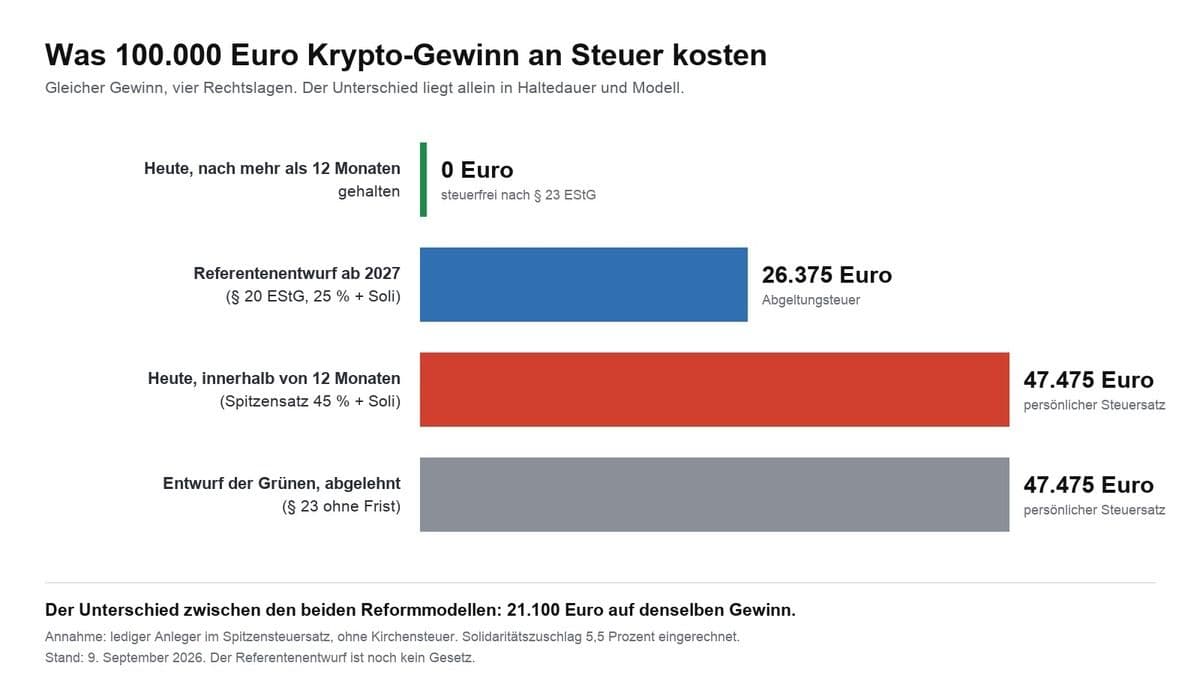
Crypto gains are tax-free after twelve months; before that your personal tax rate of up to 45 percent applies. What triggers tax, how the holding period is calculated, what happens with staking and losses, and what the draft bill would change from 2027.
August 12, 2026 6:24 PM

Tokenized Stocks and Tax in Germany: When the One-Year Holding Period Applies and When the Flat Tax Bites
If you buy a tokenized stock, you often apply the crypto rule: hold for a year, then the gain is tax-free. For these products that assumption usually does not hold, and this article shows from the wording of the law which feature decides the tax regime and how to find it in the issuer documents.
September 19, 2026 7:26 AM

Offsetting Crypto Losses Against Share Gains: What Is Really Allowed in Germany
Crypto losses and share gains sit in separate loss buckets in Germany, and there is no offsetting between them. Where the line runs, why crypto derivatives are the exception, and how you can still use losses through carryback and carryforward.
September 22, 2026 10:13 AM

Circle Lends Against Bitcoin via cirBTC: Why the Wrapper Can Cost You the German Holding Period
Circle launched loans against deposited bitcoin on September 21, 2026. In Germany, the detour through the cirBTC token is very likely a swap, and a swap restarts your one-year holding period.
September 24, 2026 10:19 PM

Bitcoin for Retirement: What Applies from 2027 and What You Decide Now
Bitcoin is not permitted in any state-subsidised retirement product, including the new retirement savings account from 2027. Anyone who still wants to use crypto assets for their own pension goes through private assets, and there a cutoff date at the end of 2026 is shifting the tax rules right now.
October 5, 2026 4:26 PM

Shiba Inu price up 4.4 percent: outperforms the market, but 88 trillion SHIB sit on exchanges
Shiba Inu adds 4.4 percent on Monday, making it the strongest of the six big names. At the same time 88.08 trillion SHIB worth $525 million sit on trading venues, almost five times a single day of turnover.
October 5, 2026 10:14 AM

Solana price 108.46 euros: a 2.4 percent gain in euros, a 2.5 percent loss in dollars: what to check now
Solana is quoted at 108.46 euros and $121.30 on Monday morning. That leaves a gain of 2.4 percent for 2026 in euros and a loss of 2.5 percent in dollars. The difference comes purely from the exchange rate, and in Germany it decides the holding period, the tax threshold and the figure that ends up on the tax return.

September 24, 2026 10:19 AM

Uniswap Falls 11.8 Percent After a 114 Percent Month: What to Check on Profit Taking, Holding Period and Leverage
UNI lost 11.75 percent on Wednesday morning but is still up 113.85 percent over the month. Anyone realising gains now almost certainly triggers a taxable disposal in Germany.
October 8, 2026 4:17 AM

Crypto Holding Period: Without a Purchase Record the Tax Withheld Runs Ten Times Too High
The consultation on Germany's crypto tax bill closed on October 6 and the cabinet is to adopt it on October 14, with tax advisers, banks and the Bitcoin Bundesverband having filed their objections. The sharpest concerns everyone whose purchase data the selling platform does not hold: one adviser calculates a withholding ten times the tax owed.
October 1, 2026 7:36 PM

Crypto tax and withholding at source from 2028: what to check now
The German Federal Ministry of Finance’s draft bill goes to cabinet on October 14, 2026. The underexposed part of it is the deduction of tax from 2028: which providers are to withhold the tax on investment income, why self-custody and foreign platforms stay exempt from it, and what you should document by December 31.
August 31, 2026 10:30 PM

Taxing Crypto Lending: Your Personal Rate Instead of Withholding Tax, and the Right Federal Fiscal Court Case Number
According to the only tax court ruling so far, income from crypto lending falls under Section 22(3) of the German Income Tax Act and therefore under your personal tax rate. The appeal is pending at the Federal Fiscal Court under VIII R 22/25, not under the case number given in many professional articles.
More from CryptoTicker