
Crypto Futures Tax in Germany: 25 Percent From the First Trade, No One-Year Rule
Crypto futures and perpetuals fall under Section 20 of the German Income Tax Act and therefore a flat 26.375 percent, with no holding period and no 1,000-euro exemption. Since the Annual Tax Act 2024, losses on them can again be offset without limit.




Which topics should we dive deeper into?
Select what genuinely interests you. Your picks feed directly into our editorial planning.
Crypto news that's actually worth your time.
Weekly. 60 seconds. Carefully curated by our editors: no hype, no promo flood, no spam.
Crypto futures and perpetuals are taxed in Germany under rules that have nothing to do with spot trading. A gain on a forward transaction counts as investment income and is charged at 25 percent income tax plus the solidarity surcharge. The one-year rule that makes a held Bitcoin tax-free after twelve months does not exist there. Trade a perpetual and you pay from the first closed position, and in return, since the Annual Tax Act 2024, you can again offset losses against other investment income without limit.
That split costs money if you only notice it when filing. Two separate loss-offsetting pools mean one thing: a loss on your leveraged account does not reduce the gain on coins you sold, even when both arose on the same platform and both were bets on the same price. What follows is the split in detail, with the sections of law your tax office relies on, and with a side-by-side calculation showing when the forward transaction actually comes out ahead of the spot purchase.
Two Tax Regimes: Section 20 EStG for Futures, Section 23 EStG for Spot
A coin you buy and the leveraged contract on that same coin are two different things for tax purposes. A crypto asset you buy and sell again is an other asset within the meaning of Section 23 (1) sentence 1 no. 2 of the German Income Tax Act. That is where the one-year rule sits: if no more than a year passes between acquisition and disposal, the gain is a private disposal transaction and taxable. Beyond that, it goes untaxed.
A future or a perpetual is not an asset you acquire and hold. It is a contract on a price difference, and it belongs in the catalogue of Section 20 (2) of the German Income Tax Act. Sentence 1 no. 3 letter a expressly names the gain “on forward transactions through which the taxpayer obtains cash settlement or a monetary amount or benefit determined by the value of a variable reference figure”. That describes a perpetual precisely: you receive or pay the difference between entry and exit price without ever owning the coin.
Forward transaction here means any contract whose performance lies in the future and whose value derives from a reference figure, in this case the price of the underlying. That the underlying is a cryptocurrency rather than a share changes nothing about the classification. How the European supervisor classifies perpetuals, and which leverage caps follow from that, we set out in our piece on the MiFID classification of perpetuals.
Cash Settlement Makes a Perpetual a Forward Transaction
A classic future has an expiry date. A perpetual has none, and that raises the question of whether the classification still holds. It does hold, because the law turns on cash settlement and not on an expiry date: what matters is the mechanism through which your gain arises. A perpetual tracks the spot price through the funding rate, a payment that flows between the long and short side at short intervals. The contract runs on, yet settlement is always in money and never in coins.
For your tax return that means every closed trade is a completed event with a result. There is no holding period that improves anything, and no point from which the gain becomes tax-free. A position closed after four minutes and one closed after four months are treated alike. To see how these platforms are built and who holds the keys, start with our explainer on what a perp DEX is.
25 Percent Flat Tax, Solidarity Surcharge and Church Tax
Section 32d (1) sentence 1 EStG sets income tax on investment income at 25 percent. On top comes the solidarity surcharge of 5.5 percent on that tax, which puts the total burden at 26.375 percent. One point matters here: the solidarity surcharge is still due on investment income, including for incomes that long ago fell below the threshold on wages.
If you are liable for church tax, the law calculates differently from what many expect. The 25 percent is reduced under sentence 3 by one quarter of the church tax, and sentence 4 provides the formula. At a church tax rate of 9 percent, a gain of 10,000 euros produces 2,444.99 euros in income tax, 134.47 euros in solidarity surcharge and 220.05 euros in church tax, together 2,799.51 euros, or roughly 28.0 percent. Without church tax it stays at 2,637.50 euros.

No Holding Period and No 1,000-Euro Exemption on Forward Transactions
Two reliefs that make spot trading attractive in Germany do not apply to leveraged trading. The first is the one-year rule in Section 23 EStG. The second is the 1,000-euro exemption threshold in Section 23 (3) sentence 5: gains from private disposal transactions stay tax-free if total gains in the calendar year came to less than 1,000 euros. Both apply solely to assets, meaning the coin you bought, and never to the contract on it.
Their place in the investment income regime is taken by the saver's allowance of 1,000 euros under Section 20 (9) EStG, or 2,000 euros for jointly assessed spouses. The difference is larger than the identical figure suggests. The spot exemption falls away entirely once you exceed it; at a gain of 1,000 euros the full amount is taxable. The saver's allowance, by contrast, survives as a deduction and is still subtracted at 50,000 euros of investment income. It does cost you the deduction of actual expenses, and for active traders that is the more painful half of the rule.
 Compare perp DEXs and trading fees
The 20,000-Euro Cap on Forward Transactions Has Gone From the Law
From 2021 to 2024 a rule applied that made leveraged trading dangerous in tax terms: losses from forward transactions could only be offset against gains from forward transactions up to 20,000 euros a year, with the remainder carried into future years. Anyone who made 100,000 euros and lost 100,000 euros in the same year paid tax on 80,000 euros, even though nothing was left at the end of it. The Federal Fiscal Court held this restriction to be constitutionally doubtful in a decision of 7 June 2024.
That cap is no longer in the law today. The Annual Tax Act 2024 deleted the former sentence 5 of Section 20 (6) EStG, and not only for the future. Section 52 (28) EStG has since carried the sentence that the old version “is no longer to be applied to any open cases”. The same goes for the then sentence 6, which capped losses from bad debts at 20,000 euros. If you still have an open assessment for a past year, through an appeal or a provisional review, the new rule covers you.
Today's Section 20 (6) EStG carries only two restrictions: losses on share sales stay in their own pool, and losses subject to withholding tax require a loss certificate under Section 43a. Forward transactions no longer appear there. For perpetual traders that is the most important change of recent years, and it regularly gets lost in the coverage of holding periods.
Losses on Perpetuals Never Meet Gains From Sold Coins
One hurdle remains, and it is higher than the one that was deleted. Section 20 (6) sentence 1 EStG prohibits offsetting losses from investment income against income from other categories. Gains on sold coins are such other income, namely other income under Section 22 in conjunction with Section 23 EStG. Between your leveraged account and your spot holdings stands a wall that is solid in both directions.
Take an example with round numbers. You lose 8,000 euros on perpetuals and in the same year sell Ethereum at a gain of 8,000 euros after a four-month holding period. In economic terms you are flat. In tax terms the 8,000 euros of spot gain remain fully taxable at your personal rate, and the loss on the forward transaction sits as a carry-forward within investment income until you make gains there again. The reverse holds too: a spot loss does not reduce your tax on perpetual gains. Which losses can be set against which gains, we broke down in detail for offsetting crypto losses against share gains.
Our assessment: the tax rate argues for the forward transaction more often than investors assume, but the offsetting rules argue against it. On a gain of 10,000 euros at a personal tax rate of 42 percent, the spot sale within the one-year period costs 4,200 euros and the perpetual gain 2,637.50 euros, a difference of 1,562.50 euros in favour of the leveraged product. Past the one-year mark the relationship flips completely: the held coin costs nothing, the contract still 26.375 percent. Against that stand the separate offsetting pools, which turn expensive in a losing year, and the fact that a leveraged contract wipes out the whole stake on liquidation. Long-term holders are better placed in spot for tax; traders who are short-term anyway and realise gains within weeks often pay less on forward transactions. Which platform charges what, our perp DEX comparison shows.
Funding Payments, Fees and the Lost Deduction for Expenses
Leveraged trading brings running costs that spot trading does not: funding payments, trading fees on both sides of the trade and, on margin positions, interest on borrowed capital. Section 20 (9) EStG governs these within investment income, and it is worded without mercy: the saver's allowance is deducted as expenses, and “the deduction of actual expenses is excluded”.
Pay 6,000 euros in funding and fees over a year and you cannot claim 6,000 euros; you get a flat 1,000 euros. This is the point where active traders fare worse on forward transactions than in spot, where incidental acquisition costs feed into the calculation of the gain. Trading venues usually net fees and funding directly into the result of the position, so that they reduce the taxable gain without being expenses at all. Whether your provider works that way decides several hundred euros a year, and it is set out in their settlement logic rather than in the statute. Capital borrowed against coins as collateral follows its own logic, because there the coin stays in your holdings.

Annex KAP Instead of Annex SO: Offshore Venues Withhold Nothing
If your provider has a domestic paying agent, it deducts withholding tax and remits it to the tax office. Most perpetual platforms do not. There the gain reaches you gross, and you owe the tax all the same. It is declared in Annex KAP of the income tax return, in the lines for investment income without tax deducted. Gains on sold coins belong in Annex SO instead.
Two forms for two regimes mean double care over records. For the spot side the tax office expects an allocation under the FIFO principle, under which the coins bought first count as sold first and determine the holding period. Forward transactions have no holding period and therefore no FIFO question, but you do need to document every closed position individually with its result. Since the national implementation of the European reporting obligation, crypto service providers report transactions to the tax authorities, which raises the odds that discrepancies get noticed. How to clean up an automated trading account for tax, we described for trading bots and their tax treatment.
 Find the right crypto tax tool
Commercial Trading: When Private Trading Becomes a Business
Section 20 (8) EStG makes clear that investment income is attributed to a business where it belongs there. Neither the 25 percent nor the saver's allowance then applies; the personal tax rate does, plus trade tax and an obligation to keep accounts. The line runs between private asset management and trading that organises itself like a company.
Private investors deploying their own money on their own accounts normally stay within asset management, even with many trades a year. It looks different as soon as third-party capital is managed, infrastructure is run for others, or the trader presents itself outwardly as a service provider. Because the consequences are large and the dividing line turns on the individual case, this question belongs with a tax adviser rather than in a self-assessment.
Four Records for Your Trading Log
Your tax return is only as solid as the paperwork beneath it, and with perpetuals no German paying agent delivers a finished annual statement. What you should export from your account and keep:
- Every closed position individually, with opening and closing time, direction, size and realised result. A monthly total from the platform will not do when the tax office asks.
- Funding payments shown separately, because they reduce or increase your result, and that depends on whether they sit inside the position or alongside it.
- Trading fees per trade, for the same reason, and in case you have to justify treating them as part of the result.
- The conversion into euros at the relevant moment, if your account is denominated in dollars or a stablecoin. What is taxable is the euro amount, not the account balance in USDT.
- Liquidations with timestamps, because a forced close is a realised loss and belongs in the offsetting calculation, not in your memory.
For the spot part of your portfolio you also need the acquisition data for the FIFO principle. The two data sets drifting apart is the most common reason a clean return costs days rather than hours at year end.
Crypto Futures Tax: Two Pots the Tax Office Never Connects
The split between Section 20 and Section 23 EStG is the rule from which everything else follows: the flat 26.375 percent, the missing holding period, the separate offsetting and Annex KAP. Three steps to put this in order before the turn of the year:
- Pull your annual statement separately for both areas. Perpetual results belong in Annex KAP, coin sales in Annex SO. A tax tool with a portfolio tracker separates them if you import both accounts.
- Check your open losses from 2021 onwards. If an assessment for a year is still open, the deletion of the 20,000-euro cap applies retroactively, and a carry-forward may come out higher than previously determined. Where to trade in future and at what fees, our perp DEX comparison shows.
- Choose deliberately between contract and coin. Hold for more than a year and spot is tax-free; trade short term and the forward transaction often costs less than your personal rate. Interest on lent holdings follows a third rule again, set out in our lending comparison.
A leveraged contract can wipe out your stake completely, and the tax rule does nothing to change that.
(As of October 12, 2026. This article is not investment advice. Prices and fee structures change; check the terms with the provider before you buy.)
Frequently asked questions about crypto futures tax
Transparency note: This article was produced with the assistance of artificial intelligence and reviewed by our editorial team before publication. All figures and claims were checked against the primary sources linked in the text. The feature image was generated with AI.
Related articles
- Solana DEX Trades Overtake the NYSE: What to Check on Swaps, Tax and Oversight
- Offsetting Crypto Losses Against Share Gains: What Is Really Allowed in Germany
- Using Hyperliquid from Germany: What Applies to Your Funds Without a MiCA Licence
- Taxing Crypto Lending: Your Personal Rate Instead of Withholding Tax, and the Right Federal Fiscal Court Case Number
- Crypto Holding Period and Grandfathering: Why December 31, 2026 Becomes the Cut-Off in Germany's Draft Bill
Which topics should we dive deeper into?
Select what genuinely interests you. Your picks feed directly into our editorial planning.
Crypto news that's actually worth your time.
Weekly. 60 seconds. Carefully curated by our editors: no hype, no promo flood, no spam.

August 21, 2026 1:42 PM

Writing Off a Total Crypto Loss: When the Tax Office Recognises Worthless Coins
A token that has collapsed only reduces your tax once you actually dispose of it. What applies to delisting, exchange insolvency and worthless holdings under Section 23 of the German Income Tax Act, and how you offset losses.
September 16, 2026 7:12 PM

Borrowing Against Bitcoin Instead of Selling: When German Tax Still Applies
Posting Bitcoin as collateral for a loan is not a sale in Germany, because section 39 of the Fiscal Code keeps the coins attributed to you for tax purposes. Tax arises only when the collateral is liquidated, and then the one thing that decides the bill is how long you held the coins beforehand.
September 7, 2026 7:22 AM

German Crypto Holding Period Set to Go After All: A Separate Draft Targets Purchases From 2027
Correction of 8 October 2026: The Income Tax Reform Act 2027, adopted by the German federal cabinet on 2 September, does not cover crypto assets. That did not mean the holding period stays. A separate draft bill from the Federal Ministry of Finance, dated 30 September, would abolish it for anything acquired after 31 December 2026. The cabinet is due to decide on 14 October.
September 17, 2026 7:12 PM

Gifting Bitcoin to Children: Allowance, Holding Period and the Tax Office Report
Transferring Bitcoin to your child hands over your holding period and your entry price along with the coins. This guide sets out what really applies in Germany on the allowance, the reporting deadline, representation and custody.
October 6, 2026 4:32 AM
Bitcoin for a gift card: what paying with crypto means for your holding period
Paying for a gift card with Bitcoin is a sale for tax purposes. What counts as the disposal proceeds, when the twelve-month holding period bites, and the four records the tax office expects.
September 8, 2026 1:19 AM

Germany's Crypto Holding Period: What Happens Now Signing for Petition 201716 Closed on September 15
Recap as of September 27, 2026: the signature period for German parliamentary petition 201716, which asks for the one-year crypto holding period to be preserved, closed on September 15, 2026. This article explains what ended that day, how the petitions committee proceeds and why no investor has to sell because of it.
September 9, 2026 4:22 PM
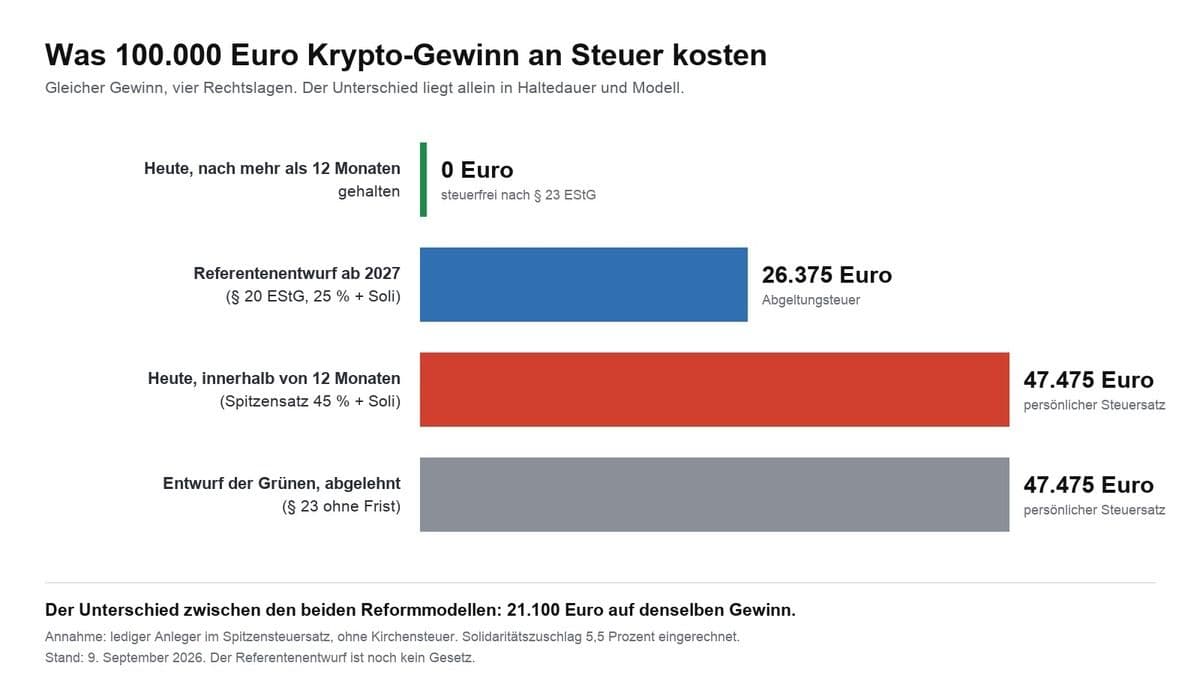
Crypto Tax in Germany: What Applies in 2026 and What Is Set to Change in 2027
Crypto gains are tax-free after twelve months; before that your personal tax rate of up to 45 percent applies. What triggers tax, how the holding period is calculated, what happens with staking and losses, and what the draft bill would change from 2027.
September 25, 2026 10:26 PM

Selling bitcoin privately: the tax in Germany and the records you need
A direct sale to a private individual falls under the same one-year rule as an exchange sale, but there is no tax report to go with it. This guide walks through the calculation, the 1,000 euro threshold and the records the tax office wants to see.
September 9, 2026 1:15 AM

Germany's Crypto Tax: 160 Million Euros for a 555-Billion Budget
The German finance ministry's draft bill puts a figure on the crypto tax for the first time: 160 million euros from 2028. What that number means in the 2027 federal budget, how 11.4 billion became 160 million, and what investors can read from it.
September 9, 2026 4:13 PM

Bitcoin 29 Percent Below Last Year: Which Crypto Losses You Can Still Use Before the One-Year Holding Period Expires
Nine out of ten major crypto assets trade lower today than exactly twelve months ago, Bitcoin alone by 29.2 percent. We measured the price series ourselves and show why the purchase date alone decides the tax value of your loss.
September 26, 2026 1:19 AM

Germany’s Crypto Holding Period Is Wobbling: What to Check Before December 31
A CDU member of the Bundestag makes it plain: the coalition agreement does not guarantee that the one-year holding period for crypto assets will survive. What that means for purchases made before the planned cutoff date of December 31, 2026.
August 11, 2026 5:24 PM

Perp DEX Explained: How Funding Rate, Liquidation and Taxes Work on Perpetual Futures
Perpetual contracts run without an expiry date, and in exchange you pay funding for as long as you hold them. This article explains the mechanics behind perp DEX, the liquidation thresholds and the regulatory and tax framework in Germany.
October 1, 2026 7:36 PM

Crypto tax and withholding at source from 2028: what to check now
The German Federal Ministry of Finance’s draft bill goes to cabinet on October 14, 2026. The underexposed part of it is the deduction of tax from 2028: which providers are to withhold the tax on investment income, why self-custody and foreign platforms stay exempt from it, and what you should document by December 31.
September 11, 2026 10:18 AM

Bitcoin Tax Audit: What Proof Austria Requires
Which bitcoin records can the Austrian tax office examine? Purchase dates, wallet transfers, acquisition costs and sale proceeds are what count.
October 9, 2026 1:18 PM

Bitcoin Tax: One Year Past the $126,080 Peak, Losses No Longer Count
Bitcoin trades at $82,558 on Friday morning, 34.5 percent below an all-time high that is now a good year old. Anyone who bought back then loses more than the prospect of a quick recovery when the one-year period expires: the tax value of the loss goes with it.
August 21, 2026 4:24 AM

Forced Sale on a Crypto Exchange: Which Moment Counts for the Holding Period and What You Must Document
At Luno, Kraken and Valour the deadlines are running out, after which the provider realises the remaining holding itself. For tax purposes that is a disposal, and what governs it is the exchange's timestamp.
October 2, 2026 1:33 PM

Crypto tax before the cabinet on October 14: “Comments are only possible until October 6”
Germany's Federal Ministry of Finance sent the draft bill on crypto taxation to the associations on September 30, 2026, and the cabinet is to decide on October 14. For your holdings one date counts above all: December 31, 2026.
August 11, 2026 9:13 PM

Germany's Crypto Holding Period Faces Abolition: What Petition 201716 and the Draft Bill Mean for Your Tax
Petition 201716 calls for the one-year holding period for crypto assets to be kept and will be heard in public by the Bundestag's Petitions Committee on 12 October 2026. Correction of 8 October: the reform was not decided by the cabinet in July. A draft bill of 30 September would end the holding period for crypto acquired after 31 December 2026, and the cabinet is due to take it up on 14 October.
August 16, 2026 6:14 AM
Crypto Credit Card Tax in Germany: Why Every Payment Is a Disposal
Paying with a crypto credit card means disposing of your coins for tax purposes. What that means for the holding period, the exemption threshold and your record-keeping duties, and which card design keeps the effort small.
September 17, 2026 10:22 PM
Selling Bitcoin at a Loss and Buying It Straight Back: What That Does to Your Holding Period
Germany has no wash sale rule: the loss stays deductible even if you buy back immediately. The buyback, however, restarts the one-year period for every new unit.
August 24, 2026 4:22 AM

Selling XRP After a 53 Percent Week: What the Holding Period Costs
XRP trades at $1.51 after a weekly gain of a good 50 percent, yet your net proceeds are decided by the purchase date. This article works through the holding period, the exemption limit and FIFO at measured reference-date prices.
September 25, 2026 10:14 PM

Sequans sells its last 314 bitcoin: what to check if you hold a treasury stock
Semiconductor maker Sequans has wound down its bitcoin reserve completely, 15 months after setting a target of one hundred thousand coins. What the case reveals about treasury stocks, and which tax rule applies to the share and to the coin.
September 30, 2026 10:13 PM
Robinhood Announces Perp Futures With 10x Leverage for US Customers: “Markets don’t work without traders”
Robinhood plans to offer eligible US customers perpetual futures on eight cryptocurrencies, with up to 10x leverage on Bitcoin and Ethereum. Nothing is tradable yet, and a different leverage cap applies in Europe.

September 27, 2026 1:17 PM
Dogecoin Price: What to Check on Holding Period and Custody Before the Year End
The Dogecoin price stands at $0.0977 on September 27, 2026 and has barely moved in a day. That calm is exactly the moment to work through the holding period, the reporting duty from 2026 and custody without any time pressure.
September 12, 2026 10:11 PM

Crypto CFD or Buying Real Coins? How Leverage, Margin Calls and Tax Differ
With a crypto CFD you own a contract; with a direct purchase you own the crypto asset itself. From that one difference follow the 2:1 leverage cap, forced close-out, the tax burden and the question of who is liable for your money if things go wrong.
August 27, 2026 10:32 AM

A Securities Account at the Crypto Exchange: Why Capital Gains Tax and Anlage KAP Are on You
On August 18, 2026 Kraken opened trading in more than 7,000 US stocks to customers in the European Economic Area, provided by a Cypriot investment firm. That puts the securities account abroad, and German capital gains tax, loss offsetting and the saver’s allowance now run through your own tax return.
September 27, 2026 10:14 AM

Shiba Inu Price Prediction: What to Check on SHIB Before the December 31 Deadline
SHIB trades at $0.00000592 on September 27, 2026, around 93 percent below its all-time high. For German investors one date matters more than the chart right now: December 31, 2026.
More from CryptoTicker