
Hyperliquid (HYPE): $14.58 Million From USDC Earnings Flows Into the Buybacks, and What to Watch Now
Since the start of October, Hyperliquid has paid for its HYPE buybacks not only out of trading fees but also out of the earnings on its USDC reserves. The first payment came to around 14.58 million USDC, while the price sits 13 percent below its record.





Which topics should we dive deeper into?
Select what genuinely interests you. Your picks feed directly into our editorial planning.
Crypto news that's actually worth your time.
Weekly. 60 seconds. Carefully curated by our editors: no hype, no promo flood, no spam.
Hyperliquid buys back its own token, and since the start of October 2026 the protocol has no longer paid for those buybacks out of trading fees alone. Under the AQAv2 framework, around 90 percent of the cost-adjusted earnings from the USDC reserves flow into the same fund that collects HYPE on the open market. The first payment from this source came to around 14.58 million USDC. For holders, that does not move the price overnight; what it changes is the question of what demand for the token actually rests on.
The price itself offers little at the moment. HYPE trades at around $85.03, a good one percent above where it stood 24 hours earlier, but down 5.6 percent over seven days (price data from the OKX exchange and from CoinPaprika, as of Sunday morning). It sits about 13 percent below the record high of $97.93 set on September 23. With a market value of around $18.9 billion, the token ranks eleventh among the largest crypto assets.
What the Assistance Fund at Hyperliquid actually does
The Assistance Fund is a protocol-owned treasury that buys HYPE on the market with the exchange's revenue. It does not negotiate, it does not vote and it does not wait for a resolution: the revenue accrues, and the fund buys. According to DefiLlama, 99 percent of the fees from the perpetual and spot order books go into this fund, with certain builder and unit fees excluded; other analyses put it at around 97 percent. The range comes from the exclusions being drawn differently.
One point matters for understanding this: a buyback is not a promise about the price. It is standing demand whose size depends on revenue. If trading volume falls, the buyback falls. That is exactly where the change at the start of October comes in.
AQAv2: the earnings on the USDC reserves as a second source of money
AQAv2 stands for Aligned Quote Asset v2. Behind the name sits a simple mechanic: USDC reserves held on Hyperliquid earn interest. Around 90 percent of those earnings go to the Assistance Fund after costs, and the fund uses them to buy back HYPE. The network's validators approved the framework on June 12, 2026 with 69.08 percent in favour, the earnings have been accruing since August 26, 2026, and the first payout of around 14.58 million USDC was transferred to the fund at the start of October. crypto.news reports this, citing the project's own figures.
The rhythm here is not a detail for statisticians. The earnings accumulate in periods of around 30 days each and are then forwarded automatically. Anyone watching the inflows will therefore see no daily trickle. The amount arrives at longer intervals. A single payment accordingly says little about a trend.

HYPE price at $85, 13 percent below the record of September 23
The past week was not a good one for HYPE. The weekly high came on October 5 at $95.27, the weekly low on October 8 at $82.67 (daily candles from OKX). Around 13 percent lies between those two points, and the current price sits closer to the low than to the high. The all-time high of $97.93 dates from September 23 and is therefore just under three weeks old.
This is the contradiction that makes the case interesting: the protocol buys its own token day after day, and the price gives way anyway. That does not mean the buybacks have no effect. It means they are only one force among several. On the other side stand sales from unlocking holdings, the general state of the market, and a crypto market that went into October weaker overall.
$1.34 billion in protocol revenue: what the figures support
For a sense of scale, the cumulative values are worth a look. According to DefiLlama, Hyperliquid has taken in fees of around $1.65 billion since launch; as protocol revenue, meaning the share that goes to the protocol and therefore to the buyback, the analysis puts the figure at around $1.34 billion. Over the last 30 days it was about $71.4 million, over the last seven days around $14.2 million.
Set the 14.58 million USDC from the first AQAv2 payment alongside that, and the scale becomes tangible: this single transfer matches roughly what the trading business throws off in an average week. The second source of money is therefore no footnote, but it is no substitute for the core business either. What it does is broaden the base.
On the token itself, around 955.3 million HYPE are in issue, with a cap of one billion. Whatever the fund buys back is withdrawn from that circulating amount. How large that holding has now become is reported differently by different analyses, which is why no single figure stands here: the defensible statement is that cumulative revenue of around $1.34 billion marks the ceiling on what could have flowed into buybacks at all.
Buyback and burn are two separate steps
Precision pays here, because the terms get mixed up in reporting. A buyback means the fund acquires tokens on the market. A burn means those tokens are destroyed for good. The first takes supply out of trading temporarily, the second removes it from the total permanently. The available reports agree that buying is happening; whether and to what extent the holdings are subsequently destroyed rather than held, they present differently. Money flowing into the fund is therefore not yet evidence that a corresponding quantity of HYPE has been burned.
For holders the difference is a practical one: a holding that is kept can in theory come back to the market, a burned one cannot. Anyone building the buybacks into their assessment should therefore track the two separately.
Why trading volume remains the pacemaker
Both sources of money hang on the business. The fees hang directly on trading volume. The reserve earnings hang on the size of the USDC reserves and on the level of interest rates, and the reserves in turn grow when users bring capital onto the exchange. If the market cools, both streams shrink, only at different times. The buyback is thus no floor under the price. It mirrors the exchange's activity.

Buying HYPE from Germany: MiCA licence and exchange access
Hyperliquid is a decentralised exchange for perpetual contracts, that is, futures contracts with no expiry. The exchange does not operate in the EU as a provider licensed under the MiCA Regulation. Two things follow from that for you: there is no German investor protection in the sense of a supervised service, and there is no body with which you lodge a complaint in a dispute. Anyone wanting to hold HYPE as a token therefore usually takes the detour via a regulated trading platform that lists it. Which providers hold a European licence and how the fees differ is shown by our comparison of the best crypto exchanges.
If instead you want to trade on the infrastructure itself, you are moving in the territory of decentralised perpetual exchanges. These differ widely in fees, liquidity and liquidation rules; our comparison of the best perp DEXs gives an overview.
Custody of HYPE: your own wallet against an exchange account
If HYPE sits in an exchange account, the exchange holds the keys. You have a claim against the company, not direct access to the coins. That is convenient and saves work, but it concentrates the risk in one place, as the withdrawal freezes following exchange incidents in recent months have shown. In a wallet of your own the responsibility is yours, including the recovery phrase and the duty to secure it offline and in two separate places.
There is no real middle ground. The honest trade-off runs like this: amounts whose loss would genuinely hurt you belong in your own custody, and the rest may sit where you trade.
Leverage and liquidation on perpetual contracts on HYPE
Perpetual contracts are traded with leverage, and there the swing along the way decides, not the direction alone. With a weekly low of $82.67 and a weekly high of $95.27, the range over the past seven days came to around 13 percent. A position with tenfold leverage is wiped out by a move of that size, even if the direction had been right by the end of the week. Add to that the funding rate, the running payment between the long and short sides, which makes a held position more expensive over several days.
If you do not want to work through that in detail, you are better off trading without leverage. That is not caution on principle. It follows from the figures above.
Holding period and tax on gains with HYPE
In Germany the one-year holding period under the Income Tax Act continues to apply to crypto assets held privately: sell after more than a year and the gain stays tax-free; sell before that and it counts as a private disposal transaction and is charged at your personal tax rate. Gains from leveraged futures transactions do not fall under this period and are treated differently. Anyone mixing the two needs clean records of every transaction with date, quantity and value; which programs manage that is set out in our comparison of crypto tax tools.
A practical note on the buyback: a protocol buying its own tokens changes nothing about your tax position. For tax purposes, all that counts is when you bought and when you sold.
Levels between $82.67 and $95.27
As an observation, not a price target: to the downside, the weekly low of $82.67 marks the next point at which buyers were found in recent days, and below it lies the round $80 level. To the upside the weekly high of $95.27 stands in the way first, then the all-time high of $97.93 and the round $100 level. As long as the price oscillates between $82.67 and $95.27, last week's picture is unchanged.
HYPE buybacks: without trading volume the second source of money shrinks
The news is structural, not spectacular: the buyback now stands on two legs instead of one. Both legs only carry, though, as long as trading happens on the exchange and capital sits there. Three steps follow from this:
- Mark the next AQAv2 payment in the calendar. The earnings accumulate in periods of around 30 days; the first payment ran at the start of October. If the second comes in markedly smaller, that points to shrinking reserves or a lower level of interest rates, not to a one-off effect.
- Settle the purchase route before you buy. Without a European licence for the protocol, the platform decides on investor protection and costs; the comparison of the best crypto exchanges shows where HYPE is tradable under a MiCA licence.
- Plan leverage and the holding period separately. Different rules apply to trading perpetual contracts than to the token in a portfolio; an overview of the platforms is in the comparison of the best perp DEXs, and the tax record-keeping is handled by crypto tax tools.
(As of October 11, 2026. This article is not investment advice. Prices and fee structures change; check the terms with the provider before you buy.)
Frequently asked questions about Hyperliquid (HYPE)
Transparency note: This article was produced with the assistance of artificial intelligence and reviewed by our editorial team before publication. All figures and claims were checked against the primary sources linked in the text. The feature image was generated with AI.
Related articles
- NEAR Falls Almost 8 Percent After a 62 Percent Week: What to Check on Perps, Buying Route and Holding Period
- Stellar Climbs to $0.22: Why 446 Tokens Are Called USDC and What XLM Holders Must Check Now
- Uniswap jumps above $9: what UNI holders should check on the fee switch now
- Dogecoin Price: What to Check on Holding Period and Custody Before the Year End
- XRP Falls 9.7 Percent: What to Check on Holding Period and Buying Route
Which topics should we dive deeper into?
Select what genuinely interests you. Your picks feed directly into our editorial planning.
Crypto news that's actually worth your time.
Weekly. 60 seconds. Carefully curated by our editors: no hype, no promo flood, no spam.

September 24, 2026 1:13 AM

Solana DEX Trades Overtake the NYSE: What to Check on Swaps, Tax and Oversight
Solana's decentralised exchanges settled roughly 208 million trades in a single week and overtook the New York Stock Exchange for the first time. The figure is real, but it measures something other than the comparison suggests, and for German investors it carries tax duties that no provider takes on.

September 30, 2026 4:14 AM
Bitcoin Price Before the Core PCE at 14:30 CEST: Will the $82,735 Level Hold?
At 14:30 CEST today the Bureau of Economic Analysis publishes the core PCE deflator for August, the inflation gauge the Fed anchors its 28 October rate decision to. Bitcoin stands at $83,329, less than $600 above its daily low, and anyone holding on leverage decides this morning.
September 27, 2026 10:14 AM
Shiba Inu Price Prediction: What to Check on SHIB Before the December 31 Deadline
SHIB trades at $0.00000592 on September 27, 2026, around 93 percent below its all-time high. For German investors one date matters more than the chart right now: December 31, 2026.

September 24, 2026 1:34 PM

Cardano Slides Below $0.24: What ADA Holders Should Check on Leverage, Liquidation and Holding Period
Cardano has given back its move above $0.25 and trades around seven percent below the high of the past 24 hours. What that means for leveraged positions, the holding period of your tranches and the buying route under MiCA.
September 24, 2026 4:16 AM
Trump-Xi Summit at the White House: The Crypto Positions to Check Before the Meeting
Xi Jinping is on a state visit to Donald Trump today, and the crypto market comes into the meeting carrying the gains of an exceptionally strong week. What to check on leverage, holding period and custody before the first headline runs.
October 6, 2026 1:34 AM

93.56 million dollars out of the Zcash ETF in one week: what changes for ZEC holders in Europe
The Grayscale Zcash ETF lost money for the first time since launch in the week to October 5, 2026, a net $93.56 million. What the figure says about demand and what it means for ZEC holders in Europe.
September 25, 2026 7:24 PM

Bitcoin Forecast: What to Check on Levels, Holding Period and Buying Route Before the Quarter Ends
Bitcoin stands at $83,877 at 16:40 UTC on September 25, 2026, and the measured volatility of the past 30 days spans a band of $73,600 to $94,200 for the coming month. More important than that band before the quarter ends are three checks: holding period, buying route under MiCA and the reporting duty in force since January 2026.
September 24, 2026 1:11 PM
Stellar Becomes a Payment Rail at Mastercard's BVNK: What XLM Holders Should Check on Buying Route, Memo and Holding Period
BVNK has switched on Stellar as a payment rail for business customers in more than 130 countries. On the same trading day XLM falls by around seven percent — we separate what the news means from what the pullback means for your portfolio.
September 21, 2026 1:13 PM

Ethereum Rises While ETF Money Leaves: What ETH Holders Should Check Now
US ether funds lost $140 million in the week to September 18, ending four weeks of inflows. The ETH price still gained a good 5 percent.
September 19, 2026 7:17 AM
Chainlink Jumps Above $12: What LINK Holders Should Check Now
Chainlink trades at $12.34, 7.4 percent higher than yesterday. What part of the move is the broad market rally, what Chainlink itself contributes, and the three things you should check as a LINK holder.
October 5, 2026 10:14 AM

Solana price 108.46 euros: a 2.4 percent gain in euros, a 2.5 percent loss in dollars: what to check now
Solana is quoted at 108.46 euros and $121.30 on Monday morning. That leaves a gain of 2.4 percent for 2026 in euros and a loss of 2.5 percent in dollars. The difference comes purely from the exchange rate, and in Germany it decides the holding period, the tax threshold and the figure that ends up on the tax return.
October 4, 2026 10:14 AM

Dogecoin price at $0.0929: why the 200-day line sits at $0.0878 and not at $0.093
Dogecoin trades at $0.0929 on Sunday morning. Market reports put the 200-day line at around $0.093; recalculated from 366 daily closes it sits at $0.0878. Two October dates that matter for investors in Germany run alongside it.
October 2, 2026 4:40 PM

Ethereum price prediction: Citi raises its twelve-month target to $3,028, and what you can do now
Citi has raised its twelve-month target for Ethereum from $2,240 to $3,028. Anyone following that horizon also decides the tax on the gain with the purchase date.
September 24, 2026 10:36 PM
Ethereum Price Prediction: What to Check on Staking, Leverage and Where You Buy After Three Attempts at $2,800
Ether stands at $2,700 and has bounced off the zone around $2,800 three times in thirty days, without a single daily close above it. What our own count shows, and the three things to settle before the next attempt.
September 24, 2026 10:11 PM

Bitcoin Price Prediction: What to Check on Levels, Holding Period and Leverage Before the October 28 Rate Decision
Bitcoin is trading at around $83,800, a third below its October 2025 high, while the sentiment index reads greed. Which dates, levels and deadlines over the coming weeks really decide your net gain, and which of them you steer yourself.
September 22, 2026 7:20 PM

ETH Price Prediction: What to Check at the $2,800 Mark Now
Ether stands at $2,735.96 on September 22, 2026, right below the zone at which it has failed repeatedly. Instead of a target number, you get four checks that count before your next order: holding period, buying route, the staking line and the distance to liquidation.
September 9, 2026 4:22 PM
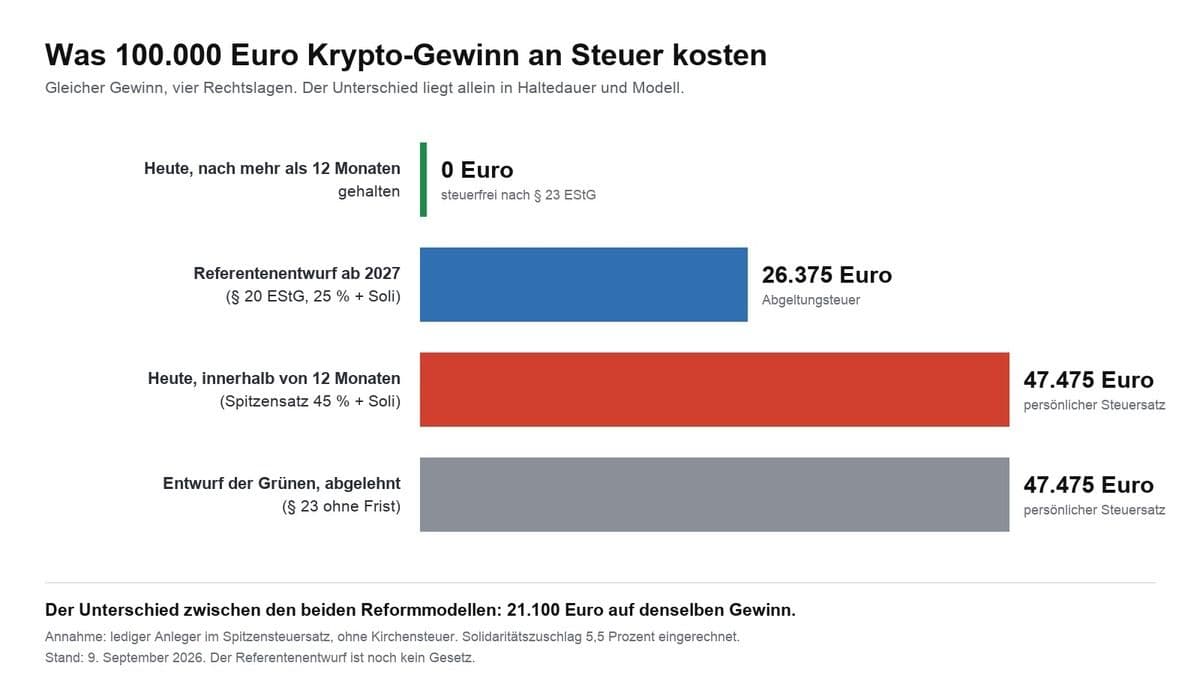
Crypto Tax in Germany: What Applies in 2026 and What Is Set to Change in 2027
Crypto gains are tax-free after twelve months; before that your personal tax rate of up to 45 percent applies. What triggers tax, how the holding period is calculated, what happens with staking and losses, and what the draft bill would change from 2027.
September 8, 2026 10:21 PM

Crypto Holding Period and Grandfathering: Why December 31, 2026 Becomes the Cut-Off in Germany's Draft Bill
A ministerial draft bill from Germany's finance ministry names a cut-off date for the first time: crypto assets acquired after December 31, 2026 are to fall under the flat-rate withholding tax. What that means for legacy holdings, running savings plans and staking income, and why nothing has been decided yet.

June 10, 2025 12:17 PM

Hyperliquid Hits New ATH Today: What's the Hype about HYPE?
Hyperliquid (HYPE) just hit a new all-time high, and traders are piling in. But what's fueling this rally, and is it sustainable? We break down everything from whale activity to tokenomics.
October 7, 2026 4:28 PM

Shiba Inu Price at $0.00000538, Down 8.6 Percent in a Day: Hold or Sell?
Shiba Inu loses 8.6 percent on Wednesday afternoon and trades at $0.00000538. Whether a sale makes sense is decided in Germany less by the chart than by the purchase date of the individual tranche, because the one-year period hangs on it.
October 6, 2026 10:14 AM

$3.8 Million Back From the Attacker: Why the NEAR Price Is Up 7.8 Percent
The attacker has sent back the full $3.8 million from the NEAR Intents exploit, and the NEAR price is up 7.8 percent at $5.23. What is behind the recovery, what role the Bitwise NRR ETF plays, and what follows from it for buying route, holding period and custody.
October 5, 2026 4:26 PM

Shiba Inu price up 4.4 percent: outperforms the market, but 88 trillion SHIB sit on exchanges
Shiba Inu adds 4.4 percent on Monday, making it the strongest of the six big names. At the same time 88.08 trillion SHIB worth $525 million sit on trading venues, almost five times a single day of turnover.
October 2, 2026 10:17 PM
Dogecoin breaks below $0.093: the BWOW fund turns every DOGE into cash on October 14
Dogecoin costs $0.0914 on Friday evening and has lost 3.4 percent in 24 hours. On October 14 the US fund BWOW sells its entire holding, and on the same day the German cabinet takes up the reform of crypto taxation.
September 27, 2026 7:14 PM
Solana Price at $121.93: What to Check on Staking Yield, Unstaking and Tax
SOL stands at $121.93 on September 27 at 16:42 UTC, after a 12.7 percent gain over seven days. More important than the weekly move is a calculation almost nobody makes: of the staking yield usually quoted, roughly a quarter is left in real terms, and the epoch decides when you can reach your coins again.
September 26, 2026 10:12 PM

Solana Price Above $120: What to Check on Staking Yield, Holding Period and Spread
Solana is trading at $121.00 on September 26, 2026, 8.6 percent above its level a week earlier. What a self-measured staking yield of 5.27 percent is worth, how the one-year holding period applies to staked SOL, and what an order in euros really costs.
September 26, 2026 7:14 AM
Cardano Before the RealFi Launch on October 1: What ADA Holders Should Check on USDr, MiCA and Tax
On October 1, 2026 the stablecoin platform RealFi goes live on the Cardano mainnet, and ADA has gained 14.67 percent in a week. What is documented about the yield-bearing dollar token USDr, and what investors should settle beforehand.
September 25, 2026 7:14 PM
Chainlink Above the September High: What Open Interest, Funding Rate and Liquidation Risk Mean for LINK
Chainlink stands at $13.86, 11.2 percent higher than 24 hours ago. Our own query at OKX and Hyperliquid shows funding at the baseline rate, and what that means for leverage, buying route and tax.
More from CryptoTicker