
ETH Price Prediction: What to Check at the $2,800 Mark Now
Ether stands at $2,735.96 on September 22, 2026, right below the zone at which it has failed repeatedly. Instead of a target number, you get four checks that count before your next order: holding period, buying route, the staking line and the distance to liquidation.





Which topics should we dive deeper into?
Select what genuinely interests you. Your picks feed directly into our editorial planning.
Crypto news that's actually worth your time.
Weekly. 60 seconds. Carefully curated by our editors: no hype, no promo flood, no spam.
Ether costs $2,735.96 at 18:41 German time on September 22, 2026. That puts the price around half a percentage point below the $2,750 mark and a good two percent below $2,800, in other words right underneath the zone at which Ethereum has bounced off repeatedly over the past weeks. Anyone looking for a serious ETH price prediction gets no target number here but a to-do list: which purchase date sits in your account, which buying route carries your tax logic, how far your position is from the liquidation price, and what happens to your holding period if you reshuffle now.
The figures in this article come from CoinGecko market data for September 22, 2026. Prices change by the minute; the calculations underneath them do not.
Where the Ethereum price really stands on September 22, 2026
In the query, Ether is quoted at $2,735.96, down 0.66 percent from its level 24 hours earlier. The daily range runs from $2,716.11 to $2,804.42. That is the single most important finding of the day: the price has already touched the $2,800 mark today and failed to hold it. Market capitalisation sits at roughly $334 billion, trading volume over the past 24 hours at just under $18 billion.
For perspective on the upside: the all-time high of $4,946.05 dates from August 24, 2025. From the current level, that is roughly 81 percent away. Anyone reading a forecast that treats the high as an interim target for the coming weeks should place this figure alongside it.
On September 21, Ether was quoted at $2,703.62 according to market reports, a good five percent above the previous day. The move of the past few days is therefore pointing upwards, but it has not yet cleared the decisive zone.
Why a daily range of 3.2 percent is a metric
Between the daily low and the daily high lie $88.31, or 3.23 percent of the current price. You need that number twice further down: once to judge what a break above $2,800 would actually prove, and once to work out which level of leverage survives a normal day's move.
The zone between $2,750 and $2,800: why analysts are watching exactly there
Resistance is a price area in which, in the past, enough sell orders repeatedly sat to stop an advance. Support is its counterpart on the downside. Neither is a law of nature; they are observations about how market participants behave at familiar prices.
In the coverage by German and international financial portals, among them wallstreet-online and invezz, the zone between $2,750 and $2,800 is consistently named as the next reference point after the price cleared the long-capped $2,600 mark. On the downside, the same assessments name $2,550 and the area around $2,350, along with the moving averages EMA50 and EMA200 at roughly $2,282 and $2,269. A moving average is the mean of the closing prices of the last 50 or 200 periods respectively and serves as a rough trend line.
These levels are quoted analyses, not commitments. They are good for exactly one thing: you decide in advance what you will do if the price reaches one of them, instead of deciding in the moment of the move. From the current level it is 6.8 percent down to $2,550 and 2.3 percent up to $2,800.
ETF inflows from the US: what the contradictory numbers really say
A spot ETF is an exchange-traded fund that holds the coin itself rather than a futures contract. Such products on Ether have been approved in the US since 2024; in the EU they do not exist in that form, more on which below.
The figures of recent days are contradictory, and that is exactly how they belong in a report. According to assessments cited among others by kryptoszene.de, US spot ETFs on Ether lost roughly $140 million on balance in the trading week to September 18, 2026. It was the first negative week since the week to August 14, and it ended a run of four inflow weeks that together had gathered $1.94 billion. Other assessments of the same period cite a single day's inflow of $143.8 million for September 18, of which roughly $114 million went to BlackRock.
Both can be true, because one strong day does not cancel a negative weekly balance. Whoever reads only the daily figure sees demand. Whoever reads only the weekly figure sees selling. For your decision, that means a single ETF day is not a signal; only a run is a direction.
For you in Germany there is the added point that these inflows influence your price but are not your product. US spot ETFs cannot normally be bought by retail investors in Germany, because they lack the European investor information documents.

Holding period under Section 23 of the Income Tax Act: which date in your account counts
The holding period is the span between the acquisition and the disposal of a crypto unit. Under Section 23 of the German Income Tax Act, a gain from a sale is tax-free if more than a year lies between purchase and sale. Below that threshold the gain counts as a private disposal transaction and is charged at your personal income tax rate.
Two details decide matters in practice more often than the tax rate itself. First the exemption limit: if the sum of all private disposal gains in a calendar year stays below 1,000 euros, it remains tax-free. An exemption limit is not an allowance; it falls away entirely once exceeded, and then the whole gain is taxable, not only the part above the limit. Second the allocation: if you sell part of your holdings, the order of acquisition governs which units count as sold, colloquially FIFO, first in, first out. The unit bought first counts as sold first.
The check that takes ten minutes
Export your exchange's purchase history as a CSV file and sort it by date. Mark every tranche whose purchase date lies less than twelve months back. Those tranches are exactly the ones on which a sale at the $2,800 mark would be taxable. If a tranche turns up whose one-year deadline expires in a few weeks, you have a concrete figure for your decision instead of a gut feeling. Tools that keep this allocation automatically can be found in the overview of crypto tax tools and portfolio trackers.
The tax reform planned from 2027: why your purchase date becomes a variable
On April 29, 2026, German finance minister Lars Klingbeil announced that he intends to tax crypto assets differently in future. According to consistent specialist reporting, the model under discussion is a flat withholding tax of 25 percent plus the solidarity surcharge, from the 2027 assessment period at the earliest. A coordinated draft bill had not been tabled as of the reports assessed here.
That is explicitly a plan and not applicable law. For 2026 the one-year deadline under Section 23 of the Income Tax Act continues to apply, and nobody should bring a sale forward on the strength of an announcement alone. What you can do is a piece of date arithmetic: a unit you buy today reaches its one-year deadline on September 22, 2027. Whether a later law will protect existing holdings is open; German constitutional law recognises the protection of legitimate expectations, but its concrete shape is a matter for the legislator.
The practical consequence is unspectacular and useful all the same: document every purchase with date, quantity and euro equivalent, regardless of what the price is doing. If the legal position changes, the quality of your records will decide whether you can demonstrate a favourable transitional rule at all.
Staking on Ethereum: what a 2.6 percent yield leaves after tax
Staking means that you deposit Ether as collateral in the network and receive rewards for it, because your units contribute to securing block production. Current assessments most recently put the yield on Ether at around 2.62 percent a year.
For tax purposes the rewards run into a different line from the price gain. Under the administrative view in the Federal Finance Ministry circular of March 6, 2025, which replaces the version of May 10, 2022, income from passive staking generally counts as other income under Section 22 number 3 of the Income Tax Act. It is taxed at the time it accrues, at the market value on that day, not only on a later sale. This type of income carries an exemption limit of its own, 256 euros per calendar year.
Two points are regularly confused here. First: under the current administrative view, staking does not extend the one-year holding period of the staked units to ten years. That worry stems from an older debate and is off the table for the normal case. Second: the rewards received are themselves newly acquired units, and a one-year deadline of their own begins for them on the day they accrue.
A worked example with round numbers
Anyone staking Ether worth 1,000 euros receives roughly 26 euros a year at 2.6 percent. That sits below the exemption limit of 256 euros, so the amount remains tax-free, but it still has to be recorded. Only from a staked equivalent of about 9,850 euros is the exemption limit breached at this yield, and then the full amount is taxable, not only the part above it. Which providers offer staking at which fees and with what payout logic is shown in the overview of staking platforms.

Coin, ETN or savings plan: what the buying route changes for you under MiCA
MiCA is the EU regulation on markets in crypto-assets, which regulates the operation of trading platforms and custodians uniformly across Europe. Germany brought its national transition period under Section 50 of the Crypto Markets Supervision Act forward to December 31, 2025, six months ahead of the EU-wide cut-off on July 1, 2026. Since January 1, 2026, providers without a licence may no longer render crypto services in Germany. According to a survey published in June 2026, 56 of the licences granted across Europe went to Germany, ahead of the Netherlands with 26 and France with 21.
For you this is a check with one outcome: your provider is in the licence register or it is not. BaFin lists the authorised institutions in its company database. A provider without a licence that continues to serve German clients is not a bargain but a legal risk at the point of withdrawal and proof. An overview of regulated venues and their fee models can be found in the crypto exchange comparison.
The difference that decides your tax
An ETN is an exchange-traded debt security that replicates the price of an underlying. In Europe, crypto products are mostly offered in this form, because under EU fund law a classic fund may not hold only a single asset. For tax purposes one detail in the base prospectus decides the matter: physically backed crypto ETPs with a delivery claim on the coin are treated like a direct investment under the administrative view and therefore fall under Section 23 of the Income Tax Act, one-year deadline included. Products without a delivery claim, by contrast, are classified as a monetary claim, and there the flat withholding tax of 25 percent applies regardless of the holding period.
The check takes a few minutes: search the base prospectus or the key information document of your product for the terms delivery claim and physical backing. Anyone holding the same amount once as a coin and once as an ETN without a delivery claim has two different tax outcomes after a year, with identical price performance.
 Staking platforms compared: yield, fees and payout
Leverage and liquidation at the edge of resistance: what to calculate before the order
Liquidation means that the exchange forcibly closes your leveraged position because the collateral posted no longer covers the loss. The distance to that point can be calculated in advance, and it is precisely at a resistance level that the calculation is worth doing, because false breakouts are particularly frequent there.
From the level of $2,735.96, the rough liquidation threshold of a long position at five times leverage sits around 20 percent lower, at about $2,189. At ten times leverage it is around $2,462, at twenty times around $2,599. Fees and financing costs push these values upwards, so the threshold is reached earlier than the pure percentage calculation suggests.
Now set the daily range next to it, 3.23 percent today. A position at twenty times leverage has a buffer of roughly five percent and therefore survives barely one and a half normal daily moves. That is no longer a risk assessment but a coin toss with fees. Anyone trading derivatives should also know the funding rate, the periodic balancing payment between the long and short sides of perpetual futures: when positioning is heavily one-sided, the dominant side pays the other continuously, and those costs run on regardless of the price.
Levels above and below: how to recognise a confirmation
Today's trading session provides an object lesson: the daily high of $2,804.42 was already above the round mark, yet the price stands at $2,735.96. A brief overshoot is therefore not a confirmation.
Three criteria to fix in advance
First, a closing price rather than a wick: what matters is where the price stands at the close, not which peak it brushed along the way. Second, volume: a breakout on markedly elevated turnover carries further than one on thin trading, and the current daily turnover of roughly $18 billion is the benchmark for that. Third, confirmation from outside: if ETF inflows turn positive again in the same week, there is capital behind the move and not merely positioning in the derivatives market.
On the downside the same discipline applies in reverse. If the price falls back below $2,550, the advance of the past few days is arithmetically used up. Anyone who has noted in advance what they will do in that case is spared the decision at the least convenient moment.
Putting an ETH price prediction in context: what to take away
The short-term direction of Ether is open, and every forecast claiming otherwise is selling you a certainty that does not exist. What is not open are the four things you can check today.
- Sort your purchase dates. Export your purchase history and mark every tranche held for less than twelve months. Only then do you know what a sale at the $2,800 mark really costs. The right tools are in the comparison of crypto tax tools and portfolio trackers.
- Check your buying route and its licence. Establish whether your provider has been licensed in Germany since January 1, 2026, and whether your product is a coin or an ETN without a delivery claim. Both change your tax outcome at identical price performance. The overview is provided by the crypto exchange comparison.
- Calculate staking separately. Record every reward with its accrual date and euro value and check the 256-euro exemption limit separately from the 1,000-euro limit for sale gains. Which platform stakes on which terms is shown by the comparison of staking providers.
(As of September 22, 2026. This article is not investment advice. Prices and fee structures change; check the terms with the provider before you buy.)
Transparency note: This article was produced with the assistance of artificial intelligence and reviewed by our editorial team before publication. All figures and claims were checked against the primary sources linked in the text. The feature image was generated with AI.
More on Ethereum: All Ethereum news at a glance
Related articles
- Ethereum Price Prediction: What to Check on Staking, Leverage and Where You Buy After Three Attempts at $2,800
- Ethereum Rises While ETF Money Leaves: What ETH Holders Should Check Now
- Ethereum price prediction: Citi raises its twelve-month target to $3,028, and what you can do now
- Cardano Slides Below $0.24: What ADA Holders Should Check on Leverage, Liquidation and Holding Period
- Shiba Inu Price Prediction: What to Check on SHIB Before the December 31 Deadline
Which topics should we dive deeper into?
Select what genuinely interests you. Your picks feed directly into our editorial planning.
Crypto news that's actually worth your time.
Weekly. 60 seconds. Carefully curated by our editors: no hype, no promo flood, no spam.

October 2, 2026 10:17 PM
Dogecoin breaks below $0.093: the BWOW fund turns every DOGE into cash on October 14
Dogecoin costs $0.0914 on Friday evening and has lost 3.4 percent in 24 hours. On October 14 the US fund BWOW sells its entire holding, and on the same day the German cabinet takes up the reform of crypto taxation.
September 25, 2026 7:24 PM

Bitcoin Forecast: What to Check on Levels, Holding Period and Buying Route Before the Quarter Ends
Bitcoin stands at $83,877 at 16:40 UTC on September 25, 2026, and the measured volatility of the past 30 days spans a band of $73,600 to $94,200 for the coming month. More important than that band before the quarter ends are three checks: holding period, buying route under MiCA and the reporting duty in force since January 2026.

September 24, 2026 1:24 PM

NEAR Falls Almost 8 Percent After a 62 Percent Week: What to Check on Perps, Buying Route and Holding Period
NEAR Protocol loses up to 7.9 percent on September 24, 2026 and is still more than 55 percent higher over the week. The rally was carried by a confidential perp offering via Hyperliquid, which raises questions of its own on buying route, leverage and holding period in Germany.
September 19, 2026 7:17 AM

Chainlink Jumps Above $12: What LINK Holders Should Check Now
Chainlink trades at $12.34, 7.4 percent higher than yesterday. What part of the move is the broad market rally, what Chainlink itself contributes, and the three things you should check as a LINK holder.
October 12, 2026 4:28 PM

XRP price prediction: $160 million behind Solana, 13 weeks of inflows against a 9 percent weekly loss
The XRP funds are only $160 million behind the Solana funds and have been taking in fresh money for 13 weeks. Why the price is falling anyway at $1.38, and what that means for the $2.80 year-end target.
October 6, 2026 10:14 AM

$3.8 Million Back From the Attacker: Why the NEAR Price Is Up 7.8 Percent
The attacker has sent back the full $3.8 million from the NEAR Intents exploit, and the NEAR price is up 7.8 percent at $5.23. What is behind the recovery, what role the Bitwise NRR ETF plays, and what follows from it for buying route, holding period and custody.

October 5, 2026 10:14 AM

Solana price 108.46 euros: a 2.4 percent gain in euros, a 2.5 percent loss in dollars: what to check now
Solana is quoted at 108.46 euros and $121.30 on Monday morning. That leaves a gain of 2.4 percent for 2026 in euros and a loss of 2.5 percent in dollars. The difference comes purely from the exchange rate, and in Germany it decides the holding period, the tax threshold and the figure that ends up on the tax return.
September 26, 2026 10:12 PM

Solana Price Above $120: What to Check on Staking Yield, Holding Period and Spread
Solana is trading at $121.00 on September 26, 2026, 8.6 percent above its level a week earlier. What a self-measured staking yield of 5.27 percent is worth, how the one-year holding period applies to staked SOL, and what an order in euros really costs.
September 24, 2026 10:11 PM

Bitcoin Price Prediction: What to Check on Levels, Holding Period and Leverage Before the October 28 Rate Decision
Bitcoin is trading at around $83,800, a third below its October 2025 high, while the sentiment index reads greed. Which dates, levels and deadlines over the coming weeks really decide your net gain, and which of them you steer yourself.

June 25, 2024 12:18 PM

After Bitcoin Crash, Will Altcoins Gains Reach 500%?
In the latest Bitcoin News today, and mainly after the Bitcoin Crash, crypto analysts predict a major shift towards altcoins with market corrections near the end and BTC dominance drop. Will the altcoins gain reach 500%?
September 14, 2026 10:23 AM

Take Ethereum Profits or Wait Out the Holding Period? What the Price Jump Means for Your Tax Bill
Ether reached its highest level since the end of January on September 11, 2026, and many are asking whether to sell now. In Germany the answer hangs on the purchase date first: we work out which tranches are tax free and which of them are showing a gain at all.
September 30, 2026 10:15 AM

Ethereum Price Prediction: 1.6 Million ETH Face a 28-Day Wait for Activation, and What You Can Do Now
1,603,958 ETH are standing in the entry queue for Ethereum staking and waiting almost 28 days for activation. What that tied-up supply means for the price levels, for your yield and for the 256 euro exemption limit at the German tax office.
September 27, 2026 1:17 PM

Dogecoin Price: What to Check on Holding Period and Custody Before the Year End
The Dogecoin price stands at $0.0977 on September 27, 2026 and has barely moved in a day. That calm is exactly the moment to work through the holding period, the reporting duty from 2026 and custody without any time pressure.
September 24, 2026 10:12 AM

XRP Falls 9.7 Percent: What to Check on Holding Period and Buying Route
XRP is down around 9.7 percent on the morning of September 24, twice as much as the typical large crypto asset. Our count of 18 coins shows who the pullback hits and which three things hold true regardless of the price.
September 9, 2026 4:22 PM
Crypto Tax in Germany: What Applies in 2026 and What Is Set to Change in 2027
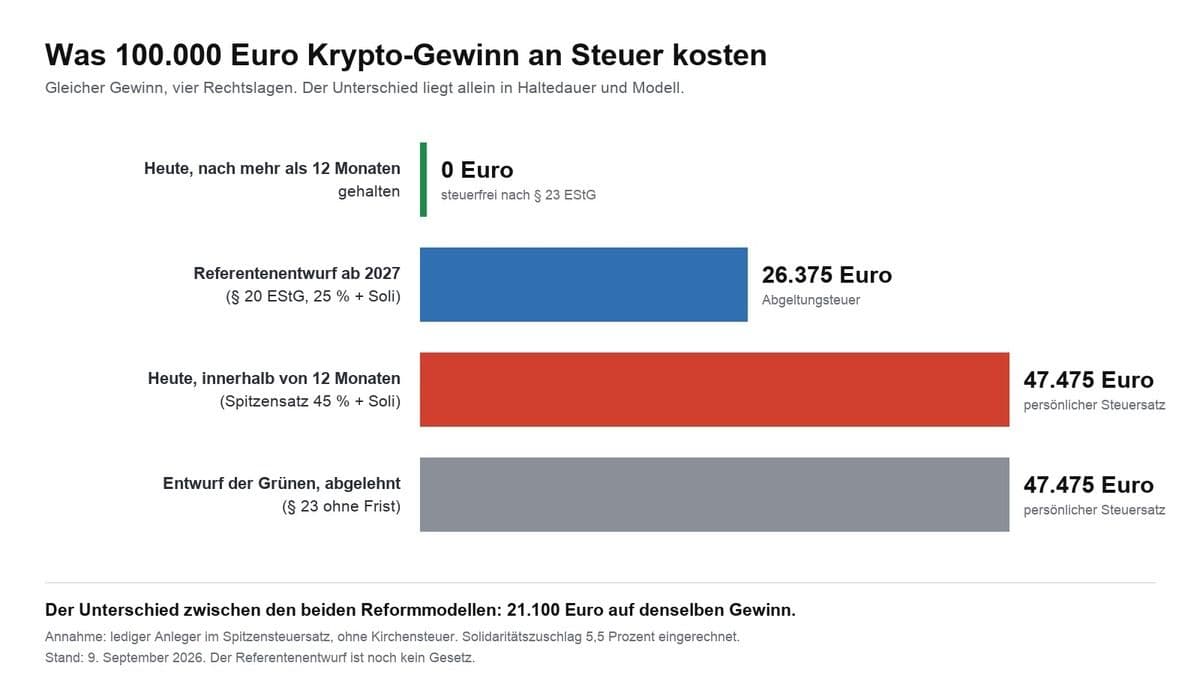
Crypto gains are tax-free after twelve months; before that your personal tax rate of up to 45 percent applies. What triggers tax, how the holding period is calculated, what happens with staking and losses, and what the draft bill would change from 2027.
September 27, 2026 10:16 PM

Dogecoin Price Prediction: Which Levels Decide the Fourth Quarter
Dogecoin trades at $0.0973 on September 27 and has gained 12.2 percent in seven days. Which three measured levels frame the fourth quarter, how accurate the circulating price targets proved in September, and which four checks are due before the quarter turns.
September 24, 2026 1:13 AM

Solana DEX Trades Overtake the NYSE: What to Check on Swaps, Tax and Oversight
Solana's decentralised exchanges settled roughly 208 million trades in a single week and overtook the New York Stock Exchange for the first time. The figure is real, but it measures something other than the comparison suggests, and for German investors it carries tax duties that no provider takes on.
July 25, 2024 12:35 PM
Ethereum Price Analysis: Why is Ethereum Price Down?
Here is the impact of the recent Ethereum ETF launch on the crypto market, leading to a significant sell-off and a $300 million liquidation event. Not what was expected?
October 6, 2026 1:34 AM

93.56 million dollars out of the Zcash ETF in one week: what changes for ZEC holders in Europe
The Grayscale Zcash ETF lost money for the first time since launch in the week to October 5, 2026, a net $93.56 million. What the figure says about demand and what it means for ZEC holders in Europe.
September 27, 2026 4:25 PM
Ethereum Price Prediction: What to Check on ETH Before the Quarter Turns
Ethereum trades at 2,714.60 dollars on September 27, 2026 and remains pinned to the zone between 2,750 and 2,820 dollars. Which levels decide October, how far apart the analyst targets sit, and which checks to complete before the quarter turns.
September 26, 2026 1:19 AM

Germany’s Crypto Holding Period Is Wobbling: What to Check Before December 31
A CDU member of the Bundestag makes it plain: the coalition agreement does not guarantee that the one-year holding period for crypto assets will survive. What that means for purchases made before the planned cutoff date of December 31, 2026.
October 2, 2026 5:02 PM

Bitcoin or Ethereum in the fourth quarter of 2026: the two largest crypto-assets compared
Bitcoin is scarce by protocol rule, Ethereum only as scarce as its utilisation, and on access and tax in Germany the paths part again. This comparison puts the verifiable figures on supply, usage, staking and purchase route side by side, without making a price call.
September 26, 2026 7:40 AM

The RAIN Token After the Enlivex Termination: What to Check on Access, Forced Sale and Holding Period
Enlivex terminated a share placement of 66,666,667 shares payable in RAIN tokens on September 22, 2026. The token sits 46.4 percent below its all-time high, and at Kraken the withdrawal deadline expired long ago.
September 24, 2026 4:16 AM

Trump-Xi Summit at the White House: The Crypto Positions to Check Before the Meeting
Xi Jinping is on a state visit to Donald Trump today, and the crypto market comes into the meeting carrying the gains of an exceptionally strong week. What to check on leverage, holding period and custody before the first headline runs.
September 8, 2026 10:21 PM

Crypto Holding Period and Grandfathering: Why December 31, 2026 Becomes the Cut-Off in Germany's Draft Bill
A ministerial draft bill from Germany's finance ministry names a cut-off date for the first time: crypto assets acquired after December 31, 2026 are to fall under the flat-rate withholding tax. What that means for legacy holdings, running savings plans and staking income, and why nothing has been decided yet.
October 10, 2026 7:15 PM

ING and Bitcoin: Around 50 Crypto ETNs in the Portfolio, and What the Delivery Claim Means for Your Holding Period
Bitcoin can be bought at ING, but only as an exchange-traded note: around 50 crypto ETNs from five issuers, as a one-off purchase or a savings plan from one euro. What the offer really costs, and what the one-year holding period hangs on, is not in the advertising but in the key information document.
September 24, 2026 1:11 PM

Stellar Becomes a Payment Rail at Mastercard's BVNK: What XLM Holders Should Check on Buying Route, Memo and Holding Period
BVNK has switched on Stellar as a payment rail for business customers in more than 130 countries. On the same trading day XLM falls by around seven percent — we separate what the news means from what the pullback means for your portfolio.
More from CryptoTicker