
Shiba Inu price up 4.4 percent: outperforms the market, but 88 trillion SHIB sit on exchanges
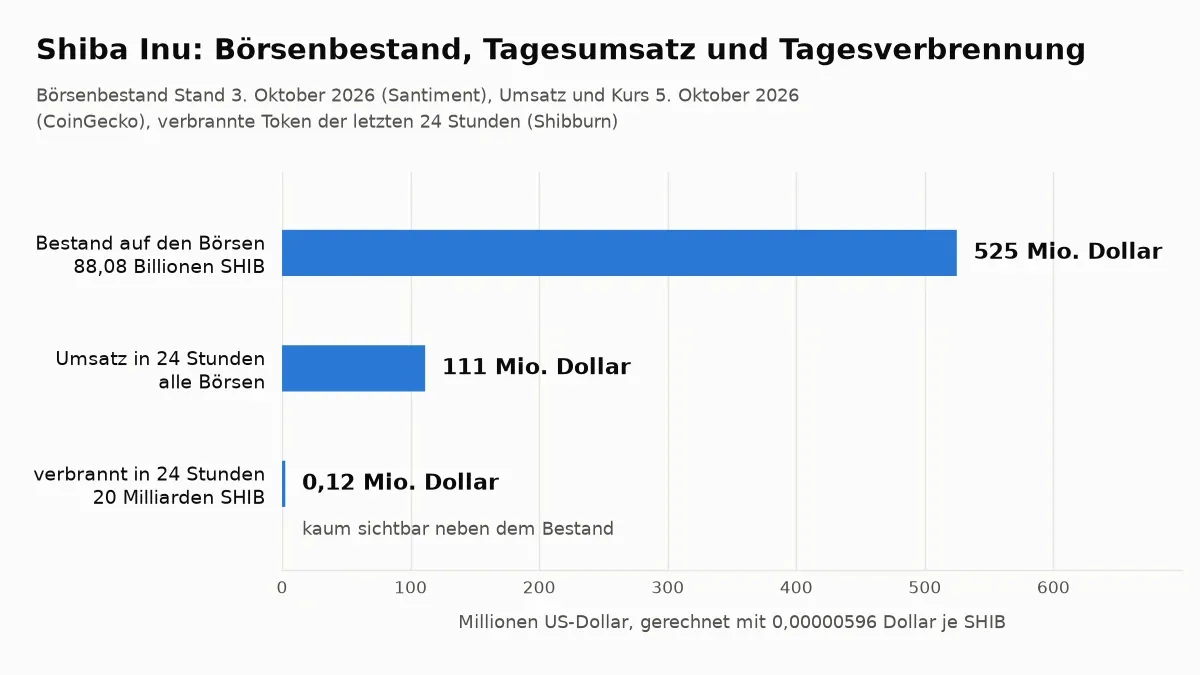
Shiba Inu adds 4.4 percent on Monday, making it the strongest of the six big names. At the same time 88.08 trillion SHIB worth $525 million sit on trading venues, almost five times a single day of turnover.





Which topics should we dive deeper into?
Select what genuinely interests you. Your picks feed directly into our editorial planning.
Crypto news that's actually worth your time.
Weekly. 60 seconds. Carefully curated by our editors: no hype, no promo flood, no spam.
Shiba Inu trades at $0.00000596 at midday on Monday, or €0.00000531. That is 4.4 percent more than 24 hours earlier, and on the day it is the strongest reading among the six largest names on the market. The more important figure, though, is not the one in the price window: according to data from the analytics firm Santiment, 88.08 trillion SHIB sit on trading venues, counted as of October 3. At the current price that is roughly $525 million that could be sold at any moment. Total trading turnover for a full day comes to $111 million.
This article sets the three figures that regularly get mixed up around Shiba Inu against one another: the balance held on exchanges, the daily turnover and the volume of tokens burned. After that it turns to what an investor in Germany can actually do with it, from custody through the holding period to the question of which provider is even allowed to sell SHIB.
Shiba Inu price on October 5: $0.00000596 and €0.00000531
Over the past 24 hours the price moved between $0.00000568 and $0.00000602. That is a 6.0 percent span between the daily low and the daily high; the figures come from CoinGecko as of midday on October 5, 2026. One million SHIB therefore costs €5.31.
Over longer windows the picture looks calmer than the day suggests. On a seven-day view there is a gain of 5.0 percent, over 30 days 10.2 percent, over 60 days 26.1 percent. Measured over a year, by contrast, there is a loss of 53.3 percent. From the record set in October 2021, then $0.00008616, the price is 93.1 percent away. Getting back there would require the price to multiply fourteenfold.
Why the daily gain says little about SHIB's direction
Turnover of $111 million equals 3.2 percent of market capitalisation. For an asset quoted that far down in the decimals, comparatively small buy orders are enough to move a percentage figure that looks impressive on screen. Four percent on $0.00000571 works out at $0.00000025. Anyone wanting to place the move therefore looks not at the percentage but at the volume that carried it.
88.08 trillion SHIB on exchanges: $525 million hanging over the market
Santiment counts the balances held on the trading venues it tracks. On October 3 the figure was 88,076,900,000,000 SHIB. Measured against the circulating supply of 589.24 trillion tokens, that is 14.95 percent. The last time this reading stood at that level was in early June.
The number matters for a simple reason: tokens on an exchange are ready to be sold. Tokens in a self-custody wallet are only ready after a transfer that costs time and network fees. The balance on trading venues is therefore an upper bound on how much supply can reach the market at short notice, and at $525 million it is 4.7 times what changes hands in an entire day.
No forecast follows from this. What follows is an order of magnitude: if even one fifth of that balance came to market within a day, it would match the whole of the current daily turnover. Anyone working in SHIB with larger sums should therefore pick a trading venue not on fees alone, but on the depth of its order book.
20 billion tokens burned a day: 4,404 days until the exchange balance would be gone
Burning tokens is the best-known argument among Shiba Inu's followers. Burning means that tokens are sent to an address nobody holds the key to, and are therefore permanently out of circulation. On Shibarium, the project's second layer, that runs automatically through ShibTorch, which swaps the base fees paid in BONE into SHIB and burns them.
Shibburn keeps the counter. For October 3 the dashboard shows around 20 billion SHIB burned within 24 hours, after the burn rate rose by more than 17,000 percent against a quiet previous day. The percentage sounds enormous; the absolute figure puts it in perspective. Twenty billion tokens are 0.0034 percent of the circulating supply and worth roughly $119,200 at the current price.
The arithmetic that follows is something anyone can work through. If 20 billion SHIB were burned every day, it would take 4,404 days before today's exchange balance of 88.08 trillion tokens alone had disappeared. That is a good twelve years. For the full circulating supply of 589.24 trillion tokens it would come to more than 80 years. Burns do tighten supply, but on a scale that carries no weight next to daily trading.
What the burn rate does show
The counter is useful as a measure of activity. Because ShibTorch is fed from transaction fees, the amount burned rises when more happens on Shibarium. A jump in the burn rate is therefore first a statement about network usage and only secondarily one about supply. Reading the figure as a price driver confuses the two.
 Compare crypto exchanges and fees
Rank 34 and $3.51 billion market capitalisation: where Shiba Inu stands in the field
Shiba Inu's market capitalisation stands at $3.51 billion, or €3.13 billion, which is rank 34 in the overall market. For comparison, the daily moves on October 5: SHIB is up 4.4 percent, Dogecoin up 2.3 percent, Bitcoin up 0.7 percent, XRP up 0.5 percent, Ethereum up 0.3 percent and Solana down 0.9 percent.
That the smallest of the six shows the largest daily swing is neither coincidence nor strength. It is the usual consequence of thinner market depth. The same property works in both directions, as the yearly comparison of minus 53.3 percent makes plain.
ERC-20 instead of its own chain: where your SHIB actually sits
SHIB is not a standalone network but an ERC-20 token on Ethereum. An ERC-20 token is an entry in a contract on someone else's chain, not a balance in a blockchain of its own. In practice that means anyone withdrawing SHIB from an exchange pays the network fee in ether, not in SHIB, and therefore always needs a small amount of ETH in the same wallet to be able to move the tokens again later.
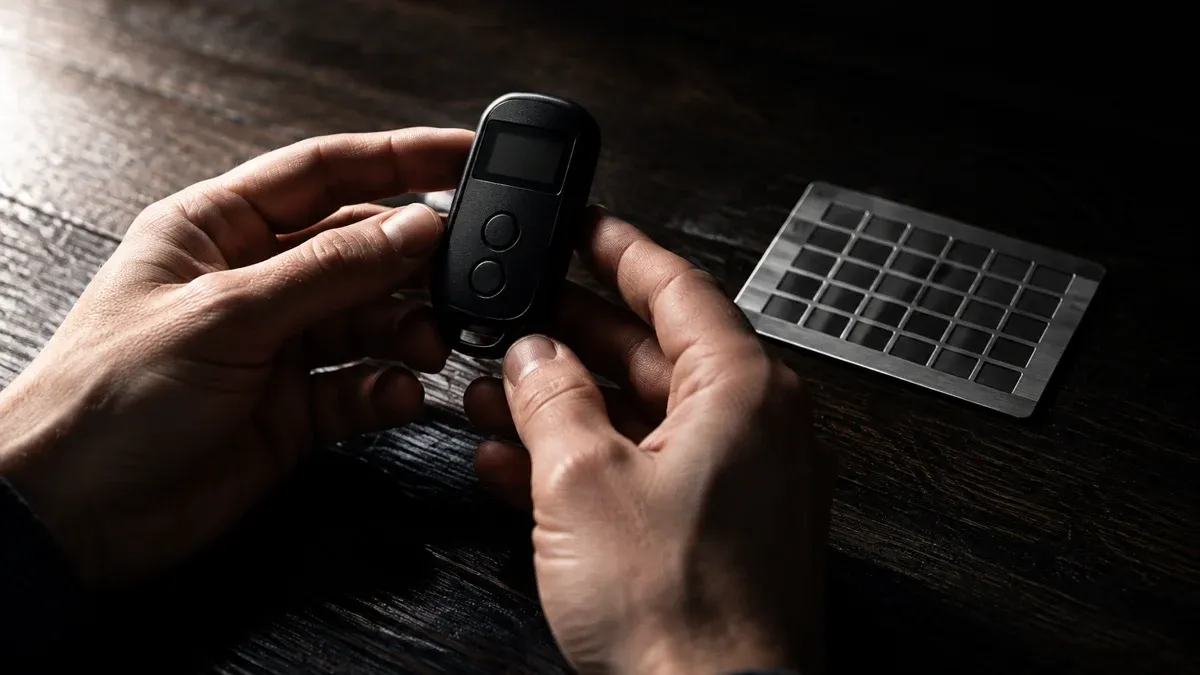
For custody the same logic applies as for any other Ethereum token. A hardware wallet does not store the tokens themselves but the private key used to address the contract. The recovery phrase of twelve or 24 words is the actual backup; the device is replaceable. Anyone who photographs those words or puts them in cloud storage cancels the protection again.
Transferring from an exchange into your own wallet is not a sale in Germany and therefore triggers no tax. The holding period also keeps running, because it attaches to the time of acquisition, not to the place of custody. What it does require is a clean note, because proving the acquisition later rests with you.
One-year holding period, €1,000 exemption limit: the tax rules for SHIB in Germany
Gains from selling crypto assets count in Germany as private disposals under Section 23 of the Income Tax Act. Two figures decide the outcome. First the holding period: anyone who holds SHIB for longer than a year and then sells pays no income tax on the gain. Second the exemption limit: if the sum of all private disposal gains in a calendar year stays below €1,000, no tax arises either. The increase to that amount is set out in Section 23 paragraph 3 sentence 5 and has been carried over into the Federal Ministry of Finance circular of March 6, 2025 on the income tax treatment of crypto assets.
An exemption limit is not a tax-free allowance. If the limit is exceeded by one euro, the entire gain becomes taxable, not just the part above it. This is exactly where SHIB becomes practically relevant, because the unit counts are large and a gain adds up faster than the decimal places suggest.
A worked example with real prices
Suppose you bought 500 million SHIB at €0.00000400 and sell at today's price of €0.00000531. The gain comes to €655 and therefore stays below the exemption limit, provided you had no other private disposal gains in the same year. At 763 million tokens the €1,000 limit would be reached, and from there the full gain is taxable. If instead you sell the same position only after a year has passed, the limit no longer matters.
 Compare crypto tax software
FIFO at 589 trillion tokens: why documentation weighs more heavily with Shiba Inu
For matching purchases to sales, the first in, first out method generally applies: the holding bought first counts as the one sold first. That determines which holding period runs for which part of the position. For an asset held in hundreds of millions of units and often bought in several tranches, this matching decides whether a sale is tax-free or not.
The Federal Ministry of Finance circular of March 6, 2025 contains, for the first time, a dedicated section on cooperation and record-keeping duties. What is required is traceable documentation of acquisitions and disposals. For SHIB that means four details per transaction in practice: date, number of units, price in euros and the platform. Anyone spread across several exchanges and a self-custody wallet is better off keeping that list as they go than reconstructing it from account statements in the spring.
How SHIB differs from Bitcoin
The difference is the unit count, not the legal position. A bitcoin purchase can be noted to eight decimal places and stays manageable. With SHIB the same line carries twelve-digit quantities and a price with six zeros after the decimal point. Rounding errors that stay harmless with other assets quickly shift three-figure euro amounts here.
MiCA since the end of 2024: which providers may legally sell SHIB in Germany
The European regulation on markets in crypto-assets has applied in full since December 30, 2024. Anyone exchanging or holding crypto assets commercially in Germany needs authorisation as a crypto-asset service provider for it; in Germany the Crypto Markets Supervision Act implements the framework, and supervision sits with BaFin. We have put together an overview of the obligations MiCA imposes on providers elsewhere.
For you as a buyer of SHIB that has two tangible consequences. First, an authorised provider must inform you about risks and costs before the purchase and disclose its fees. Second, BaFin keeps a public register of supervised firms in which a provider can be looked up before any money moves. A provider that cannot be found there and still advertises actively in Germany is not worth the risk.
$111 million in daily turnover: leveraged positions on SHIB and the liquidation threshold
SHIB is also offered on many platforms as a futures contract with leverage. For an asset whose daily range is 6.0 percent, as it is today, leverage of 17 is arithmetically enough to run a position against its margin within a single day. Liquidation then happens automatically as soon as the posted collateral falls below the required minimum rate.
On top of that comes the funding rate, which on perpetual contracts flows between the two sides of the market every four or eight hours depending on the platform. That rate is not a fee paid to the exchange but a balancing payment between the long and the short side, and it can make a position more expensive even when the price stands still. Anyone using the instrument works out before entering at which price liquidation bites, not afterwards.
Shiba Inu price: your next three steps
- Sort your holdings and holding periods. List your SHIB purchases with date, number of units and euro amount, and mark which tranches already satisfy the one-year period. A portfolio tracker with a tax function takes over the FIFO matching once you connect your exchanges.
- Review custody. Decide for each part of the position what has to stay on the exchange and what belongs in self-custody. For the latter you need a device and a separately stored backup of the recovery phrase; the overview of hardware wallets shows the differences.
- Turn leverage down deliberately, or off. If you work with futures contracts, set the leverage, the liquidation price and the funding rate down in writing before you enter. Which platforms offer which terms is in the overview of perp DEX platforms.
(As of October 5, 2026. This article is not investment advice. Prices and fee structures change; check the terms with the provider before you buy.)
Frequently asked questions about Shiba Inu
Transparency note: This article was produced with the assistance of artificial intelligence and reviewed by our editorial team before publication. All figures and claims were checked against the primary sources linked in the text. The feature image was generated with AI.
Related articles
- Shiba Inu Price Prediction: What to Check on SHIB Before the December 31 Deadline
- Shiba Inu price prediction before the October 4 triangle apex: which levels decide now
- Shiba Inu Price at $0.00000538, Down 8.6 Percent in a Day: Hold or Sell?
- Shiba Inu Forecast: 589 Trillion Tokens and What Matters Now for the Price Target
- Shiba Inu Price Below Six Millionths of a Dollar: 477 Million Burned Tokens Are 0.000081 Percent of Supply
Which topics should we dive deeper into?
Select what genuinely interests you. Your picks feed directly into our editorial planning.
Crypto news that's actually worth your time.
Weekly. 60 seconds. Carefully curated by our editors: no hype, no promo flood, no spam.

October 11, 2026 4:15 PM

Shiba Inu: 65 billion tokens to exchanges are $349,700: What to watch now
CryptoQuant reports a net inflow of 65 billion tokens to exchanges for Shiba Inu. At the price on October 11 that is $349,700, and 0.75 percent of daily turnover.

October 3, 2026 10:33 AM

Shiba Inu 93.4 Percent Below Its Record: 31 December 2026 Splits Old and New SHIB
Shiba Inu trades at $0.00000568 on 3 October, 93.4 percent below its record. More important than the day is the German draft bill on crypto tax: it splits your SHIB into grandfathered and new holdings on 31 December 2026.

January 17, 2026 1:35 PM
Shiba Inu Price Prediction: Will SHIB Delete a Zero in 2026?
SHIB trades near $0.0000059 in September 2026, down from $0.0000085 in January. What it would take to delete a zero before year-end, and what has changed since.
October 17, 2026 10:16 PM
Shiba Inu ten days before its record turns five: what matters now is the holding period
On October 27 the all-time high of Shiba Inu turns five years old, and the price stands 94.2 percent below it. For holders in Germany nothing about that date hinges on the price; it hinges on the one-year deadline in section 23 of the Income Tax Act.

October 15, 2026 7:29 AM

17 of 20 top coins down, Ethereum at $2,380: where the sell-off is measured
Ether loses 5.41 percent over 24 hours and falls to a daily low of $2,332.43. Our own count of the 25 largest cryptocurrencies shows how broadly the sell-off really carries.
September 8, 2026 10:21 PM
Crypto Holding Period and Grandfathering: Why December 31, 2026 Becomes the Cut-Off in Germany's Draft Bill
A ministerial draft bill from Germany's finance ministry names a cut-off date for the first time: crypto assets acquired after December 31, 2026 are to fall under the flat-rate withholding tax. What that means for legacy holdings, running savings plans and staking income, and why nothing has been decided yet.
October 5, 2026 10:14 AM
Solana price 108.46 euros: a 2.4 percent gain in euros, a 2.5 percent loss in dollars: what to check now
Solana is quoted at 108.46 euros and $121.30 on Monday morning. That leaves a gain of 2.4 percent for 2026 in euros and a loss of 2.5 percent in dollars. The difference comes purely from the exchange rate, and in Germany it decides the holding period, the tax threshold and the figure that ends up on the tax return.
October 20, 2026 1:33 PM
60.6 percent down in twelve months and only 12th by market value: what to check before your purchase anniversary
Dogecoin has lost 60.6 percent over twelve months, more than twice as much as Bitcoin, and now ranks only 12th by market value. For investors in Germany the calendar matters more than the next price level: the anniversary of the purchase decides whether a gain stays tax free and whether a loss still counts at all.
February 10, 2026 4:30 PM
Shiba Inu Price Prediction: Is SHIB Still a Good Investment in 2026?
Shiba Inu faces a critical juncture in 2026. In this Shiba Inu price prediction, we share ecosystem updates and a technical analysis to see if SHIB is still a buy.
August 21, 2026 4:24 AM
Forced Sale on a Crypto Exchange: Which Moment Counts for the Holding Period and What You Must Document
At Luno, Kraken and Valour the deadlines are running out, after which the provider realises the remaining holding itself. For tax purposes that is a disposal, and what governs it is the exchange's timestamp.
September 24, 2026 10:12 AM
XRP Falls 9.7 Percent: What to Check on Holding Period and Buying Route
XRP is down around 9.7 percent on the morning of September 24, twice as much as the typical large crypto asset. Our count of 18 coins shows who the pullback hits and which three things hold true regardless of the price.
September 26, 2026 1:19 AM
Germany’s Crypto Holding Period Is Wobbling: What to Check Before December 31
A CDU member of the Bundestag makes it plain: the coalition agreement does not guarantee that the one-year holding period for crypto assets will survive. What that means for purchases made before the planned cutoff date of December 31, 2026.
September 29, 2026 7:30 PM
Shiba Inu Holds 5.50 Millionths of a Dollar: Stronger Than Dogecoin Over 30 Days
Shiba Inu stands at 5.742 millionths of a dollar on Tuesday evening. What decides matters, though, is the depth of the euro order book: it carried only 28 percent of the dollar turnover, and at the best ask price it held around 10 euros.
October 23, 2026 10:13 PM
Shiba Inu: $3.0 billion market cap against $46,453 on Shibarium
The Shiba Inu project's own blockchain holds $46,453 on October 23, while the token itself is valued at $2.998 billion. What the figures mean for holders in Germany, and what happens for tax when SHIB is swapped for BONE.
October 2, 2026 7:26 PM
Shiba Inu price prediction: 1,005 Shibarium transactions today, targets up to $0.0000399
Shibarium has processed 612.8 million transactions since launch, and 1,005 were added this Friday. What that gap means for the Shiba Inu price prediction, which targets the analyst panels name, and what of it touches your tax return.
August 23, 2023 7:29 PM
Shiba Inu Prediction Amidst Market Chaos: Is $0.0000050 the Next Stop?
Shiba Inu Price Prediction: Will SHIB descend to $0.0000050 and erase all previous gains? Will Shiba Inu crash further?
September 9, 2026 1:15 AM

Germany's Crypto Tax: 160 Million Euros for a 555-Billion Budget
The German finance ministry's draft bill puts a figure on the crypto tax for the first time: 160 million euros from 2028. What that number means in the 2027 federal budget, how 11.4 billion became 160 million, and what investors can read from it.
September 24, 2026 10:11 PM
Bitcoin Price Prediction: What to Check on Levels, Holding Period and Leverage Before the October 28 Rate Decision
Bitcoin is trading at around $83,800, a third below its October 2025 high, while the sentiment index reads greed. Which dates, levels and deadlines over the coming weeks really decide your net gain, and which of them you steer yourself.
October 16, 2026 7:25 PM
Crypto holding period for Bitcoin: “That remains to be seen,” says the finance ministry
The federal cabinet did not adopt the draft abolishing the one-year crypto holding period on October 14, 2026; it is still stuck in inter-ministerial consultation. This overview sets out what applies today, which dates follow and why the December 31, 2026 cutoff has no force of law so far.
September 24, 2023 8:56 PM
Shiba Inu Price Prediction: How High Can Shiba Inu reach Short-Term?
What's next for SHIB? Will its prices touch the much-anticipated $0.000010 mark? Let's analyze in this Shiba Inu price prediction.
February 3, 2023 7:50 PM
Can Shiba Inu Reach $1? Our 2023 Prediction Checked in 2026
In February 2023 we asked whether Shiba Inu could reach $1. It could not, and it still cannot: at $0.00000583, SHIB would need a market cap of about $589 trillion. Here is what happened since.
September 20, 2026 7:15 PM
When Does the Shiba Inu Rocket Launch? We Did the Math on What Burning Really Achieves
For years the SHIB community has hoped that enough tokens would be burned to lift the price. We measured the past 30 days against the circulating supply. The result is sobering, but it finally explains why the rocket never launches.
October 15, 2026 4:13 AM

Crypto holding period: the cabinet date passes without a decision, December 31 stays the cut-off
Germany's federal cabinet did not adopt the expected decision of October 14, 2026 to abolish the one-year crypto holding period; the draft is still in interdepartmental consultation. Until new rules arrive, gains stay tax free after one year of holding, and the December 31, 2026 cut-off named in the draft separates old holdings from new ones.
September 19, 2026 1:38 AM
Uniswap jumps above $9: what UNI holders should check on the fee switch now
The UNI price gains 18.67 percent within 24 hours, driven by the active fee switch and a new exemption from the US securities regulator. What of that can be recalculated, what remains pure expectation, and which three things you should settle now as an investor in Germany.
September 8, 2026 1:19 AM

Germany's Crypto Holding Period: What Happens Now Signing for Petition 201716 Closed on September 15
Recap as of September 27, 2026: the signature period for German parliamentary petition 201716, which asks for the one-year crypto holding period to be preserved, closed on September 15, 2026. This article explains what ended that day, how the petitions committee proceeds and why no investor has to sell because of it.

January 30, 2024 3:03 PM
Shiba Inu Burn Rate Surges by HUGE 1300%: What’s Next for SHIB Price?
It's a burning spree that's set the crypto community on fire with excitement. Will the SHIB price increase?
September 28, 2026 4:38 PM
Shiba Inu Price Prediction: What Matters Now That Shibarium Handles 1,680 Transactions a Day
Shiba Inu trades at $0.0000056 on September 28, 2026, and its own layer-2 chain Shibarium processes around 1,680 transactions a day after the reorg fix, against 4.69 million in August 2025. This piece sets out which figures actually carry a SHIB forecast today and what follows from them for buying, custody and tax in Germany.
More from CryptoTicker