
Writing Off a Total Crypto Loss: When the Tax Office Recognises Worthless Coins
A token that has collapsed only reduces your tax once you actually dispose of it. What applies to delisting, exchange insolvency and worthless holdings under Section 23 of the German Income Tax Act, and how you offset losses.





Which topics should we dive deeper into?
Select what genuinely interests you. Your picks feed directly into our editorial planning.
Crypto news that's actually worth your time.
Weekly. 60 seconds. Carefully curated by our editors: no hype, no promo flood, no spam.
A token that has lost 98 percent of its value feels like a tax case. For the tax office it is initially nothing at all. As long as you leave the crypto assets concerned sitting in your holdings, nothing has happened for tax purposes, however far the price has fallen and whether or not anyone is still bidding for them.
This gap between economic damage and tax effect is why many investors give their losses away. The cause is no special rule for cryptocurrencies but the logic of the private disposal transaction. Anyone who understands it can shift several thousand euros of tax burden in a bad year. Anyone who overlooks it pays the full rate on later gains, even though the loss was borne economically long ago.
This article explains when a total crypto loss is recognised for tax, what applies in a delisting and an exchange insolvency, how offsetting against other gains works and which steps in the tax return are actually needed. It is no substitute for tax advice; with larger amounts and unresolved circumstances the case belongs in the hands of a tax adviser.
No disposal, no crypto loss: why Section 23 of the Income Tax Act ignores a falling price
For crypto assets held privately, German income tax law knows no loss in value, it knows only a disposal transaction. What is taxable under Section 23 (1) sentence 1 no. 2 of the German Income Tax Act is the disposal of another asset where no more than one year lies between acquisition and disposal. Without that event there is no gain to tax and no loss to claim.
That sounds formal but has a very practical consequence. A coin that has fallen from an entry value of 4,000 euros to 40 euros reduces your tax by exactly zero euros while it sits in your wallet. Only the sale, the swap into another crypto asset or paying for goods with the token turns the book loss into a loss you can use for tax.
How the calculation then looks is described by the federal finance ministry in margin number 57 of its crypto assets circular: the gain or loss is worked out from the disposal proceeds less the acquisition costs and the related expenses. All three figures presuppose that a transaction has taken place. Where the proceeds are missing because nothing was sold, the basis for the calculation is missing too.
Crypto assets are other assets and not investment capital, which shapes the loss
For the loss side the classification is decisive, because it determines which income you may offset against at all. The Federal Fiscal Court settled the question in its judgment of February 14, 2023 under case number IX R 3/22. Under the first headnote, virtual currencies in the form of currency tokens also count among the other assets that can be the subject of a private disposal transaction within the meaning of Section 23 (1) sentence 1 no. 2 of the Income Tax Act. The proceedings concerned bitcoin, ether and monero; the lower instance was the Cologne Fiscal Court under case number 14 K 1178/20.
Crypto losses therefore land in a pot of their own, sealed off from the rest. Such a loss is not investment income running through a bank's loss pots, and it does not count as a related expense that reduces your salary either. Anyone who earned gains on shares, interest or dividends in the same year cannot offset a crypto loss against them.
What belongs in the same pot
All private disposal transactions under Section 23 of the Income Tax Act fit into the offsetting. Alongside crypto assets that includes physical gold and silver, collectors' items such as watches or art, and property within the relevant periods. A loss on a sold altcoin can therefore quite well neutralise a gain on the sale of a gold coin, provided both events are taxable.
The one-year period of Section 23 devalues your crypto losses as well
The one-year holding period works in both directions, and that is exactly what many investors overlook. Sell at a gain after more than twelve months and you pay no tax. Sell at a loss after more than twelve months and you get no recognition for it either. The event is simply not taxable, and an event that is not taxable produces no deductible loss.
For a holding deep in the red the usual advice therefore turns around. With winning positions it pays to wait until the period has run. With losing positions you intend to unwind anyway, the moment before the anniversary of the acquisition is the one that works for tax. Sell a position bought in October in the following November and you carry the same economic damage with nothing to show for it.
Where the same coin was bought several times at different moments, allocating the individual tranches is what counts. Without clean records there is no way to show which units were acquired when, and without that evidence the period cannot be proven. Which documents are needed for it is set out at length in our article on documenting crypto losses.
Offsetting crypto losses works only against private disposal transactions
The offsetting rule sits in Section 23 (3) sentence 7 of the Income Tax Act and is drawn narrowly. Losses may be set off only up to the amount of the gain you made from private disposal transactions in the same calendar year. The general loss deduction under Section 10d is expressly ruled out at this point.
An example makes the effect visible. Say you realise 6,000 euros of gains from short-term crypto sales in one year and 4,500 euros of losses from unwinding two collapsed positions. Both amounts are offset in full, leaving 1,500 euros of taxable overall gain. Had you not realised the loss, the full 6,000 euros would have been charged at your personal income tax rate.
The reverse also holds. A loss with no matching gain in the same year does not evaporate, it merely travels onward. How that works is governed by the next sentence of the statute.
 Crypto tax tools compared
Loss carry-back and carry-forward under Section 10d keep a crypto loss year alive
Section 23 (3) sentence 8 of the Income Tax Act opens the door that sentence 7 had just closed. In accordance with Section 10d, the losses reduce the income you made or make from private disposal transactions in the immediately preceding assessment period or in the following assessment periods. Section 10d (4) applies accordingly.
In practice that means two routes. The carry-back reaches exactly one year into the past: if you had taxable crypto gains last year and losses this year, the old assessment can be amended and tax refunded. The carry-forward runs into the future without a time limit and waits there for the next gain from a private disposal transaction.
The carry-forward does not arise by itself
A carried-forward loss has to be separately assessed. That happens only where the loss was declared in the tax return for the year of the loss. Anyone who does not file at all for a bad year, because no tax is due in any case, loses the carry-forward for every later year. That return is therefore no formality but the only way to preserve the loss.
The 1,000 euro threshold decides the taxable overall gain on crypto losses
Under Section 23 (3) sentence 5 of the Income Tax Act, gains stay tax free where the overall gain made from private disposal transactions in the calendar year came to less than 1,000 euros. The word overall is the decisive one here: what counts is the sum of all gains and losses in the year, not the individual sale.
This is a threshold and not an allowance. At an overall gain of 999 euros everything stays tax free; at 1,000 euros the entire amount becomes taxable from the first euro. A realised loss can therefore have a disproportionate effect close to the borderline, because it pushes the overall gain below the line.
Anyone wanting to keep sight of these sums across several exchanges, wallets and swaps will struggle without software. Which providers handle German forms, FIFO allocation and loss pots cleanly is shown by our comparison of crypto tax tools and portfolio trackers.
Delisting without a trading pair: the token you can no longer dispose of
With a delisting the case turns awkward. When an exchange takes a trading pair off the market the token remains; what disappears is the option of selling it there. For tax purposes the holding therefore stays in your assets unchanged, and the fall in value stays without effect. What happens technically to holdings in a delisting is described in our article on tokens that can no longer be traded.
The way out is to bring the event about actively while that is still possible. Often a withdrawal to your own wallet stays open for a limited period, and often there is still a residual market elsewhere. Neither is any consolation for the fall in price, but it is the difference between a usable loss and a lost one.
When the exchange converts on its own
Some trading venues reserve the right to convert remaining holdings into a stablecoin once a deadline has passed. Where that happens, the swap is a disposal with every consequence: inside the one-year period a taxable gain or loss arises, outside it the event is irrelevant. Since such clauses are regularly worded as an option rather than a commitment, you should not rely on realisation happening by itself.
Exchange insolvency and segregation: when a shortfall becomes a realised crypto loss
When a trading platform files for insolvency the coins are economically blocked but still present for tax purposes. No disposal has taken place, and insolvency proceedings are not in themselves a disposal transaction. Only once it is settled to what extent you will be satisfied and what finally falls away is there any sensible way to talk about the tax treatment; such proceedings regularly drag on for years.
Whether your coins fall into the insolvency estate at all, or whether a right of segregation exists, is the prior and usually more important question. It decides whether you are one creditor among many or hold a claim for surrender. The civil law side of that distinction is covered in our article on segregation in exchange insolvencies.
The finance ministry circular of March 6, 2025 and the gap on total loss
The governing administrative instruction is the federal finance ministry circular Individual questions on the income tax treatment of certain crypto assets of March 6, 2025. It runs to 34 pages, replaces the version of May 10, 2022 and adds to it above all duties of declaration, cooperation and record keeping.
What the circular does not contain is a section of its own on total loss. It defines crypto assets, allocates income, deals with mining, staking, lending and airdrops, and describes the calculation of the gain on a disposal in margin number 57. A rule for the case where an asset perishes economically without a disposal is sought there in vain.
For you as an investor that means the administration gives no assurance that a worthless holding will be recognised without a sale. Anyone relying on analogies to other categories of income is running a legal dispute with an open outcome. The route you can plan for remains actual realisation inside the one-year period.
 Crypto exchanges compared
Duty to cooperate: data lost through insolvency or a hack is at your expense
The finance ministry circular turns unusually plain in one place. On the duties to cooperate it states that the taxpayer has to clarify the facts and obtain the necessary evidence; that this covers in particular the regular and complete retrieval of the transaction overviews of central trading platforms. And then follows the sentence that costs the most money in practice: missing records and data losses, for instance because of the insolvency of the trading platform or as a result of a hack, are at the expense of the taxpayer.
The allocation of risk is therefore unambiguous. When the exchange disappears and access to your trading history goes with it, you can prove neither the date of acquisition nor the acquisition costs to the tax office. Without that evidence no loss can be applied, and in the opposite case an estimate may turn out against you. At decentralised trading venues the circular adds that the heightened duty to cooperate under Section 90 (2) of the Fiscal Code generally applies as well.
The consequence is unspectacular and effective: transaction histories belong exported and stored locally on a regular basis, not only once a platform runs into trouble. Anyone not actively trading a holding is better off moving it into their own custody.
Realising a crypto loss in practice: sale for tiny amounts, swap and dust conversion
When a holding is worth almost nothing, the plain question is how to get rid of it at all. Three routes lead to a realisation, a fourth only looks as if it does.
- Sale through an existing trading pair. Proceeds of a few euros are still disposal proceeds. The loss follows from the difference to the acquisition costs and can be documented cleanly.
- Swap into another crypto asset. For tax a swap is a disposal of the asset given up and an acquisition of the one received. It works even where no euro pair exists any more.
- Conversion of tiny holdings. Some trading venues offer to swap residual amounts in a bundle into another token. The event creates a disposal but is shown differently in the statements and should therefore be tracked individually.
- Transfer without consideration. Moving coins to your own wallet is not a disposal and changes nothing for tax. Anyone simply sending the holding to a third party's address is giving it away and realises no deductible loss either.
The one-year period applies in every case. Before unwinding, check when the units concerned were acquired and work through the tranches whose period is still running. Which trading venues still carry residual pairs for collapsed assets changes constantly; an overview of the available providers is in our exchange comparison.
Schedule SO and separate loss assessment: what has to be in the tax return
Private disposal transactions are declared in Schedule SO. For each event you enter the description of the asset, the acquisition and disposal dates, the disposal proceeds and the acquisition and related costs. From those entries follows the gain or loss that the tax office feeds into the threshold and the offsetting.
Three mistakes that cost you the loss
The most common mistake is the return not filed in the year of the loss because no tax is due. No return, no assessment; no assessment, no carry-forward. The second is the incomplete capture of swaps, which do not show up as a sale in many statements but are exactly that for tax. The third concerns holdings on several platforms that are evaluated separately, even though the threshold looks at the annual total.
If it later emerges that an entry was incorrect, the route runs through a correction under Section 153 of the Fiscal Code. That is considerably more comfortable than a demand from the tax office, and with crypto assets the reporting duties of the platforms now feed back data that was not available before.
Writing off a total crypto loss: what to take away
- Check your losing positions against the one-year period before it runs out. Everything you want to use for tax has to be sold or swapped within twelve months of acquisition. Sort your tranches by acquisition date and keep the overall gain for the year in view; a suitable tool for that is in the comparison of crypto tax tools.
- Realise actively instead of hoping for recognition of a total loss. Sell or swap the holding concerned while a trading pair exists, and secure the record. Which platform still offers a market for the remainder is settled quickest through the exchange comparison.
- File the tax return in the loss year too and secure your data independently of the exchange. Only a declared loss is assessed and stays available to carry forward, and only your own copy of the trading history survives an insolvency of the platform. For holdings you keep longer, your own custody is the safer place; we compare the devices for it in the hardware wallet comparison.
(As of August 19, 2026. This article is not investment advice. Prices and fee structures change; check the terms with the provider before you buy.)
Transparency note: This article was produced with the assistance of artificial intelligence and reviewed by our editorial team before publication. All figures and claims were checked against the primary sources linked in the text. The feature image was generated with AI.
Related articles
- Bitcoin 29 Percent Below Last Year: Which Crypto Losses You Can Still Use Before the One-Year Holding Period Expires
- Crypto Holding Period and Grandfathering: Why December 31, 2026 Becomes the Cut-Off in Germany's Draft Bill
- Borrowing Against Bitcoin Instead of Selling: When German Tax Still Applies
- Crypto Tax: Why You Have to Secure Your Transaction History Before the Exchange Closes Your Account
- Offsetting Crypto Losses Against Share Gains: What Is Really Allowed in Germany
Which topics should we dive deeper into?
Select what genuinely interests you. Your picks feed directly into our editorial planning.
Crypto news that's actually worth your time.
Weekly. 60 seconds. Carefully curated by our editors: no hype, no promo flood, no spam.

September 16, 2026 1:20 PM

Crypto Loss Carryforward in Germany: What Happens to Old Losses Under the 2027 Tax Plan
Losses from crypto sales land in a ring-fenced pot and can only be set against gains of the same kind. The draft bill for 2027 moves future gains into a different pot, and we show you what that means for your assessed carryforward and what your tax notice should say.
August 21, 2026 4:24 AM

Forced Sale on a Crypto Exchange: Which Moment Counts for the Holding Period and What You Must Document
At Luno, Kraken and Valour the deadlines are running out, after which the provider realises the remaining holding itself. For tax purposes that is a disposal, and what governs it is the exchange's timestamp.
September 17, 2026 7:12 PM

Gifting Bitcoin to Children: Allowance, Holding Period and the Tax Office Report
Transferring Bitcoin to your child hands over your holding period and your entry price along with the coins. This guide sets out what really applies in Germany on the allowance, the reporting deadline, representation and custody.
August 24, 2026 4:22 AM

Selling XRP After a 53 Percent Week: What the Holding Period Costs
XRP trades at $1.51 after a weekly gain of a good 50 percent, yet your net proceeds are decided by the purchase date. This article works through the holding period, the exemption limit and FIFO at measured reference-date prices.
October 17, 2026 4:30 PM

Does swapping Bitcoin for WBTC restart the one-year holding period?
Converting Bitcoin into WBTC triggers a private disposal transaction under one reading and restarts the one-year clock. Under the other the transaction stays tax-neutral: what the statute says, what the Finance Ministry leaves open and which records count either way.
September 25, 2026 10:26 PM

Selling bitcoin privately: the tax in Germany and the records you need
A direct sale to a private individual falls under the same one-year rule as an exchange sale, but there is no tax report to go with it. This guide walks through the calculation, the 1,000 euro threshold and the records the tax office wants to see.
August 14, 2026 6:23 AM

Bitcoin Savings Plan and Tax: How the Holding Period, FIFO and the Exemption Limit Interact on Monthly Buys
Every savings plan instalment is a separate acquisition for tax purposes, with a holding period of its own. How the exemption limit, the order of disposal and record-keeping duties interact on monthly Bitcoin buys, with the sources from the statute and the Ministry of Finance circular.
September 3, 2026 10:21 AM

Bitcoin Lost in a Wallet Hack: What Tax Applies in Austria?
Bitcoin lost to hackers? In Austria, the theft of privately held coins generally does not create a capital loss you can use for tax. Only a later payout can change that.
September 19, 2026 1:23 AM
Hardware wallet lost: how to rescue your coins and what the tax office accepts
Your hardware wallet is gone, your coins are still on the blockchain: all that matters is whether you still have your recovery phrase. What goes wrong during a restore, and why the tax office as a rule does not recognise permanently lost access as a loss under Section 23 of the Income Tax Act.

October 20, 2026 1:33 PM

60.6 percent down in twelve months and only 12th by market value: what to check before your purchase anniversary
Dogecoin has lost 60.6 percent over twelve months, more than twice as much as Bitcoin, and now ranks only 12th by market value. For investors in Germany the calendar matters more than the next price level: the anniversary of the purchase decides whether a gain stays tax free and whether a loss still counts at all.
September 17, 2026 10:22 PM

Selling Bitcoin at a Loss and Buying It Straight Back: What That Does to Your Holding Period
Germany has no wash sale rule: the loss stays deductible even if you buy back immediately. The buyback, however, restarts the one-year period for every new unit.
September 26, 2026 7:29 PM

Coins Stolen in an Exchange Hack: What the German Tax Office Accepts as a Loss
After the attack on Bitget on September 24, a question the reports leave out arises for those affected in Germany: can a stolen balance be written off against tax? The answer hangs on a single term in the Income Tax Act, and it is decided by your records.
October 9, 2026 1:18 PM

Bitcoin Tax: One Year Past the $126,080 Peak, Losses No Longer Count
Bitcoin trades at $82,558 on Friday morning, 34.5 percent below an all-time high that is now a good year old. Anyone who bought back then loses more than the prospect of a quick recovery when the one-year period expires: the tax value of the loss goes with it.
September 9, 2026 4:22 PM
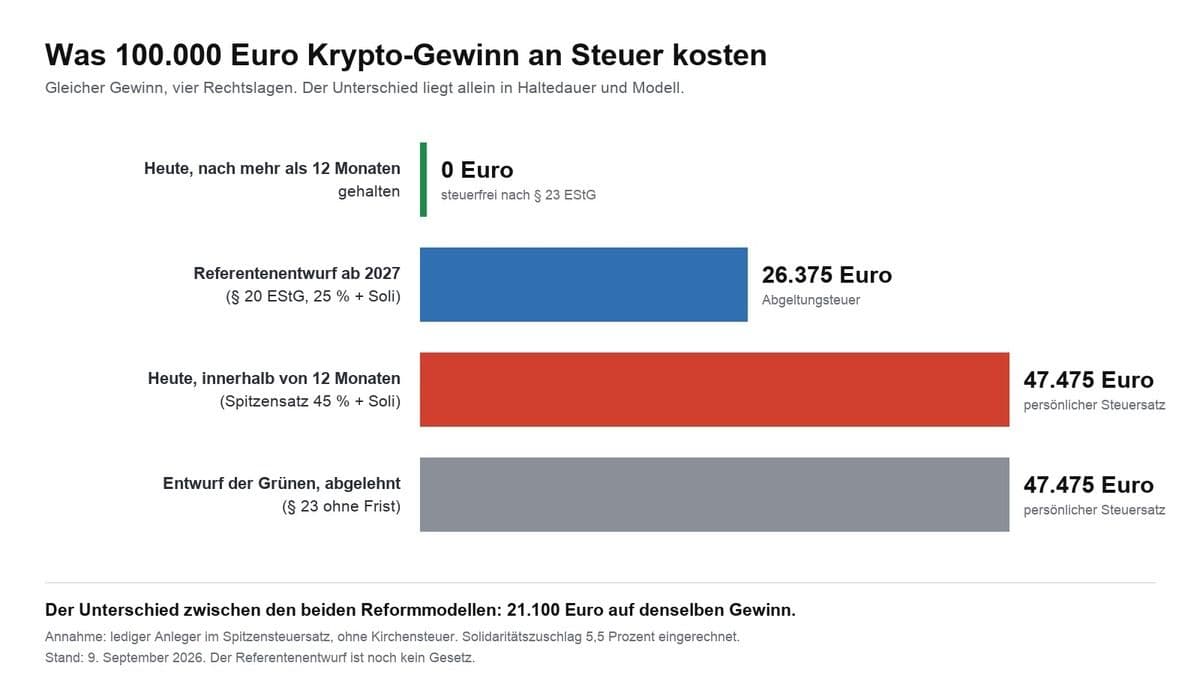
Crypto Tax in Germany: What Applies in 2026 and What Is Set to Change in 2027
Crypto gains are tax-free after twelve months; before that your personal tax rate of up to 45 percent applies. What triggers tax, how the holding period is calculated, what happens with staking and losses, and what the draft bill would change from 2027.
September 26, 2026 1:19 AM

Germany’s Crypto Holding Period Is Wobbling: What to Check Before December 31
A CDU member of the Bundestag makes it plain: the coalition agreement does not guarantee that the one-year holding period for crypto assets will survive. What that means for purchases made before the planned cutoff date of December 31, 2026.
October 7, 2026 10:54 PM

Two Routes Out of an Exchange Insolvency: Coins Back, or a Dividend in Euros
If the same coins come back after an exchange insolvency, the holding period from the year of acquisition runs on. If a dividend is paid out in money instead, the position is open, and the evidence question decides the case.
September 24, 2026 4:28 AM

Crypto Trading Bots and Tax: What Applies With Thousands of Trades a Year
A bot turns one investment decision into hundreds of disposals, and the tax office counts every single one. This guide explains the holding period, FIFO, the exemption limit and the record-keeping duties, and what to set up before the bot makes its first trade.
September 26, 2026 7:40 AM

The RAIN Token After the Enlivex Termination: What to Check on Access, Forced Sale and Holding Period
Enlivex terminated a share placement of 66,666,667 shares payable in RAIN tokens on September 22, 2026. The token sits 46.4 percent below its all-time high, and at Kraken the withdrawal deadline expired long ago.
September 9, 2026 1:15 AM

Germany's Crypto Tax: 160 Million Euros for a 555-Billion Budget
The German finance ministry's draft bill puts a figure on the crypto tax for the first time: 160 million euros from 2028. What that number means in the 2027 federal budget, how 11.4 billion became 160 million, and what investors can read from it.
October 16, 2026 7:25 PM

Crypto holding period for Bitcoin: “That remains to be seen,” says the finance ministry
The federal cabinet did not adopt the draft abolishing the one-year crypto holding period on October 14, 2026; it is still stuck in inter-ministerial consultation. This overview sets out what applies today, which dates follow and why the December 31, 2026 cutoff has no force of law so far.
October 15, 2026 4:13 AM

Crypto holding period: the cabinet date passes without a decision, December 31 stays the cut-off
Germany's federal cabinet did not adopt the expected decision of October 14, 2026 to abolish the one-year crypto holding period; the draft is still in interdepartmental consultation. Until new rules arrive, gains stay tax free after one year of holding, and the December 31, 2026 cut-off named in the draft separates old holdings from new ones.

October 5, 2026 4:26 PM

Shiba Inu price up 4.4 percent: outperforms the market, but 88 trillion SHIB sit on exchanges
Shiba Inu adds 4.4 percent on Monday, making it the strongest of the six big names. At the same time 88.08 trillion SHIB worth $525 million sit on trading venues, almost five times a single day of turnover.
September 27, 2026 4:32 AM

Hester Peirce Leaves the SEC: What Now Applies to Your Custody in Germany
The most crypto-friendly voice at the US securities regulator goes on October 2, 2026, and the commission shrinks to two members. For investors in Germany it is still the European rulebook that decides, and there a deadline falls in July 2027.
September 8, 2026 1:19 AM

Germany's Crypto Holding Period: What Happens Now Signing for Petition 201716 Closed on September 15
Recap as of September 27, 2026: the signature period for German parliamentary petition 201716, which asks for the one-year crypto holding period to be preserved, closed on September 15, 2026. This article explains what ended that day, how the petitions committee proceeds and why no investor has to sell because of it.
October 12, 2026 7:17 PM
Crypto Futures Tax in Germany: 25 Percent From the First Trade, No One-Year Rule
Crypto futures and perpetuals fall under Section 20 of the German Income Tax Act and therefore a flat 26.375 percent, with no holding period and no 1,000-euro exemption. Since the Annual Tax Act 2024, losses on them can again be offset without limit.
October 2, 2026 1:33 PM

Crypto tax before the cabinet on October 14: “Comments are only possible until October 6”
Germany's Federal Ministry of Finance sent the draft bill on crypto taxation to the associations on September 30, 2026, and the cabinet is to decide on October 14. For your holdings one date counts above all: December 31, 2026.
September 24, 2026 10:12 AM

XRP Falls 9.7 Percent: What to Check on Holding Period and Buying Route
XRP is down around 9.7 percent on the morning of September 24, twice as much as the typical large crypto asset. Our count of 18 coins shows who the pullback hits and which three things hold true regardless of the price.
More from CryptoTicker