
Crypto tax and withholding at source from 2028: what to check now
The German Federal Ministry of Finance’s draft bill goes to cabinet on October 14, 2026. The underexposed part of it is the deduction of tax from 2028: which providers are to withhold the tax on investment income, why self-custody and foreign platforms stay exempt from it, and what you should document by December 31.





Which topics should we dive deeper into?
Select what genuinely interests you. Your picks feed directly into our editorial planning.
Crypto news that's actually worth your time.
Weekly. 60 seconds. Carefully curated by our editors: no hype, no promo flood, no spam.
The German Federal Ministry of Finance’s draft bill on the taxation of crypto assets held privately has had a date since September 30, 2026: on October 14, 2026 the federal cabinet is due to take it up. For you, what matters about it is less the date than a figure that has barely featured in the coverage so far: January 1, 2028. From that day, crypto exchanges and other service providers are to withhold the tax on your gains directly and pass it to the tax office, the way a German bank does today with shares.
The short answer to the question of what that means for your trading account: for most purchases, nothing at all changes at first about the duty to declare for yourself. Deduction at source comes two years after the new rules, it affects only certain providers, and with self-custody it does not apply at all under the draft. Anyone who mixes that up is counting on relief that never arrives.
A note on the sources, because it counts for placing all this: the draft is not publicly available on the ministry’s pages. What is public is the covering letter, which Blocktrainer has published, and a detailed legal assessment of the draft version presented by the tax lawyer David Hötzel in the specialist portal Der Betrieb. Everything below is the state of the draft, not law in force.
Two dates the draft keeps strictly apart: January 1, 2027 and January 1, 2028
The draft works with two points in time that are often thrown together, although they govern different things.
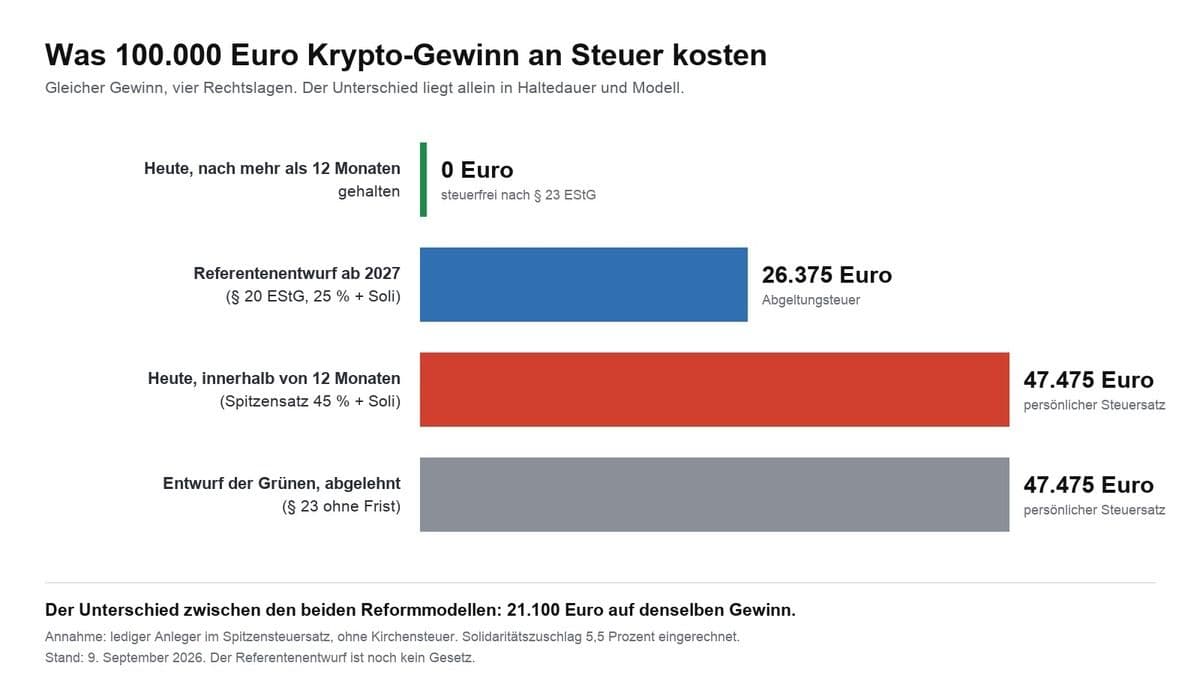
January 1, 2027 is the start of the new substantive tax rules. Gains from crypto assets acquired or received after December 31, 2026 then fall under investment income within the meaning of Section 20 of the German Income Tax Act. For those holdings, the tax exemption after one year of holding therefore falls away. They are taxed at the rate for investment income, under the draft 25 percent plus the solidarity surcharge, and that applies after five, ten or twenty years as well.
January 1, 2028 is the start of the deduction of tax at source. Only from that day is a service provider to withhold the tax on investment income. The year 2027 is therefore a transitional year with new substantive law and old procedural practice: gains from new holdings will as a rule not yet be taxed at source and have to be entered in the tax return.
By exchange crypto assets the draft means crypto assets within the meaning of the European MiCA regulation that are accepted as a means of exchange without being issued or guaranteed by a central bank. The explanatory memorandum expressly names Bitcoin and Ether. NFTs, security tokens and e-money tokens under Title IV of the MiCA regulation are to remain excluded; for them, what follows from the right conveyed in each case continues to apply.
The timetable up to cabinet: consultation deadline October 6, deliberation on October 14
The ministry sent the draft to associations and interest groups on September 30. Comments are to be submitted by October 6, 2026. Six days is a very tight allowance for a consultation of associations on a change of system, and that is precisely the signal: the pace here is being forced.
On October 14 the cabinet is to deal with the draft. If it clears that hurdle, the ministerial draft becomes a government bill. That is more than a formality, because the content thereby moves from one ministry’s working version to the declared line of the federal government. The Bundestag and the Bundesrat follow, and amendments remain possible there.
A cabinet deliberation, incidentally, is an agenda item, not a decision on the wording. Appointments of this kind get postponed, and drafts change between consultation and cabinet, which is what the October 6 deadline is for. The sentence “from 2027 this applies” is therefore wrong today. What is right: this is how it stands in the draft the cabinet is due to deal with on October 14.
Is the December 31, 2026 cut-off date certain, then?
No, it is not certain, and for two reasons that stand independently of one another.
First, the grandfathering of existing holdings is so far only the content of a ministry draft and not a legally secured position. Cabinet, Bundestag and Bundesrat are still to come. Second, the cut-off date can shift during the procedure if the timetable shifts. Until then, only this is dependable: under the current draft, crypto assets acquired up to December 31, 2026 remain within the old regime of private disposals.
What this grandfathering concretely means under the draft: holdings that are already tax-free remain disposable tax-free. For old holdings whose one-year period is still running on January 1, 2027, the tax exemption can still arise once that year has elapsed. There is no step-up; the historical date of acquisition remains decisive. We wrote up the placing of the cut-off date in the draft at the beginning of September in a separate analysis of the grandfathering; the cabinet date has only now been added.
In practice, two regimes therefore arise permanently, hanging on the date of acquisition or receipt. For your records that means: proof of when a coin came to you becomes the most important document you hold about it.

Who is to withhold the tax from 2028: domestic crypto asset service providers
This is where it becomes concrete for your trading account. Those to be obliged to deduct tax under the draft are domestic crypto asset service providers and crypto asset operators, as well as domestic branches or permanent establishments of foreign providers, in each case to the extent that they pay out or credit the corresponding income.
The decisive term is the domestic paying agent. What is meant by it is not simply “a large, well-known exchange” but an entity that sits in Germany for tax purposes and actually credits the amount to you. A platform with a European authorisation but without a domestic branch does not automatically satisfy that criterion on the wording.
For the choice of your trading venue this becomes a hard distinguishing feature from 2028 that appears on no product page today. Anyone wanting to know which providers are authorised in the European Union at all and where they are based will find the overview in our comparison of regulated crypto exchanges. The question of whether a given provider will deduct for you cannot be answered from it today, because the law is not settled, but the question of domicile already can be.
 Find the right crypto tax tool
Self-custody, DeFi and foreign platforms stay in the assessment procedure
Even from 2028, the deduction of tax will under the draft not apply across the board. Anyone who holds their coins in self-custody, who trades through decentralised applications, or who uses a foreign platform without a domestic paying agent remains obliged in principle to act for themselves: those gains still belong in the tax return.
The common line that “crypto will then run like shares” therefore covers only some of the cases. The assessment does not disappear, it becomes rarer. In practice two worlds arise side by side: domestic deduction cases, in which the provider does the arithmetic, and foreign or decentralised cases, in which you do. That both worlds together generate more administrative effort than one uniform solution has been noted expressly in the legal assessment of the draft.
From that follows an uncomfortable consequence for practice: you still need a complete record of your own, and precisely so if you move between wallets and platforms. Anyone whose purchase dates and purchase prices exist only in the interface of an exchange does not hold proof but a display.
Crypto-to-crypto swaps: the provider liquidates coins in order to pay the tax in euros
One point of the draft is usually skipped in the general coverage, although it reaches directly into your account. Swapping one crypto asset for another remains a tax-relevant transaction, because what is captured is the gain on disposal, and that term covered crypto-for-crypto swaps under the previous law too, in the view of the tax authorities and the tax courts.
From that arises a procedural problem the draft solves expressly: in a swap, no euro flows to you, yet the tax has to be paid in euros. The explanatory memorandum therefore sets out that the party obliged to deduct must be able to liquidate part of the crypto assets used in order to pay the tax in money.
The upshot is this: on a swap carried out on a platform obliged to deduct, part of the position may from 2028 be sold so that the tax can be paid. Anyone counting on a particular number of units should factor that deduction in. Exactly how the liquidation proceeds, what order applies to it and how the valuation is done is not settled in the draft down to the last question.
Missing acquisition data: 50 percent of the disposal proceeds as a substitute basis
If the platform does not know the date and the cost of acquisition, it may under the draft in principle fall back on your own particulars, as long as no contradictory data are available. Where those particulars cannot be applied, the procedure assumes the coins were acquired after December 31, 2026, and the deduction of tax is then measured on 50 percent of the entire disposal proceeds.
Two points of placing belong together here. The 50 percent are not a final fiction of profit: a deduction that is too high can be corrected in the assessment procedure. Until then, however, the money is gone, and from that arises a considerable liquidity risk. Particularly affected are transfers from a self-custodied wallet or from a foreign platform to a German platform obliged to deduct, which is precisely the route many take when selling. We worked that mechanism through in detail in a separate article on the substitute basis of assessment.
From that follows the one preparation that already helps for certain today, regardless of how the law ends up looking: a complete history of all purchases with date, quantity and price, together with the transfers between your addresses. Which tools pull that history together automatically from exchanges and wallets and build a report for the tax office out of it is in our comparison of crypto tax tools.
Loss offsetting without carryback: from 2027 there are two separate loss pools
Losses from new holdings are in future to be recognised within the system of investment income. They can therefore in principle be offset against other positive investment income and carried forward into future years. What falls away: a carryback into the immediately preceding year, as was possible in the regime of private disposals, is no longer provided for in the new system.
Old losses remain in the previous offsetting pool. The draft contains no transitional rule making losses from before the change of system offsettable, for a limited period, against gains from new crypto assets. From 2027 there are therefore two separate loss pools: one for old holdings and other private disposals, one for new crypto assets and the remaining investment income.
Anyone still holding unrealised losses in their old holdings should look at this separation before the end of the year, because under the draft it cannot be bridged after the fact. How a loss carryforward works under the law in force and which deadlines apply to it we wrote up in an article on the loss carryforward.

Crypto flat-rate tax compared with the taxation of shares from 2009
Structurally the model resembles the introduction of the flat-rate withholding tax for private share investments in 2009: a hard cut-off date, two regimes running permanently side by side, the date of acquisition as the switch. In one place, though, the draft departs from that precedent, and to your disadvantage: in 2009 there was a time-limited transitional rule for old losses, here none is provided for.
One more difference that matters for placing it: with shares, deduction by the bank came together with the new law. With crypto assets a year lies between the two, and even after that a large part of the cases stays with the taxpayer. The flat-rate tax on shares works because almost every custodian bank is a domestic paying agent. With crypto assets that is the exception.
Who gains and who loses cannot be stated across the board here. Long-term holders lose the complete tax exemption after one year. Short-term traders can come out better if their gains were previously charged at a personal marginal rate above 25 percent, and their losses become usable within a broader pool. So the model does not necessarily favour holding for a long time.
 Find a crypto exchange with an EU licence
Lending and passive staking become investment income
The draft reaches beyond disposal gains to the running income as well. Receipts from making crypto assets available and from participating in transaction processing are likewise to count as investment income. What is meant by that is above all classic lending and passive staking.
One detail of this matters for old holdings and is easily read past: according to the explanatory memorandum, lending or staking rewards that flow in after December 31, 2026 out of an old holding count themselves as a new holding. The underlying old holding stays in the old regime, the reward from it does not. So anyone who lends or stakes a position held for years is, from 2027, continuously generating new holdings with their own tax consequence.
Many questions in the decentralised area remain open in the process: liquid staking, pools, wrapped tokens, the exact moment of inflow and the boundary with commercial transaction processing. Also unresolved is a point that can have considerable consequences for gifts and inheritance: crypto assets received without consideration are to be entered with acquisition costs of 0 euros. Whether that also catches the relative receiving a gift or an inheritance who gets a Bitcoin bought before 2027 cannot be taken unambiguously from the draft. That ought to be clarified in the legislative procedure.
160 million euros for 2028: the additional revenue the draft itself expects
The draft names the additional revenue expected for the state as a whole, and the series is remarkably modest: zero euros in 2027, around 160 million euros in 2028, around 305 million in 2029, around 325 million in 2030 and around 350 million euros in 2031. The zero for 2027 fits the logic of the procedure, because without deduction at source the money only flows with the assessment.
For comparison: in the budget debate of the spring, amounts in the billions per year were in circulation. Nothing of that is left in the draft’s impact assessment. The compliance cost for citizens, business and administration is so far marked “to follow” in the draft, so it has not yet been priced. The provisions are to be evaluated six years after they come into force.
For the political placing that means: by its own calculation the reform brings the state less than a medium-sized item in the federal budget, while demanding a new documentary discipline from every private holder. That discrepancy is an argument certain to turn up in the comments submitted by October 6.
Crypto tax: the key points for your decision
Three things can already be dealt with now, regardless of how the law ends up looking. None of these steps presupposes that the draft goes through unchanged.
- Secure the acquisition data in full. Date, quantity and price of every purchase, plus the transfers between your addresses. That is the proof that prevents the substitute basis of 50 percent, and it helps you in every conceivable legislative scenario. Where you made your purchases and how you export the history depends on the provider; the export routes of the common trading venues are in our exchange comparison.
- Keep custody and responsibility apart. With self-custody the duty to declare stays with you under the draft, even after 2028. Anyone considering their own custody anyway should know that no service provider will then do the tax arithmetic for them; the types of device and how they are operated are in the hardware wallet comparison.
- Go through the running income before the turn of the year. Rewards from lending and staking that flow in from 2027 out of an old holding count as a new holding under the draft. Anyone holding such positions should look at the terms and the inflow rhythms; an overview of the providers and their models is in the lending comparison.
What you should not derive from this text, by contrast, is a buying decision. That an acquisition before December 31, 2026 stays within the old regime on the current state of the draft is a tax consequence. Whether a purchase makes sense for you is an entirely different question, and no explanatory memorandum answers it.
(As of October 1, 2026. This article is not investment advice. Prices and fee structures change; check the terms with the provider before you buy.)
Frequently asked questions about crypto tax
Transparency note: This article was produced with the assistance of artificial intelligence and reviewed by our editorial team before publication. All figures and claims were checked against the primary sources linked in the text. The feature image was generated with AI.
Related articles
- Germany’s Crypto Holding Period Is Wobbling: What to Check Before December 31
- Crypto Holding Period: Without a Purchase Record the Tax Withheld Runs Ten Times Too High
- Crypto Holding Period and Grandfathering: Why December 31, 2026 Becomes the Cut-Off in Germany's Draft Bill
- Crypto Loss Carryforward in Germany: What Happens to Old Losses Under the 2027 Tax Plan
- Crypto holding period for Bitcoin: “That remains to be seen,” says the finance ministry
Which topics should we dive deeper into?
Select what genuinely interests you. Your picks feed directly into our editorial planning.
Crypto news that's actually worth your time.
Weekly. 60 seconds. Carefully curated by our editors: no hype, no promo flood, no spam.

September 9, 2026 1:15 AM

Germany's Crypto Tax: 160 Million Euros for a 555-Billion Budget
The German finance ministry's draft bill puts a figure on the crypto tax for the first time: 160 million euros from 2028. What that number means in the 2027 federal budget, how 11.4 billion became 160 million, and what investors can read from it.
September 9, 2026 4:22 PM
Crypto Tax in Germany: What Applies in 2026 and What Is Set to Change in 2027
Crypto gains are tax-free after twelve months; before that your personal tax rate of up to 45 percent applies. What triggers tax, how the holding period is calculated, what happens with staking and losses, and what the draft bill would change from 2027.
August 31, 2026 10:30 PM

Taxing Crypto Lending: Your Personal Rate Instead of Withholding Tax, and the Right Federal Fiscal Court Case Number
According to the only tax court ruling so far, income from crypto lending falls under Section 22(3) of the German Income Tax Act and therefore under your personal tax rate. The appeal is pending at the Federal Fiscal Court under VIII R 22/25, not under the case number given in many professional articles.
October 2, 2026 1:33 PM

Crypto tax before the cabinet on October 14: “Comments are only possible until October 6”
Germany's Federal Ministry of Finance sent the draft bill on crypto taxation to the associations on September 30, 2026, and the cabinet is to decide on October 14. For your holdings one date counts above all: December 31, 2026.
September 7, 2026 7:22 AM

German Crypto Holding Period Set to Go After All: A Separate Draft Targets Purchases From 2027
Correction of 8 October 2026: The Income Tax Reform Act 2027, adopted by the German federal cabinet on 2 September, does not cover crypto assets. That did not mean the holding period stays. A separate draft bill from the Federal Ministry of Finance, dated 30 September, would abolish it for anything acquired after 31 December 2026. The cabinet is due to decide on 14 October.
September 25, 2026 1:30 PM

NEAR Staking ETP Passes $100 Million: What to Check on Yield, Brokerage Account and Holding Period
The Bitwise NEAR staking ETP has crossed $100 million in assets under management while NEAR climbs to $4.99. Our own retrieval of the issuer's figures shows the price made the jump, not the inflows.
September 24, 2026 10:19 PM

Bitcoin for Retirement: What Applies from 2027 and What You Decide Now
Bitcoin is not permitted in any state-subsidised retirement product, including the new retirement savings account from 2027. Anyone who still wants to use crypto assets for their own pension goes through private assets, and there a cutoff date at the end of 2026 is shifting the tax rules right now.
October 19, 2026 4:15 AM

Crypto FIFO across several exchanges: each wallet counts on its own in Germany
Hold bitcoin on several exchanges and in wallets of your own, and the holding period is calculated per pot, not across the total holding. What paragraph 62 of the BMF guidance orders, and why 31 December 2026 hangs on it.
September 27, 2026 10:14 AM

Shiba Inu Price Prediction: What to Check on SHIB Before the December 31 Deadline
SHIB trades at $0.00000592 on September 27, 2026, around 93 percent below its all-time high. For German investors one date matters more than the chart right now: December 31, 2026.
August 21, 2026 1:33 PM
Bitcoin With No Cost Basis: How Austria Taxes the Sale
Bitcoin purchase price no longer provable? How Austria works out the capital gains tax, when a flat-rate cost basis applies and what investors can do.
August 26, 2026 10:25 PM
Selling Bitcoin at a Loss: Loss Offsetting in Austria
Sold Bitcoin at a loss? Austria allows the loss to be offset against certain investment income. When loss offsetting is possible and which limits apply.
October 5, 2026 10:14 AM

Solana price 108.46 euros: a 2.4 percent gain in euros, a 2.5 percent loss in dollars: what to check now
Solana is quoted at 108.46 euros and $121.30 on Monday morning. That leaves a gain of 2.4 percent for 2026 in euros and a loss of 2.5 percent in dollars. The difference comes purely from the exchange rate, and in Germany it decides the holding period, the tax threshold and the figure that ends up on the tax return.
August 18, 2026 7:13 AM

Bitcoin Tax Reporting in Austria 2026: What Applies
Bitcoin tax reporting in Austria: which data investors can request from crypto exchanges in 2026, and when the report matters for the tax return.
October 12, 2026 7:17 PM
Crypto Futures Tax in Germany: 25 Percent From the First Trade, No One-Year Rule
Crypto futures and perpetuals fall under Section 20 of the German Income Tax Act and therefore a flat 26.375 percent, with no holding period and no 1,000-euro exemption. Since the Annual Tax Act 2024, losses on them can again be offset without limit.
August 31, 2026 10:23 AM

Bitcoin Abroad: The Tax Duty Austrian Investors Carry Themselves
Sold bitcoin through a foreign platform? When Austrian investors have to declare gains themselves and account for the 27.5 percent tax rate.
August 22, 2026 4:47 PM

Offsetting Bitcoin Losses Against Stock Gains in Austria
Offset bitcoin losses against gains on shares? Austria allows it in principle, but only under certain conditions and usually via the tax return.
September 19, 2026 7:12 PM

Bitcoin Sold Without Austrian Tax Withheld: What to Do Next
Sold Bitcoin but no Austrian capital gains tax was withheld? That does not make the sale tax free. When investors have to declare the gain themselves at 27.5 percent.

January 1, 2026 3:12 PM
Crypto Taxes 2026 in Germany: Automatic Reporting Under DAC8, What Applies Now
Since 1 January 2026 crypto providers in the EU must record their customers' transactions for the tax authorities. The first report for 2026 follows in 2027. What investors need to know.
August 27, 2026 10:16 AM
Bitcoin Tax Return in Austria: When You Must File
Even with a crypto exchange, a tax return can still be necessary in Austria. Foreign platforms, missing capital gains tax withholding and cross-provider losses are the typical triggers.
September 1, 2026 1:25 PM

Bitcoin Tax Report Wrong: What Austrian Investors Can Do
Errors in a Bitcoin tax report are not unusual. This is the data Austrian investors should check, and how a wrong capital gains tax deduction is put right.
October 9, 2026 1:18 PM

Bitcoin Tax: One Year Past the $126,080 Peak, Losses No Longer Count
Bitcoin trades at $82,558 on Friday morning, 34.5 percent below an all-time high that is now a good year old. Anyone who bought back then loses more than the prospect of a quick recovery when the one-year period expires: the tax value of the loss goes with it.
August 21, 2026 4:24 AM

Forced Sale on a Crypto Exchange: Which Moment Counts for the Holding Period and What You Must Document
At Luno, Kraken and Valour the deadlines are running out, after which the provider realises the remaining holding itself. For tax purposes that is a disposal, and what governs it is the exchange's timestamp.
August 11, 2026 9:13 PM

Germany's Crypto Holding Period Faces Abolition: What Petition 201716 and the Draft Bill Mean for Your Tax
Petition 201716 calls for the one-year holding period for crypto assets to be kept and will be heard in public by the Bundestag's Petitions Committee on 12 October 2026. Correction of 8 October: the reform was not decided by the cabinet in July. A draft bill of 30 September would end the holding period for crypto acquired after 31 December 2026, and the cabinet is due to take it up on 14 October.
September 16, 2026 7:12 PM

Borrowing Against Bitcoin Instead of Selling: When German Tax Still Applies
Posting Bitcoin as collateral for a loan is not a sale in Germany, because section 39 of the Fiscal Code keeps the coins attributed to you for tax purposes. Tax arises only when the collateral is liquidated, and then the one thing that decides the bill is how long you held the coins beforehand.
August 10, 2026 9:15 PM

Selling Bitcoin at an ATM: Tax Rules in Austria
Selling bitcoin for cash at an ATM: when the 27.5 percent rate applies in Austria and which records you need to keep.
September 19, 2026 7:26 AM

Offsetting Crypto Losses Against Share Gains: What Is Really Allowed in Germany
Crypto losses and share gains sit in separate loss buckets in Germany, and there is no offsetting between them. Where the line runs, why crypto derivatives are the exception, and how you can still use losses through carryback and carryforward.
September 17, 2026 7:12 PM

Gifting Bitcoin to Children: Allowance, Holding Period and the Tax Office Report
Transferring Bitcoin to your child hands over your holding period and your entry price along with the coins. This guide sets out what really applies in Germany on the allowance, the reporting deadline, representation and custody.
More from CryptoTicker