
Crypto holding period: the cabinet date passes without a decision, December 31 stays the cut-off
Germany's federal cabinet did not adopt the expected decision of October 14, 2026 to abolish the one-year crypto holding period; the draft is still in interdepartmental consultation. Until new rules arrive, gains stay tax free after one year of holding, and the December 31, 2026 cut-off named in the draft separates old holdings from new ones.





Which topics should we dive deeper into?
Select what genuinely interests you. Your picks feed directly into our editorial planning.
Crypto news that's actually worth your time.
Weekly. 60 seconds. Carefully curated by our editors: no hype, no promo flood, no spam.
Germany's federal cabinet did not take up the abolition of the one-year holding period for crypto assets on Wednesday, October 14, 2026. The published results of its 62nd session make no mention of the measure, and the government press conference that followed did not address it either. Current law therefore stands: anyone who holds Bitcoin, Ether or any other crypto asset for more than a year and then sells it pays no income tax on the gain.
For investors in Germany that is a breathing space, not an outcome. The Federal Ministry of Finance told Blocktrainer on request that the internal government consultations were still running. The ministry named no new date for the cabinet to take up the file. The departmental draft that would delete the one-year rule thus remains what it has been since late September: a working paper from the finance minister's house that has not yet passed the cabinet.
What happened in the cabinet on October 14, and what did not
October 14 had been treated as a fixed date in coverage since the start of the month. We named it ourselves on October 3, in our reporting on the departmental draft, as the next step in the procedure. It did not materialise.
Blocktrainer reports that as early as the previous day the ministry had said it knew of no such date. Frank Schäffler, a former FDP member of the Bundestag, wrote on X that the abolition of the holding period was still stuck in interdepartmental consultation. Both accounts match the ministry's official statement.
A missing agenda item is not a withdrawal. Government measures slip as a matter of routine when departments are still arguing over detail. Only one thing is solid on this day: there is no cabinet decision, and without one there is no government bill.
Interdepartmental consultation: why a departmental draft is not yet law
The road from an idea inside the finance ministry to an amendment of the Income Tax Act runs through several stations, and each of them can take time. The departmental draft is the working version produced by a ministry's specialist unit. It has no legal effect and does not bind the federal government.
In interdepartmental consultation, the other ministries check the text against their own remits. Only once they agree can the cabinet adopt the draft. That decision turns the departmental draft into a government bill, which is then introduced in the Bundestag and the Bundesrat. Readings, committee deliberations and finally the assent of both chambers follow.
The measure is stuck at precisely that second station. Associations and interest groups had their chance to comment; according to Blocktrainer, responses were requested by October 6. The Federal Chamber of Tax Advisers publicly doubted that the submissions could be evaluated seriously in the time left.

Section 23 and Section 20 of the Income Tax Act: the difference decides your tax bill
Today, gains from the sale of crypto assets fall under Section 23 of the German Income Tax Act, which covers private disposal transactions. That provision carries two features crypto investors have benefited from for years. First, the one-year rule: after more than twelve months of holding, the gain is tax free. Second, the 1,000-euro exemption threshold for gains realised inside the period.
The finance ministry's draft moves crypto assets to Section 20, in other words to income from capital assets. There the flat withholding tax of 25 percent applies, plus the solidarity surcharge and, where relevant, church tax, regardless of how long someone has held their coins. The saver's allowance takes the place of the one-year rule.
In practice the shift means more than a different section number. Loss offsetting would be affected as well, together with the question of who withholds the tax and how much documentation the tax office demands. Our comparison of crypto tax software and portfolio trackers shows how to keep clean records of your transactions today; the documentation burden rises under either model.
December 31, 2026 separates old holdings from new ones
The most important figure in the draft is not the tax rate but the date of first application. Under the version on the table, the new rules would apply only to crypto assets acquired after December 31, 2026. Everything already sitting in a securities account or a wallet before that would stay under the old law, and therefore inside the one-year rule.
That gives investors a clear dividing line for as long as the draft keeps this shape. Purchases up to the turn of the year follow the existing rule. Purchases after it would fall under the flat withholding tax. A good eleven weeks separate today from that date.
One caveat belongs with it, and it is no formality: this cut-off sits in a draft that neither the cabinet has adopted nor the Bundestag has debated. It can move during the procedure, and with earlier tax measures that is exactly what happened more than once. Basing decisions on this date alone means planning around a number that carries no force of law.
Until new rules arrive, the one-year period applies unchanged
Nothing changes for the current tax year because the date was missed. Anyone who sold crypto assets in 2026 settles under Section 23 as it stands: a holding period of more than a year means no tax, below that the personal income tax rate applies, provided total gains from private disposal transactions exceed the 1,000-euro threshold.
The same holds for swaps. Moving from Bitcoin into a stablecoin or into another coin counts for tax purposes as a disposal and an acquisition at once. Every swap starts a fresh one-year period for the asset received. Reshuffling a portfolio in December may therefore move holdings out of the old regime and into a future one.
 Compare the best crypto tax tools
Petitions committee and chamber of tax advisers: where the headwind comes from
A second track runs alongside the government procedure. On Monday, October 12, 2026, the Bundestag's petitions committee considered a petition to keep the holding period in a public session. We covered the state of the parliamentary process in our piece on the Bundestag's handling of the crypto holding period.
A hearing in the petitions committee does not change tax law. It builds political pressure and forces the federal government to state a position. Combined with the Federal Chamber of Tax Advisers' criticism of the timetable, a picture emerges that makes the delay plausible: the measure is contested on technical and political grounds, and the consultation window was tight.
Resistance is therefore documented at two levels. What is not documented is how the federal government will respond. Whether it reworks the draft, stretches the timetable or takes it to the cabinet unchanged is open as matters stand.
Gold in the mix: how far the reform could reach
One side track in the debate goes beyond crypto assets. According to a report by BTC-Echo, the finance ministry has floated proposals to extend new rules to physical gold. The one-year speculation period under Section 23 applies there today as well.
That point is revealing for any assessment of the measure. If the reform went beyond crypto, considerably more investors would be affected, and political resistance would grow accordingly. That raises the likelihood of further delay, but says nothing about whether the reform arrives in the end.

Our assessment: the timetable for January 1, 2027 is ambitious
From the newsroom's point of view, entry into force on January 1, 2027 becomes less likely with every date that passes. The evidence is in the open. The draft went to association consultation in late September, responses were requested by October 6, and the cabinet decision expected on October 14 did not come. After the cabinet there are still three readings in the Bundestag, committee deliberation and the passage through the Bundesrat. A good eleven weeks remain in the year.
Against that, the federal government has not withdrawn the measure and the ministry speaks expressly of consultations in progress. Tax legislation has been pushed through the procedure in less time at year-end when the political will was there. We offer no forecast of the outcome; there is no solid basis for one.
What follows for practice is more modest than many posts online suggest: today's legal position is certain, the future one is not. Anyone who makes arrangements depend on a law that does not yet exist carries that risk alone.
Documentation: purchase date and acquisition cost per position
However the procedure ends, a cut-off rule has one consequence: the acquisition date of each individual position becomes the decisive record. Proving in 2027 that a holding was bought before the cut-off takes more than a bank statement.
Each position needs the date, the quantity, the acquisition cost in euros and the exchange or wallet where the purchase took place. Across several years and several platforms, that record does not assemble itself retroactively. Exchanges issue tax reports of varying quality; some provide complete transaction histories for export, others only annual summaries. The depth of those histories differs from venue to venue.
A second point concerns sequence. For crypto assets the tax office works on the FIFO method as a rule, first in, first out. Selling part of a holding therefore touches the oldest positions first, and under a future cut-off rule those are precisely the protected ones.
Crypto holding period: every purchase date counts up to December 31
The cabinet date has passed; the measure has not. These three steps make sense whatever the outcome of the procedure:
- Record your holdings with purchase dates. Pull the date, quantity and acquisition cost for every position from your exchanges and wallets, and store the exports outside the platform. A tax tool or portfolio tracker handles the reconciliation across several providers.
- Check where your oldest holdings sit. Because of the FIFO rule, the order of purchases decides which coins a sale hits first. You need that information before you reshuffle at year-end. At regulated crypto exchanges the full history is usually available for export.
- Look at your venues on record quality. Anyone unable to export a full history has a documentation problem later. Our comparison of crypto exchanges shows which providers deliver usable tax reports.
There is no known next date for the procedure itself. Once the cabinet adopts the draft, the parliamentary stage begins, and only then will it be clear whether December 31, 2026 remains the dividing line.
(As of October 15, 2026. This article is not investment advice. Prices and fee structures change; check the terms with the provider before you buy.)
 Find an exchange with a clean tax report
Frequently asked questions about the crypto holding period
Transparency note: This article was produced with the assistance of artificial intelligence and reviewed by our editorial team before publication. All figures and claims were checked against the primary sources linked in the text. The feature image was generated with AI.
Related articles
- Germany’s Crypto Holding Period Is Wobbling: What to Check Before December 31
- Bitcoin Tax: One Year Past the $126,080 Peak, Losses No Longer Count
- Forced Sale on a Crypto Exchange: Which Moment Counts for the Holding Period and What You Must Document
- Borrowing Against Bitcoin Instead of Selling: When German Tax Still Applies
- German Crypto Holding Period Set to Go After All: A Separate Draft Targets Purchases From 2027
Which topics should we dive deeper into?
Select what genuinely interests you. Your picks feed directly into our editorial planning.
Crypto news that's actually worth your time.
Weekly. 60 seconds. Carefully curated by our editors: no hype, no promo flood, no spam.

September 17, 2026 10:22 PM

Selling Bitcoin at a Loss and Buying It Straight Back: What That Does to Your Holding Period
Germany has no wash sale rule: the loss stays deductible even if you buy back immediately. The buyback, however, restarts the one-year period for every new unit.
September 8, 2026 10:21 PM

Crypto Holding Period and Grandfathering: Why December 31, 2026 Becomes the Cut-Off in Germany's Draft Bill
A ministerial draft bill from Germany's finance ministry names a cut-off date for the first time: crypto assets acquired after December 31, 2026 are to fall under the flat-rate withholding tax. What that means for legacy holdings, running savings plans and staking income, and why nothing has been decided yet.
September 8, 2026 1:19 AM

Germany's Crypto Holding Period: What Happens Now Signing for Petition 201716 Closed on September 15
Recap as of September 27, 2026: the signature period for German parliamentary petition 201716, which asks for the one-year crypto holding period to be preserved, closed on September 15, 2026. This article explains what ended that day, how the petitions committee proceeds and why no investor has to sell because of it.
September 16, 2026 1:20 PM

Crypto Loss Carryforward in Germany: What Happens to Old Losses Under the 2027 Tax Plan
Losses from crypto sales land in a ring-fenced pot and can only be set against gains of the same kind. The draft bill for 2027 moves future gains into a different pot, and we show you what that means for your assessed carryforward and what your tax notice should say.
October 2, 2026 1:33 PM

Crypto tax before the cabinet on October 14: “Comments are only possible until October 6”
Germany's Federal Ministry of Finance sent the draft bill on crypto taxation to the associations on September 30, 2026, and the cabinet is to decide on October 14. For your holdings one date counts above all: December 31, 2026.
September 9, 2026 4:13 PM

Bitcoin 29 Percent Below Last Year: Which Crypto Losses You Can Still Use Before the One-Year Holding Period Expires
Nine out of ten major crypto assets trade lower today than exactly twelve months ago, Bitcoin alone by 29.2 percent. We measured the price series ourselves and show why the purchase date alone decides the tax value of your loss.
August 11, 2026 9:13 PM

Germany's Crypto Holding Period Faces Abolition: What Petition 201716 and the Draft Bill Mean for Your Tax
Petition 201716 calls for the one-year holding period for crypto assets to be kept and will be heard in public by the Bundestag's Petitions Committee on 12 October 2026. Correction of 8 October: the reform was not decided by the cabinet in July. A draft bill of 30 September would end the holding period for crypto acquired after 31 December 2026, and the cabinet is due to take it up on 14 October.
September 24, 2026 1:13 AM

Solana DEX Trades Overtake the NYSE: What to Check on Swaps, Tax and Oversight
Solana's decentralised exchanges settled roughly 208 million trades in a single week and overtook the New York Stock Exchange for the first time. The figure is real, but it measures something other than the comparison suggests, and for German investors it carries tax duties that no provider takes on.
October 6, 2026 4:32 AM

Bitcoin for a gift card: what paying with crypto means for your holding period
Paying for a gift card with Bitcoin is a sale for tax purposes. What counts as the disposal proceeds, when the twelve-month holding period bites, and the four records the tax office expects.
September 25, 2026 10:26 PM

Selling bitcoin privately: the tax in Germany and the records you need
A direct sale to a private individual falls under the same one-year rule as an exchange sale, but there is no tax report to go with it. This guide walks through the calculation, the 1,000 euro threshold and the records the tax office wants to see.
September 9, 2026 1:15 AM

Germany's Crypto Tax: 160 Million Euros for a 555-Billion Budget
The German finance ministry's draft bill puts a figure on the crypto tax for the first time: 160 million euros from 2028. What that number means in the 2027 federal budget, how 11.4 billion became 160 million, and what investors can read from it.
September 9, 2026 4:22 PM
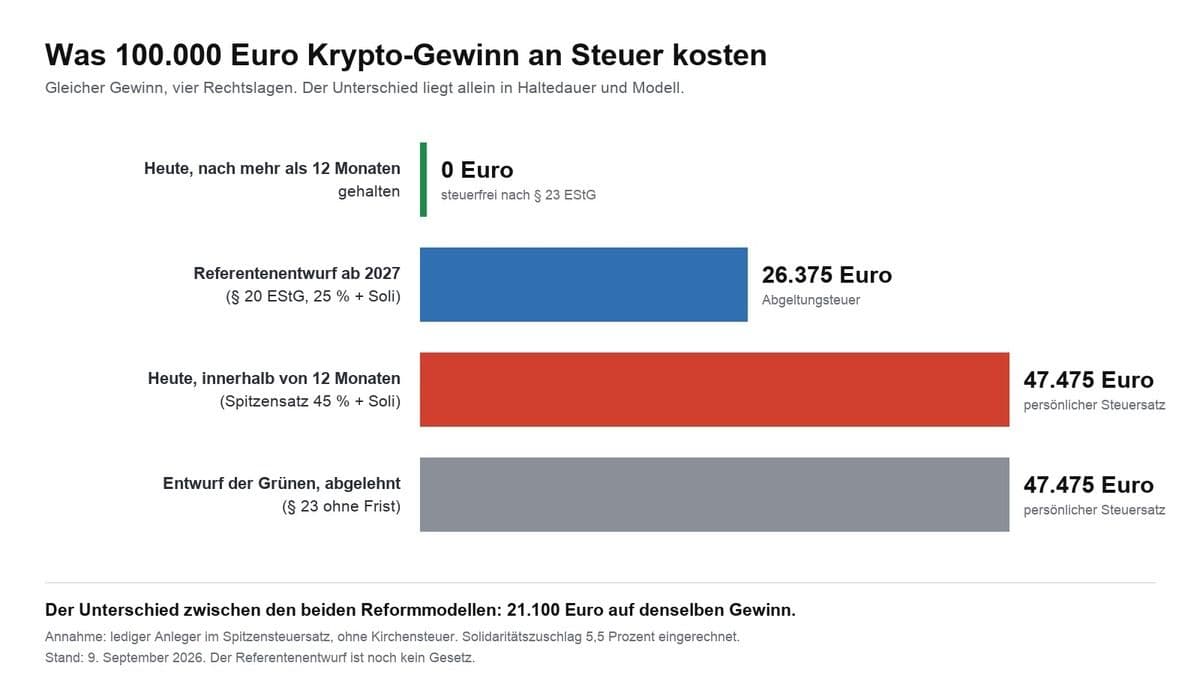
Crypto Tax in Germany: What Applies in 2026 and What Is Set to Change in 2027
Crypto gains are tax-free after twelve months; before that your personal tax rate of up to 45 percent applies. What triggers tax, how the holding period is calculated, what happens with staking and losses, and what the draft bill would change from 2027.

September 27, 2026 1:17 PM
Dogecoin Price: What to Check on Holding Period and Custody Before the Year End
The Dogecoin price stands at $0.0977 on September 27, 2026 and has barely moved in a day. That calm is exactly the moment to work through the holding period, the reporting duty from 2026 and custody without any time pressure.
August 31, 2026 10:30 PM

Taxing Crypto Lending: Your Personal Rate Instead of Withholding Tax, and the Right Federal Fiscal Court Case Number
According to the only tax court ruling so far, income from crypto lending falls under Section 22(3) of the German Income Tax Act and therefore under your personal tax rate. The appeal is pending at the Federal Fiscal Court under VIII R 22/25, not under the case number given in many professional articles.
September 18, 2026 10:13 AM

Bitcoin and the German Exit Tax: What Applies When You Move Abroad
Anyone emigrating with Bitcoin expects an exit tax on unrealised gains and finds nothing of the sort in the statute. Where the real risks sit is decided at four points: residence, the holding period, the legal form of your investment, and automatic reporting from 2026.
October 2, 2026 4:39 AM

Donating bitcoin: when does the full market value count, when only the purchase price?
A bitcoin donation to a charitable organisation is deductible as a donation in kind, and the donation itself produces no taxable gain. The size of the deduction turns solely on whether a sale would have been taxable on the day of the transfer.
October 1, 2026 10:44 AM

German crypto tax reform: without a receipt, half the sale price is taxed
The Federal Ministry of Finance's draft bill goes to the cabinet on October 14. Anyone who cannot prove their acquisition cost pays tax on 50 percent of the sale proceeds under the substitute assessment.
September 26, 2026 7:29 PM

Coins Stolen in an Exchange Hack: What the German Tax Office Accepts as a Loss
After the attack on Bitget on September 24, a question the reports leave out arises for those affected in Germany: can a stolen balance be written off against tax? The answer hangs on a single term in the Income Tax Act, and it is decided by your records.
September 14, 2026 10:23 AM

Take Ethereum Profits or Wait Out the Holding Period? What the Price Jump Means for Your Tax Bill
Ether reached its highest level since the end of January on September 11, 2026, and many are asking whether to sell now. In Germany the answer hangs on the purchase date first: we work out which tranches are tax free and which of them are showing a gain at all.
September 19, 2026 7:26 AM

Offsetting Crypto Losses Against Share Gains: What Is Really Allowed in Germany
Crypto losses and share gains sit in separate loss buckets in Germany, and there is no offsetting between them. Where the line runs, why crypto derivatives are the exception, and how you can still use losses through carryback and carryforward.
September 27, 2026 10:35 AM

Crypto Exchange Tax Report Wrong: How to Correct It Before the Tax Office Does
Missing acquisition costs, transfers booked as sales, holding periods restarted: your exchange's report is an aid and not proof. How to check it, how to correct it and which deadline is running.
September 17, 2026 7:12 PM

Gifting Bitcoin to Children: Allowance, Holding Period and the Tax Office Report
Transferring Bitcoin to your child hands over your holding period and your entry price along with the coins. This guide sets out what really applies in Germany on the allowance, the reporting deadline, representation and custody.
October 6, 2026 10:24 PM

Germany's Crypto Holding Period Before the Petitions Committee on October 12: What Matters Now
The Bundestag's petitions committee debates the crypto holding period on Monday, October 12, 2026, from 12 noon in a public sitting, with federal government representatives on hand for questions. Two days later the cabinet is to decide on the draft bill that removes the one-year period for purchases from 2027.
August 24, 2026 4:22 AM

Selling XRP After a 53 Percent Week: What the Holding Period Costs
XRP trades at $1.51 after a weekly gain of a good 50 percent, yet your net proceeds are decided by the purchase date. This article works through the holding period, the exemption limit and FIFO at measured reference-date prices.
September 22, 2026 10:13 AM

Circle Lends Against Bitcoin via cirBTC: Why the Wrapper Can Cost You the German Holding Period
Circle launched loans against deposited bitcoin on September 21, 2026. In Germany, the detour through the cirBTC token is very likely a swap, and a swap restarts your one-year holding period.
September 27, 2026 10:14 AM

Shiba Inu Price Prediction: What to Check on SHIB Before the December 31 Deadline
SHIB trades at $0.00000592 on September 27, 2026, around 93 percent below its all-time high. For German investors one date matters more than the chart right now: December 31, 2026.
September 24, 2026 10:19 PM

Bitcoin for Retirement: What Applies from 2027 and What You Decide Now
Bitcoin is not permitted in any state-subsidised retirement product, including the new retirement savings account from 2027. Anyone who still wants to use crypto assets for their own pension goes through private assets, and there a cutoff date at the end of 2026 is shifting the tax rules right now.
More from CryptoTicker