
Hyperliquid falls 5.9 percent while Bitcoin loses 0.8: $1.66 billion of leverage sits on HYPE
HYPE drops to $82.61 while Bitcoin gives up only 0.8 percent. An own survey of the exchange shows why: $1.66 billion of open leveraged positions stand against $611 million of daily turnover.


Which topics should we dive deeper into?
Select what genuinely interests you. Your picks feed directly into our editorial planning.
Crypto news that's actually worth your time.
Weekly. 60 seconds. Carefully curated by our editors: no hype, no promo flood, no spam.
Hyperliquid lost 5.9 percent on Monday morning, Bitcoin only 0.8 percent over the same period. A look into the exchange's own books explains the gap: Hyperliquid carries $1.66 billion of open leveraged positions on its own token. That makes it the house's third-largest market after Bitcoin and Ethereum, and it is almost three times what trades there in a day.
cryptoticker.io compiled this analysis itself on October 13, 2026, from the exchange's publicly accessible data and from CoinGecko. What follows from it, and what an investor in Germany can check against it, is set out in the sections below.
HYPE falls to $82.61 while Bitcoin loses only 0.8 percent
HYPE trades at $82.61, or 73.95 euros, on October 13, 2026. Over 24 hours that is a loss of 5.9 percent, over seven days one of 11.5 percent. Over 30 days, by contrast, the token is still up 4.5 percent. The daily range ran from $79.52 to $88.00, a spread of 10.7 percent between low and high in a single day.
For comparison, the two largest coins over the same window: Bitcoin stands at $83,401 and is giving up 0.8 percent, Ether at $2,514.63 with a loss of 1.9 percent. The broad market is moving, in other words, but it is not breaking down. HYPE is falling roughly seven times as hard as Bitcoin.
The backdrop comes from last week. $681 million flowed out of the American spot ETFs on Bitcoin on a net basis, according to CoinDesk, the largest weekly withdrawal since June on figures from provider SoSoValue. Analysts there name $82,000 as an important support for Bitcoin. The next date that can move the whole market is the US inflation print on October 14.
A token such as HYPE hangs on that wider weather, but it amplifies it. A look into the books of the exchange it trades on shows why.
1.66 billion dollars: HYPE is the third-largest leverage market on its own exchange
Hyperliquid is a decentralised exchange for perpetual futures. A perpetual future, or perp, is a futures contract with no expiry date: you bet on a coin's price with leverage without owning it, and the position runs for as long as you can fund it. The exchange publishes its market data openly, and anyone can pull it.
The pull on October 13, 2026 gives $11.75 billion of open positions and $7.73 billion of turnover over 24 hours across all 234 perp markets. Open positions are known in the jargon as open interest: the sum of all contracts currently running and not yet closed.
The ranking by open interest looks like this:
- Bitcoin: $3.14 billion
- Ethereum: $2.79 billion
- HYPE: $1.66 billion
- Solana: $627 million
- Zcash: $554 million
- NEAR: $367 million
The exchange's own token therefore sits ahead of Solana, Zcash and NEAR, and ahead of all three combined. For a coin ranked 11th by market capitalisation, that is an unusually heavy position on a single venue. Maximum leverage on HYPE is 10, against 40 on Bitcoin.
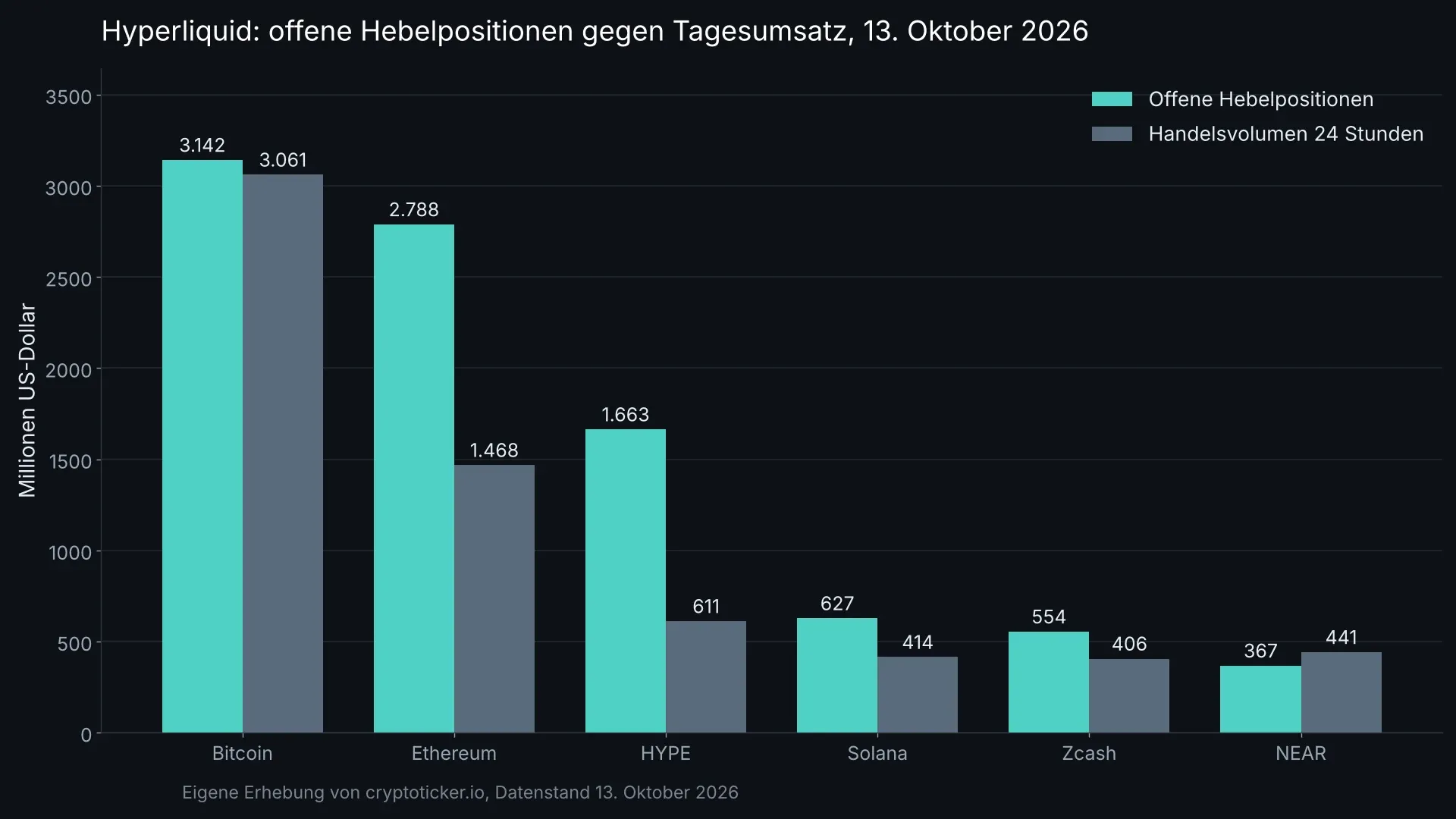
Open interest against daily turnover: the ratio explains the gap
The absolute figure says little on its own. It becomes meaningful in relation to turnover, because turnover shows how quickly positions can change hands.
On Bitcoin, $3.14 billion of open positions stand against $3.06 billion of daily turnover. The ratio is 1.03: on a normal day, roughly as much is traded in this market as is open in positions altogether. Anyone who wants out finds a buyer.
On HYPE, $1.66 billion of open positions stand against $611 million of daily turnover. The ratio is 2.72. There are therefore almost three times as many running bets in the market as are traded there in a day. If everyone wanted to close at once, the market would need just under three days of turnover to do it.
That is exactly what creates the difference in the price move. A market with plenty of open positions and little turnover reacts more strongly to the same piece of news, because every sale eats up a larger share of the available other side. The 5.9 percent decline in HYPE against 0.8 percent in Bitcoin is built into that number before any news arrives.
Funding rate and liquidation threshold: how forced selling pressure builds
Two mechanisms keep a perp market in balance, and both are currently working against the buy side.
The first is the funding rate. It is the payment that holders of long and short positions make to each other every eight hours so that the futures price does not detach from the spot price. On HYPE it stands at plus 0.00125 percent per eight hours on October 13. Positive means the long side pays the short side. The rate is low, but the direction is unambiguous. Bet on rising prices and you pay for every day you wait.
The second is liquidation. If the price falls far enough that the posted collateral no longer covers the losses, the exchange closes the position automatically and sells. With ten times leverage, a decline of around ten percent against the position is enough on paper. The daily range of $79.52 to $88.00 amounts to 10.7 percent. A move of that size was therefore enough on Monday to hit leveraged long positions.
Such forced sales hit further positions, which then close in turn. The bigger the pile of open positions relative to turnover, the longer that sequence runs.

Funding rate, fees and leverage caps differ from one perp exchange to the next
The three variables that decide the outcome of a leveraged position are each set by the exchange itself. The funding rate of plus 0.00125 percent per eight hours is at the lower edge of the band on Hyperliquid; at other venues the base rate of 0.01 percent per eight hours is eight times as high, which means markedly higher carrying costs on the same position. On leverage, Hyperliquid's 10 on its own token is on the low side for the industry, while 40 on Bitcoin is at the upper end.
Which platforms are candidates for trading perps, and how they differ on these points, is set out in the comparison of the best perp DEXs.
 Compare perp DEXs for leveraged trading
Only 22 percent of HYPE tokens are in circulation
Alongside leverage, a second item in the books weighs on the price over a horizon of months: the quantity of tokens not yet in the market.
Of a maximum supply of one billion HYPE, around 222.4 million units are in circulation on October 13, 2026. That is 22.2 percent. The remaining 77.8 percent sit in lock-ups, with core contributors, in the community fund and in reserves.
That gap shows up in two valuation figures. Market capitalisation, circulating supply times price, stands at $18.36 billion. The fully diluted valuation, or FDV, counts every token that will ever exist at today's price and comes to $78.83 billion. The factor between the two is 4.3.
This is not a peculiarity of Hyperliquid but the usual picture for young tokens with long lock-ups. It does mean, though, that every unlock releases new units into a market whose demand does not automatically grow to the same degree.
The monthly unlock on the 6th, and the buyback against it
A monthly distribution to core contributors, meaning the project's team and developers, has been running since January 2026. According to a report by Cryptotimes it falls on the 6th of each month and began with 1.2 million HYPE on January 6. The October 6, 2026 tranche comprised 3.75 million HYPE, worth around $340 million. Hyperliquid Labs is selling that tranche over the counter to a single institutional buyer, according to the same report; co-founder iliensinc confirmed this on Discord, and neither buyer nor price has been named.
If the pattern continues, the next distribution falls on November 6. No confirmed number of units exists for that date, and the public unlock calendars contradict each other on this point. The monthly pattern is documented; the coming quantity is not.
Against that stands a buyback programme. The exchange's assistance fund bought back $11.81 million of HYPE in the week before October 6, and $14.81 million in the week before that. Measured against the value of the October tranche, the weekly buyback amounts to around 3.5 percent. The buybacks are running, then, but they do not offset the unlocks. How the programme is built and where the money for it comes from is described in our article on the buyback out of USDC earnings.
Perpetual futures without a MiCA licence: deposit protection does not apply
This is where the situation becomes concrete for investors in Germany. The EU regulation on markets in crypto-assets, MiCA for short, has applied since December 30, 2024. Anyone offering crypto services in the EU needs a licence for it, and for providers based in Germany, BaFin runs the procedure.
Hyperliquid is a decentralised exchange with no EU base and no such licence. Three things follow from that which stand differently at a licensed provider:
- No supervisor to turn to. In a dispute over a liquidation, there is no German authority you can approach and no complaints body under German law.
- No segregation of client money to the EU standard. MiCA requires licensed providers to hold client assets separately. Without a licence that obligation does not apply.
- No leverage protection for retail investors. For contracts for difference on crypto-assets, EU-regulated brokers face a leverage cap of 2 for retail clients. On an unlicensed perp exchange it does not bite, and there ten times leverage on HYPE and forty times on Bitcoin are possible.
Anyone who wants to trade leveraged products inside the European framework will find the licensed addresses in the comparison of the best crypto brokers. The price for it is markedly lower leverage; the return is supervision.
Tax on perp gains: the one-year holding period does not apply here
One point is regularly overlooked and cannot be repaired after the fact. When you buy a coin directly, the one-year speculation period applies in Germany: hold for longer and you sell tax-free. With perpetual futures that rule does not bite, because the gain does not come from selling a held asset but from a futures transaction.
Gains from perps therefore count as investment income from the first minute and are subject to the 25 percent flat-rate withholding tax plus the solidarity surcharge and, where applicable, church tax. How the taxation works in detail, and which offsetting limits apply to losses from futures transactions, is set out in our piece on the tax on crypto futures and perps.
For record-keeping that means every closed position belongs in the log, including the small ones. An unlicensed exchange abroad transmits no data to the German tax office, and the duty to declare stays with the taxpayer.
 Find a regulated broker for crypto derivatives
Our assessment: leverage weighs more heavily than the unlock
From the newsroom's point of view, the unlock volume is the smaller of the two issues for the price over the coming weeks. The October 6 tranche went over the counter to a single buyer, according to Cryptotimes, so it did not pass through the order book. What does pass through the market is the $1.66 billion of open leveraged positions, and their ratio of 2.72 to daily turnover is the highest reading among the house's six largest markets.
The figures above argue for that. Against it stands the fact that the buyback keeps running and, at $11.81 million a week most recently, generates real demand, and that HYPE is still up 4.5 percent over 30 days despite the pullback. The token currently sits 15.7 percent below its high of $97.96 from September 23, 2026. This is a pullback in a market that has risen, not a collapse.
No buy or sell recommendation follows from this. With a token whose price hangs on the utilisation of a single exchange, a total loss is possible.
HYPE at $82: leverage decides before the inflation print
The US inflation print on October 14 is the next date that can move the whole market. If it meets a market carrying just under three days of turnover in open positions, the reaction in HYPE will be stronger than in Bitcoin. Three steps make sense ahead of that date:
- Hold the leveraged position against the daily range. $79.52 to $88.00 was Monday's range, 10.7 percent. Calculate your liquidation threshold against a move of that size rather than against the current price. To build such a position without leverage, the venues are in the comparison of the best crypto exchanges.
- Settle the venue's framework. Without a MiCA licence there is no supervision and no leverage protection. If you do not want to carry that, move the leveraged part to a licensed provider from the comparison of the best crypto brokers.
- Set up the tax records now. Perp gains are taxable from the first trade, and the one-year rule does not help. Every closed position belongs on file before the year draws to a close.
(As of October 13, 2026. This article is not investment advice. Prices and fee structures change; check the terms with the provider before you buy.)
Frequently asked questions about Hyperliquid and HYPE
Partner links: some links on this page are partner links. If you become a customer through one of them, we may earn a commission at no extra cost to you. Selection, ratings and ranking are decided independently by our editorial team. Ethics and Independence · Ownership and Funding
Transparency note: This article was produced with the assistance of artificial intelligence. Figures and claims are based on the primary sources linked in the text. The feature image was generated with AI.
For later? Save this article and find it again in your profile.
More on Bitcoin: All Bitcoin news at a glance
Related articles
- Hyperliquid: crash day brings highest fees since October, HYPE recovers 14 percent from its low
- Uniswap crash: UNI closes below $5 and gives up half its September high
- What Is Open Interest? Crypto Open Interest Explained
- $191 million in Hyperliquid revenue, yet HYPE slides below its 200-day line
- Hyperliquid defies the crash as buybacks and burns support the HYPE price
Which topics should we dive deeper into?
Select what genuinely interests you. Your picks feed directly into our editorial planning.
Crypto news that's actually worth your time.
Weekly. 60 seconds. Carefully curated by our editors: no hype, no promo flood, no spam.

November 4, 2026 10:12 AM

CFTC Approves Stock Perpetual Futures: What It Means for Hyperliquid and US Traders
The CFTC just cleared perpetual futures on single stocks for US exchanges. Here is how equity perps work and why Hyperliquid is at the center of it.

November 4, 2026 7:20 AM

Crypto futures in the EU: six licensed exchanges compared, all capped at 10x
As a retail trader in Germany, you can trade crypto futures legally on six exchanges with an EU licence, all capped at 10x leverage for retail clients. The comparison covers contract design, fees, collateral and what ESMA's February statement changes for you.

November 2, 2026 6:01 PM
Hyperliquid: why HYPE is up 13 percent while Binance pauses withdrawals
HYPE trades at $89.42, up around 13 percent, while bitcoin loses 4.1 percent and ether 5.3 percent. The trigger is the withdrawal halt at Binance: we counted all 235 markets on Hyperliquid and show what the inflow really means for volume, open interest and funding costs.
November 2, 2026 4:10 PM

Hyperliquid: ICE plans regulated US perpetuals, HYPE outperforms the market
NYSE owner Intercontinental Exchange is taking a stake in trade[XYZ] and wants to bring perpetual futures on equities, indices, commodities, currencies and crypto assets into a CFTC-regulated US market running on Hyperliquid's technology. HYPE trades at $90.97, 14.3 percent higher than the day before, while bitcoin and ether slip.
October 29, 2026 4:18 PM

Tokenized silver: what matters at the MiCA cut-off on October 30
Pax Gold will be converted compulsorily in the EEA on October 30, Bitpanda's metal tokens will not. The reason is a classification in the small print – and it decides trading, liability and tax.
October 25, 2026 1:37 AM

NEAR opens cross margin for 50 Hyperliquid perp markets at up to 40 times leverage
NEAR released a cross-margin mode for its Hyperliquid perps on October 22, 2026: more than 50 markets, leverage up to 40 times, collateral at account level instead of per position. The price falls 9.9 percent the same day, and in the backstop procedure cross margin puts the whole account on the line.
October 23, 2026 1:23 PM
$1.81 billion on a single exchange: Monero open interest figures differ sixfold
Monero is down 6.2 percent at $606.80 over 24 hours, after reaching $653.71 within the same range. An own count of 52 futures contracts shows why reported open interest differs sixfold depending on the data source, and which figure matters for your position size.
October 21, 2026 7:15 PM

What is Hyperliquid? Its own blockchain, the HYPE token and access from Germany
Hyperliquid ranks 11th with a market value of $18.12 billion and runs its order book on a layer-1 blockchain of its own. What HyperCore, HyperEVM and the HYPE token do, what trading costs, and what applies to access from Germany.
October 21, 2026 4:14 AM

Pump.fun launches perpetual futures with 40x leverage: what to watch now
Pump.fun has traded perpetual futures on Bitcoin and Ethereum since October 16, 2026, with leverage of up to 40 times and Hyperliquid as the technical operator. At that leverage a 2.5 percent price move is enough for liquidation, and a MiCA licence for the EU market is missing.
October 20, 2026 4:17 AM

Stablecoin interest: MiCA article 50 bans it, and lending yield is taxable from 256 euros
No issuer in Europe pays interest on the token itself, and article 50 of MiCA expressly forbids it. Where a quoted yield actually comes from and how the tax office treats it.

October 15, 2026 10:13 PM

NEAR up 9 percent, and longs pay in 74 of 86 perp markets: What it means for your coins
NEAR trades at around $5.26 on October 15, 2026 and gains 9.25 percent, while Bitcoin adds only 0.96 percent. Our own survey of 86 perpetual markets shows the buy side paying for its position in 74 of them.
October 15, 2026 1:34 PM

$489 million in liquidations in one hour: where your leverage breaks first
Forced closures wiped out around $489 million within one hour on 15 October 2026, more than half the daily total of $942 million. Our analysis of OKX futures market data shows why Ether was hit harder than Bitcoin.
October 13, 2026 10:18 PM

Papertrade loses $1.28 million on launch day: the reference price came from Hyperliquid
The perpetuals venue Papertrade launched on October 10 with leverage of up to 1,000 and drew its execution prices from the Hyperliquid order book. One trader moved the Ether price there by around three dollars and took between $1.28 million and $1.54 million out of the liquidity pool, according to several trade publications.
October 12, 2026 7:17 PM
Crypto Futures Tax in Germany: 25 Percent From the First Trade, No One-Year Rule
Crypto futures and perpetuals fall under Section 20 of the German Income Tax Act and therefore a flat 26.375 percent, with no holding period and no 1,000-euro exemption. Since the Annual Tax Act 2024, losses on them can again be offset without limit.
October 11, 2026 1:37 PM

Hyperliquid (HYPE): $14.58 Million From USDC Earnings Flows Into the Buybacks, and What to Watch Now
Since the start of October, Hyperliquid has paid for its HYPE buybacks not only out of trading fees but also out of the earnings on its USDC reserves. The first payment came to around 14.58 million USDC, while the price sits 13 percent below its record.
September 30, 2026 10:13 PM
Robinhood Announces Perp Futures With 10x Leverage for US Customers: “Markets don’t work without traders”
Robinhood plans to offer eligible US customers perpetual futures on eight cryptocurrencies, with up to 10x leverage on Bitcoin and Ethereum. Nothing is tradable yet, and a different leverage cap applies in Europe.
September 30, 2026 4:45 PM
CFTC Registers Coinbase Clearing for Fully Collateralised Derivatives: What Matters for Investors in Europe
The US regulator CFTC registered Coinbase Clearing as a clearing house on September 28, but only for fully collateralised contracts without leverage. For investors in Europe another decision counts for more: ESMA's CFD classification of perpetual futures.
September 30, 2026 4:36 PM

Dogecoin Price Prediction: 28 Billion DOGE Make $0.098 the Level That Decides
Dogecoin trades at around $0.0973 on Wednesday midday and keeps failing at the zone at $0.098, where roughly 28 billion DOGE changed hands. At the same time $1.50 billion sits in open leveraged positions, and the tax authority's one-year period runs separately for every purchase.
September 28, 2026 10:12 PM

Dogecoin Futures Hold $1.5 Billion in Open Leverage: What Investors Need to Know
The Dogecoin price fell 4.2 percent on Monday to $0.0932. What matters more is where it is set: $1.5 billion in leveraged positions sit open on the derivatives market, a good tenth of market capitalisation. What that means for leverage, liquidation distance and German tax.
September 24, 2026 1:34 PM

Cardano Slides Below $0.24: What ADA Holders Should Check on Leverage, Liquidation and Holding Period
Cardano has given back its move above $0.25 and trades around seven percent below the high of the past 24 hours. What that means for leveraged positions, the holding period of your tranches and the buying route under MiCA.
September 24, 2026 1:24 PM

NEAR Falls Almost 8 Percent After a 62 Percent Week: What to Check on Perps, Buying Route and Holding Period
NEAR Protocol loses up to 7.9 percent on September 24, 2026 and is still more than 55 percent higher over the week. The rally was carried by a confidential perp offering via Hyperliquid, which raises questions of its own on buying route, leverage and holding period in Germany.
September 24, 2026 1:13 AM

Solana DEX Trades Overtake the NYSE: What to Check on Swaps, Tax and Oversight
Solana's decentralised exchanges settled roughly 208 million trades in a single week and overtook the New York Stock Exchange for the first time. The figure is real, but it measures something other than the comparison suggests, and for German investors it carries tax duties that no provider takes on.
September 23, 2026 7:15 AM

SoFi Settles Card Payments in Stablecoin: What Cardholders Should Check
Since September 22, 2026, the US bank SoFi has run its entire card business through its own stablecoin, SoFiUSD, on the Mastercard network. What sets the model apart from a crypto credit card, and which rules would apply if a European provider followed suit.
September 18, 2026 10:20 PM

Hyperliquid at a Record High: What Is Behind the HYPE Jump Above $90 and What to Check Before Buying
HYPE, the token of the trading platform Hyperliquid, has set a new all-time high at $92.56. The trigger is a new lending function. What is behind it, what risks the rise brings and what you should check from Germany before buying.
September 15, 2026 4:12 AM

Using Hyperliquid from Germany: What Applies to Your Funds Without a MiCA Licence
Hyperliquid is not entered in any EU register as an authorised crypto-asset service provider, and for perpetual futures a MiCA licence would be the wrong paperwork anyway. Here is what that means in concrete terms for your funds, your keys and your tax return.
August 11, 2026 5:24 PM

Perp DEX Explained: How Funding Rate, Liquidation and Taxes Work on Perpetual Futures
Perpetual contracts run without an expiry date, and in exchange you pay funding for as long as you hold them. This article explains the mechanics behind perp DEX, the liquidation thresholds and the regulatory and tax framework in Germany.
More from CryptoTicker