
What Is Open Interest? Crypto Open Interest Explained
Open interest counts every open futures contract. What the metric shows for bitcoin, how it builds up and shrinks on perpetuals, how to read it with price and why it signals squeeze risk.


Which topics should we dive deeper into?
Select what genuinely interests you. Your picks feed directly into our editorial planning.
Crypto news that's actually worth your time.
Weekly. 60 seconds. Carefully curated by our editors: no hype, no promo flood, no spam.
Open interest refers to the total number of outstanding derivative contracts in a market, futures and options that remain open because they have not been closed, settled or delivered. Every open contract has two sides: one long position and one short position together make exactly one contract. When open interest (OI) rises, new money is entering the market. When it falls, traders exit positions or get liquidated. On Binance's BTCUSDT perpetual, open interest stood at 98,389 bitcoin, or $6.72 billion, on November 14, 2026.
Open interest says nothing about the direction of the market or about market sentiment, but a lot about how loaded it is: how much leveraged capital sits in active positions. If you are new to the contracts behind it, start with our guide to crypto futures and perpetual futures. The current reading for bitcoin is on our live open interest chart.
Bitcoin open interest: the key numbers
- On November 15, 2026, 98,138 bitcoin were open on Binance's BTCUSDT perpetual, about $6.29 billion at a mark price of $64,109.
- From October 16 to November 14, 2026, open interest in dollars fell from $7.76 billion to $6.72 billion, a drop of 13%.
- Measured in bitcoin, it rose 4% over the same period, from 94,395 to 98,389 BTC.
- The highest daily value in dollars was $8.24 billion on October 22, 2026.
- The long/short account ratio climbed from 1.50 on October 16 to 3.23 on November 14, 2026, with 76.4% of accounts long.
- Longs paid shorts at 89 of 90 funding intervals.
What is open interest? One long and one short make one contract
A futures contract is an agreement between two parties. The buyer goes long and profits if the price rises. The seller goes short and profits if the price falls. A contract only exists once both sides meet. That is why the number of open long positions on an exchange always equals the number of open short positions, counted in contracts or in bitcoin. Open interest counts each of these pairs once.
One point is easy to miss: open interest measures size, not sentiment. Rising open interest shows that more capital and more market participants are committed, not whether buyers or sellers will be proven right. To read direction, combine the open interest data with price, the long/short ratio and funding rates.
Open interest is calculated by adding every new contract and subtracting every contract that is closed. It is quoted as the number of contracts, in units of the underlying asset or as notional value in dollars, which is quantity times price. The notional value moves even when only the price changes. The same principle applies in options trading and in the futures market of CME Group: every open call option has a buyer and a seller, and the exchange reports the total number of open options contracts at the end of each trading day.
Open interest vs. trading volume
Trading volume counts how many contracts are traded during a period and resets to zero every day. Open interest counts how many open contracts remain afterwards. A simple example with three traders shows the difference:
| Step | What happens | Trading volume | Open interest |
|---|---|---|---|
| 1 | Alice opens a long position of one contract, Bob opens the matching short | 1 | 1 |
| 2 | Alice sells her long to Carol, a new trader | 2 | 1 |
| 3 | Carol sells, Bob buys back: both close their positions | 3 | 0 |
In step 2 only the owner changes. In step 3 the contract disappears. Volume shows trading activity, open interest shows the market participation that stays in the market.
 Compare the best perp DEXs for perpetual futures
When open interest increases and when it decreases on bitcoin perpetuals
On bitcoin perpetual futures, the contracts without an expiry date, three things change open interest. Every trade falls into exactly one of them.
- New positions: a buyer opens a new position on the long side and a seller opens the matching short. Open interest increases by the traded amount.
- Transfer: a trader closes an existing position by selling it to someone who is opening a new one. Only the owner changes, open interest stays the same.
- Closing: both sides exit, the long sells and the short buys back. Open interest decreases.
Liquidation is a special case of closing. When the margin behind a position is no longer enough, the exchange closes it with a market order. A long liquidation is a forced sale, a short liquidation a forced purchase. If no other trader takes over the position, the contract disappears and open interest decreases sharply. To see how close your own position is to that point, use our guide on how to calculate your liquidation price.
Perpetuals also carry a funding rate. When the perpetual trades above the spot price, longs pay shorts every eight hours on Binance. Our guide to the funding rate shows what that costs a position over time.
Bitcoin open interest: 30 days of Binance data
Binance Futures trading data for the BTCUSDT perpetual, the Tether-settled bitcoin contract without expiry, show a move that looks contradictory at first. Measured in dollars, open interest fell 13% from October 16 to November 14, 2026, from $7.76 billion to $6.72 billion. Measured in bitcoin, it rose 4%, from 94,395 to 98,389 BTC.
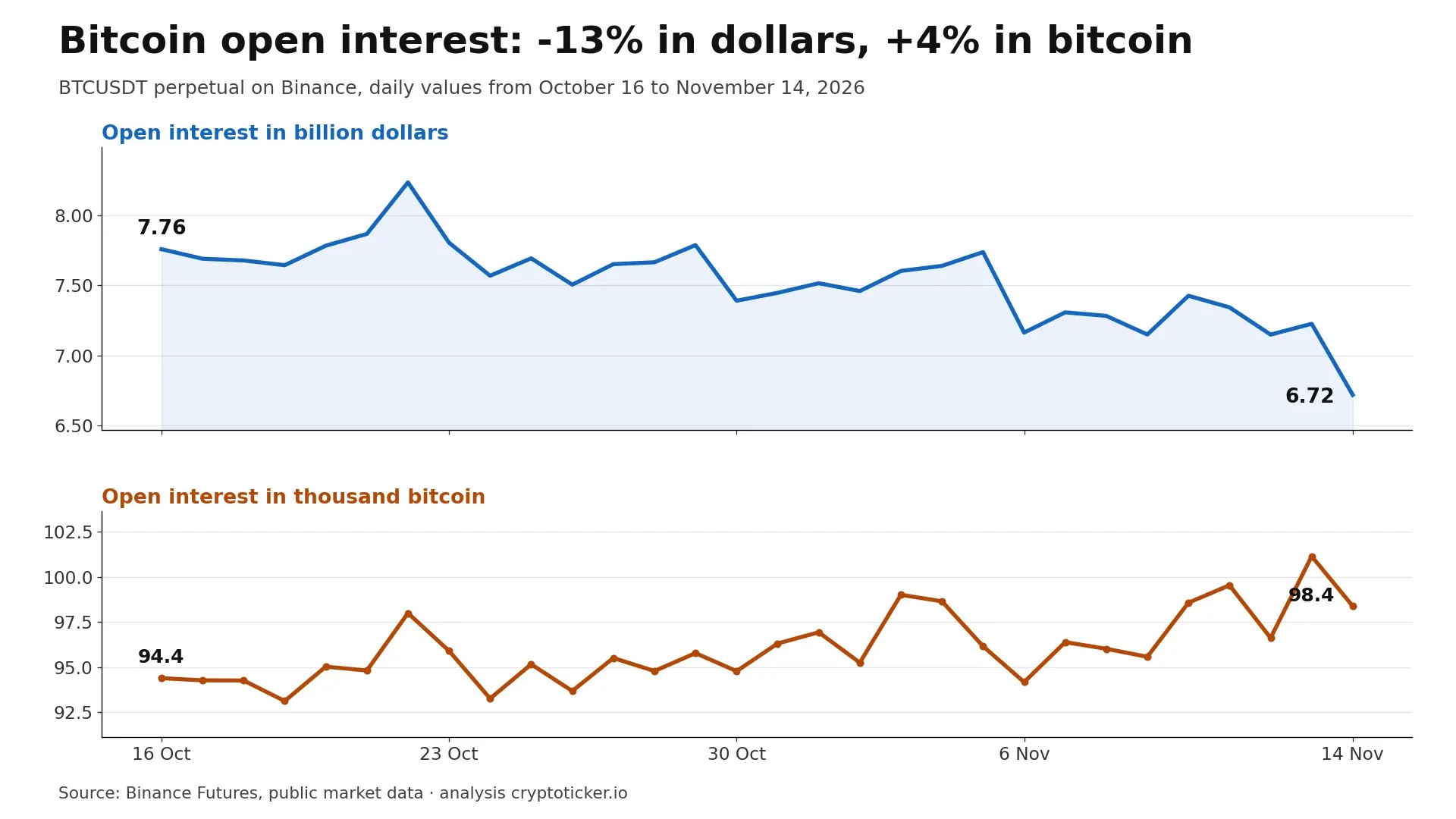
Both are true, because notional value depends on price. Dividing open interest in dollars by open interest in bitcoin gives the price Binance uses: it fell from $82,199 to $68,272 over those 30 days, a decline of 16.9%. Traders did not cut their positions. They even added bitcoin, which is simply worth less in dollars. Look only at the dollar line and you see a retreat that never happened. Over weeks, compare open interest in bitcoin. The dollar figure is the right tool for comparing markets such as Binance, Bybit and the CME.
Open interest analysis: reading price and open interest together
Combined with price, open interest gives four common readings. They describe what is happening in the market and are not a forecast:
| Price | Open interest | Reading |
|---|---|---|
| rising | rising | New longs are coming in, new money is supporting the price trend |
| rising | falling | Shorts are closing, the rally comes from short covering rather than new capital |
| falling | rising | New shorts are coming in, or longs are adding against the trend |
| falling | falling | Decreasing open interest: longs are closing or being liquidated, the market is shedding leverage |
The last 30 days on Binance fit the third row: price fell while open interest in bitcoin rose slightly, so the current trend lost no participants. The table alone cannot tell you which side opened the new positions. For that you need a second metric, the long/short ratio.
 Find a regulated crypto exchange with a license
High open interest and a one-sided long/short ratio: why that signals squeeze risk
A squeeze happens when many leveraged positions sit on the same side and price moves against them. The first liquidations are market orders in the direction of the move and push price toward the next liquidation levels. When longs get caught in that chain, it is a long squeeze; when shorts do, a short squeeze. High open interest typically means more positions that can be pulled into such a cascade.
The long/short ratio shows whether the load is one-sided. On Binance's BTCUSDT perpetual it rose from 1.50 on October 16 to 2.57 on November 3 and 3.23 on November 14, 2026. By then 76.4% of accounts were long. On October 22, the day of peak open interest at $8.24 billion, the ratio was still 1.02. Our long/short ratio chart tracks the current value.
One detail matters for the reading: the ratio counts accounts, not volume. Since every contract has a long and a short, the many accounts on the long side face fewer but larger accounts on the short side. The data describe many small longs against a few large shorts, with price down about 17% since mid-October. The funding rate fits: longs paid at 89 of 90 intervals, 0.0070% per interval on average. A setup like this shows where a liquidation cascade would find the most fuel. None of these numbers says whether or when it starts.

Worked example in euros: one position and its open interest
This example with a €1,000 stake shows what a single position adds to open interest and how quickly leverage brings it to liquidation. It uses the mark price of $64,109 on November 15, 2026, converted at the ECB reference rate of $1.1052 per euro, so about €58,007 per bitcoin. It assumes isolated margin and a maintenance margin of 0.5%, excluding fees and funding.
| Item | 2x | 5x | 10x |
|---|---|---|---|
| Stake (margin) | €1,000 | €1,000 | €1,000 |
| Position size | €2,000 | €5,000 | €10,000 |
| Added open interest | 0.0345 BTC | 0.0862 BTC | 0.1724 BTC |
| Result if price rises 5% | +€100 | +€250 | +€500 |
| Result if price falls 5% | −€100 (−10% of stake) | −€250 (−25%) | −€500 (−50%) |
| Distance to liquidation | 49.7% | 19.6% | 9.5% |
| Liquidation price | €29,149 | €46,639 | €52,468 |
If you open the 10x long and the other side opens a new short, open interest rises by 0.1724 BTC, about $11,052. If price then falls 9.5%, the exchange liquidates your position and the same amount leaves open interest again, unless another trader takes it over. In a long squeeze, the data show this thousands of times at once. Our guide to leverage trading in crypto explains how leverage, margin and liquidation price fit together.
Where to find open interest data and how traders use it
Open interest is an indicator of market structure, not of the next price movement. High open interest generally comes with higher liquidity. A sudden drop during a large candle points to liquidations, a quick rise during a sideways phase to new leverage. For trading decisions, read it alongside price, the long/short ratio and the funding rate, not on its own.
Every exchange reports its own open interest: Binance, Bybit and OKX for their perpetuals, the CME for its regulated bitcoin futures, and decentralized exchanges such as Hyperliquid on the blockchain. Our comparison of the best perp DEXs gives an overview of those platforms. If you want to trade with a licensed provider, our comparison of regulated crypto exchanges lists exchanges with a license.
Leveraged derivatives are risky, and even small price moves can cost your entire stake. This article explains a metric and is not investment advice.
Open interest near 98,000 BTC: traders held their bets as price fell
In mid-November 2026, open interest on Binance's BTCUSDT perpetual painted a clear picture: fewer dollars but more bitcoin in open positions than four weeks earlier, and three out of four accounts on the long side. Read open interest together with price and the long/short ratio, and you see earlier where positions are piling up.
Frequently asked questions about open interest
Partner links: some links on this page are partner links. If you become a customer through one of them, we may earn a commission at no extra cost to you. Selection, ratings and ranking are decided independently by our editorial team. Ethics and Independence · Ownership and Funding
Transparency note: This article was produced with the assistance of artificial intelligence and reviewed by our editorial team before publication. All figures and claims were checked against the primary sources linked in the text. The feature image was generated with AI.
For later? Save this article and find it again in your profile.
Related articles
- Gold vs bitcoin: one bitcoin now buys only about 18 ounces of gold
- Bitcoin on Friday the 13th: weekend panic builds as traders eye $60,000
- Why Is Crypto Crashing? The 3 Reasons Behind This Brutal Sell-Off
- Cardano open interest climbs to $395 million while ADA falls
- Shiba Inu price slips below $0.0000045 as SHIB falls twice as hard as Bitcoin
Which topics should we dive deeper into?
Select what genuinely interests you. Your picks feed directly into our editorial planning.
Crypto news that's actually worth your time.
Weekly. 60 seconds. Carefully curated by our editors: no hype, no promo flood, no spam.

November 6, 2026 1:20 PM

Crypto market cap explained: Bitcoin vs gold and Apple
Market capitalization shows how large a coin is valued in the market and exposes the fallacy of cheap unit prices. We explain the formula, Bitcoin dominance and FDV with current figures and show why Bitcoin, at $1.53 trillion, trails far behind gold.
November 6, 2026 7:31 AM
XRP Price Prediction: Third Test of the $1.19 Zone in Eight Days
Analysis: XRP fell to $1.188 on Friday morning and is testing the zone around $1.19 for the third time since October 30. Futures positioning, Binance reserves and the US jobs report will decide whether it holds once more.
November 6, 2026 5:32 AM

Bear market: what it means, how long it lasts and where stocks and Bitcoin stand in 2026
Bitcoin has been in a bear market since November 2025, and the Nasdaq 100 is closing in on the threshold. What a bear market is, how long it lasts on average, how to spot its end and what you can do now, worked out from 27 S&P 500 bear markets since 1928.

November 5, 2026 9:28 PM

Dogecoin Price Hits Lowest Since August as OKX Traders Pile Into Longs
Analysis: Dogecoin fell with Bitcoin and chip stocks to as low as $0.0710, its lowest since August. On OKX, the ratio of long to short accounts rose to 5.41 in the process. What the positioning shows, which levels count and where leveraged positions tip over.
November 5, 2026 5:36 PM
Bitcoin Crash: Why BTC Fell to $75,568, How Low It Could Go and How to Hedge
Bitcoin (BTC) lost more than $5,000 in under a day as a Nasdaq chip rout wiped out leveraged longs. The reasons, the levels that count now, what 23 earlier 5 percent days show, and how to earn and hedge in this market.

November 4, 2026 5:20 PM

Ethereum price jumps above $2,400: why Ether is outpacing Bitcoin after the US midterms
Ether (ETH) has recovered almost 8 percent in twelve hours from its US election-night low and is rising faster than Bitcoin (BTC). What is driving the move, which chart levels matter now and what investors in Germany should consider on buying, tax and custody.
November 4, 2026 7:20 AM
Crypto futures in the EU: six licensed exchanges compared, all capped at 10x
As a retail trader in Germany, you can trade crypto futures legally on six exchanges with an EU licence, all capped at 10x leverage for retail clients. The comparison covers contract design, fees, collateral and what ESMA's February statement changes for you.

November 3, 2026 8:28 AM
Why Is Crypto Down Today? The 5 Reasons Behind the November 3 Sell-Off
Why is crypto down today? Bitcoin sits near $76,000 after the Binance hack, a hawkish Fed and a Nasdaq slide. The five drivers, explained.
November 3, 2026 7:58 AM

Crypto futures trading: perpetual futures explained simply
Crypto futures and perpetual futures explained: how futures trading works, what the funding rate really costs and which exchanges are licensed for it in the EU.
November 3, 2026 1:12 AM

Polkadot at $0.94: 70 percent of accounts bet on a rise while funding turns negative
Analysis: Polkadot trades at $0.9385, 20.7 percent lower than 30 days ago. On OKX, 69.6 percent of accounts are long, yet the funding rate is negative, and 81 percent of Monday's liquidations hit long positions.
October 30, 2026 6:27 PM

$1.54 billion in crypto liquidations: the next step for leveraged traders
Within 24 hours the crypto market lost leveraged positions worth more than $1.54 billion, spread across 237,314 accounts. What triggered the drop and which rules in Germany cap the loss.
October 29, 2026 9:49 PM

Is This the End? How Low Bitcoin Could Fall After the Binance Hack
About $2.8 billion left a Binance hot wallet and Bitcoin slid below $79,000. Whether this turns into a real crash depends on one question. Three scenarios, the key price levels for Bitcoin, Ethereum and Solana and what to do now.
October 29, 2026 9:45 PM

How to Short Bitcoin in the Crash: Step by Step on Bitget and OKX
Bitcoin fell below $79,000 after the Binance hack. If you want to bet on falling prices or hedge, a short does exactly that. How it works on Bitget and, for EU readers, on OKX Europe, a worked example at tonight's price and the risks of shorting after a crash.
October 28, 2026 6:30 AM
Bitcoin Cash: all 81 futures markets are perpetuals, CME is missing
Bitcoin Cash rises to $294.31 and holds a weekly gain as one of the few top-25 assets. A count of our own shows all 81 futures markets are contracts with no expiry date, and half of the open positions hang on a single trading venue.
October 27, 2026 5:23 PM

China AI Bubble Bursts: $480 Billion Gone, So Why Is Bitcoin Not Crashing?
China’s AI stock bubble has burst, erasing $480 billion as the STAR50 drops 40%. Here is why it happened and what it means for Bitcoin and crypto.
October 26, 2026 6:23 AM
Gram (GRAM): the slide to $1.16 came from spot trading, not leverage
Analysis: Gram is quoted at $1.25, 7.2 percent below the level of a week ago, after the price was marked down to $1.157 on October 23. What is established is that the spot market carried more turnover than the leveraged market that day; our assessment follows further down.
October 23, 2026 1:23 PM
$1.81 billion on a single exchange: Monero open interest figures differ sixfold
Monero is down 6.2 percent at $606.80 over 24 hours, after reaching $653.71 within the same range. An own count of 52 futures contracts shows why reported open interest differs sixfold depending on the data source, and which figure matters for your position size.
October 22, 2026 10:13 PM

Solana price prediction: 2.57 long accounts per short as $12.9 million leaves the futures market
Solana's futures market lost $12.9 million in open interest within a day, yet the long ratio holds at 2.57 accounts per short. What that means for the $100 level, and how to work out your own liquidation distance.
October 21, 2026 4:14 AM

Pump.fun launches perpetual futures with 40x leverage: what to watch now
Pump.fun has traded perpetual futures on Bitcoin and Ethereum since October 16, 2026, with leverage of up to 40 times and Hyperliquid as the technical operator. At that leverage a 2.5 percent price move is enough for liquidation, and a MiCA licence for the EU market is missing.
October 15, 2026 10:13 PM

NEAR up 9 percent, and longs pay in 74 of 86 perp markets: What it means for your coins
NEAR trades at around $5.26 on October 15, 2026 and gains 9.25 percent, while Bitcoin adds only 0.96 percent. Our own survey of 86 perpetual markets shows the buy side paying for its position in 74 of them.
October 15, 2026 1:34 PM

$489 million in liquidations in one hour: where your leverage breaks first
Forced closures wiped out around $489 million within one hour on 15 October 2026, more than half the daily total of $942 million. Our analysis of OKX futures market data shows why Ether was hit harder than Bitcoin.
October 15, 2026 10:15 AM
XRP open interest down 29.7 percent, 360 long accounts per 100 short
Two moves are running against each other in the XRP derivatives market: open interest has fallen almost 30 percent since September 22, while there are now 360 long accounts for every 100 short accounts. What the thin positioning means for the $1.29 level, and which leverage caps apply in Germany.
October 13, 2026 10:26 AM

Hyperliquid falls 5.9 percent while Bitcoin loses 0.8: $1.66 billion of leverage sits on HYPE
HYPE drops to $82.61 while Bitcoin gives up only 0.8 percent. An own survey of the exchange shows why: $1.66 billion of open leveraged positions stand against $611 million of daily turnover.
October 9, 2026 10:32 PM

Bitcoin Cash Recovers Only 16 Percent of the Slide, Bitcoin 88 Percent: The Level That Decides
Bitcoin Cash is down 7.3 percent at $273.80 while Bitcoin recovers almost all of the October 8 slide. There is no news specific to BCH, and the exchange ratio against Bitcoin falls by 7.9 percent.
September 28, 2026 10:12 PM

Dogecoin Futures Hold $1.5 Billion in Open Leverage: What Investors Need to Know
The Dogecoin price fell 4.2 percent on Monday to $0.0932. What matters more is where it is set: $1.5 billion in leveraged positions sit open on the derivatives market, a good tenth of market capitalisation. What that means for leverage, liquidation distance and German tax.
September 22, 2026 4:12 AM

Open Interest Climbs After the Short Squeeze: Why the Longs Are Paying Now
The short squeeze of September 21 wiped out $648 million in bearish bets, yet open interest rose instead of falling. A survey of our own across four exchanges shows the funding rate is positive on 24 of the 25 largest bitcoin perpetuals.
September 9, 2026 1:26 PM

Bitcoin Options Expiry of September 25: What Holders of Leveraged Positions Should Know in Hindsight
Recap as of September 27, 2026: Bitcoin options worth $14.39 billion were due to expire on September 25, alongside Ether options worth $1.81 billion. This article describes the situation before that date, our own count of the derivatives market and what holders of leveraged positions should have checked at the time.
More from CryptoTicker