
XRP open interest down 29.7 percent, 360 long accounts per 100 short
Two moves are running against each other in the XRP derivatives market: open interest has fallen almost 30 percent since September 22, while there are now 360 long accounts for every 100 short accounts. What the thin positioning means for the $1.29 level, and which leverage caps apply in Germany.





Which topics should we dive deeper into?
Select what genuinely interests you. Your picks feed directly into our editorial planning.
Crypto news that's actually worth your time.
Weekly. 60 seconds. Carefully curated by our editors: no hype, no promo flood, no spam.
XRP traded at $1.30 on Thursday morning, 4.6 percent lower than 24 hours earlier. Over seven days the loss comes to 6.8 percent, over 30 days to 7.4 percent. The daily low was $1.29, the daily high $1.38 (as of October 15, shortly before 7 a.m., data from CoinGecko). More telling than the price level is what is happening in the derivatives market: money is leaving it, and the accounts that remain lean to the buy side more heavily than at any time since mid-August.
We collected the positioning data for this article ourselves, through the market data interface of the exchange OKX, retrieved on October 15. The data show a gap that has been widening for three weeks. If you trade XRP with leverage, you should know about it before you build your next position.
Where things stand on Thursday morning
XRP sits at $1.30, market capitalisation is $82.3 billion, fifth place in the overall market. Coins worth $2.40 billion changed hands in 24 hours. The price is 64.2 percent below its all-time high of $3.65, reached on July 17, 2025.
The decline is not specific to XRP. On Wednesday the US Labor Department reported annual inflation of 3.7 percent for September, with the core rate above expectations. That has pushed back the prospect of swift rate cuts, and assets without a running yield lose appeal. Bitcoin shed 2.9 percent over the same period, Ethereum 5.6 percent, Solana 4.6 percent. XRP sits mid-pack in that move at 4.6 percent.
Open interest falls 29.7 percent
Open interest is the sum of all futures contracts that have not yet been closed out. It measures how much capital is currently tied up in a coin's derivatives trading. When it rises, money is flowing into the market. When it falls, traders are leaving their positions without new ones taking their place.
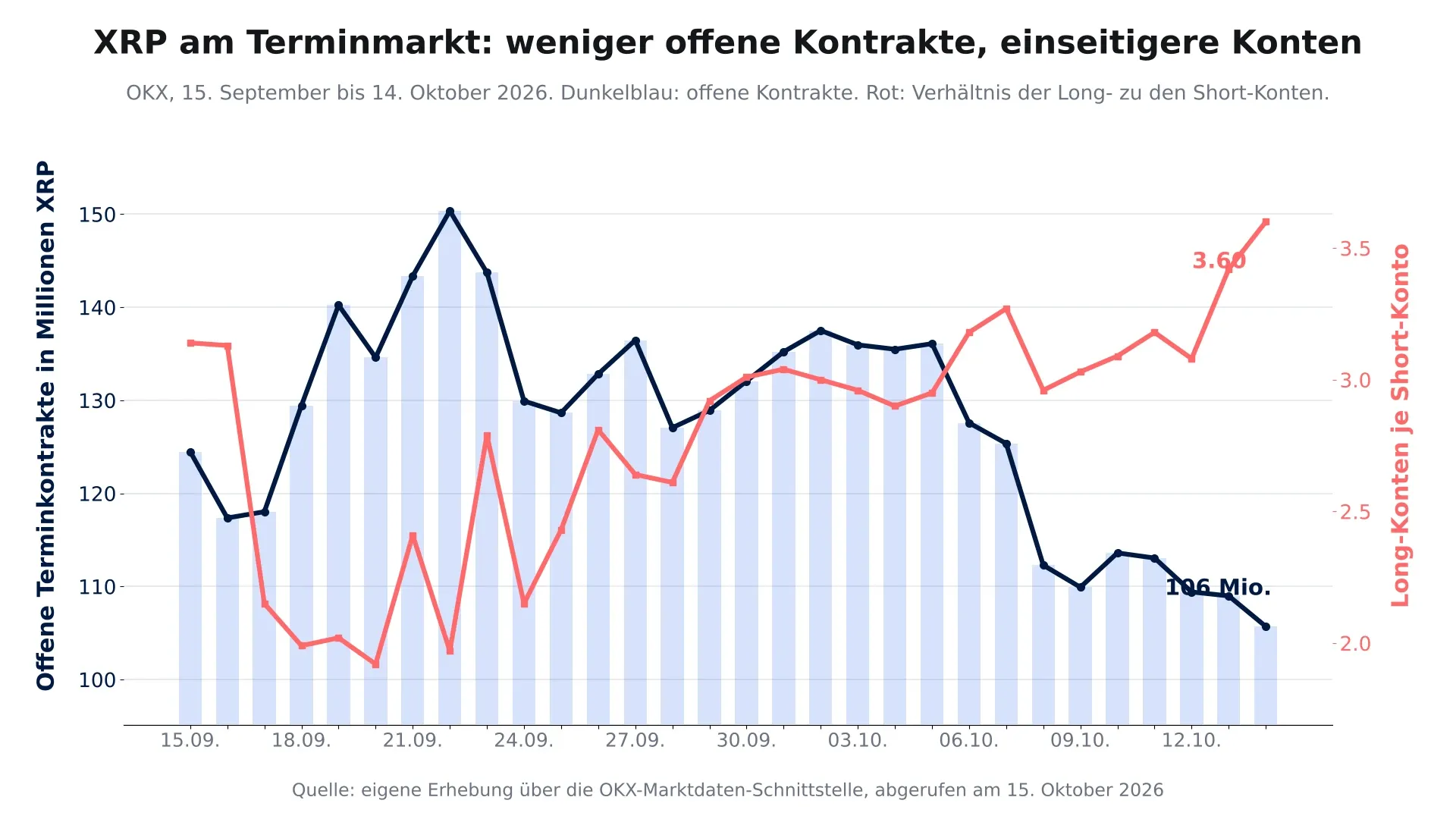
For XRP it is falling sharply. On September 22, OKX still showed 150.4 million XRP in open contracts. By October 14 the figure was 105.7 million. That is a drop of 29.7 percent in three weeks. Since the monthly high on October 2 alone, when the figure stood at 137.5 million, it comes to 23.1 percent.
The reduction was not steady. Between October 7 and October 8, open interest fell from 125.4 million to 112.3 million, down 10.4 percent in a single day. Jumps like that occur when many positions are closed at the same time, whether voluntarily or through forced selling.
360 long accounts for every 100 short accounts
The second figure from the same survey runs in the other direction. The ratio of long to short accounts stood at 3.60 on October 14. For every account betting on falling prices there are 3.6 accounts betting on rising ones.
That is a high reading. Over the past 180 trading days it reached this level or higher on only seven days, most recently on August 17, 2026. As late as September 20 it stood at 1.92, almost half as high. Within four weeks the majority of accounts has shifted markedly to the buy side, and it did so while the price was falling.
Long accounts and long positions are two different numbers
A distinction is worth making here, one that often gets lost in market reports. There are two ways to measure positioning, and they can produce opposing pictures.
The first counts accounts: how many traders are long, how many are short? That is exactly what the 3.60 reading from our survey shows. The second counts volume: how much money sits on each side? The data provider CoinGlass puts the volume-weighted ratio for XRP at around 0.80, according to a market report from FXStreet dated October 15 the lowest level in more than a month. By that measure the short side dominates.
Both figures can be correct at the same time, and only together do they give the full picture: many small accounts are long, a few large positions are short. That is the typical set-up in which retail buyers buy into a falling price while larger addresses hold the other side. We deliberately do not smooth the two readings into a single number here, because they measure different things.
 Compare perp DEXs and trading fees
A thin derivatives market moves the price faster
The combination of shrinking open interest and a one-sided spread of accounts has one practical consequence. When less capital sits in the market, a smaller order is enough to move the price. And when accounts are mostly on one side, a move against that side hits many positions at once.
The mechanism behind it is called a liquidation cascade and runs in three steps. If the price falls below the liquidation price of leveraged long positions, the exchange closes those positions automatically by selling. Those sales push the price down further. The lower price then reaches the next layer of liquidation prices. In a thin market that chain runs through faster, because fewer counter-orders stand ready to absorb the pressure.
That is not a forecast but a description of market mechanics. Whether it takes hold depends on whether the price drops below the levels where liquidation prices cluster.

The levels: $1.29 behind, $1.38 ahead
To the downside, the next level backed by data is the daily low of $1.29. It was tested over the past 24 hours and has held so far. Below it, the FXStreet report of October 15 names horizontal support at $1.30, which the price has already broken, and sees further room to the downside on a sustained break.
To the upside stands the daily high of $1.38. Between $1.30 and $1.38 lies a range of around six percent, which the price has covered within a day. That is the band in which the question is being settled right now.
One point for context: these levels come from the past 24 hours of trading, not from a model. Price targets from individual analysts, such as the $1.80 on a recovery or $1.28 on a setback named by FXEmpire, are the assessments of their respective authors and not a calculation we can reproduce here.
Leverage in Germany: 2:1 on CFDs, no obligation to top up
Retail clients in Germany who want to take a leveraged bet on XRP run into two rules that draw the frame more tightly than many international venues do.
First, the leverage cap. Contracts for difference on cryptocurrencies are capped at 2:1 leverage for retail clients. That cap goes back to the product intervention measures of the European securities regulator ESMA, which BaFin made permanent for Germany with its general administrative act of July 23, 2019. Put up 1,000 euros and you move 2,000 euros in exposure at most.
Second, the ban on obligations to top up. BaFin prohibited contracts for difference carrying an obligation to make additional payments for retail clients back in May 2017. With a regulated provider you can lose at most the capital you have put up, no more.
The classification of perpetual futures, the source of the positioning data above, remains open. ESMA stated on February 24, 2026, that such products are likely to fall under the same restrictions. What that means for access in the EU we have set out in detail in our classification of perpetual futures and the 2:1 cap. Anyone trading today through a provider outside the EU is moving outside that protective framework, and in a dispute German supervisory law would not apply. Which venues are available for perpetual contracts at all, and how they differ, is shown in our overview of perp trading venues.
 Compare regulated brokers for leveraged trades
What has changed since October 12
Our XRP forecast of October 12 dealt with the $160 million gap in inflows against Solana and with 13 weeks of inflows running into a weekly loss of 9 percent. Three things have moved since then.
The price has fallen further. XRP stood at $1.39 on October 11, at $1.36 on October 13, at $1.33 on October 14 and at $1.30 today. That is 6.5 percent in four days, with no counter-move in between.
Open interest has contracted at a faster clip. On October 12 there were still 109.4 million XRP in open contracts, on October 14 it was 105.7 million. The reduction is continuing, though more slowly than in the week before.
And the spread of accounts has turned. On October 12 the ratio stood at 3.08, on October 13 at 3.42, on October 14 at 3.60. That is the strongest two-day rise in all of October. The buy side is growing precisely while the price is giving way.
Our assessment
In the view of our editorial team, the XRP derivatives market is in a more fragile state than the 4.6 percent price decline suggests. Three verifiable points support that: open interest 29.7 percent below its level of September 22, an account ratio of 3.60 at its highest since August 17, and a volume-weighted ratio of around 0.80 on the other side. Little capital, many small buyers, few large sellers.
Against it stands the fact that a fall in open interest can also be a clean-out. Less leveraged capital means, conversely, less material for a cascade. So the market has not only become more vulnerable, in one respect it has become more solid as well. Which effect prevails will be settled at the $1.29 level.
We draw no directional call from this. What we can say: go long with leverage now and you are standing in the most crowded corner of the market, and that is the corner cleared out first on a move downwards.
XRP derivatives market: below $1.29 the long side turns into the risk
Three steps that follow from the data:
- Calculate the liquidation price, do not estimate it. If you hold a leveraged position, read the liquidation price from the position overview at your venue and compare it with the $1.29 level. If it sits above, the daily low decides your position. Which providers are regulated in Germany and what leverage they offer is set out in our broker comparison.
- Keep the difference between accounts and volume in view. A report about "mostly long traders" says nothing about how much money stands behind them. With every positioning figure, check whether it counts accounts or volume before you take it as a signal.
- Separate the tax frame from the trading frame. In Germany, gains from leveraged derivatives do not fall under the one-year holding period for cryptocurrencies but are treated as investment income. Mix the two and your year-end calculation will be wrong. An overview of the tools for that is in our comparison of tax software.
(As of October 15, 2026. This article is not investment advice. Prices and fee structures change; check the terms with the provider before you buy. Trading leveraged products can lead to a total loss of the capital invested.)
Frequently asked questions about the XRP derivatives market
Transparency note: This article was produced with the assistance of artificial intelligence and reviewed by our editorial team before publication. All figures and claims were checked against the primary sources linked in the text. The feature image was generated with AI.
Related articles
- Open Interest Climbs After the Short Squeeze: Why the Longs Are Paying Now
- XRP Explodes 40 Percent in Seven Days: Now the $1.50 Mark Counts
- Dogecoin: 94 Percent of Liquidations Hit Long Positions, and How the Leverage Compares With Bitcoin
- HYPE Token Hits $70 All-Time High: 4 Reasons for the Surge
- XRP Price Prediction: Can XRP Price Skyrocket By A 10000% Surge?
Which topics should we dive deeper into?
Select what genuinely interests you. Your picks feed directly into our editorial planning.
Crypto news that's actually worth your time.
Weekly. 60 seconds. Carefully curated by our editors: no hype, no promo flood, no spam.

October 3, 2026 4:23 AM

ESMA Places Perpetual Futures Inside the CFD Perimeter: 2:1 Leverage for Retail Clients in the EU
ESMA stated on February 24, 2026 that perpetual futures are likely to fall under the CFD measures, and with them under a leverage cap of 2:1 for retail clients. The Hyperliquid Policy Center wants that settled differently, and filed its case as the MiCA review closed on September 30.

September 30, 2026 4:36 PM

Dogecoin Price Prediction: 28 Billion DOGE Make $0.098 the Level That Decides
Dogecoin trades at around $0.0973 on Wednesday midday and keeps failing at the zone at $0.098, where roughly 28 billion DOGE changed hands. At the same time $1.50 billion sits in open leveraged positions, and the tax authority's one-year period runs separately for every purchase.

September 28, 2026 10:12 PM

Dogecoin Futures Hold $1.5 Billion in Open Leverage: What Investors Need to Know
The Dogecoin price fell 4.2 percent on Monday to $0.0932. What matters more is where it is set: $1.5 billion in leveraged positions sit open on the derivatives market, a good tenth of market capitalisation. What that means for leverage, liquidation distance and German tax.
April 8, 2026 11:46 PM

BXB Market Review 2026: Platform, Pricing, and What Traders Should Know
Considering using BXB Market? Here's a detailed look at their platform, account tiers, spread discounts, and trading conditions as of 2026.
September 30, 2026 10:13 PM
Robinhood Announces Perp Futures With 10x Leverage for US Customers: “Markets don’t work without traders”
Robinhood plans to offer eligible US customers perpetual futures on eight cryptocurrencies, with up to 10x leverage on Bitcoin and Ethereum. Nothing is tradable yet, and a different leverage cap applies in Europe.
September 19, 2026 7:19 PM

Binance Launches FX Perpetuals With 100x Leverage: What Is Allowed in Germany
Binance launches a perpetual future on the US dollar and the Brazilian real with up to 100x leverage on September 21. For German retail investors, what counts is less the announcement than the question of which leverage is permitted here and which tax rule applies to futures transactions.
October 13, 2026 10:18 PM

Papertrade loses $1.28 million on launch day: the reference price came from Hyperliquid
The perpetuals venue Papertrade launched on October 10 with leverage of up to 1,000 and drew its execution prices from the Hyperliquid order book. One trader moved the Ether price there by around three dollars and took between $1.28 million and $1.54 million out of the liquidity pool, according to several trade publications.
October 13, 2026 10:26 AM

Hyperliquid falls 5.9 percent while Bitcoin loses 0.8: $1.66 billion of leverage sits on HYPE
HYPE drops to $82.61 while Bitcoin gives up only 0.8 percent. An own survey of the exchange shows why: $1.66 billion of open leveraged positions stand against $611 million of daily turnover.
September 9, 2026 1:26 PM

Bitcoin Options Expiry of September 25: What Holders of Leveraged Positions Should Know in Hindsight
Recap as of September 27, 2026: Bitcoin options worth $14.39 billion were due to expire on September 25, alongside Ether options worth $1.81 billion. This article describes the situation before that date, our own count of the derivatives market and what holders of leveraged positions should have checked at the time.

February 21, 2025 10:26 AM

Bitcoin Price Prediction: BTC Price Over $100,000 AGAIN Soon?
Bitcoin price is nearing the $100,000 threshold, fueled by several factors among the upcoming expiration of $2.04 billion in options contracts. Could a major breakout be around the corner?

August 24, 2021 10:33 AM
What are long and short positions in cryptocurrencies?
The concept of long and short is simple and easy to understand. The basic principle behind Crypto Trading is necessary for every trader. Long and short
August 10, 2024 6:02 PM

Ethereum Price Prediction: Amid Mixed Signals What To Expect For ETH Price?
Ethereum faces volatility and competition, but signs of bullish activity and whale accumulation suggest potential recovery. How does it compare to Solana, and what does the future hold for ETH?
July 6, 2024 11:45 AM

XRP Price Prediction: Can XRP Reach $1 in July Amid Ripple's SEC Battle?
Many factors could drive XRP to $1 this July amid Ripple's ongoing legal battle with the SEC, and significant whale activity in the market. What is there to know?
October 7, 2026 8:42 PM
Can XRP Price Reach $10? Here Is What the Math Says
XRP trades near $1.42 after losing $1.50. We check the $10 forecasts, the charts and the market cap math to see if XRP can really reach $10.
February 16, 2025 10:36 AM
XRP Price Forecast: SEC Shift, Key Resistance Levels, and New ATH Predictions
XRP price potential push to a new all-time high is in focus as the SEC's evolving crypto stance, key resistance levels, and bullish analyst forecasts suggest potential gains ahead.
December 5, 2024 11:00 PM
Expert Analysis: How High Will XRP Price Reach Before 2025?
XRP price has soared to $2.64 as of December 2024, becoming the third-largest crypto asset by market cap. What’s next for XRP in 2025? Ryan Lee, Chief Analyst at Bitget Research, weighs in.
December 3, 2024 12:18 PM

XRP Meme Coins Surge: ARMY, BEAR, and MAG also surge as XRP Hits 7-Year Highs
XRP's impressive surge has fueled the rise of meme coins like ARMY, BEAR, and MAG on the XRP Ledger, creating excitement in the crypto community. Find out what the future holds for XRP-based tokens.
November 29, 2024 12:02 PM
XRP Price Prediction as XRP Price Hits New All Year High Today
XRP's price is one step closer to its ATH as it hit its 2024 all-year high today. What drove this surge, and what is the XRP price prediction for December 2024?
February 4, 2026 5:45 PM
XRP Price Prediction: XRP might crash to $1 if the Cryptos do this...
XRP price drops toward key support as market pressure builds. Will XRP hold above $1, or is a deeper correction ahead?
February 1, 2025 3:13 PM

Japan's Banks Set to Fully Adopt XRP: A Game-Changer for Global Finance
Japan's banks are set to adopt Ripple’s XRP, a move that could transform global banking, boost XRP’s value, and streamline cross-border payments.
November 16, 2024 6:41 PM
XRP Price Prediction as XRP Price Surges Beyond $1: What Next?
XRP breaks the $1 price mark, making waves in the crypto market. Up over 100% in the past week, it solidifies its position as a key player.
June 13, 2024 4:13 PM

Crypto Market DOWN As Bitcoin Price Slides, Ethereum Price Consolidates, And XRP Price Nears New Lows
The recent Federal Reserve decisions and market dynamics impact Bitcoin, Ethereum, and XRP. How to manage and what to monitor amid market volatility and uncertainty?
February 7, 2026 3:00 PM
XRP Price Prediction 2026: Current Analysis After the Crash – News, Chart & Outlook
Current XRP Price: Learn all about the price development, forecast, and opportunities of Ripple XRP in the dynamic crypto market of 2026.
July 23, 2024 11:43 AM
XRP Price Prediction: Why Is XRP Price Surge Highly Anticipated?
Why XRP might be the next big investment opportunity? Here are the insights from top analysts with indicators signaling XRP price and promising market trends.
October 1, 2026 1:34 AM

Shorting Quant: Where QNT Can Be Traded After Its Sixfold Run and What It Costs
Quant has almost sextupled within a week. Anyone wanting to bet on falling prices will find QNT futures on seven large exchanges, but is currently paying daily fees to the buyers. The routes, the costs and the biggest risk at a glance.


More from CryptoTicker