
Crypto liquidations: $2 billion in 24 hours, mostly longs on bitcoin and ether
Around $2 billion in leveraged crypto positions were liquidated within 24 hours, almost all of them bets on rising prices. Our own data show how far the long/short ratio has shifted and how large a move it takes for leverage to wipe out the stake.


Which topics should we dive deeper into?
Select what genuinely interests you. Your picks feed directly into our editorial planning.
Crypto news that's actually worth your time.
Weekly. 60 seconds. Carefully curated by our editors: no hype, no promo flood, no spam.
Leveraged crypto positions worth around $2 billion were forcibly closed within 24 hours, and almost all of them were bets on rising prices. Investing.com, citing CoinGlass, reported the figure for the period up to Sunday morning Asian time. Bitcoin alone accounted for $774 million and Ethereum for $488 million. The trigger was another weekend sell-off: overnight into Sunday, bitcoin fell as low as $62,112, its lowest level since July 14.
The number is more than a headline. It shows how much borrowed money was in the market and how quickly it disappears once the price moves against the majority. This article puts the liquidations into context, uses our own data to show how the ratio of long to short positions has shifted, and explains how large a price move has to be before a leveraged position is lost.
Crypto liquidations in 24 hours: around $2 billion, mostly longs
A liquidation is the forced closure of a leveraged position by the exchange once the collateral posted (the margin) no longer covers the losses. The trader loses all or almost all of the amount committed. A long bets on rising prices, a short on falling ones.
At around 7:55 a.m. CET on Sunday, the live overview from CoinGlass showed $600.5 million in liquidated bitcoin longs over the previous 24 hours against $152.4 million in shorts. For ether, $399.5 million in longs compared with $72.7 million in shorts. For both coins, roughly four fifths of the liquidations came from buyers who had used leverage. Much of it happened overnight: in the last twelve hours, bitcoin longs alone accounted for $431.6 million.
The figures from different snapshots vary because CoinGlass shows a rolling 24-hour window. Depending on the time of day, older liquidations drop out and new ones are added. For bitcoin, the range is therefore between about $753 million and $774 million, and for the market as a whole about $2 billion.
The pattern behind it matters more. When a long position is liquidated, the exchange sells it on the market. Those sales push the price down further and trigger the next liquidations. Traders call this a long squeeze: a chain reaction in which falling prices force more and more leveraged buyers out of the market.
Bitcoin and ether price after the crash: lows, prices and distance from the record
According to CoinGecko, bitcoin traded at $64,442 at 7:47 a.m. CET on Sunday, down 4.3 percent in 24 hours. The low of the day was $62,081. That leaves bitcoin about 49 percent below its record high of $126,080 from October 2025. Ether cost $1,793 at the same time, 5.8 percent less than the day before, after a low of $1,714. Its distance from the record of $4,946 is just under 64 percent. Investing.com puts the ether low at $1,711, the lowest level since July 8.
Smaller coins in the top 25 were hit even harder. Avalanche lost 10.6 percent in 24 hours to $7.23, Cardano 8.1 percent to $0.15, Litecoin 8.0 percent and Dogecoin 7.8 percent. Solana fell 6.7 percent to $70.47. Our running analysis of the crypto crash gives an overview of all major coins. Sentiment matches the numbers: the Fear and Greed Index from Alternative.me stands at 10 points, in the zone of extreme fear, after 13 points the day before.
The decline has stretched over several days. On a daily basis, bitcoin closed 3.5 percent lower on November 12, 4.3 percent lower on November 13 and 6.0 percent lower on November 14, according to CoinMarketCap. Readers following Ethereum more closely will find the details in our piece on the Ethereum crash to $1,715.

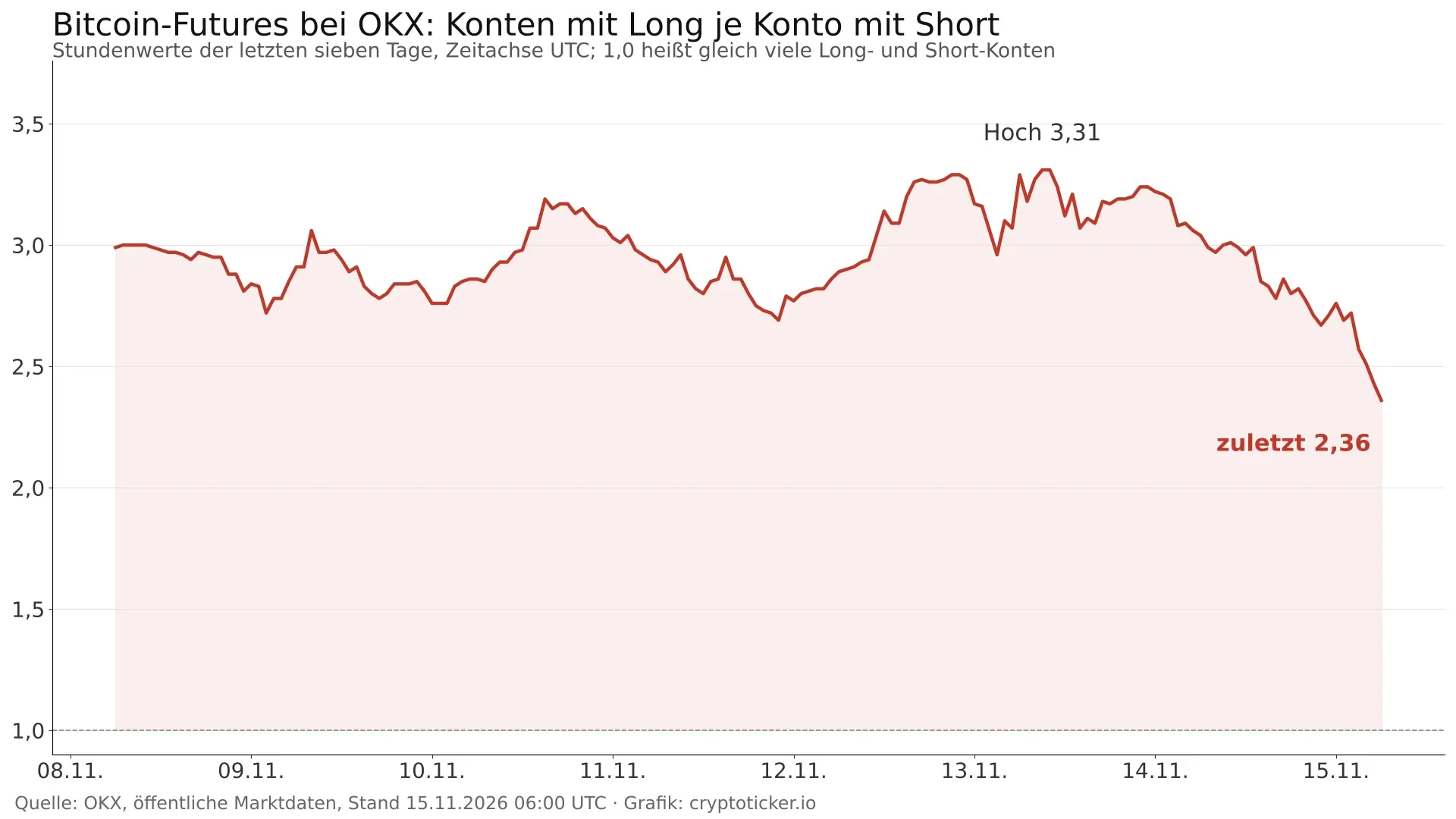
Long/short ratio on OKX: from 3.31 to 2.36 in two days
The long/short ratio shows how one-sided the market was. It divides the number of accounts with an open long position by the number of accounts with a short position. A value of 1 means balance, a value of 3 means three long accounts for every short account.
For bitcoin futures on the OKX exchange, this value stood at 3.31 at 10 a.m. CET on November 13, the highest in the past seven days. By the evening of the same day it was 3.24. Since then it has fallen almost without interruption and reached 2.36 at 7 a.m. CET on Sunday, the lowest value of the week. cryptoticker.io compiled this analysis itself on November 15, 2026, based on 168 hourly readings from OKX's public market data.
The move fits the liquidations. Our reading: some buyers had bet on a rebound in a falling market. When it failed to come, those positions were closed and the number of long accounts fell. A ratio of 2.36 is still well above 1, however, so more accounts remain on the buy side than on the sell side. The ratio counts accounts, not amounts: a single large short account can outweigh many small long accounts.
 Compare perp DEXs by fees and leverage
Open interest and funding: leverage in the market is shrinking
Open interest is the total value of all open futures contracts. When it rises, new borrowed money is entering the market; when it falls, positions are being closed, voluntarily or through liquidation. Our explainer what open interest is covers exactly what the metric measures.
On OKX, open interest in bitcoin contracts fell from a daily value of $3.87 billion on November 12 to $3.24 billion on November 14. That is roughly 16 percent less in two days. On the decentralized derivatives exchange Hyperliquid, open bitcoin contracts on Sunday morning covered about 36,970 BTC, or roughly $2.38 billion, plus ether contracts worth about $1.1 billion. cryptoticker.io also compiled these figures itself on November 15, 2026.
The funding rate is a regular payment between the long and short sides of perpetual futures, contracts without an expiry date. When it is positive, longs pay; when it is negative, shorts pay. On OKX, bitcoin most recently settled at a slightly negative rate of minus 0.0038 percent per eight-hour period, and the current period stood at plus 0.0014 percent on Sunday morning. Both values are close to zero, so extreme overheating on the buy side can no longer be read from them. The market has shed part of its leverage, but not all of it.
Why the price crashed: ETF outflows and uncertainty ahead of the Fed
Liquidations amplify a move; they do not cause it. The sell-off started with outflows from US spot bitcoin ETFs. According to Investing.com, investors pulled a net total of almost $3 billion between October 30 and November 13, including about $1.07 billion in the past trading week. It was the seventh session in a row with net outflows. At the same time, the supply of stablecoins shrank by $17 billion over the past month, a sign that capital is leaving the crypto market.
Monetary policy adds to the pressure. Investing.com points to additional uncertainty around the US Federal Reserve's December meeting. Rising interest rates make risky assets less attractive, and cryptocurrencies are among the riskiest asset classes. A detailed look at the reasons is available under why bitcoin is falling.
On the charts, bitcoin has broken through important levels. Investing.com cites the break of the 200-day moving average at around $73,000. On Saturday the price had already fallen below the 200-week moving average, a level that often acted as a floor in earlier bear markets.
Will bitcoin fall below $60,000? The liquidation zone between $59,500 and $62,600
After a night like this, the obvious question is how far the price can still fall. Nobody can give a serious price forecast. What can be shown is where further liquidations are waiting. According to Investing.com, the analytics firm Glassnode sees a marked cluster of potential liquidations between $59,500 and $62,600. If bitcoin falls into this range, more long positions could be forcibly closed, which would accelerate the decline.
The overnight low of around $62,100 was already at the upper edge of this zone. That leaves investors with two scenarios. If bitcoin holds above $62,000 and the long/short ratio does not climb sharply again, part of the leverage has already left the market and the risk of another cascade falls. If the price slips below $60,000, however, a psychologically important round number would have given way, and the price would sit in the middle of the zone Glassnode identified. Historical comparisons and scenarios are covered in our piece on how low bitcoin can fall.
The conditions under which a recovery would be possible are set out in the scenarios under when bitcoin could rise again.
 Find an exchange for your next trade
Leverage from 10x to 100x: the price move that triggers liquidation
Leverage multiplies the gain and loss of a position relative to the collateral posted. With $100 of margin and 10x leverage, you control a position of $1,000. The arithmetic works in both directions, and that is exactly what many traders experienced over the weekend.
- 10x leverage: if bitcoin rises 10 percent, the stake doubles. If bitcoin falls 10 percent, the stake is gone. In practice the exchange closes the position slightly earlier because it requires a minimum level of collateral.
- 20x leverage: a move of about 5 percent against you is enough for a total loss.
- 50x leverage: about 2 percent is enough.
- 100x leverage: a move of roughly 1 percent ends the position. Over the past 24 hours, bitcoin swung between $62,081 and $67,442, a range of more than 8 percent.
A worked example using this weekend's numbers: a trader who went long at $67,000 with 10x leverage lost the entire margin at a price of around $60,300. Bitcoin did not fall quite that far. With 20x leverage, though, the threshold was already around $63,650, and the price fell well below it overnight. A trader who went short at $67,000 with 10x leverage, by contrast, was up about 73 percent on the stake at the overnight low. Leverage never works for one side only.
Our perp DEX comparison shows how perpetual futures differ on decentralized exchanges and what fees they charge.
Stop-loss orders and position size when trading long and short
A stop-loss is an order that closes a position automatically once the price reaches a set level. It limits the loss before the exchange liquidates. In fast markets like this one overnight, however, the order can be filled below the intended level because buyers are missing. This effect is called slippage.
Position size matters at least as much. Many experienced traders risk only a small share of their capital on any single trade. Working that way, a trader can survive a run of losing trades. Anyone who puts an entire account on one direction with high leverage needs only one night like this to lose everything.
A price crash can be traded in either direction. A short profits if the price keeps falling, a long bets on a rebound. Both are speculation. This section explains the mechanics and is not a recommendation: anyone using leverage decides for themselves and should only commit money they can afford to lose.
Regulated trading venues under MiCA: where investors in Germany trade crypto
In the EU, the MiCA regulation (Markets in Crypto-Assets) has governed since the end of 2024 which providers may trade and hold crypto assets for clients. In practice, a provider with a MiCA licence is supervised by a European authority, in Germany by BaFin. Our overview of regulated crypto exchanges shows which platforms hold such a licence.
In Germany, leveraged bets on crypto prices are offered mainly by brokers in the form of CFDs. A CFD (contract for difference) means you do not own the coin; you only trade on its price change, long or short. Retail clients in the EU face strict leverage limits on crypto CFDs, well below the levels offered by crypto derivatives exchanges. Providers and terms are listed in our crypto broker comparison.
Risk warning: CFDs are complex instruments and come with a high risk of losing money rapidly due to leverage. A large share of retail investor accounts lose money when trading CFDs. You should consider whether you understand how CFDs work and whether you can afford to take the high risk of losing your money.
To buy or sell without leverage, you trade the coin directly on an exchange. Our piece on whether to buy or sell bitcoin looks at whether selling makes sense in this situation.
Crypto liquidations: Glassnode sees the next zone from $62,600
Around $2 billion in liquidations, a long/short ratio that has fallen from 3.31 to 2.36 and shrinking open interest show that the market has shed part of its leverage. It has not fully cleared: on OKX, more than twice as many accounts are still long as short, and Glassnode sees the next cluster of potential liquidations just below the overnight low.
- Check your leverage: if your liquidation threshold lies within the past 24 hours' range of just over 8 percent, a single further move is enough. You can compare providers' fees and leverage limits in the perp DEX comparison.
- Set your levels: decide on stop-loss and position size before you trade, not afterwards. The broker comparison shows which brokers offer long and short positions with stop orders.
- Choose your venue: to get in or out without leverage, trade on an exchange with a MiCA licence. Fees and offerings are listed in the crypto exchange comparison.
(As of November 15, 2026. This article is not investment advice. Prices and fee structures change; check the terms with the provider before you buy.)
Frequently asked questions about crypto liquidations
Partner links: some links on this page are partner links. If you become a customer through one of them, we may earn a commission at no extra cost to you. Selection, ratings and ranking are decided independently by our editorial team. Ethics and Independence · Ownership and Funding
Transparency note: This article was produced with the assistance of artificial intelligence and reviewed by our editorial team before publication. All figures and claims were checked against the primary sources linked in the text. The feature image was generated with AI.
For later? Save this article and find it again in your profile.
More on Bitcoin: All Bitcoin news at a glance
More on Ethereum: All Ethereum news at a glance
Related articles
- Weekend crypto crash: leverage and crypto loans with bitcoin below $66,000
- What Is Open Interest? Crypto Open Interest Explained
- Bitcoin on Friday the 13th: weekend panic builds as traders eye $60,000
- Bitcoin price prediction: shorts pay the deepest funding in three months as puts gain demand
- Shiba Inu price prediction: funding turns negative as seven in ten accounts stay long
Which topics should we dive deeper into?
Select what genuinely interests you. Your picks feed directly into our editorial planning.
Crypto news that's actually worth your time.
Weekly. 60 seconds. Carefully curated by our editors: no hype, no promo flood, no spam.

November 11, 2026 9:25 AM

Cardano open interest climbs to $395 million while ADA falls
Analysis: open interest in the Cardano futures market grows to $395 million while ADA slips below $0.175. What the funding rate, order books and the August low show, and where liquidation looms for leveraged positions.
November 4, 2026 5:20 PM

Ethereum price jumps above $2,400: why Ether is outpacing Bitcoin after the US midterms
Ether (ETH) has recovered almost 8 percent in twelve hours from its US election-night low and is rising faster than Bitcoin (BTC). What is driving the move, which chart levels matter now and what investors in Germany should consider on buying, tax and custody.

November 3, 2026 9:21 AM

Leverage trading in crypto: how margin and the liquidation price work
With leverage you move a larger crypto position than your stake would allow. We work through margin and liquidation price, show the leverage limits in the EU and which licensed providers offer leverage trading.

November 3, 2026 1:12 AM

Polkadot at $0.94: 70 percent of accounts bet on a rise while funding turns negative
Analysis: Polkadot trades at $0.9385, 20.7 percent lower than 30 days ago. On OKX, 69.6 percent of accounts are long, yet the funding rate is negative, and 81 percent of Monday's liquidations hit long positions.
October 29, 2026 12:35 PM

21 million dollars in the SHIB futures market: the level that decides
Analysis: the futures market for Shiba Inu holds 21.1 million dollars across four exchanges, 0.74 percent of market value. The positions are documented; we set out what they mean for the price.
October 28, 2026 6:30 AM
Bitcoin Cash: all 81 futures markets are perpetuals, CME is missing
Bitcoin Cash rises to $294.31 and holds a weekly gain as one of the few top-25 assets. A count of our own shows all 81 futures markets are contracts with no expiry date, and half of the open positions hang on a single trading venue.

October 27, 2026 12:30 PM

Dogecoin funding rate at 7.4 percent a year: the next step
Analysis: long positions in Dogecoin have been paying funding costs again on OKX since Monday afternoon, annualised at 7.4 percent as of Tuesday morning. At the same time, almost five long accounts come for every short account while open interest shrinks.
October 25, 2026 1:21 AM

XRP price prediction: why 4.8 percent open leverage cushions the fall
XRP sits on its 100-day average on Saturday evening. Only 4.8 percent of its market capitalisation is held in open leveraged positions on the futures market, against more than three times that for Ethereum and Solana.
October 23, 2026 1:23 PM
$1.81 billion on a single exchange: Monero open interest figures differ sixfold
Monero is down 6.2 percent at $606.80 over 24 hours, after reaching $653.71 within the same range. An own count of 52 futures contracts shows why reported open interest differs sixfold depending on the data source, and which figure matters for your position size.
October 22, 2026 10:13 PM

Solana price prediction: 2.57 long accounts per short as $12.9 million leaves the futures market
Solana's futures market lost $12.9 million in open interest within a day, yet the long ratio holds at 2.57 accounts per short. What that means for the $100 level, and how to work out your own liquidation distance.
October 16, 2026 1:28 PM

Dogecoin: four in five leveraged accounts are long, more one-sided than Bitcoin, Ethereum and Solana
On the OKX derivatives market there are 4.17 long accounts per short account in Dogecoin, more than in any other large coin. What our own Friday morning measurement says about the risk of a chain of forced closures.
October 16, 2026 1:32 AM

US producer prices at 6.3 percent: the $80,000 level decides the leverage question up to October 28
US producer prices rose 1.3 percent on the month and 6.3 percent on the year in September, running well above consumer prices. Bitcoin fell to just under $80,000 while the probability of a rate rise on October 28 jumped from 22 to 47 percent within a day and fell back to 26 percent.
October 15, 2026 10:13 PM

NEAR up 9 percent, and longs pay in 74 of 86 perp markets: What it means for your coins
NEAR trades at around $5.26 on October 15, 2026 and gains 9.25 percent, while Bitcoin adds only 0.96 percent. Our own survey of 86 perpetual markets shows the buy side paying for its position in 74 of them.
October 15, 2026 1:34 PM

$489 million in liquidations in one hour: where your leverage breaks first
Forced closures wiped out around $489 million within one hour on 15 October 2026, more than half the daily total of $942 million. Our analysis of OKX futures market data shows why Ether was hit harder than Bitcoin.
October 15, 2026 10:15 AM
XRP open interest down 29.7 percent, 360 long accounts per 100 short
Two moves are running against each other in the XRP derivatives market: open interest has fallen almost 30 percent since September 22, while there are now 360 long accounts for every 100 short accounts. What the thin positioning means for the $1.29 level, and which leverage caps apply in Germany.
October 15, 2026 7:29 AM

17 of 20 top coins down, Ethereum at $2,380: where the sell-off is measured
Ether loses 5.41 percent over 24 hours and falls to a daily low of $2,332.43. Our own count of the 25 largest cryptocurrencies shows how broadly the sell-off really carries.
October 13, 2026 10:16 AM

337 million dollars of leverage gone in five days: where does Ether stand now?
Ether trades at $2,533.59 on Tuesday morning after the $2,495 level gave way. In the derivatives market, $337 million of open interest has disappeared in five days.
October 10, 2026 7:30 PM

Bitcoin Price Prediction: 140,844 BTC Expire on October 30, and What Matters Now at $80,000
On October 30, 140,844 Bitcoin contracts worth $11.69 billion run out, and two thirds of them are bets on higher prices. At both expiry dates the largest hedge sits at $80,000.
October 9, 2026 10:32 PM

Bitcoin Cash Recovers Only 16 Percent of the Slide, Bitcoin 88 Percent: The Level That Decides
Bitcoin Cash is down 7.3 percent at $273.80 while Bitcoin recovers almost all of the October 8 slide. There is no news specific to BCH, and the exchange ratio against Bitcoin falls by 7.9 percent.
October 9, 2026 10:25 PM

Dogecoin: 94 Percent of Liquidations Hit Long Positions, and How the Leverage Compares With Bitcoin
On the Dogecoin futures market $7.82 million was force closed within 24 hours, almost all of it on the long side. Our count of 106 contracts shows how much leverage really sits in the market and how much of it is open to retail investors in Europe.
September 30, 2026 4:14 AM

Bitcoin Price Before the Core PCE at 14:30 CEST: Will the $82,735 Level Hold?
At 14:30 CEST today the Bureau of Economic Analysis publishes the core PCE deflator for August, the inflation gauge the Fed anchors its 28 October rate decision to. Bitcoin stands at $83,329, less than $600 above its daily low, and anyone holding on leverage decides this morning.
September 26, 2026 1:11 AM

Funding Rate on Perpetual Futures: How to Calculate What Your Position Really Costs
The funding rate is the payment between the long and the short side of a perpetual future. This guide shows how to calculate it, what Bitcoin longs have just paid, and what the rate reveals about squeeze risk.
September 25, 2026 7:14 PM

Chainlink Above the September High: What Open Interest, Funding Rate and Liquidation Risk Mean for LINK
Chainlink stands at $13.86, 11.2 percent higher than 24 hours ago. Our own query at OKX and Hyperliquid shows funding at the baseline rate, and what that means for leverage, buying route and tax.
September 24, 2026 10:11 PM

Bitcoin Price Prediction: What to Check on Levels, Holding Period and Leverage Before the October 28 Rate Decision
Bitcoin is trading at around $83,800, a third below its October 2025 high, while the sentiment index reads greed. Which dates, levels and deadlines over the coming weeks really decide your net gain, and which of them you steer yourself.
September 24, 2026 4:16 AM

Trump-Xi Summit at the White House: The Crypto Positions to Check Before the Meeting
Xi Jinping is on a state visit to Donald Trump today, and the crypto market comes into the meeting carrying the gains of an exceptionally strong week. What to check on leverage, holding period and custody before the first headline runs.
September 22, 2026 4:12 AM

Open Interest Climbs After the Short Squeeze: Why the Longs Are Paying Now
The short squeeze of September 21 wiped out $648 million in bearish bets, yet open interest rose instead of falling. A survey of our own across four exchanges shows the funding rate is positive on 24 of the 25 largest bitcoin perpetuals.
September 19, 2026 1:31 AM

Bank of Japan rate move: how to spot a carry trade unwind before it hits your Bitcoin holdings
Japan raises to 1.25 percent, the Fed to 3.75 to 4.00 percent two days earlier, and the crypto market rises anyway. How to tell whether an unwinding of yen-funded positions is under way, and what to check now on leverage, holding period and loss offsetting.
More from CryptoTicker