
Dogecoin: four in five leveraged accounts are long, more one-sided than Bitcoin, Ethereum and Solana
On the OKX derivatives market there are 4.17 long accounts per short account in Dogecoin, more than in any other large coin. What our own Friday morning measurement says about the risk of a chain of forced closures.

Which topics should we dive deeper into?
Select what genuinely interests you. Your picks feed directly into our editorial planning.
Crypto news that's actually worth your time.
Weekly. 60 seconds. Carefully curated by our editors: no hype, no promo flood, no spam.
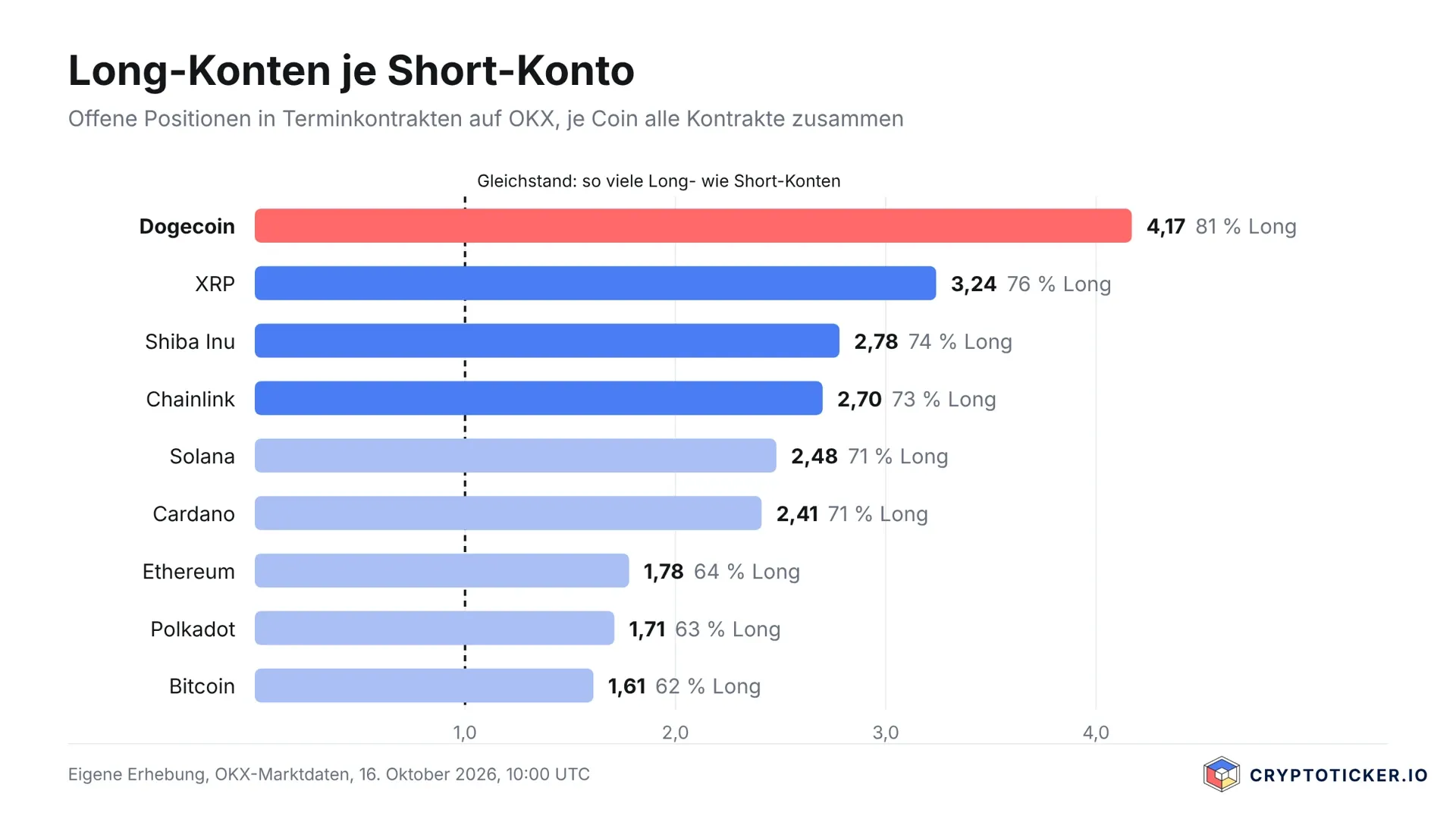
On the OKX derivatives market on Friday morning, 4.17 long accounts face a single short account in Dogecoin. That is 81 percent of all accounts with an open position, and no other large coin comes close. For Bitcoin the ratio is 1.61, for Ethereum 1.78. We measured this ourselves at 10:00 UTC using the exchange's public market data.
If you hold Dogecoin, this is no footnote. A long side this lopsided changes what happens in a setback: the more accounts sit on the same side, the more forced closures pile up once the price slips below a level where many positions get tight at the same time. Which levels those are today, how reliable the metric is and what an investor in Germany can make of it follows below.
4.17 long accounts per short account: the Friday morning measurement
The figure comes from the long/short account ratio that OKX publishes for every tradable currency. The metric divides the number of accounts with an open long position by the number with an open short position, across all of the exchange's futures contracts on that coin. A value of 1.00 would mean equal numbers on both sides. 4.17 means that for every account betting on falling prices there are a good four betting on rising ones.
The price itself offers little support for that. Dogecoin trades at $0.082375 at midday on Friday, 2.9 percent above the previous day and 3.5 percent below the level of a week ago (CoinGecko, as of October 16). The low of the day was $0.077935, the high $0.082513. Those two points are 5.9 percent apart, and the price sits at the upper edge of that range.
Why we collect the figure ourselves
Position data from individual exchanges is often quoted in market reports, rarely put in context and almost never placed side by side. We therefore pulled the same metric for nine coins in a single pass on October 16 at 10:00 UTC, so the values come from the same moment and the same source. You can follow the running values at Coinglass, among others, which aggregates the same metric across several exchanges.
What the ratio counts and what it does not
The metric counts accounts, not money. An account with $200 at stake weighs exactly as much as one with $2 million. A high value therefore says that many individual traders sit on the same side, not that most of the capital is there too. That is precisely why the metric counts as a sentiment gauge for retail traders: large accounts tend to work with few, big positions and barely register in a head count.
A second limitation applies. The figure describes a single exchange. OKX is large enough to be representative, but it is not the whole market. Reading the metric as a statement about all derivatives markets overstretches it. As a statement about the behaviour of accounts on this exchange it holds, and as a comparison between coins on the same exchange at the same moment all the more so.
Dogecoin is the outlier among nine coins
The comparison is what turns the reading into a finding. Behind Dogecoin at 4.17 comes XRP at 3.24, then Shiba Inu at 2.78 and Chainlink at 2.70. Solana stands at 2.48, Cardano at 2.41. At the other end sit the two largest assets in the market: Ethereum at 1.78 and Bitcoin at 1.61. Polkadot comes in at 1.71.
In shares, 81 percent of Dogecoin accounts are on the long side, against 62 percent for Bitcoin. The gap of 19 percentage points is the widest in this field, and it has held steady through the day. That meme coins are carried more by retail traders than Bitcoin is no surprise. The scale is: Dogecoin sits almost a full step above XRP, which is itself strikingly one-sided.
Long positions were cut overnight even as the price rose
The second part of the measurement is the more interesting one. At 23:00 German time the ratio still stood at 4.43. By midday it had fallen to 4.17, hour by hour, without a jump. Over the same period the price gained 2.9 percent. Accounts therefore closed their long positions into the recovery rather than letting them run.
That fits a market in which many positions from last week's weak phase are still under water and get squared on the first countermove. Open interest tells the same story: across all Dogecoin contracts on OKX it stood at $117.7 million early on Friday morning and $119.7 million at midday, so effectively unchanged. The day before it had jumped from $109.3 million to $121.6 million, a rise of 11.2 percent on a day of falling prices.
The spot market points the same way
On Thursday, Dogecoin worth $462.3 million was sold and $403.3 million bought on the same exchange's spot market, measured by the side that actively hit the market. The excess on the sell side came to $59 million or 14.6 percent, on turnover that almost doubled against Wednesday. Selling happened on the spot market, building happened on the derivatives market.
Funding rate at 0.01 percent: the imbalance sits in the number of accounts
Anyone expecting longs to pay dearly for this one-sidedness is wrong. The funding rate on the DOGE-USDT perpetual stood at 0.01 percent per eight-hour period on Friday morning, the exchange's usual base value. Annualised over a day that is 0.03 percent. The premium of the contract over the spot price was even slightly negative at minus 0.06 percent, so the contract traded a shade below spot.
Together the two give a clear picture: the one-sidedness sits in the number of accounts, not in the volume. Were the capital equally lopsided, the funding rate would have to sit well above the base value, because longs would then pay shorts continuously. It does not. This is many small long positions against few, larger short positions.

How a chain of forced closures builds
The mechanism behind it is plain. A leveraged position is closed automatically once the collateral falls below the required minimum. That closure is a market sale, which pushes the price down further. When many positions sit close together, the first wave triggers the next, without any new piece of news being needed.
Small accounts amplify this because they typically work with higher leverage and thinner collateral than large ones. An account at ten times leverage is stopped out on a ten percent countermove, one at two times only at fifty. In Dogecoin, 81 percent of accounts sit on the same side, and the span between the low and the high of the day is 5.9 percent. Those two figures belong together.
Levels where it gets tight: $0.0779 and $0.0825
On the downside, the low of the day at $0.077935 is the first solid level. The price turned there overnight and has recovered 5.7 percent from it. If it falls below, there is no traded support left until the zone from which the recovery of recent days started.
On the upside the high of the day sits at $0.082513, less than two tenths of a percent above the current price. The next level above comes from our own measurement of October 11, when Dogecoin traded at $0.0868 and $57.2 million was withdrawn from exchanges. Between $0.0825 and $0.0868 lie 5.2 percent, and within that span the coin has turned lower twice in recent days.
 Compare exchanges for buying Dogecoin
Where things stand since our article of October 15
On Thursday we measured here that Dogecoin lost 8.6 percent in seven days while Bitcoin gave up only 2 percent. That gap has narrowed sharply since: over the week Dogecoin now stands at minus 3.5 percent, Bitcoin at minus 0.8 percent. The reason is the countermove of the past 24 hours, in which almost every large asset gained.
Dogecoin only came along in the middle of the field. Chainlink gained 5.5 percent, Polkadot 5.1 percent, Solana 4.3 percent, Ethereum 4.1 percent. Dogecoin managed 2.9 percent, ahead of XRP at 2.7 percent and Bitcoin at 1.6 percent, but behind every other altcoin in the comparison. The relative weakness of the previous week has not disappeared, it is simply less visible when prices rise.
The blockchain itself stays quiet
Little has changed on the Dogecoin blockchain in these days. Over 24 hours, 22,754 transactions were confirmed, 46 transactions were waiting in the mempool at the time of measurement, and hash rate stood at 3.44 petahash per second (Blockchair, October 16). The largest single transfer of the day was worth $46.9 million. The price move therefore comes from trading, not from a change in usage.
Leverage in Germany, 2 to 1 on contracts for difference
The figures above come from an international derivatives exchange whose leverage is not available to you as a retail investor in Germany. The European securities regulator ESMA has capped leverage at 2:1 for retail clients on contracts for difference on cryptocurrencies, the strictest tier of its scale. For comparison: the most liquid currency pairs allow 30:1, single equities 5:1.
In practice, a provider under European supervision lets you move at most twice your stake in Dogecoin. With €1,000 of collateral the position is €2,000, and a 50 percent setback wipes out the stake. Offers with twenty or fifty times leverage are aimed at clients outside that framework; anyone trading there has no European supervisor behind them in a dispute. Which providers work under which licence is set out in our broker comparison.
Three things that can be checked concretely
First, your own liquidation price: every trading interface shows it per position, and it belongs next to the low of the day at $0.077935. Second, the funding rate of the contract traded, because 0.01 percent per eight hours does add up to around eleven percent a year over time. Third, the holding period: anyone holding Dogecoin in spot and selling after a year sells tax-free as things stand, while every gain from a contract for difference falls under capital gains tax regardless of how long it was held.
Our assessment of the positioning
From the newsroom's point of view, the finding is a warning signal of medium strength, not an alarm. In favour: 81 percent long accounts is the highest value in the comparison field, the spot market sold with a 14.6 percent excess on Thursday, and open interest rose 11.2 percent on a falling day. Against it, just as clearly: the funding rate sits at the base value of 0.01 percent, the premium is negative at minus 0.06 percent, and the ratio has been unwinding since the night rather than climbing further. An imbalance that resolves in an orderly way is a different thing from one that keeps stacking up.
What follows can be said without a price target: the probability of a fast move down is currently higher in Dogecoin than in Bitcoin or Ethereum, because more leveraged positions on the same side meet the same levels. That is expressly not a statement about whether the price rises or falls. Anyone holding spot without leverage is affected by all of this only through the price, not through a forced closure.
Dogecoin: $0.0779 is where the long side is decided
Three steps that make sense today:
- Match position against liquidation price. Note the liquidation price of every open Dogecoin position and hold it against $0.077935. If it sits above or just below, the position is in the zone where a break of that level closes many others at the same time. Which providers offer which collateral requirements and leverage is shown in the broker comparison.
- Weigh cost against holding time. 0.01 percent per eight hours is around eleven percent a year. A position meant to stay open for weeks carries that cost; a spot position does not. Where buying without leverage runs at which fees is in the exchange comparison.
- Track the metric instead of checking it once. A ratio of 4.17 is a snapshot. It only becomes meaningful over time: if it keeps unwinding as it has since Thursday night, the situation eases. If it climbs back above 4.4 while prices fall, the material for a chain of forced closures is thickening.
(As of October 16, 2026. This article is not investment advice. Prices and fee structures change; check the terms with the provider before you buy.)
Frequently asked questions about Dogecoin
Partner links: some links on this page are partner links. If you become a customer through one of them, we may earn a commission at no extra cost to you. Selection, ratings and ranking are decided independently by our editorial team. Ethics and Independence · Ownership and Funding
Transparency note: This article was produced with the assistance of artificial intelligence. Figures and claims are based on the primary sources linked in the text. The feature image was generated with AI.
For later? Save this article and find it again in your profile.
Related articles
- Dogecoin price slips below $0.0577 as OKX funding rate turns negative
- Trade Anthropic stock: ANT perpetuals on Bitget, OKX and Kraken, long or short
- Coinglass explained: what the liquidation heatmap shows and where its limits lie
- Dogecoin news: DOGE futures market shrinks by a quarter since early November as funding turns negative
- Crypto liquidations: $2 billion in 24 hours, mostly longs on bitcoin and ether
Which topics should we dive deeper into?
Select what genuinely interests you. Your picks feed directly into our editorial planning.
Crypto news that's actually worth your time.
Weekly. 60 seconds. Carefully curated by our editors: no hype, no promo flood, no spam.

November 15, 2026 12:58 AM
What Is Open Interest? Crypto Open Interest Explained
Open interest counts every open futures contract. What the metric shows for bitcoin, how it builds up and shrinks on perpetuals, how to read it with price and why it signals squeeze risk.

November 13, 2026 8:39 PM

Bitget Futures Trading: Your First Trade, Leverage and Risk
How to trade futures on Bitget step by step: USDT-M contracts, leverage up to 150x, how far Bitcoin can move before your margin is gone, what fees and funding cost per day and how a stop-loss protects you.
November 13, 2026 9:26 AM

Bitcoin price prediction: shorts pay the deepest funding in three months as puts gain demand
Analysis: after the slide below $70,000, the funding rate on bitcoin perpetuals has turned negative, its lowest in three months. At the same time, professionals are buying puts to hedge ahead of the November 27 expiry. What the derivatives market says about the coming weeks.

November 12, 2026 9:17 PM

Shiba Inu price prediction: funding turns negative as seven in ten accounts stay long
Analysis: funding in the SHIB futures market turned negative on Thursday evening, while seven in ten accounts are still betting on higher prices. What that means for Shiba Inu until Nvidia's results on November 17, and which levels count now.

November 11, 2026 9:25 AM

Cardano open interest climbs to $395 million while ADA falls
Analysis: open interest in the Cardano futures market grows to $395 million while ADA slips below $0.175. What the funding rate, order books and the August low show, and where liquidation looms for leveraged positions.
November 7, 2026 1:12 PM

Shiba Inu price slips below $0.0000045 as SHIB falls twice as hard as Bitcoin
Analysis: Shiba Inu drops below $0.0000045 in thin Saturday trading and has lost twice as much as Bitcoin over 30 days. For buyers from November 2025, the one-year holding period expires at the same time.
November 6, 2026 11:24 AM

Shiba Inu Price Prediction: OKX Long-Short Ratio Slides to 2.2 Before Jobs Data
Analysis: on OKX, there are now only 2.2 long accounts for every short account in SHIB, down from 2.8 three days earlier. What the long unwind, the US jobs report at 14:30 German time and the levels between $0.00000412 and $0.00000515 mean for the days ahead.
November 6, 2026 7:31 AM
XRP Price Prediction: Third Test of the $1.19 Zone in Eight Days
Analysis: XRP fell to $1.188 on Friday morning and is testing the zone around $1.19 for the third time since October 30. Futures positioning, Binance reserves and the US jobs report will decide whether it holds once more.
November 6, 2026 1:17 AM

Chainlink Price Falls 7.6 Percent as Long Bets Grow: Will $10.26 Support Hold?
Chainlink lost 7.6 percent on November 5, falling to $10.69 as the Nasdaq sell-off dragged crypto lower. Yet on OKX the number of long accounts rose to as many as 2.59 per short account, and the 200-day line at $10.06 is moving closer.
November 5, 2026 9:28 PM

Dogecoin Price Hits Lowest Since August as OKX Traders Pile Into Longs
Analysis: Dogecoin fell with Bitcoin and chip stocks to as low as $0.0710, its lowest since August. On OKX, the ratio of long to short accounts rose to 5.41 in the process. What the positioning shows, which levels count and where leveraged positions tip over.
November 3, 2026 1:12 AM
Polkadot at $0.94: 70 percent of accounts bet on a rise while funding turns negative
Analysis: Polkadot trades at $0.9385, 20.7 percent lower than 30 days ago. On OKX, 69.6 percent of accounts are long, yet the funding rate is negative, and 81 percent of Monday's liquidations hit long positions.
November 2, 2026 7:30 PM

Chainlink slips below its 100-day line as long bets shrink by a third
Analysis: Chainlink trades at $11.11 and falls below its 100-day line at $11.36. At OKX the long-short ratio has dropped from 3.18 to 2.10 since October 24, and the 200-day line sits at $10.03.
October 30, 2026 9:17 PM

Markets price a December Fed hike: core inflation stuck at 3.1 percent
The Fed held its policy rate at 3.75 to 4.00 percent on October 28, but two members wanted it raised. A day later the BEA reported core inflation of 3.1 percent. That puts a hike on the table for December 9 rather than a cut.
October 29, 2026 9:45 PM

How to Short Bitcoin in the Crash: Step by Step on Bitget and OKX
Bitcoin fell below $79,000 after the Binance hack. If you want to bet on falling prices or hedge, a short does exactly that. How it works on Bitget and, for EU readers, on OKX Europe, a worked example at tonight's price and the risks of shorting after a crash.
October 29, 2026 12:35 PM

21 million dollars in the SHIB futures market: the level that decides
Analysis: the futures market for Shiba Inu holds 21.1 million dollars across four exchanges, 0.74 percent of market value. The positions are documented; we set out what they mean for the price.
October 28, 2026 6:30 AM
Bitcoin Cash: all 81 futures markets are perpetuals, CME is missing
Bitcoin Cash rises to $294.31 and holds a weekly gain as one of the few top-25 assets. A count of our own shows all 81 futures markets are contracts with no expiry date, and half of the open positions hang on a single trading venue.
October 27, 2026 12:30 PM
Dogecoin funding rate at 7.4 percent a year: the next step
Analysis: long positions in Dogecoin have been paying funding costs again on OKX since Monday afternoon, annualised at 7.4 percent as of Tuesday morning. At the same time, almost five long accounts come for every short account while open interest shrinks.
October 22, 2026 10:13 PM

Solana price prediction: 2.57 long accounts per short as $12.9 million leaves the futures market
Solana's futures market lost $12.9 million in open interest within a day, yet the long ratio holds at 2.57 accounts per short. What that means for the $100 level, and how to work out your own liquidation distance.
October 15, 2026 1:34 PM
$489 million in liquidations in one hour: where your leverage breaks first
Forced closures wiped out around $489 million within one hour on 15 October 2026, more than half the daily total of $942 million. Our analysis of OKX futures market data shows why Ether was hit harder than Bitcoin.
October 15, 2026 10:15 AM
XRP open interest down 29.7 percent, 360 long accounts per 100 short
Two moves are running against each other in the XRP derivatives market: open interest has fallen almost 30 percent since September 22, while there are now 360 long accounts for every 100 short accounts. What the thin positioning means for the $1.29 level, and which leverage caps apply in Germany.
October 15, 2026 7:29 AM

17 of 20 top coins down, Ethereum at $2,380: where the sell-off is measured
Ether loses 5.41 percent over 24 hours and falls to a daily low of $2,332.43. Our own count of the 25 largest cryptocurrencies shows how broadly the sell-off really carries.
October 9, 2026 10:25 PM

Dogecoin: 94 Percent of Liquidations Hit Long Positions, and How the Leverage Compares With Bitcoin
On the Dogecoin futures market $7.82 million was force closed within 24 hours, almost all of it on the long side. Our count of 106 contracts shows how much leverage really sits in the market and how much of it is open to retail investors in Europe.
September 26, 2026 1:11 AM

Funding Rate on Perpetual Futures: How to Calculate What Your Position Really Costs
The funding rate is the payment between the long and the short side of a perpetual future. This guide shows how to calculate it, what Bitcoin longs have just paid, and what the rate reveals about squeeze risk.
September 25, 2026 7:14 PM
Chainlink Above the September High: What Open Interest, Funding Rate and Liquidation Risk Mean for LINK
Chainlink stands at $13.86, 11.2 percent higher than 24 hours ago. Our own query at OKX and Hyperliquid shows funding at the baseline rate, and what that means for leverage, buying route and tax.
September 24, 2026 4:16 AM
Trump-Xi Summit at the White House: The Crypto Positions to Check Before the Meeting
Xi Jinping is on a state visit to Donald Trump today, and the crypto market comes into the meeting carrying the gains of an exceptionally strong week. What to check on leverage, holding period and custody before the first headline runs.
September 22, 2026 4:12 AM

Open Interest Climbs After the Short Squeeze: Why the Longs Are Paying Now
The short squeeze of September 21 wiped out $648 million in bearish bets, yet open interest rose instead of falling. A survey of our own across four exchanges shows the funding rate is positive on 24 of the 25 largest bitcoin perpetuals.

More from CryptoTicker