
337 million dollars of leverage gone in five days: where does Ether stand now?
Ether trades at $2,533.59 on Tuesday morning after the $2,495 level gave way. In the derivatives market, $337 million of open interest has disappeared in five days.


Which topics should we dive deeper into?
Select what genuinely interests you. Your picks feed directly into our editorial planning.
Crypto news that's actually worth your time.
Weekly. 60 seconds. Carefully curated by our editors: no hype, no promo flood, no spam.
Ether traded at $2,533.59 on Tuesday morning, 1.47 percent below its level of 24 hours earlier and 6.39 percent below where it stood a week ago. The more interesting number sits in the derivatives market rather than in the price: open interest in Ethereum contracts on the OKX exchange has fallen from $2.113 billion to $1.776 billion since October 7. That is $337 million, or almost 16 percent less leverage in five days. If you hold ETH, read the two numbers together, because a market without leverage falls more slowly and rises more slowly as well.
Ethereum price today: $2,533.59 after the low at $2,411
The range of the past 24 hours runs from $2,411.24 to $2,575.42 according to CoinGecko data. That is $164 between high and low, a good 6.4 percent of the range measured against the low. The current level of $2,533.59 sits above the midpoint of that range, which runs at $2,493. Ether worth $16.26 billion changed hands over the period.
Against the wider market, Ethereum stands out in neither direction. Bitcoin trades at $83,697 and has given up 2.31 percent in seven days, Solana stands at $108.59 and lost 9.73 percent over the same period. Ether sits between the two with a weekly loss of 6.39 percent. No coin-specific problem can be read from that.
The $2,495 level has gone, and what has happened since
On Sunday the question here was whether the $2,495 level would hold. Ether cost $2,504 at the time, and the network fee had dropped to a sixth of its September value; the detail is in our October 11 analysis of the Ethereum price and the collapsed base fee. The answer is that the level did not hold. At the low of the past 24 hours the price stood at $2,411.24, $84 below it.
The price has come back nonetheless. At $2,533.59 Ether trades almost $39 above the old level. For the chart picture, the support at $2,495 has turned into a waypoint rather than a floor or a ceiling. Only a second test will show what role it plays from here.
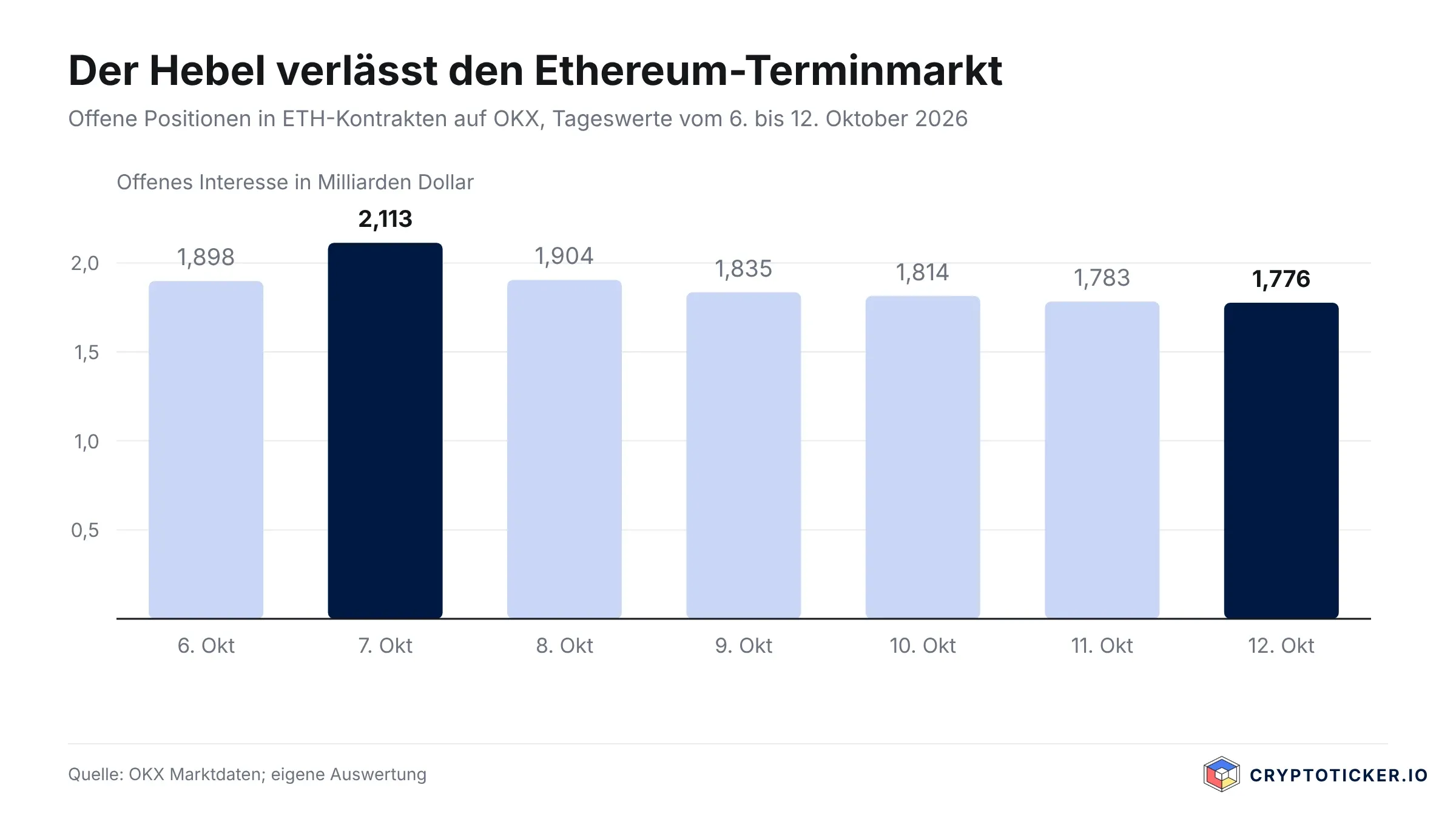
Open interest: $337 million less leverage in five days
Open interest is the sum of all futures contracts that are currently open and have not yet been closed out. The measure shows how much borrowed money sits in a market. When it rises, leverage is being added; when it falls, leverage is leaving, either because traders close positions voluntarily or because the exchange liquidates them.
According to the public OKX market data we reviewed on Tuesday, open interest in ETH contracts stood at $2.113 billion on October 7. It has fallen every single day since: $1.904 billion on October 8, $1.835 billion on the 9th, $1.814 billion on the 10th, $1.783 billion on the 11th and $1.776 billion on October 12. Six trading days down in a row, $337 million or 15.9 percent in total.
A second signal arrived on October 12. Trading volume in the same contracts jumped from $2.122 billion the previous day to $5.551 billion, a factor of 2.6. High volume alongside falling open interest is the classic pattern of a wave of position closures: a great deal is traded, but on balance positions are being closed rather than opened.
 Find an exchange for your leveraged positions
Long-short ratio falls from 2.30 to 1.73
The same data source tracks the ratio of accounts betting on rising prices to those betting on falling ones. On October 7 there were 2.30 long accounts per short account in ETH contracts. By October 12 the figure was 1.73. That is the lowest reading of the week under review and a decline of a quarter.
The number says nothing about the size of the positions, only about how many there are. As a price forecast it is therefore useless. What can be read from it is that the bet on a quick rally has thinned out. Those same positions generated the selling pressure of the past week as they were closed one after another.
Funding rate near zero: the derivatives market barely pays a premium
A perpetual is a futures contract with no expiry date. To stop its price drifting away from the spot price, holders on one side pay a fee to holders on the other at fixed intervals, the funding rate. When it is clearly positive, buyers are paying, and the market is crowded on the buy side.
On the ETH-USDT perpetual on OKX the rate stood at 0.00255 percent per eight-hour period on Tuesday morning. Annualised, that is around 2.8 percent, and the futures price was even 0.04 percent below spot. By comparison, in an overheated phase the rate sits at 0.05 percent or more per period. The market is currently asking almost no premium for a bet on rising prices.
How a liquidation happens: the mechanism in three steps
This sequence is responsible for last week's deleveraging, and it is the reason a single sell-off can grow larger than the news behind it would suggest.
Step 1: the margin shrinks
Buy $10,000 of Ether with five times leverage and you post $2,000 as collateral. If the price drops 10 percent, $1,000 of that collateral is gone. The buffer halves on a price move that would barely register without leverage.
Step 2: the exchange closes the position
Once the collateral falls below the maintenance margin, the exchange closes the position automatically and sells the underlying coins on the market. The selling is real rather than a book entry, and it hits the same order book as any other sale.
Step 3: one sale triggers the next
That selling pressure pushes the price lower, which breaks the maintenance margin on the next position. This is the chain reaction that produces more price movement in half an hour than a week of quiet trading. The volume spike of October 12 shows exactly that.
The reverse holds on the way up. The less leverage sits in the market, the fewer forced sales a pullback can trigger. A market with $1.776 billion rather than $2.113 billion of open interest is slower in both directions. If you use leveraged products, the terms and maintenance margins of the providers are set out in our comparison of perpetual exchanges.
A 2:1 leverage cap: what applies to retail investors in Germany
At a provider supervised in Germany, the numbers in the example above would not be permitted at all. BaFin has made permanent, by general administrative act, the restrictions on contracts for difference that the European Securities and Markets Authority introduced in August 2018. Cryptocurrencies fall into the strictest tier: a maximum of two times leverage for retail clients. For comparison, the cap is 30 for major currency pairs and 5 for equities.
Two further protections come with it that are often missing at exchanges outside the EU. An obligation for retail clients to add funds is prohibited, so the loss is limited to the money committed. And the position is closed at the latest when the collateral has shrunk to half of the initial margin. The detail is in BaFin's publication on the general administrative act covering contracts for difference. A perpetual on an exchange without an EU licence is not covered, and there 50 times leverage and margin calls are the norm.

Futures and tax: 25 percent from the first euro
The tax gap between a perpetual and a bought Ether is wider than the economic one, and it is regularly overlooked in leveraged trading. A gain from a futures transaction counts as investment income under section 20 of the German Income Tax Act. It attracts 25 percent capital gains tax plus the solidarity surcharge and, where applicable, church tax, so at least 26.375 percent in total. There is no holding period after which the tax falls away. We worked the case through in detail on October 12, in our piece on the tax on crypto futures and perpetuals.
One relief has applied since the 2024 Annual Tax Act. The separate loss-offsetting pool for futures transactions and the annual ceiling of 20,000 euros have both been scrapped, and for all open cases. Losses from perpetuals can therefore be set against other investment income again. The statutory text is at section 20 EStG on gesetze-im-internet.de. Whether your provider withholds the tax automatically depends on whether it is a domestic paying agent; with foreign exchanges you have to declare the income yourself.
 Compare exchanges to buy Ether directly
Spot instead of perpetual: the holding period applies to the coins alone
Buy Ether directly and take it into your own custody and you fall under section 23 EStG. The one-year rule applies there: after twelve months of holding, the disposal gain is tax-free regardless of its size. Within the year the personal income tax rate applies, though there is a 1,000-euro exemption threshold covering all private disposals in a year.
That produces a decision which has nothing to do with a view on the price. Two investors with identical expectations for the Ethereum price pay different amounts of tax depending on whether they invest through a perpetual or through bought coins. For holding periods beyond a year, buying directly is the cheaper route in tax terms; over short periods the difference barely matters. Which venues are licensed in Germany and what they charge is set out in our comparison of crypto exchanges.
The ETF side: a tenth day of outflows in a row
Alongside the derivatives market, a second flow has been running against Ether. The American spot ETFs on Ethereum recorded a net outflow of $85.4 million on October 12, according to figures from data provider SoSoValue. It was the tenth trading day of outflows in a row. BlackRock's ETHA fund accounted for the bulk at $75.1 million, with a further $10.3 million from Grayscale's mini trust. None of the eleven funds took in money that day.
Net assets under management across all Ethereum ETFs now stand at $15.86 billion, with cumulative inflows since launch of $13.17 billion. At Bitcoin the outflow was smaller on the same day at $65.4 million. For the coming weeks this is the figure that shows whether new money is returning: as long as the ETFs are selling, the price lacks the demand that could offset the deleveraging.
Our assessment: less risk and less momentum at the same time
From the newsroom's point of view, the deleveraging is the better of the two pieces of news, even though it sounds like the worse one. The evidence: $337 million less open interest, a long-short ratio of 1.73 instead of 2.30 and a funding rate of 0.00255 percent per period together mean the crowded buy side has been cleared out. A sell-off from the current level meets far fewer forced sales than the one on October 8 did.
Against that stands the ETF side. Ten days of outflows in a row and $85.4 million on Monday alone show that the demand which carried the price through the summer is not there at the moment. A market with neither leverage nor inflows moves sideways until one of the two flows turns. We therefore read the situation as a calming rather than a turning point. This is an assessment of market conditions and not a recommendation to buy or sell Ether; with cryptocurrencies a total loss is possible.
Ethereum and leverage: without inflows, $2,575 stays the ceiling
The range the price has moved in since Monday is the framework for the days ahead: $2,411 at the bottom, $2,493 in the middle, $2,575 at the top. As long as open interest keeps falling and the ETFs keep selling, a break above the upper end is unlikely. Three steps follow from that:
- Recalculate your own leveraged position. At what price does the maintenance margin bite, and how far is that price from the low at $2,411? The providers' margin rules are in the comparison of perpetual exchanges.
- Settle on how you buy. For holding periods beyond a year, the one-year rule argues for buying directly rather than for a futures transaction. The venues licensed in Germany and their fees are in the comparison of crypto exchanges.
- Sort the paperwork for the tax return. Futures transactions belong in the KAP schedule, sold coins in the SO schedule. Tools that report the two pots separately are in the comparison of crypto tax software.
(As of October 13, 2026. This article is not investment advice. Prices and fee structures change; check the terms with the provider before you buy.)
Frequently asked questions about the Ethereum price
Partner links: some links on this page are partner links. If you become a customer through one of them, we may earn a commission at no extra cost to you. Selection, ratings and ranking are decided independently by our editorial team. Ethics and Independence · Ownership and Funding
Transparency note: This article was produced with the assistance of artificial intelligence. Figures and claims are based on the primary sources linked in the text. The feature image was generated with AI.
For later? Save this article and find it again in your profile.
More on Ethereum: All Ethereum news at a glance
Related articles
- Whales Are Buying the Ethereum Dip While ETFs Dump $400 Million: Who Is Right?
- Litecoin price crash: LTC falls to $42.63, its lowest level since July
- Uniswap crash: UNI closes below $5 and gives up half its September high
- Canton price crashes below $0.08 and clings to 25th place
- Crypto liquidations: $2 billion in 24 hours, mostly longs on bitcoin and ether
Which topics should we dive deeper into?
Select what genuinely interests you. Your picks feed directly into our editorial planning.
Crypto news that's actually worth your time.
Weekly. 60 seconds. Carefully curated by our editors: no hype, no promo flood, no spam.

November 15, 2026 1:23 AM

Weekend crypto crash: leverage and crypto loans with bitcoin below $66,000
Bitcoin has dropped below $66,000 and ether below $1,850, while the US spot ETFs only reopen on Monday. This guide works through how close leveraged positions and crypto loans are to forced closure.

November 15, 2026 12:58 AM

What Is Open Interest? Crypto Open Interest Explained
Open interest counts every open futures contract. What the metric shows for bitcoin, how it builds up and shrinks on perpetuals, how to read it with price and why it signals squeeze risk.
November 11, 2026 7:24 PM

Ethereum price prediction: can buyers hold $2,000 as ETF outflows shrink 99 percent?
Analysis: outflows from US ether ETFs shrank to $1.32 million on November 10, after $184.5 million the day before. Why ether is still stuck around the $2,000 zone and what role Friday's producer prices play.

November 9, 2026 1:17 AM

Ethereum drops below €2,000: will the $2,000 support hold?
Ether lost around 4.5 percent within an hour on Sunday evening and traded at roughly €1,904 late in the evening. We show when the sell-off hit, which price levels now matter and what leverage, the holding period and custody mean for investors in Germany.
November 6, 2026 7:17 PM

Ethereum price prediction: 986,847 ETH queue to stake while only 4,320 ETH wait to exit
Close to one million ether is waiting to enter staking, while only 4,320 ETH want out. What that ratio says about ether at $2,229, which levels matter until the end of November and what stakers in Germany need to know about tax.
November 5, 2026 12:07 PM

Ethereum Price Prediction: 77,441 Puts for November 13, Then the Options Market Flips
Ether just gained 5.5 percent, yet the options market is split: for November 13 there are three times as many puts as calls, for November 27 twice as many calls as puts. What that means and which levels count now.
November 4, 2026 5:20 PM

Ethereum price jumps above $2,400: why Ether is outpacing Bitcoin after the US midterms
Ether (ETH) has recovered almost 8 percent in twelve hours from its US election-night low and is rising faster than Bitcoin (BTC). What is driving the move, which chart levels matter now and what investors in Germany should consider on buying, tax and custody.
November 3, 2026 9:21 AM

Leverage trading in crypto: how margin and the liquidation price work
With leverage you move a larger crypto position than your stake would allow. We work through margin and liquidation price, show the leverage limits in the EU and which licensed providers offer leverage trading.
October 29, 2026 9:50 PM
Ethereum Crash: The Binance Hacker Sits on 195,000 ETH. Is a Sell-Off Coming?
Ether fell 2.6% within an hour after the Binance hack. The bigger risk: about 195,460 ETH sit with the attacker and, unlike stablecoins, cannot be frozen. How big the selling pressure really is, which price levels matter and why Ethereum itself was not hacked.
October 29, 2026 12:35 PM

21 million dollars in the SHIB futures market: the level that decides
Analysis: the futures market for Shiba Inu holds 21.1 million dollars across four exchanges, 0.74 percent of market value. The positions are documented; we set out what they mean for the price.
October 27, 2026 12:30 PM

Dogecoin funding rate at 7.4 percent a year: the next step
Analysis: long positions in Dogecoin have been paying funding costs again on OKX since Monday afternoon, annualised at 7.4 percent as of Tuesday morning. At the same time, almost five long accounts come for every short account while open interest shrinks.
October 24, 2026 10:24 PM

Ethereum price prediction: the premium for leveraged buys falls to zero, and $2,311 is the level that decides
Analysis: it is documented that the funding rate for leveraged Ethereum buys on OKX has fallen to zero for the period up to midnight, the first time since October 13, and that Ether is quoted at $2,300 on Saturday evening. Our assessment follows further down: cheap leverage turns no price, and the 100-day line at $2,311 decides the direction.
October 18, 2026 10:16 AM
Ethereum staking pays 2.21 percent while the ECB pays 2.50
Ethereum's staking yield of 2.21 percent sits below the European Central Bank's deposit rate of 2.50 percent. What that gap means for the price, for the levels at $2,364 and $2,438 and for your tax return.
October 17, 2026 10:33 PM

Ethereum forecast: 2,955 new ETH a day, only 13.6 burned, next target: $2,552
Ethereum's supply grew by 2,955 ETH over the past 24 hours, while only 13.6 ETH were burned. What that finding means for the levels between $2,417 and $2,552, and what investors in Germany can take from it.

October 15, 2026 10:13 PM

NEAR up 9 percent, and longs pay in 74 of 86 perp markets: What it means for your coins
NEAR trades at around $5.26 on October 15, 2026 and gains 9.25 percent, while Bitcoin adds only 0.96 percent. Our own survey of 86 perpetual markets shows the buy side paying for its position in 74 of them.
October 15, 2026 1:34 PM

$489 million in liquidations in one hour: where your leverage breaks first
Forced closures wiped out around $489 million within one hour on 15 October 2026, more than half the daily total of $942 million. Our analysis of OKX futures market data shows why Ether was hit harder than Bitcoin.
October 15, 2026 7:29 AM

17 of 20 top coins down, Ethereum at $2,380: where the sell-off is measured
Ether loses 5.41 percent over 24 hours and falls to a daily low of $2,332.43. Our own count of the 25 largest cryptocurrencies shows how broadly the sell-off really carries.
October 12, 2026 10:19 AM

Ethereum price prediction: the price turned higher at $2,495.93, and two dates decide this week
Ether's daily low came in at $2,495.93, so the level held by 93 cents. Two fixed dates shape the week: the US price index on Wednesday and the options expiry on Friday.
October 7, 2026 1:18 PM

2,598 dollars and a sixth day of ETF outflows: will Ethereum hold the 2,500 line?
The Ethereum price stands at $2,598 on Wednesday morning, 3.9 percent below the previous day, while the US spot ETFs report a sixth consecutive trading day of net outflows. This article shows which levels below still hold, how far your leverage sits from the liquidation price, and what the German one-year rule under section 23 of the Income Tax Act means for a sale at a loss.
October 2, 2026 4:40 PM

Ethereum price prediction: Citi raises its twelve-month target to $3,028, and what you can do now
Citi has raised its twelve-month target for Ethereum from $2,240 to $3,028. Anyone following that horizon also decides the tax on the gain with the purchase date.
September 30, 2026 10:15 AM

Ethereum Price Prediction: 1.6 Million ETH Face a 28-Day Wait for Activation, and What You Can Do Now
1,603,958 ETH are standing in the entry queue for Ethereum staking and waiting almost 28 days for activation. What that tied-up supply means for the price levels, for your yield and for the 256 euro exemption limit at the German tax office.
September 28, 2026 10:12 PM

Dogecoin Futures Hold $1.5 Billion in Open Leverage: What Investors Need to Know
The Dogecoin price fell 4.2 percent on Monday to $0.0932. What matters more is where it is set: $1.5 billion in leveraged positions sit open on the derivatives market, a good tenth of market capitalisation. What that means for leverage, liquidation distance and German tax.
September 25, 2026 7:14 PM

Chainlink Above the September High: What Open Interest, Funding Rate and Liquidation Risk Mean for LINK
Chainlink stands at $13.86, 11.2 percent higher than 24 hours ago. Our own query at OKX and Hyperliquid shows funding at the baseline rate, and what that means for leverage, buying route and tax.
September 24, 2026 10:36 PM

Ethereum Price Prediction: What to Check on Staking, Leverage and Where You Buy After Three Attempts at $2,800
Ether stands at $2,700 and has bounced off the zone around $2,800 three times in thirty days, without a single daily close above it. What our own count shows, and the three things to settle before the next attempt.
September 24, 2026 1:34 PM

Cardano Slides Below $0.24: What ADA Holders Should Check on Leverage, Liquidation and Holding Period
Cardano has given back its move above $0.25 and trades around seven percent below the high of the past 24 hours. What that means for leveraged positions, the holding period of your tranches and the buying route under MiCA.
September 22, 2026 7:20 PM

ETH Price Prediction: What to Check at the $2,800 Mark Now
Ether stands at $2,735.96 on September 22, 2026, right below the zone at which it has failed repeatedly. Instead of a target number, you get four checks that count before your next order: holding period, buying route, the staking line and the distance to liquidation.
More from CryptoTicker