
Uniswap crash: UNI closes below $5 and gives up half its September high
Uniswap closed at $4.88 on November 14, 2026, its lowest since late August, and lost almost 30 percent in a week. This article covers the levels down to the August low, the derivatives market, fees during the crash and how leverage works on UNI.

Which topics should we dive deeper into?
Select what genuinely interests you. Your picks feed directly into our editorial planning.
Crypto news that's actually worth your time.
Weekly. 60 seconds. Carefully curated by our editors: no hype, no promo flood, no spam.
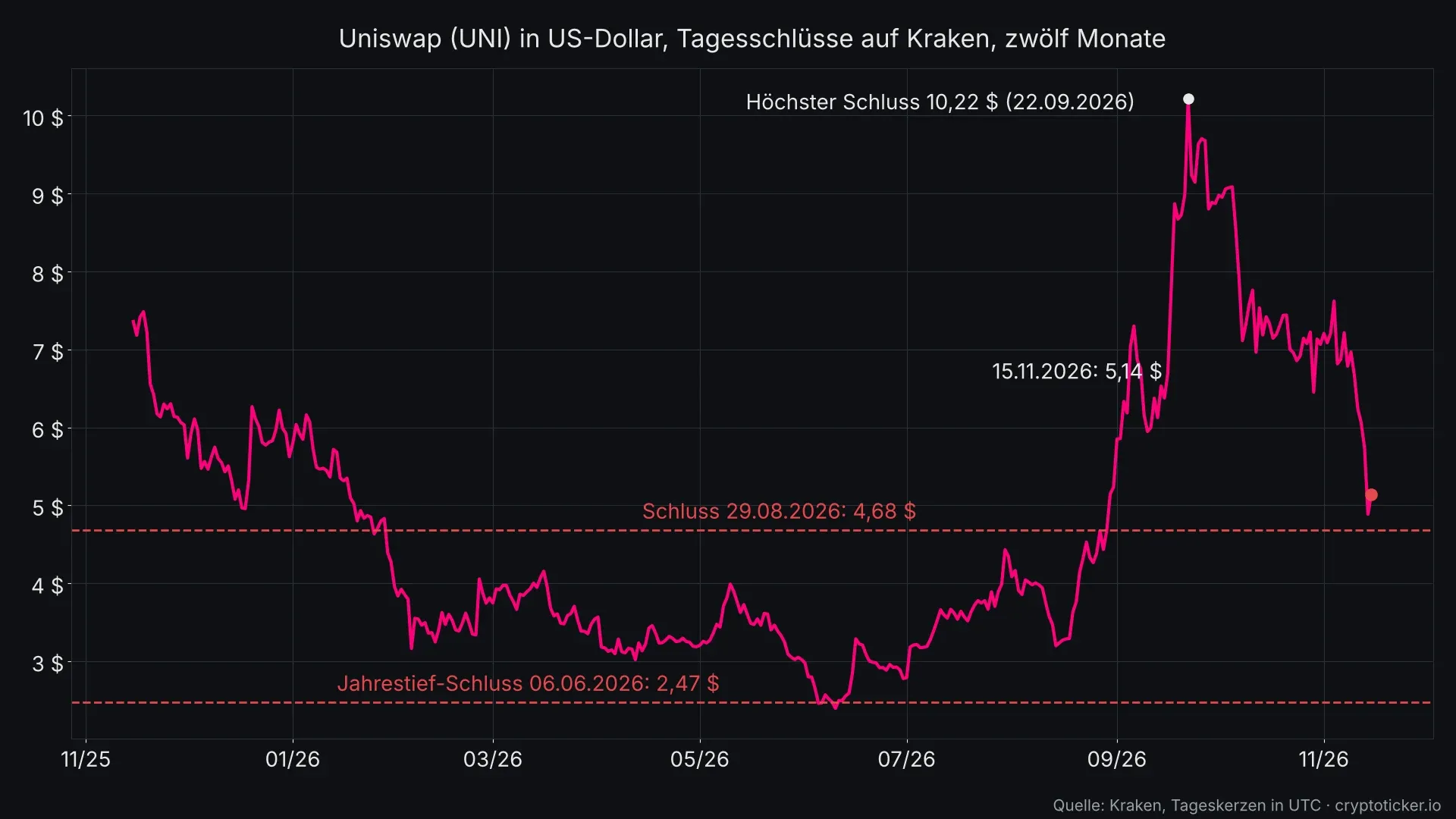
The Uniswap price dropped below $5 in the weekend market sell-off. On Saturday, November 14, 2026, UNI closed at $4.88 on Kraken, its lowest close since August 29. The intraday low was $4.61. On Sunday morning the token of the largest decentralized exchange trades at $5.12 (CoinGecko), down 7.7 percent from 24 hours earlier and almost 30 percent from a week ago. Half of the value at its highest daily close of the year, $10.22 on September 22, is gone.
Uniswap is a decentralized exchange (DEX) on Ethereum and other networks: users swap tokens straight from their wallet against liquidity pools, without an account at any provider. UNI is the governance token used to vote on the protocol. With a market capitalization of $3.11 billion, UNI ranks 27th on CoinGecko, which puts it among the biggest losers of the week among the large cryptocurrencies.
Uniswap crash on November 15: price, daily range and volume
The weekend figures at a glance, each with date and source:
- Price on Sunday: $5.12, down 7.65 percent in 24 hours and 29.6 percent in seven days (CoinGecko, November 15).
- 24-hour range: $4.64 to $5.55, with $726 million worth of UNI traded (CoinGecko).
- Daily close on November 14: $4.88, with a daily high of $5.78 and a daily low of $4.61 (Kraken). The gap between high and low was 20 percent.
- Close a week earlier, on November 7: $7.21 (Kraken).
- Distance from the all-time high of $44.92 set in May 2021: minus 88.6 percent (CoinGecko).
In terms of the weekly loss, anyone who bought at the closing price on November 7 is now down almost 29 percent. The current price with chart and volume is on our Uniswap price page.
Why is Uniswap falling? Rate fears and the weekend crypto crash
There is no Uniswap-specific negative trigger these days. UNI is falling with the broader market, but much harder. Bitcoin lost 14.7 percent in the same week and stands at $65,345 on Sunday, while ether lost 19.5 percent to $1,826 (CoinGecko). The Fear and Greed Index for the crypto market stands at 10, in extreme fear territory (alternative.me, as of November 15).
The main driver is the US rate outlook. According to the CME FedWatch tool, futures traders on Friday priced in an 88.5 percent probability of a 0.25 percentage point rate hike at the Fed meeting on December 8 and 9, Bitcoin.com News reported on November 14. Higher rates make credit more expensive and safe assets more attractive; risky assets such as altcoins usually lose first. Our article on why bitcoin is falling sets out the reasons in more detail, and our crypto crash page provides the daily overview.
A governance token falling twice as hard as bitcoin in a sell-off is not unusual. Such tokens have a smaller buyer base, are traded with leverage more often and had risen more strongly in late summer. In Uniswap's case, the token had already lost considerable ground in the weeks before the slump; on November 11 we reported its lowest level since September.
Uniswap since its September high: from $10.22 to below $5
The price history of the past twelve months explains why the decline is so steep. In August UNI still stood at $3.20, the lowest daily close of that month, on August 14. By September 22 the price had climbed to $10.22, more than tripling. One driver was the debate over the protocol fee, which we covered on September 18 in our article on the fee switch.
After the weekend, around 72 percent of that rally has been erased. The daily close on November 14 was the lowest since August 29, when UNI closed at $4.68. On August 30, a day later, it closed at $5.14, almost exactly today's price. The lowest level of the past twelve months is well below that: on June 6, 2026, UNI closed at $2.47.
Fees, TVL and volume: what Uniswap data show in the crash
The gap between price and usage is striking. A price slump brings heavy trading, and that is what a DEX lives on. According to data from DefiLlama, Uniswap generated trading fees of $2.49 million on November 14, more than on any other day of the previous week. Over the past 30 days, fees totalled $72.9 million. Trading volume over the past 24 hours came to $2.77 billion.
Most of the fees go to liquidity providers, the users who deposit their tokens into the pools. The share DefiLlama reports as revenue for token holders was $346,000 on November 14 and $8.14 million over the past 30 days. Annualized, that would be just under $100 million, or around three percent of a market capitalization of $3.11 billion. That calculation reflects today's figures and is no promise for the future.
Total value locked (TVL), the combined value of the tokens deposited in Uniswap pools, points the other way. According to DefiLlama it fell from $3.93 billion to $3.05 billion between October 17 and November 15. Part of that is a pure price effect, because the deposited tokens themselves have lost value. For liquidity providers the crash is still costly: anyone providing ETH against a stablecoin in a pool holds more of the falling token after the slump than before.
 Find an exchange for your Uniswap tokens
Leverage on Uniswap: what 10x and 100x mean at a price around $5
Anyone looking to trade UNI in this market quickly comes across leveraged products. Leverage multiplies the price move on the capital deployed, in both directions. A long position bets on rising prices, a short position on falling ones. Our article on long and short in crypto explains the basics.
A worked example using Sunday's price: with 10x leverage and an entry at $5.12, a 10 percent fall to $4.61 means a loss of 100 percent of the stake. UNI hit exactly that daily low on November 14. If the price instead rises 10 percent to $5.63, the stake doubles. With 100x leverage, a move of about one percent, roughly 5 cents, is enough to liquidate the position. Fees and the funding rate come on top, so in practice liquidation kicks in somewhat earlier.
A liquidation means the exchange forcibly closes the position because the margin has been used up. Leveraged traders usually limit the risk with a small position size and a stop-loss, an order that closes the position automatically at a set price. In this weekend's sell-off, around $2 billion of positions across the crypto market were forcibly closed, according to our report of November 15, mostly longs; details are in our article on crypto liquidations.
Uniswap open interest: fewer open bets, fewer optimists
Open interest measures the total value of all open futures contracts on a coin. If it rises while prices fall, new bets are being added; if it falls, traders are closing positions or being liquidated. Our article on open interest explains more.
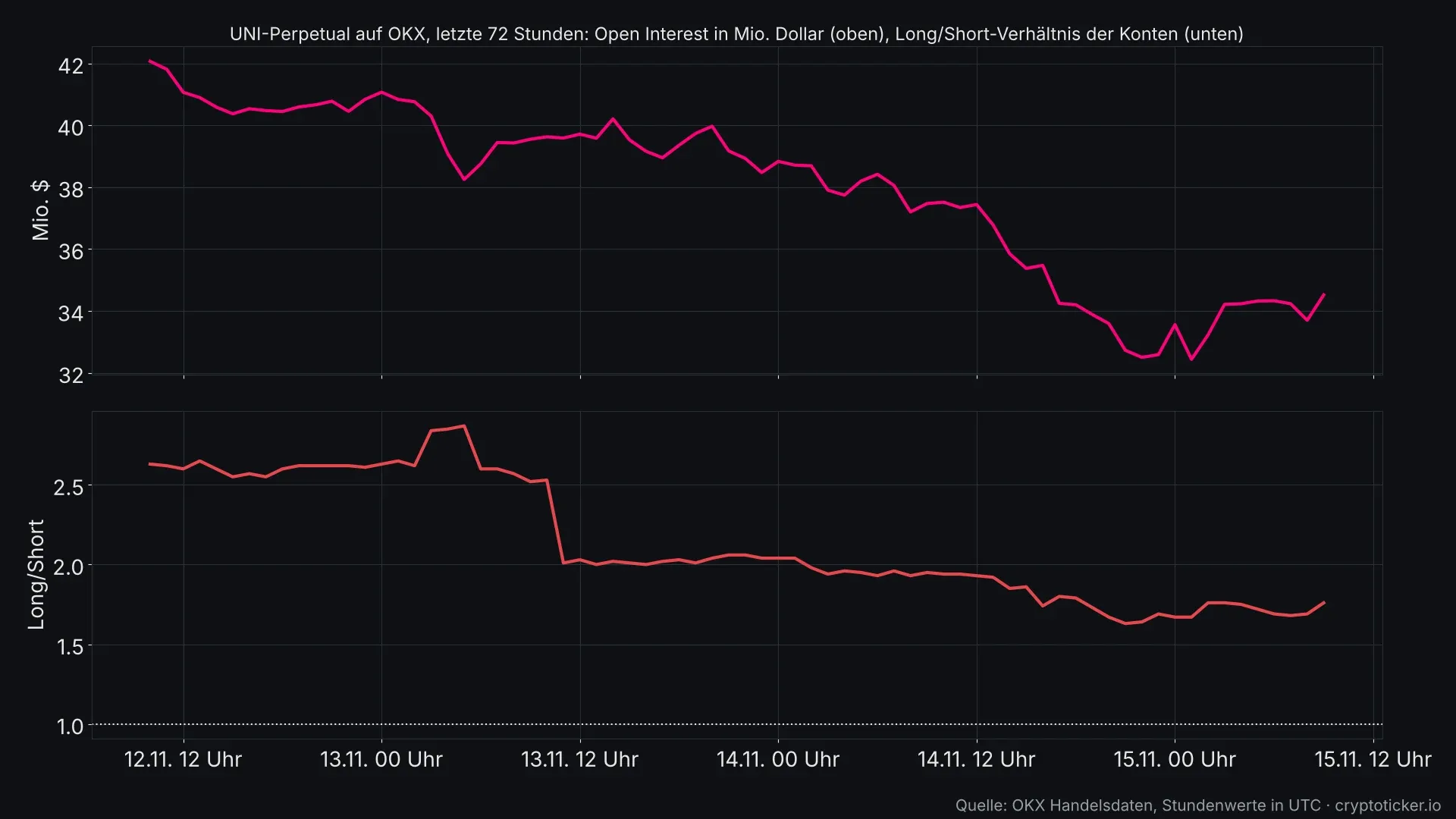
On the UNI perpetual on OKX, a futures contract without an expiry date, open interest fell from $42.1 million on the morning of November 12 to $34.5 million on Sunday morning, November 15, a decline of 18 percent. At the same time the long/short ratio of accounts dropped, meaning the number of accounts with a long position per account with a short position. In the early hours of November 13 it still stood at 2.87; by Sunday morning it was 1.76. The funding rate, through which the long and short sides pay each other, was last only just positive at 0.0034 percent per settlement period (OKX, November 15).
Taken together, this means many traders who had bet on a rebound have been forced out of the market. Most accounts are still long, but by a much narrower margin than before the slump.
 Long and short on UNI: perp DEXs compared
Will Uniswap fall below $4.61? The levels from the price history
No one can make a credible price forecast. The price history does, however, provide levels traders watch. On the downside, the first zone lies between $4.68, the close of August 29, and $4.61, the intraday low of November 14. Below that is the area around $4.43, where UNI closed on August 28. If that zone also gives way, the next level is only the August low of $3.20, where the rally started.
On the upside, UNI would first have to reclaim the November 14 daily high of $5.78. After that come the November 12 close of $6.06 and the weekly close of November 7 at $7.21. A recovery to that point would fully offset this week's slump. How far the overall market has fallen in earlier cycles is covered in our article on how far bitcoin can fall.
Trading Uniswap in Europe: MiCA exchanges, perpetuals and CFDs
Investors in Europe have three ways to trade UNI. The obvious one is buying through a crypto exchange licensed under the European crypto regulation MiCA. MiCA stands for Markets in Crypto-Assets and sets EU-wide rules on which providers may trade and hold crypto assets for clients. Which platforms list UNI and what fees they charge is shown in our comparison of the best crypto exchanges; providers with a European licence are listed in our comparison of regulated crypto exchanges.
The second way is perpetuals like the OKX contract described above, which let you trade long and short with leverage. Such contracts are offered by centralized exchanges and by decentralized venues, listed in our comparison of perp DEXs. The third way is CFDs, contracts for difference on the price, offered by the brokers in our comparison of the best crypto brokers. A CFD only tracks the price; you do not own any coins. Whether a given provider offers a UNI contract is something you check there before opening an account.
CFDs are complex instruments and come with a high risk of losing money rapidly due to leverage. A high percentage of retail investor accounts lose money when trading CFDs. You should consider whether you understand how CFDs work and whether you can afford to take the high risk of losing your money.
Sell or hold Uniswap? Two scenarios after the crash
This article makes no recommendation. The situation can, however, be framed in conditions you can check yourself.
In the first scenario the broader market calms down. Bitcoin holds above its weekend low, rate expectations ahead of the Fed meeting on December 8 and 9 rise no further, and UNI holds the zone around $4.61 to $4.68 on a daily closing basis. In Uniswap's favour would be the fact that fees rose during the slump: the platform is being used even as the token falls. A recovery towards $5.78 would be the first hurdle in that case.
In the second scenario the sell-off continues. If UNI closes below $4.43, there is little technical support until the August low of $3.20. The shrinking TVL and the still mostly long accounts in the futures market suggest further forced selling is possible. How investors in the bitcoin market approach the same question is described in our article on whether to buy or sell bitcoin.
Crypto crash of November 14 and 15: where Uniswap stands in the field
Uniswap is not the only large altcoin with a double-digit weekly loss. Among the 30 largest cryptocurrencies on CoinGecko, UNI lost the most in seven days, ahead of Zcash at 29.1 percent and Solana at 20.7 percent. The same weekend also sent Avalanche, Cardano and NEAR to multi-month lows. Our report on bitcoin's fall to $63,500 sums up the overall market, and the current bitcoin price is on our bitcoin price page. An overview of the reasons is on our page why is crypto down.
Uniswap price: below $4.61, August levels begin
Uniswap has lost almost 30 percent in a week and given up half of its September high. The cause lies in the broader market; the severity of the decline lies in leverage and the preceding rally. Three points help put it in context:
- Watch the daily close: what matters is whether UNI holds the zone of $4.61 to $4.68. You can compare UNI prices and fees at the best crypto exchanges.
- Run the numbers on leverage before you trade: at 10x, a 10 percent move is enough for a total loss. Which venues offer perpetuals and at what fees is shown in the comparison of perp DEXs.
- Look at the licence: for accounts in the EU, MiCA authorization is what counts. Which providers have it is listed in the comparison of regulated crypto exchanges.
(As of November 15, 2026. This article is not investment advice. Prices and fee structures change; check the terms with the provider before you buy.)
Frequently asked questions about Uniswap
Partner links: some links on this page are partner links. If you become a customer through one of them, we may earn a commission at no extra cost to you. Selection, ratings and ranking are decided independently by our editorial team. Ethics and Independence · Ownership and Funding
Transparency note: This article was produced with the assistance of artificial intelligence and reviewed by our editorial team before publication. All figures and claims were checked against the primary sources linked in the text. The feature image was generated with AI.
For later? Save this article and find it again in your profile.
Related articles
- Crypto Crash Prediction: Where Will 3 Major Coins Bottom Out?
- Gold Price Falls to $3,886: Is Gold Still a Safe Haven in the Crypto Crash?
- Canton price crashes below $0.08 and clings to 25th place
- Dogecoin sinks below 6 cents, its lowest level since June 2023
- NEAR price slides under $3, 48 percent below its October high
Which topics should we dive deeper into?
Select what genuinely interests you. Your picks feed directly into our editorial planning.
Crypto news that's actually worth your time.
Weekly. 60 seconds. Carefully curated by our editors: no hype, no promo flood, no spam.

November 15, 2026 3:48 AM
Cardano price crashes below $0.15, just above its low for the year
Cardano fell by just over 9 percent overnight into November 15, 2026, to $0.149, making it the biggest loser among the largest coins. This article sets out the levels down to the low for the year, the state of the futures market and how leverage works on ADA.

November 15, 2026 3:24 AM
Hyperliquid price crashes to $62, its lowest level since August
Hyperliquid fell by more than 12 percent overnight into November 15, 2026, to around $62, its lowest level since August. This article sets out the levels below $64, the state of the futures market and how leverage works on HYPE.
November 15, 2026 3:14 AM

Chainlink price crashes below $9 to its lowest close since August
Chainlink fell by just over 10 percent overnight into November 15, 2026, to $8.85, its weakest close since August. This article sets out the levels below $9, the state of the futures market and how leverage works on LINK.
November 15, 2026 1:29 AM

Avalanche crashes to $7.08: the level that decides is August's $6.78 close
Avalanche fell 13.8 percent to $7.08 on November 14, 2026, making it the weakest coin in the top 25. The article sets out the price levels below $7, the day's liquidations and how leverage works on AVAX.

November 15, 2026 1:23 AM

Weekend crypto crash: leverage and crypto loans with bitcoin below $66,000
Bitcoin has dropped below $66,000 and ether below $1,850, while the US spot ETFs only reopen on Monday. This guide works through how close leveraged positions and crypto loans are to forced closure.

November 15, 2026 12:58 AM

What Is Open Interest? Crypto Open Interest Explained
Open interest counts every open futures contract. What the metric shows for bitcoin, how it builds up and shrinks on perpetuals, how to read it with price and why it signals squeeze risk.
November 14, 2026 11:12 PM

Solana drops below $72 and is back at its late-June level
Solana loses around 11 percent on November 14, 2026, and falls to $71.37, putting its lowest daily close since late June within reach. The trigger is a broad sell-off with liquidations above $1.2 billion, one day before the Breakpoint conference in London.
November 13, 2026 5:48 PM
Bitcoin on Friday the 13th: weekend panic builds as traders eye $60,000
Bitcoin fell to its lowest level since August on Friday the 13th as $1.31 billion in leveraged bets were wiped out. Since 2014, it closed lower on only 3 of 22 such Fridays. What the weekend can bring, the levels down to $60,000 and what long and short positions returned today.
November 13, 2026 8:06 AM
Why Is Crypto Crashing? The 3 Reasons Behind This Brutal Sell-Off
Crypto is bleeding red and billions in leveraged bets just got wiped out. Here are the 3 forces behind the crash and where prices stand right now.
November 11, 2026 3:17 PM

Uniswap price falls to its lowest level since September: the level that decides
Uniswap (UNI) fell 7.3 percent to $6.49 on November 11, 2026, its lowest level since mid-September. Liquidations, a weak altcoin market and selling by large addresses are weighing on the price, and the $6.26 level now decides.
November 10, 2026 11:36 PM

Crypto crash live: Solana and Aave lead the sell-off as markets price a December Fed hike
Hot US inflation data turned a slow slide into a flush: Bitcoin touched its lowest level since August, Solana has lost a quarter of its value in 30 days and Aave fell almost three times as hard as Bitcoin. The live timeline, the reasons and the levels that matter now.
November 7, 2026 9:46 AM

Crypto Crash: Why Bitcoin, Ethereum, XRP and Solana Fell This Week and What Comes Next
Bitcoin lost its post-election gains, ETH hit a 10-week low and XRP led the losses. The four drivers behind this week's crypto crash and the levels to watch.
November 5, 2026 7:06 PM

Uniswap Price Drops 10.7%: Why UNI Falls Harder Than Bitcoin
Uniswap lost 10.7% in 24 hours and 21% in 30 days as the Nasdaq rout hit crypto. The levels that count now, what could turn the picture and how to hedge.
November 4, 2026 5:20 PM

Ethereum price jumps above $2,400: why Ether is outpacing Bitcoin after the US midterms
Ether (ETH) has recovered almost 8 percent in twelve hours from its US election-night low and is rising faster than Bitcoin (BTC). What is driving the move, which chart levels matter now and what investors in Germany should consider on buying, tax and custody.
November 4, 2026 11:12 AM

Uniswap (UNI) back above $7: Santiment's level holds after the address surge
Santiment counted 13,137 new UNI addresses in a single day at the end of October, the most since September 2020. Uniswap now trades at $7.37, above the level the analytics firm called decisive.
November 3, 2026 8:28 AM
Why Is Crypto Down Today? The 5 Reasons Behind the November 3 Sell-Off
Why is crypto down today? Bitcoin sits near $76,000 after the Binance hack, a hawkish Fed and a Nasdaq slide. The five drivers, explained.
October 29, 2026 9:55 PM

Solana Crash: SOL Falls Below $100. Is $80 Next?
Solana lost 3.3% within an hour after the Binance hack and slid to $95.64, although not a single SOL was stolen. Why Solana falls anyway, why it was already weak before and which price levels matter now.
October 29, 2026 9:49 PM
Is This the End? How Low Bitcoin Could Fall After the Binance Hack
About $2.8 billion left a Binance hot wallet and Bitcoin slid below $79,000. Whether this turns into a real crash depends on one question. Three scenarios, the key price levels for Bitcoin, Ethereum and Solana and what to do now.
October 29, 2026 9:40 PM

Crypto Crash After Binance Hack: $628 Million Liquidated in One Hour
At 20:24 UTC a Binance hot wallet was drained of about $2.8 billion. Within an hour Bitcoin fell below $79,000 and BNB lost 6.3%. Here is the minute-by-minute timeline, the prices of all major coins and what could come next as Asia wakes up.
October 25, 2026 10:51 AM
Crypto Crash: Why the Top Cryptos Lost Up to 4% in One Week
Crypto crash week: the largest cryptos lost up to 4% in seven days. We break down why crypto prices are falling and what to watch next.
October 20, 2026 10:38 AM
Crypto Crash Today: Why Is Bitcoin Stuck Below $82,000?
Bitcoin can't hold $82K, Ethereum is down 20% in 2026 and ETF money keeps leaving. Here is what is really behind the crypto crash today.
October 16, 2026 1:22 PM

CME lists Uniswap futures on October 19: why UNI is up 8.3 percent three days out
CME Group opens trading in futures on Uniswap on Monday, October 19. Three days ahead the UNI price stands at $7.49, well below the level it reached right after the announcement.
October 15, 2026 10:13 PM

NEAR up 9 percent, and longs pay in 74 of 86 perp markets: What it means for your coins
NEAR trades at around $5.26 on October 15, 2026 and gains 9.25 percent, while Bitcoin adds only 0.96 percent. Our own survey of 86 perpetual markets shows the buy side paying for its position in 74 of them.
October 15, 2026 1:34 PM

$489 million in liquidations in one hour: where your leverage breaks first
Forced closures wiped out around $489 million within one hour on 15 October 2026, more than half the daily total of $942 million. Our analysis of OKX futures market data shows why Ether was hit harder than Bitcoin.
October 13, 2026 10:26 AM

Hyperliquid falls 5.9 percent while Bitcoin loses 0.8: $1.66 billion of leverage sits on HYPE
HYPE drops to $82.61 while Bitcoin gives up only 0.8 percent. An own survey of the exchange shows why: $1.66 billion of open leveraged positions stand against $611 million of daily turnover.
October 7, 2026 10:33 AM

Why the burn does not carry the UNI price: 38,000 UNI in a day is 0.0061 percent of the supply
An on-chain analysis of our own shows how much UNI the Uniswap burn mechanism really destroys in a day. The amount is smaller than its reputation, and it explains why the reduction in supply does not carry the price on this day.
September 19, 2026 1:38 AM

Uniswap jumps above $9: what UNI holders should check on the fee switch now
The UNI price gains 18.67 percent within 24 hours, driven by the active fee switch and a new exemption from the US securities regulator. What of that can be recalculated, what remains pure expectation, and which three things you should settle now as an investor in Germany.
More from CryptoTicker